|
|
December 6th, 2008
 Need a custom full-length sizing die? Want something very special that will be gentle on your brass, reduce sizing effort, not rust, and never wear out? Tool-maker CH Tool & Die, CH4D.com, offers custom sizing dies, with optional Titanitum Nitride (TiN) coatings inside and out. Internal die dimensions can be set from fired brass you supply, a chamber cast, or specifications you provide (which could be based on a reamer print, with the dimensions tightened up slightly). Cost for a custom sizer die is $80-$130, depending on chambering (common calibers cost less). TiN coating adds to the price. Add $36.50 for the TiN die body, $10.80 for TiN expander ball. Need a custom full-length sizing die? Want something very special that will be gentle on your brass, reduce sizing effort, not rust, and never wear out? Tool-maker CH Tool & Die, CH4D.com, offers custom sizing dies, with optional Titanitum Nitride (TiN) coatings inside and out. Internal die dimensions can be set from fired brass you supply, a chamber cast, or specifications you provide (which could be based on a reamer print, with the dimensions tightened up slightly). Cost for a custom sizer die is $80-$130, depending on chambering (common calibers cost less). TiN coating adds to the price. Add $36.50 for the TiN die body, $10.80 for TiN expander ball.
CH4D custom FL dies are conventional full-length sizers without bushings. If you need to vary the neck tension, have the die spec’d for “normal” tension and then use a separate bushing neck-sizer when you need more tension. Normal turn-around time for a CH4D custom die is 10-12 weeks; TiN coating can add 2-3 weeks to that.
CH4D’s Dave Davison explains: “Titanium Nitride coatings have been used in industry for many years, primarily to extend the life of carbide tools. It has not been useful in reloading until recent advances in technology permitted TiN coating a die without softening the steel of the die itself. A TiN coated sizer in 308 Win showed no measurable wear after sizing 50,000 rounds. Although Titanium Nitride is harder than carbide and has a lower coefficient of friction it does not eliminate the need for lubricant when full-length sizing cases. It does reduce sizing effort considerably and minimizes the lubricant required. TiN-coated dies will live longer and require less force to operate than any die available. If you ever manage to wear out your TiN coated die, we will replace it at no charge. All we ask is that you tell us how many rounds you’ve loaded with it.”
CH4D can coat other manufacturers’ dies with Titanium Nitride. However, CH4D cautions: “TiN coating other manufacturers’ dies can be done, and is usually successful. However we have no control over the material or heat treatment of these dies and cannot guarantee the results.”
November 30th, 2008
 Powered case prep centers are nothing new. RCBS has offered a little AC-powered unit for years with whirling brushes and chamfering tips. But Hornady has beefed up the concept, adding a drill-press type vertical case trimmer. (Unlike a drill press, however, the case is held in place and the cutter spins below it.) Powered case prep centers are nothing new. RCBS has offered a little AC-powered unit for years with whirling brushes and chamfering tips. But Hornady has beefed up the concept, adding a drill-press type vertical case trimmer. (Unlike a drill press, however, the case is held in place and the cutter spins below it.)
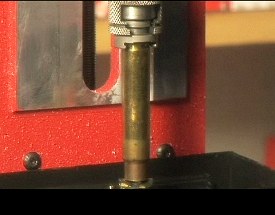
The new Hornady Lock-N-Load™ Power Case Prep Center is a substantial unit, roughly 2 feet high and 10″ wide at the base. With four (4) attachment bolts, it should be very stable on the bench. There are six (6) power take-offs that extend horizontally from the bottom half of the unit. These all spin at the same time so you can quickly switch from one tool to another. Hornady provides the following tools that operate with the horizontal power take-offs: inside neck chamfer, outside neck chamfer, large flash-hole cleaner, small flash-hole cleaner, and a neck brush. An optional primer pocket reamer and an optional flash-hole deburrer can be purchased separately.
 At the middle level of the Hornday unit a case trimming tool is centered in a black plastic tray to catch shavings. The vertical position of the cutter is fixed. You lower the case down on the spinning cutter to trim cases to length. A pivoting handle controls vertical movement of the case which is held by its rim in a shellholder mounted in a chuck. The rotary handle you see in the picture is NOT for power. It is used to adjust the starting height of the chuck/shell-holder assembly. By turning the crank you can move this whole sub-assembly up and down to suit different length cases. At the middle level of the Hornday unit a case trimming tool is centered in a black plastic tray to catch shavings. The vertical position of the cutter is fixed. You lower the case down on the spinning cutter to trim cases to length. A pivoting handle controls vertical movement of the case which is held by its rim in a shellholder mounted in a chuck. The rotary handle you see in the picture is NOT for power. It is used to adjust the starting height of the chuck/shell-holder assembly. By turning the crank you can move this whole sub-assembly up and down to suit different length cases.
The new Hornady Case Prep Center, product No. 050012, is slated for a 2009 release. MSRP is $431.67, with expected “street price” around $300.00. You should definitely watch the Hornady Video linked below, as it shows the case trimmer in action. If our written description of the inline vertical trimmer left you confused, it will quickly become clear once you watch the video.
 Editor’s Comment: If you have hundreds of cases that regularly need trimming, the Hornady Case Prep Center could be a real time-saver, provided that: 1) the cut length can be adjusted with sufficient precision; and, 2) cases can be moved in and out of the holder quickly and efficiently. As for powered case-neck chamfering… we’re a little less enthusiastic about that. It is very easy to ruin cases by over-chamfering. If Hornady really wanted to do this right, it would have the chamfer tool run on the top half of the machine. Then the chamfer depth could be controlled very precisely, with a positive stop, so you couldn’t over-chamfer. Editor’s Comment: If you have hundreds of cases that regularly need trimming, the Hornady Case Prep Center could be a real time-saver, provided that: 1) the cut length can be adjusted with sufficient precision; and, 2) cases can be moved in and out of the holder quickly and efficiently. As for powered case-neck chamfering… we’re a little less enthusiastic about that. It is very easy to ruin cases by over-chamfering. If Hornady really wanted to do this right, it would have the chamfer tool run on the top half of the machine. Then the chamfer depth could be controlled very precisely, with a positive stop, so you couldn’t over-chamfer.
While Hornady’s Case Prep Center can certainly speed up trimming chores, you still have to trim and chamfer in separate steps. Consider that the Gracey Case Trimmer trims-to-length and chamfers (inside and out) all in one operation, processing up to 20 cases per minute. That’s impressive. We do like the powered neck brush on the Hornady unit, however. This could definitely help you prep a large quantity of brass more efficiently.
November 29th, 2008
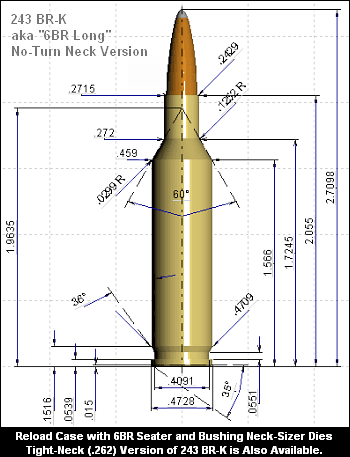
Gunsmith Mike Sosenko and long-time 6mmBR.com supporter John Adams have been using a modified .243 Winchester case with great success in Varmint Silhouette matches at the Pala Range in Southern California. Officially called the “243 BR-K” (and informally dubbed the “6BR Long”), the wildcat is basically a .243 Winchester with less body taper and a 30-degree shoulder. The design essentially grafts a 6mmBR Norma “top end” to the .243 Winchester case. After fire-forming, Mike and John can reload this case using normal, unmodified 6BR neck-sizing and seater dies.
Compared to a .243 Winchester, the 243 BR-K’s body length is about .006″ longer, and the shoulder is about .0055″ wider. The main difference is the shoulder angle (30° vs. 20°), and the location of the neck-shoulder junction (“NSJ”). Based on reamer prints, the base to NSJ dimension is 1.718″ on the 6BR Long, compared to 1.804″ for the .243 Winchester. Neck length is a bit shorter because “the neck shrinks a little when the shoulder blows out” according to Sosenko. We’ve provided a mock-up diagram of the 243 BR-K, but you should check with Dave Kiff of Pacific Tool & Gauge for exact dimensions. Dave created the reamers for both the 6mm and 22-caliber versions of this wildcat. Ask for the “22 BR-K” or “243 BR-K” reamer designs.
 |
 |
Wicked Velocity with Stable Brass
The main advantage of the 243 BR-K is serious velocity in a case that is very stable. Mike’s favorite load is the 95gr Berger VLD pushed by Reloader 22. With a stout load of RL22 and Federal 210m Primers, Sosenko is getting 3450 fps with the 95-grainer, with no bullet blow-ups. This is with a 1:8.5″ twist Broughton 5R barrel finished at 28.5″. The cases are holding up very well. Mike has a half-dozen loads on his brass and he hasn’t had to full-length size yet. Mike runs a .262″ tight neck, but there is also a no-turn version of the case (see illustration). Accuracy is excellent. Mike says the round delivers repeatable 1/4 MOA groups at 100 yards in testing. He has also experimented with N160, but, thus far, Reloader 22 has delivered smaller groups with better ES and SD.
VIEW 243 BR-K REAMER PRINT (No-Turn Neck)
John Adams shoots a no-turn (.274″) neck 243 BR-K with 105gr Berger VLDs. He’s getting about 3230 fps using Reloader 22. John says he can push the 105s faster, but 3220-3240 fps “seems to be the sweet spot.” John notes that “after about five reloadings on a case, it gets a little tight”. John then full-length sizes with a custom Hornady FL bushing die. “The Hornady custom shop dies work great” according to John. Adams also shoots a version of this wildcat necked down to 22-caliber. It has demonstrated outstanding velocity and good accuracy in initial testing with a 9-twist barrel. Using the 80gr Amax bullets, John is getting 3570+ fps speeds. John feels that his 22 BR-K needs some more development work. “The 243 BR-K is proven. We know what works. With the 22 I want to try different seating depths, experiment with a few different bullets, and fine-tune the velocity.”
Whitley’s 6mm Super X
Robert Whitley shoots a variant of the .243 Winchester he calls the 6mm Super X. This features a 30° shoulder, and slightly less body taper. He gains a little case capacity over the standard .243 Win, and he says the cartridge is extremely accurate with both 105-108 grain pills and the heavier 115s: “Here’s a picture of a .243 Win (left), a 6mm Super X (center), and a 6XC (right). All I can say is the 6mm Super X has been good to me and I have shot many a clean in 600-yard High Power matches with it with either DTAC 115s or Berger 115s.”

While Mike Sosenko and John Adams use their BR-Ks to push 95s and 105s at high velocities, Robert takes a different approach with his Super X. He shoots the high-BC 115s and keeps velocities under 3000 fps. A long-range High Power shooter, Robert demands consistency during long shot strings. That means backing off from max attainable speeds, at least with the 115s. Robert writes:
“You can get 3050 fps with H4831SC and the 115s with no problem, I did it in testing multiple times, but to me that also does not mean anything because I shoot loads where they are the most consistent and accurate over a 22+ shot string. I have never found that any of the 6mm cartridges I have used with 115s will stay consistent, tight and accurate the whole way at 3050 fps for 22+ shots straight. I have tried 115s in the .243 Win, the 6CM, the 6mm Super X, the 6XC, the 6-6.5 x 47 Lapua and none of them ever stayed consistent and tight for 22 shots straight with the 115s at that speed. Most of the time with all the 6mm cartridges, if you get the 115s much over 2975 fps, they won’t hold tight for 22+ shots straight. Now if you’re a bench rest shooter and you only need to do a few sighters then 5 or 10 shots for record, you can run 3050 fps or more and the groups will likely hold tight during your string, but not when you need to go 22+ shots straight with no break. I have shot many different 6mm cartridges and done a lot of testing with many different powders, moly and non-moly bullets. I don’t find the ‘consistent accuracy’ (for 22+ shots straight) at those higher velocities.”
November 19th, 2008
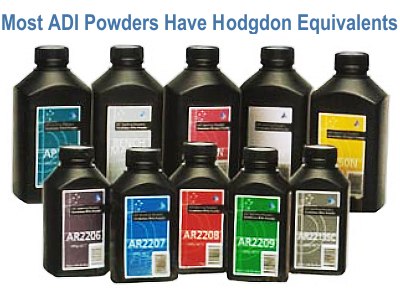
Many of the most popular powders sold under the Hodgdon brand in the USA (including Varget and H4350) are made by ADI Ltd. in Australia. Some load manuals list ADI data, but not Hodgdon data, or vice-versa, so we’ve compiled this list of equivalent powders. If you can’t find a recommended load for a particular Hodgdon powder in your caliber, download the latest ADI Smokeless Powders Handloaders Guide, a 2.8 megabyte Acrobat file.
Here’s a list of ADI to Hodgdon Powder equivalents:
AS30N=Clays
AP50N = (No Hodgdon)
AS50N = International
AP70N = Universal
AP100 = (No Hodgdon)
AR2205 = H4227
AR2207 = H4198
AR2219 = H322
Bench Mark1 = (No Hodgdon)
Bench Mark2 = BenchMark |
AR2206 = (No Hodgdon)
AR2206H = H4895
AR2208 = Varget
AR2209 = H4350
AR2213 = (Discontinued)
AR2213SC = H4831
AR2217 = H1000
AR2225 = Retumbo
AR2218 = H50BMG |
November 16th, 2008
When Reloder 17 first became available (in limited quantities) our team tested it and found that it possessed some remarkable qualities. In certain cartridges, such as the 6XC and .284 Winchester, Reloder 17 provided significant increases in velocity compared to other popular propellants. We’re not talking about a mere 10 or 20 fps gain. Reloder 17, in some cartridges, lets you shoot 100 or even 150 fps faster than ever before. (RL 17 is a slow-burning powder that works best in cartridges where you might otherwise use H4350, Reloder 22, or H4831sc.) Needless to say, when the word got out, Reloder 17 quickly sold out at the major vendors such as Grafs.com and Powder Valley.

We’ve been informed that a 20,000-lb shipment of Alliant Reloder 17 is on its way to the USA via cargo ship. Once it arrives on American shores it must clear customs, then be inspected, and then transferred from bulk containers into consumer packaging. That will take a few weeks. Alliant tells us it hopes to have Reloder 17 back on dealers’ shelves by Mid-December.
November 5th, 2008
In recent weeks we’ve seen many Forum posts from folks who are just getting started with precision hand-loading. They tell us that it’s a bit overwhelming in the beginning. Just learning all the technical terms (e.g. ogive, meplat, ballistic coefficient, load density etc.) is difficult, and the task of selecting the right tools and gear can be daunting.
 The first thing a new reloader should do is find a seasoned veteran to act as a “reloading mentor”. One can learn the basics much more quickly under the guidance of an experienced hand-loader who “knows the ropes”. We also recommend that newbies acquire a good basic reloading handbook — not just a list of load recipes, but a book that explains the processes. One of the best handbooks available is The ABC’s of Reloading (8th Edition, 2008) by Bill Chevalier. Recently updated, this reference contains 288 pages with 300 black-and-white photos. The new 8th Edition is available from Amazon.com for $16.49. Here’s a review from a recent purchaser of “The ABC’s”: The first thing a new reloader should do is find a seasoned veteran to act as a “reloading mentor”. One can learn the basics much more quickly under the guidance of an experienced hand-loader who “knows the ropes”. We also recommend that newbies acquire a good basic reloading handbook — not just a list of load recipes, but a book that explains the processes. One of the best handbooks available is The ABC’s of Reloading (8th Edition, 2008) by Bill Chevalier. Recently updated, this reference contains 288 pages with 300 black-and-white photos. The new 8th Edition is available from Amazon.com for $16.49. Here’s a review from a recent purchaser of “The ABC’s”:
“When I first got the itch to load my own ammunition, I was overwhelmed by the amount of information and terminology involved in this fascinating field/hobby. It was very difficult to take all the individual pieces of information that I had and form it into an understandable process. I was snowed in under a blizzard of data that I was piecing together through chat rooms and web sites. Phrases like ‘roll crimp’ and ‘headspace’ came at me in a blizzard. I could look up each phrase, understand each one as a piece, but still the whole picture was fuzzy. In essence, that is what this book will do for you — turn it all into a coherent, linear whole. The writing is very solid and clear, the illustrations are well-done and helpful, and the information is very complete. After reading this book, the entire process made sense to me, and more importantly, I was fully warned about the dos and don’ts of the reloading world. The coverage is very complete. Primers, powders, bullets, and … all necessary tools and accessories are discussed and explained. This is just a great book. It won’t make you an expert … but it will put you on the right road if you wish to become one.” — Mykal Banta
October 7th, 2008
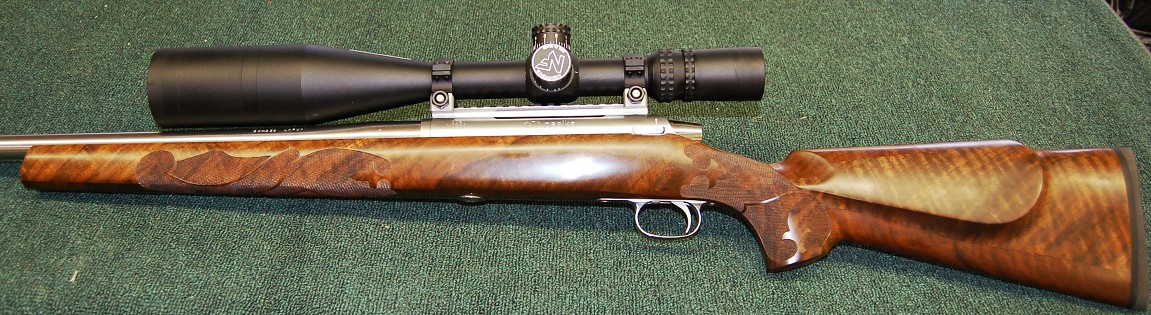
In our new article on the 30-338 Wildcat, you’ll find expert advice on forming the cases from .338 Lapua Magnum brass plus tips on selecting powder and bullets. The story also features some great photos of a 30-338 custom Richard Franklin built for a California client. That rifle is designed as an Elk Gun, shooting the 190gr Berger VLDs with Reloder 22 powder. The laminated stock is made from exhibition-grade Claro Crotch Walnut and Dennis Smith (aka the Stock Doctor) provided beautiful checkering and a hand-rubbed oil finish.


 Ultimate Big Boomer for Varminters Ultimate Big Boomer for Varminters
Franklin has also pioneered an ultra-high-velocity varmint version of the 30-338. This cartidge achieves amazing 30-Cal velocities using long, very slow-twist barrels. Richard tells us: “I use 15- to 17-twist barrels with both the 300 WSM Varminter and the 30-338 Lapua Varminter. The 300 WSM easily gets 3900 fps with the Nosler 125 Ballistic Tip and the 30-338 Lapua will do 4150 fps easily with the same 125gr B-Tip. In the 30-338, the 130gr Barnes, a “ringed” bullet with grooves to reduce bearing surface, will get another 150 fps, topping out at 4300 fps. I find the 17-twist does a good job with the light bullets in the 30-338 but I’m going to try an 18-twist and a 19-twist to see if high velocity is a little more easier to obtain. I believe the 19-twist will beat any thing I’ve built to date for velocity and I also believe it’s going to be very accurate.”
The “Official” .300 Lapua Magnum
While nearly every 30-338 you see in the USA is a wildcat, manually formed by necking-down the .338 Lapua brass, there was an “official” version, the “.300 Lapua Magnum”. This was a factory 30-caliber cartridge based on the .338 Lapua Magnum parent case. Lapua produced enough factory ammo to get the .300 Lapua Magnum sanctioned as an official CIP-certified cartridge. QuickLOAD includes the .300 Lapua Magnum in its load database, and QuickDESIGN has complete CIP cartridge specifications. Unfortunately, the .300 Lapua Magnum is no longer in production. For you cartridge collectors, we’re not even sure if Lapua ever produced brass with a distinctive “300 Lapua Magnum” headstamp. However Vihtavuori does include .300 Lapua Magnum load data in the current Vihtavuori Load Manual. That reloading guide shows the .300 Lapua Magnum can drive a 220gr HPBT Sierra MatchKing at 2910 fps with a max charge of VV 20N29 powder. The .300 Lapua Magnum can push the 30-caliber 155gr Lapua Scenar at nearly 3500 fps with VV N170 powder. That’s impressive performance indeed!
CLICK HERE to download Current 2008 Vihtavuori RELOADING MANUAL (35-page .pdf file).

October 5th, 2008
Federal Small Rifle Primers, both standard (205) and match (205M) versions, have recently been in short supply. Grafs.com now has these in stock, at discounted prices. Graf’s has large supplies of Federal standard small rifle primers in both 1000- and 5000-primer lots. Price is $27.99 for a 1000-count box, or $131.99 for a 5000-count case.

For the hard-to-find small rifle 205M Match primers, Grafs.com is showing good quantities in 5000-count cases, priced at $157.99. Individual, 1000-count boxes of 205M match primers, priced at $33.59, are in low supply. Graf’s prices include shipping but not HazMat fees. Powder Valley Inc. is showing both 1000-count and 5000-count supplies of Federal 205M (small rifle match) primers in stock at $31.00 and $150.00 respectively.
Both Grafs.com and Powder Valley are out of stock on the Federal 210M LARGE Rifle match primers. However, Powder Valley has supplies of the standard Federal 210 (non-match) large rifle primers for $25.50 (1000-count) and $122.50 (5000-count). Grafs.com is nearly sold out of the Federal 210s, so grab the limited quantities while you can.
September 30th, 2008
Sinclair International has just introduced a new Neck-Turning Tool. Part of a complete system with carbide mandrels, this product promises to be one of the best neck-turners on the market. The new tool has many improved features we really like:
▪ The cutter body is big, and curved to fit the hand. So, it is easier to hold than the old Sinclair tool or the K&M tool.
▪ The cutter-depth adjustment works really well. A large, knurled rotary knob on the back of the cutter body connects to an eccentric mechanism. This moves the mandrel shaft (and case) in and out relative to the cutter tip. You start by setting the cutter with feeler gauges, then fine-tune with the knob. Adjustments are very positive and precise, with laser-engraved index marks. This is a very good adjustment system, we think.
▪ The end of the tool is open so you can easily eyeball the caseneck as you’re cutting.
▪ High-grade carbide mandrels in 17 through 338 calibers will be offered with the new cutter system. At about $45 per caliber, they’re expensive, but the carbide mandrels DO work better — you’ll notice smoother case rotation and less heat build-up than with conventional (non-carbide) mandrels. If you already have mandrels, don’t worry. Sinclair says: “Our single-ended stainless mandrels will work fine with the new Neck-Turning Tool.”

Precise Adjustments Possible
With the eccentric adjustment system, you can make quick cut-depth changes with great precision. The cutter adjustment knob is click-adjustable in .0002″-.00025″ per click increments. The cut depth can be adjusted through a range of .004″-.005″ using the adjustment dial. A mandrel adjustment screw is included to make mandrel set-up and adjustment easier.
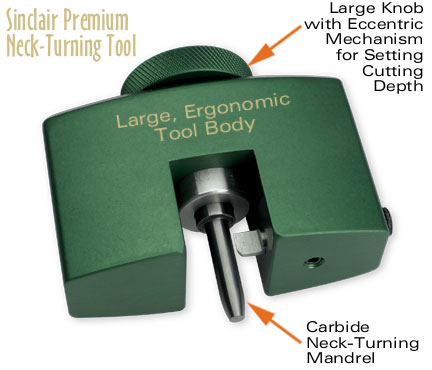
Sinclair’s new Premium Neck-Turning Tool includes three (3) feeler gauges for quickly setting cutter depth in the approximate range of the cut desired. With the cutter in range using the feeler gauge, the eccentric adjustment knob can make final adjustment for the exact neckwall thickness you desire. Sinclair claims: “Cutter adjustment is very fast and sure with none of the usual trial and error experienced with other tools.”
The $145.95 Premium Neck Turning Tool Kit (item NT-4000) includes three feeler gauges and a case-holder Turning Handle. Or you can save ten bucks and get the Tool and gauges without handle for $135.95 (item NT-4100). All popular Sinclair neck-turning tool accessories, including expander mandrels, will work with the Premium Tool. Order caliber-specific carbide turning mandrels separately for $44.75 per mandrel (items 95-0XX).

September 27th, 2008
Among our readers are fans of the ultimate “big boomer” cartridge, the 50 BMG. The fifty is popular with long-range shooters, many of whom compete in matches under the auspices of the Fifty Caliber Shooters Association (FCSA). The FCSA World Championship was held at Raton, NM in July, attracting shooters from around the globe. The Whittington Gun Club is holding a regional 50-caliber match at Raton this very weekend (Sept. 26-28). Other 50-caliber match dates are calendared on the FCSA website, www.fcsa.org. The FCSA site offers general info, match rules, a list of 50-cal friendly shooting ranges, plus a records archive.

50 BMG Components on Sale
If you’re a 50-Cal shooter, or are thinking about acquiring a Fifty in the near future, it’s not a bad idea to lay in a stock of reloading components. The Big Fifty has been banned in California, and there are efforts in Congress to extend that ban nationwide. Better to be prepared. Here are some good deals on 50 BMG components:
Wideners.com has brand new, primed Lake City 50 BMG Brass. This is 2006 production, with “LC 06″ headstamp. The brass is factory boxer primer w/ purple sealant, annealed case necks, and tar sealant* inside the case mouths. This is top tier brass that is fully reloadable. Widener’s is charging $52.50 for 25 cases or $200 for 100, item LC50BMG.

Natchez Shooters Supplies currently has a sale on primed, Winchester-headstamp 50 BMG brass (item WN50CALPB). The price is $34.70, marked down from $39.79. That works out to $173.50 per hundred — a good deal on new, WCC 06 Mil-Spec brass.
50bmgSupply.com also has Winchester-headstamp 50 BMG brass. This is NEW manufacture (WCC 06 and WCC 08) with neck sealant and sealed primer. Cases are boxer primed, and fully reloadable. The price is $195.00 for 100 pieces.
50bmgSupply.com also offers 2004-2007 once-fired Lake City or PSD head-stamped 50 BMG brass. (PSD is made in South Korea by Poongsan Metal Manufacturing. It is good brass.) This used brass has been tumbled clean, resized, deprimed, primer pocket chamfered (to remove military crimp), then trimmed to length. It is ready to reload. Prices is $100.00 for 100 unprimed cases, or $130.00 for 100 primed cases.
Polygunbag.com carries a wide variety of 50 caliber projectiles including Hornady 750gr A-Max match bullets, and Barnes “Banded Solid” 750gr match bullets. Both the 750gr A-Maxs and 750 Barnes Solids are priced at $37.00 per box of 20 bullets. The A-Maxs are very popular with long-range 50 Caliber match shooters.

*Regarding the Tar mouth Sealant, Widener’s notes: “This brass is ready to be charged and the bullet seated. If you want complete waterproofing, leave the tar seal in the mouth. If you do not want the tar, use a swab with XYLENE solvent and the tar can be easily removed. NOTE: Do not use an expander unless you remove the tar first as the tar will gum up on it.”
|