|
|
January 14th, 2008
 A Universal Decapping Die belongs in every reloader’s die inventory. This simple, inexpensive tool allows you to remove primers from any size case, without altering the case body or neck. This die can be useful if you have very dirty brass that you plan to tumble or ultrasonically clean before sizing and loading. If you decap BEFORE ultrasonic cleaning, the ultrasound will clean out the primer pocket. By cleaning before you run the brass in your full-length die, you keep the FL die cleaner and reduce the risk of scratching the inside of the die. A Universal Decapping Die belongs in every reloader’s die inventory. This simple, inexpensive tool allows you to remove primers from any size case, without altering the case body or neck. This die can be useful if you have very dirty brass that you plan to tumble or ultrasonically clean before sizing and loading. If you decap BEFORE ultrasonic cleaning, the ultrasound will clean out the primer pocket. By cleaning before you run the brass in your full-length die, you keep the FL die cleaner and reduce the risk of scratching the inside of the die.
Another benefit of the Universal Decapping Die is that it lets you punch out any occlusions in the flash hole before loading for the first time. Lastly, if you use a progressive press, using a decapping die on the brass first will let you inspect and clean the primer pockets before cycling your brass through the progressive loader.
The LEE Universal Decapping Die is inexpensive and performs as advertised. Right now it is on sale for $7.99 at MidwayUSA. We’ve used a LEE Universal Decapping Die on everything from a 17 Fireball case to a 45/70. However, as delivered with the die, the decapping pin was too large in diameter to fit the small flash-holes on our 6BR brass. Lapua 220 Russian (PPC parent), 6BR, and 6.5×47 brass has flash-holes spec’d at 1.5mm or about 0.059″. The pin can probably be jammed through, but that’s not wise. If your pin is a bit too large you can just chuck the pin in a drill and turn it down slightly with some sandpaper or a stone.
January 8th, 2008
Conventional, non-bushing full-length sizing dies can create exceptionally accurate ammo with very low run-out. For some applications, we actually prefer a non-bushing FL die over a bushing die — so long as the neck tension is correct. But many FL dies have an undersized neck diameter so you end up with excess neck tension, and you work the brass excessivly. Forster offers a simple, inexpensive solution — honing the neck diameter to whatever size you want.
If you purchase a Forster non-bushing, full-length sizing die, Forster will hone the neck dimension to your specs for just $10.00 extra. This way you can have a FL die that provides the optimal amount of tension for your particular load. Forster dies are relatively inexpensive so you can afford to have a couple of FL dies with necks honed to different dimensions — such as 0.266″ and 0.267″ for a no-turn 6mmBR.
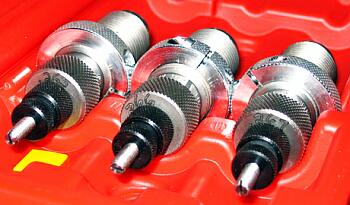
Forster FL dies, necks honed to .265″, .266″, and .267″.
Steve Rasmussen of IowaHighPower.com gave this a try. In fact, he had three dies made — each with a different neck dimension. Here’s his report: “My original Forster 6BR FL die sized the necks down a lot, less than 0.260″, .256″ if I recall correctly. I sent my die in and asked if they could supply two more FL dies (for three total) to have the necks honed to 0.265″, 0.266″, and 0.267″. The cost was $10 for my supplied die and $38.50 plus $10.00 for each additional die. Return shipping was $11.00 via USPS Priority Mail.
The table below shows the neck diameter range of 10 sized cases using each die. Brass springback after sizing is running 1 to 1.3 thousandths. My loaded rounds are running 0.2697-0.2699 using Lapua I bought last year. So far the dies are working well. I sized 80 cases with the 0.266″ necked die. The shoulder is running 0.4582″ and 0.300″ up from the base is 0.4684". I spun 20 of ‘em and 16 had a runout of one thousandth (0.001) and the other 4 at 1.5 thousandths (0.0015).”
| Die Diameter |
Sized Brass |
Springback |
Neck Tension |
| 0.267 Die |
0.2683-0.2684 |
0.0013 |
0.0014 |
| 0.266 Die |
0.2672-0.2674 |
0.0013 |
0.0025 |
| 0.265 Die |
0.2659-0.2660 |
0.0010 |
0.0039 |
December 26th, 2007
Quite a few novice reloaders have recently started visiting our site. One common question is “What should I watch out for when inspecting new brass?” First, always check the cases for obvious defects such as split necks, defective case heads, or dimpled shoulders. But don’t toss a case merely because the neck may be slightly out of round. We recommend you run an expander down the necks to straighten them out before loading, and reduce neck tension slightly. That will take care of minor neck dents.
If you’re using the brass for competition, you may want to weight-sort your cases. You can also benefit by sorting the brass using a Neck Wall Thickness Gauge. Even if your rifle has a “no-turn” neck chamber, you’ll get enhanced accuracy and more consistent velocities if you cull the brass with extremely non-uniform neck-wall thickness.

You’ll want to inspect the flash holes carefully. With domestic brass, you may find flash holes that are slightly off-center, or that are not consistent in diameter. Segregate the brass with off-center holes, and you can uniform the flash holes with a variety of tools. Normally Lapua and Norma brass have very consistent flash holes. However, in some recent lots, we’ve seen a little crescent-shaped sliver of brass around the edge of the flash hole (see photo). This can cause inconsistent ignition and should be removed. You can clean up the edge of the flash hole with a flash hole uniforming tool or a small bit fitted to a pin vise.
Note to newbies–Lapua 220 Russian and 6BR brass has a small flash hole, specified at 1.5mm, about .059″, in diameter. Select a tool that will clean up the flash hole without increasing the flash hole significantly. Some tools will ream the flash hole to .067″ or larger and that is too much. But the actual diameter of your flash holes (whether .059, .062, .067) after reaming is not that critical–so long as all your cases end up with the same hole diameter. Uniformity is the key. With many lots of Lapua brass we’ve found that flash hole reaming is not necessary for 95+ cases out of a box of 100. But you should inspect every case before you load.
December 17th, 2007
 The Ballistics Page for the Canadian National Firearms Association (NFA) website offers a variety of useful programs and data charts created by Peter Cronhelm. These include: The Ballistics Page for the Canadian National Firearms Association (NFA) website offers a variety of useful programs and data charts created by Peter Cronhelm. These include:
Caliber Twist Rate Chart
Greenhill Formula Twist Calculator
Bullet Stability Calculator (MS Excel)
Ballistic Coefficients Chart (MS Word), (Or DOWNLOAD HERE.)
Ranging Ballistics Computer (Scroll to bottom of page.)
There is even a detailed table with bullet weights and velocities for over 100 varieties of 22LR Rimfire ammunition from Aguila, CCI, Eley, Federal, Fiocchi, Lapua, PMC, Remington, RWS, and Winchester. This Rimfire Ammo Table is a “must-have” resource for any smallbore shooter. Shown below is the section for Lapua:

December 14th, 2007
Credit this find to ace British benchrest shooter Vince Bottomley, United Kingdom 1K record-holder and publisher of the excellent Precision Rifle website.
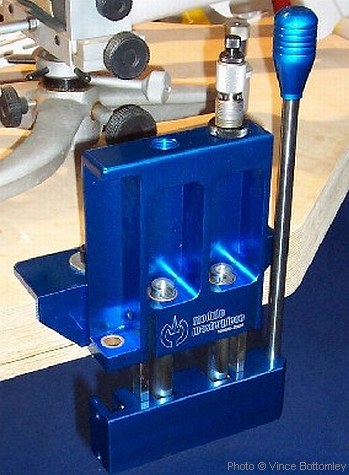
Vince writes: “This beautiful compact press is made by an Italian company, Modulo Masterpiece, run by Vittorio Taveggia. Vittorio builds some superb rifles but he also has a very useful range of accessories for accuracy aficionados. I’m sure you’ll be interested in Vittorio’s loading press — this is offered in several configurations for normal dies, Wilson-style hand-dies, or both. The press is superbly made. Vittorio also crafts very nice Weaver-style rings and bases. Again they are beautifully-finished and very strong. Vittorio also makes stocks and actions. At present, there is no UK importer for the press, but there could be very soon. If you are at all interested in any of the products please drop me an e-mail at vinceb [at] 6ppc.fsnet.co.uk and I’ll pass your interest onto the ‘soon to be’ UK importer.”

Editor’s note: We don’t know of a US importer, but you can contact Vittorio directly. Information for his company in Torino, Italy is found on the Modulo Masterpiece website. Send email to: info [at] modulo-masterpiece.it.
Photo © Vince Bottomley, used by permission
December 9th, 2007
Jason Baney, our 1000-yard editor, has done some pioneering work on Ultrasonic Case Cleaning. In general, ultrasonic cleaning is a “good thing” for accuracy, as it thoroughly cleans the inside of the case, preventing the stubborn build-up of soot and carbon that will eventually affect your internal case volume. However, there is one small “down-side” to ultrasonic cleaning, according to Jason.
Jason found that Ultrasonic cleaning leaves the inside of the case-necks so “squeaky clean” that there is excess friction when seating bullets. On a fired case that has been cleaned conventionally (no ultra-sound), a thin layer of carbon remains to lubricate the bullet entry and exit. To restore that lubricity in cases cleaned with ultrasound, Jason applies a dry lube to the inside of his case necks. Jason prefers the $10.95 moly dry lube kit from Neconos.com. With this kit, small carbon steel balls transfer moly to the neck when you place your brass nose-down in the container.

December 3rd, 2007
Starting in spring 2008, Hodgdon Powder Co. will start shipping two new powders suitable for target and hunting calibers. Hybrid 100V is designed to combine the even burn qualities of an extruded (stick) powder, with much smoother metering in a powder measure, due to its advanced kernel design. Supreme 780 is the identical ball powder loaded in Winchester’s factory Supreme® ammunition including 243 Win, 270 Win, and 300 Win Magnum.
 
Hybrid 100V is big news for shooters on this board, many of whom use H4350 in their 6.5-284s and medium sized 6mms such as the 6XC and 6-6.5×47. We talked to Chris Hodgdon Friday and he confirms that Hybrid 100V offers excellent velocity and accuracy, with a burn rate similar to H4350. We told Chris that H4350 is hard to beat for accuracy in many match calibers and it offers extremely low ES and SD. “Can Hybrid 100V really rival H4350’s performance?” we asked.
Chris paused, then said with obvious pride: “We’ve done a LOT of testing and this stuff is really good. Velocity is excellent, accuracy is excellent, and the new powder matches up well against anything on the market, including our own H4350″. Chris continued, “the really great thing about the powder is that the new kernel shape allows it to meter much better in powder measures. This is because the edges or ends are rounded. I think reloaders will be very happy with the Hybrid. It’s a state-of-the art kernel design, and it’s made in America, by St. Marks.” One could tell from Chris’s tone that he really believes Hybrid 100V will be a winner.


Hodgdon’s official press release states: “HYBRID 100V marries two technologies: the chemistry of a Spherical powder with the geometry of an Extruded propellant. [It is] ideal for use in calibers that fit H4350, [delivering] velocities not seen before in a variety of popular cartridges, such as 3,310 fps for a 150-grain bullet in the 300 Weatherby Magnum. Hybrid 100V’s unique small grain, part Spherical, part Extruded shape benefits the handloader in two ways — the powder flows accurately and easily through a measure, and charge weights are consistent for ideal load density.”
Winchester Supreme 780, a ball powder, is designed for those wanting an easy-metering propellant that emulates popular factory loads. Tim Vaitekunas, Hodgdon’s director of R&D, notes that “Supreme 780 allows the handloader to duplicate Winchester Supreme factory loads.”
Load Data Already Online
Though Hybrid 100V and Supreme 780 are brand new, Hodgdon’s engineers have already posted some load data for both powders on the Hodgdon Reloading Data Center. Hodgdon has initial Hybrid 100V loads for 18 cartridge designs so far. Here are samples:
Cartridge + Starting Loads with Hybrid 100V
22-250: 55gr SP | 2.35″ COL | 36.0gr | 3254 fps | 43,500 psi
243 Win: 100gr BTSP|2.65″ COL|40.0gr|2868 fps|45,400 cup
7 WSM: 160gr SP | 2.85″ COL| 57.0gr | 2716 fps | 49,400 psi
You’ll also find data for the new Supreme 780, covering 14 different cartridges and 35 different recipes. For more info, contact Hodgdon Powder at (913) 362-9455.
 . .
September 21st, 2007
Hodgdon powder has recently updated its interactive Reloading Data Center to include load information for the new 17 Remington Fireball. Introduced earlier this year, the 17 Fireball is based on a .221 Fireball necked down to 17 caliber. It is similar to the 17 Mach IV wildcat, but case dimensions aren’t identical. Kurt Nelson of Redding Reloading explains: “Headspace and the shoulder/neck geometry are different–plus there are variations of the 17 Mach 4 out there.” Hodgdon’s Data Center provides loads for 20-35 grain varmint bullets, with velocities up to 3758 fps. Powders include Benchmark, H332, H335, H4198, and IMR 4198.

September 16th, 2007
Experienced handloaders consider many factors in determining loads for their rifles: type and amount of powder, primer “hotness”, brass strength in the web area, case neck tension, bullet weight, diameter and bearing surface, freebore length, seating depth, barrel land/groove configuration, and ambient temperature. Some folks even compensate for the altitude and humidity at the range. That pretty much covers it right? Wrong. You can get in BIG Trouble if you don’t account for barrel fouling as well.
Barrel fouling is not often discussed in reloading articles. Yet barrel fouling (both carbon and copper) can dramatically increase pressure inside a bore. It can do this in many ways. First a build-up of carbon ahead of the throat can increase pressures by constricting the bore. Likewise, heavy copper build-up can constrict the bore over a significant amount of its length. This means the bullet is being driven through what is, effectively, a smaller hole. As well, even a light layer of copper can increase friction. Added friction means more heat, and heat and pressure are directly related.
If you have a barrel that fouls heavily, and you need to shoot 20+ rounds with no opportunity to remove the fouling (say during a match), you should adjust your loads down so they are safe when the barrel is fouled. Don’t assume that a load which is safe in a “squeaky clean” bore will remain safe as your bore gets heavily fouled. This is especially true with non-lapped factory barrels with heavy “chatter marks” from machining. Look at this photo, provided by Forum member Clark. It shows the SAME load (identical bullet and powder charge) fired in the same barrel, at progressively heavier levels of copper fouling:

Pretty scary, right? Cartridge ‘C’, fired in a heavily coppered barrel, shows signs of catastrophic case failure, as well as damage to the primer. By comparison, cartridge ‘A’ merely shows some cratering, but the primer pocket edges are still rounded. ‘A’ is probably at the upper limit of a safe load. ‘C’ is at truly dangerous overpressure–with the same amount of powder in the case. The only difference was the amount of fouling in the barrel–particularly heavy copper.
August 26th, 2007
 If you’ve been looking for the specialized reloading tools from K&M, contact Precision Reloading, 1-800-223-0900, a catalog and online vendor located in Mitchell, South Dakota. Precision Reloading recently started stocking the excellent K&M Arbor Press, which can measure bullet seating pressure with an optional Force Gauge. K&M’s neck-turning tool (item KMMACN) is a favorite of serious reloaders, and the Primer Seating Tool with depth gauge (item KMPST975, below) is perhaps the most sophisticated device of its kind. This gives a positive read-out confirming that your primers are all seated to the same depth. If you’ve been looking for the specialized reloading tools from K&M, contact Precision Reloading, 1-800-223-0900, a catalog and online vendor located in Mitchell, South Dakota. Precision Reloading recently started stocking the excellent K&M Arbor Press, which can measure bullet seating pressure with an optional Force Gauge. K&M’s neck-turning tool (item KMMACN) is a favorite of serious reloaders, and the Primer Seating Tool with depth gauge (item KMPST975, below) is perhaps the most sophisticated device of its kind. This gives a positive read-out confirming that your primers are all seated to the same depth.

Bruno Shooters’ Supply also carries K&M products at very attractive prices. Shown below is the Neck-turning Tool with optional Pilot Jack, Carbide “doughnut-cutter” mandrel and indicator for neck-wall thickness.

|


