|
|
August 16th, 2007
Midsouth Shooters Supply has the brand New SPEER Reloading Manual #14 on sale for just $23.92, item 021-9515. The SPEER manual is one of the best printed reloading resources, and it remains the top-selling reference worldwide. The 14th edition contains more than 700 pages of how-to information with charts, illustrations, and photographs. You’ll find over 9,000 powder loads, plus bullet data, detailed ballistics tables, bullet energy and velocity tables, special techniques sections, and much more. This volume is a worthwhile addition to every reloader’s library.

August 7th, 2007
Recently one of our Forum members complained that he wasn’t able to set his primers flush to the rim. He tried a variety of primer tools, yet no matter what he used, the primers still didn’t seat deep enough. He measured his primers, and they were the right thickness, but it seemed like his primer pockets just weren’t deep enough. He was mystified as to the cause of the problem.
Well, our friend Boyd Allen diagnosed the problem. It was the decapping rod. If the rod is adjusted too low, the base of the full-diameter rod shaft (just above the pin) will contact the inside of the case. That shaft is steel whereas your case is brass, a softer, weaker metal. What happens is, when you run the case up into the die, the shaft can actually push the base of the primer pocket outward. Most presses have enough leverage to do this. If you bell the base of the primer pocket outwards, you’ve essentially ruined your case, and there is no way a primer can seat correctly.
The fix is simple. Just make sure to adjust the decapping rod so that the base of the rod shaft does not bottom out on the inside of the case. All you need is for the pin to extend through the flash hole far enough to knock the primer out. The photo show a Lyman Universal decapping die. But the same thing can happen with any die used for decapping.

Whenever you use a die with a decapping pin for the first time, OR when you move the die to a different press, make sure to check the decapping rod length. And it’s a good idea, with full-length sizing dies, to always re-check the height setting when changing presses. We had a full-length die set up to give .0015″ shoulder bump when used with a turret press. When that same die was switched into a more rigid Rockchucker press that had less play and “thread slop”, the die bumped the shoulder over .004″. We had to back-off the die and re-set the lock-ring to maintain the proper bump.
August 1st, 2007
Hodgdon has produced some interesting tables that show how changing temperatures affect the performance of various powders. While most powders generate higher velocities as temperatures rise, it is interesting to note that some powders experience much smaller velocity shifts than others. Here are two charts prepared by Hodgdon:
Extreme Velocity Spread For Temps Between 0°-125°
 |
Cartridge: 30-06
Case: W-W
Primer: WLR
165 gr. Hornady SP |
|
Cartridge: 300 Win. Mag.
Case: W-W
Primer: WLRM
180 gr. Sierra Boat Tail SP |
To learn more about how ambient temperature (and primer choice) affect pressures (and hence velocities) you should read the article “Pressure Factors” by Denton Bramwell. In that article, the author uses a pressure trace instrument to analyze how temperature affects powder performance. Bramwell’s tests yielded some fascinating results.
For example, barrel temperature was a key factor: “Both barrel temperature and powder temperature are important variables, and they are not the same variable. If you fail to take barrel temperature into account while doing pressure testing, your test results will be very significantly affected. The effect of barrel temperature is around 204 PSI per degree F for the Varget load….If you’re not controlling barrel temperature, you about as well might not bother controlling powder temperature, either. In the cases investigated, barrel temperature is a much stronger variable than powder temperature.“
August 1st, 2007
 MidwayUSA now has Ramshot Hunter on sale for $9.99 per pound, item # 920960. That’s $5.50 off the regular price of $15.49 per pound. Ramshot Hunter is a quality ball powder that meters easily, with a burn rate similar to H4350, Norma 204, or Alliant Reloader 19. It is a good choice for the 22-250, 6-6.5×47, 6XC, and the short magnum cartridges. Ramshot Hunter’s small spherical particles pack tightly, offering good velocities in cases that are short on capacity. If you’ve run out of room with H4350, consider Ramshot Hunter. The sale ends August 31, 2007. MidwayUSA now has Ramshot Hunter on sale for $9.99 per pound, item # 920960. That’s $5.50 off the regular price of $15.49 per pound. Ramshot Hunter is a quality ball powder that meters easily, with a burn rate similar to H4350, Norma 204, or Alliant Reloader 19. It is a good choice for the 22-250, 6-6.5×47, 6XC, and the short magnum cartridges. Ramshot Hunter’s small spherical particles pack tightly, offering good velocities in cases that are short on capacity. If you’ve run out of room with H4350, consider Ramshot Hunter. The sale ends August 31, 2007.
July 31st, 2007
On July 30th, internet auction site eBay announced it will change its current policies regarding sales/auctions of gun parts and reloading components. Currently, one cannot sell firearms on eBay, nor live ammunition, nor a variety of “black-listed” gun accessories such as high-capacity magazines. Now, eBay will prohibit the sale of “any firearm part that is required for the firing of a gun.” This will include brass, bullets, and barrels. The new policy was announced by Matt Halprin, eBay Vice President:
“In mid-August, we will be updating our Firearms, Weapons and Knives Policy to place more restrictions around gun-related items. Once these changes take effect, we will prohibit listings of any firearm part that is required for the firing of a gun. This includes items like bullet tips [sic], brass casings and shells, barrels, slides, cylinders, magazines, firing pins, trigger assemblies, etc. Please read the Firearms, Weapons and Knives Policy for more details on our current policy.

As you may know, eBay does not allow the listing of any items which are regulated by individual states or the federal government; however, there are still a large number of firearm-related parts that are legal and are widely available in retail stores. These items have also historically been allowed on eBay.
After learning that some items purchased on eBay may have been used in the tragedy at Virginia Tech in April 2007, we felt that revisiting our policies was not only necessary, but the right thing to do. After much consideration, the Trust & Safety policy team – along with our executive leaders at eBay Inc. – have made the decision to further restrict more of these items than federal and state regulations require. This new update… brings our policies in the U.S. and Canada in closer alignment with our existing policies in other markets around the globe.”
July 29th, 2007
 What is the most-used piece of equipment on this editor’s reloading bench? No it’s not my Rock-Chucker press, or even my calipers. The one item in near-constant use is a small, folding magnifying glass. Mine folds into a square case and offers 4X viewing with an 8X bifocal insert. With this handy tool I can inspect case mouths for burrs, check primer pockets, and look for flaws on bullet jackets. I also use the magnifier to see rifling marks on bullets seated into the rifling, or check my bolt for galling. The number of uses is nearly endless. What is the most-used piece of equipment on this editor’s reloading bench? No it’s not my Rock-Chucker press, or even my calipers. The one item in near-constant use is a small, folding magnifying glass. Mine folds into a square case and offers 4X viewing with an 8X bifocal insert. With this handy tool I can inspect case mouths for burrs, check primer pockets, and look for flaws on bullet jackets. I also use the magnifier to see rifling marks on bullets seated into the rifling, or check my bolt for galling. The number of uses is nearly endless.
Folding magnifiers are so handy yet inexpensive that you should own a couple spares (including one in the range box). I bought my magnifier in a book-store, but you can also find them on the web at Edmund Scientifics and WidgetSupply.com starting at just $1.97.
July 26th, 2007
 How would you like a full-length sizing die perfectly fitted to your fired brass? At one time that required you to purchase a die blank, a special undersized reamer (a chamber reamer is too big), and send the work out to a skilled gunsmith. You could expect to have $250-$350 tied up in your custom die when all was said and done. How would you like a full-length sizing die perfectly fitted to your fired brass? At one time that required you to purchase a die blank, a special undersized reamer (a chamber reamer is too big), and send the work out to a skilled gunsmith. You could expect to have $250-$350 tied up in your custom die when all was said and done.
Now Hornady’s custom shop offers a much less expensive alternative. For roughly $75-$90, plus shipping, Hornady will produce a custom-made die based on your reamer print, spec sheet or fired brass. You can either order a conventional non-bushing FL die, or a FL die that uses bushings to size the case-necks. To order, we recommend you send 3 or 4 fired cases along with a reamer print to Lonnie Hummel at Hornady Mfg., Box 1848, Grand Island, NE, 68802. Give Lonnie a call first at (800) 338-3220, ext. 208, to discuss design details and get an estimated delivery date.

Lonnie and his team of skilled machinists have produced custom dies for many top shooters. Scott Parker had Hornady produce a custom full-length die for Scott’s 6BRX. Scott reports: “The die is great. I’m very impressed. The die is a perfect fit for my brass and the sized brass has very low run-out.” Past F-Class Champion John Brewer has a set of Hornady custom 6-6.5×47 Lapua dies on order currently.
July 23rd, 2007
Even in today’s digital age, many reloaders prefer the simplicity and reliabilty of a balance scale for weighing powder charges. In this Bulletin, we reported that our own PACT digital scale suffers from fluctuating read-outs. The weight reading drifted up to 0.3 grains in less than an hour. (PACT Story). LTRDavid has come up with a clever upgrade to an O’Haus-type scale that makes the weighing process easier for those of us with old eyeballs. He’s simply mounted a magnifying glass in front of the balance marker, using two clamps. Pretty ingenious wouldn’t you say? We wonder why the scale-makers didn’t offer a small magnifier as a factory option long ago. For more smart reloading tips, check out David’s website, LTRDavid.net.
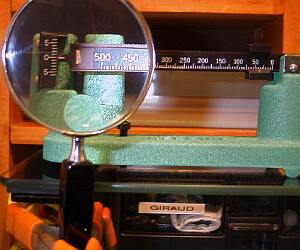
When working with balance beam scales, be sure you have the device leveled. Even a small amount of tilt will throw off the measurement. We’ve seen folks who keep their scale on a shelf or storage area, and then take it out for use. That’s fine, but remember than your loading bench may not be uniformly level on all sections. Unless you put the scale in exactly the same place on the bench every time (at the same angle), you may have to re-set the level. Likewise, if you take the scale to a range, be sure to re-level it to your new working surface. And remember that is it just as important to level the scale front to back as left to right.
July 20th, 2007
Here is a simple, low-cost way to get reliable readings of case headspace when you “bump” the shoulder back on your 6BR, .243, or .308 Win brass. Credit Boyd Allen for this tip. First, you’ll need one .45acp case, with primer removed. Make sure the .45acp case is trimmed square and that it is round. We recommend you first run it through an expander, then size it, trim it and chamfer. Next, take the .45acp case and slip it over the neck of a fired, unsized case with the primer removed. Align the two cases between the jaws of your calipers and note the length from rim to rim (Top Photo, striped case).

OK, now you have the length for a fired case. Next, take a sized case (without primer) and do the same thing, placing the .45acp over the neck of the FL-sized case (Bottom Photo). The difference between the two numbers is the amount of “bump” or set-back you are applying to the shoulder. Here the difference is .0015″. The amount of bump you need varies with your chamber and your load, but .0015-.002″ is a good initial setting. By using this simple tool, you can avoid bumping the shoulder too much. This will also help you set-up the depth of your full-length die to get the proper amount of bump each time.

July 20th, 2007
We had a chat yesterday with Ed Eckhoff, who has served as Match Director for the U.S. F-Class Nationals, NBRSA 600-yard Nationals and other major events held at the Sacramento Valley Shooting Center. Ed has been working with the 6.5×47 Lapua necked down to 6mm. Ed told us he was getting good velocity and stellar accuracy with the new IMR 4007 SSC powder. “I was testing recently at 300 yards, and the first two shots pretty much went through the same hole. The group ended up well under .4 inches. Pretty amazing for 300 yards”. Ed is using 39.0+ grains of IMR 4007 SSC with his own custom-made 108 grain boat-tail bullets. Ed said he can get his 108s well over 3100 fps and there has been no stiff bolt lift and no extrusion of brass into the ejector area. Ed’s big question was barrel life. He asked us–“Has anyone shot out the barrel on a 6-6.5×47 yet? I wonder what kind of barrel life can be expected.”

|


