Sinclair International has created a series of instructional videos illustrating the basics of metallic cartridge reloading. The 8-Part series starts with reloading basics and provides step-by-step, how-to instructions that will help new reloaders get started. Detailed, animated illustrations show you what happens inside the chamber when shooting, and inside the dies during each step of reloading. The videos can be viewed on Sinclair International’s YouTube channel. Shown below is the first video in the series:
Each of the Sinclair videos is hosted by then Sinclair Int’l President Bill Gravatt (now with Creedmoor Sports). Bill doesn’t just show you “how”, he tells you “why”. The how-to segments cover case inspection, proper die set up, case sizing, primer installation, powder measuring, bullet seating, crimping, and even goes into the record keeping needed for the handloader. “We wanted to give shooters who haven’t reloaded a look at all the advantages of creating your own ammo and how easy it is to get started,” said Gravatt, “without telling them they had to have any certain brand or type of equipment to do the job.”
The Eight Video Topics Are:
Part 1 — Intro to Video Series
Part 2 — Intro to Reloading Safety
Part 3 — Metallic Cartridge Components
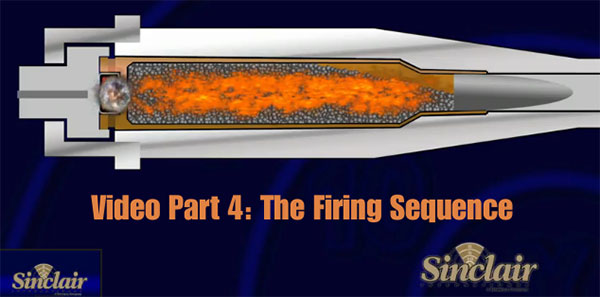
Part 4 — The Firing Sequence
Part 5 — Tools for Reloading
Part 6 — Loading Bottle-Neck Cartridges (2 videos)
Part 7 — Loading Straight Wall Cartridges
Part 8 — Reloading Series Conclusion
Reloading Tools
Shown below is Part 5 of the video series, covering the tools used for precision reloading.
We also strongly recommend the Part 4 Video to readers who are getting started in reloading. This “How Things Work” segment covers the sequence of events inside the chamber (and barrel) when the cartridge is fired. The video includes helpful graphics that show what happens to the primer, powder, cartridge, and bullet when the round is fired. The video also illustrates “headspace” and explains how this can change after firing. We think this video answers many common questions and will help reloaders understand the forces at work on their brass during the firing process.
Bryan Litz and The Science of Accuracy Academy has released a new Podcast with vital information for all handloaders. This Podcast examines the effects of humidity variances on powder. Bryan notes: “If you want to know how much this can matter, we’re talking up to 200 fps difference for the same load of H4350 in 6.5 Creedmoor” at opposite extremes of humidity.
Bryan adds that “Most shooters don’t realize what a big deal this can be — it overshadows many of our efforts to make consistent velocity and hit targets. This can happen in loaded rounds not just for hand loading where you expose powder to ambient humidity. This is especially important for hunters considering the range of environments hunting ammo goes through.”
25% Off Sale on The Science of Accuracy Academy Products
As a Black Friday/Cyber Monday promotion, The Science of Accuracy Academy is running a 25% OFF Sale on everything in the store, now through Monday, November 28, 2022. Save on Bryan Litz’s six impressive books about Ballistics, Bullet Performance, and Long Range Shooting. The Berger Bullets Reloading Manual is also discounted. Use Discount Code BF2022.
In addition you can get your own subscription to the Academy, allowing you to access all podcasts, exclusive videos, learning resources, and bullet data sheets.
Progressive reloading presses offer shooters speed and efficiency in producing custom-tailored rifle and pistol ammunition. However, there is a wide choice of Progressive Presses and a bewildering array of options to consider. In this video, the 6.5 Guys and UltimateReloader.com’s Gavin Gear provide an overview of the leading Progressive Presses on the market along with key considerations for precision rifle shooters. If you are considering getting a Progessive for rifle ammo reloading, you should watch this informative, 25-minute video.
10 Tips for Reloading Rifle Ammo on a Progressive Press:
1. Make sure the brass is very clean. Don’t mix old range pick-up brass with newer brass.
2. Apply a thin, spray lube to all cases before the sizing/loading cycle.
3. Consider priming your brass separately (with a hand or bench tool) before the operation. Then inspect the primers before loading powder and bullets.
4. Always wear eye protection when loading with the Progressive, particularly if you are priming cases.
5. With masking tape, mark the powder measure/dropper with the powder type and cartridge charge weight. Check the charge mass multiple times (see below).
6. Cycle a few cases, sizing and adding powder but NOT seating bullets. Weigh the powder charges to ensure the powder measure is dispensing the correct charge. Sometimes this will change a couple tenths as it “settles down” after the first few charges.
7. Check the brass for shoulder bump and bullet seating depth carefully for the first few rounds, then check again periodically.
8. Try to maintain a steady pace and operate the handle the same way every time.
9. Visually inspect the powder charge in each case (before bullet seating), and use a lock-out die if your Progressive Press has enough stations.
10. Never, ever mix pistol and rifle powders! If you have previously loaded pistol ammo with your Progressive, make sure ALL the powder (every flake and kernel) is removed from all parts of the powder-dropping system before you add rifle powder.
Visit these sites for more Reloading and Precision Shooting Videos:
Do you ever use military-style brass with swaged primer pockets? Then you can really benefit from the new LEE Ram Swage tool. This innovative swaging tool provides a fast, simple, and efficient method of removing the primer pocket crimp on milsurp brass.
Primer pocket swaging is necessary when reloading brass with crimped primer pockets. Many brands of brass for military (and some law enforcement) applications have this crimp. You may find such primer pocket crimps on a variety of milsurp brass types including: 9mm Luger, LEO .40 S&W, .45 ACP, .223 Rem (5.56×45), .308 Win (7.62×51), and .30-06 Springfield, as well as older European cartridge types such as 6.5×55. If you use a progressive press, this new LEE Ram Swage is a boon. Nothing reduces priming problems on a progressive press more than properly swaged primer pockets.
Why use milsurp brass? Surplus military and police department brass is a great low cost source of cases. It is typically very strong, long-lasting, and can often be acquired for a fraction of the cost of new commercial brass. For example, Lake City 7.62×51 (.308 Win) brass is excellent.
Note: This tool is designed for Boxer-primed cases only, not cases with Berdan Primers.
The Lee Ram Swage works on all single stage presses with 7/8″-14 frame threads, and rams which take common “universal” shell-holders. This new tool features spring-assisted case extraction, and an all-steel case guide. This ensures that your cases will be positively centered on the push rod. The swage holder, large or small, installs in seconds into your press ram with no adjustments required.
LEE’s engineers devised a clever “Shell-holderless design” for the LEE Ram Swage. This allows you to swage any small or large primer pocket, without swapping to a different size shell-holder. The hardened steel swage punch is automatically extracted from the primer pocket by five disc springs. The complete LEE Ram Swage set includes one guided 7/8″-14 threaded swage push die, with both large and small ram swage holder assemblies.
Good news — this should eventually help ease the primer shortage. Fiocchi will be building a new primer production center in Arkansas. The new facility will be one of only six primer manufacturing operations in the USA and the only dedicated lead-free primer plant in the world. Fiocchi announced the selection of a 281-acre site in the Port of Little Rock, Arkansas for a new ammunition primer manufacturing facility. Representing a $41.5 million investment and a 120-person workforce expansion, the new primer production center will, eventually, provide much-needed primer supply relief for handloaders. The primers will also be used in Fiocchi’s factory ammo.
Maurizio Negro, Fiocchi Group CEO stated: “This groundbreaking represents another significant milestone in Fiocchi’s long-term plan to strengthen and expand our manufacturing capabilities and to bolster primer supplies not only for Fiocchi products but also to increase supplies for the ammunition manufacturing industry at large.” Part of Fiocchi’s vertical integration strategy, the new primer facility will allow the company to meet internal primer supply needs and provide second-sourcing for industry contracts.
New Plant Will Produce Lead-Free Primers
Fiocchi is a leader in lead-free and heavy-metal-free primers and is the only manufacturer of lead-free primers to receive NATO qualification. The new Arkansas facility will follow Fiocchi’s other commitments to sustainable technology: lead-free projectiles, non-toxic shot, and biodegradable components.
Arkansas Leaders Praise Fiocchi Decision to Build Facility in Arkansas
Arkansas Governor Asa Hutchinson stated: “I am pleased to celebrate Fiocchi’s growth, which is also a demonstration of the continued expansion of the firearms and ammunition industry in our state. Fiocchi’s decision to grow in Arkansas speaks to the significance of maintaining the business-friendly climate that Arkansas is becoming so well known for.” The new facility will bring 120 jobs to the Little Rock area.
Arkansas Secretary of Commerce Mike Preston praised Fiocchi’s decision to build a new plant in Arkansas: “For more than a century, Fiocchi has been a leader in its industry, and we have witnessed firsthand their commitment and excellence in business. This expansion will help Fiocchi reach more customers as they continue to strengthen their brand[.]” Pulaski County Judge Barry Hyde concurred: “Fiocchi joins a growing list of world-class international businesses choosing to locate at the Port of Little Rock. Fiocchi is a leader in sustainable technology, and we are proud to welcome their investment in Pulaski County.”
For more information about Fiocchi ammunition and primers, including inquiries about available positions, visitFiocchiUSA.com.
At the request of our readers, we provide select “Deals of the Week”. Every Sunday afternoon or Monday morning we offer our Best Bargain selections. Here are some of the best deals on firearms, hardware, reloading components, optics, and shooting accessories. Be aware that sale prices are subject to change, and once clearance inventory is sold, it’s gone for good. You snooze you lose.
NOTE: All listed products are for sale to persons 18 years of age or older. No products are intended for use by minors. Prices may vary for Amazon Prime members.
⏺ Good alternative to bulky, heavy electronic muffs
Electronic earmuffs work well but they can be heavy and bulky. And they can interfere with cheek weld. If you want the benefits of electronics but the comfort of ear plugs try the Caldwell E-MAX Shadow electronic ear plugs which boast a 23 decibel NRR (Noise Reduction Rating). Experience high quality stereo sound while confidently protecting your hearing. With six sizes of included foam tips, you’ll find a custom fit for your ear to ensure proper noise cancellation and hearing protection.
2. Midsouth — CCI Bargain Rimfire Ammo in Stock
⏺ Large inventory of CCI Rimfire ammo starting at 9 cents per round
More people than ever are getting rimfire rifles for plinking and/or matches. Rimfires are inexpensive to shoot, and the reduced noise and recoil are big positives. If you need some .22 LR rimfire ammunition check out the CCI .22 LR ammo sale at Midsouth. There’s a wide variety of CCI rimfire ammo on sale, starting at $4.50 per 50ct box. This is a great chance to pick up quality .22 LR ammo at attractive prices.
3. Brownells — $25 Gift Card Bonus with $100 Gift Card Purchase
⏺ Spend $100, get $25 Gift Card back with Brownells promo
Do you like giving gift cards for the holidays? For a limited time you can pick up a FREE $25 gift card with the purchase of $100 in Brownells gift cards. That’s like getting a 25% rebate! This is a great deal and good way to treat someone else AND yourself.
⏺ Very good spotting scope with great long eye relief
Whether shooting at matches or just target shooting having a good spotting scope is a must. A great choice is this Kowa TSN-82SV Combo on sale for $975, a $110 savings. This item includes the highly-rated 82SV spotting body, plus an excellent 25X LER (Long Eye Relief) eyepiece AND a deluxe protective cover. NOTE: With its fixed-power Long Eye Relief eyepiece, this scope works great for prone work, mounted right next to the shooter. However, for long-range spotting duties you may want a unit fitted with a higher-magnification zoom eyepiece.
5. Palmetto SA — Taurus TX 22 .22 LR Pistol Sale, $276.85
⏺ Great price on a very good rimfire pistol
If you’re looking to keep ammo costs down by training with .22 LR rimfire handgun, consider this Taurus TX 22 pistol. Taurus TX 22s have earned very positive reviews from purchasers. The frame has comfortable ergonomics and the Taurus Pittman Trigger System (PTS) offers a very good trigger pull. This is a good choice for a first .22 LR rimfire pistol, at a very good price — starting at $276.85.
6. Amazon — 3″ Splatter Squares On A Roll, $19.99
⏺ Cool product — stick-on grid targets with splatter effect
Splatter targets are popular but the cost of large-size bullseye splatter targets adds up quickly. A cool alternative are these Pistep Splatter Shooting Targets. These are handy “reactive” targets that show a yellow splatter on shot locations. Each roll contain 250 three-inch-square stick-on grids. Each sticker has nine 1″ squares on it so determining group size is easy. For a shooter with an accurate rifle, these 3″ x 3″ splatter squares can work better than a large splatter bullseye target.
Don’t want a gun case that screams “There’s a rifle inside”? If you need to transport small rifles discreetly, check out the Darekuku 30″ Rifle Backpack Bag. The main compartment has padded protection for two rifles. The handy shoulder straps can be covered with a zip-over panel. There is a zipper-access top compartment and a large secondary compartment (with inner mesh pocket and MOLLE straps) to hold ammo, Kestrel, muffs, targets, or other accessories. We like this case to carry a carbine with folding stock. It’s a steal at just $49.99.
It’s getting easier to stock up on ammunition and .223 Rem is the most popular rifle cartridge. If you need a good supply of .223 Rem ammo, consider this PMC 1000-round case of .223 Rem at Locked & Loaded. This is one of the best deals we’ve seen on quality .223 Rem ammo in quite some time.
9. Amazon — NEIKO 6″ Digital Calipers, $25.99
⏺ Good, reliable digital calipers at attractive price
Every handloader needs to measure shoulder bump, cartridge length, and other dimensions. A good set of calipers is essential. If you need calipers, check out the NEIKO Electronic Digital Calipers. The tool’s body/frame is constructed of finely polished stainless steel with a knurled thumb roller and locking screw that ensures smooth sliding and accurate positioning. If you’re getting started in reloading or are looking for a back-up set of calipers, this is a good option.
10. Graf & Sons — Sierra Ammo Sale with Rebate
⏺ Nice rebate on quality Sierra hunting and defense ammo
Did you know that Sierra makes hunting and self-defense ammo? You can grab Outdoor and Sports Master ammo on sale PLUS there’s a rebate that takes $3 off 1 box or $10 off 2 boxes. NOTE: These boxes contain TWENTY (20) rounds only. These are NOT 50-rd boxes.
Cleaning Rod Rack Costs Just $7.99
Looking to better organize your reloading room (aka “man cave”)? Here’s a handy, affordable product that will help you organize gear in your reloading room or “man cave”. Tipton’s Cleaning Rod Rack (Tipton #100335) can accommodate up to six rods with various size handles. The wall-mounted Rod Rack also has horizontal studs on either end for additional accessories. These are useful for hanging the Tico Tool shotgun cleaning wands that stow in a tube with a plastic hook on the top.
Tipton Cleaning Rod Racks come complete with mounting screws (and screw slots are molded-in). You’ll find Tipton Cleaning Rod racks for under $9.00 at most vendors. They are $7.99 at MidwayUSA, while Amazon.com offers the racks for just $9.99 with free shipping for Amazon Prime Members.
Do you have a hankering to shoot Extreme Long Range (ELR)? Then you’ll want a large-caliber cartridge with plenty of boiler room. Some of the most successful ELR cartridges have been based on the CheyTac family, including the .375 CheyTac (9.5×77) and .408 CheyTac (10.36 x 77). Now brass for both these jumbo cartridges is offered by Peterson Cartridge. This Peterson Cheytac brass has proven to be tough and long-lived. And it is capable of winning — Derek Rodgers won the 2017 King of 2 Miles (K02M) event shooting a .375 Cheytac with Peterson brass. Here’s a report on how Peterson developed and tested its tough CheyTac cartridge brass.
Developing and Testing CheyTac Brass
Report by Peterson Cartridge Co.
Our president, Derek Peterson, has live-tested our most recent iteration of the .375 CheyTac (aka 9.5 X 77). He started with five casings, and did a full-body resizing after each firing. He got 17 firings out of each before he started to notice the early signs of case head separation. [Editor: Theses were with extremely high pressure loads.] He then took another set of casings and after each firing he just bumped the shoulder back, like a typical reloader would. He got 20 firings out of those casings.
Note: CheyTac® is a registered trademark of CheyTac USA, LLC. Peterson Cartridge has no affiliation.
Low MV Extreme Spread
On the first two shots the muzzle velocities were within 12 feet per second of each other. On the 3rd and 4th shots the muzzle velocities were within 6 feet per second of each other. By the 5th shot the muzzle velocities were within 1 foot per second of each other. Now that is how you can put two bullets in the same hole down range.
No SAAMI Spec for CheyTac Cartridges
As many of you probably already know there is no SAAMI spec on these calibers. So, without a SAAMI spec there is no stated maximum pressure for a service load. However, there IS an international spec on the .408 [promulgated by the] CIP (Commission International Permanente). And the CIP max pressure for this round is extremely high. Our partner in Europe tells us it is probably unnecessarily high. Our partner loads these rounds and they have a standard load for the .375s which is also quite high. So that is the pressure we did our testing at. To even achieve that pressure, we had to use a compressed load. We are explaining all this to say that you [should not use] a load that hot, and therefor you will most likely get more reloads than we did[.]
Peterson Brass Goes Through 11 Dimensional Tests
With all the casings we make in any caliber, we perform a battery of in-process, real-time dimensional checks. [We test] 11 different dimensions continuously throughout each shift. Some of these are tube cylindricity, mouth to body concentricity, primer pocket diameter, length to shoulder, overall length, and more. These measurements are automatically fed into Statistical Process Control software. If a dimension begins to drift from nominal we can catch it immediately and correct it.
Peterson is Fully Committed to CheyTac Brass Production
Peterson Cartridge purchased additional manufacturing equipment designed specifically to produce these large casings. Our capacity is 5-million casings a year. We are committed to there not being a shortage of these calibers ever again.
Derek Rodgers is the 2017 King of 2 Miles. He is also the first-ever human to ever hit the maximum distance target target at 3368 yards (1.91 miles) in competition. His cartridge choice? The .375 CheyTac. Derek ran Cutting Edge Bullets in Peterson brass with Hodgdon H50BMG powder.
Q: Why did you choose the .375 CheyTac cartridge?
Derek: When I was asked to join the Applied Ballistics Team, I needed to get an ELR rifle built in a short period of time. I was under a very tight time schedule to get the project complete. In an effort to eliminate variables, I decided to keep things standard and as simple as possible. I chose the .375 CheyTac for the ease of getting components. The larger rifles are more difficult to get components quickly and I felt like the .375 CheyTac had enough attributes to be competitive at ELR distances.
Product Tip from EdLongrange. We welcome reader submissions.
Peterson Cartridge Company (“Peterson”) has released a lengthy, authoritative guide to the 22 Creedmoor cartridge, a popular wildcat based on the 6.5 Creedmoor or 6mm Creedmoor necked down to .224 caliber. We think the .22 Creedmoor would be a great long-range varmint cartridge, similar to the .22-250 Rem, but with a more modern, efficient cartridge design. In addition, some PRS/NRL competitors may turn to the .22 Creedmoor because it has less recoil and is flatter-shooting than the 6mm Creedmoor. In addition, .224-caliber match bullets are typically less expensive than heavier 6mm and 6.5mm projectiles. Less recoil, and less cost — what’s not to like?*
Along with load data, this article has specific sections dedicated to: Primers, Rifling Twist Rates, and Reloading Supplies. If you are considering building a .22 Creedmoor, we recommend you download the full Peterson .22 Creedmoor article, which is available in PDF format.
Peterson states, “Since its inception in 2007… the 6.5 Creedmoor has seen some pretty meteoric growth in popularity. That growth continues as of this writing, as the cartridge has now gone mainstream with hunters and shooters alike. As the popularity of the 6.5 Creedmoor has increased, so has the number of wildcat cartridges based off of it. Some of those popular wildcat cartridges are the 6mm Creedmoor, the .25 Creedmoor, and now the .22 Creedmoor. This data sheet will cover the .22 Creedmoor.
To help our customers, and anyone else who shoots .22 Creedmoor, we decided to create this Data Sheet and distribute it. [In this LOAD DATA Document] you will find four (4) common bullets, and four (4) common rifle powders used when handloading the .22 Creedmoor cartridge. We then took the different bullet and powder combinations and loaded them up to the SAAMI Maximum Average Pressure (MAP) for the 6.5 Creedmoor and 6mm Creedmoor cartridges, which is 62,000 PSI. [O]ur goal was to provide a wide spectrum of bullet weights and the powders used with them.
All of the following data was gathered by our ballistician in our indoor ballistics lab located in our factory in Pennsylvania. Although we were able to gather pressure and velocity data in our lab, we have NOT tested these loads for accuracy. Again, these loads are just designed to give shooters information regarding what velocity, a given bullet and powder charge combination, will produce the SAAMI Maximum Average Pressure (MAP) of 62,000 psi.”
Sample 22 Creedmoor LOAD DATA
IMPORTANT — Pressures can vary significantly with different Cartridge Overall Lengths (COAL). In addition, ANY change to ANY load components — primers, bullets, brass, powder — can affect pressure. Always load conservatively. In addition, because of variances in bore dimensions, some barrels may show higher pressures than others. Again, always start with conservative loads, well below MAX pressures.
*Actually there IS a potential downside — reduced barrel life. We expect that a .22 Creedmoor running hot varmint loads would experience shorter useful barrel life compared to a 6.5 Creedmoor. This is based on what we’ve observed with .22-250 and .22-250 Ackley barrels compared to our 6.5 CM barrels.
Good news for shooting gear shoppers. Brownells customers can now find all the deals, promotions, and specially-priced products in one convenient location via the new Brownells Deals site. The Deals site is accessible through www.Brownells.com with the word “Deals” highlighted in red text near the top right of the main page. From a smartphone, click on the menu icon upper left, then select “DEALS”.
On the Deals page, customers can access to Featured Deals on Brownells house products, AR-15 parts, and items from Magpul, Aero Precision, and other popular manufacturers. There are also clickable images for deals on product categories such as ammunition and reloading components. Below the categories you can click specific products on sale. To see all the deals available at Brownells, visit Brownells.com/deals.
SAVE More Money with Brownells DISCOUNT CODES
IMPORTANT: To save the most on a wide variety of Brownells products, you’ll want to use a current Brownells DISCOUNT CODE. Check our Daily Bulletin regularly for current codes. Here are some of the CODES for today, 11/2/2022. Use these codes during check-out to save up to 13% on your purchases.
CODE: NOV20 — $20 Off Orders $150
Expiration date: November 20, 2022
CODE: NOV40 — $40 Off Orders $300
Expiration date: November 20, 2022
CODE: NOV65 — $65 Off Orders $500
Expiration date: November 20, 2022
CODE: NOV95 — $95 Off Orders $750
Expiration date: November 20, 2022
CODE: NOV150 — $150 Off Orders $1000
Expiration date: November 20, 2022
CODE: NOV225 — $225 Off Orders $1500
Expiration date: November 20, 2022
CODE: HOME10 — $10 Off $100
Expiration date unknown
CODE: TA10 — 10% OFF over $150
Expiration date unknown
CODE: WLS10 — 10% OFF over $150
Expiration date unknown
CODE: BACK15 — $15 off $150
Expiration date unknown
CODE: 20OFF200 — $20 off $200
Expiration date unknown
CODE: Q63 — Free S/H over $99
Expiration date unknown
Codes are subject to change at any time. Find current Brownells discount codes at Gun.deals/coupons.




 The
The 


