For today’s Sunday Gunday Feature, we provide a selection of videos showcasing rifle and pistol cartridge types — from tiny .17 caliber cases to 30mm cases (and a few even bigger rounds). Two of the videos use advance computer animation to provide 3D views of dozens of cartridge types. Then there are some expert commentaries by Jerry Miculek and Ron Spomer discussing the characteristics and performance of various cartridge types. Finally, we provide two videos that discuss rimfire cartridges and show how .22 LR rounds are produced in a modern CCI factory.
90 Different Rifle Cartridge Types in Computer Animation
In this rifle ammunition comparison animation there are 90 different cartridge types, from very small (.22 Flobert) to very, very big (20mm Vulcan). This video employs sophisticated, 3D CAD animation to showcase 90 different rifle cartridges, one after the other, in sequence. It covers from .17 Caliber up to 20mm. Obviously a lot of time and effort went into this video, but it really is cool to see so many different cartridge types in one 3.5-minute video.
After the full line-up is complete at 1:41, the video then provides other smaller comparison, such as multiple large hunting cartridges (2:15) and .22 Caliber cartridges (2:45, see above). All the cartridge models are made using Autodesk Inventor software, and then the “line-up” animation was completed with Autodesk Showcase.
Cartridge Types Included (in Caliber Order, then Metric Order):
1) .17 HM2
2) .17 HMR
3) .204 Ruger
4) .218 Bee
5) .22 Flobert
6) .22 Hornet
7) .22 LR
8) .22 Magnum
9) .22 PPC
10) .22 Short
11) .220 Jaybird
12) .223 Rem/5.56x45mm
13) .223 WSSM
14) .224 Weatherby Magnum
15) .225 Winchester
16) .240 Weatherby Magnum
17) .243 Winchester
18) .25 Remington Auto
19) .250 Savage
20) .25-06 Remington
21) .256 Winchester Magnum
22) .257 Roberts
23) .260 Remington
24) .264 Winchester Magnum
25) .270 Weatherby Magnum
26) .270 Winchester
27) .280 British
28) .280 Remington
29) .284 Winchester
30) .30 Carbine
31) .300 H&H Magnum
32) .300 Rem Ultra Magnum
33) .300 Savage
34) .300 Winchester Magnum
35) .300 Win Short Mag (WSM)
36) .30-06 Springfield
37) .303 British
38) .30-30
39) .308 Norma Magnum
40) .308 Winchester
41) .32 Winchester Special
42) .325 WSM
43) .338 Lapua Magnum
44) .35 Whelen
45) .350 Remington Magnum
46) .375 H&H Magnum
47) .376 Steyr
48) .408 Cheyenne
49) .416 Remington Magnum
50) .416 Weatherby Magnum
51) .444 Marlin
52) .450 Marlin
53) .450 Nitro Express
54) .458 Win Magnum
55) .45×70
56) .460 Weatherby Magnum
57) .465 H&H Magnum
58) .470 Nitro Express
59) .50 BMG / 12.7×99 NATO
60) .500 jeffery
61) .505 Gibbs
62) .577 Nitro Express
63) .577 Tyrannosaur
64) .600 Nitro Express
65) .700 Nitro Express
66) .950 JDJ
67) 4.6×30 mm
68) 4.6x30mm
69) 5.6×50 Magnum
70) 5.7x28mm
71) 5mm/SMc
72) 6mm LEE
73) 6.5×55 Swedish
74) 6.5×6 mm Schuler
75) 6.8mm Remington SPC
76) 6mm PPC
77) 6×45 mm
78) 7mm Weatherby Magnum
79) 7mm Remington Magnum
80) 7mm Rem Ultra Magnum
81) 7.62×39 mm FMJ
82) 7.7×58 Arisaka
83) 7.95×57 Mauser
84) 8mm Remington Magnum
85) 9.3x62mm
86) 9.3×64 Brenneke
87) 14.5x114mm
88) 20mm Vulcan
89) 25mmx137mm
90) 30mmx173mm
Ammunition Size Line-Up — from Tiny to Massive
This animation video shows the size comparison of ammunition from a 2.34mm rimfire caliber to the massive 800mm caliber shell of the Schwerer Gustav railway cannon used by German forces in World War II. This video includes many common rifle and pistol cartridges/calibers, but also includes large artillery ammunition. This video has very good CGI Graphics. Below is part of the line-up from the .17 Remington Fireball (far left) to the famed .50 BMG (far right):
Ammunition Types Showcased in this video:
2.34mm rimfire
2.7mm Kolibri
3mm Kolibri
4.25 mm Liliput
.17 Hornady Mach 2
.17 Remington Fireball
.17 Hornady Magnum Rimfire
.22 Long Rifle
.22 Winchester Magnum Rimfire
HK 4.6×30mm
4.6×36 Loffelspitz
5.45mmx18 MPTs
5.7×28mm SS190
.280 British 7×43
.297/230 Morris Short
.297/230 Morris Long
.30 Pedersen 7.65×20mm
7.92×33mm Kurz
.300 Winchester Short Magnum
8×50mmR Mannlicher
.499 LWR
.577/450 Martini–Henry
.600 Nitro Express
.470 Nitro Express
.50 Beowulf
.50 BMG
20×102 M55A3
25×137 M793
Popular Cartridges/Calibers for Self-Defense and Hunting
This video focuses on popular calibers/cartridges used for self-defense and hunting. It provides a quick but informative overview of the capabilities (and intended uses) of many types of pistol, rifle, and shotgun ammunition. The video discusses the pros/cons of various cartridge types and explains how you would select ammo for a particular purposes (e.g. skeet loads vs. defense shotshells). If you are considering buying a carry pistol and are undecided about caliber choice, this is a good video to watch.
Flattest-Shooting Cartridges by Caliber (Ron Spomer)
In this 15-minute video, hunting expert Ron Spomer examines a variety of standard and wildcat cartridges from .17 caliber all the way to .338 caliber. For each caliber, Ron picks a flat-shooting “winner” and provides some ballistics comparison tables. This video is quite popular, with over 550,000 views on YouTube.
Ammo Types and Calibers — Jerry Miculek Explains the Basics
In this video, legendary shooter Jerry Miculek talks about popular types of pistol and rifle ammunition and the various bullet options used for plinking, competition, and self-defense. Jerry, one of the greatest pistol shooters on the planet, provides useful insights on cartridge selection and bullet choices. Jerry notes: “There are a TON of different types of ammunition” so he explains the basics. And Jerry answers common questions such as: “What is the difference between ball and hollow-point bullets?” and “What type of gun takes rimmed cartridge versus rimless?”.
.22 Caliber Rimfire Cartridges — Some Key Facts Revealed
We recommend all .22 rimfire shooters watch this video from Old English Outfitters. It explains some important facts and clarifies some common misconceptions about to .22 caliber ammunition. To learn more about modern .22 LR rimfire ammo, we also recommend the video below, which shows how CCI .22 LR ammunition is manufactured, start to finish.
BONUS Video — How .22 LR Ammunition Is Made
YouTube host 22Plinkster toured the CCI/Speer production facility in Lewiston, Idaho. While touring the plant, 22Plinkster was allowed to capture video showing the creation of .22 LR rounds from start to finish. This is a fascinating video, well worth watching.
This revealing video shows all phases of .22 LR ammo production including cupping, drawing, annealing, washing, drying, head-stamping, priming, powder charging, bullet seating, crimping, waxing, inspection, and final packaging. If you’ve got ten minutes to spare, we really recommend you watch the video from start to finish. You’ll definitely learn some new things about rimfire ammo.
The text in this article is Copyright 2023 by AccurateShooter.com. No text shall be republished on any other site without authorization and payment of license fees.
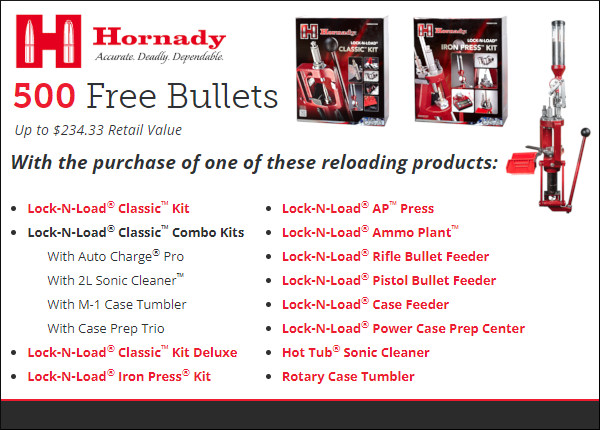
Back by popular demand, Hornady is now running its 2023 Get Loaded® promotion. With this promo you can get up to 500 FREE BULLETS with qualifying purchases of Hornady reloading products.
The 2023 Get Loaded program begins on February 1, 2023 and continues through December 31, 2023. Customers who purchase from the qualifying Hornady lineup of reloading presses and reloading tools will receive free bullets after submitting official redemption forms. Depending on the products purchased, customers can get 500 or 100 free bullets, valued up to $234.33.
For centerfire rounds, consistent ignition (and low ES/SD) all begins with the primer in the base of the cartridge. When the firing pin strikes the primer, it sets off a small flame/spark which lights the powder in the case. Energy from that burning powder pushes the bullet out of the cartridge, down the barrel, and out to the target. It’s fair to say, then, that accurate shooting all begins with the primer.
When seating primers, consistency counts. You want to make sure the primer is fully seated in the primer pocket in the base of the case. You want to ensure a slight bit of crush (flattening) for proper seating, and it doesn’t hurt to have very consistent primer seating depths. That’s why guys use tools to uniform their primer pockets.
Here’s a tool that lets you measure the consistency of primer seating depths. Forum members have reported it works really well — measurements are quick and repeatable. Will this tool lower your ES/SD or improve accuracy? That’s hard to say. However, it will definitely help you detect when a primer in a loaded round is seated too high or too low — that’s important. In addition, it can give you precise measurements for comparison testing with different types of primers.
Accuracy One Precision Primer Gauge
The Accuracy One Precision Primer Gauge will precisely measure primer pocket depth and the depth of seated primers in relationship to the face of the case head. The Precision Primer Gauge can also be used to measure the thickness of an unseated primer, allowing you to calculate the optimum seating depth for the particular primers and cases you are loading.
Precision Primer Gauge Features:
Digital Indicator with 0.01mm/0.0005″ resolution
Gauge Body is machined from 303 stainless steel
Small Primer Stem and Large Primer Stem
Both .223 Rem and .308 Win zeroing block
Magnum and .338 Lapua zeroing block
Case Compatibility: The Precision Primer Gauge works with 300 Win. Mag case head diameter (.532”) cartridges, .308 Win. case head diameter (.473”) cartridges, and .223 Rem case head diameter (.378”) cartridges using either large or small primers.
Precision Primer Gauge Pricing:
PPG Without Indicator: $150.00
PPG With Indicator: $210.00
PPG Main Body Only: $55.00
Gauge Stand: $55.00
Phone Orders: Call (814) 684-5322
How to Order the Precision Primer Gauge:
The Precision Primer Gauge can be ordered via phone, email, or postal mail. CLICK HERE for more info.
Assembly Tips: Nylon screw is provided for securing the gauge body to the indicator. The contact point of the indicator must be removed to provide proper function. Also, please note that the standard gauge body is not compatible with cartridges that share the .338 Lapua case head diameter unless the diameter of the magnum step is machined to .595” to accept the larger diameter case head. This modification of the gauge body is available upon request.
Product Tip from EdLongRange. We welcome reader submissions.
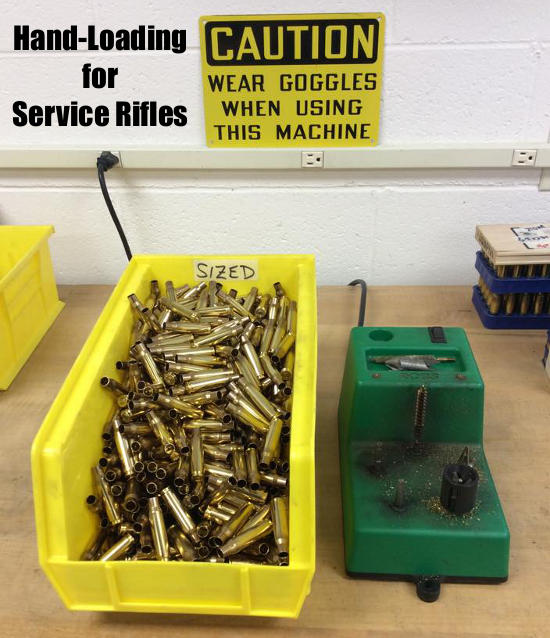
The U.S. Army Marksmanship Unit (USAMU) has published a great series of reloading “how-to” articles on its Facebook Page. This post covers key factors to consider when loading ammunition for Match Rifles and Service Rifles, with a particular focus on self-loading “gas guns”. Visit the USAMU Facebook Page regularly for other, helpful reloading and marksmanship tips.
We offer some “cardinal rules” to help new gas-gun handloaders with safety and efficiency. These address both Match Rifle and Service Rifle versions of the AR15, M1 Garand, M1A, and M110. However, they can also improve safe reloading for many other auto-loaders such as M1 Carbines, FALs, SIGs, etc. The author distilled these principles many years ago to help focus on the essential aspects of these rifles.
RULE ONE: Service Rifles Are Not Benchrest Rifles
Gas-guns require a relatively loose fit between ammunition and chamber (vs. bolt actions) for safe, smooth operation. Many techniques, such as neck sizing and keeping cartridge headspace quite tight, are popular in the extreme bolt gun accuracy realm. However, they are of little value with Service Rifles, and some could even be hazardous. Before adopting a specialized technique, seriously consider whether it is appropriate and beneficial in a gas-gun.
RULE TWO: Never Compromise Safety to Obtain Accuracy
Example: If choosing a brand of great, but ultra-sensitive match primers offers possibly better accuracy at the risk of slam-fires in your design of rifle, don’t do it! You are issued exactly two eyes and ten fingers (best-case scenario). Risking them trying to squeeze 0.25 MOA better accuracy out of an M1A, etc. simply isn’t worth it.
RULE THREE: Tailor the Precision to Your Individual Skill and Your Rifle’s Potential
This has been addressed here before, but bears repeating for newcomers. If you are struggling to break out of the Marksman Class, or using a CMP M1 “As-Issued,” then laboriously turning the necks of your 600-yard brass is a waste of time. Your scores will improve much faster by practicing or dry-firing. On the other hand, if the reigning champions anxiously check your scores each time you fire an event, a little neck-turning might not be so far-fetched.
Verifying Load Improvements — Accuracy hand-loading involves a wide variety of techniques, ranging from basic to rather precise. Carefully select those which offer a good return on investment for your time and labor. In doubt? Do a classic pilot study. Prepare ammo for at least three or four ten-shot groups with your new technique, vs. the same with your standard ammo. Then, pick a calm day and test the ammo as carefully as possible at its full distance (e.g. 200, 300, or 600 yards) to verify a significant improvement. A little testing can save much labor!
This video explains the procedure for ordering an M1 Garand from the CMP.
RULE FOUR: Be Your Own Efficiency Expert
Serious Service Rifle shooters generally think of ammunition in terms of thousands of rounds, not “boxes”, or even “hundreds”. Analyze, and WRITE DOWN each step in your reloading process. Count the number of times each case is handled. Then, see if any operations can be dropped or changed without reducing safety or accuracy. Eliminating just two operations saves 2000 steps per 1000 rounds loaded. Conversely, carefully consider any measurable benefits before adding a step to your routine.
RULE FIVE: In Searching for Greater Accuracy with Efficiency, Look for System Changes
For example, instead of marking your 300-yard rounds individually to differentiate them from your 200-yard ammo, would a simple change in primers work? If accuracy is maintained, using brass-colored primers for 200 and silver for 300 provides an indelible indicator and eliminates a step! Similarly, rather than spending hours selecting GI surplus brass for weight and neck uniformity, consider splurging on some known, high-quality imported match brass for your 600-yard loads. Results should be excellent, time is saved, and given limited shooting at 600 yards, brass life should be long.
RULE SIX: Check All Your Primers Before Packaging Your Loaded Ammo
This seems simple and even intuitive. However, many slam-fires (which were much more common when M1s and M1As were the standard) are due, at least in part, to “high” primers. Primers should be seated below flush with the case head. The USAMU has addressed this at length in a previous column, but each round should be checked for properly-seated primers before they are packaged for use.
A fire in the home is always to be feared. And a fire in your reloading room can be disastrous. Near your reloading bench you probably have flammable solvents, and maybe gunpowder. What would happen if an electrical fire started in your reloading room? Would you be alerted? Do you have a proper fire extinguisher at hand?
Here’s a true story from Forum Member Joe O. (aka “Joecob”) that provides a valuable safety lesson. After Joe started up his old tumbler, an internal connector worked loose, causing an arc which started a fire in his basement reloading area. Luckily Joe had a functioning smoke detector, and a fire extinguisher.
Very few of us would worry about fire when we plug in a tumbler or other AC-powered reloading tool. But there is always the possibility of a malfunction and a fire. Quick thinking (and a handy extinguisher) prevented serious damage to Joe’s reloading room and house — but things could have been worse (much worse), had Joe not responded quickly.
Fire in the Reloading Room — Report by Joecob
The day before ‘Sandy’ hit I was cleaning brass the way I always have. I set the vibratory tumbler on the back of my reloading bench in the basement. I loaded the media hopper with 40 fired empty brass cases (and walnut media), plugged the cord in, turned the tumbler on and went back upstairs to watch TV. I could hear the tumbler running in the background.
About half an hour later I heard the basement smoke alarm go off. I ran downstairs. Flames were licking from the melting plastic of the tumbler.
I grabbed the nearby ABC cannister extinguisher and squirted out the fire and soaked the charred bench areas with water. Good thing I had the extinguisher! And I was glad I religiously store powder and primers properly — away from the bench (and everything else).
What caused the fire? It looks like an internal AC connector finally vibrated loose enough to arc and ignite the plastic. WHEH! I had been using that thing for 25 years the same way without mishap. Guess I should have known to periodically check the guts of a thing that plugs in and vibrates for a living?
Today I went out and bought a new even bigger ‘Pro’ ABC extinguisher, plus a dual-detector smoke alarm, and an ultrasonic cleaner. That experience was scarier than the storm. I hope this true account might help someone else to avoid a bad experience.
In his account, Joe refers to an “ABC” cannister fire extinguisher. The “ABC” refers to the fire classification rating: Class A (trash, wood, and paper), Class B (liquids and gases), and Class C (energized electrical equipment) fires. There are many brands of ABC-rated extinguishers.
The rechargeable Kidde 210 unit (sku 21005779) contains four pounds of a multipurpose monoammonium phosphate dry chemical extinguishing agent. It has a discharge time of 13 to 15 seconds, a discharge range of 10 to 15 feet, and an operating pressure of 100 PSI. The seamless aluminum cylinder measures 4.5 inches in diameter and 15.7 inches tall. The Kidde 210 has a 6-year limited warranty. This is Amazon’s #1 Best Seller among Fire Extinguishers.
This is a grim tale. A man almost lost the use of his right hand, and did suffer terrible injuries to his fingers. All because he picked the wrong bottle of powder off the shelf. We have run this story before, and we will continue to run it every year, as a caution to our readers. This mistake is easy to make, but the consequences can be dire. Always, always double-check your powder labels before you start the hand-loading process. If you don’t, you may not have a hand to load with next time…
Similar Labels, Disasterous Consequences
The shooter, Denny K., was assembling some rounds for his brand new 7mm-08 Savage hunting rifle. He thought he was loading with Hodgdon Varget. Instead he had filled his powder measure with Hodgdon TiteGroup, a fast-burning pistol powder. The labels are similar, so the mistake is understandable. But the results were devastating. Here’s what 41 grains of TiteGroup can do in a 7mm-08:
Posting on the Firing Line, in a thread entitled “Lucky to Be Alive”, Denny writes:
“This is the hardest post to post. I know if I had read it a week ago my comment would have been: ‘You have no business reloading’. I had everything perfect, except pouring the wrong powder in the powder measure. I type this slowly with my left hand, embarrassed but … possibly saving someone else a tragedy or, like me, a long drive to the Emergency Room and surgery to save my finger.”
The Still-Sealed Bottle of Varget
Denny did not initially comprehend exactly why the kaboom happened. He thought maybe his new Savage rifle was at fault. Then, on his return home, he discovered something…
Denny wrote: “The seven-hour period it took to go to ER, transport to Trauma Center and surgery made me think it was a Savage rifle issue. Brand new rifle, new brass, triple-checked loading data. The next day I was humbled when I realized the Varget powder was still sealed.
I knew what powder to use. I thought [Varget] was what I used. Not until the following day did I realize the Varget was still sealed.”
At that point, Denny realized what caused the accident — “operator error”. He knew he had to warn others about using the wrong powder: “I knew I needed to share my mistake, even though it is embarrassing, just to remind people. I’ve been reloading for 30 years…”
Editor’s Comment: Denny was not a novice reloader. His experience demonstrates that this kind of mistake can be made by any hand-loader, even one with decades of experience. Be safe guys, take your time when you load your ammo. Remove powders from measures after your loading sessions (pistol powders can look very similar to rifle powders). And by all means CHECK the LABEL on the jug. As the TiteGroup label says: “A little goes a long way.”
It’s not a bad idea to separate your pistol powders from your rifle powders, or perhaps even load for pistol in a separate part of your workshop.
Today’s the day — SHOT Show 2023 has officially opened with thousands of gun industry exhibits at the Venetian EXPO and Caesars Forum center. The big event, the largest gun/shooting/hunting convention on the planet, will attract tens of thousands of visitors to Las Vegas for the next four days. SHOW Shot 2023 concludes on Friday, January 20, 2023. Our Daily Bulletin will provide reports from SHOT Show all week, highlighting interesting new firearms and shooting sports products. If you want an “insider’s view” of SHOT Show, check out the SHOT Show Facebook Page and SHOT Show Instagram Page.
CLICK HERE for the searchable database of all SHOT Show 2023 exhibitors.
SHOT Show Level 2 of the Venetian Expo, just hours before the event opened this morning.
Notable Products on Display at SHOT Show 2023
New Forster Co-Ax XL Reloading Press
The folks at Forster Products surprised us all with a remarkable new Co-Ax XL Press. This is bigger than the classic Co-Ax so it can handle cases up to .50 BMG. This new press features a floating quick change die station, floating “universal” shell holder, and integrated LED lighting.
Our friend Gavin Gear of UltimateReloader.com has an exclusive video showcasing the features of the new XL Co-Ax press. Gavin posted: “The Co-Ax XL is a lot like the standard Forster Co-Ax, but on a larger scale to accommodate cartridges up to the mighty 50 BMG!”
MPA Matrix Air Professional Air Rifle Chassis
Leading rifle chassis-maker MasterPiece Arms (MPA) has released the new Matrix Air Professional Chassis. Built for stability and precision, the Matrix Air Pro is rugged and sturdy. Compatible with RAW HM1000X and FX Crown, the Matrix Air Pro can handle Plenums and 300, 580, and 700CC bottles. This game-changing Airgun Rifle Chassis offers simple installation and a large variety of accessories. MPA President Phil Cashin noted: “Over the past several years, there has been a huge growth in the Competition Precision Airgun market. Masterpiece Arms has recognized a significant need for a Precision Oriented Airgun Chassis. The Matrix Air Professional Chassis answers that need.”
Elite Iron Revolution Bipod
Elite Iron offers the impressive Revolution Bipod. Designed for long-barreled rifles in .338, .375, and .408 calibers, this unique bipod design provides exceptional strength, stability, and adjustability. Every bipod is hand-constructed to individual customer specifications, ensuring the highest quality fit and standards for even the most demanding environments.
AMP Bullet Seating Press — Computer Controlled
The AMP Press from Annealing Made Perfect combines a motor driven ram, a distance sensor, and a load cell to deliver extremely accurate and precise Force / Distance bullet seating measurements. It is designed for use with inline bullet seating dies. For the first time, this data can be stored and sorted according to a multitude of variables. This allows users to enhance their case preparation, so as to achieve more consistent “neck tension”. It also allows users to batch their loads accordingly. Users can store sessions for each caliber. Current bullet seating sessions can be compared to previous ones to accurately see how loads are changing (if at all) over time.
New Handguns for 2023 — Video Previews
Thousands of handguns will be showcased at SHOT Show 2023. This video covers seven relatively new design pistols that will be on display at SHOT Show 2023. These are: 00:34 The CZ P-10 F; 02:06 Rock River Arms STK 100; 03:44 SAR9 Compact; 05:04 Smith and Wesson M&P M2.0 10mm; 06:22 Bond Arms Roughneck Derringer; 07:08 Mossberg MC2sc; and 08:39 Cabot Guns Apocalypse.
Want to see even MORE new pistols? This Survival Gear video features has ten other recently introduced pistols. Most of these will be featured at SHOT Show 2023.
SHOT Show is a Massive Event — 800,000 Square Feet of Products
Based on current bookings, SHOT Show 2023 will encompass over 800,000 net square feet. That’s the equivalent of 14 football fields. There should be over 2600 exhibitors this year. CLICK HERE to search for exhibitor booths by company name.
There’s a new advanced powder dispensing system on the market — the SuperTrickler. This is an extremely advanced, push-button control powder dispenser that aims to offer the speed and precision of the AutoTrickler V4 in a unitized product with all the components — powder container, fast dispenser, and precision trickler — in one device. Below are four videos that show the SuperTrickler in action.
The SuperTrickler was designed by Rex Petersen of Denmark in collaboration with Australian Peter Kowald, a retired automation/process control engineer. Peter concentrated on the software, while Rex designed and crafted the mechanical functions. The SuperTrickler prototype attracted worldwide attention. It is now manufactured and sold from Denmark to customers worldwide.
The design team states: “Rather than just dropping powder, the SuperTrickler has been designed from the get-go to be part of a compact system approach to reloading, which is affordable to the home user. Apart from the precision balance, it does not rely on third-party products and has a responsive touch-screen interface to a stand-alone microprocessor that enables powerful … features such as laddering, data logging, automatic power-up, robotics interface and much more. When true precision matters for reloaders that want more, the SuperTrickler is a very fast, feature rich, expandable and future-proof investment in the art of reloading.”
The SuperTrickler is available by itself, or as a bundle with an A&D FX-120i force restoration scale. Prices are listed in U.S. Dollars NOT including shipping. If you have questions about the SuperTrickler, you can get answers via the SuperTrickler Facebook Group. There is also a SuperTrickler thread in our Shooters’ Forum. Units have started shipping but there can be significant wait times from order to arrival.
At the request of our readers, we provide select “Deals of the Week”. Every Sunday afternoon or Monday morning we offer our Best Bargain selections. Here are some of the best deals on firearms, hardware, reloading components, optics, and shooting accessories. Be aware that sale prices are subject to change, and once clearance inventory is sold, it’s gone for good. You snooze you lose.
NOTE: All listed products are for sale to persons 18 years of age or older. No products are intended for use by minors.
1. Palmetto SA — PSA 16″ Barrel Complete AR 5.56 Rifle
⏺ Very good deal on complete 5.56 AR rifle with top rail
Well the corrupt politicians in Illinois have passed a so-called “Assault Weapons Ban” that will prohibit sales of many semi-automatic modern sporting rifles. That’s the 9th state that has done this. If you think it’s time to finally get that Black Rifle before ARs are outlawed in your jurisdiction, here’s a great deal from Palmetto State Armory. Get a complete modern PSA AR with 16″ barrel for $599.99, $400 off the regular price. This includes an adjustable stock plus flip-up MBUS sights. And you even get FREE Shipping to your FFL. This SHOT Show Sale is good for this week.
2. Brownells — January Black Rifle Sale, up to 45% Off
⏺ Major discounts on uppers, lowers, stocks, triggers and more
Now through the end of January 2023, Brownells is running a major Black Rifle Parts Sale. You can save up to 45% on a wide variety of AR-platform rifle components. On sale are lowers, uppers, complete rifle kits, triggers, bolt carriers, handguards and more. You’ll find all the part you need to build a Modern Sporting Rifle for home defense, varminting, or 3-gun games. if you own a lower, consider the Foxtrot Mike .223 Wylde Rifle Build Kit. It has a fully assembled upper with barrel and all the lower parts you need. This is on sale now for $499.99, marked down from $766.49, a 35% Savings. NOTE: On many of these items you can save even more with Brownells Discount Codes. These codes may work through 1/31/2023: JAN60 ($60 Off $475+); JAN35 ($35 Off $275+); JAN20 ($20 Off $150+); and TA10 (10% Off 150+).
3. Precision Reloading — 10% Off Whidden Dies and Products
⏺ Superb Whidden sizing and seating dies in stock and now 10% Off
Whidden Gunworks makes some of the best dies and reloading tools you can buy. And right now at Precision Reloading you can save 10% on a wide selection of Whidden die sets, individual dies, bump gauges and more. For example, a 6BR Ackley (6BRA) FL bushing Sizing Die is $102.05, marked down from $111.39. And a 6.5 Creedmoor Micrometer Seating Die is $125.01, discounted from $138.90. Dies for a wide variety of cartridge types, regular and magnum, are on sale now through 11:59 pm on 1/19/2023.
4. Amazon or MidwayUSA — RCBS Summit Press, $164.02
⏺ Unique compact design, also great for loading at the range
Do you need a press that can be mounted on a bench with limited space and no overhang? Consider the RCBS Summit Press. This press has a small footprint design making it very compact, versatile and easy to transport to ranges. With a 4.5″ opening, this has great frontal access and there is no linkage below the press. The case does not move — instead, the die is lowered onto the case. The Summit Press works with standard 7/8″-14 threaded dies, or 1-1/4″-12 with the reducing bushing removed. Our tester found this press to work great — READ FULL REVIEW. If you want an RCBS Summit Press — act quickly. Get it now for $164.02 on Amazon with free shipping for Prime members. It is also offered for $164.02 at MidwayUSA (shipping extra). These are great deals. The same RCBS Summit Press sells for $230 elsewhere!
5. Palmetto State Armory — Norma TAC-22 Ammo, $3.99/box
⏺ Excellent rimfire ammo at a GREAT price — .22 LR Deal of the Year
We’ve found no other .22 LR ammo that rivals Norma TAC-22 at anywhere near the price — just 8 cents per round ($3.99/box). If you shoot NRL22 or just practice for fun, grab some Norma TAC22 .22 LR ammo at Palmetto State Armory. On sale at just $3.99 per 50-round box, this TAC-22 ammo is a truly great bargain. In our test, it out-shot some ammo that cost $8 per box. During testing with a CZ 457, one of our Editors had multiple 5-shot groups at 50 yards that were typically one ragged hole (all shots touching). He observed “It’s amazingly good ammo for the money”.
⏺ Rugged backpack includes First Aid Kit and survival tools
This rugged EVERLIT Survival Backpack includes a 68 oz. Hydration Bladder. In addition the pack comes complete with 23 tools and accessories including compass, flashlight, glow sticks, multi-function pliers, saber card, paracord, poncho, shovel, thermal blanket and a well-equipped First Aid Kit! You get all this for $69.95 at Amazon — a pretty amazing deal. This is a great product for hikers and hunters. Choose either tan or black backpack for the same $69.95 price.
7. Amazon — Smart Weigh Gem20 Digital Scale, $18.69
⏺ Great little accurate, repeatable scale at amazing price — Watch the VIDEO!
The Smart Weigh Gem20 scale is a very inexpensive option for weighing chores in the reloading room. At this low price (under $20 currently), this is a great option as a back-up or travel scale used at the range. Of course it cannot perform like a $400+ scale, yet verified purchasers, including the maker of the video above, have praised the scale. Watch the video to see how precise it is — the scale measures kernel by kernel. Use the “mode” button to select grains. The scale can also weight in grams, ounces, and other modes. Use the tare function to zero with powder pan. This scale ships with two 10g calibration weights.
The 9mm Luger (9x19mm) is the most popular centerfire pistol cartridge. Every handgunner should keep a good supply of 9mm ammo on hand for days at the range. Here’s a great deal on quality, major-manufacturer 9mm FMJ pistol ammunition. Get 1000 rounds of Fiocchi 9mm 115gr FMJ ammo for just $259.99. That works out to just $13.00 per 50 count box, or $0.26 per round — a great deal.
⏺ Good, low-cost device for sighting-in hunting rifles
Need to sight-in that new hunting rifle? A handy in-chamber laser boresighter can get you on target quickly. The Hunter Select no-neck, shoulder-only .308 Win version ($10.99) should work with the entire .308 Win family, plus the 6mmBR and 6.5 Creedmoor families. In addition, also for $10.99, there are cartridge-specific units for .223 Remington and .30-06 Springfield (also works for .270 Win). These Hunter Select laser boresighters are cheap, easy to use, and effective. NOTE: Not all colors in stock currently.
⏺ Excellent, comfortable earplugs with 33 dB Noise Reduction Rating
These Howard Leight NRR 33 Max plugs are your Editor’s favorite foam earplugs. The flared outer edge creates a good seal and helps with fit. Between shooting, motorcycling, and mowing lawns, I probably have Max plugs in my ears 2-3 days a week. This is a very good price for a bulk pack of 50 pairs (100 plugs). NOTE: With the lower NRR thin earmuffs (NRR 21-22), we recommend running plugs under the muffs.
If you read our lengthy article on Ultrasonic Case Cleaning by Jason Baney, you’ve seen the remarkable results that can be achieved with this method, as shown by the photo above. Ultrasonic cleaning has many advantages over traditional tumbling methods of case cleaning. There is no dust or media residue to remove from the brass, and when done right, the cases come out clean and shiny, inside and out, even the primer pockets.
In its Benchtalk Archives, Brownell’s has an excellent article discussing Ultrasonic Case Cleaning. Brownell’s staff compares results, with measured dwell times from 5 to 75 minutes, using both Mpro-7 and HCS 200 cleaning solutions. Tests are performed with once-fired and 5X-fired Tactical 20 (Tac20) cases, as well as once-fired .260 Rem Cases. The article also compares the results from ultrasonic cleaning vs. tumbling in walnut media. Below are Brownell’s results for Tac20 cases with the HCS 200 (non-acidic solution). Go to Brownell’s article for MPro7 results and Rem 260 results.
HCS 200 Cleaning Solution Test
Procedure — Solution was de-gassed for 15 minutes, then 63 Tac20 cases were placed in a single layer, in stainless steel mesh basket. The temperature of the starting solution was 102° F. When the cases were removed the temperature was 110° F.
Once-Fired Tactical Twenty Cases (HCS 200) — Observations 5 minutes: The exterior of the cases are not significantly brighter/cleaner. The primer pockets and case interiors are still dirty. 10 minutes: Exterior of the cases are brighter. 70% of the cases show some degree of cleaning of the primer pockets. Little difference seen inside the case, but case mouths are cleaner. 15 minutes: Case brightness is about the same. Still only 70% of the primer pockets are clean, but a larger portion of each is cleaner. A Q-tip swabbed inside the cases shows that carbon/powder residues are loosening up. 20 minutes: Case exteriors are brightening up. 80-85% of the primer pockets are about 90% clean. The insides of the cases and case mouths are cleaner. 25 minutes: Cases are brighter/cleaner than even new brass. 80-85% of the cases have almost completely clean primer pockets. The inside of the cases are 80-90% clean. 30 minutes: The insides of the cases and case mouths appear to be completely clean. 87% of the primer pockets are virtually 100% clean. 13% of the cases had stubborn primer pocket residue that could not be completely removed. 60 minutes: Eight cases (13%) were placed in the tank for another 30 minutes to try to remove the remaining residue in their primer pockets. Six out of the eight cases were completely clean.
Five-Times Fired Tac20 Cases — Observations 30 minutes: Based on the above observations, I didn’t begin to observe these 5-time fired cases until after 30 minutes: The exterior cases are bright/clean. Brighter than new cases. The primer pockets on 75% of the cases are 75% clean. The remaining cases had primer pockets that were only 25% clean. The inside of the cases appear to be clean. 65 minutes: 25% of the primer pockets were 95% clean, 25% of the primer pockets were 90% clean, 25% of the primer pockets were 85% clean; and 25% were 80% clean. 75 minutes: 75% of the primer pockets were 90% clean.
How Does Ultrasonic Cleaning Work? The Brownell’s Benchtalk article explains: “Ultrasonic cleaning uses high-frequency sound waves (generally between 20-80 kHz) to remove a variety of contaminants from objects immersed in a liquid. The result of these high-frequency sound waves is a process called cavitation. These high frequency bursts of ultrasonic energy produce a three-dimensional wave of alternating positive and negative pressure areas as the sound wave passes through the solution. During negative pressure, microscopic cavitation bubbles form and will continue to grown until they reach resonant size. As the positive sound wave passes, the pressure rises rapidly and implodes these tiny bubbles. Before these minuscule bubbles implode they store a tremendous amount of energy. These bubbles can be as hot as 10,000 degrees and have as much as 50,000 lbs per square inch of pressure. This sounds alarming, but you have to remember that these bubbles are microscopic in nature and pose no harm to anything, unless you are a carbon /powder residue deposit on a cartridge case!
When this cavitation bubble implodes near your brass case, it transforms the bubble into a jet about 1/10th of its size. This jet of energy can travel as fast as 400 km/hour. At 43 kHz, as is the frequency for our L & R HCS 200 ultrasonic cleaner, this is happening 43,000 times per second. This micro-burst of extreme energy is responsible for removing contaminants from the surface of your cartridge brass. Ultrasonic cleaning can reach into crevices and inaccessible areas and remove surface debris that can’t be cleaned by any other process.”






 A fire in the home is always to be feared. And a fire in your reloading room can be disastrous. Near your reloading bench you probably have flammable solvents, and maybe gunpowder. What would happen if an electrical fire started in your reloading room? Would you be alerted? Do you have a proper fire extinguisher at hand?
 I grabbed the nearby ABC cannister extinguisher and squirted out the fire and soaked the charred bench areas with water. Good thing I had the extinguisher! And I was glad I religiously store powder and primers properly — away from the bench (and everything else).





 If you read our lengthy article on
  The Brownell’s Benchtalk article explains: “Ultrasonic cleaning uses high-frequency sound waves (generally between 20-80 kHz) to remove a variety of contaminants from objects immersed in a liquid. The result of these high-frequency sound waves is a process called cavitation. These high frequency bursts of ultrasonic energy produce a three-dimensional wave of alternating positive and negative pressure areas as the sound wave passes through the solution. During negative pressure, microscopic cavitation bubbles form and will continue to grown until they reach resonant size. As the positive sound wave passes, the pressure rises rapidly and implodes these tiny bubbles. Before these minuscule bubbles implode they store a tremendous amount of energy. These bubbles can be as hot as 10,000 degrees and have as much as 50,000 lbs per square inch of pressure. This sounds alarming, but you have to remember that these bubbles are microscopic in nature and pose no harm to anything, unless you are a carbon /powder residue deposit on a cartridge case!
 When this cavitation bubble implodes near your brass case, it transforms the bubble into a jet about 1/10th of its size. This jet of energy can travel as fast as 400 km/hour. At 43 kHz, as is the frequency for our L & R HCS 200 ultrasonic cleaner, this is happening 43,000 times per second. This micro-burst of extreme energy is responsible for removing contaminants from the surface of your cartridge brass. Ultrasonic cleaning can reach into crevices and inaccessible areas and remove surface debris that can’t be cleaned by any other process.”


