The 151st NRA Annual Meetings and Exhibits in Houston, Texas, runs for three days this upcoming weekend. Visitor will enjoy 14 acres of exhibitors, along with informative seminars, appearances from political leaders, and performances from major musical talents. The Exhibit Hall will be open 9:00 AM to 6:00 PM, Friday and Saturday and 10:00 AM to 5:00 PM on Sunday.
Vihtavuori Powders will be celebrate its 100th Anniversary during the 2022 NRA Annual Meetings & Exhibits. Attendees can visit Vihtavuori in Booth #3816 to receive a FREE Vihtavuori reloading guide, technical advice, and more.
Vihtavuori is recognized around the globe as a top-tier powder maker respected serious competitive shooters and hunters. Vihtavuori powders deliver clean-burning results, superior consistency, excellent temperature stability, and great accuracy shot-after-shot.
Vihtavuori is a part of the Capstone Precision Group, exclusive U.S. distributor for Berger, Lapua, Vihtavuori and SK-Rimfire products. For more information, visit Vihtavuori.com.
“Capstone Precision Group is proud to bring Vihtavuori powders to the USA. The N100, N300, and N500 series powders offer something for all metallic reloaders,” said Adam Braverman, VP of Sales & Marketing. “Vihtavuori’s strict quality control and lot-to-lot consistency ensure that every customer’s experience exceeds expectations. With 100 Years of experience, the Power of Accuracy is in every shot.”
The Vihtavuori Rifle Reloading Data page covers over 70 cartridge types. Vihtavuori notes: “We provide our reloading data in [both] metric and imperial dimension systems, i.e. charge weight in grams and grains as well as muzzle velocity in meters and feet per second. All the rifle loads… are pressure tested according to the C.I.P. method. The listed maximum loads should never be exceeded. Please note that due to safety regulations, we can’t suggest or recommend loads or bullets that are not available on this site.”
by Sierra Bullets Ballistic Technician Paul Box
One thing that plays a major role in building an accuracy load is neck tension [one of the factors that controls the “grip” on a bullet]. I think a lot of reloaders pretty much take this for granted and don’t give that enough thought.
So, how much neck tension is enough?
Through the years and shooting both a wide variety of calibers and burn rates of powder, I’ve had the best accuracy overall with .002″ of neck tension. Naturally you will run into a rifle now and then that will do its best with something different like .001″ or even .003″, but .002″ has worked very well for me. So how do we control the neck tension? Let’s take a look at that.
First of all, if you’re running a standard sizing die with an expander ball, just pull your decapping rod assembly out of your die and measure the expander ball. What I prefer [for starters] is to have an expander ball that is .003″ smaller than bullet diameter. So for example in a .224 caliber, run an expander ball of .221″. If you want to take the expander ball down in diameter, just chuck up your decapping rod assembly in a drill and turn it down with some emery cloth. When you have the diameter you need, polish it with three ought or four ought steel wool. This will give it a mirror finish and less drag coming through your case neck after sizing.
Tips for Dies With Interchangeable Neck Bushings
If you’re using a bushing die, I measure across the neck of eight or ten loaded rounds, then take an average on these and go .003″ under that measurement. There are other methods to determine bushing size, but this system has worked well for me.
Proper Annealing Can Deliver More Uniform Neck Tension
Another thing I want to mention is annealing. When brass is the correct softness, it will take a “set” coming out of the sizing die far better than brass that has become too hard. When brass has been work hardened to a point, it will be more springy when it comes out of a sizing die and neck tension will vary. Have you ever noticed how some bullets seated harder than others? That is why.
Paying closer attention to neck tension will give you both better accuracy and more consistent groups.
At the request of our readers, we provide select “Deals of the Week”. Every Sunday afternoon or Monday morning we offer our Best Bargain selections. Here are some of the best deals on firearms, hardware, reloading components, optics, and shooting accessories. Be aware that sale prices are subject to change, and once clearance inventory is sold, it’s gone for good. You snooze you lose.
⏺ Good press, quality measure, and very complete set of tools
This fine RCBS Rebel Reloading Kit contains all one needs to get started in reloading. This Kit includes: Rebel Single-Stage Reloading Press, Uniflow-III Powder Measure, 1500gr digital scale, hand priming tool, deburring tool, case loading block, powder funnel, hex key set, accessory handle with neck brushes, primer pocket brush, spray case lube, and Speer #15 manual. Currently $399.99 at Brownells, this Kit is a good deal. The exact same Rebel Kit is $439.99 at MidwayUSA and Cabela’s.
⏺ Amazing deal for under $210 — Sights, good ergos, action and forearm rails
Looking for a semi-auto defensive 12 gauge? This Citadel Warthog offers reliable function, nice ergonomics, and the features you want, all for just a crazy-low $209.99 cash price ($216.29 Credit Card). This nice scattergun boasts a black metal finish and black synthetic stock with black pistol grip. It comes standard with raised tactical rear sight and ghost ring front sight plus a Picatinny rail on the action and on the forearm (for lights etc.). This shotgun includes 3 extended choke tubes. A recent buyer was pleased: “Reliable, great ergonomics, will cycle everything”.
3. Midsouth — SALE on all LEE Presses and Reloading Kits
⏺ Big savings on all LEE presses, ACP, APP, and reloading kits
LEE makes good basic presses, and the LEE quick-change bushing system for dies is a real time-saver. LEE’s new ACP and APP systems work great for bulk priming and case prep functions. Some top F-Class shooters are now priming with the LEE ACP unit which is very efficient and consistent. Right now all LEE press products and Press kits are on sale at Midsouth. You can save 10-25% on dozens of LEE products. CLICK HERE for all LEE products on sale at Midsouth.
4. Brownells — Magpul PRS Lite Stock for ARs, $99.99
⏺ Excellent AR buttstock that rides bags well, with nice cheekpiece
We like this Magpul PRS Lite Stock for target and varmint work with ARs. The long, straight section on the lower part of the buttstock, with its shallow angle, rides a sandbag WAY better than a typical AR buttstock. This PRS Lite buttstock provides plenty of cheek-height adjustment, as well as 1.4 inches in length-of-pull adjustment. This buttstock, now $99.99 at Brownells, sells elsewhere for $114 or more. We would put this stock (or something similar) on any AR rifle shot from a bench or used with a rear bag. This buttstock is offered in three colors: Black, Flat Dark Earth, or OD Green.
5. Graf & Sons — $70 Rebate on Leupold SX-2 Spotting Scope
⏺ Save $70 on quality HD Leupold Spotters now through June 5, 2022
The Leupold SX-2 Alpine HD (High Definition) spotting scope provides exceptionally clear glass and high light transmission. Now through June 5, 2022 you can get a $70 instant rebate when you purchase Leupold SX-2 spotters. Choose the 20-60x60mm SX-2 for $329.99 at Graf’s, or the bigger 20-60x80mm SX-2 for $429.99 at Graf’s. These sale prices include the $70 discount. Savings are automatically applied to the purchase of the following SX-2 Alpine HD models at participating retailers.
⏺ Effective, very reliable dispenser with detachable scale
The RCBS ChargeMaster was a game-changer for reloaders. And this original-style unit is still preferred by many users because it is very fast and the scale section can be detached and used separately. The ChargeMaster Combo features the ChargeMaster 1500 Scale and ChargeMaster Dispenser. Average dispensing time is less than 30 seconds for a 60gr powder charge. Priced at $309.99 at Natchez on sale, this is a real bargain. The same unit sells for $409.99 on Amazon (100 bucks more). NOTE: If you want to control your scale/dispenser via a Mobile App, we recommend the newer model ChargeMaster Supreme, $408.49 at Precision Reloading.
8. Palmetto State Armory — Norma TAC-22 Ammo, $4.19/box
⏺ Excellent rimfire ammo at a GREAT price — .22 LR Deal of the Year
We’re repeating this deal because we’ve found no other .22 LR ammo that rivals Norma TAC-22 at anywhere near the price — just over 8 cents per round ($4.19/box). If you shoot NRL22 or just practice for fun, grab some Norma TAC22 .22 LR ammo at Palmetto State Armory. On sale at just $4.19 per 50-round box, this TAC-22 ammo is a truly spectacular bargain. In our test, it out-shot some ammo that costs $8 per box. During testing with a CZ 457, one of our Editors had multiple 5-shot groups at 50 yards that were typically one ragged hole (all shots touching). He observed “It’s amazingly good ammo for the money”.
⏺ Good, comprehensive, many powder options, with color illustrations
Everyone should have a good hard copy reloading manual. With a print manual, you can bookmark key pages, quickly compare various powder/bullet combos, and you don’t need a computer in your loading room. We like the Lyman Reloading Manual because it includes all major powder makers. New cartridges in this 51st Edition include 224 Valkyrie, 22 Nosler, 24 Nosler, 6mm ARC, 6mm Creedmoor, 6.5 PRC, 6.5 Weatherby RPM, 6.8 Western, 300 PRC, and more. Choose Hard Cover for $28.99 or Soft Cover for $26.99. Both are good deals — the softcover Lyman 51st Reloading Handbook costs $44.97 on Amazon.
⏺ Everything you need to clean pistols, rifles, and shotguns — super-low price
This versatile cleaning kit originally retailed for $39.99. Now just $9.99 on sale, this Hoppes Black Universal Cleaning Kit includes 2 oz. of Hoppe’s High-Performance Gun Cleaner, 2 oz. of Hoppes Precision Gun Oil, a 3-piece aluminum cleaning rod, 5 bronze brushes, 3 nylon jags, 2 cotton mops, one nylon shotgun slotted tip, one shotgun adapter, and cleaning patches, all packaged in a reusable storage case. Killer deal — you could pay $9.99 just for the five brushes.
At the request of our readers, we provide select “Deals of the Week”. Every Sunday afternoon or Monday morning we offer our Best Bargain selections. Here are some of the best deals on firearms, hardware, reloading components, optics, and shooting accessories. Be aware that sale prices are subject to change, and once clearance inventory is sold, it’s gone for good. You snooze you lose.
WARNING re CZ Rifle Sales: There was a previous link to a purported sale of blemished CZ Rifles. Do NOT purchase anything from the listed seller which called itself CZ USA Firearms. There are multiple issues.
1. Creedmoor Sports — Sightron Scope Sale
⏺ Save $200 on highly-rated Sightron Scopes now through June 30, 2022
If you’re looking for a great deal on a solid, competition-worthy optic, check out the Sightron Sale at Creedmoor Sports. They have a large selection of the most popular scopes in the Sightron lineup all at prices you can’t pass up. You can save $200 on the SIII 8-32x56mm and save $200 on the SIII 10-50x56mm model. Both are great choices for benchrest or F-Class Competition. Varminters should consider the S-TAC 4-20x560mm, now discounted from $529.99 to $449.99.
2. Midsouth — Berger Match Grade .223 Rem Ammo, $34.99
⏺ Match-quality loaded ammo with Berger bullets, Lapua brass
Are you looking to compete but don’t want the hassle of hand-loading ammo? Then consider Berger Match Grade Long Range .223 ammo, now $34.99 per 20-rd box at Midsouth. This is very high quality ammo employing the best components — Lapua brass and Berger bullets. This ammo should work great for service rifle shooters and Palma shooters who run a .223 Rem. Two bullet options are offered: 73gr BT target bullet or the 77gr OTM Tactical bullet.
3. Amazon — Frankford Arsenal Hand Deprimer Tool, $26.81
⏺ Very good, effective depriming tool that retains spent primers
Decapping brass can be a time-consuming and messy chore. Simplify the task (and avoid messing up your loading area) with the Frankford Arsenal Platinum Series Hand Deprimer Tool. This device lets you remove spent primers anywhere — no press needed and all the mess (cups/anvils/residue) stays in the capture chamber. You can deprime cases while watching TV. This tool features a Universal collet that works with all case types. With good leverage, this tool is easy on the hands too. This is a great deal at just $26.81!
4. Grizzly — Bald Eagle 45″ Soft Rifle Case, $24.97
⏺ Excellent case with shoulder straps and four side pockets
If you need a soft carry case for a rifle under 45″ OAL, here is an exceptional deal. Grizzly Industrial has the Bald Eagle 45″ Soft Rifle Case on sale now for just $24.97 — a steal. These are great cases for the money. They are no longer in production, so you may want to grab a couple while you can at this price.
5. Graf & Sons — Caldwell Hydrosled, $179.95
⏺ Fill lower tank with water for added stability
Looking for a solid rest that’s not oppressively heavy? Check out the Caldwell Hydrosled. The unique design lets you fill a lower tank with water at the range for added weight and stability. Then when you’re done, simply dump the water out and you’ve got a much lighter product to load in your vehicle. When filled, this Hydrosled handles heavy-recoiling cartridges very well, so it’s good for sighting-in hunting rifles.
6. Amazon — Real Avid Toolkit, $80.42
⏺ Great 90-piece tool kit performs many functions
Real Avid offers high quality tools in convenient packages. Here is a very complete 90-piece Gunsmithing Tool Kit. The kit includes Hex, Phillips, and Torx Bits, plus long bit driver, small bit driver, complete bit set, scope turret adjustment tool and storage case. This is a high quality tool kit with extras like an LED light, integrated hammer, and more. We can recommend this set for gun-owners who work on their firearms.
7. MidwayUSA Pro Series Competition Shooting Mat, $35.99
⏺ Excellent mat — good size with nice padding and carry handle
MidwayUSA’s Pro Series Competition Shooting Mat is on sale for just $35.99 — 40% off the regular $59.99 price. This mat is bigger and better than MidwayUSA’s basic shooting mat. The Pro Series mat measures a full 73.5″ x 35.5″ and the padding is thicker. A zippered pocket on the front extension flap holds ammo or log book. There are pockets for bipod feet so you can pre-load your bipod. At $35.99 on sale this Pro Series mat is an excellent deal. Choose either OD green as shown, or Coyote Tan.
8. Amazon — TufForce Shooting Rest Bag, $12.99
⏺ Good basic support sandbag at exceptionally low price
Whether varmint hunting, target shooting, or attending a precision match, having a versatile bag for front or rear rifle support is important. This nice little TufForce Shooting Rest Bag is on sale now for $12.99 on Amazon. Sized 4″ x 7″ x 9″, the bag offers different heights with different orientations. The bag ships UNFILLED but has a convenient fill hole for rice, sand, or other media. Filled with rice the bag weighs about 5.5 pounds, while filled with sand it weighs about 11 pounds.
9. Amazon — Caldwell Rock Jr., $33.59
⏺ Low-cost basic front rest — keep as extra for training new shooters
Here is a basic, adjustable front rest you can use for sighting in a hunting rifle, testing handguns, or varminting. No it won’t suffice for benchrest competition, but it is inexpensive and relatively lightweight so it can be useful at the range or when varminting. This is also a good “spare” rest for shooting sessions with a young family member. On sale now, the Caldwell Rock Jr. Rest is now just $33.59 on Amazon, a very good price for simple yet effective basic shooting rest.
Notice re CZ-USA Firearms: CZ firearms are distributed in the USA by CZ-USA headquartered in Kansas City, MO. For a few hours the Bulletin had a link to a different enterprise calling itself CZ USA Firearms. Do NOT do business with CZ USA Firearms. Stay Away.
Do you have a friend who is getting started in hand-loading? Or would you like a refresher course in some of the more important aspects of reloading? Today’s video showcase provides a wealth of information. In these videos, Philip Massaro, Editor-in-Chief of the Gun Digest Annual, explains the techniques handloaders should employ to create safe and accurate pistol and rifle ammunition. These videos are part of an 11-Video Reloading Series from Gun Digest.
After the intro video, there is a video on case resizing, with a focus on full-length sizing. Next Massaro explains how primers work and he demonstrates how to seat primers. There is a video dedicated to bullet choice, followed by a video on bullet seating, both with and without crimping. Today’s video showcase concludes with a helpful video on troubleshooting, showing how to check your ammo and disassemble rounds when something isn’t right.
Basics Of Reloading
What goes into reloading ammo? Here are the five basic handloading steps — removing the primer, resizing the case, inserting a new primer, adding powder, and seating a new bullet. Gun Digest also has a related video on Reloading Tools, explaining the basic tools you’ll need: dies, press, scale, powder measure or powder-dispensing machine, and measuring tools.
Case Prep and Resizing
The reloading process starts with your cartridge brass. You need to remove carbon from the case exterior, check for case damage and signs of incipient separation. And it often makes sense to clean the primer pockets. It’s also wise to check case length, and chamfer/debur the case necks (as needed). Then the cases should be resized before loading. We recommend full-length resizing for rifle rounds.
Primer Types Explained
What is the difference between a large rifle primer and a magnum large rifle primer? Can you use magnum primers in standard cartridges and vice versa? These are among the topics discussed in this video.
Priming Procedures — Using Press or Hand Tool — and Powder Throwing
In this video, Philip Massaro tackles primer installation, the first process of assembly in reloading and case charging. Learn the differences between large and small primers, and how to use a primer cup accessory on a single stage press. Then Massaro shows various methods to dispense the correct powder charge.
Bullets — How to Select the Right Projectile for your Application
Not every bullet is appropriate for every job. Find out what projectile you’ll need to win a shooting match or put meat on the table. Not all bullets are created equal — hunting bullets are different than match bullets and varmint bullets are different than big game projectiles. With this in mind, Phil Massaro examines different bullet designs — including a look at Nosler’s line of projectiles.
Cartridge Completion — Bullet Seating
In this installment, Philip Massaro covers the final step in cartridge assembly, bullet seating. He covers how to use a micrometer seating die for reloading, as well as various ways to crimp handgun bullets. Massaro demonstrates seating bullets for the .357 Mag, .45 ACP, .30-06 Springfield, and .458 Win Magnum cartridges. The video also covers using a roll-crimp and taper crimp.
Reloading Troubleshooting
This is a very important video, that shows how to troubleshoot potential problems with handload ammunition. The host shows how to check for potential case head separation and other brass problems. He shows how to get stuck cases out of dies using the drill and tap procedure. Also covered are collet bullet pullers and inertia hammers for removing seated bullets from cases. This is necessary if you mistakenly seat too deeply or forget to charge the case with powder.
Have you tried IMR Enduron powders yet (IMR 4166, 4451, 4955, 7977, and/or 8133)? We’ve been impressed with what we’ve seen. IMR’s line of Enduron extruded powders offer excellent temp stability, reduced copper fouling, and good load density for many popular cartridges (such as .223 Rem, 6mmBR, .308 Win, .30-06, 300 WSM to name a few). Some of our Forum members have reported excellent results with IMR 4166 in the 6mmBR, Dasher, 6.5×47 Lapua and .308 Win. One member wrote: “in my 6.5×47… 4166 gives speeds and accuracy pretty much exactly the same as Varget.” And other shooters have observed reduced copper fouling with Enduron series powders, so IMR’s Enduron anti-fouling chemistry does seem to work.
IMR now offers five (5) Enduron powders: IMR 4166, IMR 4451, IMR 4955, IMR 7977, and IMR 8133. Shooters looking for good alternatives to hard-to-find extruded powders should definitely check out the Enduron line-up. Precision shooters will find an Enduron option well-suited to most popular precision cartridge types. For example, IMR 4166 is a good replacement for Hodgdon Varget (commonly used in the .223 Rem, 6mmBR and .308 Win), while IMR 4955 is a fine substitute for H4831 (favored by F-Open shooters for the .284 Win and 7mm WSM cartridges).
The Enduron Line-Up of Five Powders
IMR now offers five Enduron powders that cover a broad range of burn rates. They are suitable for a wide variety of cartridges, from small varmint cartridges all the way up to the .338 Lapua Magnum.
IMR 4166 possesses the fastest burn rate in the Enduron lineup. It is the perfect burn speed for cartridges such as .308 Win, 7.62mm NATO, 22-250 Rem and 257 Roberts. A versatile, match-grade propellant, IMR 4166 is comparable to Hodgdon® Varget.
IMR 4451 is a mid-range burn speed powder, ideally suited for cartridges such as .270 Winchester, .30-06 and 300 Winchester Short Magnum. This powder is comparable to Hodgdon H4350.
IMR 4955 is a medium burn speed powder, falling in between IMR 4451 and IMR 7977 in burn speed. It provides top performance in big game cartridges such as 25-06, 280 Remington and 300 Winchester Magnum. This powder is comparable to Hodgdon H4831.
IMR 7977 is a slower burn rate in the Enduron family. Loading density is perfect for magnums. This is a true magnum propellant yielding outstanding performance in .300 Winchester Magnum, 7mm Remington Magnum and .338 Lapua Magnum. IMR 7977 is comparable to Hodgdon H1000.
IMR 8133 IMR Enduron 8133 is the slowest burn rate in the Enduron family. Loading density is perfect for the very large magnums, including the 6.5mm and 7mm magnums. This is a true magnum propellant yielding outstanding performance in 6.5-300 Weatherby, .264 Win Mag, 28 Nosler and .300 Rem Ultra Mag, among other cartridges.
IMR Enduron Technology powders are sold in one-pound (1 lb) and eight-pound (8-lb) containers through quality retailers including Graf & Sons, Midsouth, and Powder Valley. Check frequently for current availability as these will sell out quickly after arrival. Also check your local sporting goods dealers for recent powder shipments.
Why You CANNOT Rely on the MV Printed on the Ammo Box!
When figuring out your come-ups with a ballistics solver or drop chart it’s “mission critical” to have an accurate muzzle velocity (MV). When shooting factory ammo, it’s tempting to use the manufacturer-provided MV which may be printed on the package. That’s not such a great idea says Bryan Litz of Applied Ballistics. Don’t rely on the MV on the box, Bryan advises — you should take out your chrono and run your own velocity tests. There are a number of reasons why the MV values on ammo packaging may be inaccurate. Below is a discussion of factory ammo MV from the Applied Ballistics Facebook Page.
Five Reasons You Cannot Trust the Velocity on a Box of Ammo:
1. You have no idea about the rifle used for the MV test.
2. You have no idea what atmospheric conditions were during testing, and yes it matters a lot.
3. You have no idea of the SD for the factory ammo, and how the manufacturer derived the MV from that SD. (Marketing plays a role here).
4. You have no idea of the precision and quality of chronograph(s) used for velocity testing.
5. You have no idea if the manufacturer used the raw velocity, or back-calculated the MV. The BC used to back track that data is also unknown.
1. The factory test rifle and your rifle are not the same. Aside from having a different chamber, and possibly barrel length some other things are important too like the barrel twist rate, and how much wear was in the barrel. Was it just recently cleaned, has it ever been cleaned? You simply don’t know anything about the rifle used in testing.
2. Temperature and Humidity conditions may be quite different (than during testing). Temperature has a physical effect on powder, which changes how it burns. Couple this with the fact that different powders can vary in temp-stability quite a bit. You just don’t know what the conditions at the time of testing were. Also a lot of factory ammunition is loaded with powder that is meter friendly. Meter friendly can often times be ball powder, which is less temperature stable than stick powder often times.
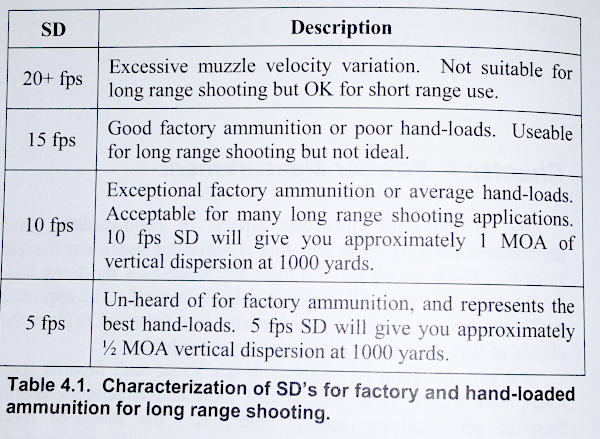
3. The ammo’s Standard Deviation (SD) is unknown. You will often notice that while MV is often listed on ammo packages, Standard Deviation (normally) is not. It is not uncommon for factory ammunition to have an SD of 18 or higher. Sometimes as high as 40+. As such is the nature of metering powder. With marketing in mind, did they pick the high, low, or average end of the SD? We really don’t know. You won’t either until you test it for yourself. For hand-loaded ammo, to be considered around 10 fps or less. Having a high SD is often the nature of metered powder and factory loads. The image below is from Modern Advancements in Long Range Shooting: Volume II.
4. You don’t know how MV was measured. What chronograph system did the manufacturer use, and how did they back track to a muzzle velocity? A chronograph does not measure true velocity at the muzzle; it simply measures velocity at the location it is sitting. So you need to back-calculate the distance from the chrono to the end of the barrel. This calculation requires a semi-accurate BC. So whose BC was used to back track to the muzzle or did the manufacturer even do that? Did they simply print the numbers displayed by the chronograph? What kind of chronograph setup did they use? We know from our Lab Testing that not all chronographs are created equal. Without knowing what chronograph was used, you have no idea the quality of the measurement. See: Applied Ballistics Chronograph Chapter Excerpt.
5. The MV data may not be current. Does the manufacturer update that data for every lot? Or is it the same data from years ago? Some manufacturers rarely if ever re-test and update information. Some update it every lot (ABM Ammo is actually tested every single lot for 1% consistency). Without knowing this information, you could be using data for years ago.
CONCLUSION: Never use the printed MV off a box of ammo as anything more than a starting point, there are too many factors to account for. You must always either test for the MV with a chronograph, or use carefully obtained, live fire data. When you are using a Ballistic Solver such as the AB Apps or Devices integrated with AB, you need to know the MV to an accuracy down to 5 fps. The more reliable the MV number, the better your ballistics solutions.
The U.S. Army Marksmanship Unit regularly publishes “how-to” articles on the USAMU Facebook page. A while back, the USAMU’s reloading gurus looked at the subject of case lubrication. Tasked with loading thousands of rounds of ammo for team members, the USAMU’s reloading staff has developed efficient procedures for lubricating large quantities of cases. This article reveals the USAMU’s clever “big-batch” lube methods. For other helpful hand-loading tips, visit the USAMU Facebook page.
Rapid, High-Volume Case Lubrication
Today’s topic covers methods for quickly applying spray lube to cartridge cases prior to sizing. A typical order for this shop may be 25,000 rounds, so [speeding up] the lubrication process can be a real time-saver. While your ammunition lots probably aren’t this large, the efficient methods discussed here may help save a considerable amount of time over your handloading career. Our case lubrication rates range from 1500-1600 cases per hour, to 2400-2500 cases per hour, depending on caliber.
This shop uses virgin brass, whereas most home handloaders use fired brass, which necessitates some small changes at times. These will be discussed as they arise. Begin with fired brass that has been tumbled clean.
Ensure as much tumbling media as possible is removed from the brass, as when it gets into a size die, it can dent cases significantly. This is a good time to round out dents in the case mouths using a tapered tool to prevent damage from the decapping stem.
First, dump the clean cases into a large box or reloading bin. Shake the bin back and forth so that many cases are oriented with the mouths up. Next, pick up as many cases as is convenient with the mouths “up”, from natural clusters of correctly-oriented cases. With 7.62mm-size cases, this is usually 3-4, and with 5.56mm cases, this can be up to 8-10. Place the cases into the rack slots, mouth-up. Doing this in groups rather than singly saves considerable time. Once these clusters have been depleted, it will be time to re-shake the bin to orient more cases “up.”.
This photo shows a case lubrication rack made by a USAMU staffer.
Naturally, adjust the spacing to best fit the calibers you reload. We have found this size … convenient for handling through the various phases of case lubrication/transfer to progressive case feeders for processing. Note that the 1/2-inch angle does not cover much of the critical case area at the base, just forward of the extractor groove, where most re-sizing force will be exerted. As the USAMU uses virgin brass, less lubrication is required for our brass than would be needed for Full Length (FL) sizing of previously-fired brass.
NOTE: The amount applied using our rack is easily enough for our purpose. If using fired brass, be sure to adequately lube this base area to avoid having cases stick in the full-length sizing die.
Using a spray lube, coat the cases adequately, but not excessively, from all sides. Be sure to get some lube into the case mouths/necks, in order to reduce expander ball drag and case stretching/headspace changes. The spray lube this shop uses does not harm primers or powder, and does not require tumbling to remove after lubing.*
Take a close look at the photo above. The USAMU shop uses a common kitchen turntable, which allows the rack to be rotated easily. We place this in a custom-made box which prevents over-spray on to floors and walls.
Angled Box Method for Smaller Cases to be Neck-Sized
A refinement of the above method which especially speeds processing of 5.56x45mm cases is as follows. A small cardboard box which holds about 100 cases is fitted with an angled “floor” secured by tape. With the smaller 5.56mm cases, usually about 8-10 cases per handful can be picked up, already correctly-oriented, and placed into the box together. This prevents having to place them into the rack slots, saving time.
HOWEVER, note that this does not allow nearly as much lube access to the case bodies as does the rack. For our purposes — neck-sizing and setting neck tension on new brass, this works well. If using this procedure with fired brass, take steps to ensure adequate lube to prevent stuck cases.
As always, we hope this will help our fellow handloaders. Good luck, and good shooting!
*A two-part test performed here involved spraying primed cases heavily, while getting more lube into the case mouth/body than even a careless handloader would likely apply. The second part of the test involved literally spraying considerable quantities of the lube directly into the cases, drenching the primers. After a several-day wait to allow the lube to penetrate the primers, they were then fired in a test barrel. All fired normally; no unusual reports were noted. This bolstered confidence that normal amounts of the lube would not adversely affect our ammunition, and we have been pleased with the results over several years.
Applied Ballistics has just launched a great, new online resource for shooters: The Science of Accuracy Academy. This subscription-based website is launching with nearly 30 podcast episodes, with many more planned, as well as video content, Zoom classes, and much more.
The main goal of this new online resource is to adapt and modernize the delivery of content coming from Applied Ballistics LLC. In past years, books, DVDs, and seminars were the primary avenues for delivering information. Modern technology has evolved, and the delivery of information can be done in more efficient ways such as streaming videos, podcast discussions of book and seminar content. In addition to being a more modern delivery platform, The Science of Accuracy Academy allows for more frequent updates than traditional books and DVDs.
Bryan Litz, owner of Applied Ballistics LLC tells us: “I’m very excited about this avenue to share what we’re learning in the Applied Ballistics lab. I think many shooters will benefit from the podcasts, which contain very insightful discussions and can be enjoyed in your car, or as you work. We look forward to publishing more of our research thru the Science of Accuracy Academy”.
About the Science of Accuracy Academy Content and Programs
Below, Bryan Litz comments about the Academy’s new podcast offerings and other interactive content. Bryan notes: “We’ve benefited a great deal from practicing the scientific method, and we want to share what we’ve learned.”
Book Content via Podcasts — Many of the podcast episodes are specific reviews of Applied Ballistics book chapters. I’ll sit with Mitch or Francis (both experienced, champion shooters) and discuss the chapter, what it was like to do the tests. We will also discuss behind the scenes problems, as well as what we’ve learned since publishing the books. This lets subscribers get knowledge from the books. And, as a podcast, you can listen while driving, working out, or whatever.
The World of Doppler Radar — In recent years we have spent considerable time visiting shooting matches with the AB Mobile Lab and running Doppler radar. Between that and some of the government contracting work, we’ve built up a lot of experiences and it’s been a long time since a book was published. This Academy is a great outlet for us to update the shooting world on what we’ve been doing and learning.
Ballistics Science and Precision Loading — We’ve been doing hardcore ballistic science for the past few years and have a lot to share. We’ve come to see some aspects of handloading and shooting in a fundamentally different way. For example, understanding the statistical nature of precision has caused us to re-shape how we make decisions in the handloading process. As a result, we now better understand cause-effect relationships and can make deliberate, reliable progress as a result.
Bryan Litz Announces the New Science of Accuracy Academy
The Lighter Side — Bryan told AccurateShooter.com: “Some of the podcast episodes are much less serious! We have fun arguing about which shooting disciplines are harder. For example, Mitch Fitzpatrick and I talk with Francis Colon and Chad Heckler about PRS vs. ELR shooting. We discuss what we like and dislike about the different sports, what we would like to see changed, and what competition shooting has meant for us as individuals. This open-ended format explores long range shooting from the technical to the personal and everything in-between.”
At the request of our readers, we provide select “Deals of the Week”. Every Sunday afternoon or Monday morning we offer our Best Bargain selections. Here are some of the best deals on firearms, hardware, reloading components, optics, and shooting accessories. Be aware that sale prices are subject to change, and once clearance inventory is sold, it’s gone for good. You snooze you lose.
Today is Tax Day 2022
Today, April 18, 2022, is the deadline for individuals to file Federal and (most) state tax returns. April 15 is the typical deadline, but the the 2022 IRS deadline was moved to April 18, due to the Emancipation Day Holiday observed in DC. If you are anticipating getting a tax refund, here are some great deals to make the most out of that IRS refund check.
⏺ Very good value for a quality press with all needed tools
This Hornady reloading kit is quite a bargain at $359.99. The Hornady Lock-N-Load Classic Kit includes all this hardware: L-N-L Classic Single-Stage Press, L-N-L Powder Measure, Digital Scale, Powder Trickler, Powder Funnel, 3 Die Bushings, Hand Priming Tool, Chamfer & Deburr Tool, Reloading Handbook, Positive Priming System with primer catcher, Universal Reloading Block, and Aerosol One Shot® Case Lube. Considering you can easily pay $240+ for a good single-stage press by itself, this very complete Classic Kit is a great value. The regular price is $445.99.
⏺ Complete, well-equipped tactical 12ga pump shotgun for under $180!
A pump 12ga with iron sights is a great choice for a home defense weapon. And here is one of the best shotgun deals we’ve found. No that $179.99 price is not a mis-print. This GFORCE Arms GF3T features 19.5″ barrel with 3″ chamber. There is a nice fiber optic front sight and large ghost ring rear sight. Overall weight is 7 pounds. The stock is impact-resistant synthetic stock with pistol grip. There is a rail on top of the action for mounting optics, plus a short rail on the underside of the fore-end to mount lights and/or lasers. The same shotgun sells for $379.99 elsewhere and it has earned great reviews on Guns.com from verified buyers (who paid $323.99): “Great home defense shotgun for the price!”
3. EuroOptic — Nikon Spring Sale on Spotting Scopes and Binocs
⏺ Save hundreds on high-quality spotting scopes and binoculars
Nikon is a legendary brand in optics. Nikon’s premium spotting scopes rival elite European brands costing 50-70% more. Right now you can save big on Nikon spotters and binoculars with the Nikon Spring Sale running April 11, 2022 through May 8th, 2022. Check out the Monarch 20-60x82mm ED, a great spotter with outstanding glass and sharpness. Save $200 with EuroOptic’s $1399.95 sale price. You’ll have to pay a LOT more to get a better 80mm-class spotting scope.
Shooting steel is fun — you get instant gratification from hearing the “clang” and seeing the gong swing. Shooting steel is also good practice for PRS/NRL events and ground-hog matches. Right now, you can get some great deals on quality AR500 steel targets. These Dragon Target Gongs start at just $16.99 for a 4″-diameter, 3/8″-thick gong. Larger 6″, 8″, 10″, and 12″ gongs are offered in 3/8″ and 1/2″ thicknesses, and a 3-pack of 8″ gongs is available. A 6″-diameter gong is $25.99 (3/8″ thick) or $32.99 (1/2″ thick). The largest 12″-diameter gong in the heavy 1/2″ thickness is $76.99. NOTE: All these Dragon gongs have a center hole allowing more hanging options.
⏺ Save $100 on good rangefinder for hunting with effective stabilization
This Monarch 3000 Stabilized laser rangefinder, now $319.97 on sale ($100 off), is a great value in a big-name laser rangefinder. This unit can range faster than typical LRFs because the Monarch 3000 instantly stabilizes the image you see in the 6X monocular. This makes one-handed ranging much easier — vibrations in the viewfinder caused by wind or hand movements are dramatically reduced. Nikon says vibrations of the image in the viewfinder caused by hand movement (sinusoidal waves) are reduced to one-fifth or less. This Monarch 3000 also has Incline Correction, providing the true horizontal distance to the target. The Monarch 3000 Stabilized LRF is also fully waterproof and fogproof, important for hunters.
6. Midsouth — Rimfire Ammo Sale, as low as $4.59 50/rd
⏺ Highly-rated units with impressive range and 50 channel
Walkie-Talkies are “must-have” items for long-range hunting and ELR shooting. They are also great for communicating with a buddy who is down-range setting or recovering targets. The 50-CH Midland GXT1000VP4 Two-Way Radio set is Amazon’s #1 Best Seller among FRS/GMRS Handheld Radios. Priced at $69.99, this Midland two-unit kit includes earbuds plus both 12V and 120V chargers. This Midland set features 50 Channels with impressive range plus “whisper mode”, so they’re good for hunting. These units include Vibrate Alert and VOX for hands-free operation. These units even offer NOAA Weather Scan capability.
8. MidwayUSA — Caldwell NRR 23 dB Youth Earmuffs, $12.74
⏺ Very good price on earmuffs sized to fit youngsters and teens
It’s vital to protect the hearing of young persons whenever they go to a shooting range or are exposed to loud noises. But the full-sized earmuffs designed for adults may not fit younger heads and ears so well, reducing muff effectiveness. These NRR 23-rated Caldwell Youth Earmuffs are designed to properly fit younger persons. Right now these NRR 23 muffs are just $12.74 in a choice of three bright colors: Hot Coral Orange (shown), Neo Blue, and Neon Green.
9. Amazon — 12″ x 12″ Splatter Grid Targets, 10 for $10.99
This 12″x12″ Splatterburst Target combines splatter shot marking with a grid background, with five aiming points. The bright neon shot circles make it easy to see your shots. And the handy grid lets you quickly estimate your group size. Get a 10-pack for $10.99, or a 25-pack for $19.99 (better deal). This particular target has earned rave reviews — 87% of verified buyers gave this a FIVE-Star rating.
⏺ Very positive user reviews, good selection of diameters
While bore cleaning should be done with a good cleaning rod and fitted bore guide, there are times when Bore-Snakes can be handy, such as when cleaning pistols, ARs, and 10/22s. Now on Amazon you can get two (2) Gogoku Bore-Snakes for just $9.99. You can get a twin-pack for .223 (5.56) rifles, a combo for .223 and .308 caliber rifles, or a pair with big and small diameters for .223 rifle plus 12ga shotguns. There are also single Huntsen Bore-Snakes for $5.99 in a wide variety of calibers and shotgun bore sizes.