The 300 Meter .22 PPC — Smaller Caliber for Less Recoil
By GS Arizona
[This article originally appeared in Precision Shooting Magazine many years ago, but we are reprising it because the .22 PPC remains a notable cartridge for many disciplines, from benchrest to silhouette.]
I’ve spent the past few years pursuing the largely solitary pastime of 300 Meter shooting in the US. While it is a hugely popular sport in Europe, with thousands of competitors in each of various countries and overflowing national championships, in the U.S., 300 Meter shooting is simply a forgotten discipline. As an example, consider that the entry at the USA Shooting 300 Meter National Championships held at Fort Benning did not reach 20 competitors in [years past]. For those not familiar with the discipline, the 300 Meter ISSF target has a 100 mm ten ring, 200 mm 9 ring and so forth. That’s a 3.9″ ten ring at 328 yards for those of you who may object to the metric system, electricity and other intrusions upon a well settled universe (which ends at the dragons). [Editor’s Note: GS Arizona was a championship-class prone shooter, in both rimfire and centerfire disciplines, who had a popular online Blog, which has been closed.]
300 Meter Basics
300 Meter matches can be either three-position (prone, standing, kneeling) or all prone. Being of that age at which limbs aren’t limber and the mid-section obscures one’s view of the toes, I shoot prone matches only and leave the 3P to those for whom the term “shooting athlete” doesn’t produce an automatic smirk from the better half.
Like most 300 Meter shooters, I shoot a 6BR as my main rifle. As used in 300 Meter shooting, the 6BR is loaded with a 105-108gr bullet, with a velocity in the 2850 fps range. There is simply no cartridge out there at this time that delivers the accuracy, low recoil and ease of loading that can be had from the 6BR. That doesn’t mean we shouldn’t embark on a quixotic adventure now and then to find something better. This article is about one such search. So, if you don’t mind spending some time learning about an uphill struggle in a forgotten corner of the shooting world, pour a hot cup of coffee, get a plate of chocolate chip cookies and read on.
Getting Started–The Concept Behind the Project
The premise for building a .22 PPC was simple — less is more. Less recoil, that is, while retaining good ballistics and accuracy, should allow for higher scores. The hard part is meeting the ballistic and accuracy standards set by the 6BR. If pressed I might also admit to a desire to do something different. I made a decision early on in the project to stick to 80-grain bullets. I believe the 80 is pushing the envelope for safe and sane pressure in a case the size of the PPC; additionally, there are a number of manufacturers of 80-grain .224″ bullets so selection and testing can be more meaningful. Barrels are another consideration and all of the better barrel makers offer a 1:8″ twist .224 barrel (unlike the limited selection of 1:6.5″ twist required for 90 grain .224″ bullets).
With the basic parameters of a full-length .22 PPC case (reformed Lapua .220 Russian to be exact) and an 80-grain bullet established, a few other details needed attention. The first of these was specifying certain dimensions for the reamer maker. I chose not to change any of the essential dimensions of the .22 PPC such as headspace, shoulder angle or body taper, but there were a couple of areas that I felt needed to be different from the typical Benchrest PPC. These were neck diameter and throat length. With the outstanding quality of the Lapua brass, I elected to go with a 0.255″ neck diameter which would allow the use of unturned brass and still leave 0.002″ clearance around the neck of a loaded cartridge. The throat was specified longer than a standard PPC to allow for the length of the 80-grain bullets and avoid having the bullet go past the neck/shoulder junction.
300 Meter .22 PPC — Equipment List Hardware
Action: RPA Quadlite, RPADefense.com.
Stock: Master Class Highpower Prone MasterClassStocks.com
Barrel: Broughton .224″ bore, 1:8″ twist, 30″ Palma contour
Rear Sight: Warner #1, Anschutz Iris, Warner-Tool.com
Front Sight: Gehmann Iris from Scott Riles
Trigger: Jewell 4 oz. one-stage
Bolt Knob: Keychain from 7-11 ($2.00)
Detours Along the Way
Like Quixote stumbling his way to his dreams, I’ve made a few mistakes. That 0.255″ neck diameter turned out to be the first. Turning brass isn’t a problem, but I was so captivated by the quality of the .220 Russian brass that I planned to skip turning or just take a light (0.001″) clean-up cut. Well, that’s fine, but as it turns out, PPC die makers assume you have turned necks and using unturned brass causes problems. The Redding Competition Seater, for instance, wanted to crimp the entire length of the neck onto the bullet. Turns out it was 0.250″ in the neck diameter of the sliding sleeve. This required reaming the sleeve which wasn’t too hard as the sleeve is made of relatively soft steel. Hand turning the chambering reamer with lots of care and oil took care of that problem. This opened up the neck to 0.255″ which might be 0.001″ more than ideal but I’ll live with it.
Sizing dies were another problem altogether. Forget using a non-bushing die with unturned brass–you’ll just overwork the neck to death. The Redding bushing dies worked well, though. Fired brass ends up at 0.254″ and is sized to 0.250″ in two steps (0.252″ and 0.250″) to maintain better concentricity.
I also got the throat length wrong as the base of the bullet (above the boat tail) is halfway up the neck and I want it just above the shoulder. I don’t know how I missed on that spec, but that’s what happened. As it turns out, the extra throat length hasn’t caused any problems with the Nosler 80, but it might with shorter or pointier bullets. Powder and primer choices became additional areas for demonstrating my inability to make good choices. You might think that adding a heavier bullet to an existing cartridge would be simple but it really turned into a full scale adventure.
Choice of Components and Smiths — Only the Best
Based on my previous favorable experience and that of a few friends, I ordered a Broughton barrel for the PPC, a .224″ bore 1:8″ twist, long enough to finish at 30 inches in what is generally referred to as a medium Palma taper. I haven’t been disappointed by the barrel: like all of those made by Tim North of Broughton Barrels, it is top notch. With the barrel and reamer in hand, they and the RPA Quadlite action were sent to Al Warner for barreling and then on to Alex Sitman for the stock. I can’t say enough good things about Alan’s metal work and Alex’s stock work. They have barreled and stocked many rifles for me over the years, all flawless. Alex’s Highpower Prone stock fits me like a comfortable moccasin. The trigger is a Jewell set at 4 oz., the rear sight is a Warner #1 and the front sight is a Scott Riles with a Centra aperture.
Eventually, the UPS man — purveyor of all things worth having — arrived with a long package and the real work began. Load testing and shooting can be a lot more frustrating than planning and talking to gunsmiths, but hopefully the eventual results make it worthwhile. I had a good supply of Nosler 80-grain bullets and some preconceived notions about powder and primers. Off to the loading bench.
Load Development + Accuracy Testing Fire-forming the .220 Russian cases to the PPC chamber was a breeze: run an expander into the neck to get them to .224″, bump the shoulder 0.002″, load a caseful of IMR 4895 (about 23 grains) and insert a Nosler 77 (leftover from another project) and fire. I shot these at 100 yards while zeroing the rifle and was very impressed with the accuracy. Fouling was minimal, off to a promising start.
Once formed, I loaded the brass with Varget and the 80-grain bullets. Since Varget has given such good results in the 6BR, it was a natural starting point for this project. However, it quickly became evident that it might be too slow. While accuracy was excellent, powder fouling in the barrel was very heavy even at the highest charge tried (28.5 grains) and there was soot all the way down the shoulders of the cases. Cleaning the bore felt like patching a rusty water pipe after just 20 shots. I knew I’d never make it through a 60-shot match (about 70 shots with sighters) without cleaning[.]
Putting the .22 PPC to the Test in Competition
At this point, I took the PPC to a 300 Meter match with the Varget load. While it might not look perfect, I needed to try it. The first string was a 198 and I was able to clean the rifle immediately after firing. The second string was also a 198 but I had to fire the third string without cleaning. The effects of the fouling were evident in the last score, a 194.
While a 590 total isn’t bad for 300M, it was a bit below my average with the 6BR at this range – my home range that I knew well. More importantly, the score dropped as the group opened up in the third string when I wasn’t able to clean. At the Nationals all 60 shots are fired without a break for cleaning or additional sighters; therefore, Varget, while promising, wouldn’t work in the long run.
The next faster powder on my shelf was IMR 4895. I’d used it in the fire forming loads and if I had a lick of sense I would have tried it right away since the fire forming loads shot so well. However, stubbornly clinging to the preconceived notion that Varget was going to be a great powder for this combo cost me a month or so fooling with it. I then worked up loads with 4895 from 26.8 to 28.6 and saw that while 4895 was better suited to the case than Varget, it was still slow. The powder fouling was still occurring, though to a lesser degree. The shoulders still showed some soot, but less. I settled on 27.8 grains as a useful load and loaded 70 cases.
New Load for a New Home
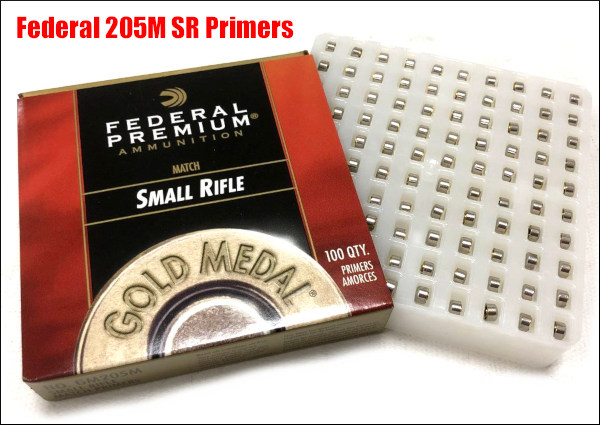
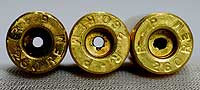
At this point, I moved from Florida to Arizona causing a delay of several months in testing. The move also had an effect on the load as the hotter and drier climate in Arizona turned out to be much more suitable for 4895. Of course, I still had those 70 rounds loaded with 27.8 so I shot them in practice. Everything seemed OK but one primer (Federal 205M) pierced at the edge. I didn’t pay much attention to that as there were no other pressure signs and it was the first primer failure of any sort so far in this project. Extraction was fine, primer edges were nicely radiused and base growth was under two tenths. There was an opportunity to shoot a 500-yard prone match the following day so I reloaded the cases with the same load. At the match I pierced two more primers, this time right at the edge of the firing pin, causing two craters running into the firing pin hole. As you might imagine, all subsequent shots cratered into that area, although no more pierced.
I was contemplating a switch to Hodgdon Benchmark (slightly faster than H4895) until this point. Now, repairing the bolt face and switching to a tougher primer took priority. I loaded 25 rounds with CCI BR4 primers and 25 with Remington 7.5 primers. Both of these are well known for their tougher cups which I hoped would eliminate the piercing. I like the mild flash from the Federal 205 and believe it contributes to good accuracy, but I needed a primer that holds together more than I need to cut another tenth MOA. Bearing in mind that the powder charge itself might need reworking, I took those 50 rounds to the range to test them with the 27.8 gr. IMR 4895 load as it remains best to only change one thing at a time. Temperatures were in the 100 to 110 degree range during testing as they are for a good portion of the year here in Phoenix. If the load won’t work in hot temperatures, it just won’t work at all for me.
The primer testing at 200 yards showed the CCI BR4 primers to be better suited to this load than the Remington 7.5 primers. While no primer failed out of the 50 fired, the CCI BR4 primers gave distinctly better accuracy. I fired two ten-shot groups prone (scoped) with each, the Remington-primed groups averaged just over 1 MOA and the CCI-primed groups averaged 1/2 MOA. The difference between the two was principally in the amount of elevation in the groups. Given that result, as well as previous good experience with the CCI primers in the 6BR, I settled on the CCI BR4 primers for the PPC.
Final Testing at 500 Yards–It all Comes Together
While the purpose of the 80-grain PPC is 300 Meter shooting, those matches are somewhat hard to find so I’ve done most of my testing at 200 yards on the local public range (Ben Avery Shooting Facility in Phoenix) and at 500 yards in some of the local prone matches. With the primer issue potentially resolved, I went back to the 500-yard range to make sure the load held good elevation at that distance.
Final testing at 500 yards was a complete success. I fired one group of 24 shots from the prone position. Elevation for the bulk of the group was right at 3″ (0.6 MOA), the horizontal spread was somewhat larger as the group was fired in gusty, fast-switching conditions. The CCI BR4 primers functioned flawlessly, with no sign of pressure despite ambient temperatures over 100° F. None of this should be taken as a general statement of inadequacy of Federal primers. I have used (and continue to use) the very same lot of Federal 205M primers in my 6BR and have not experienced any problems at all. Simply stated, the 80-grain .22 PPC is an odd duck and has special requirements when fired under the conditions that prevail in my area.
At this point, I’ve determined that the basic premise of a .22 PPC for 300 Meter matches is perfectly viable, even if it is quite a bit more complex an undertaking than the 6BR. Recoil reduction over the 6BR was minimal, bordering on unnoticeable, but accuracy is on a par with the 6BR, perhaps slightly better. As a nice bonus, the PPC has proven to be quite useful for the 500-yard prone matches that are a regular part of the Phoenix shooting scene and it never fails to spark a good conversation with a new friend when I’m practicing or testing at the range. Future plans include testing Berger and Hornady 75 and 80-grain bullets and Hodgdon Benchmark powder. And, after conferring with your moderator, who ran some simulations in QuickLOAD, I’ll be trying Reloder 15 soon (QuickLOAD predicts RL15 allows 100% load density with good velocity). At some point I’ll also have the reamer reground for a shorter throat and tighter neck, but probably not until time comes to rebarrel.
6mmBR Norma versus .22 PPC
For the shooter who wants a superbly accurate, easy to load cartridge for 300 Meters to 600 yards, you simply can’t beat the 6BR. Everything you need, including brass, dies, reamers and knowledge are just a phone call away. The .22 PPC, by contrast, is an uphill struggle. The chambering reamer was custom ground to my specifications to allow unturned brass, as well as a longer freebore for the 75- and 80-grain bullets that are the heart of the project. The no-turn necks also meant that the Redding Competition Seater (an excellent unit) had to be reworked to allow for the thicker neck diameter. Once those hurdles were overcome I struggled to find the best powder for this combination–and I’m still searching. Unlike the 6BR where any of a half dozen or more powders will do the job (Varget, Reloder 15, N140, N540, IMR 4895, Norma 203B, etc.) the .22 PPC with heavy bullets has proven finicky with even the most accurate powders leaving fairly heavy carbon fouling.
Despite the problems, the .22 PPC offers a bit more pure accuracy than the 6BR and also a tiny bit less recoil. Both of these things can contribute to slightly higher scores in prone matches. However, to get the most out of the PPC, one must find the time to clean between 20 shot strings–a not inconsiderable effort sometimes in the mad rush of pit changes, scoring, shooting and just plain being tired.
This rifle was initially a .223 and when that cartridge proved unsatisfactory for my purposes, I had it rebuilt as the .22 PPC you see here. I like it and I enjoy the challenge, but I would not recommend this combination as someone’s primary rifle; it can get a bit frustrating. To put it into another context, the 6BR is like a 350 Chevy, it’ll just keep on doing the job forever, no matter what. The .22 PPC is like a Ferrari, it’ll scream when you do everything right, but it takes more attention to detail and a lot more maintenance. You wouldn’t want a Ferrari as your only car and likewise, you would be better off making the .22 PPC a second rifle.
Parting Shots — The .22 PPC vs. 6mm BR
If you’re looking for a simple, accurate and reliable cartridge for 200 to 600 yards, you probably can’t improve on the 6BR. However, if you’re someone who finds the journey as rewarding as reaching the destination, then you may very well enjoy a .22 PPC for prone shooting. While I received a great deal of help in this project from friends, gunsmiths, suppliers and parts makers far and wide, I really must acknowledge the huge debt we all owe to Ferris Pindell and Dr. Lou Palmisano. Without them there would be no PPC. We truly stand on the shoulders of giants.
Tipton Cleaning Rod Racks on Sale
Looking to better organize your reloading room (aka “man cave”)? Here’s a handy, affordable product that will help you organize gear in your reloading room or “man cave”. Tipton’s Cleaning Rod Rack (Tipton #100335) can accommodate up to six rods with various size handles. The wall-mounted Rod Rack also has horizontal studs on either end for additional accessories. These are useful for hanging the Tico Tool shotgun cleaning wands that stow in a tube with a plastic hook on the top.
Tipton Cleaning Rod Racks come complete with mounting screws (and screw slots are molded-in). You can find Tipton Cleaning Rod racks for under $7.00 right now. They are $6.95 at MidwayUSA. And Amazon currently offers the racks for $6.95 with free shipping for Amazon Prime Members.
A while back, we featured a portable reloading bench built on a Black & Decker Workmate. That proved a VERY popular do-it-yourself project so we’re showing it again, in case you missed it the first time.
Texan Robert Lewis made himself a great portable reloading bench from plywood mounted to a Black & Decker Workmate. The bench, roughly 22″ x 19″ on top, folds up to fit easily in your car’s trunk or behind the seats in a pick-up truck cab. Four recessed bolts hold the wood top section to the collapsible B&D Workmate. The sides and back of the unit are attached to the base with small nails. There is a small shelf (also nailed in place) which can be used to clamp a powder measure or hold a scale. Shown in the photo is a Harrell’s Benchrest measure and Harrell’s single-stage “C” press.
The whole unit can be built for about $65.00 with pine, or $80.00 with oak (as shown). Robert explained: “The Workmate was $40. If someone bought a 2’x4′ sheet of 3/4″ oak plywood, I think it is around $30. Using pine plywood would be about half that. Fasteners were $3. Spar Urethane would be $5.”
Robert told us: “I used a couple ideas I found on the web. The Larry Willis website gave me the idea to use the Black and Decker Workmate as a base. I found the Workmate on sale for $40 and the top is made from oak plywood I had in my shop. I sealed the wood with three coats of Spar Urethane. The whole thing folds into a nice package for transportation to and from the range.”
NOTE: Since we first ran this story, the price of a Black & Decker Workmate WM225 has increased. However you can still pick a WM225 Workmate for under $75.00. Amazon is currently selling WM225 Workmates for $70.34. The next best price we found was $72.96 at Home Depot, still a good price (Lowe’s is charging $94.98).
Kulzer Sets Eight New IBS 1000-Yard IBS Benchrest Records with 6 BRA Rifle Report by Alex Wheeler
2021 was a banner year for 1000-yard Benchrest. Glenn Kulzer of Dillon, Montana had a season that will go down in history. Glenn set eight IBS records in 2021 at the Deep Creek range in Missoula, and then was named IBS 1K Shooter of the Year. What makes this so incredible is not just the number of records but the records themselves. Normally when a world record small group is shot that’s a singular event — never accompanied by Aggregate records set by the same shooter. Glenn’s IBS record small group wasn’t a one-time lucky string. Consider this — Glenn nailed that historic small group, but also recorded multiple IBS Aggregate records in 2021. And Glenn set these IBS Heavy Gun records actually using his 6 BRA (6mmBR Ackley) Light Gun! Mighty impressive.
1000-yard Benchrest Aggregate records represent a series of targets shot over the course of multiple matches during a season. That really takes any luck out of the equation. You have to keep the rifle shooting at its peak all year long. It’s the ultimate test of accuracy. But the small groups do get the most notice and Glenn also broke the small group record with a remarkable 2.6853″ 10-shot group (photo below).
Eight IBS Records Set by Glenn Kulzer in 2021
Date: 06/13/2021
Class: Heavy Gun
Record: 10-Shot Group, 2.6853″
Date: 06/13/2021
Class: Heavy Gun
Record: 10-Shot Score 100/2.6853″
Date: 2021
Class: Heavy Gun
Record: 6-Match Group Aggregate, 4.349″
Date: 2021
Class: Heavy Gun
Record: 6-Match Score Aggregate, 99.167/4.679″
Date: 2021
Class: Heavy Gun
Record: 12-Target Group Aggregate, 4.529″
Date: 2021
Class: Heavy Gun
Record: 12-Target Score Aggregate, 98.583/5.058″
Date: 2021
Class: Heavy Gun
Record: 20-Target Score Aggregate, 95.2/6.422″
Date: 2021
Class: Light Gun
Record: 20-Target Group Aggregate, 5.202″
This IBS record 1000-yard group, and Glenn’s other IBS records, were shot with Roy Hunter’s 103gr “A” bullet, Hodgdon H4895 powder, CCI BR4 primers, and Alpha Munitions 6 BRA brass. However, Glenn does use Lapua brass for some other 6 BRA rifles.
Glenn’s record-setting rifle is a Light Gun with a common setup used in long range Benchrest. The rig features a Borden BRM drop-port action with a Bix’n Andy trigger. The action is glued and screwed into a industrial wood laminate Deep Creek Tracker stock, a predecessor of the McMillan LRB. The Krieger barrel is a 4-groove, 1:8″-twist Heavy Varmint contour chambered for the 6 BRA (6mmBR Ackley) cartridge. All of Glenn’s rifles are topped with Vortex Golden Eagle scopes. Glenn notes that his Vortex Golden Eagles have show excellent point-of-aim stability when tested with a scope checker. The front rest was a Sinclair competition with Edgewood front bag, Field & Cave outfitters front rest plate, and speed screw. For rear support Glenn uses an Edgewood LRB rear bag.
Loading Procedures for Record-Setting 1000-Yard Shooting
Glenn’s loading process is pretty simple. He full-length sizes every time, bumping the shoulders back about .003″. Powder is weighed to the kernel, and bullets are seated with a Wilson seater. NOTE: Glenn does does not anneal his brass. He sorts primers by weight but does not otherwise measure them by dimensions. He seats the primers by feel using a relatively inexpensive primer seating tool — nothing fancy.
Glenn worked up a trim-and-point recipe for this lot of bullets based on group size. Load development is all performed at 1000 yards using the group ladder method. Glenn’s record load ended up being 30.3 grains of H4985 powder with the 103gr bullet seated very far into the rifling with .005″ of neck tension. This gave a velocity of 3030 fps in the 28″ Krieger.
Glenn shot Alpha Munitions 6 BRA brass all year with the .080″ flash hole. This year he shot Roy Hunter’s 103gr “A” bullet set quite deep into the rifling. NOTE: This deep jam has proven to be very stable IF you barrel likes it. Glenn used CCI BR4 primers and Hodgdon H4895 with .005″ of neck tension. His load delivered 3030 fps out of a 28″ barrel. NOTE: This is a “HIGH NODE” that may not be possible in an average barrel with different brass. Many 6 BRA shooters are reaching a 3000+ fps node, but you should always start low and work up. Some 6 BRA barrels will max out at 2950 FPS with 103-108gr bullets.
Glenn Interview Part I — All About the Rifle that Set Eight 1000-yard Records
Glenn Interview Part II — Load Development Process and Loading Methods
Glenn Interview Part III — Barrel Cleaning Discussion
Glenn Kulzer also shot his impressive 6 BRA at the 2021 IBS Nationals at Deep Creek (shown above). This Deep Creek range photo is by Forum member Dave Way.
Setting Records in June 2021 Report by Alex Wheeler
It was a typical match for June, nothing unique about it. Saturday was actually looking to be a really great day. Overall it was good but not great. Sunday had a clear blue sky with bright sun. I looked through a couple of scopes before the match and it was milky. I probably would have shot that relay at 30-35 power. But somehow Glenn Kulzer was able to pull off the best heavy gun group ever shot in 1000-yard IBS competition. With that group Glenn also broke the 6-match Group Aggregate record. The group was no fluke, this rifle also shot great in previous matches with small groups at 1000. To my knowledge this may be the only time a small group record AND an Aggregate record were broken in the same season by the same gun. The ultimate achievement.
On June 13, 2021, Glenn shot a 2.6583″ 10-shot group, all shots in the 10 Ring for a 100 score. This now stands as the current IBS Heavy Gun 1000-Yard 10-shot group record AND score record. It is also part of new Aggregate Records listed above.
About Glenn Kulzer — Rising Star in the Long-Range Benchrest Game by Alex Wheeler
Kulzer is a pharmacist in Dillon, Montana. The attention to detail required for his job crosses over to Long-Range Benchrest. He started off a very competitive shooter right from the start. I have said it many times, but benchrest is not an elitist sport. Hard work and dedication will always rise to the top. Glenn took the sport seriously from the beginning. Accordingly, he displayed a rapid learning curve and quickly surpassed some of his mentors in match results. Glenn tunes mostly at 1000 yards using the Deep Creek variation of ladder testing. He will also load and tune at the range to try and nail the best tune for the conditions. Again, it all about the work done by competitors. But Glenn’s success shows that a bright, hard-working shooter can rise to the top of the game in just a few seasons.
Do you know how gun primers are made — how the explosive elements are applied into those tiny cups? Find out by watching this video filmed at a Federal ammunition factory. It starts out with empty primer cups loaded, 1000 at a time, into trays using vibration (0:05 time-mark). While much of the process is automated, there is still a significant role played by production workers who apply a green, paste-like charging compound to the inside of hundreds of primer cups.
At the 0:17-second time-mark you can see the factory worker “charging” the primers with the priming compound. After the cups are filled, then the plate of cups “mates up with a plate of anvils” (0:40 time-mark). Then the primers are unloaded from trays and inspected.
Primer “Mysteries and Misconceptions” Article
There is an excellent article about primers on the Shooting Times website. This authoritative Shooting Times article explains the fine points of primer design and construction. The author reveals some little-known facts about primers and corrects common misconceptions. Here are some highlights:
Size Matters
Useful Trivia — even though Small Rifle and Small Pistol primer pockets share the same depth specification, Large Rifle and Large Pistol primers do not. The standard pocket for a Large Pistol primer is somewhat shallower than its Large Rifle counterpart, specifically, 0.008 to 0.009 inch less.
Magnum Primers
There are two ways to make a Magnum primer — either use more of the standard chemical mix to provide a longer-burning flame or change the mix to one with more aggressive burn characteristics. Prior to 1989, CCI used the first option in Magnum Rifle primers. After that, we switched to a mix optimized for spherical propellants that produced a 24% increase in flame temperature and a 16% boost in gas volume.
Foiled Again
Most component primers have a little disk of paper between the anvil and the priming mix. It is called “foil paper” not because it’s made of foil but because it replaces the true metal foil used to seal early percussion caps. The reason this little disk exists is strictly a manufacturing convenience. Wet primer pellets are smaller than the inside diameter of the cup when inserted and must be compacted to achieve their proper diameter and height. Without the foil paper, the wet mix would stick to the compaction pins and jam up the assembly process.
Capstone is a respected company that represents world-class ammunition, powder, and component manufacturers Berger, Lapua, Vihtavuori, and SK. At SHOT Show 2022, Capstone showcased new products from all these brands. Here are summaries of new products from Lapua and SK. We will follow with new Berger offerings next week.
New Lapua Centerfire Match Ammunition for 2022
Lapua produces some of the finest, most accurate factory-loaded centerfire ammunition in the world. We have shot Lapua 90gr 6mmBR ammo that produced verified groups well under quarter-MOA. For 2022, Lapua has added three new match loads that promise great consistency and accuracy. For 2022, Lapua has added 6.5 Creedmoor 136 Grain Scenar-L, .260 Remington 136 Grain Scenar-L, and .300 Winchester Magnum 185 Grain Scenar OTM, to Lapua’s highly successful Scenar Match Target ammunition line.
New Lapua Cartridge Brass — 6.5 PRC, .284 Win, .300 PRC, .300 Win Mag
Lapua cartridge brass sets the standard by which quality brass is measured. You will see Lapua brass used by top competitors for all accuracy-oriented disciplines: Benchrest for Score, Benchrest for Group, 1000-Yard Benchrest, F-Class (Open and F-TR), Palma, Service Rifle, Silhouette. And Lapua brass is also favored by varmint hunters who load their own ammo. In 2021 and 2022 Lapua has rolled out new types of top-grade cartrige barss. New offerings available now for 6.5 PRC, .284 Winchester, .300 PRC, and .300 Winchester Magnum. All are available and shipping now.
SK High-Velocity Match Rimfire Ammunitions
SK now offers an extremely accurate, High-Velocity round. For 2022 SK will offer High-Velocity Match .22 LR ammunition. This new SK ammo pushes a 40gr round-nose projectile at a very fast 1,263 FPS muzzle velocity. This high-velocity SK ammunition should work well for PRS/NRL22 matches and long-range rimfire events, some of which have targets out to 300 meters. The new SK High-Velocity Match ammo employs a proprietary clean-burning and high-energy propellant for reliable function in all platforms — shot after shot.
Coming Soon — New Berger Ammo and Bullets for 2022
Berger, another Capstone company, is offering new bullets and loaded ammunition for 2022. The new Berger offerings include Elite Hunter loaded ammunition for the 6.5 PRC and .300 PRC, plus new Berger .30 Caliber 245 Grain Long Range Hybrid Target (LRHT) Bullets. We’ll have a feature on these Berger products soon.
At the request of our readers, we provide select “Deals of the Week”. Every Sunday afternoon or Monday morning we offer our Best Bargain selections. Here are some of the best deals on firearms, hardware, reloading components, optics, and shooting accessories. Be aware that sale prices are subject to change, and once clearance inventory is sold, it’s gone for good. You snooze you lose.
1. Graf’s — Peterson Brass and Loaded Ammo
⏺ New loaded ammo offering and excellent cartridge brass
Accurate loads start with high-quality brass. American-made Peterson Brass is VERY high-quality. It’s extremely uniform and long-lasting. Right now you can get a large selection of Peterson cartridge brass at Grafs.com. Peterson offers both popular as well as hard-to-find brass types. Along with the match-grade brass, Peterson now offers excellent loaded ammo for many cartridge types, including 6×47 Lapua, 6.5-284 Norma, and .308 Win.
2. Amazon — Frankford Universal Case Trimmer, $79.99
⏺ Smart system fits drills and trims nearly all popular rifle case types
Here is a good option for trimming cases, if you shoot many different cartridge types. Frankford Arsenal Universal Precision Case Trimmer handled most popular cartridges from .17 Rem all the way up to .460 Weatherby. Just choose the right collet then attached the unit to the end of your power drill for fast, easy trimming. The built-in depth micrometer allows for fast trim-length adjustments, and the brass-shaving ejection port ensures a clean trim. The universal collet system indexes on case shoulders for precise and consistent trimming. This trimming system works with just about any 1/2″ power drill.
3. Sportsman’s WHSE — Sig Sauer P365XL Package, $549.99
⏺ Most popular new SIG pistol with holster and 3 mags
SIG Sauer P365 pistols are a fine choice for a carry gun — they are slim, well-made, and accurate. And right now Sportsman’s Warehouse has a great SIG Sauer P365XL package on sale. The P365 series now ranks second among Gunbroker’s top-selling handguns of 2021. Given the proven reliability, small form factor, and class-leading accuracy, the SIG P365XL is very popular. With an attractive price, PLUS 3 magazines and a molded belt holster, this is a good pistol package deal.
4. Bullet Central — Micron Dies In Stock
⏺ Superb quality dies can produce match-grade ammo
If you’re in the market for a new sizing die and want a premium die with superb tolerances and excellent internal finish, consider Micron Precision Series Sizer Dies. These are some of the straightest, best-crafted dies you can find. Each die blank is caliber-specific in length. JGS resize reamers are used to chamber the dies which are hand-polished and inspected before surface treatment. These Micron Sizers boast sub-0.0002″ runout from OD to bushing pocket and die chamber. All dies come with a bushing retainer cap for full neck sizing.
5. Precision Reloading — Hornady Auto Charge Pro, $299.99
⏺ Save over $70 on advanced powder scale/dispenser
A good electronic scale/dispenser is a vital tool for precision handloading. Right now you can get the high-tech Hornady Auto Charge Pro at significant savings. The Auto Charge Pro is precise to within +/- 0.1 grain, and offers customizable trickle speeds and custom time settings. This machine has its display screen on top so the unit takes up less space on your loading bench. This is an excellent deal — the Auto Charge Pro sells for up to $380 elsewhere (e.g. $373.99 at MidwayUSA).
6. Natchez — Frankford Quick-N-Easy Case Tumbler Kit, $79.99
⏺ We’ve used this Combo Kit for many seasons — very good value right now
Keeping your brass clean is important (and essential if you anneal). If you’re looking for a new, affordable setup to clean cartridge brass, consider the Frankford Arsenal Quick-N-EZ Case Tumbler Master Kit. You get everything needed to dry-tumble your brass and remove the media. This is all available now for a very low $79.99. You could pay that much for a good vibratory tumbler alone, yet this combo kit includes tumbler, media separator, bucket, brass polish, and media.
7. Amazon — Real Avid Torque Wrench, $70.79
⏺ Essential tool for mounting scope rings, rails, and accessories
Every serious gun owner should have a good tool to properly set torque values for scope mounts and other accessories. Here’s a good product at an attractive price. The Real Avid torque wrench kit includes a torque wrench, 12 common bits/drivers, a force lever, and a hard case. The adjustable torque wrench adjusts from 10-70 inch-pounds with precise one-lb increments. The special “force assist driver” increases torque power when needed to tighten screws and fasteners.
8. Amazon — Tipton Action Cleaning Kit, $11.99
⏺ Get inside of actions clean with inexpensive kit
Everyone knows to clean your barrel but do you know that cleaning your action and lug recesses is equally important? Pick up the Tipton Action Cleaning Kit and you’ll be able to get into every nook and cranny of your gun. With a rod that accepts standard 8/32 brushes and tips as well as a specially-designed lug recess tool that uses cotton rolls to get the gunk out of there you’ll be clean in no time.
9. Amazon — Caldwell Pivot Bipod, $38.39
⏺ Good basic bipod with legs that can swivel around center axis
For both prone shooting and bench work, a good bipod is a vital accessory. The Caldwell Pivot Bipod provides a stable shooting support that conveniently attaches via a sling swivel stud. The legs can spring out to the shooting position with the touch of a button, and height is easily adjusted via leg notches. The bipod is able to cant 18 degrees left or right around the center axis (essentially rotating left or right). This allows your firearm to be quickly leveled on uneven ground.
⏺ Quality name-brand shooting eyewear — buy multiples at this price
Every shooter needs eye protection EVERY TIME you go to the shooting range. Right now Midsouth has the good Radians clear lens Outback Shooting Glasses for just $5.88. These ANSI Z87.1 Radians Shooting Glasses provide 99.9% UVA/UVB protection with the coated lenses. These offer excellent wrap-around protection and are fairly light and comfortable. A handy neck cord is included. With this low $5.88 price, you can buy 3 or 4 sets and keep spares in your vehicles, so you always have protective eyewear for yourself and your friends.
Today we showcase five YouTube videos that explain basic reloading processes. This article primarily focuses on the .45 ACP cartridge because this a very good choice for hand-loaders getting started. The .45 ACP is one of the easier cartridges to reload, because it has a large case diameter and large primer pocket, and because it operates at relatively low pressures (compared to rifle rounds).
We recommend that new reloaders consider starting with the .45 ACP cartridge. There are many reasons why the .45 ACP is a good choice for those just getting started in hand-loading:
1. The case is fairly short but has a relatively large diameter (and minimal taper), so it is easy to see inside the case. That helps you quickly check powder levels.
2. Many good powders (for the .45 ACP) will fill the case over 60%, so you will have an obvious overflow if you double-charge by accident.
3. The .45 ACP round runs at relatively low pressures, but delivers excellent accuracy.
4. Good .45 ACP brass lasts a long time, is easy to size, and is good for many reloads.
5. Along with 1911s, there are fine .45 ACP revolvers that shoot the round with moon clips.
6. The vast majority of .45 ACP brass uses large pistol primers (although there ARE some small primer pocket varieties*). We find that large primers are easier to pick up and handle if you are using a single primer tool.
The .45 ACP (Automatic Colt Pistol) cartridge is a rimless straight-walled handgun cartridge originally developed in 1904 by John Moses Browning for use in his prototype Colt semi-automatic pistol. After successful military trials, it was adopted as the standard chambering for Colt’s M1911 pistol.
For reloading, there are many good powder choices. We recommend Vihtavuori N320. This is very accurate and burns cleaner than some otherwise good powders, such as Accurate (AA) No. 5 and Unique.
Basic Reloading for the .45 ACP Cartridge
This is the most-viewed .45 ACP reloading video on YouTube. It is directed primarily for the novice or prospective reloader. It covers the basic processes: case inspection, cleaning, trimming, sizing, priming, powder filling, bullet seating, and crimping. The video creator notes: “Trimming pistol/revolver brass is optional and usually not necessary. it was included because that is what I did when I first began reloading, before I found out that handgun brass does not stretch as much as bottleneck rifle brass.”
How To Reload .45 ACP Start to Finish — Tutorial for Newer Reloaders
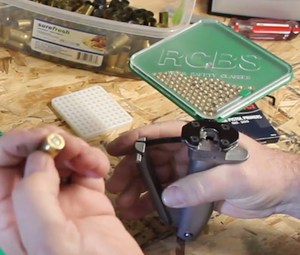
This is a detailed 20-minute video that shows the reloading process start to finish. The video shows how to clean the cases, deprime, and check them before loading.
In this video the cases are sized and bullets seated using a single-stage RCBS press. The cases are primed using an RCBS hand-priming tool which keeps multiple primers in a tray (see 8:55 time-mark). For efficiency, we recommend seating with a hand tool (or bench-mounted tool) vs. seating primers using the priming system on the press itself. The hand seating tool also gives you a better “feel” for setting the primers.
Safety First When Loading All Cartridges
Along with the first two instructional videos above, we include two important videos focused on reloading safety. In the first video, UltimateReloader’s Gavin Gear explains how to check your cartridge during the loading process to eliminate squib loads and other defects. In the second video, Starline Brass tech Hunter Pilant explains how to avoid double charges.
Load .45 ACP Safely — Avoid Squib Loads and Overcharges
You need to check the powder level of EVERY round you load. Do this visually BEFORE seating a bullet. (Or, with a progressive press, use a lock-out die that monitors powder levels). This is very important because a squib load (with little or no powder) can leave a bullet lodged in the barrel. A subsequent full, live round can cause a Kaboom with dire consequences.
Preventing Double Charges — Use a Case-filling Powder with .45 ACP
IMPORTANT TIP: Use a bulky powder that fills your case more than half way with a correct charge. “This will over-fill the case if it is double-charged, making it impossible to load. This is one safeguard that can keep you from making a big [mistake]” (Hunter Pilant, Starline). A bulky powder with high fill level will also be easier to see inside the case.
The Progressive Option — Loading .45 ACP on the Dillon 550B
Once you have mastered the basics of reloading for the .45 ACP, if you require large quantities of ammo, you may want to consider getting a progressive press. Progressive presses can significantly increase your ammo output, but there are also important safety considerations. You need to be careful about powder levels and priming. In this video, Gavin Gear explains how to reload safely with a Dillon 550B progressive press. The equivalent current model is the Dillon 550C.
.45 ACP Ammunition Loading Guide — Nosler Data
If you “roll your own” .45 ACP cartridges, there are many good powder choices. Our favorites are Vihtavuori N320, AA No. 5, and Hodgdon TiteGroup, but there are many other good choices. You’ll find these three recommended powders (plus many others) in the .45 ACP Load Data Charts from Nosler. Shown below are the Nosler Guides for 185gr bullets and 230gr bullets. Right-click each image below to access/download printable PDF files.
Click for PDF File
Click for PDF File
* However, be aware that CCI and other companies are now manufacturing .45 ACP brass with SMALL PRIMER POCKETS. Whenever you get new brass, be sure so check ALL the cases for primer size, and segregate large and small in two groups. Attempting to push a large primer into a small primer hole can lead to jams, or worse, dangerous detonation. Be CAREFUL!
Most shooters realize that significant changes in temperature will alter how powders perform. That’s why you want to keep your loaded ammo out of the hot sun, and keep rounds out of a hot chamber until you’re ready to fire. But there are other factors to be considered — HUMIDITY for one. This article explains why and how humidity can affect powder burn rates and performance.
We’ve all heard the old adage: “Keep your powder dry”. Well, tests by Norma have demonstrated that even normal environmental differences in humidity can affect the way powders burn, at least over the long term. In the Norma Reloading Manual, Sven-Eric Johansson, head of ballistics at Nexplo/Bofors, presents a very important discussion of water vapor absorption by powder. Johansson demonstrates that the same powder will burn at different rates depending on water content.
Powders Leave the Factory with 0.5 to 1.0% Water Content
Johansson explains that, as manufactured, most powders contain 0.5 to 1% of water by weight. (The relative humidity is “equilibrated” at 40-50% during the manufacturing process to maintain this 0.5-1% moisture content). Importantly, Johansson notes that powder exposed to moist air for a long time will absorb water, causing it to burn at a slower rate. On the other hand, long-term storage in a very dry environment reduces powder moisture content, so the powder burns at a faster rate. In addition, Johansson found that single-base powders are MORE sensitive to relative humidity than are double-base powders (which contain nitroglycerine).
Tests Show Burn Rates Vary with Water Content
In his review of the Norma Manual, Fred Barker notes: “Johansson gives twelve (eye-opening) plots of the velocities and pressures obtained on firing several popular cartridges with dehydrated, normal and hydrated Norma powders (from #200 to MRP). He also gives results on loaded .30-06 and .38 Special cartridges stored for 663 to 683 days in relative humidities of 20% and 86%. So Johansson’s advice is to keep powders tightly capped in their factory containers, and to minimize their exposure to dry or humid air.”
Confirming Johansson’s findings that storage conditions can alter burn rates, Barker observes: “I have about 10 pounds of WWII 4831 powder that has been stored in dry (about 20% RH) Colorado air for more than 60 years. It now burns about like IMR 3031.”
What does this teach us? First, all powders start out with a small, but chemically important, amount of water content. Second, a powder’s water content can change over time, depending on where and how the powder is stored. Third, the water content of your powder DOES make a difference in how it burns, particularly for single-base powders. For example, over a period of time, a powder used (and then recapped) in the hot, dry Southwest will probably behave differently than the same powder used in the humid Southeast.
Reloaders are advised to keep these things in mind. If you want to maintain your powders’ “as manufactured” burn rate, it is wise to head Johannson’s recommendation to keep your powders tightly capped when you’re not actually dispensing charges and avoid exposing your powder to very dry or very humid conditions. The Norma Reloading Manual is available from MidwayUSA for $24.99.
Real-World Example — “Dry” H4831sc Runs Hotter
Robert Whitley agrees that the burn rate of the powder varies with the humidity it absorbs. Robert writes: “I had an 8-lb. jug of H4831SC I kept in my detached garage (it can be humid there). 43.5-44.0 gr of this was superbly accurate with the 115 Bergers out of my 6mm Super X. I got tired of bringing it in and out of the garage to my house for reloading so I brought and kept the jug in my reloading room (a dehumidified room in my house) and after a few weeks I loaded up 43.5 gr, went to a match and it shot awful. I could not figure out what was going on until I put that load back over the chronograph and figured out it was going a good bit faster than before and the load was out of the “sweet spot” (42.5 – 43.0 gr was the max I could load and keep it accurate when it was stored in less humid air). I put the jug back in the garage for a few weeks and I now am back to loading 43.5 – 44.0 gr and it shoots great again. I have seen this with other powders too.”
If you have two jugs of the same powder, one kept in a room in your house and one somewhere else where it is drier or more humid, don’t expect the two jugs of the same lot of powder to chrono the same with the same charge weights unless and until they are both stored long enough in the same place to equalize again.
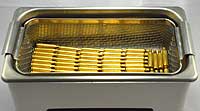
If you read our lengthy article on Ultrasonic Cleaning by Jason Baney, you’ve seen the remarkable results that can be achieved with this method, as shown by the photo above. Ultrasonic cleaning has many advantages over traditional tumbling methods of case cleaning. There is no dust or media residue to remove from the brass, and when done right, the cases come out clean and shiny, inside and out, even the primer pockets.
In its Benchtalk Archives, Brownell’s has an excellent article discussing Ultrasonic Case Cleaning. Brownell’s staff compares results, with measured dwell times from 5 to 75 minutes, using both Mpro-7 and HCS 200 cleaning solutions. Tests are performed with once-fired and 5X-fired Tactical 20 (Tac20) cases, as well as once-fired .260 Rem Cases. The article also compares the results from ultrasonic cleaning vs. tumbling in walnut media. Below are Brownell’s results for Tac20 cases with the HCS 200 (non-acidic solution). Go to Brownell’s article for MPro7 results and Rem 260 results.
HCS 200 Cleaning Solution Test
Procedure — Solution was de-gassed for 15 minutes, then 63 Tac20 cases were placed in a single layer, in stainless steel mesh basket. The temperature of the starting solution was 102° F. When the cases were removed the temperature was 110° F.
Once-Fired Tactical Twenty Cases (HCS 200) — Observations 5 minutes: The exterior of the cases are not significantly brighter/cleaner. The primer pockets and case interiors are still dirty. 10 minutes: Exterior of the cases are brighter. 70% of the cases show some degree of cleaning of the primer pockets. Little difference seen inside the case, but case mouths are cleaner. 15 minutes: Case brightness is about the same. Still only 70% of the primer pockets are clean, but a larger portion of each is cleaner. A Q-tip swabbed inside the cases shows that carbon/powder residues are loosening up. 20 minutes: Case exteriors are brightening up. 80-85% of the primer pockets are about 90% clean. The insides of the cases and case mouths are cleaner. 25 minutes: Cases are brighter/cleaner than even new brass. 80-85% of the cases have almost completely clean primer pockets. The inside of the cases are 80-90% clean. 30 minutes: The insides of the cases and case mouths appear to be completely clean. 87% of the primer pockets are virtually 100% clean. 13% of the cases had stubborn primer pocket residue that could not be completely removed. 60 minutes: Eight cases (13%) were placed in the tank for another 30 minutes to try to remove the remaining residue in their primer pockets. Six out of the eight cases were completely clean.
Five-Times Fired Tac20 Cases — Observations 30 minutes: Based on the above observations, I didn’t begin to observe these 5-time fired cases until after 30 minutes: The exterior cases are bright/clean. Brighter than new cases. The primer pockets on 75% of the cases are 75% clean. The remaining cases had primer pockets that were only 25% clean. The inside of the cases appear to be clean. 65 minutes: 25% of the primer pockets were 95% clean, 25% of the primer pockets were 90% clean, 25% of the primer pockets were 85% clean; and 25% were 80% clean. 75 minutes: 75% of the primer pockets were 90% clean.
How Does Ultrasonic Cleaning Work? The Brownell’s article explains: “Ultrasonic cleaning uses high-frequency sound waves (generally between 20-80 kHz) to remove a variety of contaminants from objects immersed in a liquid. The result of these high-frequency sound waves is a process called cavitation. These high frequency bursts of ultrasonic energy produce a three-dimensional wave of alternating positive and negative pressure areas as the sound wave passes through the solution. During negative pressure, microscopic cavitation bubbles form and will continue to grown until they reach resonant size. As the positive sound wave passes, the pressure rises rapidly and implodes these tiny bubbles. Before these minuscule bubbles implode they store a tremendous amount of energy. These bubbles can be as hot as 10,000 degrees and have as much as 50,000 lbs per square inch of pressure. This sounds alarming, but you have to remember that these bubbles are microscopic in nature and pose no harm to anything, unless you are a carbon /powder residue deposit on a cartridge case!
When this cavitation bubble implodes near your brass case, it transforms the bubble into a jet about 1/10th of its size. This jet of energy can travel as fast as 400 km/hour. At 43 kHz, as is the frequency for our L & R HCS 200 ultrasonic cleaner, this is happening 43,000 times per second. This micro-burst of extreme energy is responsible for removing contaminants from the surface of your cartridge brass. Ultrasonic cleaning can reach into crevices and inaccessible areas and remove surface debris that can’t be cleaned by any other process.”


 300 Meter .22 PPC — Equipment List
 Sizing dies were another problem altogether. Forget using a non-bushing die with unturned brass–you’ll just overwork the neck to death. The Redding bushing dies worked well, though. Fired brass ends up at 0.254″ and is sized to 0.250″ in two steps (0.252″ and 0.250″) to maintain better concentricity.
 Fire-forming the .220 Russian cases to the PPC chamber was a breeze: run an expander into the neck to get them to .224″, bump the shoulder 0.002″, load a caseful of IMR 4895 (about 23 grains) and insert a Nosler 77 (leftover from another project) and fire. I shot these at 100 yards while zeroing the rifle and was very impressed with the accuracy. Fouling was minimal, off to a promising start.
 While a 590 total isn’t bad for 300M, it was a bit below my average with the 6BR at this range – my home range that I knew well. More importantly, the score dropped as the group opened up in the third string when I wasn’t able to clean. At the Nationals all 60 shots are fired without a break for cleaning or additional sighters; therefore, Varget, while promising, wouldn’t work in the long run.
 New Load for a New Home
 Final testing at 500 yards was a complete success. I fired one group of 24 shots from the prone position. Elevation for the bulk of the group was right at 3″ (0.6 MOA), the horizontal spread was somewhat larger as the group was fired in gusty, fast-switching conditions. The CCI BR4 primers functioned flawlessly, with no sign of pressure despite ambient temperatures over 100° F. None of this should be taken as a general statement of inadequacy of Federal primers. I have used (and continue to use) the very same lot of Federal 205M primers in my 6BR and have not experienced any problems at all. Simply stated, the 80-grain .22 PPC is an odd duck and has special requirements when fired under the conditions that prevail in my area.


 A while back, we featured a portable reloading bench built on a Black & Decker Workmate. That proved a VERY popular do-it-yourself project so we’re showing it again, in case you missed it the first time.


 Glenn worked up a trim-and-point recipe for this lot of bullets based on group size. Load development is all performed at 1000 yards using the group ladder method. Glenn’s record load ended up being 30.3 grains of H4985 powder with the 103gr bullet seated very far into the rifling with .005″ of neck tension. This gave a velocity of 3030 fps in the 28″ Krieger.




 New Lapua Cartridge Brass — 6.5 PRC, .284 Win, .300 PRC, .300 Win Mag


 This is a detailed 20-minute video that shows the reloading process start to finish. The video shows how to clean the cases, deprime, and check them before loading.


 Tests Show Burn Rates Vary with Water Content

 If you read our lengthy article on
 The Brownell’s article explains: “Ultrasonic cleaning uses high-frequency sound waves (generally between 20-80 kHz) to remove a variety of contaminants from objects immersed in a liquid. The result of these high-frequency sound waves is a process called cavitation. These high frequency bursts of ultrasonic energy produce a three-dimensional wave of alternating positive and negative pressure areas as the sound wave passes through the solution. During negative pressure, microscopic cavitation bubbles form and will continue to grown until they reach resonant size. As the positive sound wave passes, the pressure rises rapidly and implodes these tiny bubbles. Before these minuscule bubbles implode they store a tremendous amount of energy. These bubbles can be as hot as 10,000 degrees and have as much as 50,000 lbs per square inch of pressure. This sounds alarming, but you have to remember that these bubbles are microscopic in nature and pose no harm to anything, unless you are a carbon /powder residue deposit on a cartridge case!
 When this cavitation bubble implodes near your brass case, it transforms the bubble into a jet about 1/10th of its size. This jet of energy can travel as fast as 400 km/hour. At 43 kHz, as is the frequency for our L & R HCS 200 ultrasonic cleaner, this is happening 43,000 times per second. This micro-burst of extreme energy is responsible for removing contaminants from the surface of your cartridge brass. Ultrasonic cleaning can reach into crevices and inaccessible areas and remove surface debris that can’t be cleaned by any other process.”


