Our friend and colleague F-Class John tests some of the finest reloading and shooting equipment you can buy. Recently he added the impressive Henderson Gen 3 Powered Trimmer to his inventory of tools. John is now a Henderson fan. He likes the speed, precision, and repeatability of the $779.00 Henderson machine, which trims-to-length and chamfers the case mouth all in one pass. Unlike some other trimming tools, the Henderson indexes off the overall case length NOT the shoulder. John found this worked just fine for his .284 Winchester brass, which has all been full-length sized prior to trimming.
John liked the precision of the Henderson trimmer and the overall design of the machine, which offers good ergonomics and very precise alignment of the cases. Cycling is smooth and positive, as you can see from the videos. Fit over the pilot was fine for John’s .284 Win brass, but he notes that other users may need to expand their case necks appropriately to fit their pilot.
Watch the video to see the Henderson trimmer in action. The dual, parallel horizontal support shafts provide precise alignment of the case as it moves inward toward the cutter blade. The Taper-Lock cutter provides a 14-degree inside chamfer and 30-degree outside chamfer. The trimming process is very consistent case after case, and the Henderson’s design captures brass shavings effectively.
Testing Trim Length Consistency — Henderson Shows Superb Repeatability
John did a separate quick test to demonstrate the trim length consistency of the Henderson unit. Measuring with digital calipers, John found that he could easily hold case overall trim lengths within .001″ (one-thousandth). The consistency was excellent even when trimming cases very quickly. When trimming .003″ off his cases, John said the Henderson showed superb repeatability. Henderson promises the trimmer “will repeat to within 0.002″ with same brand brass”, and John was able to hold 0.001″ length consistency.
Another Henderson owner posted: “I love mine. I like [the] consistent trim length with the positive stop. [Doing] the trim, chamfer, and debur all in one step sure makes the process nice and easy! I also immediately noticed the problem with the pilot on the cutting head with my sized cases. I just polished the pilots on my cutting heads with some fine grit sand paper a little at a time till I got it perfect for my preferred neck tension setting! I’m very pleased with my purchase of the Henderson precision trimmer.”
Henderson Power Trimmer vs. Giraud Power Trimmer
After he tested his new Henderson trimmer, F-Class John compared the pros and cons of the Henderson vs. his other high-volume power trimmer, a Giraud. He likes both machines, but now favors the Henderson for trimming his .284 Winchester match brass. He found that his ES/SD dropped a bit for brass trimmed with the Henderson vs. brass trimmed with the Giraud. With the Henderson-trimmed brass, John achieved an ES of 15 fps for 49 shots. That’s mighty impressive (see photo at right).
But the Giraud does have it’s advantages. It can work with calibers above .338, and it is very fast. One viewer of this video commented: “The Giraud is insanely fast if you aren’t only loading insane precision ammo. I borrowed one when I first started reloading and immediately ordered one. I’ve trimmed somewhere between 40-50k .223 cases. You can just rip through them while watching TV or listening to a podcast. It trims to length consistently less than +/-.001 all day.” The Giraud also indexes off the shoulder while the Henderson trims based on Cartridge Overall Length (OAL).
Henderson Gen 3 Trimmer Details
The Henderson Trimmer is available from HendersonPrecision.com for $779.00. When ordering, you must select a caliber and a collet size. Expect to wait a bit for delivery, depending on the cartridge type(s) you load. Available calibers are: .223, .243 (6mm), .25, .264 (6.5mm), .277, .284 (7mm), .308, and .338.
Product Description: The Gen 3 powered case trimmer uses a powerful, single-speed DC motor. The DC motor is extremely smooth and quiet and powers the spindle at around 1700 rpm. The enclosed aluminum motor mount shroud bolts directly to the bearing housing. The 90-volt DC motor offers maximum torque at 1700 rpm where you need it most. The motor has an in-line on/off switch for easy control. The Tri-Trim case trimmer includes one Henderson Precision Taper-Lock cutting head with Forster pilots as well as one Forster collet. The Taper-Lock cutter provides a 14 degree inside chamfer and 30 degree outside chamfer. The following cutter heads are available: 224, 243, 25, 264, 277, 284, 308, 338.
Nosler now offers the Nosler Reloading Guide #9, the latest in a respected series of hardback Nosler load manuals. This 800-page guide covers 101 cartridge types. New in this edition you’ll find the popular 6mm Creedmoor, 6mm XC, 6.5 PRC, and 7.62×39, along with 20 Nosler, 22 Nosler, 24 Nosler, 27 Nosler and 33 Nosler. This new guide draws from thousands of hours in the Nosler Ballistic Lab, along with the experience of many respected experts.
The book is available now for $27.99 at Grafs.com. In addition, much of the book’s latest load data is available for free on the Nosler.com online LOAD DATA Center. But to get ALL the data, PLUS the technical articles, you’ll need to buy the book.
The Nosler Reloading Guide 9 Reloading Manual provides load data for 101 rifle and handgun cartridges with hundreds of new powder additions. A comprehensive data set for today’s reloader, this manual is current with every bullet that Nosler offers through 2020 from 17 caliber up to 458 caliber in the rifle section and 9mm up to 45 caliber in the handgun section. Nine new cartridges were added to this manual. These include: 20 Nosler, 22 Nosler, 24 Nosler, 6mm Creedmoor, 6mm XC, 6.5 PRC, 27 Nosler, 7.62×39 and 33 Nosler. Also new for the Nosler Reloading Guide #9 are cartridge introductions written by veteran outdoor writers and industry tech experts. The 800-page book also has helpful “how-to” sections such as “Getting Ready to Reload”.
Q. Why Buy a Book when Load Data is Available Online from Powder Makers?
There are good, solid reasons to buy print-format loading guides produced by bullet-makers. If you go to the Hodgdon online Reloading Data Center you’ll only find loads with Hodgdon, IMR, and Winchester powders — the key brands they sell. In a book such as this Nosler #9 or the Sierra Reloading Manual, you will find loads with a much wider selection of powders including Vihtavuori, Alliant, Accurate, Norma, Ramshot, and other brands. You won’t find a Reloder 16 or VV N140 load on Hodgdon’s website.
In addition, it is handy to have loads in a print edition which is easy to access on your load bench. You don’t need a computer or an internet connection. And using a book is often faster than a web interface when quickly scanning through a variety of bullet choices for a cartridge.
Along with the Nosler #9 Manual, here are four other recommended Reloading Manuals:
In the wintertime, it’s common to encounter problems with static electricity when throwing your powder charges. The static can cause powder kernels to cling to the surface of reloading components, and can cause powder clumping. Clumped or sticky powder may make your measure bind or grab in the middle of the cycle, which can throw off your charge weight. Here are a couple simple ways you can minimize the effects of static electricity and improve the consistency of your powder measuring.
Ground Your Powder Measure — If you’re throwing powder charges in the fall or winter and have problems with bridging or sticking powder, use a ground wire. Bullet-smith Victor Johnson (Johnson Precision Bullets) tells us: “I have a 25-foot piece of real small wire with alligator clips on each end. It’s that long so I can run it down the hall to a water pipe. Use the wire tie from a bread bag to hold it in a small roll to put in the range box. When using it at the range use a 6″ nail from the co-op or Lowe’s / Home Depot and just push it into the ground.”
Use Bounce Dryer Sheets — A quick pass with the thin sheets used in dryers will eliminate “static cling” on your plastic reloading parts like powder throwers, powder funnels, and reloading press guides. Thanks to Doc76251 for this tip.
Reduce Electronic Scales’ Drift with Anti-Static Spray
Reloading Tip by GS Arizona from Riflemans Journal
Apparently reducing static charges on and around electronic scales can reduce their propensity to drift, lessening the problem of “wandering zero”. Just how and why static charges interfere with scale performance is unclear, but many shooters have noticed that static electricity can cause electronic scales to behave strangely. So how do you reduce static charges around your digital balance? GS Arizona has found a very simple solution — an anti-static aerosol spray — that, by all indications, actually works. When this “spray-can solution” was suggested by a fellow shooter, GS was skeptical. However, he tried the stuff and he says that it really does help the scale maintain zero over time, with much less observed drift.
GS explains that the use of “Static Guard” spray helped mitigate the problem of a drifting zero on his Ohaus electronic scale: “My electronic scale… suffers from drifting zero (as they all seem to). I’ve read dozens of forum posts about drift and how to minimize its occurrence, so I know this problem isn’t limited to my scale or my workshop. Sometime last year, John Lowther mentioned the use of anti-static spray as a solution to the drift problem. John stated that the spray had virtually eliminated drift for him.”
GS found that the Static Guard actually worked: “The spray works great, just as John said it would. I spray all surfaces that I touch with my hands and arms as well as the pan (top and bottom), the metal tray on which the pan rests and the table under the scale. In six months or so of using the spray I’ve re-applied it about two or three times; it certainly isn’t something that you need to do each time you sit down to load. Before using the spray, it was not uncommon for me to re-zero the scale 10 times in the course of loading 72 rounds; now it might need it once during a session.”
At the request of our readers, we provide select “Deals of the Week”. Every Sunday afternoon or Monday morning we offer our Best Bargain selections. Here are some of the best deals on firearms, hardware, reloading components, optics, and shooting accessories. Be aware that sale prices are subject to change, and once clearance inventory is sold, it’s gone for good. You snooze you lose.
1. Bruno Shooters Supply — Reloading Press Sale
⏺ Good sale on single-stage and turret presses
Bruno’s is running a good SALE on Reloading presses, with some of the best prices we’ve found. Get significant savings on RCBS, Lyman, and Redding presses — single-stage presses along with turret presses. The classic RCBS Rock Chucker Supreme is now $180.00 at Bruno’s — that’s $30 cheaper than MidwayUSA. Check out these offerings:
2. Norma — Centerfire and Rimfire Ammo Direct from Norma
⏺ Great savings on excellent ammo, plus free shipping over $150
Good news for rimfire and centerfire shooters. Norma is now selling ammunition direct through its website NormaShooting.com at very competitive prices. What’s more you get FREE Shipping on all orders over $150, plus free insurance with all orders. Norma’s online ammo store has both centerfire and rimfire ammunition “in stock, ready to ship… there is plenty of ammo for sale at Norma Shooting.” The Norma 9mm Luger ammo is a good value at $17.99 for 50 rounds. And Norma’s 55gr .223 Rem ammo is just $15.49 for 30 rounds, 30% OFF the regular price.
3. Savage — November Rimfire Rebate — $50 or $25 Back
⏺ Get $50 or $25 money-back rebate on Savage rimfire rifles
Let Rimfire Ring… Purchase any Savage A or B Series rimfire rifle and receive a $50 mail-in Rebate, or purchase any Savage Rascal, 93, or 93R17 Rifle and receive a $25 mail-in Rebate. These rebate offers apply to rifle purchases between 11/1/2021 through 11/30/2021. CLICK HERE for Rebate INFO. Purchasers can REDEEM Online or return their Rebate Form through the mail. DEADLINE for mail-in or online submission is 12/31/2021.
4. Midway USA — Vortex Scopes Clearance Sale, Save 30-35%
⏺ Big-time 30-35% savings on many popular Vortex riflescopes
Vortex Optics riflescopes are reliable and are protected by one of the best warranties in the business. Right now you can save big on Vortex scopes for competition and hunting. Save 30-35% with MidwayUSA’s Vortex Clearance Sale. In addition to the optics shown above, there are a dozen other models on sale including: Viper PST Gen II 3-15x44mm, Viper HS 6-24x50mm, Viper HS LR 4-16x44mm, Viper HS 2.5-10x40mm, Viper 3-9x40mm, Viper 4-12x40mm, Viper PST 1-4x24mm and more.
5. CDNN Sports — Winchester Wildcat with Reflex Optic, $299.99
⏺ Handy .22 LR rimfire with Reflex optic, and easy take-down
Here’s fun, functional rimfire rifle for under $300 with reflex optic. This special edition .22 LR Winchester Wildcat features a field-removable lower receiver, ambidextrous magazine release, integral Picatinny top rail, and rear barrel access for easy cleaning. There is even a Picatinny rail on underside of forearm for mounting bipod or accessories. This SHOT Show Special Wildcat comes with a Reflex-style electronic optic, plus ghost ring rear sight and post front sight. TFB praised the one-button takedown and 10/22 magazine compatibility (see video). This can be a great fun plinker or first rifle for a family member. CDNN Sports also offers the Wildcat without Reflex sight for $279.99.
6. Amazon — BOG Deathgrip Aluminum Tripod, $137.99
⏺ Versatile tripod mounts quickly, securely — use for PRS/NRL or hunting.
This is a great tripod for long-range hunters and PRS/NRL competitors. The Clamp-type head quickly secures to your rifle’s forearm for a secure shooting solution. The BOG Deathgrip Aluminum Tripod is on sale now on Amazon for $137.99 (add to cart to see price). If weight is critical, there is also a lighter BOG carbon fiber tripod for $249.99. For the extra $112 you save a pound in total weight (7.5 lbs for carbon vs. 8.5 lbs for aluminum).
7. MidwayUSA — Frankford Large Rotary Tumbler, $149.99
⏺ Big Capacity, Great Deal — save $77 over typical price
If your brass is dirty on the outside or if you want to get it “squeaky clean” before annealing, a Rotary Wet Tumbler is a smart option. Right now the large, full-size Frankford Rotary Tumbler is on sale. Order it now from MidwayUSA for just $149.99 including 5 pounds of 304 stainless media pins and a packet of Frankford Brass Cleaning Solution. NOTE: You must ADD to CART to see that $149.99 price. This a great deal — this tumbler sells elsewhere for $220 or more. Note: if you already have stainless media, you can also buy the unit by itself from Amazon for $149.99, with free shipping for Prime members.
⏺ Affordable padded mat rolls up for easy transport
When shooting prone, it’s really important to be comfortable. You need a good mat that offers some padding along with plenty of room for your gear. The Redneck Convent Padded Shooters Mat fits the bill. Measuring 64 inches by 21 inches it boasts plenty of room and features 1/2″ padding top to bottom. This mat rolls up for easy storage/transport (Rolled size is 21″x8″) with handy built-in rolling straps. This is also available in Black for $35.99.
9. Midsouth — Hornady Quick Change Die Bushing Kit, $17.99
⏺ Great upgrade to any brand single-stage reloading press
With this inexpensive Hornady Lock-N-Load Die Conversion Kit, you can swap dies in and out of a press in a few seconds. This is great if you worth with multiple cartridge types, or size and seat on the same single-stage press. Simply insert the Hornady conversion bushing into a Rock Chucker or other press that uses a standard 1-1/4:12 thread. Then put the die bushing on your die. This Lock-N-Load Conversion Kit includes three die bushings and one conversion bushing.
10. Amazon — 12″ x 12″ Splatter Grid Targets, 10 for $10.99
⏺ Great for hunting rifle Sight-In and easy to estimate group size
This 12″x12″ Splatterburst Target combines splatter shot marking with a grid background, with five aiming points. The bright neon shot circles make it easy to see your shots. And the handy grid lets you quickly estimate your group size. Get a 10-pack for $10.99, or a 25-pack for $18.99 (better deal). This particular target has earned rave reviews — 87% of verified buyers gave this a FIVE-Star rating. One example: “Excellent quality and durability. The adhesive is really strong and the splatter contrast is [great].”
One side of this gauge is the “go” side which quickly tells you the depth of a primer pocket, whether any crimp is properly removed, and whether the primer pocket is loose. If it feels loose on the “go” side, use the other end of the tool, the “no go” side, to test to see if the primer pocket is too loose to hold a primer. If the no-go slides into the pocket, then you know to junk that brass.
Primer Pocket Growth and Useful Case Life
Repeated firings at stout pressures can cause primer pockets to grow in diameter. This can create an unsafe condition if your primers are not seating properly. Are your primer pockets “good to go”, or have they been pushed to the point of no return? Do you really know? Many guys try to gauge primer pocket tightness by “feel”, as they seat the primer. But that method isn’t precise. Now there’s a better way…
The folks at Ballistictools.com have created a handy set of precision-machined gauges that let you quickly and accurately check your primer pockets. These gauges (aka “gages”) are offered in two sizes — for large and small primer pockets. A two-piece set of both large and small gauges costs just $22.99. These gauges let you quickly measure the depth of a primer pocket, and check if the crimp has been removed properly. Most importantly, the gauge tells you if the primer pocket has opened up too much. One side of the gauge has an enlarged diameter plug. If that “No-Go” side fits in the primer pocket, you should ditch the case — it’s toast.
Precision ground from O-1 tool steel, The Ballistic Tools primer pocket gauges serve multiple functions. The inventor of these tools explains: “I created the prototype of this tool for my own use in brass processing. I needed a way to quickly and easily measure primer pockets that was reliable and did not require wasting a primer. This tool has been indispensable for me and I would never go back to the old method of uncertainty and guessing.”
Product tip from Boyd Allen. We welcome reader submissions.
When Annealing Made Perfect (AMP), a New Zealand-based company, first unveiled its original induction annealing machine at SHOT Show 2015, it was big news in the reloading world. This was a real breakthrough — an induction annealer running on electricity that was fully programmable. No more flames to fuss with. The advent of the AMP annealer was a true “game-changer” for the shooting enthusiasts who reloaded their ammo.
The AMP system is based on smart science and modern technology. Right from the start, AMP invested in advanced lab equipment (such as gear for Micro-Vickers hardness testing). AMP also worked with independent outside metallurgical laboratories. And AMP invited shooters from around the world to send in sample cartridge cases. AMP accumulated a huge archive of cartridges from .17 Hornet to an array of .50 BMG wildcats and everything in-between. AMP’s archive includes multiple brands and even different lot numbers of the same cartridge. AMP now offers the most highly developed and precise consumer annealing system on the planet. That is because of the amazing amount of R&D behind the product, plus the use of advanced technologies.
Annealing Under the Microscope — Informative Articles
Alex and Matt Findlay have produced a series of articles called “Annealing Under the Microscope”. The first of these was released in July 2017. Part 1 was a general explanation of annealing, and busted a number of myths. It examined the repeatability of annealing over multiple reloads, and conducted a series of tensile bullet pull tests.
Annealing Different Brands of Brass
Part 2 of Annealing Under the Microscope covered an important topic — annealing for different brands of brass. This article examines the reasons why different brands of the same cartridge can require different annealing settings. The article also reveals that lot to lot variations of the same brand of brass can make a big difference.
AZTEC Annealing System — AMP Annealers become Smart Machines
In late 2017, Alex and Matt started the development of their revolutionary AZTEC system, which in effect transformed AMP annealers into SMART annealers. It meant that individual customers could analyse their own cases with laboratory grade accuracy without the need to send samples to the AMP lab for calibration.
Part 3 of Annealing Under the Microscope was released in July 2018 after nearly 12 months of R&D on AZTEC. It focused on how to best utilize this new self-calibration capability. It also highlighted the difference between several “premium” brands of brass compared to cheaper alternatives.
Benefits of Precision Annealing — Accuracy and Repeatability
Part 4 of the series was released in September 2019. It focused on the true benefits of accurate annealing, and the arguments for annealing every reload. The study identified sizing accuracy and repeatability as the key factor. This article also revealed the first prototype of AMP’s new auto bullet seater with seating pressure data capture.
Proof on the Target — Down-Range Benefits of Annealing
In Part 5 of the series, AMP’s experts focus on the real world, down-range benefits of annealing, turned out to be a much more complex process than AMP initially planned. Accordingly, Part 5 was conducted in three stages, with three detailed write-ups.
The Part 5, Stage 1 paper examined sizing accuracy of annealed vs un-annealed cases, taking two sets of three identical Peterson Cartridge .308 Winchester cases through twenty (20) reloading cycles. For every cycle, cases were measured both fire-formed and as re-sized. With each cycle the cases were measured for case length, shoulder bump, neck OD, and head OD.
Field Testing in Tennessee — Proof on Target
The Part 5, Stage 2 article covered detailed ballistic testing using multiple rifles, cartridges, and shooters at the Strategic Edge range in Tennessee.
The Tennessee testing sessions accumulated a wealth of data on velocity spreads and group sizes right out to 1,000 yards. The evidence showed a clear advantage for annealed brass, both for average group size and average Extreme Spread for the groups shot with AMP-annealed cases.
Underground Testing with Lou Murdica
Lastly, AMP’s Part 5, Stage 3 paper featured testing by Lou Murdica at an underground range in California. We have previously shown a video of Lou shooting one case, then reloading it and shooting the same case into the same hole at 100 yards.
This time he repeated the feat, shooting one un-annealed case twenty times into the one hole. Then Lou produced another even smaller 20-shot group, shot with a case which he annealed before every shot.
Enjoy These Technical Articles from AMP Annealing
Collectively AMP’s “Annealing Under the Microscope” series represents a remarkable body of outstanding work. Whether you anneal your cartridge brass now, or just want to learn more about the benefits of annealing, we recommend you take a look at this series of informative articles.
At the request of our readers, we provide select “Deals of the Week”. Every Sunday afternoon or Monday morning we offer our Best Bargain selections. Here are some of the best deals on firearms, hardware, reloading components, optics, and shooting accessories. Be aware that sale prices are subject to change, and once clearance inventory is sold, it’s gone for good. You snooze you lose.
1. KYGUNCO — Savage Axis II Precision Rifle, $699.99
⏺ Good entry-level PRS rifle that also works for hunting
The Savage Axis II, on sale for $699.99 at KYGUNCO in 6.5 Creedmoor or .308 Win, offers good performance for the price. It can serve as a competent starter rig for PRS/NRL competition, and also function well for hunting, with a weight of 9.9 lbs without scope. The Savage Axis II combines an accurate barreled action with a nice MDT chassis with adjustable comb and adjustable length-of-pull. For more info, read the very thorough Savage Axis II review in Guns America Digest.
2. Scopelist (EuroOptic) — Nightforce Clearance SALE
⏺ Save HUNDREDS on Nightforce ATACR and other NF optics
Right now ScopeList (a EuroOptic.com partner) is running a big Nightforce Clearance Sale. You can save up to $515 dollars on demo Nightforce optics with full factory warranty. Chose from the popular ATACR series or the advanced NX8 model with MOA or MilRad clicks. There are a variety of good FFP and SFP Nightforce optics on sale now.
3. Bass Pro — Garmin GPSMAP 64SX, $219.99
⏺ $130 Savings on full-featured modern GPS with TopoActive Maps
This rugged handheld Garmin GPSMAP boasts reliable satellite connectivity with Altimeter and Compass features. This 64SX model also comes pre-loaded with TopoActive Maps, which are great for backcountry hunters. This water-resistant design features button operation with a sun-readable 2.6″ screen.
4. Midsouth — SIG Sauer Optics Sale
⏺ SIGnificant savings on BDX scopes, BDX rangefinders, and red dot optics
SIG Sauer makes excellent products with notable features. SIG BDX Laser Rangefinders can communicate (via Bluetooth) to BDX series scopes. This allows calculated hold-over points to appear in the scope reticle. In addition, the LRF communicates with Ballistics Apps on your mobile device. Right now Midsouth has SIG Sauer optics products on SALE including scopes, rangefinders, Red Dots, and binoculars. Along with BDX scopes, SIG’s Whiskey5 SFP scopes are on sale. Many items also qualify for FREE Shipping.
5. Palmetto SA — AR15 Complete Stealth Lower (Blem), $139.99
⏺ GREAT deal on complete lower with full trigger group and adjustable stock
With changes to Federal law looming on the horizon, it may be wise to get your Black Rifle now. Here is a great deal on a complete lower with stock. The PSA AR-15 MOE Stealth Lowers include full, installed trigger group, plus a nice, adjustable MagPul MOE buttstock. The price is just $139.99 because these “blem” lowers may have a small scratch or blemish somewhere. For the same $139.99 bargain price, chose the Black Stealth Lower or the Flat Dark Earth Model as shown above.
6. MidwayUSA — Hoppes Gun Vise and Cleaning Kit, $39.99
⏺ Good basic gun vise at great price with bonus cleaning kit
The Hoppe’s Gun Vise is a good basic support for working on your firearms. Clamping brackets in the front and rear hold your rifle or shotgun securely without scratching. The vise is made out of a durable, chemical resistant polymer and has multiple compartments for your cleaning chemicals, tools, and accessories. Included with this vise is a 12-piece Cleaning Kit for rifles, pistols, and shotguns. Features include: Dual lockable no-scratch brackets, multiple compartments for tools, and adjustable feet.
7. Natchez — Bushnell Optics Sale, Save 35%
⏺ Great prices on hunting scopes and Red Dot optics
Hunting season is in full swing. If you need an affordable optic for your hunting rifle, check out the Bushnell Optics Sale at Natchez. A variety of scopes are 35% off. In addition, there are great prices on Red Dots you can use on a shotgun, pistol, or tactical rifle. And prices have been slashed on Bushnell binoculars and spotting scopes as well. Act soon — these Natchez sales don’t last long.
8. Midsouth — Forster Accu-Ring, $14.99
The new Forster Accu-Ring has precise markings so you can set your sizing dies with extreme precision in your press. The anodized ring has laser-etched precision markings in .001″ increments. This allows you to more easily set the amount of sizing and shoulder “bump” you get when you move a die up or down in your press. In addition, if you have a conventional seating die without a micrometer adjustment, this new Forster Accu-Ring can help you achieve more precise bullet seating. SEE Ultimate Reloader Review.
⏺ Owners say it is sharp with good features for price
This Sawback Bowie spring-assisted folding knife, just $9.70 on Amazon, has a 3.5″ blade. There is a curved cutting edge with a serrated section near the handle. Actual purchasers state: “This knife is very well made with a tight feel. No play at all. The assisted open is excellent [and] they come very sharp too”, and “This is a good quality knife. It’s solid and a bit heavy, really good looking and comes pretty sharp. Overall its a great knife.”
⏺ Quality name-brand shooting eyewear — buy multiples at this price
Every shooter needs eye protection EVERY TIME you go to the shooting range. Right now Midsouth has the good Radians clear Lens Outback Shooting Glasses for just $5.88. These ANSI Z87.1 Radians Shooting Glasses provide 99.9% UVA/UVB protection with the coated lenses. These offer excellent wrap-around protection and are fairly light and comfortable. A handy neck cord is included. With this low $5.88 price, you can buy 3 or 4 sets and keep spares for yourself and your shooting buddies.
One of the most important aspects of precision reloading is setting the shoulder bump during the full-length (FL) sizing process. You want the amount of “bump” to be precise and identical for every loaded round. However, when you switch brands of brass you may need to change the die position to get the desired bump and case body sizing. And even with the same brand of brass, you may find that you need to adjust your FL die as the number of brass load cycles increases. Brass that has been fired many times will behave differently than new or near-new brass.
Also, even with the same cartridge type, brass loaded for a semi-auto rifle may need more bump than brass fired in a bolt gun. For example, with .223 Rem ammo, you’ll normally want to push the shoulder back farther if the ammo will be shot in a AR15 as opposed to a bolt-action rig.
So how do you make all these needed adjustments for your full-length dies? You can move a conventional locking ring up and down, but that can be a tedious, trial-and-error process. Some guys use shims in one-thousandth intervals, but that still requires taking your dies in and out of the press. Well there is a better way now…
PMA Tool Micro-Die Adjuster
Wouldn’t it be great if you could precisely adjust your FL die up and down in half-thousandth increments, with a simple indexed click. That is now possible with products offered by PMA Tool and Whidden Gunworks. PMA Tool offers a Micro-Die Adjuster that replaces your existing lock ring and can be used with nearly any 7/8-14 full length sizing die. The engraved marks correspond to approximately .001″ of shoulder bump adjustment. Splitting the engraved marks is therefore approximately equal to .0005″ (half a thousandth). Users love this product, saying it adds precision and saves time.
Whidden Click-Adjustable FL Sizing Die System
Whidden Gunworks offers a complete click-adjustable FL sizer die with a special, indexed ring. With Whidden’s patented Click Adjustable Sizer Die system, the die and lock ring work together to allow rapid, precise bump adjustments. One click changes the bump .001″. It’s simple and fast. Included with the Click Adjustable Sizer Die is a shoulder bump gauge. John Whidden explains:
“There has become a need for an easier way to adjust the sizer die properly. Until now there have been few options other than trial and error to get the shoulder setback correct. Anyone who has done this can attest that it’s a slow and imprecise job! Our die and lock ring work together to give the user a clicking feel to the adjustment. Each click moves the shoulder bump .001” so you can easily find the exact shoulder bump that you desire.” — John Whidden
New Universal Click Adjustable Lock Ring for Standard Sizing Dies
Whidden Gunworks also now offers a Universal Click Adjustable Lock Ring for all brands of standard sizing dies. If you don’t need a complete die, this special Lock Ring provides the functionality of the Whidden click-adjustable sizing dies for the standard 7/8-14 dies you already own. Lock Ring Instructions PDF.
John Whidden explains: “With our Universal Click Adjustable Lock Ring (Patent No: 10,393,488) you can instantly turn your sizer die into a Click Adjustable Die. Our ring works with any 7/8 OD sizer of any brand with adjustable shoulder bump. The inner and outer ring can rotate independently of each other. Each click is metered in true 1 thousandths adjustment and has .100″ total available travel. Those loading for two rifles with different headspace can easily optimize the shoulder bump for each rifle.”
Photo 1: Three Near-Equal-Weight 7mm Bullets with Different Shapes
TECH TIP: Bullets of the same weight (and caliber) can generate very different pressure levels due to variances in Bearing Surface Length (BSL).
Bullet 1 (L-R), the RN/FB, has a very slight taper and only reaches its full diameter (0.284″) very near the cannelure. This taper is often seen on similar bullets — it helps reduce pressures with good accuracy. The calculated BSL of Bullet 1 was ~0.324″. The BSL of Bullet 2, in the center, was ~0.430”, and Bullet 3’s was ~ 0.463″. Obviously, bullets can be visually deceiving as to BSL!
This article from the USAMU covers an important safety issue — why you should never assume that a “book” load for a particular bullet will be safe with an equal-weight bullet of different shape/design. The shape and bearing surface of the bullet will affect the pressure generated inside the barrel. This is part of the USAMU’s Handloading Hump Day series, published on the USAMU Facebook page.
Beginning Handloading, Part 13:
Extrapolating Beyond Your Data, or … “I Don’t Know, What I Don’t Know!”
We continue our Handloading Safety theme, focusing on not inadvertently exceeding the boundaries of known, safe data. Bullet manufacturers’ loading manuals often display three, four, or more similar-weight bullets grouped together with one set of load recipes. The manufacturer has tested these bullets and developed safe data for that group. However, seeing data in this format can tempt loaders — especially new ones — to think that ALL bullets of a given weight and caliber can interchangeably use the same load data. Actually, not so much.
The researchers ensure their data is safe with the bullet yielding the highest pressure. Thus, all others in that group should produce equal or less pressure, and they are safe using this data.
However, bullet designs include many variables such as different bearing surface lengths, hardness, and even slight variations in diameter. These can occasionally range up to 0.001″ by design. Thus, choosing untested bullets of the same weight and caliber, and using them with data not developed for them can yield excess pressures.
This is only one of the countless reasons not to begin at or very near the highest pressure loads during load development. Always begin at the starting load and look for pressure signs as one increases powder charges.
Bullet bearing surface length (BSL) is often overlooked when considering maximum safe powder charges and pressures. In photo 1 (at top), note the differences in the bullets’ appearance. All three are 7mm, and their maximum weight difference is just five grains. Yet, the traditional round nose, flat base design on the left appears to have much more BSL than the sleeker match bullets. All things being equal, based on appearance, the RN/FB bullet seems likely to reach maximum pressure with significantly less powder than the other two designs.
Bearing Surface Measurement Considerations
Some might be tempted to use a bullet ogive comparator (or two) to measure bullets’ true BSL for comparison’s sake. Unfortunately, comparators don’t typically measure maximum bullet diameter and this approach can be deceiving.
Photo 2: The Perils of Measuring Bearing Surface Length with Comparators
In Photo 2, two 7mm comparators have been installed on a dial caliper in an attempt to measure BSL. Using this approach, the BSLs differed sharply from the original [measurements]. The comparator-measured Bullet 1 BSL was 0.694” vs. 0.324” (original), Bullet 2 was 0.601” (comparator) vs. 0.430” (original), and Bullet 3 (shown in Photo 2) was 0.602” (comparator) vs. 0.463” (original). [Editor’s comment — Note the very large difference for Bullet 1, masking the fact that the true full diameter on this bullet starts very far back.]
Lyman makes a very handy product for reloaders that can save space on your reloading bench and give you more efficient powder flow into your cases. With common plastic “one size fits all” type powder funnels, the powder sometimes sticks to the sides of the funnel. Or, the fit to the case mouth is less than ideal so some of the kernels end up on the bench.
Precision powder funnels solve those problems. But what if you shoot a wide range of calibers with big and small case mouths? Lyman has the answer: the Brass-Smith Precision Funnel set, now $28.99 on Amazon. This handy product combines a static-free cast aluminum funnel with a set of SIX (6) CNC-machined inserts that fit cartridges from .22 caliber all the way up to .338 caliber. It is easy to swap the inserts to match the particular cartridge you are loading. In this Ultimate Reloader video, our friend Gavin Gear shows how to use the Lyman Precision Powder Funnel Set with multiple neck-diameter inserts:
Product Description: “The Brass-Smith Precision Funnel set is made to be completely static-free, no more powder clinging to surfaces which can happen with lightweight plastic Funnel. This is no ‘one size fits all’ funnel — the Brass Smith Precision Funnel set uses precision-machined, caliber-specific inserts to properly fit the case neck. CNC-turned aluminum inserts to fit specific cartridge families for calibers 22 to 338. Inserts are laser-marked for caliber identification. The inserts can be quickly and easily installed by simply pushing them into place and then pulling them out when changing calibers. The Funnel comes with inserts for .22, .243/6mm, .25/6.5mm, .270/7mm, .30 and .338 caliber rifle cartridges. A padded storage case neatly stores the funnel and inserts when not in use.”
Forum Member Likes the Lyman Precision Powder Funnel Set
One of our Accurate Shooter Forum members, Garandman, purchased the Lyman Precision Funnel System. He has used it now for multiple cartridge types and is very pleased with the results. Here is his report:
“I wanted to share my good experience with the Lyman powder funnel. First off, with the funnels being aluminum / pot metal, no static charge forms and the powder kernels go right down the funnel into the case with no hang-up.
Also the funnel comes with interchangeable case neck dimension inserts so you get no powder loss outside the case neck. And the funnel is also is less likely to stick to the case neck and pull it out of your loading block. That could spill powder all over the place.”
Overall, the Lyman Precison Funnel Set with case neck inserts has done a great job for Garandman and he suggests you may want to add this tool to your reloading tool collection. Below is a Lyman Precision Funnel Set review from Johnny’s Reloading Bench. This video review has nice close-ups of the six precision inserts from .22 to .338 calibers.


 After he tested his new Henderson trimmer, F-Class John compared the pros and cons of the Henderson vs. his other high-volume power trimmer, a Giraud. He likes both machines, but now favors the Henderson for trimming his .284 Winchester match brass. He found that his ES/SD dropped a bit for brass trimmed with the Henderson vs. brass trimmed with the Giraud. With the Henderson-trimmed brass, John achieved an ES of 15 fps for 49 shots. That’s mighty impressive (see photo at right).


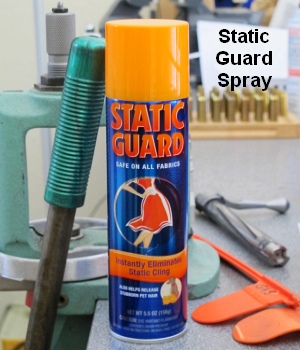 Apparently reducing static charges on and around electronic scales can reduce their propensity to drift, lessening the problem of “wandering zero”. Just how and why static charges interfere with scale performance is unclear, but many shooters have noticed that static electricity can cause electronic scales to behave strangely. So how do you reduce static charges around your digital balance? GS Arizona has found a very simple solution — an anti-static aerosol spray — that, by all indications, actually works. When this “spray-can solution” was suggested by a fellow shooter, GS was skeptical. However, he tried the stuff and he says that it really does help the scale maintain zero over time, with much less observed drift.


 The folks at