At the request of our readers, we provide select “Deals of the Week”. Every Sunday afternoon or Monday morning we offer our Best Bargain selections. Here are some of the best deals on firearms, hardware, reloading components, optics, and shooting accessories. Be aware that sale prices are subject to change, and once clearance inventory is sold, it’s gone for good. You snooze you lose.
⏺ Nicely equipped semi-auto .22LR — Good for NRL22 matches
Are you looking to get into the NRL22 discipline but don’t have a rifle to do it with? Check out the Thompson Center T/CR22 .22 LR Rimfire Rifle. This features a 17″ barrel (with front and rear sights) and the stock has a handsome Mossy Oak Camo finish. Equipped with a Picatinny Rail, this is ready to mount a scope for competition. This is a good starter rifle for NRL22 and other tactical rimfire games. Plus it can serve for fun plinking and hunting small varmints.
⏺ Save $110-$125 on quality spotters with Big 82mm objectives
Having a quality spotting scope is critical for a successful hunt or for reading wind and mirage at a match. One of the absolute best scope for the money is the Kowa 82sv and right now you can take advantage of the Kowa Scope Specials over at Creedmoor Sports. You can pick up the 82sv along with a cover plus your choice of the 25x LER eyepiece or the 20-60x eye piece and be ready for whatever adventure is next on your list.
3. Bullet Central — Berger 7mm 180gr Hybrid Bullets, $63.99
⏺ Choice of Champions — Get Berger 7mm 180s while you can
One of the most sought-after match bullets right now is the Berger 7mm/.284 180gr Hybrid Match Bullet. Many vendors are sold out. But we found them in-stock at Bullet Central and ready to ship. Considering the demand, we wouldn’t wait long to order and we’d probably order enough for your upcoming matches this year (including the F-Class Nationals).
4. Amazon — Roll-Up Shooting Mat with Bonus Sand Bag, $34.99
⏺ Great value, rolls-up into small format, free support sandbag
Traveling for matches can often mean stripping down to the bare minimum of gear and that usually mean leaving behind large padded shooting mats. A good option instead is a packable shooting mat such as this 78.5″ x 28.5″ Depring folding mat. This mat folds up into a very small footprint making it great for throwing in your checked baggage. FOUR Colors are offered, all priced at $34.99: Tan (shown), OD Green, Black, and Camo. These Depring shooting mats ship with a FREE 6″ x 3.75″ “Unfilled Gun Rest Sand Bag” which can be used for front or rear support.
5. Midsouth — LEE Breech Lock Reloader Press, $41.99
⏺ Great deal on compact press with breech lock quick die changes
Every handloader can benefit from a compact, secondary press for decapping at home and/or seating bullets at the range. Weighing under 2.5 pounds, this LEE Breech Lock Reloader Press is easy to transport. The open front design makes it easy to insert/remove cases. This LEE press offers Breech Lock functionality for rapid die changes. With the Breech Lock bushing in place, you can instantly swap dies with a twist of the wrist. Right now this LEE Reloader Press is on sale for $41.99 at Midsouth
6. Natchez — Federal XM193 5.56×45 Ammo 400rds, $399.99
⏺ Big savings on CCI 9mm ammo and XM193 ammo for ARs and .223 Rem rifles
Natchez is running a special ammo deal right now. You can save on rifle and pistol ammo AND get FREE SHIPPING. Choose one of three bulk packs: CCI Blazer 9mm 500 rounds for $549.99; or Federal XM193 5.56×45 400 rounds in can for $369.99 ($319.99/400 rds if you buy two cans); or Winchester Lake City M193 5.56×45 1000 rounds in box for $779.99. NOTE: The rifle bulk packs are officially 5.56x45mm ammo, but it should also shoot fine in most modern rifles chambered for .223 Remington. The CCI 9mm and Winchester M193 are priced very competitively, so don’t hesitate.
7. Sportsman’s Warehouse — Allen Soft Rifle Case Sale, 20% OFF
⏺ Huge selection of soft-side rifle cases on sale starting at $16
You can never have enough protection for your rifles while transporting them which means having a quality soft case. A great place to start is with the Allen soft case sale over at Sportsman’s Warehouse. You’ll find everything from simple single gun cases to deluxe double rifle cases — all at 20% off.
⏺ Durable, fitted pistol cases for 3 or 6 handguns
Do you find yourself needing to transport several pistols at a time but are tired of having a case for every gun? A handy, affordable solution are the MTM Tactical Pistol Handgun Cases. These fitted cases are offered in different sizes to accommodate 3 to 6 pistols with ease. These can also be locked up to comply with just about any state requirement. They also feature a rubber O-Ring for weather protection.
⏺ Versatile knife for camping and home, sharp stainless blade
Sometimes you just need a simple, no-nonsense knife in the field that doesn’t cost a lot in case it’s lost or broken. We found this Morakniv Craftline Pro S Fixed Blade Utility Knife which fits the bill exactly. It’s stainless steel, comes with a sheath, and is 3.6″ long making it well-suited for a multitude of cutting tasks. It also makes a good marine safety knife.
10. Amazon — MTM 50rd Deluxe Ammo Carry Box, $11.49
⏺ Hinged top, bullet tip protection, secure latches
Carrying 50 rounds of .20 Practical, .222 Rem, .204 Ruger, or .223 Rem/5.56×45 ammunition has never been easier thanks to the MTM H50-RS Deluxe 50-Round Rifle Ammo Case. These stackable MTM ammo boxes feature a strong, durable mechanical hinge. This provides years of use and allows the lid to sit flat. This MTM Deluxe case also has specially designed slots that hold the cartridges in place while protecting the bullet tips. Maximum Overall Cartridge Lenthe is 2.37″ bullet up and 3.45″ bullet down.
Sinclair Internationalhas released an interesting article about Case Concentricity* and bullet “run-out”. This instructional article by Bob Kohl explains the reasons brass can exhibit poor concentricity, and why high bullet run-out can be detrimental to accuracy.
Concentricity, Bullet Alignment, and Accuracyby Bob Kohl
The purpose of loading your own ammo is to minimize all the variables that can affect accuracy and can be controlled with proper and conscientious handloading. Concentricity and bullet run-out are important when you’re loading for accuracy. Ideally, it’s important to strive to make each round the same as the one before it and the one after it. It’s a simple issue of uniformity.
The reason shooters work with tools and gauges to measure and control concentricity is simple: to make sure the bullet starts down the bore consistently in line with the bore. If the case isn’t properly concentric and the bullet isn’t properly aligned down the center of the bore, the bullet will enter the rifling inconsistently. While the bore might force the bullet to align itself with the bore (but normally it doesn’t), the bullet may be damaged or overstressed in the process – if it even it corrects itself in transit. These are issues we strive to remedy by handloading, to maintain the best standard possible for accurate ammunition.
The term “concentricity” is derived from “concentric circle”. In simple terms it’s the issue of having the outside of the cartridge in a concentric circle around the center. That goes from case head and center of the flash hole, to the tip of the bullet.
Factors Affecting Concentricity
The point of using this term is to identify a series of issues that affect accurate ammunition. Ideally this would work best with a straight-walled case; but since most rifle cartridge cases are tapered, it equates to the smallest cross section that can be measured point by point to verify the concentric circle around the center. For the examples below, I’m working with .308 Winchester ammo.
Figure 1: The cartridge.
Figure 2: Centerline axis of the case, extending from flash hole to case mouth.
The case walls have to be in perfect alignment with the center, or axis, of that case, even if it’s measured at a thousandth of an inch per segment (in a tapered case).
Figure 3: Case body in alignment with its axis, or centerline, even in a tapered case.
The case neck must also be in alignment with its axis. By not doing so you can have erratic bullet entry into the bore. The case neck wall itself should be as uniform as possible in alignment and in thickness (see the M80 7.62x51mm NATO cartridge in Figure 5) and brass can change its alignment and shape. It’s why we expand the case neck or while some folks ream the inside of the neck and then turn the outside for consistent thickness, which affects the tension on the bullet when seated.
Figure 4: Neck in alignment with center of the case axis.
Figure 5: Variations in case neck wall thickness, especially on some military brass, can cause an offset of the bullet in its alignment. This is an M80 ball round. Note the distinct difference of the neck walls.
Having a ball micrometer on hand helps, especially with military brass like 7.62x51mm in a semi-auto rifle, where there are limits as to how thin you want the neck walls to be. In the case of 7.62 ball brass you want to keep the wall to .0145″.
Figure 6: A ball micrometer like this RCBS tool (#100-010-268) can measure case neck thickness.
Turning the outside of the neck wall is important with .308 military cases regardless of whether you expand or ream the neck walls. There are several outside neck turning tools from Forster, Hornady, Sinclair, and others. I’ve been using classic Forster case trimming (#100-203-301) and neck turning (#749-012-890) tools for 40 years.
Bullet Run-Out
The cartridge, after being loaded, still needs to be in alignment with the center of the case axis. Figure 7 shows a bad example of this, a round of M80 ball. A tilted bullet is measured for what’s known as bullet “run-out”.
Figure 7: An M80 round with the bullet tilted and not aligned with the axis. This will be a flyer!
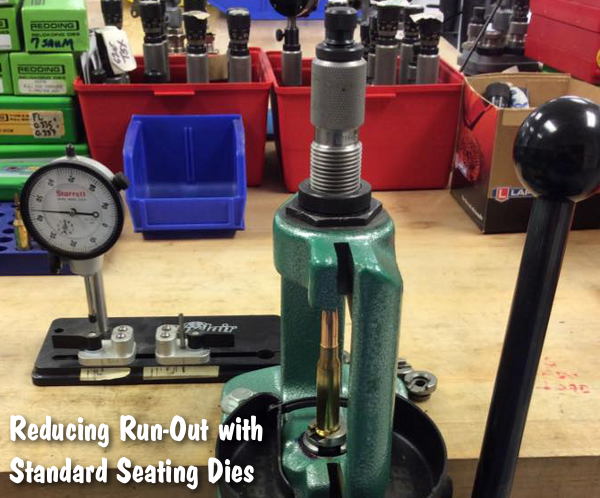
Run-out can be affected by several things: (1) improperly indexing your case while sizing, which includes not using the proper shell holder, especially while using a normal expander ball on the sizing die (it also can stretch the brass). (2) The head of a turret press can flex; and (3) improper or sloppy bullet seating. This is also relevant when it comes to using a progressive press when trying to load accuracy ammo.
Mid Tompkins came up with a simple solution for better bullet seating years ago. Seat your bullet half way into the case, back off the seater die and rotate the case 180 degrees before you finish seating the bullet. It cuts down on run-out problems, especially with military brass. You also want to gently ream the inside of the neck mouth to keep from having any brass mar the surface of the bullet jacket and make proper seating easier. A tilted bullet often means a flyer.
Figure 8: Proper alignment from the center of the case head to the tip of the bullet.
(NOTE: This links to a Web Archive of the original Sinclair Int’l article.)
*Actually some folks would say that if we are talking about things being off-center or out-of-round, we are actually talking about “eccentricity”. But the tools we use are called “Concentricity Gauges” and Concentricity is the term most commonly used when discussing this subject.
Story Tip from EdLongrange. We welcome reader submissions.
On Father’s Day, time spent together is more important than any gift that comes in a box…
Today is Father’s Day, a special Sunday when we acknowledge our patriarchs and show our gratitude for all their hard work and sacrifice on our behalf, and the love they have shown us over the years. If you’re lucky, you’re reading this after having spent a day at the shooting range (or the local fishing hole, or golf course) with your Dad. The important thing is to be together with “Pops” and do something you both enjoy together. If you haven’t finalized your Father’s Day planning, here are some suggestions:
1. Hand-wash and wax your father’s truck or car.
2. Clean your dad’s rifles, or help him put together some handloads.
3. Take your dad out to a live music concert, go to a ball game, or maybe head down to the local fishin’ hole.
4. Go for a hike together or just a drive in the country.
5. Head down to Sears or the local hardware store and let you Dad pick out some new tools.
6. Sit down with your dad, bring a note pad, and ask him to tell you some stories about his youth, or his military experience. This Editor learned some amazing things about his own father this way.
Whatever you choose to do with your father, use your time wisely. Turn off your computer, and go be with your father today. Do something with him that makes him smile. The time spent together is more important than any gift that comes in a box. And, if he lives far from you, give him a call and let him know how important he is to your life. Remind him of the old adage: “Good fathers make good sons”.
When my father, a disabled WW2 Army vet, passed away I received the flag that was draped on his coffin. On most days I fly one of those nylon flags that you can pick up at hardware or department stores. But on holidays, like today, and his birthday, Dad’s flag is out there snapping in the breeze on top of the pole. I find myself talking to him as it gets put up in the morning and comes down at sunset. Hope when the time comes one of my boys will fly my flag. — Bill Slattery Jr.
My father used to play with my brother and me in the yard. Mother would come out and say, “You’re tearing up the grass”! “We’re not raising grass,” Dad would reply, “We’re raising boys”. — Harmon Killebrew.
Gavin Gear, founder of the UltimateReloader.com website, has created a very popular YouTube Channel. Over the past 13 years, Gavin has produced hundreds of videos covering nearly every aspect of reloading, rifle assembly, and gunsmithing. When important new reloading products are released, you’ll often find that the very first, in-depth reviews come from Gavin. He seems to get the new stuff before ANYone else.
And Gavin’s multi-product reviews are legendary, such as his remarkable 14-Press Shootout. That video, in which Gavin set up and operated 14 different single-stage presses, has received over 583,000 views, making it Gavin’s third most popular video of all time. The Single-Stage Shootout video, along with Gavin’s five other most popular videos, are linked below.
Consider this a “Greatest Hits” showcase, with a half-dozen Ultimate Reloader videos that have, collectively, been watched nearly 8.5 million times. We present these videos in descending order of total YouTube views, leading with Gavin’s epic .223 Rem vs. 5.56 video, which has been watched over 5 million times.
.223 Rem vs. 5.56x45mm — 6.3 Million Views
Full Story:https://bit.ly/2neNXAS
This video explains essential facts and corrects common misconceptions related to both .223/5.56 ammunition, as well as .223/5.56 rifles. Gavin provides insight on chamber specs, pressure levels, barrel twist rates, military 5.56 crimped brass, and other important topics. If you are new to the AR world, this video is definitely worth watching. And that’s why it now has garnered over 6.3 MILLION YouTube views, making it one of the most popular gun-related videos ever. Gavin adds: “Don’t forget to check out the full write-up on UltimateReloader.com.”
Lee Loadmaster loading .45 ACP — 1.08 Million Views
The .45 ACP is a classic cartridge, and one of the best for a starting reloader. The case diameter is large enough that you can see the case fill level easily. Also you can pick a powder that won’t allow a mistaken double charge (the case will overflow). In this video, from Gavin’s early days on YouTube, Gavin shows how to run a Lee Loadmaster progressive. Lee should be paying Gavin royalties, as this video have been watched over 1 million times.
AR Handguard Upgrade Step-by-Step — 870,000 Views
The AR15 is truly “America’s rifle”. Along with buttstock replacement, one of the most common upgrades done by AR owners is changing out the front handguard. In this video, Gavin shows how to replace your stock handguard with a modern free-floating system. There can be accuracy improvements with this upgrade, and this also allows you to optimize the ergonomics and weight balance of your black rifle.
Full Story:https://bit.ly/2WS9jE0
This truly may be the “ultimate” reloading press video. Running a full 41 minutes in length, this video shows the features/operation of no less than fourteen (14) modern single-stage presses. No other reloading gear review even come closes to this video in terms of the variety of products covered and the sophistication of the tests. In his full story, Gavin offers comparison charts with sizing force and seating precision comparisons. He also measures ram to press frame fit.
Anyone considering purchasing a single-stage press should watch this video from start to finish. A typical gun magazine review might look at two or three presses, load a few rounds, and then offer some subjective comments. Gavin studied 14 presses, did very thorough testing, and delivered tons of objective data. Listed below are 13 of the presses tested. Click each press name for specific details and test results:
Lee Loadmaster Loading .223 Rem/5.56 NATO — 526,000 Views
Here’s another early video from the Ultimate Reloader YouTube Channel. Gavin shows how to produce .223 Rem/5.56x45mm ammo with an affordable Lee Loadmaster progressive. Gavin explains how to set up the Loadmaster and how to best control priming, case sizing, and powder-dropping operations. For anyone thinking about getting a progressive press, this video is worth watching. Gavin has created many other videos reviewing progressive presses from Dillon, Hornady, and RCBS. And just last year he showcased the amazing Mark 7 Apex 10, a ten-station progressive press marketed by Lyman. Gavin’s Mark 7 Apex 10 was equipped with both case-feeder and bullet feeder, allowing very impressive production rates.
How It’s Made: BAT Custom Rifle Actions — 489,000 Views
Full Story:https://bit.ly/3hD2d11 BAT Machine Co. makes some of the finest custom actions you can buy. Numerous national and world records have been set with BAT actions. To create this 31-minute video, Gavin traveled to Idaho to visit the BAT Machine production center in Post Falls, ID. Gavin talked with BAT’s founder Bruce Thom. The video features extensive footage of advanced CNC machines used to produce the superb BAT actions.
Click Image Below to Visit the Ultimate Reloader YouTube Channel:
The .375 EnABELR cartridge is slightly shorter than a .375 CheyTac so it allows the round to mag-feed. Applied Ballistics is currently using brass made by Peterson. The .375 EnABELR has achieved impressive velocities — 2990 FPS — with prototype Berger 379-grain solid bullets fired from a 1:7″-twist 30″ barrel. Applied Ballistics may also test 1:8″-twist and 1:9″-twist barrels. READ Bullet Testing Report.
The .375 EnABELR cartridge was designed to offer .375 CheyTac performance in a slightly shorter package: “The problem with the .375 CheyTac is that, when loaded with the highest performance .375 caliber bullets (379-407 gr Berger Solids, and the 400-425 grain Cutting Edge Lazers) the round is not magazine feed-able in any action that’s sized for CheyTac cartridges.
“Knowing the .375 CheyTac produced substantial performance, and that it was just too long for magazine feeding, made it easy to converge on a design for the .375 EnABELR. We just had to make the case short enough to achieve magazine length with the desired bullets, while adding a little more diameter to keep the case capacity similar to the .375 CheyTac. The resulting basic shape is quite similar in proportions to the successful .338 Norma Magnum Cartridge which, interestingly, was selected as the cartridge for General Dynamics Lightweight Medium Machine Gun (LWMMG).”
Here is Mitchell Fitzpatrick, shooting the 375 EnABELR in an ELR Competition.
At the request of our readers, we provide select “Deals of the Week”. Every Sunday afternoon or Monday morning we offer our Best Bargain selections. Here are some of the best deals on firearms, hardware, reloading components, optics, and shooting accessories. Be aware that sale prices are subject to change, and once clearance inventory is sold, it’s gone for good. You snooze you lose.
1. KYGUNCO — Savage Axis II Precision, $799.99
⏺ Compares well with tactical rigs costing much more
Here’s a smart choice for PRS/NRL Factory Class. Get the Savage Axis II Precision rifle in 6.5 Creedmoor for $799.99. Add a high-quality scope and you’ll have a complete set up for well under $2K with money left over for bipod, support bags, and other accessories. If you are looking for a metal chassis varmint rifle, Sportsman’s Warehouse has the .223 Rem Axis II Precision in stock for $829.99.
2. MidwayUSA — Crimson Trace 5-Series Tactical Scope Sale
⏺ Really amazing deals on excellent FFP optics for PRS/NRL applications
KILLER DEAL on high-quality First Focal Plane MilRad optics, ideal for PRS/NRL tactical applications. These high-tech Crimson Trace scopes are over HALF OFF now. Grab the 3-24x56mm for $699.99 (61% OFF) or the 3-18x50mm for $599.99 (62% OFF). Both feature 34mm main tubes, tons of elevation, and advanced MR1-MIL illuminated reticles. We’ve looked through these optics and they have good glass and nice controls. These scopes feature EZ Mount Leveling Indicators for quick, precise mounting. All Crimson Trace scopes come with FREE Batteries for life and a Lifetime Protection Warranty.
⏺ Save $120 on this reloading Kit/Sonic Bundle, $519.99 Value
With the shortage of loaded ammo, millions of gun owners are getting into hand-loading. Here’s a good starter kit at a great price. This Hornady Bundle Kit combines a complete reloading set-up with a Hornady ultrasonic cleaning unit. For just $399.99 you get a single-stage press, quality powder measure, digital scale, priming tool, powder trickler, funnel, case prep tools and more. All that would easily be worth the $399.99 price. But with this deal you get all that PLUS a quality L-N-L Sonic 2L ultrasonic cleaning machine as well. This is one of the best bundles we’ve seen — act soon before it sells out.
4. Midsouth — Tumbler Kit Pro with Separator/Sorter, $89.99
⏺ Ample capacity, great reviews, and good value right now
Keeping your brass clean is one of the best ways to keep your dies (and reloading presses) clean as well. If you’re looking for an affordable setup to clean cartridge brass, consider the Midsouth Tumbler Kit Pro. You get everything needed to dry-tumble your brass and then remove the media. Get the combo kit now for a very low $89.99, including Vibratory Tumbler, Media Separator (with bucket), Media, and Brass Polish. The Tumbler Kit Pro will handle 600-1000 handgun cases, or 250-450 rifle cases (depending on size). Nearly all verified purchaser reviews have been five stars.
⏺ Hard to beat bench at this price; swivel seat, 60-lb total weight
The Caldwell® Stable Table, a 60-lb tripod-style bench, offers a 34″L x 23″W top surface with a bench seat that adjusts from 16″ to 22″ in height. The polymer top has two integrated carry handles. These handles double as anchors for two gun-holding forks that can be used when cleaning your rifle. Leg adjustments keep the table and seat parallel even on uneven ground. The overall unit breaks down into seven pieces using a quick-release pin system. Maximum weight capacity is 350 pounds. This bench has earned 80% 5-star reviews from actual purchasers.
6. Sportsman’s WHSE — GET $50 Coupon with $200 Purchase
⏺ Get a $50 Store Coupon with $200 single-item purchase
Here’s a great “Father’s Day Bounceback” promo good through June 20, 2021. Through the 20th if you spend $200 at Sportsman’s Warehouse, you’ll qualify for a $50.00 COUPON. The flyer says: “You read that right, now through June 20 get a $50 coupon when you spend $200 or more on a single purchase. We’ll send you a code to use online between July 5-18, 2021.” Remember to get the $50 coupon, the $200 (or more) must be on a single purchase — you can’t add up multiple items.
7. Browning — Summer Rebate, Save up to $50 on Guns
⏺ Great Price on versatile self-Loader for plinking or NRL22
Get up to $50 back when you buy an eligible new Browning firearm at retail between May 28 and July 5, 2021. This applies to NEW guns purchased from a Browning Dealer. You get $50 Off Citori shotguns, $25 Off X-Bolt rifles (and A5 or Maxus II shotguns), and $10 Off Browning pistols. To submit your rebate request, visit Rebates.browning.com.
⏺ Strong yet light boots with good ankle support — big savings
These Viktos Boots can serve many functions — hiking, work, pretty much any outdoor activity. The combination of leather and nylon offers good protection with lighter weight than an all-leather boot. We liked this $99 deal so much this Editor bought a pair. These same Viktos boots sell elsewhere for $180.00.
9. Amazon — Motion-Sensor LED Interior Light, $13.99
⏺ Activates when door opens, Rechargeable, 3 LED Light Levels
Here’s a great accessory for your Gun Safe or closet. This rechargeable LED Lamp turns itself on when you open the door, and off when you close the door. Select three brightness levels: 10LED, 20LED, 30LED. With the supplied 3M adhesive magnetic strip you can easily attach the light to the inner walls of your gun safe. And then quickly remove the unit for charging with a standard USB cord (no batteries to replace!). It works, it’s handy, and it’s inexpensive — just $13.99 on Amazon (plus you may see a $2.00 off coupon). These motion-sensor LED lamps can also be used in garages or stairwells.
10. Amazon — Howard Leight MAX Earplugs, $9.50/50 Pairs
20 Pairs
50 Pairs
⏺ Best NRR (33 dB), Very Comfortable, Great Value
These Howard Leight NRR 33 Max Plugs are your Editor’s favorite foam earplugs. Between shooting, motorcycling, and mowing lawns, I probably have Max plugs in my ears 2-3 days a week. This is a very good price for a bulk pack of 50 pairs. NRR 33 is the best Noise Reduction Rating you’ll find for plugs alone. And if you act soon, you can get free shipping to boot.
When you make a reloading mistake, you may need to “pull down” assembled ammo. The embedded UltimateReloader.com video demonstrates how to use the Hornady Cam-Lock bullet pulling system.
When Reloading Goes Bad — The Danger of Over-Charging
Our friend Gavin Gear of UltimateReloader.com was recently reloading some 9mm pistol ammo with his Hornady progressive press. As part of his reloading procedure, he visually checks the cases — and he noticed that the charges seemed high. Sure enough, his most recently-produced rounds were about two grains over spec. He diagnosed the issue: “I was using a powder measure without a baffle. What happened was, over the course of the loading session, things settled in, and the charge level increased.”
Not knowing just when his powder measure started delivering too much powder, Gavin decided, for safety’s sake, to pull down all the ammo he had just reloaded. Yes that’s time-consuming, but it’s better than the alternative — having a dangerous Kaboom while shooting. With fast-burning pistol powders, a two-grain over-charge could cause a blown case, damaged firearm, and/or serious injury.
Watch Cam-Lock Bullet Puller Used to Remove Bullets from Loaded Ammo:
Use of Bullet Puller starts 4:00 minutes into video.
Gavin says it is vitally important to perform safety checks during the reloading process: “You’ve got to do it — check every single round to make sure there IS powder, and that there’s not too MUCH powder. Double, Triple, Quadruple check your components… and your powder charges. You can’t be too careful.”
To pull down a loaded round, first place the cartridge in the shellholder on your press ram. Then raise the round up into the bullet puller device installed where a die would go. The Hornady Cam-lock bullet puller works by clamping the bullet in a collet when you flip down the red-coated lever. Then, with the case held by the rim in the shell-holder, the bullet exits the cartridge as the press ram is lowered. It takes time, but it’s pretty fool-proof once you get the hang of it. This entire process is illustrated in Gavin’s video, starting near the four-minute mark.
The Hornady Cam Lock Bullet Puller has four (4) key components: 1. Cam-Lock die body; 2. Cam-Lock lever; 3. Stem; and 4. Collet (Caliber-specific).
NOTE: In order to use this tool, you’ll need the appropriate collet for each diameter range of bullets you intend to pull. For example use collet #3 for 6mm, collect #6 for 7mm, and collet #7 for .308 Caliber.
RCBS Lock-Out Die
A good safety option for users with progressive presses is the RCBS Lock-Out Die. This has a charge detection rod that dips into each case after powder has dropped. You adjust the die to the proper charge height for your desired load. If the actual dispensed charge is too high or too low, the Lock-Out Die senses the problem and stops the press from advancing to the next case (it does this by preventing the ram/shellplate from fully elevating). We’ve used the Lock-out die with success for both pistol and rifle cartridges. It’s sensitive to about one-half grain with pistol powders.
This Lock-Out Die works with Hornady and Dillon progressives as well as with RCBS progressives. It does take up one die station on the press.
The U.S. Army Marksmanship Unit regularly publishes a reloading “how-to” article on the USAMU Facebook page. One excellent “Handloading Hump Day” post covered preparation of once-fired 5.56x45mm brass. This article, the first in a 3-part series, has many useful tips. If you shoot a rifle chambered in .223 Rem or 5.56x45mm, this article is worth reading.
This week, Handloading Hump-Day will answer a special request from several competitive shooters who asked about procedures for morphing once-fired GI 5.56mm brass into accurate match brass for NRA High Power Rifle use. The USAMU has used virgin Lake City (LC) 5.56 brass to win National Championships and set National Records for many years. In this 3-part series, we’ll share techniques proven to wring match-winning accuracy from combat-grade brass.
GI brass has an excellent attribute, worth noting — it is virtually indestructible. Due to its NATO-spec hardness, the primer pockets last much longer than most commercial brass when using loads at appropriate pressures.
Preparing Once-Fired GI 5.56 Brass for Reloading (Part 1 of 3)
Assuming our readers will be getting brass once-fired as received from surplus dealers, the following steps can help process the low-cost raw material into reliably accurate components.
1. Clean the Brass
First, clean the brass of any dirt/mud/debris, if applicable. Depending on the brass’s condition, washing it in a soap solution followed by a thorough rinsing may help. [This step also extends the life of the tumbling media.] Approaches range from low-tech, using gallon jugs 1/2 full of water/dish soap plus brass and shaking vigorously, to more high-tech, expensive and time-consuming methods.
2. Wet-Tumbling Options (Be Sure to Dry the Brass)
When applying the final cleaning/polish, some use tumblers with liquid cleaning media and stainless steel pins for a brilliant shine inside and out, while others take the traditional vibratory tumbler/ground media approach. Degree of case shine is purely personal preference, but the key issue is simple cleanliness to avoid scratching ones’ dies.
If a liquid cleaner is used, be SURE to dry the cases thoroughly to preclude corrosion inside. One method is to dump the wet brass into an old pillow case, then tilt it left/right so the cases re-orient themselves while shifting from corner to corner. Several repetitions, pausing at each corner until water stops draining, will remove most water. They can then be left to air-dry on a towel, or can be dried in a warm (150° F-200° F max) oven for a few minutes to speed evaporation.
Shown below are Lake City cases after cleaning with Stainless Media (STM). Note: STM Case cleaning was done by a third party, not the USAMU, which does not endorse any particular cleaning method.
3. Inspect Every Case
Once dry, inspect each case for significant deformation (i.e., someone stepped on it), damaged mouths/necks and case head/rim damage. Some rifles’ ejectors actually dig small chunks of brass out of the case head — obviously, not ideal for precision shooting. Similarly, some extractors can bend the case rims so badly that distortion is visible when spinning them in one’s fingers. These can be used for plinking, but our match brass should have straight, undamaged rims.
Dented case mouths are common, and these can easily be rounded using a conical, tapered tool, [such as a .223 expander mandrel. A dummy 7.62 or .30-06 cartridge with a FMJ spitzer can also work.] If most of your brass is of one headstamp, this is a good time to cull out any odd cases.
4. Check the Primers Before Decapping
Your clean, dry and inspected brass is now ready for full-length sizing, decapping and re-priming. Historically, primer crimps on GI brass have caused some head-scratching (and vile language) among handloaders. Our next installment will detail efficient, easy and practical methods to remove primer crimp, plus other useful handloading tips. Until next week, Good Shooting!
NOTE: The USAMU Handloading (HL) Shop does not RE-load fired 5.56 brass. We use virgin LC brass with our chosen primer already staked in place. However, our staff has extensive personal experience reloading GI brass for competition, which will supplement the Shop’s customary steps. In handloading, as in life, there are many ways to accomplish any given task. Our suggestions are note presented as the “only way,” by any means. Time for loading/practicing is always at a premium. Readers who have more efficient, alternative methods that maintain top accuracy are invited to share them here.
Accuracy Potential of Mil-Surp 5.56×45 Brass
So, how accurate can previously-fired GI surplus brass be in a good National Match AR-15? Well, here’s a data point from many years ago that might be of interest. A High Power shooter who wrote for the late Precision Shooting magazine took a Bill Wylde-built AR match rifle to a registered Benchrest match. His first 5-round group ever fired in a BR match was officially measured at 0.231″ at 200 hundred yards. This was fired in front of witnesses, while using a moving target backer that confirmed all five rounds were fired.
He recounted that his ammo was loaded progressively with factory 52gr match bullets and a spherical powder using mixed years of LC brass with no special preparation whatsoever. Obviously, this was “exceptional”. However, he had no difficulty obtaining consistent 0.5-0.6 MOA accuracy at 200 yards using LC brass and a generic “practice” load that was not tuned to his rifle.
Saving Money by Using GI Brass
So, with good commercial brass readily available, why would one go to all the extra steps necessary to process fired GI brass? [Editor: It’s about saving money.]
Economically, it makes great sense. When the author was actively practicing and competing with the service rifle, he had ~3,000 rounds of 5.56mm brass, which allowed him to load during winter and spend most time in the summer practicing. If one were wealthy and wanted to shoot nothing but the finest imported brass, the current cost of 3,000 is ~$1920 (plus shipping.)
Dropping down to good, but less-expensive new, U.S. commercial brass brings the price to a much more realistic ~$720. However, at current rates, the same amount of surplus GI once-fired brass costs between $120 — $150, leaving lots of room in the budget for other expenses. [Editor: that’s less than 10% of the cost of the best imported brass.]
At the request of our readers, we provide select “Deals of the Week”. Every Sunday afternoon or Monday morning we offer our Best Bargain selections. Here are some of the best deals on firearms, hardware, reloading components, optics, and shooting accessories. Be aware that sale prices are subject to change, and once clearance inventory is sold, it’s gone for good. You snooze you lose.
1. Palmetto State Armory — Savage A22 .22 LR, $249.99
⏺ Great Price on versatile self-Loader for plinking or NRL22
Looking for an affordable, versatile .22 LR rifle for NRL22 rimfire matches, varminting, and fun shooting? The Savage A22, now just $249.99 on sale, is a great value. The A22 features a strong steel receiver, chromed bolt, 10-round rotary magazine, and adjustable Savage AccuTrigger. The A22’s rotary magazine offers fast cycling, while the delayed blowback action is safe and reliable. For gun games where speed counts, we like semi-autos — follow-up shots are way faster than a bolt-action.
2. Midsouth — Frontier .223 Rem 55gr HP Ammo, $12.99/20
⏺ Yes, finally — .223 Rem ammo IN STOCK at a reasonable price!
Looking for good .223 Rem ammunition without breaking the bank? Midsouth has Frontier .223 Remington 55 Grain Hollow Point ammo in stock at just $12.99 per box of 20 rounds. Quality .223 Rem ammo at $0.65 per round is about the best deal you’ll find these days. So grab some now before it’s all gone. Verified buyers say this ammo is dependable.
3.Graf & Sons — Magnetospeed Sporter Chronograph, $170.99
⏺ Great Deal on efficient, reliable, easy-to-use Chronograph
Priced at just $170.99, the Magnetospeed Sporter Chronograph model costs less than half as much as Magnetospeed’s V3 models. This chronograph attaches directly to your barrel so you don’t have to go downrange to set up sky-screens or tripods. For most people the Sporter Model contains all the features they need. Using Magnetospeed’s XFR adapter (sold separately), data can be transferred easily to your mobile device. Check out this Magnetospeed Sporter Review to learn more.
⏺ No FFP scope can rival this 6-24X Athlon anywhere near this price
Looking to get into PRS or need an affordable FFP scope? Check out this Athlon Argos BTR 6-24X50mm riflescope. Now deeply discounted, this versatile optic features a wide 6-24X magnification range — just about perfect for PRS (or varmint hunting). Controls are precise and glass is surprisingly good. The Argos BTR’s advanced ATMR reticle features a 2 MOA center cross and 2 MOA hashmarks to compensate for bullet drop and wind drift. This scope has a First Focal Plane (FFP) reticle, meaning the reticle hashmarks stay constant relative to the viewed target as you zoom in or out.
5. Creedmoor Sports — Radians Safety Product Sale
⏺ All Radians products now discounted 10-15%
Protecting your vision and hearing is vital. Every shooter needs good eye and ear protection. If you’re looking to upgrade your current safety gear, check out the Radians Safety Equipment Sale over at Creedmoor Sports. You can find everything from earmuffs to custom fit earplugs to ANSI Z87.1-certified safety glasses, all on sale. Head over to Creedmoor Sports this week for 10-15% savings on quality eye and ear protection.
6. Amazon — Lyman Brass Smith Xpress, $119.99
⏺ Efficient, well-designed power trimmer that indexes off shoulder
Trimming brass is critical to precision reloading. However, with most case trimmers it’s a pain to adjust trim length, plus the hand-cranking becomes tiresome. A better, more efficient case trimming solution is offered by the Lyman Brass Smith Case Trim Xpress. We like this case trimmer for good reason. The smart design allows for .001″ trim length adjustments with the click of a dial. The tool ships with 10 bushings that cover the most popular neck sizes on the market. To see a video of the Case Trim Xpress in action, check out our Lyman Case Trim Xpress Review.
7. EuroOptic — SIG Sauer Kilo1000 Laser Range Finder, $129.99
⏺ Insanely low price on good Laser Rangefinder for hunters
Get a quality Laser Rangefinder at an insanely low price. Right now the SIG Sauer Kilo1000 Laser Range Finder is just $129.99 on sale at EuroOptic. This unit is probably all a hunter needs for most ranging chores. SIG says it is good to 1200 yards on reflective targets, 800 yards on trees and 600 yard on animals such as deer. The handy Kilo1000 LRG is compact and easy to carry. Note: EuroOptic also has BDX model SIG Sauer LRFs on sale. These BDX units communicate via bluetooth with your Ballistics App. The SIG Kilo 1000 with BDX is $199.99. If you want more performance, EuroOptic also has longer-range-rated SIG Laser Rangefinders for a bit more money. For example the 2200-yard-rated Sig2200 BDX is $319.99 on sale, a $180.00 savings.
8. Amazon — Brifit Digital Mini Scale, $16.99
⏺ Good, very compact scale for component sorting, many positive reviews
Handloaders can benefit from having a speedy, compact digital scale for basic tasks. Use this as a supplement to your ChargeMaster or premium, full-size scale. The very affordable Brifit Digital Mini Scale is great for sorting duties — weighing bullets, brass, primers and other items. This handy Brifit pocket scale measures up to 200 grams, with stated precision of 0.01 grams. With the push of a button, you can switch between grams, ounces, or grains instantly. This $16.99 Brifit scale ships with a 50 gram calibration weight. The unit boasts a nice LCD Backlit Display and “Auto Off” feature that saves battery life.
9. Amazon — Meralian Range Bag and Pistol Tote, $26.99
⏺ Great Value for Range Bag that holds multiple pistols, muffs, and mags
Here’s a well-designed, functional range bag at a good price — just $26.99. The Meralian tactical pistol range bag is great for hauling handguns. With a 13″ x 7″ x 9″ main compartment, there’s plenty of room for your pistols, ammo, and safety gear such as muffs and eye protection. Under an outer zip panel are six dedicated pouches for magazines. This range bag is currently available in four colors. You may want to select a bright color so your bag stands out at the range.
10. Amazon — Feyachi AR Brass Shell Catcher, $11.99
⏺ Many great features — holds its shape, easy to empty
Shooting AR-platform rifles can be fun but they can eject spent cases a considerable distance. Nobody likes to chase down the fired brass tossed out by these semi-auto rifles.
An easy fix for brass-chasing chores is the Feyachi Brass Shell Catcher. This attaches to the side of your AR and capture all your ejected cases. This new version features a strong 45-deg upper wire frame so the entire unit sticks out further and holds its shape better. There is also an updated Velcro attachment plus reinforced mesh that retains large amounts of brass. With these design enhancements, this is a smart choice AR brass-catcher. This unit also boasts a zipper at the bottom for quick and easy brass removal.
The 600-yard target has an X-Ring 6 inches (1 MOA) across, while the 10-Ring spans 12 inches (2 MOA).
The following article is about reloading for NRA/CMP Highpower Rifle competition and is geared toward competitors shooting the AR15 Service Rifle. In Highpower Rifle competition, shooters fire in four stages: Standing slow-fire at 200 yards, Sitting rapid-fire at 200 yards, Prone rapid-fire at 300 yards, and Prone slow-fire at 600 yards. Competitors use a sling for support in all positions but standing. A typical AR15 Service Rifle sports a 20″ free-floated barrel and a 4.5-pound trigger. Service Rifle scopes are limited to maximum power of 4.5X.
Thoughts on Loading for Service Rifles, Particularly for 600 Yards
by Danny Arnold, Team CMP Article originally published in CMP Shooting News
Before we get started, I want to stress that all of the information that follows is geared toward the .223/5.56 Service Rifle. That doesn’t mean that there’s nothing here for anyone else, but the .223/5.56 Service Rifle platform is where I’ve spent the majority of my time, so here we go.
There is only one “Perfect” 600–yard load for my rifle, True or False? This example is more anecdotal than scientific, but it provides some food for thought….
Team CMP spent the early part of March competing in the Orange Blossom Regional. As soon as we got on the range, Sara Rozanski (Team CMP member) started having problems with her 600-yard ammunition. Nearly 1/3 of her cases were exiting the chamber minus the primers. I offered to swap my ammunition for hers, suspecting that my Wylde chamber would be more forgiving than her CLE chamber — a solution that seemed to solve the problem. At least neither of us was blowing primers!
Sara’s ammunition was a factory load using a well-known 80+ grain bullet with an unknown primer and powder, using brass from a respected manufacturer. My load was a different brand of 80-grain bullet, with my choice of powder and primer, all in brass made by someone else. Given the color of the primers, the only thing that our ammunition could possibly have had in common was the brand of powder… maybe. So, how did we shoot?
Sara and I shot the two-person team together and the entire 2,400 Aggregate, although on different relays. Sara’s combined 600-yard score was 780-28X (97.5%). Mine was a 783-24X (97.87%). Our scores were never more than two points apart on any of the four days. Keep in mind that we were using each other’s ammunition the entire time.
So, we had different barrels, chambers and ammunition, but similar results. That goes back to the idea that a good load will perform similarly if fired in a good barrel.
Are We Too Focused on Ballistic Coefficients (BCs)?
The revailing wisdom has always trended toward loading the highest-BC bullet we could find and pushing it as fast as possible. Back in the early ’90s when I got started with the AR15, the 80-grain Sierra was state of the art. Actually, I picked up all of my Leg points with it, although today it looks a bit dated — kinda like me.
So, the question I’ll pose is this: Would you rather shoot a high-BC bullet that groups 3/4-MOA (minute of angle) or a lower-BC bullet that groups into one-half-MOA traveling 50 feet-per-second faster? The reason that I posed this question is a situation I found myself in a decade ago. Our coach decided that he wanted us to pair-fire some 600-yard for practice. Unfortunately, I hadn’t gotten the memo and all that I had available was my normal short-line ammunition, loaded with a 77-grain bullet. The shooter I was paired with was using a higher-BC bullet than I was, but in the end, we both shot 198s.
Admittedly, using 77-grainers meant that coach had to work a little harder to keep us together on target, but it was a teaching moment for me. I knew that my upper shot 77s better than the available bullets in the 80-grain range, so I cranked out a windage table for the 77-grain bullet at 600 yards and shot those for the rest of the season. After all, the wind blows ALL bullets around. It’s just a matter of knowing what YOUR bullet is doing.
With the shortages that we’re experiencing right now, a lighter bullet may be all that you have available for the 2021 season. That doesn’t mean that you’re disadvantaged though.
Danny Arnold teaching Highpower Clinic at 2021 CMP Eastern Games
Loading High-BC Bullets
In the past decade, several bullets have appeared that weigh 80-grains or more. One thing that many of them have in common is a very sharp nose profile, whether metal or polymer. The question is: Are you using the right seating stem?
The jacket material in the bullet’s nose is very thin. If you section a bullet, you’ll find that there is a surprising amount of air space in the nose. If you’re using older seating dies, your seating stem may be contacting the bullet nose too close to the tip, where the jacket is the both thinnest and is unsupported by the lead core. This can manifest itself either as a deformation at the very tip of the bullet or as a circular dent around the bullet nose that you can see and feel with your thumbnail. I think we can all agree that denting a bullet is usually considered a bad thing.
One company goes so far as to recommend their proprietary seating stem for use with their high-BC bullets. Other companies leave it up to you to find a seating stem that will allow the bullet nose to go deeper into the seating stem, moving the contact point further down the bullet where the jacket is thicker and supported by the core material.
Seating Depth and Bullet Preferences
Some bullets don’t mind some “jump” into the lands, but some really do. Unfortunately, manufacturers don’t tell you much about that. Your chamber configuration (Wylde, CLE, or some hybrid of the two) and the bullet that you choose will determine your optimal seating depth. Long and short of it, a quality measuring tool to determine seating depth is a necessity these days. Keep in mind that if you’re doing this with a brand new barrel, the throat is likely going to change slightly in the first 200 rounds and may need to be re-measured. Actually, since all of your short range ammunition has to be loaded to magazine length, you’re probably better off developing your short range loads before starting on long range load development. That gives the throat a chance to wear in a bit on a new barrel.
Brass Prep — Why It Is Important
When match-grade AR15s first arrived on the scene, it was amazing how little it took to get them to shoot well. Other than making sure that I had brass from the same lot and running it through a set of match-grade dies, I did nothing. Of course, we were also using a post front sight. Was the occasional bad shot me, the rifle, the load or just an archaic sighting system?
Transitioning to optics has caused me to reconsider how and what I do in my reloading process: That, and having some extra time on my hands to experiment.
A little (or a lot) of time spent with a neck turning tool, a primer-pocket uniformer and a flash-hole reamer will quickly show you how consistent brass is by manufacturer and even by individual lot. That exercise also makes the prices charged for high-quality brass seem ridiculously cheap. That doesn’t mean that I advocate neck-turning or other uniforming practices, nor do I advocate spending scandalous amounts of money on long-range brass. However, our sport is about consistency. The consistency of your brass is a matter of choice, whether you choose to simply segregate cases by weight (cheap option), neck turn (labor intensive) or open your wallet a little wider for premium brass.
Weighing Charges vs. Throwing with Powder Measure
To measure or weigh? For a long time, I used a powder measure to throw all of my 600-yard loads. The powder I was using metered well, and the results downrange didn’t justify the extra time spent with a scale. That was in the day of iron sights though. Nowadays, I’m throwing my charges and trickling up to the desired weight as measured on a scale that weighs to a 100th of a grain.
To quantify the difference between individually weighing each charge versus throwing charges with a powder measure, I weighed six kernels of powder that I trickled into the pan and then dumped them into the hopper. Going through that process 10 times, I came up with an average weight of .08 grains for six kernels. Next, I threw 50 charges for weighing using my powder measure. If I felt the measure hanging up as it cut kernels, I put the charge back into the hopper without weighing it.
That’s six kernels of powder sitting in the pan — average weight .08 grains.
Those 50 smoothly-thrown charges varied .26 grains from lowest to highest, with the majority varying no more than .16 grains from highest to lowest. If the desired weight was exactly in the middle, at worst you’d be .13 grains (9-10 kernels) low or high, with the majority being off no more than .08 grains (6 kernels) above or below the desired charge weight. Is that enough to send a shot outside the 2-MOA 10-Ring? Probably not.
Has more consistent brass and weighing charges to one-hundredth (0.01) of a grain added up to higher scores? Honestly, this question is hard to answer. Looking at the results on paper at 200 yards, using a powder that meters well combined with a consistent touch on the loading lever doesn’t appear measurably different than meticulously weighing each and every powder charge. Looking back over my 600-yard plots however, I can see a trend toward a group that is closer to X-Ring height.
Since the bullseye is widest at the center, shooting groups that are the height of the X-ring gives you more room for error when the wind is blowing. That can translate into higher 600-yard scores.
How You Load Your Ammunition vs. How You Load Your Rifle
The loading/chambering cycle of the AR-15 is, in a word, violent. You have a relatively heavy bolt and carrier assembly under power of a stout buffer spring slamming forward to chamber each round of ammunition. By design, those rounds were supposed to be held securely by the magazine feed lips until the bolt stripped them off the follower. Obviously, due to their overall length, 600-yard loads can’t be chambered that way. Although the barrel extension is funnel-shaped, it’s also got a lot of “teeth” ringing the inside of it (see below).
Whether you’re using a standard magazine or a single-round loading device (SLED), dropping a round in the loading port and releasing the bolt is an act of faith in that you’re trusting the bullet to arrive in the chamber undamaged.
Ask yourself, how many times have you seen someone drop a round on the follower, press the bolt release and watch as the bolt jammed on a cockeyed round? If that happens once every 100 tries, how many times did the bolt close on a scratched, dented, or misaligned bullet? Could that be the cause of the occasional errant shot?
My technique is to drop each round on top of the SLED and then push it slightly forward with my finger, partially chambering it before releasing the bolt. Admittedly, some people may be unable to do this due to body configuration or left-handedness, but why go to all the trouble of loading “perfect” ammunition and then damage it on the way into the chamber?
Now that we’ve covered bullets, brass, and assorted errata we can move on to discussing loads for 600 Yards…
The NRA Highpower 600-yard target has a 6-inch (1 MOA) X-Ring, and a 12-inch (2 MOA) 10-Ring.
Load Development for 600 Yards
Finding a load for 600 yards is a lot like finding a load for short range. Once I decide on a bullet, powder, primer, velocity range and a measured guesstimate of seating depth, I load 10 rounds of each test load, increasing in 0.2 (2/10) grain increments. I test them from the prone position at 200 yards. Ideally, I want to see two loads that are 0.2 (2/10) of a grain apart that shoot almost identical groups. The load that I choose will fall in between the two best shooting loads that I tested. If the first load is XX.2 grains and the second is XX.4 grains, my chosen load will be XX.3 grains.
Why develop loads in 0.2-grain (tenths) increments if I have a scale that measures in 0.01-grain (hundredths) increments? Or, why not test in 0.1-grain increments?
For me, working in 0.2-grain increments gets me to the results quicker. Also, there is a difference between accuracy and consistency in this scenario. Developing loads in 0.2-grain increments gets me to an accurate load. Producing that load using a scale that accurately measures to .01-grain insures a consistent load, assuming that I do my part.
Once I’ve settled on a load, it’s time to play with seating depth, if I choose to. If I’m lucky and the groups are acceptable as-is, I won’t do anything. If I think there’s room for improvement, I’ll experiment a little. Depending on the bullet, changing the seating depth by a couple of thousandths one way or the other may change the group size. During this phase of testing, it’s a good idea to chamber a round and see if the entire round will then extract. If you leave a bullet stuck in the throat, your rounds are too long. Finding that out at a match can ruin an otherwise good day.
Danny Arnold shooting his AR15 Service Rifle, standing position at 2021 CMP Eastern Games.
Another thing to keep in mind is that your barrel is not static. Every round fired has an effect on the throat, vaporizing and scouring away metal until the distance the bullet travels before meeting the rifling measurably increases. If you have chosen a bullet that shoots best when close to the lands, you’ll need to periodically re-measure and possibly change your bullet seating depth to maintain that optimal relationship.
The Elephant in the Room — User Skill Level
There’s really not a delicate way to put this, so I won’t try. There’s little point in spending time and effort developing a load that shoots into half-MOA off the bench if you’re only capable of shooting 2 MOA using a sling right now.
That doesn’t mean that there’s no hope. On the contrary, it just means that your time and effort is better spent practicing with some good short-range ammunition on reduced targets at a 100 or 200-yard range. At that distance, wind is not a factor and your technique can be improved more quickly so you’re in a position to benefit from that ½ MOA ammunition.
About Team CMP
CMP has created a Highpower Team with top competitors. Team CMP competes at several events throughout the year and most importantly, helps to teach Highpower Clinics at CMP Competition Events. Learn from Team CMP at Camp Perry during the Advanced Highpower Clinic, scheduled this year for July 30 through August 1, 2021. Visit the Highpower Clinic Web Page for more information.
The Civilian Marksmanship Program is a federally-chartered 501(c)(3) non-profit corporation. It is dedicated to firearm safety and marksmanship training and to the promotion of marksmanship competition for citizens of the United States. For more information about the CMP and its programs, visit www.TheCMP.org.