Many of Hodgdon’s most popular powders, such as Varget and H4350, have become very hard to find. Shipments sell out as soon as they reach retailers’ shelves. We know our readers and Forum members are concerned about these supply shortages. Why are these powders in such short supply, and what is the prospect for more Varget, H4350, and other Hodgdon powders in the months ahead?
Hodgdon answered these (and other) questions recently in a Q&A post on the Hodgdon Facebook Page. Here are highlights of those Questions and Answers.
HODGDON POWDER UPDATE Frequently Asked Questions
Here are answers to your questions straight from Hodgdon, 1/31/2020:
Q: Why can’t I find Hodgdon powders like H4350, Varget, Retumbo, and H1000?
As you have seen, Hodgdon powders, especially rifle powders for long-range and precision shooting, can be difficult to find. Dealer shelves that were formerly filled with cans of powder now have empty spots. [Hodgdon added: “Dealer shelves are empty because powder is purchased as soon as it arrives at the dealers’ stores.”]
Q: Is Hodgdon still making powder?
A: Yes, we continue shipping powder as quickly as possible. In fact, we will ship more powder in 2020 than last year. The real problem behind empty dealer shelves is complicated, but is related to shifting supply and demand challenges. As supply decreased in 2019, demand only increased. No one wants to ship more powder than Hodgdon.
Q: What is causing the supply challenges?
A: Quite simply, our manufacturing facilities have not kept up with our orders. Additionally, military contracts began specifying Hodgdon powders in the last few years for military ammunition, impacting our supply. With expanded government regulation, shipping explosive and energetic materials has become more challenging, which also impacts available supply. Lastly, rapidly changing consumer preferences for different powder types has impacted both demand and supply. We worked with all Hodgdon providers to resolve open issues and expect powder supply to improve in 2020 as a result.
Varget, H4350, H4831SC, and other ‘Extreme Series’ powders are in very high demand.
Q: Is the shortage of reloading powder being caused by Hodgdon shipping their powder to the ammunition manufacturing companies?
A: While Hodgdon does sell powder to ammunition manufacturing companies, more than 80% of our powder is sold to our core market – handloaders just like you. Hodgdon has always been committed to the individual handloader.
Q: When will I start to see more powder on dealer shelves?
A: While Hodgdon will continue to ship powder as rapidly as possible, we have a significant backlog in demand. Some powders will be in stock more quickly, but we believe it will take much of 2020 to improve availability for all powders. [Editor: In a separate post, Hodgdon stated “We will be sending out large amounts of H4350 starting mid-March.”]
When we first ran this story a while back, it spurred a hot debate, with strong opinions on both sides of the issue. Some guys argued vehemently that volumetric powder dispensing was best — citing the experience of short-range benchresters, most of whom still throw their charges. Others say weighing your charges is best, so long as you have a very precise, and very repeatable scale. Many of the top F-Class and 1000-yard shooters now weigh their charges to the kernel.
Most competitive long-range shooters weigh powder charges for their handloads. Some even use ultra-precise magnetic force restoration scales to load to single-kernel tolerances. But is weight-based measuring always the best way to fill a case with powder? Another option is volumetric charging. This method fills a precisely-sized cavity with powder and then dumps the charge into the case. A Harrell’s rotary powder measure works this way, as does the sliding powder filler on a Dillon progressive press.
For long-range applications, most people believe that precise weighing of powder charges is the best way to achieve optimal accuracy and low ES/SD. However, those short-range Benchrest guys do pretty darn well with their thrown charges, at least at 100 and 200 yards.
Our friend Dennis Santiago recently observed something that made him scratch his head and wonder about weighing charges. His AR-15 match rifle shot better with volumetric (cavity-measured) charges than with weighed charges dispensed by an RCBS ChargeMaster. Here’s what he reports:
Cavity vs. Dribble (Dennis Santiago Report) I had the chance to compare nominally identical ammunition loaded two ways. These were all .223 Remington match loads using 77gr Sierra Match Kings over 23.4 grains of Hodgdon Varget. Same gun. However I loaded some ammo with charges dispensed with a Lee cavity-style powder measure while other rounds were loaded with powder weighed/dispensed by an RCBS ChargeMaster. The cavity-drop ammo (with powder dropped from the Lee unit) was consistently better than the weighed-charge ammo. I have no idea why…
So, ladies and gentlemen — what do you think? Why did Mr. Santiago’s volumetrically-charged ammo shoot better than ammo filled with weighed charges? What’s your theory? Gary Eliseo suspects that Dennis’s Chargemaster might have been drifting. What do you think? Post your theories in the comments area below.
Intro: Ron Dague wanted a new gun that was similar to his trusty .223 Rem rifle, but which fired 6mm bullets. There is a superb choice of bullets in this caliber, and Ron found that the 95gr Berger VLD could be driven to a healthy 2,604 fps by the small .223 Rem case. This 6mm wildcat based on the common .223 Rem offers excellent accuracy and very low recoil — something very important in the cross-the-course discipline. In addition, Ron’s 95gr load with Reloder 15 delivered an ES of just 4 fps over ten shots. That exceptionally low ES helps achieve minimal vertical dispersion at 600 yards.
I already had a .223 Remington match rifle, and I wanted the 6mm-223 to be as close to the same as I could make it. I installed the barreled action in a wood 40X stock to work up load data and work out any magazine feeding issues. While I was working on that, I looked for a McMillan Baker Special stock and finally found one to finish this project. I bedded the action and stock, then took the rifle to the range to check zeros on the sights and scope. I was surprised that I didn’t have to change anything on the sights. I thought changing the stock would cause sight changes. The thought went through my head, “Maybe the 40X stock isn’t all that bad”.
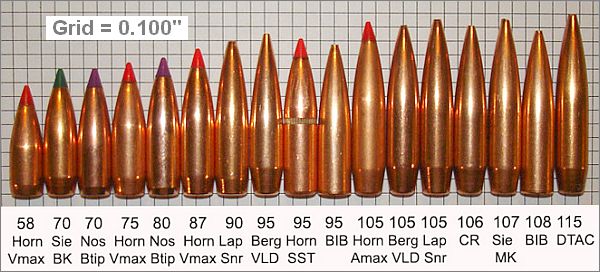
Here’s line-up of 6mm bullets. The Berger 95gr VLD is in the middle.
I took the new rifle to the first match of the year, a National Match Course match, and my off-hand score was 83, rapid sitting 95, rapid prone 95, and slow fire prone 197 — for total aggregate 470. This may not be my best work, but on match day the wind was blowing about 15 mph and the temp was around 40° F, with rain threatening. This was a reduced course of fire — we shot at 200 and 300 yards on reduced targets.
I used 70gr Berger bullets for this match, loaded in Remington brass with 25 grains of VihtaVuori N540 and Federal 205M primers. When I worked up loads for this rifle, N540 gave the best accuracy with the best extreme spread — 2,950 fps with an extreme spread of 20 fps on a 10-shot string. The load for 600 yards was with a 95gr Berger VLD bullet, with 23.0 grains of Reloder 15, Lapua cases, and the same Federal 205M primers. This load is 2,604 fps, with an extreme spread of 4 fps over a 10-shot string. I’ve shot this load at several 3×600 yard matches, and the accuracy has proven to be very good. At the last 3×600 match, my scores were as follows: 199-10x and 198-11X with scope, and 193-10X with iron sights. Best 600-yard score so far with iron sights was 198-12X.
6mm-223 Rem Rifle Specifications: 700 BDL action and floor plate, Bartlein 6mm 1:8″ twist, McMillan Baker Special stock in Desert Camo, Centra front and rear sights, Ken Farrell bases with stripper clip guide, Sinclair hand stop, and Jewell trigger. Gunsmith Neil Keller helped me with the metal work and instructed me on the action work and re-barreling.
RCBS makes some of the most rugged and durable reloading products you can buy. The RCBS Rock Chucker press is legendary — for good reason. The Editor uses one that has been in my family over twenty years. I also own an RCBS 2000 progressive press that has loaded many thousands of rounds, and features the excellent APS strip priming system. RCBS is serious about reloading, so this company has created a very complete series of instructional videos showing reloading precedures and equipment. You’ll find over 60 videos on the RCBS Video Resources Page and RCBS YouTube Channel.
We encourage readers to check out the RCBS Videos. They can help you master the basics of handloading — case prep, priming, sizing, and bullet seating. In addition, these videos can help you select the right equipment for your loading bench. Videos show presses, case tumblers, ultrasonic cleaning machines, powered case prep centers, and more.
Here are three of our favorite RCBS Reloading videos, along with links to a dozen more:
Basic Safety Precautions for Reloading
Every novice hand-loader should watch this video. It covers the key safety principles you should follow, such as “Don’t use components of unknown origin”. We would add — always double check the labels on your powder bottles, and if you don’t know 100% what powder is in your powder measure — dump it out. Some of the most serious injuries have occurred when reloaders put pistol powder in rifle cases.
Setting Up the Sizing Die Correctly
This video address the common complaint some novices have when their hand-loadeed cartridges won’t chamber properly. Kent Sakamoto explains how to set up the sizing die properly to size the case body and bump the shoulder.
Choosing a Case Cleaning System
Here Kent Sakamoto looks at the three main types of brass cleaning systems: Vibratory Tumbler, Wet Tumbler (with media), and Ultrasonic Cleaning Machine. Kent reviews the pros and cons of each system.
More RCBS Reloading Videos
Here are twelve more helpful videos from RCBS. These cover both reloading techniques and reloading equipment. There are currently over 60 videos on the RCBS YouTube Channel.
by James Calhoon
(First Printed in Varmint Hunter Magazine, October, 1995)
In the course of talking to many shooters, it has become clear to me that the manufacturers of primers have done a less than adequate job of educating reloaders on the application of their primers. Everybody seems to realize that some primers are “hotter” than others and some seem to shoot better for them than others, but few reloaders know that primers have different pressure tolerances.
Primer Pressure Tolerance
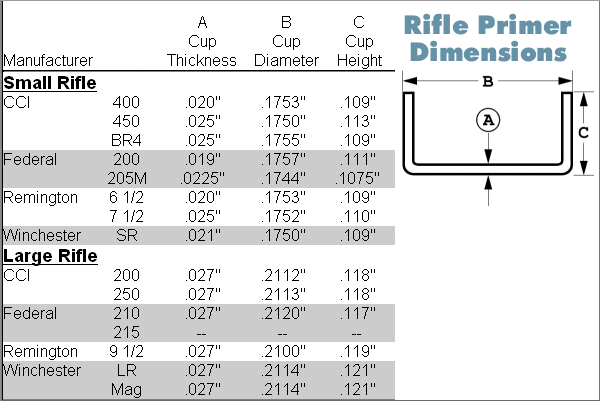
When loading a .223 to the maximum, I was getting primer piercing before I reached case overloading. I don’t know what prompted me to try CCI 450s instead of the 400s which I had been using, but I did. Presto! No more piercing! Interesting!? A primer that has a hotter ignition and yet withstands more pressure! Thats when I decided that it was time to do a dissection of all primers concerned. The chart below shows my results.
NOTE: These primer dimensions were measured many years ago. There may be some differences in current production specifications.
By studying the numbers (Cup “A” thickness), one can see which primers in the small rifle sections should be more resistant to primer cratering and/or piercing. Primer cup diameters are all similar and appear to follow a specification, but check out the cup thickness in the small rifle primers (Dimension “A”). Some cups are quite a bit thicker than others: .025″ for CCI 450 vs. .0019″ for Fed 200. Large rifle primers all appear to have the same cup thickness, no matter what the type. (As a note of interest, small pistol primers are .017″ thick and large pistol primers are .020″ thick.)
If you are shooting a 22 Cooper, Hornet, or a Bee, the .020″ cup will perform admirably. But try using the .020″ cup in a 17 Remington and you will pierce primers, even with moderate loads.
Considering that cup thickness varies in the small rifle primers, it is obvious that primer “flatness” cannot solely be used as a pressure indicator.
Another factor which determines the strength of a primer cup is the work-hardened state of the metal used to make the primer cup. Most primers are made with cartridge brass (70% copper, 30% zinc), which can vary from 46,000 psi, soft, to 76,000 psi tensile strength when fully hardened. Note that manufacturers specify the hardness of metal desired, so some cups are definitely “harder” that others.
What does all this mean to the reloader? - Cases that utilize small rifle primers and operate at moderate pressures (40,000 psi) can use CCI 400, Federal 200, Rem 6 1/2, or Win SR. Such cases include 22 CCM, 22 Hornet and the 218 Bee. Other cases that use the small rifle primer can use the above primers only if moderate loads are used. Keep to the lower end of reloading recommendations.
– Cases that utilize small rifle primers and operate at higher pressures (55,000 psi) should use CCI 450, CCI BR4, Fed 205 and Rem 7 1/2.
– All the large rifle primers measured have the same thickness. Therefore choose based on other factors, such as accuracy, low ES/SD, cost, cup hardness, and uniformity.
Hope this clears up some primer confusion. If you want more information about primers, priming compounds, or even how to make primers, the NRA sells an excellent book called “Ammunition Making” by George Frost. This book tells it like it is in the ammo making industry.
There is an excellent article about primers on the Shooting Times website. We strongly recommend you read Mysteries And Misconceptions Of The All-Important Primer, written by Allan Jones. Mr. Jones is a bona fide expert — he served as the manager of technical publications for CCI Ammunition and Speer Bullets and Jones authored three editions of the Speer Reloading Manual.
This authoritative Shooting Times article explains the fine points of primer design and construction. Jones also reveals some little-known facts about primers and he corrects common misconceptions. Here are some highlights from the article:
Size Matters
Useful Trivia — even though Small Rifle and Small Pistol primer pockets share the same depth specification, Large Rifle and Large Pistol primers do not. The standard pocket for a Large Pistol primer is somewhat shallower than its Large Rifle counterpart, specifically, 0.008 to 0.009 inch less.
Magnum Primers
There are two ways to make a Magnum primer — either use more of the standard chemical mix to provide a longer-burning flame or change the mix to one with more aggressive burn characteristics. Prior to 1989, CCI used the first option in Magnum Rifle primers. After that, we switched to a mix optimized for spherical propellants that produced a 24% increase in flame temperature and a 16% boost in gas volume.
Foiled Again
Most component primers have a little disk of paper between the anvil and the priming mix. It is called “foil paper” not because it’s made of foil but because it replaces the true metal foil used to seal early percussion caps. The reason this little disk exists is strictly a manufacturing convenience. Wet primer pellets are smaller than the inside diameter of the cup when inserted and must be compacted to achieve their proper diameter and height. Without the foil paper, the wet mix would stick to the compaction pins and jam up the assembly process.
Redding has a new tool that can make it easier to measure case neck and bullet run-out. Redding’s new Slant Bed Concentricity Gauge features a tilted, 4-point case support. The “Slant Bed” design moves the bearing surface down and away from the user, making case rotation easier. Redding explains: “Pushing down with the index finger is a natural movement as opposed to rolling on a flat which requires the movement of the entire arm. It improves both the ease of case rotation and the maintenance of proper alignment for reading.”
The orientation of the Dial Indicator also improves ergonomics. The fixed vertical indicator stand places the indicator face at the optimal sight angle of 30°, reducing the possibility of off-center readings. Precision stainless steel bearings provide single-point contact with the cartridge case. Bearing sliders on stainles guideways allow quick and easy linear adjustment for cartridge length.
Redding’s new Slant Bed tool is affordable — $124.19 with 1″ Dial Indicator. The tool ships set-up for right-handers, but quickly converts for left-hand use.
- Ergonomic Design — Ships complete with large 1″x.001″ dial indicator
– Fixed indicator position — Dliminates set-up errors
– Precision stainless steel bearings mounted on linear guideways accept cartridge sizes from .17 Hornet to .408 CheyTac.
– Supplied with non-skid rubber feet or use direct mounting holes
– Easily converted to left-hand arrangement
Redding Product Description:
The new Slant Bed Concentricity Gauge features a large, easy-to-read dial indicator which quickly mounts in a factory aligned base dead-on the centerline of the case. No additional indicator alignment is needed. The uniquely angled design of the slant bed also better positions the dial indicator for easier reading as opposed to older designs. Additionally, the Gauge can be transitioned from right-handed use to left-handed by using a provided set of mounting holes on the base. Simply remove the mount screws and transfer the working sections from one end to the other. Left-handed users no longer need to struggle to get accurate readings.
Readers — if you reload with Accurate-brand 2495, 4064, or 4350 powders, check your containers now! Accurate Powder is recalling certain lots of these powders in both 1-lb and 8-lb containers. This is serious. The manufacturer says: “The use or storage of this product may result in combustion, fire damage, and/or possible serious injury or property damage.” The problematic powders being recalled were manufactured for Western Powders Inc. prior to 10/1/2016, but they may have been sold anytime after that.
Check the Lot Number on the back or bottom of the containers. The lot number is the last digit or last two digits (right-most digits). Here are the recalled lots:
Accurate 2495 Lots 2-17 | Accurate 4064 Lots 2-16 | Accurate 4350 Lots 2-22
If you have any of the affected powder you should fill the container immediately with WATER. Then contact Western Powders at 406-234-0422 or customerservice@westernpowders.com .
Accurate Powders Recall Notice for 2495, 4064, 4360 Powders
Recall tip from EdLongrange. We welcome reader submissions.
You Should Inspect Your Powder Supplies Now
This Powder Recall was first announced in November 2019, but we are repeating it now for our readers who may still be unaware of the issue. Some of our Forum members have observed some powder degradation with affected lots. But they also report that the refunds were handled promptly and fairly.
Member Snert noted: “I went through my inventory and found an 8-pounder and a 1-pounder, 2495 and 4350 respectively. The 4350 was going….changing color and stunk, red mist. The 2495 hadn’t obviously gone, but was part of the recall.
I called and the process is easy. Read the tags and tell em what you have. Write down the info they give you. Take a photo of the product and tag, send your contact info and a claim number. I found that they are sending me back more money than I paid. Very fair refund. I was happy with the customer service. Stand-up guys who were helpful. I’d buy from them again.” READ FORUM Recall thread.
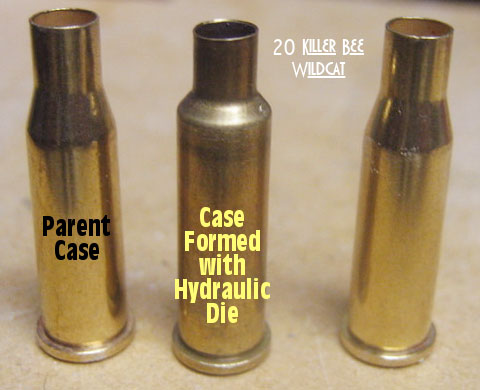
Are you a confirmed wildcatter? Do you like to experiment with custom cartridge types? Or do you just like the extra performance you can get from a specialty cartridge such as a 20 Vartarg or 22-250 AI? Well, if you love wildcat cartridges, you’ll probably enjoy this book. Now available for the first time since 2003, The Handloader’s Manual of Cartridge Conversions explains the processes and tools needed to convert standardized brass into hundreds of different rifle and pistol cartridge types. A vast variety of case designs are covered — from vintage cartridge types to modern, cutting-edge wildcats.
This classic reference guide has been revised with an easy-to-search format, complete with a full index of hundreds of cartridges. This book belongs on the shelf of any hand-loader who enjoys making and shooting wildcat cartridges. However do note that much of the text is unchanged from earlier editions. For some cartridge types, the author recommends “parent” brass brands that are no longer available. In other situations, there may be more convenient conversions now offered. Nonetheless this is an important resource. As one verified purchaser explains: “Great reference for making the cartridges that are hard to get or no longer in production. Offers an alternative to the the time, expense and effort of having to re-chamber a classic. Saves ‘Grandpa’s shooters’ from becoming safe queens.”
Forum members are lamenting that they can’t find Hodgdon H4350 at local gunstores or through major online Vendors. There ARE a few shops that do have H4350 (and Varget) on the shelves. But the nearest H4350 may be in another state, far away. Therefore, you may want to consider using Alliant Reloder 16 (RL16). We highly recommend Reloder 16 for shooters who can’t find H4350. RL16 has a very similar burn rate, excellent accuracy, and is VERY temp stable. Some ace F-Class shooters (among Top 10 at Nationals) tell us that, with hot ambient temps (80-100+° F), RL16 is even more temp stable than H4350.
Powder Availability at Online Vendors — H4350, Reloder 16, Varget
*This is available in-store only at a few locations. You need to search store locations near you for availability. For example, H4350 8-pounders are available in a couple locations including Show Low, AZ and Midvale, UT. Varget 8-pounders are available in AZ, NM, and WY and a couple other states.
Do You Like H4350? Then You Should Try Reloder 16 — It Is Accurate and Temp Stable
Alliant Reloder 16 is used now by many top shooters for cartridges that work well with Hodgdon H4350. In fact, we’d say that Reloder 16 is the best substitute for H4350 on the market. Alliant’s RL 16 is very temp stable, offers good velocity, and the accuracy is top tier. Some guys report slightly better accuracy than H4350 in the .284 Win, .260 Rem, 6.5 Creedmoor, 6mm Creedmoor, and 6XC cartridges. If you currently use H4350, you should definitely give Alliant Reloder 16 a try. The powder also boasts excellent lot-to-lot consistency and contains a proprietary de-coppering additive.
This is NOT just a slower version of Alliant’s double-based Reloder 15 (which words great in the 6mmBR and Dasher cartridges). Reloder 16 is a completely new formulation, produced in Sweden by Bofors for Alliant. Reloder 16 utilizes TZ technology, which manipulates the response of the propellant and resists the natural tendency to generate more pressure at higher temperatures and less pressure at lower temperatures. As a result, Alliant’s Reloder 16 offers truly outstanding temperature stability.


 Most competitive long-range shooters weigh powder charges for their handloads. Some even use ultra-precise magnetic force restoration scales to load to single-kernel tolerances. But is weight-based measuring always the best way to fill a case with powder? Another option is volumetric charging. This method fills a precisely-sized cavity with powder and then dumps the charge into the case. A
 By Ron Dague, Sinclair Reloading Tech