Kulzer Sets Eight IBS 1000-Yard IBS Benchrest Records with 6 BRA Rifle Report by Alex Wheeler
In 2021, Glenn Kulzer of Dillon, Montana had a season that will go down in 1000-Yard Benchrest history. Glenn set eight IBS records in 2021 at the Deep Creek range in Missoula, and then was named IBS 1K Shooter of the Year. What makes this so incredible is not just the number of records but the records themselves. Normally when a world record small group is shot that’s a singular event — never accompanied by Aggregate records set by the same shooter. Glenn’s IBS record small group wasn’t a one-time lucky string. Consider this — Glenn nailed that historic small group, but also recorded multiple IBS Aggregate records in 2021. And Glenn set these IBS Heavy Gun records actually using his 6 BRA (6mmBR Ackley) Light Gun! Mighty impressive.
[Editor: These were impressive records that have stood the test of time. A quick search of the IBS record site shows Glenn Kulzer still holds six of the ten listed IBS 1000-yard Heavy Gun records. Plus, Glenn broke the Light Gun 20-Target Agg group record, but that was later bettered by Tom Mousel.]
1000-yard Benchrest Aggregate records represent a series of targets shot over the course of multiple matches during a season. That really takes any luck out of the equation. You have to keep the rifle shooting at its peak all year long. It’s the ultimate test of accuracy. But the small groups do get the most notice and Glenn also broke the small group record with a remarkable 2.6853″ 10-shot group (photo below).
Eight IBS Records Set by Glenn Kulzer in 2021
Date: 06/13/2021
Class: Heavy Gun
Record: 10-Shot Group, 2.6853″
Date: 06/13/2021
Class: Heavy Gun
Record: 10-Shot Score 100/2.6853″
Date: 2021
Class: Heavy Gun
Record: 6-Match Group Aggregate, 4.349″
Date: 2021
Class: Heavy Gun
Record: 6-Match Score Aggregate, 99.167/4.679″
Date: 2021
Class: Heavy Gun
Record: 12-Target Group Aggregate, 4.529″
Date: 2021
Class: Heavy Gun
Record: 12-Target Score Aggregate, 98.583/5.058″
Date: 2021
Class: Heavy Gun
Record: 20-Target Score Aggregate, 95.2/6.422″
Date: 2021
Class: Light Gun
Record: 20-Target Group Aggregate, 5.202″
NOTE: Most of these records have been broken. In 2025 talented Montana shooter Tom Mousel set 8 multi-match and multi-target records, including an amazing 12-target Group Agg of 3.8790″ and 12-target Score Agg of 99.5.
This IBS record 1000-yard group, and Glenn’s other IBS records, were shot with Roy Hunter’s 103gr “A” bullet, Hodgdon H4895 powder, CCI BR4 primers, and Alpha Munitions 6 BRA brass. However, Glenn does use Lapua brass for some other 6 BRA rifles.
Glenn’s record-setting rifle is a Light Gun with a common setup used in long range Benchrest. The rig features a Borden BRM drop-port action with a Bix’n Andy trigger. The action is glued and screwed into a industrial wood laminate Deep Creek Tracker stock, a predecessor of the McMillan LRB. The Krieger barrel is a 4-groove, 1:8″-twist Heavy Varmint contour chambered for the 6 BRA (6mmBR Ackley) cartridge. All of Glenn’s rifles are topped with Vortex Golden Eagle scopes. Glenn notes that his Vortex Golden Eagles have show excellent point-of-aim stability when tested with a scope checker. The front rest was a Sinclair competition with Edgewood front bag, Field & Cave outfitters front rest plate, and speed screw. For rear support Glenn uses an Edgewood LRB rear bag.
Loading Procedures for Record-Setting 1000-Yard Shooting
Glenn’s loading process is pretty simple. He full-length sizes every time, bumping the shoulders back about .003″. Powder is weighed to the kernel, and bullets are seated with a Wilson seater. NOTE: Glenn does does not anneal his brass. He sorts primers by weight but does not otherwise measure them by dimensions. He seats the primers by feel using a relatively inexpensive primer seating tool — nothing fancy.
Glenn worked up a trim-and-point recipe for this lot of bullets based on group size. Load development is all performed at 1000 yards using the group ladder method. Glenn’s record load ended up being 30.3 grains of H4985 powder with the 103gr bullet seated very far into the rifling with .005″ of neck tension. This gave a velocity of 3030 fps in the 28″ Krieger.
Glenn shot Alpha Munitions 6 BRA brass all year with the .080″ flash hole. This year he shot Roy Hunter’s 103gr “A” bullet set quite deep into the rifling. NOTE: This deep jam has proven to be very stable IF you barrel likes it. Glenn used CCI BR4 primers and Hodgdon H4895 with .005″ of neck tension. His load delivered 3030 fps out of a 28″ barrel. NOTE: This is a “HIGH NODE” that may not be possible in an average barrel with different brass. Many 6 BRA shooters are reaching a 3000+ fps node, but you should always start low and work up. Some 6 BRA barrels will max out at 2950 FPS with 103-108gr bullets.
Glenn Interview Part I — All About the Rifle that Set Eight 1000-yard Records
Glenn Interview Part II — Load Development Process and Loading Methods
Glenn Interview Part III — Barrel Cleaning Discussion
Glenn Kulzer also shot his impressive 6 BRA at the 2021 IBS Nationals at Deep Creek (shown above). This Deep Creek range photo is by Forum member Dave Way.
Setting Records in June 2021 Report by Alex Wheeler
It was a typical match for June, nothing unique about it. Saturday was actually looking to be a really great day. Overall it was good but not great. Sunday had a clear blue sky with bright sun. I looked through a couple of scopes before the match and it was milky. I probably would have shot that relay at 30-35 power. But somehow Glenn Kulzer was able to pull off the best heavy gun group ever shot in 1000-yard IBS competition. With that group Glenn also broke the 6-match IBS Group Aggregate record (which was later broken by Tom Mousel in 2025). The group was no fluke, this rifle also shot great in previous matches with small groups at 1000. To my knowledge this may be the only time a small group record AND an Aggregate record were broken in the same season by the same gun. The ultimate achievement.
On June 13, 2021, Glenn shot a 2.6583″ 10-shot group, all shots in the 10 Ring for a 100 score. This group still stands as the current IBS Heavy Gun 1000-Yard 10-shot group record AND score record. It was also part of Aggregate Records listed above.
About Glenn Kulzer — Rising Star in the Long-Range Benchrest Game by Alex Wheeler
Kulzer is a pharmacist in Dillon, Montana. The attention to detail required for his job crosses over to Long-Range Benchrest. He started off a very competitive shooter right from the start. I have said it many times, but benchrest is not an elitist sport. Hard work and dedication will always rise to the top. Glenn took the sport seriously from the beginning. Accordingly, he displayed a rapid learning curve and quickly surpassed some of his mentors in match results. Glenn tunes mostly at 1000 yards using the Deep Creek variation of ladder testing. He will also load and tune at the range to try and nail the best tune for the conditions. Again, it all about the work done by competitors. But Glenn’s success shows that a bright, hard-working shooter can rise to the top of the game in just a few seasons.
Here’s a cool video from the University of Mississippi Womens’ Shooting Team a decade ago. The gals from Ole Miss challenge their marksmanship skills with a variety of tiny targets — grapes, pencil erasers, and playing cards on edge. The results are filmed with ultra-high-speed cameras so you can watch the moment of impact. This is a fun, feel-good video. Enjoy.
These young ladies were training for competition at the Ole Miss Invitational Tournament in Oxford, Mississsippi. For more information, visit OldMissSports.com.
When a rifle isn’t shooting up to it’s potential, we need to ask: “Is it the gun or the shooter?” Having multiple shooters test the same rifle in the same conditions with the same load can be very revealing…
When developing a load for a new rifle, one can easily get consumed by all the potential variables — charge weight, seating depth, neck tension, primer options, neck lube, and so on. When you’re fully focused on loading variables, and the results on the target are disappointing, you may quickly assume you need to change your load. But we learned that sometimes the load is just fine — the problem is the trigger puller, or the set-up on the bench.
Here’s an example. A while back we tested two new Savage F-Class rifles, both chambered in 6mmBR. Initial results were promising, but not great — one gun’s owner was getting round groups with shots distributed at 10 o’clock, 2 o’clock, 5 o’clock, 8 o’clock, and none were touching. We could have concluded that the load was no good. But then another shooter sat down behind the rifle and put the next two shots, identical load, through the same hole. Shooter #2 eventually produced a 6-shot group that was a vertical line, with 2 shots in each hole but at three different points of impact. OK, now we can conclude the load needs to be tuned to get rid of the vertical. Right? Wrong. Shooter #3 sat down behind the gun and produced a group that strung horizontally but had almost no vertical.
Hmmm… what gives?
Shooting Styles Created Vertical or Horizontal Dispersion
What was the problem? Well, each of the three shooters had a different way of holding the gun and adjusting the rear bag. Shooter #1, the gun’s owner, used a wrap-around hold with hand and cheek pressure, and he was squeezing the bag. All that contact was moving the shot up, down, left and right. The wrap-around hold produced erratic results.
Shooter #2 was using no cheek pressure, and very slight thumb pressure behind the tang, but he was experimenting with different amounts of bag “squeeze”. His hold eliminated the side push, but variances in squeeze technique and down pressure caused the vertical string. When he kept things constant, the gun put successive shots through the same hole.
Shooter #3 was using heavy cheek pressure. This settled the gun down vertically, but it also side-loaded the rifle. The result was almost no vertical, but this shooting style produced too much horizontal.
A “Second Opinion” Is Always Useful
Conclusion? Before you spend all day fiddling with a load, you might want to adjust your shooting style and see if that affects the group size and shape on the target. Additionally, it is nearly always useful to have another experienced shooter try your rifle. In our test session, each time we changed “drivers”, the way the shots grouped on the target changed significantly. We went from a big round group, to vertical string, to horizontal string.
Interestingly, all three shooters were able to diagnose problems in their shooting styles, and then refine their gun-handling. As a result, in a second session, we all shot that gun better, and the average group size dropped from 0.5-0.6 inches into the threes — with NO changes to the load.
That’s right, we cut group size in half, and we didn’t alter the load one bit. Switching shooters demonstrated that the load was good and the gun was good. The skill of the trigger-puller(s) proved to be the limiting factor in terms of group size.
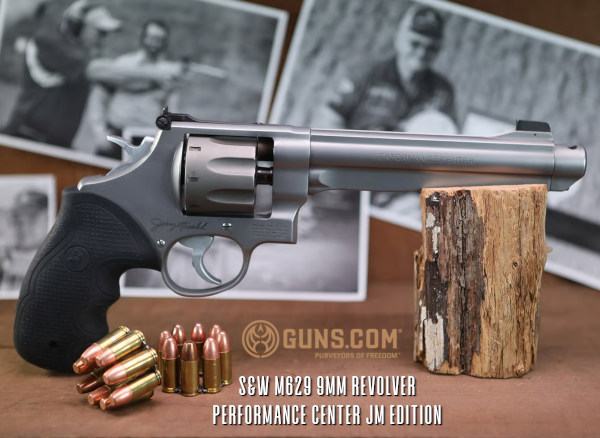
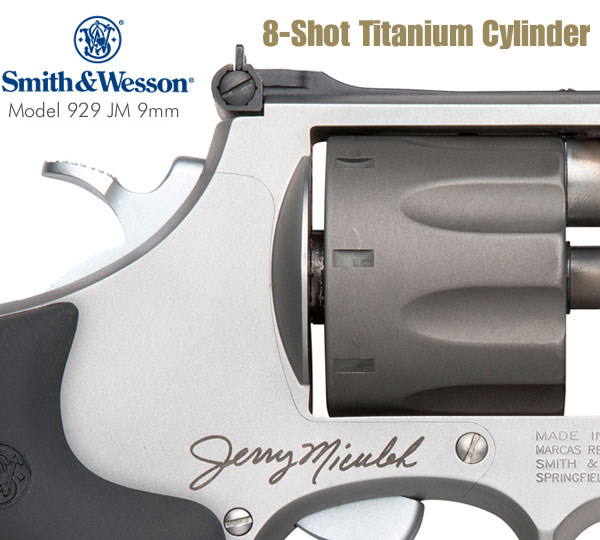
How fast can a human shoot a revolver? The legendary Jerry Miculek answers that question in this video. Using his special edition Smith & Wesson 9mm model 929 revolver, Jerry shoots 16 shots in 4.01 seconds, with a reload*. His splits between shots were running 0.16-0.17 seconds. That works out to a peak rate of fire of 353 rounds per minute, faster than some early-era machine guns. Even counting his reloads, his sustained rate of fire would be 239 rounds per minute, faster than a 19th-century Gatling gun. Amazing wheelgun skills!
16 shots w reload
Split Times
Peak Rate of Fire
Sustained Rate of Fire
4.01 seconds
0.16-0.17 seconds
353 rds per min
239 rds per min
Smith & Wesson 929 Eight-shot Revolver, Jerry Miculek Edition
Jerry really likes his JM Signature Edition model 629 revolver. Produced by the S&W Custom Shop, this 9mm handgun features a ported, broach-cut barrel plus a titanium cylinder. Jerry says the low-mass titanium cylinder reciprocates very fast, making for a responsive rapid-fire revolver.
*This was time on target. Total time including initial reaction time was 4.88 seconds.
In Tennessee, when you order a take-out pizza, you get a cardboard shooting target at no extra charge. Nashville, Tennessee-based Hunt Brothers Pizza has come up with a clever idea to promote pizza consumption among the hunting and shooting fraternity. They’ve put targets on the pizza boxes — a very cool idea.
Hunt Brothers offers cardboard pizza boxes with five red and black bullseyes printed on the back. Now your used empty pizza boxes can do more than just take up space in the trash can. This is a pretty smart idea we think — it’s a great example of clever “dual-use” packaging. Hopefully pizza parlors in other locations nationwide will follow suit someday….
Give credit to The Firearm Blog for finding this story and publishing it first.
Some folks say you haven’t really mastered marksmanship unless you can hit a target when standing tall ‘on your own hind legs’. Of all the shooting positions, standing can be the most challenging because you have no horizontally-solid resting point for your forward arm/elbow. Here 10-time National High Power Champ Carl Bernosky explains how to make the standing shot.
Carl Bernosky is one of the greatest marksmen in history. A multi-time National High Power Champion, Carl has won ten (10) National High Power Championships in his storied shooting career, most recently in 2012. In this article, Carl provides step-by-step strategies to help High Power shooters improve their standing scores. When Carl talks about standing techniques, shooters should listen. Among his peers, Carl is regard as one of the very best standing shooters in the history of High Power shooting. Carl rarely puts pen to paper, but he was kind enough to share his techniques with AccurateShooter.com’s readers.
If you are position shooter, or aspire to be one some day, read this article word for word, and then read it again. We guarantee you’ll learn some techniques (and strategies) that can improve your shooting and boost your scores. This stuff is gold folks, read and learn…
How to Shoot Standing by Carl Bernosky
Shooting consistently good standing stages is a matter of getting rounds down range, with thoughtfully-executed goals. But first, your hold will determine the success you will have.
1. Your hold has to be 10 Ring to shoot 10s. This means that there should be a reasonable amount of time (enough to get a shot off) that your sights are within your best hold. No attention should be paid to the sights when they are not in the middle — that’s wasted energy. My best hold is within 5 seconds after I first look though my sights. I’m ready to shoot the shot at that time. If the gun doesn’t stop, I don’t shoot. I start over.
2. The shot has to be executed with the gun sitting still within your hold. If the gun is moving, it’s most likely moving out, and you’ve missed the best part of your hold.
3. Recognizing that the gun is sitting still and within your hold will initiate you firing the shot. Lots of dry fire or live fire training will help you acquire awareness of the gun sitting still. It’s not subconscious to me, but it’s close.
4. Don’t disturb the gun when you shoot the shot. That being said, I don’t believe in using ball or dummy rounds with the object of being surprised when the shot goes off. I consciously shoot every shot. Sometimes there is a mistake and I over-hold. But the more I train the less of these I get. If I get a dud round my gun will dip.* I don’t believe you can learn to ignore recoil. You must be consistent in your reaction to it.
5. Know your hold and shoot within it. The best part of my hold is about 4 inches. When I get things rolling, I recognize a still gun within my hold and execute the shot. I train to do this every shot. Close 10s are acceptable. Mid-ring 10s are not. If my hold was 8 inches I would train the same way. Shoot the shot when it is still within the hold, and accept the occasional 9. But don’t accept the shots out of the hold.
6. Practice makes perfect. The number of rounds you put down range matter. I shudder to think the amount of rounds I’ve fired standing in my life, and it still takes a month of shooting standing before Perry to be in my comfort zone. That month before Perry I shoot about 2000 rounds standing, 22 shots at a time. It peaks me at just about the right time.
This summarizes what I believe it takes to shoot good standing stages. I hope it provides some insight, understanding, and a roadmap to your own success shooting standing.
— Good Shooting, Carl
* This is very noticeable to me when shooting pistol. I can shoot bullet holes at 25 yards, but if I’ve miscounted the rounds I’ve fired out of my magazine, my pistol will dip noticeably. So do the pistols of the best pistol shooters I’ve watched and shot with. One might call this a “jerk”, I call it “controlled aggressive execution”, executed consistently.
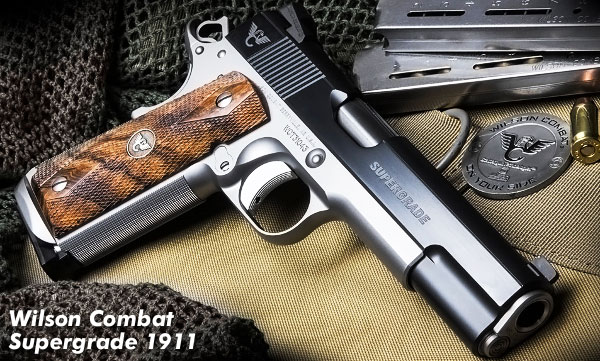
Todd Jarrett is one of the world’s best handgun shooters. A multi-time World Champion, Todd knows a thing or two about semi-auto pistols, particularly 1911s and 1911-based raceguns. Jarrett has been IPSC Open Division World Champion, has won the Steel Challenge World title four times (Limited Division), and has won than 100 Area championships, as well as many other action shooting events. Jarrett is the only USPSA Triple Crown Winner and he holds four USPSA National titles: Open, Limited, Production, and Limited-10. Jarrett revealed in an interview that between 1988 and 2001 he shot about 1.7 million rounds during practice: “I had a gun in my hand for two hours every day for 10 years to develop my skill level”.
In the video below, Todd explains how to get the proper grip on your handgun, and how to employ a proper stance. We’ve watched many videos on pistol shooting. This is one of the best handgun instructional videos we’ve seen. Todd explains, in easy-to-understand terms, the key elements of grip and stance. One very important point he demonstrates is how to align the grip in your hand so that the gun points naturally — something very important when rapid aiming is required. If you watch this video, you’ll learn valuable lessons — whether you shoot competitively or just want to have better control and accuracy when using your handgun defensively.
Recommended Thumbs-Forward Shooting Grip for 1911s
“Shooting semiautomatic pistols using the thumbs-forward method really becomes useful … where speed and accuracy are both needed. By positioning the thumbs-forward along the slide (or slightly off of the slide) you are in essence creating a second sighting device: wherever your shooting thumb is pointing is where the pistol is pointing. This makes it incredibly fast to draw the pistol, get your proper grip, and press forward to the target without needing to hunt around for the front sight.” — Cheaper Than Dirt Blog.
Are you a do-it-yourself kind of guy with a creative eye? Then you’ll love the FREE Target Generator from the folks at ShooterShed.com. This FREE, interactive webpage allows you to design a variety of fun targets, including grids, benchrest-type Score/Group Shooting targets, sight-in targets, and even playing card targets. Choose the paper size and orientation (vertical or horizontal), then select the number of target elements on the page. For example, you could have four (4) bulls or a dozen playing cards. Then click the Style TAB to choose your target style. Use the OPTIONS TAB to overlay a grid on the target, choose squares or diamonds, or include load information blocks. For bullseye targets, you can control the number, color, and spacing (diameter) of the rings. LINK to TARGET GENERATOR.
QWIK TIP: For Super-Quick Target Creation, click the “Target Style” tab, then select a design from the list on the left. Then go to OPTIONS.
Click the TARGET STYLE TAB to select one of many target styles, including NBRSA Benchrest targets and 20+ types of NRA bullseye targets, scaled to distance:
Benchrest
Bullseye
Shapes
NRA High Power
NRA Pistol
NRA Rimfire
Images
Playing Cards
Load Test Blocks
Competitors can create practice targets similar to their match targets. This target features short-range range Benchrest competition-style box/circle aiming points, along with fields for entry of gun/load data:
Creating new targets is fast and easy. No computer graphics skills required! We created this green diamonds grid target in just five minutes using the ShooterShed Target Generator:
The program provides a preview of each target you generate. There are controls to choose border and fill colors. If you like a particular design, save the file, and then print as many targets as you want. Check it out, this program is fun and handy to use. Here are four (4) targets your Editor created just for this article. With a bit of practice, you can be generating your own custom targets in minutes.
About the Creator of the Target Generator
The Target Generator program was created by Rod Brown of Sheridan, Wyoming. Rod tells us: “I build custom rifles… I’ve got a 100-yard range out my back door. I shoot short- and long-range benchrest competitively around the country. I’m a full-time software development consultant and an FFL holder. When I’m not developing custom software for my clients, I’m usually fiddling in the shop, building a custom benchrest rifle, traveling to a match, chambering a barrel, or reloading some ammunition.”
Story tip from Boyd Allen. We welcome reader submissions.
This popular video, viewed 3.9 million times on YouTube, provides a clear explanation of Minute of Angle (MOA) and how that angular measurement is used. Among novice shooters, there is much confusion over this term. In this NSSF Video, Ryan Cleckner, a former U.S. Army Sniper Instructor, defines the term “Minute of Angle” (MOA) and explains how you can adjust for windage and elevation using 1/4 or 1/8 MOA clicks on your scope. This allows you to sight-in precisely and compensate for bullet drop at various distances.
For starters, Ryan explains that, when talking about angular degrees, a “minute” is simply 1/60th. So a “Minute of Angle” is simply 1/60th of one degree of a central angle, measured either up and down (for elevation) or side to side (for windage). At 100 yards, 1 MOA equals 1.047″ on the target. This is often rounded to one inch for simplicity. Say, for example, you click up 1 MOA. That is roughly 1 inch at 100 yards, or roughly 4 inches at 400 yards, since the target area measured by 1 MOA increases in linear fashion with the distance.
More Minute of Angle (MOA) Explanatory Videos
This Gunwerks video explains that Minute of Angle subtends approximately 1″ for each 100 yards (well, 1.047″ to be more precise). That means a Minute of Angle increases in actual measured size the greater the distance of the target from the shooter.
This lengthy (24-minute) video defines Minute of Angle, and uses multiple diagrams to illustrate how MOA angular measurements works. The video also how MOA-based click values translate to point-of-impact changes at various distances.
To succeed in long-range shooting matches, given the high level of competition these days, you’ll need solid wind-reading abilities. We’ve found an article by SFC Emil Praslick III, retired USAMU Service Rifle coach and U.S. Palma Team Coach, that can help you make better wind calls in competition.
Emil Praslick, now retired from the U.S. Army, is considered one of the best wind gurus in the United States, if not the world. During his service with the USAMU he authored an excellent two-part article on wind reading that is available on the CMP (Civilian Marksmanship Program) website. Both articles contain helpful illustrations, and are “must-read” resources for any long-range shooter–not just Service Rifle and Highpower competitors.
Part One covers basic principles, tactics, and strategies, with a focus on the 200-yard stages. Emil writes: “There are as many dimensions to ‘wind reading’ as there are stages to High Power competition. Your tactical mindset, or philosophy, must be different for the 200 and 300 yard rapid-fire stages than it would be for the 600 yard slow-fire. In the slow-fire stages you have the ability to adjust windage from shot to shot, utilizing the location of the previous shot as an indicator. Additionally, a change to the existing conditions can be identified and adjusted for prior to shooting the next shot.”
In Part Two, Praslick provides more detailed explanations of the key principles of wind zeros, wind reading, and the Clock System for determining wind values: “The Value of the wind is as important as its speed when deciding the proper windage to place on the rifle. A 10 MPH wind from ’12 o-clock’ has No Value, hence it will not effect the flight of the bullet. A 10 MPH wind from ‘3 o’clock’, however, would be classified as Full Value. Failure to correct for a Full Value wind will surely result in a less than desirable result.”
Praslick also explains how to identify and evaluate MIRAGE:
Determine the accuracy of the mirage. Mirage is the reflection of light through layers of air that have different temperatures than the ground. These layers are blown by the wind and can be monitored to detect wind direction and speed.
Focus your scope midway between yourself and the target, this will make mirage appear more prominent. I must emphasize the importance of experience when using mirage as a wind-reading tool. The best way to become proficient in the use of mirage is to correlate its appearance to a known condition. Using this as a baseline, changes in mirage can be equated to changes in the value of the wind. Above all, you must practice this skill!
Click HERE for more excellent instructional articles by Emil Praslick and other USAMU Coaches and shooters.


 Glenn worked up a trim-and-point recipe for this lot of bullets based on group size. Load development is all performed at 1000 yards using the group ladder method. Glenn’s record load ended up being 30.3 grains of H4985 powder with the 103gr bullet seated very far into the rifling with .005″ of neck tension. This gave a velocity of 3030 fps in the 28″ Krieger.


 In Tennessee, when you order a take-out pizza, you get a cardboard shooting target at no extra charge. Nashville, Tennessee-based

 How to Shoot Standing
 5. Know your hold and shoot within it. The best part of my hold is about 4 inches. When I get things rolling, I recognize a still gun within my hold and execute the shot. I train to do this every shot. Close 10s are acceptable. Mid-ring 10s are not. If my hold was 8 inches I would train the same way. Shoot the shot when it is still within the hold, and accept the occasional 9. But don’t accept the shots out of the hold.



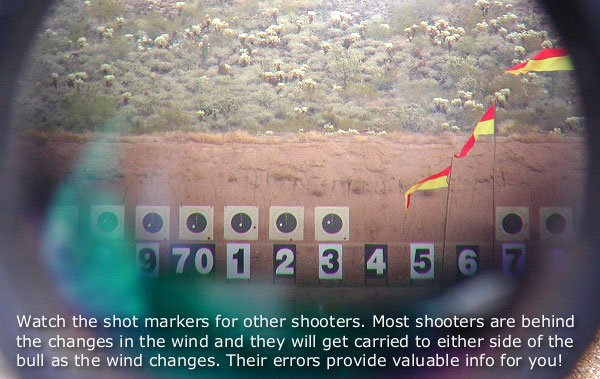

 Part One covers basic principles, tactics, and strategies, with a focus on the 200-yard stages. Emil writes: “There are as many dimensions to ‘wind reading’ as there are stages to High Power competition. Your tactical mindset, or philosophy, must be different for the 200 and 300 yard rapid-fire stages than it would be for the 600 yard slow-fire. In the slow-fire stages you have the ability to adjust windage from shot to shot, utilizing the location of the previous shot as an indicator. Additionally, a change to the existing conditions can be identified and adjusted for prior to shooting the next shot.”


