|
|
November 30th, 2018

The shooting world is lucky to have McMillan Fiberglass Stocks and MC3. Some companies talk about supporting competitive shooting. Maybe they bankroll a couple “rock stars” at pistol matches. But REAL commitment involves a LOT more. The kind of support that McMillan USA has shown to top shooters and top teams is truly exceptional. You won’t find a company that is more committed to supporting serious rifle competition than McMillan. The bossman, Kelly McMillan, loves the sport and is a capable marksman and hunter himself. McMillan has been a strong ally of AccurateShooter.com for many years. But more importantly, McMillan supports shooters and teams in many disciplines and McMillan donates prizes (and cash) in dozens of competitions.

Shown are some of the 2018 National Record holders who shoot McMillan equipment.
McMillan is a company that really supports both individual shooters and talented teams of competitors. Here is the story behind McMillan’s commitment to our sport and our Champion shooters (and rising stars).
Why We Support Competitive Shooting — McMillan’s Commitment
by Kelly McMillan
Anyone who knows the history of McMillan Fiberglass Stocks, knows that our roots are firmly planted in competitive shooting, and specifically short-range benchrest. We were in business several years before we made a stock other than a competition stock. It is where we made our reputation for high quality stocks and first rate customer service. For several years while I was running McMillan Firearms Manufacturing, I let the focus of the stock company drift a bit. I wasn’t donating to as many matches or events and was not sponsoring any shooters. When I sold the rifle company it was made clear to me almost immediately that there were competitors of mine that were taking advantage of my loss of focus, and making huge inroads into the field that used to be dominated by McMillan.
Kelly and the Talented Xit Strategy Ladies Team:

It has always been obvious to us that if we want this business to prosper for generations to come, we need to do everything we can to get young shooters and women shooters involved in the shooting sports. I personally have been sponsoring youth shooting sports, e.g. The Scholastic Clay Targets program, Boy Scouts, NRA U-25 USA team and many individual shooters. I also sponsor a Texas junior girls F-Class team as well as many individual youth and female shooters. Team Xit Strategy is an F-TR team comprised of both adult and junior female shooters. It is the only exclusively female team in the National F-Class circuit. The team includes Laura Perry 2017 (World Champion 8-person Team member), Jen Bondurant, a top level F-TR competitor, as well as Claudette Joe, one of the top juniors in F-Class currently.

Dollars and Sense — How McMillan Supports the Shooting Sports
Below is a list of the matches, teams, and shooters that McMillan has supported over the last year. Kelly notes that McMillan Fiberglass Stocks has donated $63,000 while McCubed (Mc3) has donated $6700 in gift certificates and products to various matches and conservation efforts. Kelly adds: “We have also contributed over $15,000 cash to various events. In addition, we have contributed $30,000 in cash to Team Sponsorships as well as 60 stocks of assorted types for team members.” Take note those numbers are for just ONE YEAR — yes, all that support in product and cash for just one year’s worth of sponsorship.
| Match Sponsorships
All NRL matches
All Guardian matches
Arizona Elk Society
Sportsman’s Challenge
Lone Survivor Foundation
Berger SW Nationals
Boy Scouts Troops
Various PRS matches
NRA ELR Nationals
GAP Grind
Rocky Mountain Big Horn Society
AZ Mule Deer
Hillsdale College
FClass Championships
Cactus Classic
King of 2 Mile
King of 2 Mile Television Show
JC Steel Challenge Matches
France’s PRS Match
World’s Long Shot Challenge
Bushnell Elite Tactical Sniper Challenge
WTRC/Wyoming Tactical Rifle Championship and
WYSHOT |
Team Sponsorships
Team Michigan
Team USA U-25 (2021 Open)
Team Xit
US Rifle Team
US Navy Marksman Team
Team Xit Strategy
Team Savage
Shooter Sponsorships
Regina Milkovich
Tim Milkovich
Andy Puzsman
Randy Galvan
Texas Youth Girls F-Class
Cody Hartsock
Derek Rodgers
Paul Phillips
Daniel J. Pohlabel
Jeff Rorer
Mark V. Lonsdale
David Mann
Rick Jensen
Stan Pate
Mike Miller
Warren Dean
Monte Milanuk
Dan Lentz
Austin Elbert |
McMillan Also Sponsors Team Savage

Grow the Sport By Helping Shooters Improve Their Performance
Kelly explains McMillan’s mission in supporting the shooting sports: “In competitive shooting it is fairly simple. If people who use your product win matches, and more importantly, improve their own personal scores, it shows potential customers that they can expect the same type of improvement. It sounds more simple than it is. Getting some of the best shooters in the world to shoot your stock requires more than just giving it to them. Remember these guys (and ladies) are at the top of their game so when you offer them something they have to be shown that it will actually improve their scores and if it doesn’t, no way they are changing to your product. Finally, I am sure I have forgotten some shooters and if so I apologize to each individual.”

Kelly McMillan is also an avid hunter. Here’s Kelly with Derek Rodgers (front) and Paul Phillips (top), two of his sponsored competitors. Derek is the reigning F-TR World Champion and previous King of Two Miles.
November 24th, 2018

As posted in the Calguns.net a few years back, there was a nasty out-of-battery firing incident involving a BOHICA Arms .510 DTC AR15 upper. The cause of the out-of-battery firing is not certain but it appears that the ammo was not sized properly and the firing pin may have been stuck in the extended position. As a result, the round went off before the bolt was closed with the lugs seated. In the process, the bolt handle broke off, as the bolt retracted violently, actually ending up outside the bolt raceway.

The shooter was badly injured, with broken bones and ligament damage to his left hand and tissue damage to his right hand. The shooter was holding the rifle with his left hand near the front of the chamber where a gas vent was located. Gas and shrapnel existed the vent hole causing the severe injuries to the left hand.
From range reports, it appears that the shooter had been struggling to chamber previous rounds, and was having trouble closing the bolt. After talking with one of the rangemasters, a poster on AR15.com reported: “The guy was using new reloads that weren’t exactly fitting well into his chamber. [The shooter] was slamming the bolt handle with his palm trying to get the cases to lock in. The guy was also slamming the bolt forward full force from the rearmost position back and forth trying to ram the cases into chamber in an attempt to squeeze the rounds in so the bolt could close. Finally, on one of the attempts … the possibly stuck firing pin rams into the primer and explodes the round when he slams the bolt forward (zero lug engagement hence the KB) and shooter puts himself into a world of hurt.”
Lessons Learned — Don’t Try to Force Oversize Ammo into a Chamber
By all reports, the shooter’s ammo wasn’t fitting his chamber properly. In an effort to force the ammo into the chamber, he worked the bolt with excessive force. That MAY have caused the firing pin to extend or the hammer to fall without the trigger being pulled. One theory is that the trigger system may have been modified, allowing the hammer to fall from the force of slamming the bolt forward. Others have speculated that the firing pin may have failed to retract because the bolt handle was over-torqued — a safety issue listed in the BOHICA manual.

Whatever caused the out-of-battery firing, it appears that improperly-sized ammo (or a poorly-cut chamber) was the root cause of the problems. If you go to a range and find your bolt does not close easily over the ammo — STOP SHOOTING — don’t try to force the issue. Disaster may result. To paraphrase Johnnie Cochran: “If the ammo doesn’t fit, it’s time to quit”.
Photos by Wildcard, originally posted on Calguns.net.
November 23rd, 2018

This photo is one of Nightforce’s series of picturesque “Gunscapes”. SEE MORE HERE.
With all the commercialization and buying frenzy associated with Black Friday/Cyber Monday, we should remember the real reasons most of us enjoy the shooting hobby. Many of us like shooting because it gets us outdoors, away from work pressures. Shooting gives us a chance both to enjoy solitude as well as have fun with friends and family in the outdoors. For this editor, a solo trip to the range in mid-week was often the perfect antidote to job stress. Going to a scenic venue and sending a few shots downrange was satisfying. And getting out of the hustle and bustle of the city did indeed calm the soul.
Talented 3-position shooter (and trick-shot artist) Kirsten Joy Weiss says that any day at the range is “always a good day”. Here is her photo to prove it. If that shot doesn’t motivate you to spend a day outdoor with rifles, we’re not sure what will. Here’s hoping you’ll have a chance to get in another few days of shooting this season before the snow falls. This Editor hopes to test some rimfire ammo this weekend…
“Always a good day…” — Kirsten Joy Weiss


November 22nd, 2018

Today is Thanksgiving. What better way to celebrate the occasion than to blast away at some bearded gobblers (of the paper variety). Here’s our custom Turkey Day target, ready for family fun. This special Turkey Bullseye Target was created by our friend and Forum member Pascal (aka “DesertFrog”). CLICK HERE for FREE Turkey Target.
Get a Full Set of Animal Targets
For your convenience, we’ve packaged the Turkey Target along with five (5) other varmint/animal-themed targets. These are all offered in .pdf (Adobe Acrobat) format for easy printing.
CLICK HERE to download all SIX targets in .Zip archive.

November 21st, 2018

 In today’s economy, Free is good. Here’s a list of classic, older shooting books that can be downloaded for FREE from Google Books. This list includes many classic treatises on marksmanship that still have value for today’s competitive shooters. In addition, we’ve included illustrated firearm histories, such as Townsend Whelen’s fascinating book, The American Rifle, and The Gun and its Development (9th Ed.), by William Wellington Greener. In today’s economy, Free is good. Here’s a list of classic, older shooting books that can be downloaded for FREE from Google Books. This list includes many classic treatises on marksmanship that still have value for today’s competitive shooters. In addition, we’ve included illustrated firearm histories, such as Townsend Whelen’s fascinating book, The American Rifle, and The Gun and its Development (9th Ed.), by William Wellington Greener.
In the list below, the title link will take you to the Google Books page for each book. You can read the entire book online, or (in most cases) you can download it to your computer as a PDF file* and save it (or print it). You can also create your own Google Library and save the books there for access from any computer.
The Gun and its Development, William Wellington Greener, 1907, 786 pages.
The Bullet’s Flight From Powder to Target, Franklin W. Mann, 1909, 384 pages.
Irish Riflemen in America, Sir Arthur Blennerhassett Leech, 1875, 216 pages.
The American Rifle, Townsend Whelen, 1918, 637 pages.
Suggestions to Military Riflemen, Townsend Whelen, 1909, 243 pages.
Modern Rifle Shooting From the American Standpoint, W. G. Hudson, 1903, 155 pages.
Manual for Rifle Practice: Including Suggestions for Practice at Long Range, George Wood Wingate, 1879, 303 pages.
How I Became a Crack Shot — With Hints to Beginners, W. Milton Farrow, 1882, 204 pages.
Cartridge Manufacture, Douglas Thomas Hamilton, 1916, 167 pages.
Description and Rules for the Management of the United States Rifle, Caliber .30, Model of 1903, United States Army Ordnance Dept., 1904 (5th rev. 1914), 72 pages.
 *To download a book, first click the title from the list above. Then, once you’re at the Google book site, look for the icon that looks like a gear in the upper right-hand corner. Click that and a pull-down menu will appear. Select “Download PDF” from the menu — this will bring up a security question to make sure you are a human. Respond to the security question correctly and your normal download prompt will appear. Choose a location to hold your new e-book, and click “save”.
November 20th, 2018
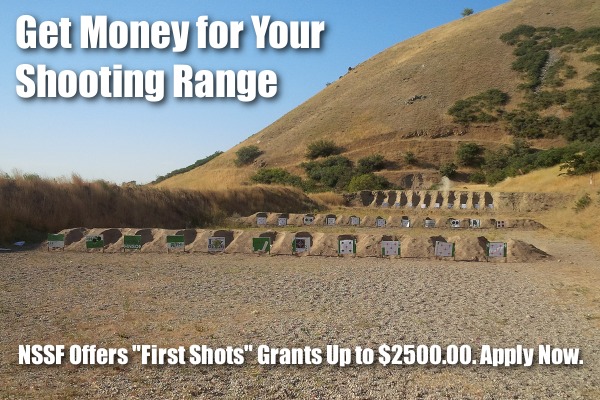
Photo courtesy LibertyManufacturing.com.
The National Shooting Sports Foundation (NSSF®), the trade association for the firearms industry, is pleased to announce that it has established a $100,000 grant program to be used by firearms ranges in support of their NSSF First Shots® introductory shooting programs. Grants up to $2500.00 will be awarded to help shooting clubs offer introductory “First Shots” events. These First Shots events serve the dual purpose of providing a safe, fun and educational introduction experience for people new to firearms and shooting while fostering community outreach and developing a new customer base for member ranges.

The grant program is now open for application by shooting ranges and organizations. Applicants may apply for grants of up to $2,500 to be used to create or enhance marketing and advertising efforts for First Shots events held preferably before April 1, 2019, or within 90 days of receiving the grant. They can also apply a portion of their funds for any necessary equipment purchases such as loaner firearms. The grant program is open to current and former NSSF Member First Shots host ranges and organizations, as well as those ranges just getting started with or that plan to start hosting First Shots events for the first time. New and former First Shots host ranges will be given Grant award priority.
“First Shots is well-established as a program that connects people interested in learning about firearms safety and target shooting with the ranges and instructors in their communities, and it’s proven to not only get these people to the range for their first shots but to keep them coming back,” said Zach Snow, NSSF Director, Shooting Range Services. “We expect this grant program, along with the additional program support we offer our First Shots host ranges, will go a long way towards improving shooting sports safety training, participation numbers and enhancing the viability of our Member ranges.”
Ranges and organizations that wish to apply for the First Shots Grant Program are encouraged to do so at their earliest opportunity. For more information, contact Ann Gamauf, NSSF Retail & Range Business Development Coordinator, at agamauf [at] nssf.org or CLICK HERE .
November 10th, 2018

It’s the holiday season — there’s no better time to sit in front of a fire and read a good gun book. Midsouth Shooters Supply now carries the full line of shooting and reloading books from Krause Publications at very attractive prices. Looking for reliable reference works on reloading, or a gift for a shooting buddy? You’ll find something worthwhile among the Krause library of gun books, which includes the respected Gun Digest Shooter’s Guides. Match directors also take note — books make great match prizes. Paperback books cost no more than wood plaques but they will provide valuable information for years instead of just gathering dust in a closet. If your club offers training programs, Krause offers many titles that will help new shooters improve their skills.
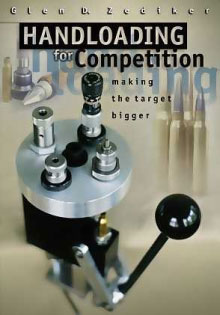
Midsouth carries Glen Zediker’s excellent books, including Handloading For Competition, the recent Top-Grade Ammo and other titles.
Here Are Some of Our favorite Krause Shooting and Reloading Titles:
November 10th, 2018

Looking to improve your competition skills? The Shooting Sports USA website has scores of informative articles that can help your score higher at your next shooting tournament. You’ll find articles on wind reading, position shooting, match strategies, and much more.
One great Shooting Sports USA article, Shooting is 90% Mental, was penned by Chip Lohman (SSUSA’s former Editor). With the help of two very smart Ph.D types, Judy Tant and Mike Keyes, Lohman examines the mental processes involved in the shooting sports. Chip’s co-authors have impressive credentials. Dr. Judy Tant is a Clinical Psychologist and National Bullseye Pistol Champion. Dr. Michael J. Keyes, is a licensed Psychiatrist and former physician for the U.S. Shooting Team.
CLICK HERE to Read Full Article in Shooting Sports USA Online Magazine.
Visualization, Brain Function, and Muscle Memory
If you shoot competitively, this is definitely a “must-read” article. The authors examine how the brain functions under stress, how “visualization” can be used to improved performance, how “brain speed” can be enhanced through proper training, and how the brain stores learned routines into “muscle memory.” And that’s just for starters — the article gives many concrete examples of techniques top shooters have employed to improve their “mental game” and shoot higher scores.
Brain Speed and Trigger Control:
 Research: Scientists believe that the newer frontal lobe may not be able to keep up with “deep” brain signals that transmit at nearly 300 mph. This is explained when athletes talk about “letting go”, rather than over-thinking the shot. Research: Scientists believe that the newer frontal lobe may not be able to keep up with “deep” brain signals that transmit at nearly 300 mph. This is explained when athletes talk about “letting go”, rather than over-thinking the shot.
This conscious signal can take up to 0.3 seconds from recognizing the desired sight picture to moving the trigger finger — too long to capture the opportunity for a perfect shot. However, if the signal is initiated spontaneously in the cerebellum where such procedures are thought to be stored through repetition, the reaction speed is much quicker. Signals are processed by the “deep brain” almost twice as fast as the problem-solving frontal lobes.
November 5th, 2018


The First Shot, the CMP’s online magazine, features a well-written article on Prone Shooting Technique by SPC Matthew Sigrist of the U.S. Army Marksmanship Unit (USAMU). The article covers all the major points of gun hold and body position: hand position, elbow position, stock weld, buttstock placement, and sling position/tension.
Keep it Steady — The Elements of a Good Prone Position
Part 1 — Building the Position
By SPC Matthew Sigrist
Imagine the following scenario: You are at the last stage of fire in the National Trophy Individual Match, firing at the 600 yard line in the prone position and every point matters. What should you reflect on as you prepare to shoot this final string? As your eyes cloud from sweat, you realize that all you have to rely on is your experience and knowledge of the fundamentals.
During the National Trophy Individual Match, you will fire 60 percent of your shots from the prone position. This article will address the fundamentals of a good prone position and help you learn the techniques required to be successful in both the slow and rapid-fire stages of National Match competition.
This article will be divided into two parts. In part one, we will discuss the elements of a good prone position. In part two, we will cover the techniques you will in the rapid-fire and slow-fire stages.
The Fundamentals
The fundamentals are the building blocks of a position. Much like the framework of a house, a correct application of the fundamentals ensures a solid and stable structure. Since each person’s position will depend on their particular body build and shape, there is no “perfect position” that applies to everyone. Experience, practice and knowledge of the correct fundamentals will dictate the best position for you.
There are six key elements of any position. The purpose for these six points is to achieve a solid platform that allows for consistent sight alignment using the least amount of muscle tension.
1. Placement of the Firing Hand (the hand that pulls the trigger)
The firing hand needs to be placed high on the pistol grip. This high hand position will give you better control of the rifle. Combined with a firm grip there will be a reduced amount of hand movement when pulling the trigger. Wrap your thumb over the three fingers on the pistol grip (excluding the trigger finger). This will help isolate the movement of the trigger finger.
2. Placement of the Non-firing Hand (the hand supporting the rifle).
The non-firing hand should grip the handguard or stock in the flat portion of the hand between the thumb and forefinger. The fingers should curl naturally around the stock, but they should not grip it tightly. The position of the hand on the stock will depend on the physical size of the shooter. Generally speaking, taller shooters with longer arms will grip the rifle further out, near the sling swivel, while shorter shooters will need to pull their hand rearward. This is sometimes referred to as “short-stocking” the rifle.
3. Stock Weld
Stock weld is the contact that the face makes with the stock. It is important because it directly effects your sight alignment. Consistent head placement will help you achieve consistent sight alignment. The human head weighs an average of 8 to 10 pounds. The full weight of the head must rest on the stock. In doing this you achieve two things, a relaxed neck and reduced recoil because of the pressure of the head.
4. Placement of the Rifle (the contact that is made in the firing shoulder)
The rifle butt placement needs to be consistent. If this changes between shots, it effects your sight alignment and the effect of recoil. In the prone position the rifle will sit lower in the shoulder compared to other shooting positions. This allows for a more forward head and a lower position as a whole.
5. Position of the Sling
The sling should be high on the arm, above the bicep. This way the sling will have less leverage on the arm so it doesn’t cut off the circulation.
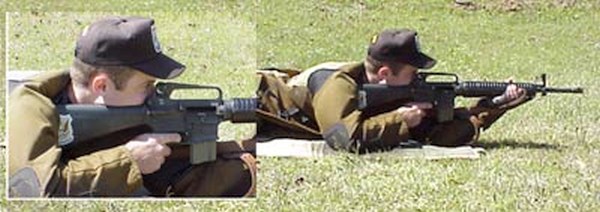
Demonstration of the placement of the firing elbow (left) and non-firing elbows (right).
6. Placement of both the firing, and non-firing elbows
A guideline for non-firing elbow placement is that there should be 1 ½’’ to 2’’ gap between your non-firing arm and the rifle’s magazine. (NOTE: this references the AR-15 service rifle) Your arm should be almost straight up and down; this will transfer the weight directly down the arm and not to the side (see picture above). Think of the firing arm as only a kind of kickstand, it doesn’t support weight it only holds the firing hand in position.
Variations of the Prone Position
There are two main variations of the prone position; open/spread legged, and bent-legged. The two types will be discussed below.
Open/Spread Leg Position

Demonstration of the Open/Spread Leg Position.
The first position is the open/spread legged position. This is when the shooter spreads their legs shoulder width or more apart. This allows for a more forward pressure on the sling and elbows. This position requires a tighter sling and solid elbow placement. The rifle should sit tight in the shoulder. With this position, your body will be farther behind the rifle compared to the bent leg position, allowing for minimum disturbance from recoil.
Bent Leg Position
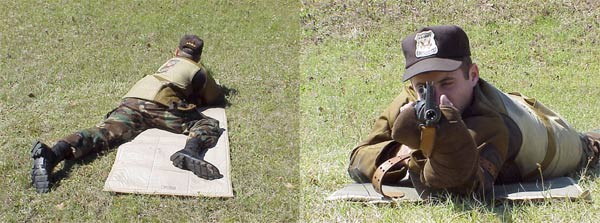
Demonstration of the Bent Leg Position.
The bent leg position is when the shooter bends the firing side leg up towards the firing hand making the knee at a rough 90 degree angle to the body. The non-firing leg will remain straight and inline with the body. This will take pressure off the lungs and heart minimizing the pulse from the chest as well as easing the pressure on the lungs which will allow for easy breathing and control.
Summary
You now know the fundamentals of a good prone position, as well as the two types most commonly used. Extensive dry-firing will reveal which is the best position for you. If possible, have a friend take pictures of you in position. This will enable you to better diagnose and correct your errors. Remember, a position must be both fundamentally sound and comfortable. Practice frequently to learn your new position and to develop the conditioning required to endure long days on the range.
November 1st, 2018

At the request of Forum members, we are reproducing this helpful article by gunsmith and Hall-of-Fame benchrest shooter Thomas “Speedy” Gonzalez
How to Reduce Vertical in Your Shot Groups
One of our Shooter’s Forum members recently built a new benchrest rifle. He was concerned because his groups were stringing vertically. This is a common problem that all precision shooters will face sooner or later. In addition to ammo inconsistencies, many other factors can cause vertical stringing. Accordingly, it’s important that you analyze your gun handling and bench set-up systematically.
Hall of Fame benchrest Shooter Speedy Gonzalez has written a helpful article that explains how to eliminate mechanical and gun-handling problems that cause vertical spread in your groups. Speedy’s article addresses both the human and the hardware factors that cause vertical. CLICK HERE to read the full article. Here are a few of Speedy’s tips:
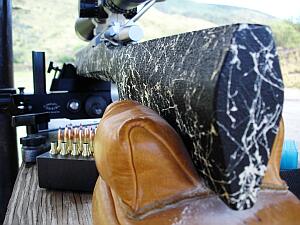 • Front Bag Tension — Vertical can happen if the front sand bag grips the fore-arm too tightly. If…the fore-arm feels like it is stuck in the bag, then the front bag’s grip is too tight. Your rifle should move in evenly and smoothly in the sand bags, not jerk or chatter when you pull the gun back by hand. • Front Bag Tension — Vertical can happen if the front sand bag grips the fore-arm too tightly. If…the fore-arm feels like it is stuck in the bag, then the front bag’s grip is too tight. Your rifle should move in evenly and smoothly in the sand bags, not jerk or chatter when you pull the gun back by hand.
• Sandbag Fill — A front sandbag that is too hard can induce vertical. Personally, I’ve have never had a rifle that will shoot consistently with a rock-hard front sandbag. It always causes vertical or other unexplained shots.
• Stock Recoil — Free-recoil-style shooters should be sure their rifle hits their shoulder squarely on recoil, not on the edge of their shoulder or the side of their arm. If you shoulder your gun, you need to be consistent. You can get vertical if your bench technique is not the same every shot. One common problem is putting your shoulder against the stock for one shot and not the next.
• Front Rest Wobble — You will get vertical if the top section of the front rest is loose. Unfortunately, a lot of rests have movement even when you tighten them as much as you can. This can cause unexplained shots.
• Stock Flex — Some stocks are very flexible. This can cause vertical. There are ways to stiffen stocks, but sometimes replacement is the best answer.
• Rifle Angle — If the gun is not level, but rather angles down at muzzle end, the rifle will recoil up at butt-end, causing vertical. You may need to try different rear bags to get the set-up right.
• Unbalanced Rifle — If the rifle is not balanced, it does not recoil straight, and it will jump in the bags. If the rifle is built properly this will not happen. Clay Spencer calls this “recoil balancing”, and he uses dual scales (front and rear) to ensure the rifle recoils properly.
• Firing Pin — A number of firing-pin issues can cause vertical. First, a firing pin spring that is either too weak or too strong will induce vertical problems. If you think this is the problem change springs and see what happens. Second, a firing pin that is not seated correctly in the bolt (in the cocked position) will cause poor ignition. Take the bolt out of rifle and look in the firing pin hole. If you cannot see the entire end of firing pin it has come out of the hole. Lastly, a firing pin dragging in bolt or shroud can cause vertical. Listen to the sound when you dry fire. If you don’t hear the same sound each shot, something is wrong.
• Be Consistent — You can get vertical if your bench technique is not the same every shot. One common problem is putting your shoulder against the stock for one shot and not the next.
• Head Position — Learn to keep your head down and follow-through after each shot. Stay relaxed and hold your position after breaking the shot.
• Last Shot Laziness — If the 5th shot is a regular problem, you may be guilty of what I call “wishing the last shot in”. This is a very common mistake. We just aim, pull the trigger, and do not worry about the wind flags. Note that in the photo below, the 5th shot was the highest in the group–probably because of fatigue or lack of concentration.
CLICK HERE for Speedy’s full article with more tips and advice.
|