Tomorrow is October 31st, Halloween (originally called “All Hallows’ Evening”). That means kids in costumes will be ringing doorbells as soon as it gets dark. No doubt some of you proscrastinators will wait ’til the last minute to set out your Halloween decorations and Jack-O-Lanterns. Don’t worry, in the video below, our friend, 3-Gun ace Taran Butler, shows how to carve a pumpkin in just about 5.5 seconds, give or take a tenth. Taran performed this feat of speed-carving with his trusty Infinity handgun, chambered in 9mm Major.
What Are the Origins of Halloween?
Halloween or Hallowe’en (a contraction of “All Hallows’ Evening”), also known as All Hallows’ Eve, is a yearly celebration observed on October 31, the eve of the Western Christian feast of All Hallows (or All Saints). According to many scholars, it was originally influenced by western European harvest festivals and festivals of the dead with possible pagan roots, particularly the Celtic Samhain. Others maintain that it originated independently of Samhain and has Christian roots.
Many of our readers are thinking of trying out PRS-type competition. Tactical matches are becoming more popular every season. Along with F-Class, tactical/practical disciplines are the fastest-growing forms of competitive rifle shooting. Rich Emmons, one of the founders of the Precision Rifle Series (PRS), has written an insightful article about getting started in the tactical game. This will help PRS novices pick the right equipment and understand the game. Here are highlights from Emmon’s “PRS — Intro to Competition” article, originally published on the PRS website. You may also want to read the current PRS FAQ Page.
Precision Rifle Series — Intro to Competition
by Rich Emmons, PRS President
Tactical Shooting with a precision rifle is not like other disciplines, there is no set course of fire or format. That is what makes it so fun!
First, you have to ask yourself what do you want to accomplish. When I was introduced to long range shooting, immediately a light turned on for me, once I saw how easy it was to hit 300–600 yard targets. What I quickly learned from my first competition and the many that followed was there is so much to learn and shooting in competition put everything you thought you knew to the test. So back to the question: “What do YOU want to accomplish?”. The reality is you may not know yet, you just think it is cool to have a bad ass rifle and scope that can make almost any shot. Now if you’ve got that rifle and scope, it’s time to take it to the next level.
Watch PRS 2016 Championship
Getting Started — What to Expect
If you’re reading this, you have probably already have been bitten by the long range shooting bug. It can seem quite intimidating to just jump in with a new bunch of shooters you don’t know and shooting lingo you don’t quite understand yet. But here is the key — show up and shoot! I guarantee you if you show up to a match as a new shooter, other experienced shooters will guide you along and give you help on anything you need.
AUDIO: Click Button to hear Rich Emmons Talk about the Precision Rifle Series.
Now, a couple things you should just expect. You’re not as good as you think you are. Don’t expect to come into your first match and beat all the veterans. That just doesn’t happen unless you have had some really good coaching or other shooting competition experience to get you ready for this type of competition. If possible, find a local rifle club that has monthly long range matches, or any type of match will help prepare you for a larger PRS event. Getting involved with a rifle club and starting out shooting monthly matches is definitely the way to jump into competition shooting.
The Gear You Need
The first question that many ask is: “What kind of rifle/caliber/scope do I need?” The easiest answer to this is, the best you can afford. It’s no secret the gear is expensive. It took me several years of buying sub-par gear and eventually trading up to figure this out. Now, a guy can get a real sense of pride of doing it on the cheap, or with a factory rifle. I’ve seen many old Savage 10FPs take down custom rigs that cost 10 times as much. And if that’s all you can afford, then eventually you will learn the limitations of yourself or your gear. As for choice of cartridge/caliber, the respected Precision Rifle Blog has analyzed four years worth of match results from the best tactical shooters in the nation. CLICK HERE to read a PRB article that reveals what the “top guns” use.
Craig Arnzen of Area 419 has created a useful article reviewing the gear PRS shooters need, including support bags, hearing protection, and other key accessories such as muzzle brakes. This helpful article also covers factory ammunition options.
Making Good Ammo
Producing quality reloads is something you have to master. It’s not hard at all, you just have to pay attention to detail, and eventually you are going to do something stupid like mis-priming your brass, or skip a row of brass when dumping your powder. Everybody has their own horror story of some reloading failure that cost them a stage or even a match. So load to perfection, work with your rifle to find what load it likes the best, then start your practice.
Practice Makes Perfect
You want to become ONE with your rifle, learning everything you can about its functionality. Getting comfortable with the operation of your rifle is key. Learn the feel of your trigger, dry-firing until you wear the paint off your bolt handle. Learn how the rifle works best — pay attention to little things like the sound and feel of the bolt feeding a round from the mag (or when it doesn’t). Learn how to remove a jammed round quickly, learn how to reload a magazine quickly. Learn to scan across a field and find targets in a quick manner, seeing the targets with your eye and coming into the scope on target. These are some of the basic practices that separate the new shooters from the seasoned ones.
Here’s a cool contest courtesy of Pyramyd Air. Win a pick-your-own prize package worth up to $3000.00. The winner selects any combination of products from Pyramyd Air’s entire inventory — air rifles, scopes, pellets, targets — you name it. You can even choose a set of products that cost more than $3000 — you just pay the difference. Act soon — the entry deadline is November 10, 2018.
This Backyard Brawl contest is a bit unusual. To enter you need to shoot a set of mini silhouettes and then make a video. The silhouette targets are free with code BRAWLER (shipping extra). Once you receive the targets, knock ‘em down with your airgun, and upload a video to YouTube or Vimeo.
How to Enter Backyard Brawlin’ Contest
Order Air Venturi Airgun Slynger Metal Silhouette Targets, FREE with promo code BRAWLER (shipping extra). Then upload a video of you shooting the targets with an air rifle or air pistol. Contest ends November 10, 2018. Limit one entry per person. All entrants will receive $5 in Bullseye Bucks at Pyramyd Air. Winner will be announced the week of November 12, 2018.
Backyard Brawl Contestant Videos
Here are two videos recently uploaded by Backyard Brawl contest entrants. You’ll see some pretty good shooting with interesting airguns. Can you make a more entertaining video?
Here Matt Coulter shoots a .22 Caliber Royale with JSP Express Jumbo pellets at about 580 fps.
In this video, UpNorthAirGunner shoots a Benjamin Marauder .177 Field & Target, a Broom-Handle Mauser clone full-auto BB Pistol, and a Seneca “Dragon Claw” .50 caliber air rifle.
If you buy one book about Long Range Shooting, this should be it. Based on sophisticated testing and research, this 356-page hardcover from Applied Ballistics offers important insights you won’t find anywhere else. Modern Advancements in Long Range Shooting – Volume II, the latest treatise from Bryan Litz, is chock full of information, much of it derived through sophisticated field testing. As Chief Ballistician for Berger Bullets (and a trained rocket scientist), author Bryan Litz is uniquely qualified. Bryan is also an ace sling shooter and a past F-TR National Champion. Moreover, Bryan’s company, Applied Ballistics, has been a leader in the Extreme Long Range (ELR) discipline.
AUDIO FILE: Bryan Litz Talks about Modern Advancements in Long Range Shooting, Volume 2. (Sound file loads when you click button).
Volume II of Modern Advancements in Long Range Shooting ($39.95) contains all-new content derived from research by Applied Ballistics. Author Bryan Litz along with contributing authors Nick Vitalbo and Cal Zant use the scientific method and careful testing to answer important questions faced by long range shooters. In particular, this volume explores the subject of bullet dispersion including group convergence. Advanced hand-loading subjects are covered such as: bullet pointing and trimming, powder measurement, flash hole deburring, neck tension, and fill ratio. Each topic is explored with extensive live fire testing, and the resulting information helps to guide hand loaders in a deliberate path to success. The current bullet library of measured G1 and G7 ballistic coefficients is included as an appendix. This library currently has data on 533 bullets in common use by long range shooters.
Bryan tells us that one purpose of this book is to dispel myths and correct commonly-held misconceptions: “Modern Advancements in Long Range Shooting aims to end the misinformation which is so prevalent in long range shooting. By applying the scientific method and taking a Myth Buster approach, the state of the art is advanced….”
Bullet Dispersion and Group Convergence
Part 1 of this Volume is focused on the details of rifle bullet dispersion. Chapter 1 builds a discussion of dispersion and precision that every shooter will benefit from in terms of understanding how it impacts their particular shooting application. How many shots should you shoot in a group? What kind of 5-shot 100 yard groups correlate to average or winning precision levels in 1000 yard F-Class shooting?
Chapter 2 presents a very detailed investigation of the mysterious concept of group convergence, which is the common idea that some guns can shoot smaller (MOA) groups at longer ranges. This concept is thoroughly tested with extensive live fire, and the results answer a very important question that has baffled shooters for many generations.
Part 2 of this Volume is focused on various aspects of advanced hand-loading. Modern Advancements (Vol. II) employs live fire testing to answer the important questions that precision hand loaders are asking. What are the best ways to achieve MVs with low ES and SD? Do flash hole deburring, neck tension, primer selection, and fill ratio and powder scales sensitivity make a difference and how much? All of these questions are explored in detail with a clear explanation of test results.
One of the important chapters of Part 2 examines bullet pointing and trimming. Applied Ballistics tested 39 different bullet types from .224 through .338 caliber. Ten samples of each bullet were tested for BC in each of the following configurations: original out of the box, pointed, trimmed, pointed and trimmed. The effect on the average BC as well as the uniformity in BC was measured and tabulated, revealing what works best.
Part 3 covers a variety of general research topics. Contributing author Nick Vitalbo, a laser technology expert, tested 22 different laser rangefinders. Nick’s material on rangefinder performance is a landmark piece of work. Nick shows how shooters can determine the performance of a rangefinder under various lighting conditions, target sizes, and reflectivities.
Chapter 9 is a thorough analysis of rimfire ammunition. Ballistic Performance of Rifle Bullets, 2nd Edition presented live fire data on 95 different types of .22 rimfire ammunition, each tested in five different barrels having various lengths and twist rates. Where that book just presented the data, Chapter 9 of this book offers detailed analysis of all the test results and shows what properties of rimfire ammunition are favorable, and how the BCs, muzzle velocities and consistency of the ammo are affected by the different barrels.
Chapter 10 is a discussion of aerodynamic drag as it relates to ballistic trajectory modeling. You will learn from the ground up: what an aerodynamic drag model is, how it’s measure and used to predict trajectories. Analysis is presented which shows how the best trajectory models compare to actual measured drop in the real world.
Finally, contributing author Cal Zant of the Precision Rifle Blog presents a study of modern carbon fiber-wrapped barrels in Chapter 11. The science and technology of these modern rifle barrels is discussed, and then everything from point of impact shift to group sizes are compared for several samples of each type of barrel including standard steel barrels.
Have you ever wondered how Olympic-class position shooters hold their aim so steady? Those bulky shooting coats help, but there is a lot of bio-mechanics involved also. Top shooters employ their body structure to help support the weight of their rifles, and to steady their aim. This interesting video, produced by GOnra Media, demonstrates rifle hold and body alignment for prone, standing, sitting, and kneeling positions. Olympic Gold Medalist Jamie Corkish (formerly Jamie Gray) demonstrates the proper stance and position of arms and legs for each of the positions. Ideally, in all of the shooting positions, the shooter takes advantage of skeletal support. The shooter should align the bones of his/her arms and legs to provide a solid foundation. A shooter’s legs and arms form vertical planes helping the body remain stable in the shooting position.
Jamie Corkish, London 2012 Gold Medalist in Women’s 3 X 20, has retired from top-level competitive shooting. However, Jamie remains involved in the shooting sports as a Public Relations/Marketing representative for ELEY, a leading maker of rimfire ammunition. Jamie also works with shooting clubs and educational institutions to promote smallbore target shooting.
Images are stills from GOnraMedia video linked above.
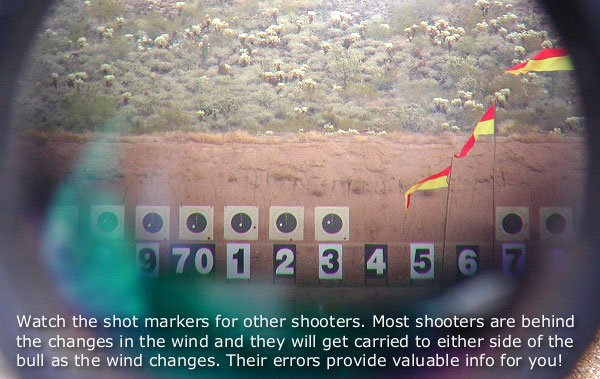
On LongRangeHunting.com, you’ll find a good article by Shawn Carlock about wind reading. Shawn is a veteran law enforcement marksman and a past USPSA national precision rifle champion. Shawn offers good advice on how to estimate wind speeds and directions using a multitude of available indicators — not just your wind gauge: “Use anything at your disposal to accurately estimate the wind’s velocity. I keep and use a Kestrel for reading conditions….The Kestrel is very accurate but will only tell you what the conditions are where you are standing. I practice by looking at grass, brush, trees, dust, wind flags, mirage, rain, fog and anything else that will give me info on velocity and then estimate the speed.”
Shawn also explains how terrain features can cause vertical wind effects. A hunter on a hilltop must account for bullet rise if there is a headwind blowing up the slope. Many shooters consider wind in only one plane — the horizontal. In fact wind has vertical components, both up and down. If you have piloted a small aircraft you know how important vertical wind vectors can be. Match shooters will also experience vertical rise when there is a strong tailwind blowing over an up-sloping berm ahead of the target emplacements. Overall, Shawn concludes: “The more time you spend studying the wind and its effect over varying terrain the more successful you will be as a long-range shooter and hunter.”
This Editor, as a life-long sailor, also has some suggestions about wind. Many folks may not realize that wind can cycle, both in direction and in speed (velocity). If you are patient, you should be able to sense the timing of the cycles, which will help you predict shifts in wind direction and velocity. While it is tempting to shoot in the lulls, sometimes the true wind vector (angle + speed) may be most constant when the wind is blowing stronger.
Another tip for hunters is to orient your shot, when possible, in alignment with the wind direction. Try to face into the wind, or have the wind at your back. This is especially effective when shooting in a varmint field. Use a string of tape on a pole to show wind angle. Then shoot directly into the wind or with the wind directly at your back. This will minimize horizontal deflection caused by the wind.
SFC Daniel Horner, now a civilian, is the best multi-gun competitor this Editor has ever met and seen in action. Horner is masterful with pistols, ultra-fast and accurate with rifles, and amazing with shotguns. Horner’s multi-gun aiming and transition speeds defy belief. Even with his world-beating skills, Horner is also respectful and humble. As a leading member of the U.S. Army Marksmanship (USAMU) team, Horner was never a show-boat, he was just (nearly always) the fastest guy on the range. I’ve seen him beat other top-level shooters by 10 seconds or more in a single stage. He’s that good. And now he’s turned PRO, having joined the SIG Sauer Shooting Team.
As a soldier with the USAMU, Horner was a true phenom with rifle, pistol, and shotgun, winning multiple 3-Gun titles against tough competition. When he was on his game, no one on the planet was better in the 3-Gun arena. His record of major multi-gun championships may never be rivaled. He has won over 125 major events/titles at the world, national, regional, and state level and he’s still a young man! Consider Horner’s amazing list of World and National titles:
10-Time USPSA Multi-Gun National Champion
4-Time 3-Gun Nation Pro Series Champion
2014 NRA World Shooting Championship Winner
2-Time IDPA National Champion
2-Time Int’l Sniper Competition Team Winner
IPSC Shotgun National Champion
Horner Highlights on Video
Here are some of our favorite Daniel Horner competition videos. You can see why he won so many major championships, including all the top multi-gun competitions.
Horner Shreds 3-Gun Nation Night-Time Stage
Horner Blazes in Rocky Mountain 3-Gun Shoot (Great Scenery!)
Horner Rips Night-Time Stage at 3-Gun Nation 2016 Pro Finale
How to Hammer Like Horner
In this USAMU Video, SFC Daniel Horner talks about grip, hold, stance, and body position. The proper hold/stance speeds up target transitions and keeps the muzzle on target for faster follow-up shots.
Champion 3-Gun Ace Daniel Horner has joined the SIG Sauer Professional Shooting Team — Team SIG. Horner recently left the service of the U.S. Army where he rose to the rank of Sergeant First Class (SFC). Horner served with the U.S. Army Marksmanship Unit, becoming one of the most successful shooters in team history. Horner also helped coach the USAMU Action Shooting Team.
Horner’s History — Rising to World Champion After Starting at Age Six
“I started shooting at six years old when I would go to the range with my Dad. When I was twelve years old I shot my first IDPA match, at sixteen I won my first IDPA National title, and at eighteen I enlisted in the U.S. Army to join the AMU. For basically my entire life I have been shooting competitively, and for as long as I can remember it’s been a lifelong goal of mine to shoot professionally. To have this opportunity to … join Team SIG is really a dream come true and I can’t wait to start working with the company and competing.”
Horner will compete primarily in multi-gun matches, and long-range rifle competition as a member of Team SIG. Horner’s first competition with Team SIG will be the SIG Sauer Fort Benning Multi-Gun Challenge next month (November 15-18, 2018). Horner will campaign a P320 X-Five full-size pistol, and a SIG M400 SDI Comp rifle with a TANGO6 1-6x24mm second focal plane scope.
This is the kind of program we like to see — a well-organized event that introduces hundreds of new participants to the shooting sports. In this instance, some 472 ladies attended a day-long event in Oklahoma City, OK. Part of the NRA’s successful Woman On Target program, the Oklahoma city Day at the Range Fun Shoot was a huge success.
Suzi Rouse, lead organizer for the event stated: “It was a great success as evidenced by the smiling faces and positive feedback on their evaluations”. Rouse heads up efforts for one of the most popular Women on Target events in the nation.
The Oklahoma City (OKC) event included pistol, rifle, and shotgun shooting with guns, ammunition, and safety gear supplied by the organizers and sponsors. This year, for example, Blaser Firearms provided two new .308 Win Mauser M18s. There were even prize give-aways during the lunch break.
The team at the Oklahoma City Gun Club has many years of experience now, and runs the big event like clockwork. While the Fun Shoot is focused on new shooters, there are many repeat lady participants, for whom this has become the social event of the year at the OKC Club. 2018 marks the 19th year the club has hosted a Fun Shoot for Women.
Spotlight on Suzi Rouse Event Director Suzi Rouse has served as President of the Oklahoma City Gun Club. She’s been a very effective leader in an activity typically dominated by men.
“Rouse grew up in a family where firearms were part and parcel of life. Rouse … has evolved into a strong advocate for female shooters. Rouse has long been active with the NRA and its marksmanship and safety efforts. And though the seed for the Women on Target program was planted in Wisconsin in 1998, Rouse was among the first women to get involved. She applied for and won a grant to train 12 women to be rifle, shotgun, and handgun instructors so the new shooters would be taught by other women. Rouse started the Oklahoma version as a ‘beta’ event a year after the Wisconsin debut, and the program went national soon thereafter.” — From America’s First Freedom.
Panteo Productions, producers of firearms training videos, has just released a new series of FREE instructional videos for handgun owners. Co-sponsored by Ruger and Federal, the Handgun 101 video series covers handgun and ammunition nomenclature, handgun functions, basic shooting skills, and the key considerations for concealed carry. The three-part series includes: Intro to Handguns, A Concealed Carry Permit, and Intro to Concealed Carry. Part 1 includes multiple chapters with a ton of information. Combined with Part 2 (20 min) and Part 3 (33 min), this series delivers over two hours of helpful content.
These free videos are available streaming online from the Panteao website, on the Panteao mobile apps for Android and Apple devices, as well as on television from the Panteao Make Ready channel on Roku, Amazon Fire TV, and Apple TV. Click the links below to watch each of the three episodes.
In part One of Handgun 101, Intro to Handguns, instructor Kyle Harth reviews the firearm safety rules, handgun function (and terminology) for both revolvers and semi-auto pistols. In addition, Harth reviews handgun sizes, ammunition, how to grip a handgun properly, safely storing a handgun, proper training, shooting sports and carrying a handgun. This video is intended to be a handgun owner’s first step in familiarizing himself with handgun operation.
In Part Two of Handgun 101, A Concealed Carry Permit, instructors Kyle Harth and Massad Ayoob carrying a handgun for self-defense, and the important issues associated with defensive gun use. This video reviews concealed carry, traveling from state to state, prohibited carry locations, the use of deadly force, protection of persons and property, and interaction with law enforcement. If you are considering obtaining a concealed carry permit or live in a state where you can carry open or concealed without a permit, this video is for you.
In Part Three of Handgun 101, Intro to Concealed Carry, instructor Kyle Harth reviews handgun selection, caliber and ammo choices, methods of carry, belts and mag pouches, clothing considerations, and the importance of training. Remember that the Handgun 101 series is not where your education process ends. Take courses from reputable firearms instructors with understanding of self-defense legal matters. Equally important, go to the range and practice!
In this article, three great champions reveal their wind-calling secrets in video interviews. We first published this “Three Champions” story a few years ago. If you are a competitive shooter, and you want to learn more about reading the wind, you should watch all three of these interviews. These guys are among the best shooters to ever shoulder a rifle, and they have much wisdom to share.
At the 2010 SHOT Show, we had the unique opportunity to corner three “superstars” of High Power shooting, and solicit their wind-reading secrets. In the three videos below (in alphabetical order), Carl Bernosky (10-Time Nat’l High Power Champion), David Tubb (11-time Nat’l High Power Champion and 7-time Nat’l Long-Range Champion), and John Whidden (5-Time Nat’l High Power Long-Range Champion) shared some of the wind-doping strategies that have carried them to victory in the nation’s most competitive shooting matches. This is GOLD folks… no matter what your discipline — be it short-range Benchrest or Long-Range High Power — watch these videos for valuable insights that can help you shoot more accurately, and post higher scores, in all wind conditions.
We were very fortunate to have these three extraordinarily gifted champions reveal their “winning ways”. These guys REALLY know their stuff. I thought to myself: “Wow, this is how a baseball fan might feel if he could assemble Babe Ruth, Hank Aaron, and Ted Williams in the same room, and have them each reveal their hitting secrets.” Editor’s Note: These interviews were conducted before all three men won their most recent National Championships so the introductions may list a lower number of titles won. For example, John Whidden won back-to-back LR Championships in 2016 and 2017/


 Tomorrow is October 31st, Halloween (originally called “All Hallows’ Evening”). That means kids in costumes will be ringing doorbells as soon as it gets dark. No doubt some of you proscrastinators will wait ’til the last minute to set out your Halloween decorations and Jack-O-Lanterns. Don’t worry, in the video below, our friend, 3-Gun ace Taran Butler, shows how to carve a pumpkin in just about 5.5 seconds, give or take a tenth. Taran performed this feat of speed-carving with his trusty Infinity handgun, chambered in 9mm Major.


 Part 2 of this Volume is focused on various aspects of advanced hand-loading. Modern Advancements (Vol. II) employs live fire testing to answer the important questions that precision hand loaders are asking. What are the best ways to achieve MVs with low ES and SD? Do flash hole deburring, neck tension, primer selection, and fill ratio and powder scales sensitivity make a difference and how much? All of these questions are explored in detail with a clear explanation of test results.


 10-Time USPSA Multi-Gun National Champion


 Event Director Suzi Rouse has served as President of the Oklahoma City Gun Club. She’s been a very effective leader in an activity typically dominated by men.