The inaugural CMP National Air Gun Matches will take place July 16-18, 2022 at the Gary Anderson CMP Competition Center located on Camp Perry in Port Clinton, Ohio. CMP is excited to integrate a National Air Gun Competition into the National Match schedule. This year’s Air Gun championship will include training and a two-member team match on the first day, followed by two days of 60-shot competitions in air rifle and air pistol. A four-member team match will be included in the two days of 60-shot competitions.
The inaugural National Air Gun Championship will be held as part of the 2022 Camp Perry National Matches. That schedule allows the CMP’s junior 3PAR National Championship, the Air Gun Championship, and the National Matches Smallbore events to all be fired consecutively, with the Air Gun events held at the Gary Anderson Competition Center at Camp Perry.
July 16 – Training & Two-Member Team Elimination Match
July 17 – Air Gun Match 1 Championship
July 18 – Air Gun Match 2 Championship & Final
Team Results: 4-Member Team Match will be based on scores fired in Match 1 and Match 2
Gary Anderson CMP Competition Center at Camp Perry.
Additionally, the CMP has implemented new Distinguished Air Rifle and Air Pistol badge programs. Starting in 2022, Air Rifle and Air Pistol competitors of all ages, not just juniors, will be able to earn Excellence-In-Competition (EIC) credits for these badges in 60-shot National Matches Air Gun Championships, monthly matches, as well as in CMP-sanctioned Air Rifle and Air Pistol club matches. For additional information about the CMP Air Gun National Matches, contact Katie Harrington at kharrington@thecmp.org or call(419) 635-2141, ext. 731.
Bang Clang! The 2022 Steel Challenge World Speed Shooting Championship is featured on Shooting USA TV this week. The Shooting USA Steel Challenge episode runs June 22, 2022 on the Outdoor Channel. Show times are: Wednesdays, 9:00 PM Eastern and Pacific, 8:00 PM Central. After those broadcast times, you can watch the show via Vimeo on Demand for $0.99 per episode.
This past April, the fastest speed shooters in the nation showcased their skills at the Steel Challenge Championship at the CMP Talladega Marksmanship Complex in Alabama. The Steel Challenge course consists of multiple 5-target close-range stages. This discipline has been called “drag racing with guns”. Draw and shoot 5 steel targets with time as your score. The shooter with the lowest overall time wins.
There are multiple pistol and revolver classes, both rimfire and centerfire, iron sights and optics. Increasing in popularity (and speed) are the rimfire rifle and pistol-caliber centerfire rifle classes. There are 13 gun classes in total, the most for any shooting championship. In the centerfire handgun match, the fastest times are posted by competitors using enhanced open guns with compensators and red-dot optics.
Here is a full length Shooting USA Steel Challenge Episode from 2017:
Shooting USA Video covers Course of Fire, Firearms Classes, and Target Layouts (1:20)
Definitely watch the 4-minute video (above) produced by Shooting USA. It explains the classes, shows the stages, and illustrates ALL the different gun classes, pistol AND rifle. You can also see some of the world’s fastest shooters including Jessie Harrison (1:47, 3:44) and Max Michel (3:48). Be amazed by the speed of semi-auto rimfire rifles — five targets hit in under two seconds!
Here is Jessie Harrison, the fastest lady pistol shooter on the planet. At the 2022 World Speed Shooting Championship, Jessie won the Ladies High Overall title plus the Steel Master award. Harrison is the first woman to claim the Steel Master award, given to the competitor with the best aggregate score for two centerfire divisions and one rimfire division. Below Jessie celebrates with Taurus team-mate K.C. Eusebio, who took the High Overall title and first place in the Open division. This was K.C.’s ninth World Speed Shooting Title.
The Steel Challenge was founded in 1981 by Mike Dalton and Mike Fichman, in Southern California. The two Mikes wanted an exciting alternative to paper targets and came up with the all-steel format. The Steel Challenge World Speed Shooting Championships have grown to one of the largest professional pistol competitions in America. In 2022, scores of competitors competed at the Talladega Marksmanship Park for glory and cash prizes. The Steel Challenge is governed by the Steel Challenge Shooting Association (SCSA) that consists of eight standardized stages with three types of steel targets: small circle, big circle, and square. Here is a steel challenge layout in Germany.
What’s a “wallet group”? It’s a singularly spectacular proof target that entitles its bearer to bragging rights. The wallet group may or may not have been shot in competition, and, by definition, it may not be repeatable. But it exists as incontrovertible proof that, at least once, the stars aligned, and the wind gods smiled on the shooter.
Five Shots in 0.178 MOA at 1000 Yards
A few years ago, Forum member and F-Class shooter Gary Wood was testing his 6.5-284 rifle at the 1000-yard range in Coalinga, California, getting ready for an upcoming long range match. In practice, Gary nailed a witnessed 1.859″ five-shot group, with four of the five shots well under an inch. Use this as proof to win those club-house arguments about whether it is possible to shoot “in the ones” at 1000 yards. Gary’s group worked out to 0.178 MOA!
Gary reports: “I was load testing with 5-shot groups. Each group was shot on a new F-Class center and pulled by Ret. Master Chief Jerry Pullens and spotted by an other long-range shooter. The second 5-shot load group looked really small … by our reckoning four out of five shots measured under an inch. I was amazed. What’s more, when I shot the group, the 4th shot blew the spindle out of the 3rd shot. My spotter saw that in his scope and Jerry Pullens told me about it afterwards”.
As measured with the OnTarget Software, using a scan of the target, Gary plotted the group size at 1.859″ total for five shots, or 0.178 MOA. Gary noted: “I had everyone sign the target which I saved and photographed.” Yes, Gary, this may be the wallet group to end all wallet groups. You should have that target framed.
Gary’s Load and 6.5-284 Rifle Specs
Gary was running a stout load of Hodgdon H4350 and CCI BR-2 primers, pushing moly-coated 142gr Sierra MKs, in Lapua 6.5-284 brass. The rifle features an F-Class, single-shot Surgeon action with a Bartlein 5R barrel chambered with a no-turn neck. Gary says “The barrel only has 70 rounds through it… yep, I think it will shoot.” Gary did all of the gunsmithing and barrel work himself.
Did Gary have any special reloading tricks? Apparently not: “Other than weighing the cases and the powder very carefully, there really were no magical reloading secrets used. The Sierra 142s were moly-coated straight from the box of 500, but they were not weighed or checked for bearing surface. The powder was dropped with a RCBS ChargeMaster then checked with an Acculab scale (to under a tenth). The Lapua cases were not neck-turned, but I did weight-sort them. The five cases for the small group weighed: 195.05, 195.03, 195.03, 195.03, 195.01.”
How’d you like a memorable shooting experience at America’s most famous shooting range? Then register now to compete at the CMP National Matches, held at Camp Perry, on the shores of Lake Erie near Port Clinton, Ohio. Registration is still open for popular centerfire and rimfire competitions. While many of America’s best marksmen will be at Perry this summer, there are programs, such as the Rimfire Sporter series, for shooters of all experience levels. There is still time to register for pistol and rifle matches.
The CMP National Matches will run from July 10 to August 13, 2022 at Camp Perry, Ohio. This major event attracts thousands of shooters over the course of the summer. The 2022 National Matches start with pistol competition and conclude with Long Range Rifle. The Full 2022 Nat’l Matches Calendar is available online.
Held annually at Camp Perry, the CMP National Matches include the CMP National Trophy Pistol and Rifle Matches, the Pistol and Rifle Small Arms Firing Schools, the National Games Rifle Matches, the National Smallbore Matches, and the National Long Range Matches. These matches are conducted by a partnership of the CMP and Ohio National Guard. Since their inception, the National Matches have become a huge, national shooting sports festival with well over 4,500 annual participants. Competitors range from beginners to many of the world’s best.
Good Gear for Camp Perry Competition — High Power and Smallbore
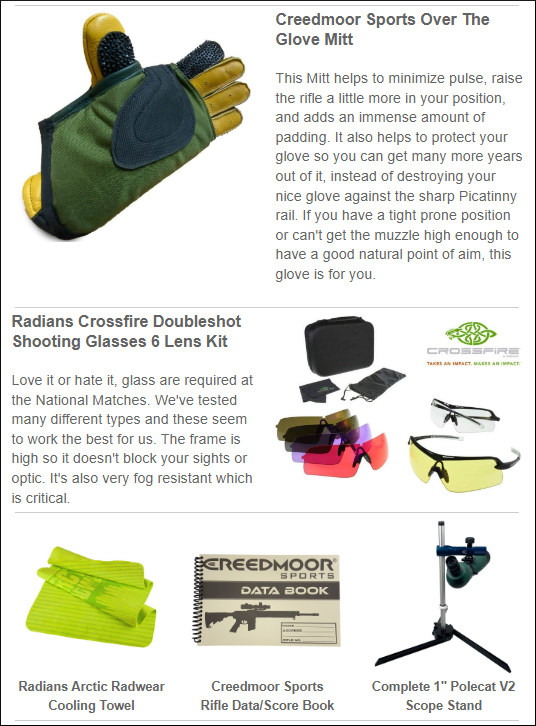
Here are some items that can benefit High Power and Smallbore shooters at the National Matches. All these items are available from Creedmoor Sports, which also sells excellent, customizable shooting coats. Through 11:59 pm on June 20th, FREE Shipping is available for $149+ orders with code DAD22.
To get the best accuracy out of any benchrest rifle, you need to find the optimal position of front rest and rear bag. The important point to remember is that each rig is different. One gun may perform best with the front rest right at the tip of the forearm (Position ‘D’ in photo), while another gun will work best with the rest positioned much further back. This Editor’s own 6mmBR rifle has a laminated stock that is pretty flexy in the front. It shoots best with the front rest’s sandbag located a good 6″ back from the forearm tip (position ‘A’).
Here’s some benchrest advice that can help you reduce vertical and shoot tighter groups… without spending another penny. Many benchrest shooters spend a fortune on equipment and devote countless hours to meticulous handloading, but they never experiment with their rifle’s position/balance on the bags. This article explains why you should test your rifle in various positions. What you learn may surprise you (and improve your scores).
Next time you go to the range, experiment with the position of your rifle on the front rest, and try a couple different positions for the rear bag. You may find that the rifle handles much better after you’ve made a small change in the placement of your gun on the bags. Recoil can be tamed a bit, and tracking can improve significantly, if you optimize the front rest and rear bag positioning.
This competitor has the front rest positioned fairly far forward but not all the way out. Note the stop on the front rest — this limits forward stock travel.
A small change in the position of the forearm on the front rest, or in the placement of the rear bag, can make a big difference in how your gun performs.
Balance Your Gun BEFORE You Spend Hours Tuning Loads
In the pursuit of ultimate accuracy, shooters may spend countless hours on brass prep, bullet selection, and load tuning. Yet the same shooters may pay little attention to how their gun is set-up on the bags. When you have acquired a new rifle, you should do some basic experimentation to find the optimal position for the forearm on the front rest, and the best position for the rear bag. Small changes can make a big difference.
Joel Kendrick, past IBS 600-yard Shooter of the Year, has observed that by adjusting forearm position on the front rest, he can tune out vertical. He has one carbon-fiber-reinforced stock that is extremely rigid. When it was placed with the front rest right under the very tip of the forearm, the gun tended to hop, creating vertical. By sliding the whole gun forward (with more forearm overhang ahead of the front sandbag), he was able to get the whole rig to settle down. That resulted in less vertical dispersion, and the gun tracked much better.
Fore/aft stock position is important even with very wide fore-ends.
Likewise, the placement of the rear bag is very important. Many shooters, by default, will simply place the rear bag the same distance from the front rest with all their guns. In fact, different stocks and different calibers will NOT behave the same. By moving the rear bag forward and aft, you can adjust the rifle’s overall balance and this can improve the tracking significantly. One of our shooters had a Savage 6BR F-Class rifle. By default he had his rear bag set almost all the way at the end of the buttstock. When he slid the rear bag a couple inches forward the gun tracked much better. He immediately noticed that the gun returned to point of aim better (crosshairs would stay on target from shot to shot), AND the gun torqued (twisted) less. The difference was quite noticeable.
A small change in the position of the forearm on the front rest, or in the placement of the rear bag, can make a big difference in how your gun performs. You should experiment with the forearm placement, trying different positions on the front rest. Likewise, you can move the rear bag back and forth a few inches. Once you establish the optimal positions of front rest and rear bag, you should find that your gun tracks better and returns to battery more reliably. You may then discover that the gun shoots smaller groups, with less vertical dispersion. And all these benefits are possible without purchasing any expensive new gear.
Vertical stringing is a common problem that all precision shooters will face sooner or later. In addition to ammo inconsistencies, many other factors can cause vertical stringing. Accordingly, it’s important that you analyze your gun handling and bench set-up systematically.
EDITOR: Folks, READ THIS ARTICLE! You WILL benefit. There are some VERY important insights here. You’ll learn ways to set up your gun better, and check for various technical issues. That can save you time at the range and save you money spent on expensive bullets and powder.
In this article, Hall of Fame benchrest Shooter Speedy Gonzalez explains how to eliminate mechanical and gun-handling problems that cause vertical spread in your groups. Speedy’s article addresses the many human and the hardware factors that can cause vertical.
Speedy Gonzalez, noted shooter, gunsmith and member of the Benchrest Hall of Fame, offers these pearls of wisdom to help you eliminate vertical in your shot strings. Remember that vertical can result from myriad gear issues and gun-handling mistakes. Try to isolate one item at a time as you work to improve your groups.
BAGS and REST–VERY IMPORTANT
• Front Rest Wobble — You will get vertical if the top section of the front rest is loose. Unfortunately, a lot of rests have movement even when you tighten them as much as you can. This can cause unexplained shots.
• Rifle Angle — If the gun is not level, but rather angles down at muzzle end, the rifle will recoil up at butt-end, causing vertical. You may need to try different rear bags to get the set-up right.
• Front Bag Tension–Vertical can happen if the front sand bag grips the fore-arm too tightly. If, when you pull the rifle back by hand, the fore-arm feels like it is stuck in the bag, then the front bag’s grip is too tight. Your rifle should move in evenly and smoothly in the sand bags, not jerk or chatter when you pull the gun back by hand.
• Sandbag Fill — A front sandbag that is too hard can induce vertical. Personally, I’ve have never had a rifle that will shoot consistently with a rock-hard front sandbag. It always causes vertical or other unexplained shots.
• Bag Ears — If the channel between the Rear Bag’s ears is not in line with the barrel, but is twisted left or right, this can affect recoil and vertical consistency. And take note — if the bag is off-axis quite a bit, you can also get horizontal stringing.
• Reliability — ALL your bench equipment must work flawlessly. If it doesn’t, get it fixed or get rid of it. We need all our attention on wind flags.
GUN HANDLING and BENCH TECHNIQUE
• Be Consistent — You can get vertical if your bench technique is not the same every shot. One common problem is putting your shoulder against the stock for one shot and not the next.
• Free Recoil — Free recoil shooters should be sure their rifle hits their shoulder squarely on recoil, not on the edge of their shoulder or the side of their arm.
• Head Position — Learn to keep your head down and follow-through after each shot. Stay relaxed and hold your position after breaking the shot.
• Eyes — Learn to shoot with both eyes open so you can see more of the conditions.
• Last Shot Laziness — If the 5th shot is a regular problem, you may be guilty of what I call “wishing the last shot in”. This is a very common mistake. We just aim, pull the trigger, and do not worry about the wind flags. Note that in the photo above, the 5th shot was the highest in the group–probably because of fatigue or lack of concentration.
• Last Shot Low — I hear a lot of discussion about low shots in a group and apparently this occurs a lot on the 5th shot. If your 5th shot that goes out most of the time, you can bet you are doing something at the bench.
• Seating — When possible, bring your own stool so that you can sit comfortably, at a consistent height, every time you shoot.
LOAD TUNING
• Find the Sweet Spot — A load that is too light or too heavy can cause vertical problems. When you’ve tuned the load right, you should see a reduction in vertical. Even 0.1 grain may make a difference, as will small changes in seating depth.
• Primers — If you’re getting vertical, and everything else looks fine, try another brand of primers. And remove the carbon from the primer pockets so the primers seat uniformly every time.
• Case Prep — When you chamfer the inside of your case necks make sure they are smooth enough that they don’t peel jacket material off when you seat the bullet. Bullets with J4 Jackets (like Bergers) and Lapua Scenar bullets seem more prone to jacket scratching or tearing than Sierra bullets.
• Shell Holders — Keep shell holders clean, in both your press and priming tool. I have seen so much dirt/crud in shell holders that the cases end up get sized crooked because the rim is not square to the die.
• Water in Cases — I see people walking around with case necks turned up in the loading block. A lot of the time there is condensation dropping from the roof of your loading area. If one drop of water gets in a case you are in trouble. How many times have you had a bad low shot when it has been raining and you have been walking around with your cases turned up in your block?
MECHANICAL and HARDWARE ISSUES
• Barrel Weight — A lot of rifles are muzzle-heavy. Some rifles have too heavy a barrel and this causes vertical, especially when shooting free recoil. Basically the gun wants to tip forward. The remedy is to trim or flute the barrel, or add weight in the rear (if you can stay within weight limits).
• Unbalanced Rifle — If the rifle is not balanced, it does not recoil straight, and it will jump in the bags. If the rifle is built properly this will not happen. Clay Spencer calls this “recoil balancing”, and he uses dual scales (front and rear) to ensure the rifle recoils properly.
• Firing Pin — A number of firing-pin issues can cause vertical. First, a firing pin spring that is either too weak or too strong will induce vertical problems. If you think this is the problem change springs and see what happens. Second, a firing pin that is not seated correctly in the bolt (in the cocked position) will cause poor ignition. Take the bolt out of rifle and look in the firing pin hole. If you cannot see the entire end of firing pin it has come out of the hole. Lastly, a firing pin dragging in bolt or shroud can cause vertical. Listen to the sound when you dry fire. If you don’t hear the same sound each shot, something is wrong.
• Trigger — A trigger sear with excessive spring load can cause problems. To diagnose, with an UNLOADED gun, hold the trigger in firing position and push down on sear with your thumb. If it is hard to push down, this will cause vertical problems.
• Stock Flex — Some stocks are very flexible. This can cause vertical. There are ways to stiffen stocks, but sometimes replacement is the best answer.
SCOPE ISSUES
• Lock Rings — This year alone I have seen nine lock rings on scopes that are not tight. Guess what that does to your group? Make sure yours are tight.
• Big Tubes Need Tension — We’ve observed that some 30mm scope rings are not getting tight enough, and scopes are slipping in the rings under recoil. This will cause point of aim movement.
• Windage Bases — If you’re using a conventional-style single dovetail with rear windage adjustment, make sure both sides of the windage screws are tight. This can induce both windage AND vertical issues since the rear ring is held down by the windage tension.
AWARENESS of CONDITIONS and READING WIND
• Basic Wind-Reading Rule–If you do not know how to read wind flags or are very inexperienced, try to shoot your group with the flags all going in one direction.
• Rate of Fire — The longer you wait between shots when a condition is changing, the more the condition change will affect your shots.
• Look Far and Wide — Learn to look at the whole field of flags, not just the row in front of you. Many times a change quite a ways out will cause shot to go out of your group well before that change shows up in front of your bench.
• Don’t Fear the Wind — When you realize that the wind is your friend you will become a much better benchrest shooter. By this I mean that wind skills can separate you from other shooters who have equally good equipment. To learn how to read the wind, you must practice in challenging winds, not only in good conditions.
• Watch Wind Direction AND Velocity — Pay attention to angle changes on flags. Even though you see the same windspeed indicators, angle changes make a big difference in your groups.
• Watch While You Wait — Between courses of fire, whenever possible, watch conditions on the range. That way you will be aware of any changes in conditions since your last group and you will be mentally prepared for the new condition.
SPECIAL ADVICE for HUNTING RIFLES
• Clean That Barrel — Most hunting rifle barrels do not get cleaned enough. If you keep barrel clean it will shoot better for you. You should clean your barrel well after every 10 to 12 shots. If you’re lazy, just use Wipe-Out.
• First Shot Inconsistency — Most hunting rifles will not put the first shot (after cleaning) with the subsequent shots. So, after cleaning, if you have a rifle that tosses that first shot high or wide, then shoot one fouling shot before going hunting or before you shoot for group.
• Barrel Heat — Thin-contour “sporter” barrels WILL change point of impact as they heat up. When testing loads for your hunting rifle, take your time and don’t let the barrel get hot on you.
AccurateShooter’s Target Page provides over 50 FREE downloadable targets. You’ll find all types of targets — sight-in targets, varmint targets, rimfire targets, bullseye targets, tactical targets, load development targets and more. CLICK HERE for all our free targets, including our popular LOAD DEV target.
On this load development target, all your load data fits neatly in the boxes under each target. The diamonds have 1/2″ sides and you can align your cross-hairs on the horizontal and vertical lines. When we test, we crank in a little elevation, setting the point-of-impact higher. That way our shots fall in the gray circles, leaving the red diamonds intact for precise aiming.
Storm Tactical Targets — Hundreds of FREE, Printable Targets
If you want an even greater selection of targets, specialized for PRS and NRL shooters, Storm Tactical offers a vast collection of tactical targets, available in three different versions: MOA, MIL Yards, and MIL Meters. Storm Tactical also created a rimfire target set. This includes side-by-side target blocks for fun, one-on-one competition. Overall there are 299 Storm Tactical Targets in four downloadable sets.
CLICK links to launch each Storm Tactical target collection. Then you can click the download icon to save to your hard drive. OR, you can scroll up and down to select the target(s) you like which you can tell your printer to print. We do recommend downloading the complete archives. File sizes are listed.
Here’s a Tikka T3 in Third Eye Tactical cerakoted chassis.
Rimfire Twin Target, for One-on-One Shooter Challenges
You’ll find this fun target on the third page of the Rimfire Target Pack. Just download the PDF file and instruct your printer to deliver page three. Or print out all six (6) rimfire targets if you like.
At the 2013 Western CMP Games, SGT Robert Evans attained what many shooters seek their entire shooting careers — a Distinguished Rifleman Badge. Evans earned his DR badge with just one hand, after losing his right hand while serving in Iraq with the U.S. Army.
SGT Robert Evans: Defying the Odds, Single-Handedly
AFter joining the Army in 2003, SGT Robert Evans served two tours in Iraq, suffering a spinal injury on the first tour. On his second tour, his life changed forever. On May 31, 2007, Evans was commanding a Bradley Fighting Vehicle in Iraq. As the Bradley drove under an old Fedayeen guard shack, an IED on top of the guard shack detonated while Evans was reaching out of the turret. The blast amputated Robert’s right hand at the wrist.
Even as a young boy, Evans had always enjoyed shooting. He vowed to stay involved with the sport despite his injury: “I couldn’t give up shooting after I lost my hand. It’s always been too important to me,” he said. “No matter what is going on in my life, when the sights are aligned and the hammer is about to fall, nothing in the world matters at that second. It’s my nirvana.”
Evans worked his way back into the sport by starting in F-Class. The position allowed him to hold hard and pull the trigger, while also being able to use his optics. Then he got involved with J.J. O’Shea’s M1 for VETS Project. The project helps transition wounded combat veterans back into the world of shooting, with equipment arrangements, position training and mental preparations.
Working with the M1 for Vets group, Evans started shooting again. But there were challenges: “The first time I shot after my amputation, it was very frustrating,” he said. “I couldn’t hold still, and shooting left-handed was so foreign.” Being extremely right-eye dominant his entire life, the loss of his right hand caused him to relearn many things, including how to shoot. Learning how to reload and adjust for wind while slung up became a pain for Evans….
In 2008, after several months and rigorous hours of dry firing, Evans found himself crossing the threshold of Camp Perry — a dream he had waited to fulfill his entire life. He scored around 50 points standing, out of 100, on his first trip. Though not bad for someone with an amputation, that wasn’t enough for Evans. He wanted to become a Distinguished Rifleman.
SGT Evans during Team Match at 2013 CMP Western Games.
He began to realize his dream as he earned his first 10 points (towards Distinguished) at Camp Perry in 2012. It took him 15 months to LEG out. His next 6 points came at the 2013 Eastern Games in Camp Butner, NC, followed by 10 more points at the 2013 National Matches. There, hoping to “bronze out,” he managed to one-up himself to actually earn a silver medal.
Then came the 2013 Western Games at the Ben Avery Shooting Facility in Phoenix, AZ. Never giving up hope and remembering his long journey from the hospital bed to the firing line, he received his final 8 points. SGT Robert Evans had become a Distinguished Rifleman.
“There was a lot of pressure, speculation and competition as to who would be the first Combat Wounded Veteran to ‘go Distinguished’ within M1 for VETS,” he said. “I’m very proud to have earned my badge, but more importantly, I hope that more wounded veterans will realize that it is within their grasp. It’s not an impossibility anymore. I hope it motivates everybody to train a little harder and hold a bit tighter – not just wounded veterans. If I can do it, anybody can.”
Commentary by GS Arizona
Robert Evans’ inspirational effort is a fresh reminder of the value of marksmanship in creating a focused challenge and reward that can help our wounded warriors regain the confidence and motivation to succeed in all aspects of life.
Robert’s effort is very reminiscent of that of Karoly Takacs, a Hungarian pistol competitor who lost his right hand in a grenade accident in World War II. Determined to overcome the injury, Takacs taught himself to shoot left-handed after the war and earned gold medals in the 1948 and 1952 Olympic Games. Robert brings that Old World grit and determination into the modern day and into the context of our nation’s most historic and cherished award for marksmanship. Robert’s Distinguished badge will shine brightly as a beacon to those who face challenges in their lives and can find a path to renewal in the brotherhood of marksmen. We salute him for his efforts and for the inspiration he brings to us all.
Editor’s Note: GS Arizona is a Distinguished Rifleman, Distinguished Pistol Shot, Distinguished Smallbore Rifleman (NRA) and a dedicated student of shooting history.
A Special Message from SGT Evans
SGT Evans wanted to thank all those who were instrumental in helping him achieve his goal of “going distinguished”. has a long list of individuals to whom he owes his successes.
“I think it’s necessary to let our fellow competitors and enthusiasts know how important they’ve been to me and the rest of the M1 for VETS shooters. They are the ones who keep us going and make our world go round,” he said. “Without all of the support from the shooting community, organizations and businesses that have donated to M1 for VETS, it never would have happened. Thank you all so very much!”
“I’d really like to thank the CMP and everyone who has helped me. That’s the real reason I went Distinguished,” he said. “M1 for VETS is a fantastic organization, and I really can’t thank them enough for what they do. No matter where my shooting career takes me, I’ll always be thankful to them for teaching, mentoring and accepting me. They are a fantastic group of guys and the reason I had the opportunity to even try. I’d also like to thank John and May Marx … and Dick Whiting.”
SGT Evans and his wife Karen after a Washington meeting with Senators Harry Reid and John Ensign.
“My mother, father and grandparents have always been there for me and are a constant source of encouragement,” he said. “And last, but certainly not least, my loving wife, Karen. She supports me no matter what I do and backs me up entirely. She’s my world and I can’t thank her enough for her support and loyalty. I love you, Karen.”
The NRA National Matches at Camp Atterbury Indiana are just a month away. The first event, the National High Power Rifle Matches, begins with Competitor Orientation on July 10, 2022. Then, after the Opening ceremony, the fun begins with Team Matches on July 11th. There is still time to register for one or more of the events. CLICK HERE to register.
National High Power Matches
July 10-29, 2022
Camp Atterbury, Indiana
PROGRAM
July 10 Packet Pick Up/Orientation
July 11 Team Matches
July 12-15 Across the Course (XTC)
July 16 Mid-Range Packet Pick Up & Squadded Practice
July 19 Mid-Range Team July 17-18 / 20-21 MR Course
July 24 Long Range Packet Pick Up
July 25-27 Long Range
July 26-27 Team Matches
July 28 Palma Individual Match
July 29 Palma Team
National Pistol Championships
July 17-23, 2022
Camp Atterbury, Indiana
PROGRAM
July 17 Registration
July 18 Un-squadded Practice
July 19 Revolver / .22 EIC
July 20 Prelim
July 21 .22
July 22 Center Fire
July 23 .45
National Smallbore Championships
July 25 – August 7, 2022
Camp Atterbury, Indiana
PROGRAM
July 25 3P Registration
July 26-27 3P Metric
July 28-29 3P Conventional
July 30 Prone Registration / Practice
July 31 – August 1 Conventional Prone Iron
August 2 Team/Spc Team
August 3 Pershing/Goodwill
August 4-5 Conventional Prone Any
August 6-7 Metric Prone
NRA Extreme
Long Range Championship
August 5-7, 2022
Camp Atterbury, Indiana
PROGRAM
August 5 Registration
August 6-7 Extreme Long Range
The new covered range at Camp Atterbury was a big hit in 2021 during the Precision Pistol and Smallbore Rifle Championships. This was built with the help of the State of Indiana, Indiana National Guard, the NRA, and the Indiana State Rifle and Pistol Association.
The CMP National Matches will run from July 11 to August 13, 2022 at Camp Perry, Ohio. This major event attracts thousands of shooters over the course of the summer. The 2022 National Matches start with pistol competition and conclude with Long Range Rifle. The Full 2022 Nat’l Matches Calendar is available online. There is still time to register for pistol and rifle matches. We provide registration links below.
Held annually at Camp Perry, the CMP National Matches include the CMP National Trophy Pistol and Rifle Matches, the Pistol and Rifle Small Arms Firing Schools, the National Games Rifle Matches, the National Smallbore Matches, and the National Long Range Matches. These matches are conducted by a partnership of the CMP and Ohio National Guard.
Registration for the 2022 CMP National Matches is still available, but don’t delay much longer. Click the links below to register for particular disciplines.







 In this article, Hall of Fame benchrest Shooter Speedy Gonzalez explains how to eliminate mechanical and gun-handling problems that cause vertical spread in your groups. Speedy’s article addresses the many human and the hardware factors that can cause vertical.
  • Front Bag Tension–Vertical can happen if the front sand bag grips the fore-arm too tightly. If, when you pull the rifle back by hand, the fore-arm feels like it is stuck in the bag, then the front bag’s grip is too tight. Your rifle should move in evenly and smoothly in the sand bags, not jerk or chatter when you pull the gun back by hand.


 If you want an even greater selection of targets, specialized for PRS and NRL shooters,



 SGT Robert Evans: Defying the Odds, Single-Handedly


