After Thanksgiving, many Eastern and snow-belt shooting ranges will halt operations for the winter. If you’re an avid rifleman who enjoys shooting regularly, the dark days of winter can bring withdrawal pains. The closure of outdoor ranges can mean months of forced inactivity… unless you have an all-weather indoor shooting solution — such as this unique airgun target backer system from Creedmoor Sports.
Some clubs maintain their own indoor air rifle ranges where you can continue to shoot and train throughout the winter. If there are no such facilities nearby, Creedmoor Sports offers a great solution for those who want to shoot indoors — even in your own basement or garage.
Creedmoor’s patented Air Gun Range provides a target holder and a curtain-type backstop capable of stopping pellets with a muzzle velocity up to 600 fps. The target boxes can be positioned at various heights for prone, kneeling, and standing. Creedmoor says the hardened steel target boxes provide 100% containment for any pellet passing through the target.
Creedmoor Air Gun Ranges Are Used by CMP, Colleges, and U.S. Military
Creedmoor’s Air Gun Range is a proven, heavy-duty product — the only Air Rifle target system ever tested and approved by the U.S. Military. This system is now being used in more than 800 schools nationwide, as well as the CMP shooting facility in Alabama. The 3-station range easily dis-assembles for transport and storage, fitting inside a 34″ x 10″ x 8″ carry duffle.
The Portable Air Gun Range comes with a durable curtain/backstop that sets up quickly and easily. Velcro edging allows multiple curtains to be joined together. The curtain provides ample stopping power for air pellets. However, this is NEVER to be used with rimfire or centerfire rounds, or even high-energy pneumatic hunting rifles. This is for standard airguns only. That could be a $100 Crosman, or a $3600 Model 9003 S2 Anschutz, as shown below:
Do you enjoy plinking with rimfire rifles and shooting reactive targets with handguns? Champion has developed a series of fun targets that tilt, spin, hop, or roll when hit. Made from a “self-healing” rubber-like polymer, Champion’s DuraSeal Targets can be hit dozens of times before they need to be replaced. (If you shoot only rimfire, they might last 200 rounds or more.) Along with the varmint spinners, we like Champion’s weighted wobble targets. These are offered in both a bowling pin shape and a sphere on a post (photo right). When you hit these targets they rock back and forth and side to side. Weights in the round bottom then bring the target back to an upright position.
Weighing 80% less than metal targets. DuraSeal spinning targets are extremely reactive so you can see every time your shot impacts the target. DuraSeal self-sealing, hole-closing material lets bullets pass through with little damage to the target prolonging the life of the target. DuraSeal is constructed to absorb hundreds of rounds from rifles and handguns.
Champion also offers “bouncing balls” and a 3D Star targets that hop and roll when shot. These make good long-range tactical rifle targets. The lifespan is not that great with large heavy bullets, but one of the ball or star targets should survive many dozens of hits with a .223 Rem or 6mmBR. We do recommend sticking to .22 LR rimfire rounds for best target longevity.
One of the biggest combined vintage military, service rifle, High Power, and pistol matches of the year, the CMP’s Talladega 600 takes place next week at the Talladega Marksmanship Park in Alabama. The event has been designed to appeal to rifle and pistol enthusiasts alike, providing a wide variety of marksmanship opportunities for competitors from around the country. Informational clinics, including the GSM Master Instructor Course and a Rifle Marksmanship 101 (with M16 EIC Match), offer an educational experience for both new and advanced marksmen.
The Talladega 600 will include a wide variety of popular CMP Matches:
BENCHREST GARAND MATCH
RIFLE MARKSMANSHIP 101/M16 MATCH
PISTOL MARKSMANSHIP 101/M9 MATCH
GARAND/SPRINGFIELD/VINTAGE/MODMIL MATCH
CONGRESSIONAL 30
RIFLE EIC MATCH
4-MAN TEAM MATCH
CARBINE MATCH
RIMFIRE SPORTER BENCHREST MATCH
HIGH POWER DIXIE DOUBLE MATCH
VINTAGE SNIPER TEAM MATCH
RIMFIRE SPORTER MATCH
M1A MATCH
CMP MATCH PISTOL 2700
CMP AS-ISSUED 1911 PISTOL MATCH
MILITARY & POLICE PISTOL MATCH
CMP .22 RIMFIRE PISTOL EIC MATCH
EIC PISTOL MATCH
Additional events include versions of prestigious National Trophy Matches, such as the Congressional 30 (with the same Course of Fire as the President’s 100 Match) and the Dixie Double Highpower Match (mirrored off of the Hearst Doubles Match).
This video has interesting aerial drone footage of the Talladega Marksmanship Park
Two Benchrest matches will be held during the Talladega 600 — a Benchrest Garand Match and a new Rimfire Sporter Benchrest Match.
Pistol Matches Are Always Popular
Many participants enjoy the Talladega 600 because they can compete with pistols between rifle matches. More Guns = More Fun. The Talladega 600 includes .22 Rimfire EIC and Service Pistol EIC matches, along with As-Issued 1911 and Military & Police pistol matches.
Advanced Electronic Target Systems — So No Pit Duty Required
Kongsberg target systems are used at the Talladega Marksmanship Park. Each firing point of the 500-acre facility is equipped with a state-of-the-art KTS electronic target and scoring monitor. This speeds up relays and eliminates the need for competitors to do pit duty to pull and mark targets. Located beside the shooter on the firing line, each monitor allows the competitor to see his/her shot location and score immediately.
To win in competitive shooting you need an accurate rifle, excellent ammo, good sights/optics, and good physical fitness. But in addition, there is the “mental game”. You need to be mentally prepared for the match. You should be focused yet relaxed, and be able to deal with stresses from a bad shot or rapid wind change. Experts say you also want to visualize the perfect shot.
One great Shooting Sports USA article, Shooting is 90% Mental, was penned by Chip Lohman (SSUSA’s former Editor). With the help of two very smart Ph.D types, Judy Tant and Mike Keyes, Lohman examines the mental processes involved in the shooting sports. Chip’s co-authors have impressive credentials. Dr. Judy Tant is a Clinical Psychologist and National Bullseye Pistol Champion. Dr. Michael J. Keyes, is a licensed Psychiatrist and former physician for the U.S. Shooting Team. CLICK HERE to read article.
Recommended Books to Focus Your Mental Game and Improve Your Shooting
Along with the article above, there are a number of good books than can help you improve your mental game and perform better in competition. Here are seven recommended books that can help your mental game and shooting skills. These are available from Creedmoor Sports and Amazon.com.
The Bullseye Mind
Bullseye Mind is the first mental training book written specifically for sport shooters.
Mental Training in Shooting
Mental training in Shooting” is a practical book packed with good, straightforward advice about techniques and mental preparation.
Mental Game and Marksmanship Books on Amazon
Mental Preparation for Shooting Matches
Advice from Emil Praslick
Along with these books we offer some smart advice from Emil Praslick III, former USAMU coach. Considered one of the best wind readers on the planet, Praslick also was known for his ability to help his shooters master the “mental game”. Here is an article from the CMP Archives in which Praslick explains how to focus your mind to achieve greater success.
Thinking Your Way to Success by Emil Praslick
Why does it seem that the same small group of shooters wins the majority of the matches? What is the difference among shooters who are technically equal? Confidence. A confident shooter is free to execute his shots without the fear of failure, i.e. shooting a poor shot.
Negative thoughts (can’t, won’t be able to, etc.) will destroy a skilled performance. The mind’s focus will not be on executing the task, but on projecting fear and self-doubt. Fear is the enemy, confidence is the cure. How does a shooter on the eve of an important match … attain the confidence needed to perform up to his potential? A pre-competition mental plan can assist in acquiring that positive mental state. The plan can be broken down into a few phases.
Build a feeling of preparedness. Developing and executing a plan to organize your equipment and pre-match routine will aid you in feeling prepared on match day.
Avoid negative and stressful thoughts. Focusing on “winning” the match or shooting for a specific score (like making the “cut” or making the President’s 100) can cause undue stress. Good shooters focus on aspects that are within their control: their sight picture, their sight alignment, their position. Each shot should be treated as an individual event.
Train stage-specific tasks during your practice sessions. Instead of shooting matches or practice matches only, include some drills that focus on your problem areas. Training in this manner will assist your level of confidence.
As part of your pre-match routine, imagine yourself shooting perfect shots. Visualize getting into the perfect position, acquiring a perfect sight picture, and perfect trigger control.
Be prepared to have your mind blown by Max Michel. This guy is FAST. In this video he puts 18 shots on three targets with two (2) reloads, in a total of 4.79 seconds. That’s right, drawing from holster, he sends 18 rounds in under five seconds, with two mag changes in the process. That works out to a rate of fire of 225 rounds per minute. Consider this — Max shoots faster than a 19th-century Gatling Gun (which had a rate of fire of roughly 200 rounds per minute). And Max is accurate as well as speedy — 16 of Max’s 18 shots were in the targets’ A-Zones, with the other two just barely outside.
Click Speaker Icon to hear sound (audio) — it’s even more impressive with sound!
At age 39, Max Michel is a legend within the world of competitive shooting. A four-time World Speed Shooting Champion, six-time USPSA National Champion, and three-time US National Steel Champion, Max is a dominant force in pistol shooting sports. Born and raised in New Orleans, Louisiana, Max began shooting when he was just five years old. In 1999 Max joined the USAMU’s Action Pistol Team and served in the U.S. Army for 10 years as an Army shooter and trainer. Today, Max is recognized worldwide as a top-tier athlete and instructor.
Winter is coming soon. For many Americans that means indoor training if they want to maintain their shooting skills. Even if you can shoot outdoors all year long in your location, it makes sense for position shooters to work on their rifle holds. The Mantis systems help with that. These advanced smart devices record and plot the movement of your firearm as you aim and then break the shot. There are systems for both dry-fire and live-fire training, starting at $99.99. Considering the cost of bullets these days, and the difficulty of finding primers, it makes sense to increase your dry-fire training.
Mantis X2 for Dry-Fire, $99.99
Built for dry-fire use only, the Mantis X2 ($99.99) provides real-time, shot-by-shot feedback for both pistol and rifle users. You can track multiple training sessions with data-driven insights, and monitor your progress. This unit has earned high user reviews such as: “As a new gun owner the Mantis X is a game changer for me. I have not been able to get to the range during the lockdowns and being able to practice at home [is great].” And another: “Easy to install[.] The App is free and easy to use.”
The Mantis X2 is a good value. The manufacturer states: “There is nothing at this price point that will give you this level of feedback for dry fire.” There are actually four Mantis models: X2 ($99.99), X3 ($169.99), X7 Shotgun ($199.99) and X10 Elite ($249.99). The X3 adds live fire functionality. MORE INFO HERE.
Mantis X10 Elite– Advanced Training System
The advanced Mantis X10 Elite ($249.99) is 50% lighter and 40% smaller than the original Mantis, with three times the battery life and four times the data transfer rate. This new quick-detach X10 system offers all X2 and X3 functions PLUS recoil analysis and software support for all shooting sports (pistol, rifle, shotgun, archery). Collecting thousands of data points per second, the X10 works with dry fire, live fire, airsoft/CO2, and simulated firearm systems.
Mantis Blackbeard Trigger Reset System for AR-Platform Rifles
If you compete with an AR-platform rifle, you can definitely benefit from the Mantis Blackbeard system, a drop-in Bolt Carrier + Magazine replacement that works with your existing trigger. Using electromechanical wizardry, the $199.00 Blackbeard quickly resets the hammer between each shot, so you can stay in position through multiple practice shots. Installation takes less than a minute — remove the bolt carrier group, drop in the red upper unit, place the red Mantis magazine and you’re good to go. All Blackbeards now support both direct impingement and piston-driven ARs. Guys we know say that a few sessions with this system delivered marked improvement in their service rifle scores.
Mantis X3 for Live-Fire or Dry-Fire, Rifle and Pistol
The Mantis X3 collects thousands of data points per second and analyzes your shooting in real-time. For both pistols and rifles, the X3 works with dry fire and live fire. It will also work with airsoft/CO2/compressed air, and simulated firearm systems. Priced at $169.99, the Mantis X3 mounts to standard universal accessory rails. (No Picatinny rail? Creedmoor Sports sells adapters). The X3 is part of the second generation of Mantis Shooting Performance Systems.
Enjoy the Shooting Sports USA Archives
With winter coming, many Americans will soon be spending more time indoors at home. For some folks that means long sessions in front of the boob tube. Here’s a better idea — there’s a vast resource of great gun-related content available online for FREE. Check out the Shooting Sports USA Articles Archive. SSUSA maintains a vast digital library with hundreds of articles going back to June 2009.
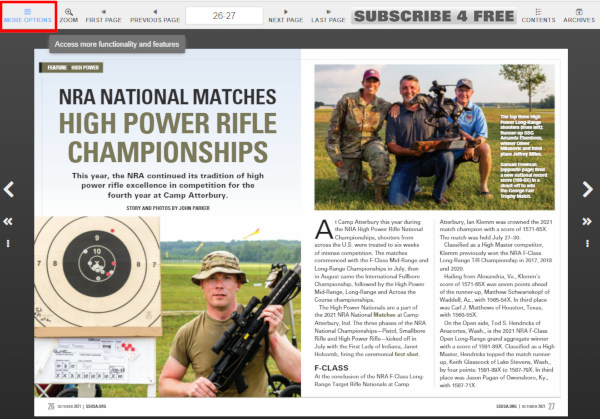
It’s easy to find back issues of Shooting Sports USA magazine. Here’s how: First, navigate to the SSUSA Online Issue. Then click on the “ARCHIVES” icon in the upper right area (indicated with red arrow). When you click on “ARCHIVES”, a window will open with a selection of Shooting Sports USA magazine covers/dates in a vertical column. The most recent issue (November 2021) will appear at the top. You can then scroll down — use the vertical scroll bar to go from November 2021 (the latest issue) all the way back to June 2009. Click any issue cover to read.
How to Find and Save Articles
To search back issues, select “MORE OPTIONS” from the toolbar (top left). Then click the “SEARCH” button. When that opens, select either “Search Archives” for ALL back issues or “Search Only this Issue”. When you’ve made your choice, enter your search term(s). For example, you can search for “Camp Perry” or “Palma” or “F-Class Championship”. You can also save any archived issue as a PDF for viewing offline. Just click “SAVE” to download the article you’re currently viewing/reading.
Read Sample Articles
Here are a couple of our favorite SSUSA feature stories from recent years. There are hundreds of other informative articles worth reading.
Every firearms owner should have some basic first-aid/trauma training. And now during hunting season, hunters should be prepared to deal with injuries in the field. And bad things can also happen at the range, even if that’s just a blown primer, or a richochet off a metal target. That’s why all shooters should always wear ear and ear protection, and be PREPARED for situations requiring emergency first aid.
Thankfully, there is a way shooters can get emergency trauma training for FREE. The folks at Mountain Man Medical offer a FREE Emergency Trauma Course. This 100% FREE online course, entitled “Emergency Trauma Response” (ETR), consists of a 13-module training program conducted via a series of web-hosted videos. It can benefit anyone who wishes to be better prepared for traumatic medical emergencies.
Online Course Description — Module Subjects
“Emergency Trauma Response” (ETR) is a comprehensive training program for to help person become better prepared to deal with massive trauma. Building off the popular “Stop The Bleed” program, the online ETR course goes above and beyond to ensure the student has the practical knowledge to use emergency products and gear when dealing with a wide variety trauma emergencies. Of course, in any serious emergency, professional medical assistance (EMTs and First Responders) should be summoned immediately whenever that is feasible.
The Mountain Man Medical ETR Course Features 13 Modules:
1. Trauma Medicine and Combat Mindset
2. The Gear Of A Medic
3. Vital Signs and Anatomy
4. Intro to MARCH
5. Massive Hemorrhage
6. Airway
7. Respirations
8. Circulation
9. Hypothermia and Head Trauma
10. Reassessment
11. Other Injury Types
12. Practical Tourniquet Exercises/Solutions
13. Your Role As A Medic
Army Medic Commentary: This Editor’s brother was a U.S. Army combat medic in Viet Nam. He received months of special training before being deployed. He told me this online ETR course provides valuable information, but one should always summon qualified medical professionals when presented with serious trauma. But when that is not possible, immediate on-the-spot correct assistance can save lives or prevent further injury.
The Tack Driver Showdown is a one-of-a-kind “all comers” rifle match. This unique multi-discipline match will reveal what rifle types are truly the MOST accurate, at least out to 300 meters. The Tack Driver Showdown II match will be held Saturday, November 6-7, 2021 at the Mid-Carolina Gun Club in Orangeburg, South Carolina. The organizers have invited virtually any type of rifle (except railguns) to compete at 300 meters for group and score honors. There should be nearly 100 competitors at the event this coming weekend. No organization membership is required. NOTE: Registration closes Wednesday November 3, 2021 at 6:00 PM. Contact Match Director Jim Cline at: 843-957-6546. Forum members can also send a PM to Jim Cline aka jcline.
Unlike any other rifle match in the world, on the firing line you will see 6 PPC LV/HV rifles, 30 BR score rigs, 17-lb 600-yard and 1000-yard benchrest guns, F-TR rifles, F-Open rifles, Palma rifles, PRS rifles, and maybe even an AR15 or two.
The concept behind the event is to settle the unending arguments about which guns are TRULY the most accurate. The 6PPC is king in 100/200 group competition, the 30BR rules 100/200 score, 6mmBRs and 6BR Improveds dominate in 600-yard Benchrest, the .284 Win is the leading F-Open cartridge, and various 6mms and 6.5mms win PRS matches. It will be interesting to see which chamberings and bullet weights will “rule the roost” at 300 meters. Match Director Jim Cline plans to post match results on our AccurateShooter.com Forum. For more information, read this Forum Thread.
Tack Driver II targets will be placed at 300 meters (328 yards). That’s not even “mid-range” by benchrest standards, but it should be far enough that the higher BCs of the bullets shot by F-Class and 600/1000-yard benchrest rigs could come into play.
Basic Information on the Tack Driver Shoot:
There are two divisions — bolt-action rifles and semi-auto gas guns. There are no specific design limits other than a 22-lb maximum weight, and a .338 maximum caliber. Past IBS President Jeff Stover tells us: “We envision the full array of the world’s most accurate rifles on the line: short and long range benchrest rifles, F-Class, AR, other tactical, egg-shoot rifles, whatever…[.]” Key rules are listed below. Semi-autos will need chamber flags, otherwise bolts must be out at all times. You do not have to be a member of the IBS to shoot. The range will be open Friday, November 13th starting at 12:00 noon for practice and flag setting.
Cash Payouts for the Winners in both Group and Score
Match Director Jim Cline noted that First place through Fifth place will be paid in both score, group and Grand Aggregate finishing positions. Match fee is $120, which includes a catered lunch both days. Jim states: “We will have an additional $30 cash option, $50 cash option and a $100 cash option. You have to be in the $30 cash option to get in the $50 cash option and in the $50 to be in the $100.”
2021 Tack Driver II Showdown Rules Overview
1. NO membership of any organization required.
2. NO one piece rest, all shooting will be done off benches. You may use a bi-pod, bags or rest combination.
3. You have to shoot the same gun at all targets. If you have a catastrophic failure, you have to continue with a gun of the SAME caliber and cartridge. (Has to be approved by the match director ONLY.) Scope failure will require a scope change.
4. No electronic equipment of any type will be allowed on the bench or downrange.
5. No spotting scopes allowed on the bench or people spotting for you.
6. No coaching under any circumstances (except youth).
7. Any gun is legal 30 caliber and under with a 22 pound weight maximum.
8. Any protest will be handled by the committee and their decision is FINAL!
2021 Tack Driver II Showdown Match Course of Fire
1. Competition will consist of 5 group targets and 5 IBS 200 yard score targets at 300 METERS.
2. All targets will be 7-minute matches. There will NO warm-up match on either day. ALL
shots count in the scoring area of the target.
3. Range will be made available for practice on Friday before the match starting at 8:00 AM only closing to set flags. Flag setting times are 7-8 am, 9-10 am, 11am-12pm and the
range will be called cold at 3:00 pm to end all practice.
4. We will alternate targets each time:
Day 1: Score/Group/Score/Group/Score
Day 2: Group/Score/Group/Score/Group
5. We will rotate 10 benches for the second day’s course of fire.
6. Winner will be determined by place of finish at each discipline. If there is a tie we will break it by highest place of finish. If that can’t break it we will go to group place of finish.
Covered Firing Line at Mid-Carolina Gun Club. Photo from 2019 100/200m Score Nationals.
Jim Cline tells us: “Preregistration is REQUIRED. A $100 nonrefundable deposit is required with your form to hold a spot. Limited to the first 100 guns! There will be a $60 nonrefundable deposit to hold a camping spot 1st come first serve. I have 13 with full hook-ups and 7 with power and water. There is space for self-contained camping as well.” For more information, including camping/RV details at the Mid-Carolina Gun Club venue, contact Jim Cline at 843-957-6546, or post questions on this Accurateshooter Forum Thread.
Happy Halloween
Hickok45 Carves Pumpkins with Handguns
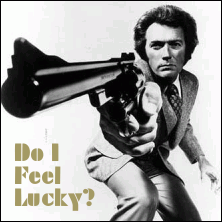
To celebrate Halloween, here’s an example of master wheelgun marksmanship. Popular YouTube host Hickok45 skillfully creates a smiling face on a pumpkin using a S&W Model 29 .44 Magnum revolver. This is the classic blued, double-action revolver popularized by Clint Eastwood as Dirty Harry. This has become a tradition for Hickok 45 — every year he puts a face on a pumpkin using a different firearm, typically a pistol, but he’s used a couple rifles as well. The latest pumpkin-carving effort, in October 2020, was done with a SIG M17 pistol. SEE PUMPKIN Shooting Playlist. Happy Halloween to all our readers.
Want to see more? Hickok45 has also carved pumpkins with a dozen firearms. Here is a pumpkin carved with a genuine, WWI-era Colt 1911 carried by an American soldier in the Pacific theater.
And here is a rather grim-looking face applied using the .40 SW Glock 23.


 After Thanksgiving, many Eastern and snow-belt shooting ranges will halt operations for the winter. If you’re an avid rifleman who enjoys shooting regularly, the dark days of winter can bring withdrawal pains. The closure of outdoor ranges can mean months of forced inactivity… unless you have an all-weather indoor shooting solution — such as this unique airgun target backer system from Creedmoor Sports.


 Do you enjoy plinking with rimfire rifles and shooting reactive targets with handguns? Champion has developed a series of fun targets that tilt, spin, hop, or roll when hit. Made from a “self-healing” rubber-like polymer,




 Happy Halloween


