Shooting ranges have gone upscale with the development of the “Guntry Club”. This new kind of recreational/social facility combines a shooting range with Country Club style amenities. Imagine a high-tech indoor range with “Pro Shop”, restaurant, and maybe outdoor shooting facilities as well. In the past five years, more and more of these deluxe “Guntry Clubs” have opened nationwide.
An episode of GunVenture TV featured some of the country’s finest gun clubs. Tom Gresham and RECOIL Magazine’s Iain Harrison checked out of the original “Guntry Clubs” — the Scottsdale Gun Club. Then, Tom visited a high-end facility in Centennial, Colorado. The upscale Centennial Gun Club features a retail store, range, training center, and lounge.
Here’s a CBS News report on upscale “Guntry Clubs”, luxurious facilities that target younger, more affluent patrons. Chip Reid reports on a high-end gun club in Manassas, Virginia: “This is not your Grandfather’s shooting range. Elite Shooting Sports is 65,000 Square feet of bright lights, polished wood, flat-screen TVs, and state of the art equipment”.
Getting started in the shooting sports can be intimidating, especially for women. Thankfully, there are many training resources available. NSSF has compiled a series of target shooting tips for women, by women. These tips, presented by instructors Deb Ferns, Kay Miculek, and Lena Miculek-Afentul, cover basic shooting methods and safety. Topics include pistol grip, stance, eye dominance, and ear protection. These tips can benefit any novice shooter, not just the ladies.
Rifle Stance and Hold (for Action Shooting)
Champion 3-Gun shooters Kay Miculek and Lena Miculek-Afentul demonstrate rifle stance basics and how to properly hold an AR-platform rifle for action shooting.
Grip and Stance for Pistol Shooting
Mother/daughter team Kay Miculek and Lena Miculek-Afentul demonstrate proper grip and stance for shooting semi-automatic pistols in action disciplines.
Eye Dominance (and Hand/Eye Cross-Dominance)
Learn how to identify your dominant eye. Kay Miculek, a cross-dominant shooter, explains how other cross-dominant individuals can maintain a proper sight picture.
Ear Protection — Double-Up for Safety
Babes with Bullets Director Deb Ferns says the most common complaint among new shooters is, “It’s too loud!” Deb recommends “doubling up” — wearing muffs OVER soft foam earplugs. That’s “sound advice” for any shooter.
Hail to the Queen — the new Queen of 2 Miles, Lindsey Paul. This lady can shoot! The talented Texan beat a large field of top competitors, including many past KO2M Champions, all guys. We congratulate Lindsey on her outstanding performance, including 3 hits in 5 shots at the max distance, 2.0 miles (3520 yards). No other competitor had more than one hit at 3520 yards, and only four other finalists even had one hit at that distance. Lindsey was shooting an Alamo Precision Rifles .375 CheyTac rig loaded with Cutting Edge 400gr solid bullets in Peterson brass.
Here Lindsey shoots her KO2M-winning .375 CheyTac rifle. You can see it packs a punch even with that big muzzle brake. One side-note — this talented lady won the title with a borrowed bipod! Lindsey told us: “Unfortunately, for this video, I don’t have the Accu-Tac bipod I used in the match because it was borrowed. I’ve got one coming from them, but it hasn’t arrived yet.”
Winning the 2021 King of 2 Miles — My Success Story
Report by Lindsey Paul, 2021 KO2M Champion
Winning the K02M title was big surprise for me. I didn’t go into this match with much confidence. My barrel has been acting strangely, for example, after the last match I cleaned it and once I fouled it back in the barrel seemed to have suddenly lost speed. It went from 2985 fps to around 2955 fps. Unfortunately this is my first ELR gun and I didn’t know how important it was to keep up with my round count. I have no idea when this barrel will die but I’d been thinking for the past couple of months that it would be any day now. So, I panicked, added some powder to get back in the middle of where I’ve determined my node to be, adjusted my seating depth a bit and got it shooting at a moderately good level.
Day One went very well. I was hoping to finish the match in the top third, that was my goal. I wasn’t really even nervous about shooting, I was more apprehensive about spotting for my team-mate, Robert Waggoner. I hit the Cold Bore target at 1572 yards and I had a great run from there on out. I was a little bummed that I didn’t get just one more hit but I was still in 4th place at day’s end.
Day Two was nerve-racking. I had to spot for Robert and spotting has been something I have historically struggled with. I’ve spent a LOT of time on the spotter this year, working to improve my skills and become proficient at making quick, accurate calls on misses. Robert cleaned Target 1 and I thought we were going to have a great run. For some reason Target 2 really got the best of him but he finally had an impact and we moved to Target 3. This might be the thing I’m most proud of at the whole match. He missed, about six plates high, and I saw it and gave him a good call. It was then that he realized he hadn’t written down his dope for Target 3 and was using the dope for Target 4! He got right back on target and had a first round impact on Target 4. We will be checking each other’s dope from now on, lesson learned!
Securing Victory with Three Consecutive Hits at 2 Miles
I went into the finals in 9th place, almost 18,000 points behind the leader, Ryan Cheney. My goal was to finish in the Top Ten. Ryan had a solid final round with one impact on the 2-mile target. At that point few believed his score was catchable. I shot 12th in the order and I was concerned about conditions but they turned out to be great. Target 2 finally started to creep out of the shadows and the wind was not doing its normal, switchy stuff. Robert did an absolutely perfect job as my spotter (see photo above). I couldn’t ask for a better set of eyes for spotting misses and calling wind. I had three consecutive impacts on the Two Mile Target to earn enough points to overtake Ryan, and finish with the high point total for the match.
Editor: Lindsey came through spectacularly at the final 3520-yard distance. One observer noted: “Ryan had it in the bag before Lindsay got hot — three out of five at 3520 yards is HOT!”
Here are Results from the K02M Finals held Wednesday, 9/29/2021:
The rifle was built by Alamo Precision Rifles in North Richland Hills, Texas. Lindsey’s spotter, Robert Waggoner, is one of the owners. NOTE: The photo above shows the Nightforce Wedge Prism in place. This prism was used only for the two most distant Finals targets, at 3166 and 3520 yards.
Mirage Extended Picatinny Rail
Nightforce ATACR 7-36x56mm scope
Nightforce Wedge Prism
Spuhr Scope Mount
Accu-Tac HD-50 Bipod
Armageddon Gear Game Changer rear bag
Personal Drag Model is Important in ELR Game
I must mention the importance of getting a PDM (Personal Drag Model) from Applied Ballistics. They are generous enough to travel the country with their mobile lab and provide PDMs at no cost. Take advantage of this! It’s not completely plug and play, I had to true my velocity but once I did some testing and adjusting the PDM was within half-MOA of accuracy all the way out to the 3520 yard target.
Loading for the Jumbo .375 CheyTac Cartridge — You Need Quality Dies and Components
The loading process is the same with the big caliber as anything else. The trick is having quality components and dies. The Cutting Edge Lazers have proven themselves over and over. They are very consistent. The biggest challenge we’ve found with these big cartridges is finding a load that is both accurate and has good ES/SD numbers. It seems like when it shoots a single hole the SD is over 10 FPS and when the SD is great, it shoots an unacceptable sized group.
Q & A with Queen of 2 Miles Lindsey Paul
Q: How satisfying was it to win the match, don the KO2M crown, and be carried in the champion’s chair?
Lindsey: I try really hard to stay grounded and humble. That said, we put everything aside and worked really hard to focus on ELR this year. This win is very satisfying because all the hard work paid off. I’m also very happy I’ve improved as a spotter. Nobody wants to be the weak half of a team.
Q: What are your training methods for Extreme Long Range?
Lindsey: We don’t often have access to long ranges to train. We had a 2000-yard range near us shut down this year so that was devastating. We did have a training day to confirm dope about two weeks before the match and I’m glad we did. I had an impact at 2 miles that day so that helped my confidence.
Q: Do you employ any special “mental prep” before shooting?
Lindsey: I did something different before the final round of KO2M that seemed to help. I sat in the truck, listened to the Rocky theme song and visualized my entire string of shots with transitions and every shot making an impact. This was something my track coach did with us in high school and I felt kind of goofy but think it helped.
Q: How has being in law enforcement made you a better shooter/competitor?
Lindsey: Yes, I think I find it easy to stay calm under pressure. I still have the ability to get rattled when things aren’t going well but for the most part, I stay focused. [Editor: Lindsey is a law enforcement officer in Texas who has worked regular duties as well as mounted (horseback) patrols.]
Q: What tips do you have for other shooters in the ELR game?
Lindsey: Stop chasing speed! These big guns hide pressure very well and you don’t need to be running on the ragged edge of pressure to get results. We learned that the easy way by ruining brass. I fear someone is going to learn it the hard, catastrophic way.
Q: What specific advice do you have for ladies who want to get involved in ELR?
Lindsey: Get a nice .22 LR (such as a Bergara) and stretch that out to 300-400 yards. It’s a great training tool to learn to make wind calls and you can see if you enjoy shooting prone at far targets without such a huge financial investment. Additionally, all you have to do is find the particular lot of factory rimfire ammo that your gun shoots well. That way you can wait to go down the “rabbit hole” that is reloading.
How Lindsey Paul Became a Champion — Talent and Dedication
Lindsey holding K02M trophy, with her Alamo Precision Rifles K02M team-mates.
I got involved with the shooting sports as a kid. My dad was a Sheriff’s Deputy so he taught me to shoot at a young age. I grew up shooting handguns a bit. My true passion is hunting so I decided to start shooting competitively to improve my rifle skills and make me a better hunter. We also shoot some .22 LR matches, a local 500-yard prone centerfire match, and I hope to make it to a few NRL Hunter matches next year. The Nightforce Steel Challenge is definitely on the calendar as well.
I initially built my ELR gun hoping to take it out to a big ranch and shoot rocks on cliff faces but after I competed with it once I was hooked. I think my police training helps me to remain calm. I’ve faced enough real-life chaos and serious situations that it’s easy for me to remember that a match is just a competition and if I have a bad day there will be another match to redeem myself.
This has been a wild year for me. We started at Clark’s Knob match and found our equipment had some flaws at the extreme distances. We regrouped, made some changes and things improved. I broke the FCSA Cold Bore world record with three consecutive shots at 2464 yards at the Spring Canyon match in August 2021 and I’ve had some solid finishes at the matches we’ve attended.
Lindsey Set a FCSA Cold Bore World Record in August 2021
Lindsey is definitely a top talent in the ELR game. Back in August 2021 she set a new FCSA Cold Bore World record at 1.5 miles (2464 yards).
If I were to start over I wouldn’t change much other than investing in a better-quality scope sooner. I am stubborn and I used an Athlon Ares ETR scope for the first couple of years, insisting that it was fine because it fit in my budget. Robert convinced me to borrow a Nightforce ATACR before the Spring Canyon match and I broke the world record so clearly the higher-quality scope with a more reliable erector system has made a difference. Lesson learned — don’t compromise on quality.
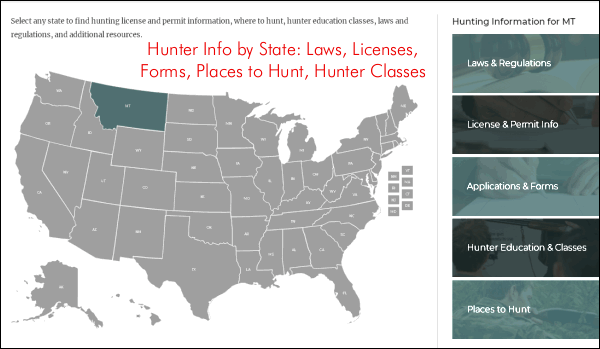
Click Map to launch interactive webpage with info for all 50 states.
Going hunting soon? Need to find out about hunting licenses, deer tags, local regulations, and the best hunting areas? Then visit WheretoHunt.org. This website has an interactive map of the country. Simply click on a state to find the info you need. For all 50 states, the NSSF provides information about hunting licenses and permits, where to hunt, hunter education classes, laws and regulations and more. For each state you’ll also find a link for required applications and license forms. Have a safe and productive hunt this year.
The Oklahoma CMP Games & CMP HP Rifle Matches will be held October 17-24, 2021 at the Oklahoma City Gun Club. The CMP Highpower Match schedule includes two CMP 800 Aggregate Matches followed by a 4-Man Team Match and EIC Service Rifle Match. Following the HP matches are the CMP Games events. The CMP Games Matches include Rifle Marksmanship 101 & M16 Match (formerly SAFS), GSMM Matches, Carbine Match, Rimfire Sporter Match, and Vintage Sniper Team Match. If you’re anywhere near Oklahoma City next week you might want to check out the action.
NOTE: The CMP’s Oklahoma Games are not just for seasoned competitors. There will be a Small Arms Firing School plus a New Shooter Clinic for those who have never shot a CMP Games match before. And the Rimfire Sporter match is popular with novice shooters, who can can compete with very affordable rifles.
Electronic Targets Allow Faster Relays and No Pit Duty!
The High Power range will be set up with Kongsberg Electronic Targets (KTS). The KTS system registers each shot and relays the location and score value to a monitor beside each shooter on the firing line. Wireless monitors are placed at each firing point so competitors can immediately view their shot placements. Scores are tallied automatically by the KTS system.
GSM New Shooter Clinic Plus M1 Maintenance Clinic
There will also be a GSM New Shooter Clinic and an M1 Maintenance Clinic held during the week. CMP Sales will be at the event with a limited supply of rifles. Ammunition and CMP memorabilia will also be available for purchase.
VINTAGE SNIPER MATCH — Wednesday, October 20th
The 2021 Oklahoma Games will include the popular Vintage Sniper Team Match. Competitors must use Korean War or earlier, as-issued military sniper rifles or replicas of those rifles. Optics must also be original issue or replica scopes from the same period. The CMP Games Rules lists the approved rifles and optics.
The course of fire is designed to reproduce the conditions under which skilled long-range military riflemen operated. Two riflemen work together as a team. During the match, each team member functions alternately as a shooter or a spotter. After one team member finishes firing, they switch roles and the other team member fires. Firing is done at distances of 300 and 600 yards from the prone position. Shooters may use either a sling or sand bag support, but not both. Wind doping is critical and firing must be done quickly; targets are exposed for each shot for only 20 seconds and then withdrawn for 20 seconds.
Pistol Competitions for Centerfire and Rimfire
There are also several pistol matches including CMP As-Issued 1911 Pistol Match, Military & Police Service Pistol Match, 40 Shot Pistol Match, EIC Service Pistol Match, CMP .22 Rimfire Pistol EIC Match and Pistol 2-Man Team Match. A Pistol Marksmanship 101 training class will also be held.
About the CMP Travel Games
The CMP Travel Games are regional competitions held in different corners of the country throughout the year, featuring exclusive CMP rifle and pistol outdoor events. A common part of the CMP schedule for the last decade, the Games are centered around recreation-oriented competition and educational activities that are designed to accommodate experienced marksmen as well as those just beginning the sport.
For more information about the Oklahoma CMP Games, email Competitions@TheCMP.org or call 888-267-0796, ext. 714.
Over 8 million Americans purchased their first firearm, typically handguns, since the start of 2020. These first-time gun owners definitely need training. In addition, all CCW permit holders should definitely practice regularly. For many, pistol practice is an indoor experience. Indoor ranges are most convenient for those who live near urban centers, where the biggest threats to public safety currently exist. This article covers indoor firearms training and the proper procedures you should follow at indoor ranges.
This Video Covers Basic Gun Range Safety Rules and Etiquette
FIVE IMPORTANT SAFETY PROCEDURES for Indoor Ranges
1. Follow the Three Fundamental Rules for Safe Gun Handling
ALWAYS keep the gun pointed in a safe direction. ALWAYS keep your finger off the trigger until ready to shoot. ALWAYS keep the gun unloaded until ready to use.
2. Follow ALL Range Officer Instructions
ROs are the first and final authority on any range and their decisions are generally final. Arguing with a Range Officer may just get you thrown out.
3. Don’t Bother Others or Touch Their Guns
Respect other shooters’ privacy unless a safety issue arises. Do NOT engage other shooters to correct a perceived safety violation unless absolutely necessary – inform the RO instead. NEVER handle or touch another shooter’s firearm without their permission!
4. Know Your Range’s Rules
Review and understand any and all range rules and requirements/expectations. For example, what is the range’s maximum rate of fire? Are you allowed to collect your brass?
5. Know What To Do During a Cease Fire
IMMEDIATELY set down your firearm, pointed downrange, and STEP AWAY from the shooting booth (or bench). Range Officers do not want shooters trying to “secure/unload” their firearms in a cease fire situation — they want the shooters separated from their guns instantly.
Double-Up on Hearing Protection When Shooting Indoors
When shooting indoors we recommend quality muffs with earplugs underneath, offering double protection. When inside an enclosed range, with other shooters blasting away right next to you, you really need effective hearing protection. But you also need to hear range commands and be able to communicate. That’s why we recommend electronic muffs with quality plugs underneath. We recommend the NRR 33 Howard Leight Max-1 Plugs. These tapered plugs are comfortable, easy to insert, and have a flared end for better sound seal.
On top of those plugs, run high-quality muffs. For indoor ranges where sound levels can be extremely high, we recommend Howard Leight Impact Pro Muffs. These offer an impressive 30 dB Noise Reduction Rating (NRR) and the effective noise reduction can be improved by 4 decibels or more by running plugs as well.* These muffs are pretty comfortable and offer Headphone Functionality so you can connect to your smartphone, MP3 player, or other audio device. These muffs are a good value, an Amazon’s Choice for $57.47.
* Four decibels may not sound like much, but remember the decibel measurement system is logarithmic, so four decibels is VERY significant. We have discussed the merits of “doubling up” hearing protection with Ph.D. sound engineers. They told us that a combination of muffs and plugs could reduce effective noise levels by up to five decibels compared to plugs alone. In addition, good muffs will block bone conduction sound energy better than plugs alone.
October is Halloween month, so we thought we’d share the seasonal spirit with our readers. In this video, our friend Kirsten Joy Weiss shows off her impressive trick-shot skills. To help celebrate the gouls/goblins holiday, Kirsten “carved” a pumpkin using her semi-auto Volquartsen .22 LR rifle. Kirsten had to send a lot of rimfire rounds into her orange friend. It turns out the little .22-caliber bullets worked better on exit than entry — Mr. Pumpkin’s posterior side was more impressive than his front. But overall, the effort turned out very well indeed, as you can see. Nice job, Kirsten.
On inspection, Kirsten found that the most impressive Jack ‘O Lantern face appeared on the reverse side of her pumpkin. The “exit wounds” were better than the entry holes.
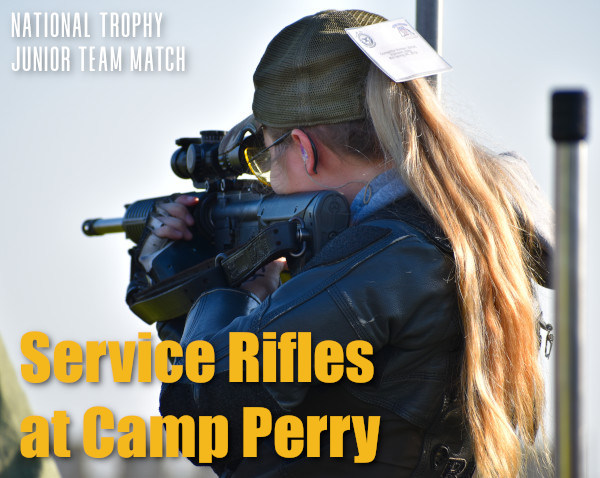
Hi-Lux Optics has created three videos of interest to across-the-course and service rifle competitors. The first video highlights the appeal of service rifle shooting, with comments from 2021 Camp Perry competitors. The second video offers five tips for new service rifle shooters. The third video focuses on the CMP matches at Camp Perry this past summer. If you have ever wanted to share the Camp Perry experience, this last video provides a great over-view of the event.
Four Reasons to Shoot Service Rifle
Service Rifle shooting is fun yet challenging. You need to develop skills with multiple positions and be able to make rapid wind calls. However, the modern AR-based service rifle is affordable and has relatively low recoil. Highly-customizable, modern service rifles can be fitted with adjustable stocks and optional magnified optics. Older military rifles, such as the M1A and M1 Garand, offer different challenges with heavier-recoiling cartridges, greater weights, and classic iron sights. Hi-Lux asked competitors at Camp Perry during CMP’s 2021 summer games what they enjoyed most about competition with service rifles and Military rifles such as the M1 Garand. The shooters’ responses had four key themes: Self-Improvement, Comradery, History (enjoying shooting rifles with heritage), and Challenge.
Five Tips for New Service Rifle Shooters
This summer at Camp Perry, Hi-Lux reporters asked competitors “What advice do you have for new shooters getting into service rifle?” The most common responses, explained below, were: Keep Learning, Don’t Quit, Stay Calm, Practice Fundamentals, and “Get Started!”. These tips will actually apply to a wide variety of shooting disciplines.
00:21 Keep Learning
Every shot you take is a learning experience. There are so many ways to learn — talk to fellow shooters, watch training videos, attend a training clinic such as those hosted at the CMP Regional Games. Don’t be afraid to ask, and never stop learning.
01:38 Don’t Quit
You may hit a performance plateau. Don’t let that stop you. The only way to get better is to continue moving forward. Persevere and continue your training off-season with dry-fire practice.
03:10 Stay Calm and Focused
Go into each shot with a clear and empty mind. While you’re up on the line, it’s just you and your rifle.
04:20 Practice Fundamentals
With the right mindset in place, practice will strengthen your fundamentals. Dry firing can reveal issues with follow-through and trigger pull that might not be noticeable under recoil. This is especially true with offhand shooting.
05:48 Get Started
You’re not too old to start a new discipline. There are many free clinics available, and many local ranges have regular service rifle competitions where you can hone your skills. Learn more about Service Rifle shooting clinics on the CMP website.
The 2021 National Matches at Camp Perry — Return of the Games
After cancellation in 2020 due to COVID, the CMP National Matches at Camp Perry returned in summer 2021 with a full selection of matches for pistol and rifle. This video showcases the unique experience that is Camp Perry — the leading venue for American marksmanship competition since 1907. The video covers different disciplines, including Service Rifle, M1 Garand matches, Vintage Sniper, and more.
History of Camp Perry
“In the year 1907 the machinery of the National Matches, now grown to immense proportions, was moved to the mammoth new range at Camp Perry.”
—James Drain, Arms and the Man, August 1911
Federal legislation originally launched the National Matches. The 1903 legislation also established the National Matches, commissioned the National Trophy and provided funding to support the Matches. The National Matches have been held at Camp Perry since 1907. The range is located along the shores of Lake Erie in northern Ohio near Port Clinton. The site was first acquired in 1906, in response to the need for a larger facility for military training and the NRA’s shooting programs. In 1906 Gen. Ammon B. Crichfield, Adjutant General of Ohio, ordered construction of a new shooting facility on the shores of Lake Erie, 45 miles east of Toledo, Ohio. The original land for Camp Perry was purchased in 1906, and the reservation was named after Commodore Oliver Hazard Perry, the American naval commander who won the Battle of Put-in-Bay during the War of 1812.
On August 19, 1907, Cpl. L. B. Jarrett fired the first shot at the new Camp Perry Training Site. And that year, 1907, Camp Perry held its first National Pistol and Rifle Championship events. This location has hosted the annual National Matches ever since (though they were cancelled in 2020 due to COVID). Typically over 4,000 competitors attend the National Matches each year, making it the most popular shooting competition in the western hemisphere.
This lady can shoot! Lindsey Paul is now officially the top ELR ace on the planet. The talented Texan beat a large field of competitors, including many past KO2M Champions, all guys. We congratulate Lindsey on her outstanding performance, including 3 hits in 5 shots at the max distance, 2.0 miles (3520 yards). No other competitor had more than one hit at 3520 yards, and only four other finalists even had one hit at that distance. Lindsey was shooting a .375 CheyTac cartridge with Cutting Edge 400gr solids.
K02M runner-up Ryan Cheney was leading the field most of the event, being the only shooter to hit ALL his targets (without a miss) at 1692, 2097, and 2376 yards, along with 4 of 5 at 2727 — the best at that distance. But Lindsey came through spectacularly at the final 3520-yard distance. One observer noted: “Ryan had it in the bag before Lindsay got hot — three out of five at 3520 yards is HOT!”
This was an impressive year, proving that the ELR game continues to evolve, with ever-greater overall performances by the ranks of talented shooters. Match Directors posted: “Every year we get more hits at Two Miles and this has been the best ever — 3 of 5 from Lindsey and five shooters hitting the 2 mile target: Lindsey Paul, Ryan Cheney, Jay Dvorsky, Peter Renwick, and Curtis Roman”.
Here are Results from the K02M Finals held Wednesday, 9/29/2021:
FINAL RESULTS FROM 2021 KO2M
NRA Whittington Center, Raton, New Mexico
27-29 September, 2021
Congratulations to all shooters, spotters and teams that drove to Raton from all over the USA and even more to those that hit the targets. Special thanks to the sponsors that made the prize table possible.
A special mention to the King (Queen) of 2 Miles 2021 Lindsay Paul, along with Rei Hoang, and Jaclyn Bryan. [They] proved that women can be as good or better shooters than men. I hope that each year we have more and more women shooters.
Congratulations too for Ryan Cheney who shot so well that he nearly made it to King.
A special mention to all the spotters that drove their shooters to the targets and are always there in their shadow. They all deserve an applause.
We have proven the point, once again, that hits at 2 Miles are possible and not just luck.
Thanks to all for being at KO2M
King of 2 Miles Team
The Queen of 2 Miles Thanks Her Team and Sponsors
Here is Lindsey’s Report on her Achievement — being the first woman ever to win the King, oops, make that QUEEN of 2 Miles Competition.
“I don’t even know where to start! What a wild ride this year this has been. First and foremost thank you to my amazing guy Robert for being the best spotter I could ask for. He is responsible for making most of this happen with his great wind calls, corrections and support. Thank you to the rest of my team.
Jeff had tough conditions with shade on targets for his final round making spotting misses impossible but still finished with a super-respectable 6th place. Shane has come a long way in a short time and did great as well with a 19th place finish, just below the cutoff for the finals. I’m really proud of my performance as Robert’s spotter. He forgot to write down his dope for target 3 and I still managed to help him get on target and he finished in 26th. Jay we missed the hell out of you and hope you are back to 100% soon!
My Applied Ballistics PDM (Personal Drag Model) was nearly spot on out to two miles. Your contribution to shooting sports is beyond remarkable. We couldn’t do what we do without your support.
I was concerned about switching to an Accu-Tac bipod right before this match but I’m dang sure a believer now! I picked up a Nightforce scope of the prize table which was just what I needed as I was borrowing one. Thank you to them and all of the other sponsors who stepped up to support this match and the shooting community.
Lindsay added praise for her competitors: “Congratulations to all the shooters, NRA Whittington Center is my favorite place to shoot but it can sure be challenging. Ryan Cheney made me work for it, congratulations man, you shot excellent! Rei and Jaclyn how awesome was it to have three ladies in the finals?! Congratulations to both of you!”
Lindsey Set a FCSA Cold Bore World Record in August 2021
Lindsey is definitely a top talent in the ELR game. Back in August 2021 she set a new FCSA Cold Bore World record at 1.5 miles (2464 yards). Lindsey posted: “WHAT A DAY! I set a new cold bore world record with 3 impacts at 2464 yds! I’m so thankful for an awesome team and my damn fine Alamo Precision Rifles .375 CheyTac. The 400gr Cutting Edge Lazers shined as usual!”
As part of NRA Women TV, hunting guide Kristy Titus hosts a series of videos that explain important strategies and shooting skills for hunters. Titus, co-host of the Team Elk TV show, is a certified instructor who has hunted around the globe. She grew up in the outdoors, running pack mules in Oregon with her father. In these videos, Kristy discusses demonstrates field positions that can be employed during a hunt. She also explains preparation for a hunt, including fitness training.
Click each link below to watch other Kristy Titus Hunting Videos.
“When it comes to bolt-action rifle fit, there is no ‘one size fits all’,” says Titus. “When picking out your rifle [consider options] after the purchase to ensure you are as comfortable as possible.”