Hunting season has started in many parts of the country… or will very soon. Before you head out to the hunting fields, you may want to practice your shooting on specialty paper targets designed expressly for hunters. Here is a selection of game targets which can help you achieve success this hunting season.
Realistic Game Targets with Marked Vital Zones
Serious hunters may prefer to practice with photo-realistic game targets with animal profiles that look like the real thing. Champion offers realistic “X-Ray” game animal targets. These X-Ray targets display the bone structure and heart/lung position of game animals. These are popular with hunters, as are Champion’s Critter Targets Set with 5 different realistic animals in a 10-pack. CLICK HERE to view X-Ray Animal Targets and Critter Targets.
Unfortunately this large ELK X-Ray target has been discontinued, but you may still find it in some stores. CLICK HERE to view large version.
Birchwood Casey offers a Realistic Deer Target that shows the vital Hit Zone. The target comes with four (4) replaceable Shoot-N-See overlays. A target twin-pack with the overlays is $7.60 at Amazon.com.
FREE Printable Game Targets from the NRA
To help you prepare for your fall hunts, NRABlog.com has created a set of color practice hunting targets. You can hone your skills on a trio of bucks, three wild hogs, or three turkeys. Each target features three red bullseyes, centered on the animals. You can print the targets in black and white, but they look best in color. Click on each image below to download a FREE printable PDF file.
Right-Click Each Image to Download Printable PDF File:
The 2021 King of 2 Miles ELR competition officially commenced yesterday at the Whittington Center in Raton, New Mexico. This unique event, the “Olympics” of Extreme Long Range (ELR) shooting, attracts many of the best marksmen on the planet, campaigning rifles capable of mind-blowing accuracy at extreme distances. The bullet, barrel, and optics technology on display was impressive — as was the amazing marksmanship. Ryan Cheney is leading the KO2M Qualifications after Day 1&2, shooting perfect 3-for-3s without a miss at 1692, 2097, and 2376 yards, and getting one hit at the most distant 2550-yard target. SEE Day One and Two Results.
Here are some of the cartridges used in ELR Competition. With these high-capacity cartridges, many competitors are using ultra-precision lathe-turned solid bullets.
Big ELR Cartridges left to right: .460 Steyr, .416 Barrett, .375 CheyTac, 33XC, .338 Lapua Magnum, and .300 Remington Ultra Magnum.
Top Results in 2021 Qualifications
Here are the sixteen highest-scoring shooters at the 2021 KO2M match, after two days of qualifications. The Top 16 advance to the Finals tomorrow.
Watch K02M Run from 2019 with 360-degree Views
Here is Bryan Litz Shooting K02M in 2019. NOTE, you can slide left/right to get a 360-degree view of the firing line — give it a try! View on Facebook, if 360° movie does not appear on your device.
Here are Target Distances and Angles
Paul Phillips, 2019 K02M Champion, posted: “I’m very happy with Clay Rhoden with Longshot Cameras and James Devoglaer with KVR Ranch. They performed very well today in qualifications. They hit every plate out to 2550 yards [after the cold bore target]. [This was] their first time at King of 2 Miles!”
Shown below is the ammunition Paul Phillips loaded for his Global Precision Group team using Cutting Edge lathe-turned bullets:
Applied Ballistics Brings High-Tech Gear to the KO2M Competition
The Applied Ballistics Team arrived early in Raton to do testing with their high-tech Doppler Radar equipment. This can provide very precise custom ballistics profiles for the ELR rifles. When you’re shooting at these extreme ranges, your come-up tables have to be perfect.
“Goooooood Moooooorning New Mexico! It’s a BEAUTIFUL day on the range! We’re setting up the Mobile Lab on the Cooper Range at the NRA Whittington Center and we’ll be hanging out in this gorgeous place.”
Pair of Premium F-Open Rifles with Kelbly Golden Bear Actions
Report by Shiraz Balolia, CEO Grizzly Industrial
This project was started 2-3 years ago when I decided to build two brand-new rifles based on the Cerus riflestock chassis. I had my own highly-figured woods and sent them to Will at Cerus Rifleworks. Within a few months I received back two very nice-looking stock blanks but unfortunately they were made for a regular recoil pad system. I was going to install the R.A.D. (Recoil Absorption Device) systems and failed to mention that to Will. Further the thumbhole slot for the adjustment knob was through-cut on both sides of the stock and placed in a position where it would interfere with the R.A.D. recoil system installation. Accordingly, some serious modifications were in order.
Modifying the Cerus Stocks and Installing the R.A.D. System
The very first thing I did was plug up the thumbhole slot in each bank and then installed decorative caps in highly-figured contrasting woods. I also wanted the thumb-knob adjustment to be accessible and adjustable using only one finger so I shifted the whole system forward and to the right. I was now able to install the R.A.D. recoil system (see below) without interfering with the cheekpiece adjustment.
Next, I installed the bottom wider track for my rear bag and also carved out the finger grooves in the grip. The blanks were quite long so I cut off approximately two inches from the front end of each stock and also deepened the large tracking cavity under the fore-ends. I went ahead and inlaid my name in Mother-of-Pearl on the Walnut stock.
Gold Kelbly Actions for Two World-Class Tack-Drivers
The two sequentially-numbered Golden Bear F-Class actions (057 and 058) arrived from Kelbly at different times and the stocks were sent to Alex Sitman at Masterclass Stocks for bedding the actions into the stocks. Alex does an outstanding job on pillar bedding and has done most of my rifles for many years.
The stocks were then sent to Sims Guitar Finishing for clear coating with “wet look” finish on the stocks. Chambering of the barrels was done in-house by Dave, our top engineer at Grizzly Industrial. Dave has chambered most of my rifles in recent years. Both he and I have been trained by Gordy Gritters in precision chambering. Finally, the rifles were assembled, scopes installed, and tested out. Both are tack-drivers made for world-class competition.
Shiraz Tests his .300 Shiraz F-Open rifle. As you’d expect shooting heavy 215gr Berger Hybrids, the recoil is significant, but the rifle tracks perfectly with smooth return to battery.
Rifle #1 – Walnut Stocked .300 Shiraz
• Chambered for .300 Shiraz (modified .300 WSM)
• Stock made of highly-figured Walnut with Curly Maple inner laminations
• Kelbly Golden Bear F-Class action
• Bartlein 1:10″-twist barrel, 31″ length
• March 10-60x56mm High Master scope with Barrett rings
• Bald Eagle tuner
• Jewel trigger
Rifle #2 – Curly Maple Stocked .284 Shiraz
• Chambered for .284 Shiraz (modified .284 Winchester)
• Stock made of highly-figured Curly Maple as well as Walnut and Wenge inner laminations
• Accents and inlays as well as the base shoe are made of Curly Koa wood
• Kelbly Golden Bear F-Class action
• BRUX 1:9″-twist barrel, 31″ length
• March 10-60x56mm High Master scope with March rings
• Bald Eagle tuner
• Jewel trigger
Two Improved Cartridges — .300 Shiraz and .284 Shiraz
The two rifles run their own respective “Improved” cartridges. The dark walnut rig runs the .300 Shiraz which is based on the .300 Winchester Short Magnum (WSM). The maple 7mm runs the .284 Shiraz derived from the .284 Winchester. Shiraz developed these two improved cartridge designs to boost the performance of the parent cartridges which are both quite popular among F-Open competitors. The .284 Shiraz has similarities to the popular .284 Shehane wildcat.
.300 Shiraz Load Information: Shiraz loads his .300 Shiraz with Berger 215gr Hybrids, CCI BR2 Primers, and Hodgdon H4350 Powder. This load produces groups under quarter-MOA.
.284 Shiraz Load Information: The .284 Shiraz (shown below) is loaded with Berger 180gr Hybrids, again with CCI BR2 Primers, and H4350 powder. And like Shiraz’s .30-cal rifle, this handsome 7mm rig delivers sub-quarter-MOA grouping capability.
This stock is made from highly-figured Curly Maple with Walnut and Wenge wood inner laminations. Accents and inlays and the base shoe are made of Curly Koa wood.
About Shiraz Balolia
Shiraz Balolia is the founder and CEO of Grizzly Industrial. He is also one of the USA’s leading F-Class shooters. He has been a Team USA member and F-Open Team USA Captain, and in individual competition he won three straight Canadian F-Open Championships (2014, 2015, 2016). That Canadian Three-Peat is definitive proof of Shiraz’s stellar long-range shooting talent.
In the video below, created when Shiraz was F-Open Team USA Captain, Shiraz works with Palma Team Coach Gary Rasmussen. With the target at 800 yards, Shiraz shows how a shooter works with a wind coach. Three cameras are employed to show the target, the shooter, and the spotter’s-eye view.
This video starts with a lesson on target reading, then Shiraz and Gary work together to judge the wind. Watch as Shiraz makes ten straight “10 point” center hits at 800 yeards. A inset frame in the video shows bullet placement after each shot. This video is highly recommended for all long-range competitive shooters and coaches.
Here is Shiraz (top left) with Team Grizzly, the 2018 U.S. F-Open Championship Team. Members are: Shiraz Balolia, Emil Kovan, David Mann, John Myers, Trudie Fay (Coach).
Today is National Hunting and Fishing Day. To help the avid hunters among our readers, here are Twenty Tips that can help ensure a safe and successful hunt. These tips have been compiled from our AccurateShooter Hunting Forum, with help from Hunting Editor Colton Reid (who has already been out hunting this month). Some items are preparatory — such as working with maps, sighting in the rifle, and improving physical fitness. We also talk about equipment — having the right gear, from proper boots to a GPS for multi-day hunts.
Of course there are entire volumes written on hunting, but these 20 Tips can benefit all hunters. Follow these suggestions and you should have a safer hunting experience with greater likelihood of success. If you liked these pointers, you’ll find two dozen more helpful hints on the NSSF Website.
Preparations Before The Hunt
1. Map Your Hunt and Notify Others — Before your hunt, make a plan and notify friends and family members about WHERE you are going and your intended return date and time. Print out a Google Satellite map and locate landmarks and trailheads. Mark where you plan to park your vehicle and give a copy of this map to friend and/or family members. A hunter may injure himself by falling off a rock, or tumbling in a creek-bed. After that kind of injury the hunter may be confused or unable to walk. If you get stranded in the wilderness, you want trusted persons to know where you are. So, before you leave on a trip, provide a map to a friend or family member. Show them where you will leave your vehicle, and where you expect to be every day of your hunting adventure.
2. Licenses and Permits — Make sure you have a valid hunting licenses and all the necessary tags. Begin this process with ample time before your intended hunt(s). The NSSF adds: “If you are crossing state or national borders, find out about any special considerations you must take care of. Border crossings can mean knowing about firearm transport laws or Chronic Wasting Disease-related regulations.”
3. Work on Your Fitness — On a multi-day hunt you may be trekking many miles. You need to be in good shape. If you are out of shape you may be putting yourself in a precarious situation, particularly if you underestimate the terrain difficulty. As the NSSF says: “Not being able to handle the conditions lessens your chances of success, can turn a great experience into an agonizing one and can endanger your health.”
4. Do Your Homework — Study the area you will be hunting. Talk to other hunters. Look at satellite photos. Get a real sense of the walking and terrain challenges. For a multi-day hunt, MAKE a PLAN. The NSSF states: “Eliminate surprises. Learn as much about where you will be staying, the area you will be hunting, what the weather might be like and what you need to bring[.]”
5. Rifle and Ammo — Make sure your rifle is sighted-in and your ammo is tested. Sight-in your rifle with the ammo you plan to use on your hunt. CLICK HERE for 4-Shot Sight-in Method. After sighting-in from the bench, confirm your zero by shooting from typical hunting positions (kneeling and with forearm supported on a rock or post).
6. Shooting Positions — Practice the shooting positions you will use in the field. Practice sitting, kneeling, and prone positions. You should also practice with shooting sticks, using your day pack as a rest, and with a bipod. Try to have a rock-steady rest before taking your shot.
7. Back-Up Irons — If possible, select a rifle with back-up iron sights. While modern scopes are very durable, they can and do fail (glass can crack). If you’ve invested a lot of time and money in your hunt, back-up iron sights can keep you in the game even if your riflescope fails.
8. Communications and GPS — Bring a GPS if you are in a wilderness area far from civilization. It’s a good idea to bring a cell phone, but you may not have coverage if you’re quite a distance from populated areas. A smart-phone also doubles as a digital camera to record your trophies. For navigation and safety, consider getting Garmin inReach Explorer+. This high-tech handheld unit features interactive SOS, connecting you to the GEOS 24/7 search-and-rescue monitoring center. They also allow you to send and receive text messages, no matter where you are, via advanced inReach satellite technology. Yes you can communicate even if you are miles from the nearest cell tower.
9. Select Good Gear — Make sure you have GOOD BOOTS that are comfortable — you’ll spend a lot of time on your feet. You may want a pack with harness for your rifle so you have both hands free. On a multi-day trip, make sure you can carry enough water, and that you will stay warm enough at night. Good practices for backpacking apply to multi-day hunts.
10. Make a Gear Checklist — Create a complete checklist of the gear and supplies you need. That includes arms, ammunition, rangefinder, binoculars, proper clothing (including spare clothes), hunting accessories, sleeping gear (on multi-day hunts), toiletries, medications. Don’t forget a good first aid kit — lots of bad things can happen during any wilderness trip. You can cut a hand, break an ankle or worse.
During The Hunt
11. Have a Plan — know where you plan to go and when. Try to be where you want in the early morning and early evening hours when deer are likely most active.
12. Take Your Time — If you spot a deer and get too excited and don’t take your time you may spook him. Go slow and glass. If possible, wait for the animals to bed down and relax. Then work out the best way to approach your prey. Remember, “You get so few opportunities, don’t screw it up!”
13. Glass More, Walk Less — Let your eyes do the walking — get good binoculars and use them. With their heightened senses of smell and hearing, deer/elk are able to spot you way better than you can spot them. If you are walking around a lot, chances are you are getting spotted by your prey.
14. Riflescopes Are Not Binoculars — Never use a riflescope as a substitute for binoculars. The temptation to do so is real, but when one does this, one is by definition pointing the muzzle of the gun at unknown targets. We like binoculars with built-in rangefinders. When glassing at long range, try supporting your binoculars on your pack.
15. Be Sure of Your Target before Shooting — Every year during whitetail season, farmers are forced to spray-paint their cattle or risk having them “harvested” by hunters who don’t bother confirming the species in their sights. Hunters with “buck fever” can make mistakes. When in doubt, don’t shoot.
16. Know When to Unload — When finished hunting, unload your firearm before returning to camp. You should also unload your gun before attempting to climb a steep bank or travel across slippery ground.
17. Bring Hearing Protection — While pursuing and stalking your prey you’ll want full sensory use of your ears. But when you’re finally ready to take the shot, slip in hearing protection. A shot from a large-caliber hunting rifle can exceed 170 decibels. Unprotected exposure to noise from a SINGLE 170+ dB shot can cause permanent hearing damage. (Source: ASHA.org). If you make a follow-up shot, you double that noise hazard. Therefore a hunter with a non-suppressed rifle should have hearing protection available.
You can keep a pair of quick-insert plugs on a cord around your neck. Or, get a lightweight neck band with earbuds, such as Howard Leight Quiet Band QB2HYG, 3M Safety Band, or Sellstrom Band, all with a good 25 dB Noise Reduction Rating. You can keep these lightweight bands around your neck, for quick deployment before you shoot.
“Once a hunter is successful, the REAL work begins.” — Colton Reid
18. Harvesting the Animal — When dressing your animal, be careful with the meat. You’ll want very sharp knives. Some hunters prefer knives with replaceable, razor-sharp blades. Don’t rush the task. Make sure you don’t get moisture or dirt on meat. The three spoilers of meat are heat, moisture, and dirt.
19. Pace Yourself When Packing Out — If you DO succeed, and bring down a big buck, will you be able to dress the animal and carry out the meat? Always be prepared to hike out with extra weight. If you are successful, make sure not to waste the meat you worked so hard for. Choose a pack that can help you carry a heavy load. Remember, this is not an insignificant challenge — you may be carrying 60 to 100 extra pounds in addition to your other gear. Again, take your time. Rest as needed. Don’t hurt yourself.
20. Remember to Enjoy the Experience — Our Hunting Editor, Colton Reid, offers this sage advice to all hunters, but particularly to novices: “Have fun, and appreciate your hunt, whether you bag a buck or not. It is a privilege to experience the wilderness and to get away from the city. Enjoy it while you’re out there. And keep your spirits up. You may get tired, but remember that ‘comes with the territory’. At the end of the day, yes you may be exhausted. And you may want to quit and go home. But stay positive, stay focused. Be patient, the experience is worth it.”
CLICK HERE for Hunter Training/Mentoring Programs State-by-State.
Prepare For Your Hunt — Get Fit and Practice Positions
As part of the NRA’s Tips & Tactics video series, Kristy Titus explains how to prepare for a hunt. Titus, co-host of the Team Elk TV show has hunted around the globe. She grew up in the outdoors, running pack mules in Oregon with her father. In this video, Kristy discusses fitness training and demonstrates field positions that can be employed during a hunt.
Kristy explains: “Hunting can lead you into some steep, rough country. It’s really important that you train both your body and your mind to handle the elements and the rigors of hunting So, if you plan on going on a mountain hunt, get out and train your body. Train with your firearm. Get off the bench and have some fun with this. Do some positional shooting or, if you want to add a stress dynamic… have someone put you under a time parameter.”
Visit WhereToHunt.org
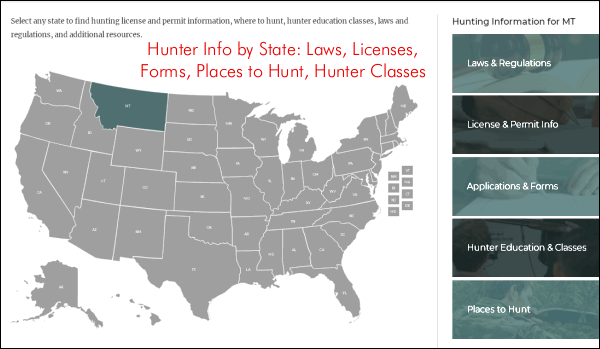
There’s a great online resource for hunters that will help you find game locations in your state and ensure you have all the proper permits and game tags. WheretoHunt.org features an interactive map of the country. For all 50 states, the NSSF has compiled information about hunting license and permits, where to hunt, hunter education classes, laws and regulations and more. For each state you’ll also find a link for required applications and license forms.
Tomorrow, September 25, 2021, is National Hunting and Fishing Day. Hunting season is here — and we know many of our readers will soon head to the woods in pursuit of deer, elk, or other game. To make a good shot, it’s wise to rest your rifle when possible. In this video, methods for stabilizing a rifle in the field are demonstrated by Forum member Thomas Haugland, who hails from Norway. Thomas focuses on practical field shooting skills for hunters. Thomas (aka ‘Roe’ on Forum and Sierra645 on YouTube) shows how to verify his zeros from bipod and then he demonstrates improvised field rests from the prone, kneeling, and sitting positions.
Thomas explains: “In this video I focus on basic marksmanship techniques and making ready for this year’s hunt. As a last check before my hunting season, I got to verify everything for one last time. My trajectory is verified again, the practical precision of the rifle is verified. I also practice making do with the best [improvised] rest possible when an opportunity presents itself. After getting knocked in the face by a .338 Lapua Magnum rifle during a previous filming session, I had to go back to basics to stop [flinching]. I include some details from bipod shooting that hopefully some hunters will find useful. Fingers crossed for this years season, good luck!”
How to Stalk Game — Tips from Thomas
If you liked that video, here is another valuable video from Thomas. In this “How to Approach Deer” video, Thomas explains the basics of a successful stalk. If you are headed into deer country this fall, definitely watch this video.
Hunting Season has already started in some states, and is right around the corner in other locations. For readers who plan to hunt game this fall, we recommend you brush up on hunter safety and learn the laws in your jurisdiction. Here are some helpful resources for hunters: Safety Tips, Hunter Education, License Requirements, and Where-to-Hunt interactive map. Top photo courtesy Horn Fork Guides, Ltd., in Colorado.
Hunter Safety Tips NRAFamily.org has a good article listing seven salient safety tips for hunters. Anyone preparing for a fall hunt should read this article before heading into the field. Here are three key bits of advice:
1. Be Positive of Your Target before Shooting
This might sound overly simplistic, but the fact remains that, every year during whitetail season, farmers everywhere are forced to spray-paint their cattle or risk having them “harvested” by hunters who don’t bother confirming the species of the large ungulate in their sights. Why does this happen? The most likely explanation is “buck fever,” meaning that the hunter wants so badly to see a nice big buck that sometimes his eyes deceive him into thinking that there’s one there. When in doubt, don’t shoot.
2. Scopes Are Not Binoculars
Never use a riflescope as a substitute for binoculars. The temptation to do so is real, but when one does this, one is by definition pointing the muzzle of the gun at unknown targets.
3. Know When to Unload
When finished hunting, unload your firearm before returning to camp. You should also unload your gun before attempting to climb a steep bank or travel across slippery ground.
Visit WhereToHunt.org
There’s a great online resource for hunters that will help you find game locations in your state and ensure you have all the proper permits and game tags. WheretoHunt.org features an interactive map of the country. For all 50 states, the NSSF has compiled information about hunting license and permits, where to hunt, hunter education classes, laws and regulations and more. For each state you’ll also find a link for required applications and license forms.
Click Map to Get State-by-State Hunting INFO
Hunting Affiliation Groups
There are many good organizations dedicated to promoting hunting and preserving our hunting habitats. These groups all offer valuable information for hunters:
Do you enjoy shooting pistols for sport, or perhaps you carry a handgun for self-defense? If you’re like most of us, you might benefit from a “refresher course” on the fundamentals of handgun shooting. The NRA has created a useful Infographic that covers important basics of handgun marksmanship — key things such as Sight Alignment and Trigger Control. Here are the first four (4) lessons. Click the link below to see all SIX (6) training topics: Sight Alignment, Sight Focus, Trigger Control, Breath Control, Hold Control, and Follow-Through.
The NSSF has a new Share Center webpage, with key information and graphics that gun owners can easily share through social media. Second Amendment advocates now have access to a growing library of shareable facts with infographics. These can be shared directly to Facebook, Instagram, and Twitter as well as blogs, forums, and websites. In addition, the graphics can easily be attached to emails.
Topics include hunting, gun safety, modern sporting rifles, background checks, conservation and more. The NSSF plans to regularly add more shareable materials to the NSSF Share Center.
The NSSF states: “The firearm industry needs your help to correct misinformation and misconceptions about the firearm industry and gun owners to ensure that our freedoms remain protected. The new NSSF Share Center makes it easy for anyone to lead discussions on social media and beyond.”
Here are some of the available infographics. To see all Share Center materials, go to NSSF.org/share.
The 2022 NRA National Rifle and Pistol Championships will be held July 15 through August 22, 2022 at Camp Atterbury, Indiana. A provisional calendar for next summer has been released, which we publish below so our readers can start their planning.
The 2022 NRA Rifle and Pistol Championships at Camp Atterbury will start with OTC (Over the Course) High Power Rifle competition. This is unlike 2021 when the Nationals at Atterbury started with Smallbore events. In 2022 the Smallbore cycle runs from July 28 through August 10. Some competitors have lamented that this overlaps with the Long Range Championship (July 20 – August 4), so shooters will have to choose one or the other. The 1-Mile ELR Match returns to the National Matches Calendar after being dropped in 2021.
OTC Events and Championship: 15-21 July, 2022
Precision Pistol Championship: 17-24 July, 2022
Mid-Range Championship: 23-28 July, 2022
Long Range Championship: 30 July – 4 August, 2022
Smallbore Nationals: 28 July – 10 August, 2022
Extreme Long Range 1-Mile Shoot: 5-7 August, 2022
The 2022 NRA High Power Across the Course, Mid-Range, and Long Range Championships will be fired on the ranges of Camp Atterbury. Matches will begin on July 15 and run through August 4. This year the NRA revives the Extreme Long Range Challenge, which will run August 5-7. All registrations are through the NRA Competition Portal.
NOTE: The F-Class Nationals, to our knowledge, will NOT be held at Camp Atterbury in 2022. We’ve been informed that the probable venue will be the Ben Avery Range in Arizona, with probable dates in late October 2022.
Pyramyd Air is running a great contest right now — the Backyard Brawl. There will be $7,000 in CASH PRIZES. Four Grand Prize winners will each get $1000.00. But act soon — the entry deadline is September 15, 2019, just a few days away.
This Backyard Brawl contest is a bit unusual. To enter you need to shoot a set of mini silhouettes and then make a video. The silhouette targets are free with code BRAWL21 (you just pay for shipping). Once you receive the targets, knock ‘em down with your airgun, and upload a video to YouTube or Vimeo. You MUST upload a video to be entered in the contest. Make sure the title includes “Pyramyd Air Backyard Brawl” and put this link in the description: https://www.pyramydair.com/bb.
How to Enter Backyard Brawl Contest
Order Air Venturi Airgun Slynger Metal Silhouette Targets, FREE with promo code BRAWL21 (just pay shipping). Then upload a video of you shooting the targets with an air rifle or air pistol. Limit one entry per person. Contest ends September 15, 2021. Winners will be announced on/around the week of October 1st, 2021.
Backyard Brawl Contestant Videos
Here are two videos uploaded by past Backyard Brawl contest entrants. You’ll see some pretty good shooting with interesting airguns. Can you make a more entertaining video?
Here Matt Coulter shoots a .22 Caliber Royale with JSP Express Jumbo pellets at about 580 fps.
In this video, UpNorthAirGunner shoots a Benjamin Marauder .177 Field & Target, a Broom-Handle Mauser clone full-auto BB Pistol, and a Seneca “Dragon Claw” .50 caliber air rifle.
How to Enter Backyard Brawl and How to Get Your Four FREE Mini Silhouette Targets


 Paul Phillips, 2019 K02M Champion, posted: “I’m very happy with Clay Rhoden with



 Tomorrow, September 25, 2021, is National Hunting and Fishing Day. Hunting season is here — and we know many of our readers will soon head to the woods in pursuit of deer, elk, or other game. To make a good shot, it’s wise to rest your rifle when possible. In this video, methods for stabilizing a rifle in the field are demonstrated by Forum member Thomas Haugland, who hails from Norway. Thomas focuses on practical field shooting skills for hunters. Thomas (aka ‘Roe’ on Forum and


