Are you looking to get started in PRS and NRL practical precision rifle competition? Or perhaps you’d like to advance your skill set so you can place higher in big matches (and get your hands on those prize table items)? Of course there is no substitute for trigger time in the field, but there ARE some great print resources. These four books can help you select the right equipment, improve your shooting skills, make better wind calls, increase your fitness, and develop a more efficient between-match training program.
1. Precision Rifle Marksmanship: The Fundamentals
Frank Galli, $20.50 Paperback, $15.99 Kindle
Frank Galli (aka “LowLight”) is the founder/head honcho of SnipersHide.com, the most active tactical community on the internet. Galli is also a retired USMC scout-sniper. Practical Precision Rifle shooting is one of the hottest trends in competitive shooting today. PRS and NRL matches draw big turn-outs and boast impressive prize tables. Galli’s Precision Rifle Marksmanship (#ad) book covers the fundamentals of precision marksmanship with easy-to-understand methodology. The book uses the same instruction process that Galli uses in his live marksmanship classes.
As Sniper’s Hide guru Frank Galli explains, there is no voodoo when it comes to precision rifle marksmanship, but there are techniques that, when practiced, make the difference between good marksmanship and great marksmanship. Understanding the reasons that a bullet hits or doesn’t hit its intended target at ultra-long distances is a crucial element to learning. Galli’s explanations of how to understand and compensate for wind speed and direction are excellent — great wind-reading advice.
Published in 2020, this 272-page well-illustrated book covers the latest equipment (scopes, LRFs, chassis systems, mags, bags, bipods, tripods) favored by tactical competitors in PRS/NRL type matches.
2. Long Range Shooting Handbook
Ryan Cleckner, $22.46 Paperback, $9.99 Kindle
Ryan Cleckner’s Long Range Shooting Handbook (#ad) is the best-selling modern book on practical rifle skills. A former U.S. Army sniper instructor, Cleckner is knowledgeable, and his text is well-organized and chock full of good information. You can view Sample Chapters on Amazon.com.
Ryan Cleckner’s highly-regarded Long Range Shooting Handbook is designed as an intro to important fundamental concepts such as MOA vs. Mils, External Ballistics, and Environmental Effects. Included are personal tips and advice based on Cleckner’s years of experience as a sniper instructor and special operations sniper.
The Long Range Shooting Handbook is divided into three main categories: What It Is/How It Works, Fundamentals, and How to Use It. “What It Is/How It Works” covers equipment, terminology, and basic principles. “Fundamentals” covers the theory of long range shooting. “How to Use It” gives practical advice on implementing what you’ve learned, so you can progress as a skilled, long range shooter. This book will benefit any long-range shooter, not just PRS/NRL competitors.
3. IMPACT! — Training and Preparing for Precision Rifle Matches
Rodney Maze, $14.99 Paperback, $4.99 Kindle
Impact!, by PRS competitor Rodney Maze, is an entry/intermediate level guide to preparing yourself and your equipment to compete in precision rifle type matches. It will also benefit anyone looking to learn about practical-style long range and precision shooting. We recommend you check it out for yourself — there are 20 Pages of free sample content (#ad) on Amazon. Topics covered include:
— Rifle, optic, and equipment selection
— Setting up your rifle, bags, tripods for PRS/NRL matches
— Understanding ballistics and how to record and use ballistic data
— Techniques for using holdovers for multi-target stages
— Gun skills, rapid fire techniques, clearing malfunctions
— Shooting off of barricades, and specialty stages
— Effects of wind and how to improve your wind calls
— Tips for live fire and dry fire practice
— Preparing yourself and your equipment for a match
— Mental strategies and techniques
Impact! is illustrated with plenty of photographs. Topics are divided logically, and concepts are explained in clear language. Also included is an extensive glossary of terms used in precision shooting and a list of additional resources you can use to further pursue your precision shooting knowledge. This book also includes a handy Appendix with formatted pages for recording data about your rifle, scope, and ammunition. There is also a Wind table for recording your rifle “dope” and wind hold-offs. Lastly, Impact! has a useful table of unit conversions.
4. Practical Shooter’s Guide
Marcus Blanchard, $19.99 Paperback, $9.99 Kindle
Thinking of getting started in the Practical/Tactical shooting game? Looking for ways to be more stable when shooting from unconventional positions? Then you may want to read Marcus Blanchard’s Practical Shooter’s Guide (A How-To Approach for Unconventional Firing Positions and Training) (#ad). Unlike almost every “how to shoot” book on the market, Blanchard’s work focuses on the shooting skills and positions you need to succeed in PRS matches and similar tactical competitions. Blanchard provides clear advice on shooting from barricades, from roof-tops, from steep angles. Blanchard says you need to train for these types of challenges: “I believe the largest factor in the improvement of the average shooter isn’t necessarily the gear; it’s the way the shooter approaches obstacles and how they properly train for them.”
As an Amazon affiliate, this site can earn revenues through sales commissions.
AR owners know that their black rifles require regular cleaning and maintenance. And this modular platform allows many options for stocks, fore-arms, and optics mounting. That ability to customize is one of the AR’s major attractions, but customization requires solid understanding of the AR’s design and components.
To help AR owners optimize and maintain their rifles, Gun Digest Media has a 320-page illustrated book: AR-15 Setup, Maintenance and Repair. Authored by Patrick Sweeney, this paperback book is a “one-stop guide to repairing, maintaining and modifying America’s favorite rifle.” The current price for the book is $29.99 from Gun Digest, or $32.34 on Amazon. Gun Digest also offers a $29.99 Digital Download version.
GET FREE 40-Page AR-15 Book Sample
Note, if you are interested in the book, there is a substantial 40+ page FREE sample available on the Amazon site. You can see the entirety of the first two chapters from the Kindle digital version. CLICK HERE to visit Amazon.com and then click on the button labeled “Read Sample” below the cover image.
AR Set-Up and Maintenance
If you need to disassemble and maintain your AR rifle, swap barrels or handguards, add optics, or customize the stock, Gun Digest’s AR-15 Setup, Maintenance and Repair book tells you what you need to know. From field-stripping to barrel mounting and trigger installations, the book covers a wide range of topics. The book provides step-by-step instructions for set-up and maintenance, with hundreds of detailed photos. The book also includes AR gunsmithing chapters with reviews of recommended tools.
Author Patrick Sweeney is a certified master gunsmith and armorer instructor for police departments. Sweeney has also authored the notable 4-volume Gunsmithing the AR-15 series (Vol. 1, Vol. 2, Vol. 3, and Vol. 4) and 20+ other titles for Gun Digest Books.
Whether you want to learn about disassembling your AR for regular maintenance, field-stripping, swapping out parts, adding optics or customizing a stock, AR-15 Setup, Maintenance and Repair guides you through everything you need to know to keep your AR-platform rifle running well. There are also tips on how to improve accuracy, and maintain your bolt carrier group properly.
Authored by Patrick Sweeney
Published by Gun Digest Books
ISBN-13: 978-1951115470
320 pages, softcover, 8 ¼ x 10 7/8 inches
Editor’s NOTE: The key to keeping an AR running reliably is proper lubrication (in the RIGHT places), and regular cleaning of the bolt carrier and bolt, including ejector recess and extractor recess. The majority of non-functioning ARs we’ve seen had gunk, lube, carbon, and brass shavings in those recesses.
Other AR Books by Patrick Sweeney
Bonus Video — AR15 Maintenance with Jerry Miculek
In this helpful video, legendary shooting Jerry Miculek explains how he cleans and maintains his AR-platform rifles. Miculek shoots ARs in three-gun competitions.
In our Shooters’ Forum, there was an discussion about a range that was threatened with closure because rifle over-shoots were hitting a farm building over two miles from the firing line. One reader was skeptical of this, asking “how’s that possible — were these guys aiming at the stars?” Actually, you may be surprised. It doesn’t take much up-angle on a rifle to have a bullet land miles down-range. That’s why it’s so important that hunters and target shooters always orient their barrels in a safe direction (and angle). Shooters may not realize how much a small tilt of the barrel (above horizontal) can alter a bullet’s trajectory.
How many degrees of muzzle elevation do you think it would take to hit a barn at 3000 yards? Ten Degrees? Twenty Degrees? Actually the answer is much less — for a typical hunting cartridge, five to seven degrees of up-angle on the rifle is enough to create a trajectory that will have your bullet impacting at 3000 yards — that’s 1.7 miles away!
Five degrees isn’t much at all. Look at the diagram above. The angle actually displayed for the up-tilted rifle is a true 5.07 degrees (above horizontal). Using JBM Ballistics, we calculated 5.07° as the angle that would produce a 3000-yard impact with a 185gr .30-caliber bullet launched at 2850 fps MV. That would be a moderate “book load” for a .300 Win Mag deer rifle.
Here’s how we derived the angle value. Using Litz-derived BCs for a 185gr Berger Hunting VLD launched at 2850 fps, the drop at 3000 yards is 304.1 MOA (Minutes of Angle), assuming a 100-yard zero. This was calculated using a G7 BC with the JBM Ballistics Program. There are 60 MOA for each 1 degree of Angle. Thus, 304.1 MOA equals 5.068 degrees. So, that means that if you tilt up your muzzle just slightly over five degrees, your 185gr bullet (2850 fps MV) will impact 3000 yards down-range.
Figuring Trajectories with Different Bullets and MVs
If the bullet travels slower, or if you shoot a bullet with a lower BC, the angle elevation required for a 3000-yard impact goes up, but the principle is the same. Let’s say you have a 168gr HPBT MatchKing launched at 2750 fps MV from a .308 Winchester. (That’s a typical tactical load.) With a 100-yard zero, the total drop is 440.1 MOA, or 7.335 degrees. That’s more up-tilt than our example above, but seven degrees is still not that much, when you consider how a rifle might be handled during a negligent discharge.
Think about a hunter getting into position for a prone shot. If careless, he could easily touch off the trigger with a muzzle up-angle of 10 degrees or more. Even when shooting from the bench, there is the possibility of discharging a rifle before the gun is leveled, sending the shot over the berm and, potentially, thousands of yards down-range.
Hopefully this article has shown folks that a very small amount of barrel elevation can make a huge difference in your bullet’s trajectory, and where it eventually lands. Nobody wants to put holes in a distant neighbor’s house, or worse yet, have the shot cause injury.
Let’s go back to our original example of a 185gr bullet with a MV of 2850 fps. According to JBM, this projectile will still be traveling 687 fps at 3000 yards, with 193.7 ft/lbs of retained energy at that distance. That’s more than enough energy to be deadly.
Photo by SFC Brandon Green, 2018 National High Power Champion.
Some of America’s most prestigious rifle matches take place at Camp Perry, Ohio over the next 17 days. The 800 Aggregate is underway now. The President’s 100 Match will be held on Monday, July 29th, followed by Individual and Team Trophy Matches. And the Garand and Modern Military events run the first weekend in August. For those competing at Camp Perry this month, we offer some insights from Tyrel Cooper, a multi-time National Champion. A past member of the USAMU, Cooper’s shooting resume includes five national championships (one each in 2008, 2011, 2012, and two in 2013). He won the 2013 NRA National Long Range Championship, as well as the 2013 NRA National Service Rifle Championship. In this article, written in 2014, Cooper explains the mental preparation that helped him win National Titles in 2013.
Below is a 2012 file photo of Ty Cooper shooting a service rifle. Cooper won the 2013 Long Range Championship using a Nesika-actioned bolt gun chambered in 7mm SAUM.
Mental Preparation by Tyrel Cooper Getting focused mentally is an important part of preparation for Perry. In 2011 I was chasing Sherri Gallagher, since then I have been chasing Brandon Green[.] If I get beat by a Service Rifle I am going to make him or her work for it. So there is your peak into my mental process. I go for the top and if I am hanging with them then the Service Rifle National Championship will come, Kind of like how I shoot for X’s and Tens will come.
Now I understand everyone is at different levels. You have to figure out what your goals are and then lie to yourself that you’ve already achieved them. Here is a trick that I used back in 2008: When I was a kid just starting out, my Dad made me read several books on shooting. One of them being With Winning In Mind by Lanny Bassham. One of the things I remember from his book is that he would make notes and place them where he would see them often. They contained his goals or stated he was already a world champion. I took a page from his book and did the same thing.
I made 3×5 cards and wrote my personal best 500 and 800 aggregate scores and taped on the horn of my truck, above the radio in my truck, on my laptop and a few other places I would see them often. Every time I saw those I would tell myself that I average those scores and I would get used to seeing them. By doing this you are lying to yourself to overcome the mental blocks the subconscious mind lays out for you.
I went from my worst year in 2007 to winning my first National Championship in 2008. I kind of slacked off in 2009 because I had reached my goals and didn’t set new ones and it showed, so I had to find new goals and motivation which I did and that pushed me back to the top.
Long story short, this is a mental sport and you have to figure out what you need to do to perform at your highest levels and breaking through those mental road blocks. You have to figure out how to get yourself to relax and control your mind keeping calm when you are shooting a personal best, either standing or on the day.
Here is a tip from my mental process from shooting. First I shoot for Xs, I took the line from the movie The Patriot and applied it to my shooting, “Aim small, miss small” and it is true. If you accept wide shots then you will keep shooting wide shots.
Winning Techniques for Rifle Competition
Slow, Solid, Smooth, Center
Always focus on the positive and good shots, and what you did physically and mentally, when you shot them. When I am nervous and need to calm myself down I tell myself: slow, solid, smooth, center.
Slow
I want my movement to be slow…
I can shoot Tens and Xs all day with slow movement.
Solid
Solid like a rock, a rock doesn’t move and that’s how I want my positions. By saying solid it reminds me to go through my little checks to make sure I am doing what I need to do make that happen.
Smooth
Smooth — that is my trigger word for smooth movement. You don’t want fast choppy movement but slow and smooth. This also reminds me to be smooth on the trigger. You can be smooth-fast or you can be smooth-slow but you have to be smooth and most people aren’t when they think they are. Just before leaving the USAMU, I walked up and down the line of five shooters during a rapid fire string and only one of them was smooth with their trigger control. It’s the second most important thing when it comes to shooting.
Center
This reminds me that I want my shots in the middle. It is just a positive reinforcement of where I want my shots to go. I shoot a reverse flat tire so it also kind of reminds me as to what I am looking for.
Story Tip from EdLongrange. We welcome reader submissions.
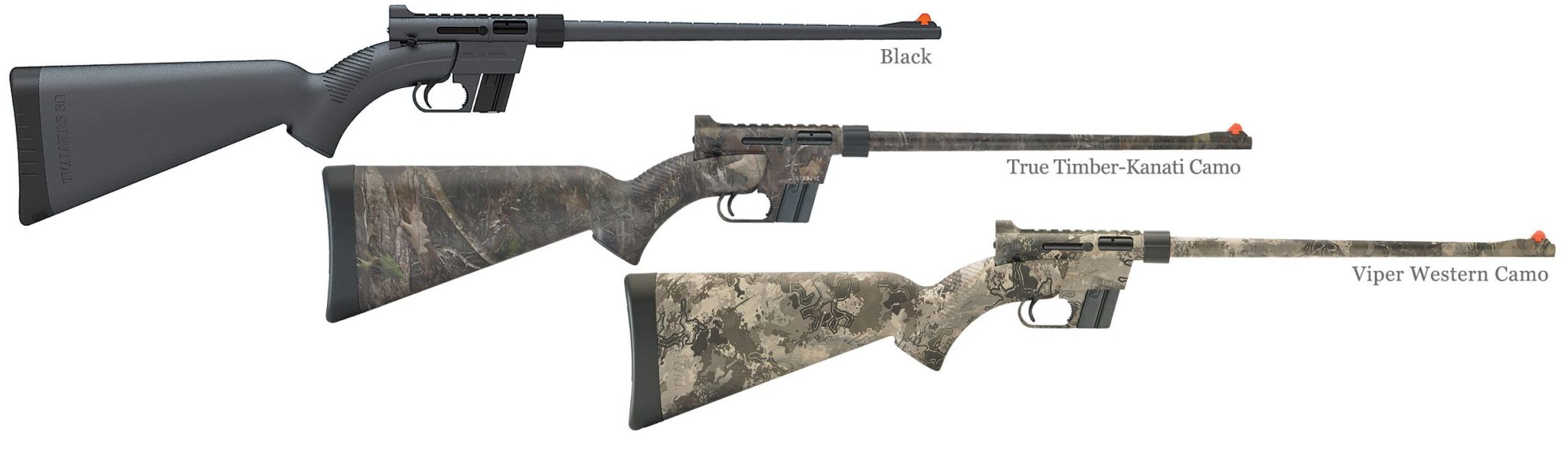
The Henry AR-7 Survival rifle is a unique rifle. Weighing just 3.5 pounds, this little semi-auto rimfire can perform pest-control duties for a farmer or rancher, or serve as a utility rifle carried in a truck or ATV. The cleverly-designed AR-7 is affordably priced, just $299.99 at Sportsman’s Warehouse.
We think most gun-owners would enjoy adding an AR-7 to their collection. The Henry AR-7 breaks down for easy carry in a backpack or a vehicle. The barrel, receiver, and magazines all fit INSIDE the buttstock. That’s handy. And this little 3.5-pound rifle offers surprisingly good accuracy.
If you don’t like basic black, Henry offers two camo versions from the factory: True-Timber Kanati Camo, and Viper Western Camo. Click the photo below for full-screen (2048 pixel wide) image:
Or, if you have artistic skills (and confidence with spray cans), you can paint your AR-7 yourself, as this owner did. The talented gun-painter reports: “[This is a] great little gun that is accurate and I love how it packs away. I paint all my black guns. Already took a grouse at 16 yards.”
History of the Henry AR-7 Rifle
Starting in 1959 the AR-7 was provided to U.S. Air Force fliers as a survival rifle to use if they were stranded in a remote area. Today the AR-7 is a favorite of bush pilots, backpackers, and backcountry adventurers who, like their Air Force counterparts, need a rifle that’s easy to carry yet can take down small game. Like the original Henry U.S. Survival Rifle, this innovative, semi-automatic rimfire rig is lightweight (3.5 lbs.) and highly portable. At just 16.5″ long, with all components stowed, it easily fits into a backpack, or the cargo area of an ATV, truck, boat. or plane. The AR-7 is chambered in .22 LR so you can carry plenty of ammo without adding much weight to your gear. When disassembled, all the pieces fit inside the impact-resistant, water-resistant stock.
Assembly is as easy as attaching the receiver to the stock, inserting the barrel, and screwing on the barrel nut. In a few seconds, without any tools, the Henry U.S. Survival AR-7 is ready for action. It now comes standard with a steel barrel covered in tough ABS plastic with a protective coating for corrosion resistance. The Henry U.S. Survival AR-7 is available in three finishes; Black, True Timber Kanati Camo Pattern, and True Timber Viper Western Camo Pattern. All models are equipped with an adjustable rear sight and a blade front sight. As you can see below, the built-in storage can be used to hold magazines and ammunition as well as the rifle components.
Another AR-7 owner posted this review:
Simple Goodness: Henry AR-7 — Fun Modern Version of a Classic
Henry got this modern take of the AR-7 right. Gentle finger-tighten is all it takes to assemble. The funky orange plastic sight on the end of the barrel is kind of loud, but was also easy to target with. Brand spanking new, I was getting grapefruit-sized patterns out of each 8-round mag at 50 feet. For a compact take-down, was surprised that length-of-pull was satisfactory for a six-foot guy. It didn’t feel cramped.
For realistic backpack, bail-out, or bug-out situations this would be a smart choice. It was fussy with a single Rem Golden in the first mag… but after that no problems, and no issues at all with Federal and CCI. The safety is right-handed but large and easy to get used to. The charge handle retracts so [you must] pull it up before pulling back, but that motion seemed to become reflexive pretty quickly. The mag eject is in front of the trigger and pushes forward. All in all, [the AR-7 offers a] really nice, compact form factor. [It is] light, perfect for backpack plinking and … low-rent varmint sniping.
The premier Multi-Gun event in the USA kicks off this week in Minnesota. The 2024 USPSA Multi-Gun National Championship runs July 19 – July 21, 2024 at the Forest Lake Sportsmen’s Club in Forest Lake, Minnesota. This event attracts top Multi-Gun competitors from across the nation vying to be crowned the USPSA National Champion. While most competitors are men, there are also talented lady shooters.
The USPSA has a great online Guide to the Multi-Gun Championship. This zoomable, 50-page “Match Book” has diagrams of all 12 stages, plus interviews with leading shooters. In addition, you’ll find a map of the Forest Lake facility on page 13 of the online Match Book.
Are you looking to get started in tactical/practical competitions? Or perhaps you already have have some PRS/NRL experience but want to upgrade your equipment and enhance your match results. Here are eight videos that can help you improve your game. These videos feature top PRS/NRL competitors and knowledgeable manufacturers’ representatives. You’ll find other related videos on the Long Range Precision Shooters YouTube channel.
How Accurate Are the Top PRS Shooters?
In this video, MDT put three top centerfire PRS shooters to the test, running them through some of the most difficult stages. The goal? To showcase the level of accuracy and precision these top shooters can achieve. From shooting off barricades to hitting targets from rooftops and rocks, these shooters demonstrate why they are considered among the best in the world. Top-tier modern PRS/NRL rifles when shot prone from a bipod at 100 yards can do 1/3-MOA or better for three shots.
Building a Custom PRS/NRL Rig
Action, trigger, barrel, chassis, rails, and optics — this video from Burris covers all the key components of the modern PRS/NRL rifle. This video discusses the pros/cons of various configurations and the explains what to look for in a PRS/NRL riflescope.
PRS Tactical Division Explained
In this video MDT Shooter Matt Stiner explains the basics of competition in the PRS Tactical division. The video covers rifle, cartridge choice, optics, and key accessories. He also explains how to set up your PRS Tactical rig for best results. In addition Matt talks about bullet and brass options.
Shooting a PRS Match for the First Time
Here’s an amusing video from the land Down-Under — Australia. The video covers a club PRS match, showing various shooting positions. Around the world, the PRS discipline is growing rapidly, particularly with younger marksmen under 35. The matches are fun and fast-paced and the sport is much more dynamic and physically challenging than benchrest or F-Class competition.
Building Your Rig — Gear and Cartridge Selection for PRS/NRL
Part of a Firearms Depot PRS mini-series, this video covers gear and cartridge. Host Adam delves into the core elements that craft a winning setup. The video covers factors to consider when choosing a cartridge. The video also discusses chassis and barrel selection. Along with the gear talk, the video covers factors to consider when selecting a smith to help with chambering and rifle building.
Road to the PRS
This video from Kestrel offers good advice on getting started in PRS/NRL shooting. Experts demonstrate multiple shooting positions and offer advice on shooting from barricades. Topics covered include rate of fire, scope use, and equipment selection.
Savage 110 Elite Precision — Good Production Class Choice
This Alabama Arsenal video shows the Savage 110 Elite Precision on PRS Match stages using bags, tripods, and bipods, firing from stone barriers, field frames, and wood platform supports. If you are in the market for a PRS rifle, this video, which now has 355,000 views, is well worth watching. It covers specific features including trigger, chassis, magazines, and Atlas attachment. NOTE: The price limit for Production Class has risen significantly over the years, with a current MSRP max of $3000 for the rifle and $2500 for the optic.
PRS on a Budget — Converting a Basic Rifle for PRS Use
Top of the line rifles for competition are exceedingly expensive, but there is another option if you have a rifle in the safe that doesn’t get much use. Top F-Class shooter and wind coach Keith Glasscock notes: “I converted my .223 Remington varmint rifle into a Tactical class/PRS training rifle to save costs on ammunition and barrels so I can get better, faster.” Keith shows a very logical way to get started in the PRS/NRL game.
One of the biggest Precision Rifle matches of the year took place recently. Nearly 200 shooters from many states competed in the 2024 Hornady Precision Rifle Challenge, held June 28-29, 2024 at Hornady’s private 250,000 acre ranch property outside of Evanston, Wyoming, across the state line in Utah. The match featured 19 challenging stages. Course of fire consisted of 200 rounds with “off trail” walking between stages. Natural terrain made for an exciting match.
George Gardner and Bryan Sikes of GA Precision were co-match directors. Gardner said the 2024 event went well: “The 2024 Hornady PRC was a huge success. The challenging course of fire coupled with the perfect weather for a precision rifle match made for an awesome weekend.” Sikes added: “We want to congratulate all the winners and thank each competitor for attending. A big thank you for all the range officers and sponsors that made this match happen, as well.” Open Division Competitor Andrew Slade was the Overall Match winner. Hornady congratulates the following Division and Class winners:
Open Division and Overall winner: Andrew Slade
Top Production: Doug Koenig
Top Tactical: Joe Thielen
Top Gas Gun: River Curtis
Top Senior: Joe McFarlane
Top Mil/LE: Kahl Harmon
Top Lady: Lauryl Akenhead
Top Junior: Reese Broughton
Top Amateur: Robert Mahaffey
Top Marksman: Austin Clark
Top Semi-Pro: Justin Eggers
Top International: Moritz Mayr
One of the biggest PRS matches of the year, the Hornady Precision Rifle Challenge is a unique long range competition with tough terrain and major elevation changes. This wasn’t a typical PRS Pro Series match by any means. Participants in this challenging Precision Rifle match encounter challenging conditions not typically seen in other tactical matches.
This video, from the 2023 PRC event, is well worth watching. It provides plenty of equipment closeups, shows stage set-ups, and includes “birds-eye-view” drone footage of the scenic range.
CLICK HERE for full match results from the 2024 Hornady Precision Rifle Challenge. NOTE: Most images in this story are captured from 2023 Hornady PRC Video embedded above.
Wouldn’t it be cool if you could have one large carry case that could hold your rifle, PLUS your ammunition, earmuffs, paper targets, rear bag, bipod, Magnetospeed, spotting scope, and all the other gear you might want to bring to the range? Well MTM Case-Gard has finally created such a do-it-all case, one of the first of its kind ever offered, available now for $89.99 on Amazon.
MTM’s new TRC39 Tactical Rifle Crate is an all-in-one solution for hunting and shooting gear transport and storage. The TRC39 has a foam-padded 39″ x 11.7″ x 3.1″ gun compartment on the top, and a storage compartment below. Up top, firearms are protected and held in place with MTM’s egg shell foam padding. Beneath the lift-out gun tray is a large compartment equipped with removable partitions. Total storage capacity of the 39″ x 11″ x 7.1″ (deep) lower compartment is 54 quarts. That’s plenty of room for gear and ammo in that lower storage area. And the TRC39 is rated to haul up to 75 pounds of guns and gear.
For security, the TRC39 has four snap latches, padlock tabs, and a water-resistant O-ring seal. To ease transport the TRC39 has two recessed wheels. And there are formed polymer handles on either end of the case. MTM Case-Gard’s TRC39 is now just $89.99 on Amazon — 36% Off the $139.99 original list price.
We can see this TRC39 case being very popular with tactical shooters and varminters who can carry a rifle, pistol, binoculars, spotting scope, ammunition, and rear bag, all in one large case. We just wish a longer version was also available — the max rifle length that can be stored would be 39″, unless the barreled action is separated from the stock.
TRC39 Tactical Rifle Crate Features:
Gun compartment holds tactical and short rifles up to 39″ long
Lift-out upper rifle tray, protected with quality foam padding
Two removable dividers in 39″ x 11″ x 7.1″ lower compartment
A full 54 quarts of storage capacity in lower compartment
Two recessed wheels can support up to 75 lbs. of gear
Stackable design with tie-down and strap-over points
Four rugged, no-break snap latches with padlock tabs
No-rust, high-impact, polypropylene construction
Water-resistant O-ring seal (non-submersible)
External Size: 43.5″ x 14.7″ x 11.5″ (Tall)
Engineered and manufactured in America
Yet another .300 Blackout disaster. Unfortunately, that .300 Blackout cartridge can fit in a .223 Rem chamber. Shooting a .308-caliber bullet in .223 bore is a recipe for disaster.
The .300 AAC Blackout aka “300 BLK”, is a compact 30-caliber cartridge designed to work in AR-15 rifles. It has a shorter cartridge case to accommodate the bigger 30-caliber bullet while still fitting in a standard AR-15 magazine. Unfortunately, that’s the danger. A careless shooter can toss a .300 Blackout cartridge in with .223 Rem rounds without noting. And because the case-head size is the same as the .223 Rem (5.56×45) the rifle’s bolt assembly will happily chamber and fire the .300 BLK round. Problem is, that forces a .308 diameter bullet down an undersized .223-caliber bore. Not good!
This images were provided by Tactical Rifle Shooters on Facebook. The message was clear: “Don’t try to run 300 Blackout in your .223/5.56mm. It won’t end well. The problem is identical rifles and identical magazines but different calibers.”
Image from Accurate Shooter Forum. Cutaway shows the jammed .30-Cal bullet:
For those who MUST have a .300 Blackout, here are some things you can do:
1. Use different colored magazines for .300 Blackout vs. .223 Rem.
2. Fit all your uppers with caliber-labeled ejection port covers.
3. Mark .223 Rem upper handguards with the caliber in bright paint.
4. Mark all .300 BLK Rounds with heavy black marker.
Comments by Folks Who Viewed these .300 Blackout Disaster Photos:
“The .300 Blackout is simply a badly-designed round. A properly-designed round would have had a feature in the shape that would have prevented cross loading in the first place.” — D. Santiago
“I almost made that mistake… I had a magazine of 300 BLK inserted in my .223/5.56 all night. Fortunately, I never pulled the trigger. Once I realized the mistake, I almost got ill. [After that incident] I no longer own a 300 BLK.” — B. Welch
“Happened to me hog hunting from a helo. Gun exploded in my face.” — B. Hood
“Fire-forming projectiles [is] so wrong in centerfire!” — M. Stres
“Had some dude come into the store the other day wanting .300 Blackout ammo to shoot in his 5.56 AR. It took 15 minutes of explaining for him to understand you got to have a .300 Blackout Upper!” — R. Williams


 In our Shooters’ Forum, there was an discussion about a range that was threatened with closure because rifle over-shoots were hitting a farm building over two miles from the firing line. One reader was skeptical of this, asking “how’s that possible — were these guys aiming at the stars?” Actually, you may be surprised. It doesn’t take much up-angle on a rifle to have a bullet land miles down-range. That’s why it’s so important that hunters and target shooters always orient their barrels in a safe direction (and angle). Shooters may not realize how much a small tilt of the barrel (above horizontal) can alter a bullet’s trajectory.


 Getting focused mentally is an important part of preparation for Perry. In 2011 I was chasing Sherri Gallagher, since then I have been chasing Brandon Green[.] If I get beat by a Service Rifle I am going to make him or her work for it. So there is your peak into my mental process. I go for the top and if I am hanging with them then the Service Rifle National Championship will come, Kind of like how I shoot for X’s and Tens will come.




 The
The 


