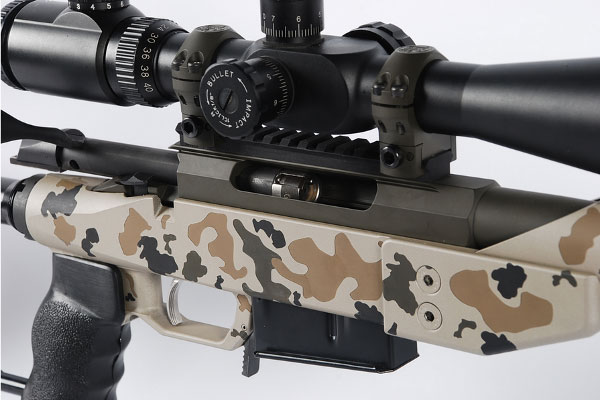
With over 240 shooting-related videos, the Alabama Arsenal YouTube Channel is a remarkable resource. This video channel provides detailed field tests of tactical-type rifles, ARs, and pistols. The testers have access to some very impressive ranges, and many of the tests are far more thorough than you’ll typically find with most gun magazines and gun-centric YouTube channels. For example, Alabama Arsenal (AA) has a series of 1000+ round pistol test videos. These are well worth watching if you are considering purchase of a defensive handgun.
Today we showcase multiple rifle videos covering two centerfire rifles, and three precision rimfire rigs. After these field test videos, you’ll find an interesting technical video which investigates how suppressors can affect muzzle velocity.
Barrett MRAD .300 PRC at 2200 Yards — Extreme Long Range
Here’s a rugged tactical rifle put to the test at Extreme Long Range. This video, featuring a Barrett MRAD chambered for the .300 PRC cartridges, features accuracy testing out to 2200 yards (1.25 miles). There is some good drone footage covering the long path to the target. The shooter noted that the bullets fired from his .300 PRC “go sub-sonic somewhere between 1800 and 1900 yards”, creating additional ballistics challenges at this yardage.
Savage 110 Elite Precision for PRS Production Class
In this video AA’s team reviews the Savage Elite Precision Rifle with MDT ACC Chassis. Retailing for about $1810.00 in 6mm Creedmoor, this is one of the better production class options for PRS and NRL competition. Starting at the 3:10 time-mark, the video shows how all the adjustments function on the MDC ACC Chassis. Guns America Digest did a full review of this rifle, and was quite impressed.
Rimfire .22 LR Bergara B-14R in WOOX Furiosa Hybrid Chassis
Alabama Arsenal recently tested a .22 LR Bergara B-14R rimfire rifle fitted with the WOOX Furiosa hybrid chassis system, an Italian-made product featuring wood sections over a strong aluminum core chassis. The bolt operation and ergonomics of the B-14R simulate a Remington 700 very closely, making this rifle good for rimfire cross-training. The B14-R model tested was the version with carbon-wrapped barrel.
The WOOX Furiosa is an innovative, unique aftermarket replacement chassis. This high-tech hybrid stock/chassis combines wood sections over a full-length, aerospace-grade aluminum skeleton chassis, giving it the “feel” of a wood stock with the strength and stability of a metal stock. We like the way the stock feels on the trigger hand in particular and the smooth wood cheekpiece is also very nice. Made in Italy, the Furiosa is offered in three versions all with wood sections on the forearm, grip area, and cheekpiece. Choose natural Walnut Brown, Micarta Black, or Midnight Grey. Alabama Arsenal tested a B14-R fitted with the Micarta Black version. Below are photos of a centerfire rifle in a WOOX Furiosa hybrid chassis, with the Brown Walnut elements.
CZ 457 Varmint Precision Trainer and Chassis
In this video, Alabama Arsenal compares two higher-end versions of the popular CZ 457 rimfire rifle, a great choice for the NRL22 and PRS 22 disciplines. The test compares the CZ 457 in a Manners composite stock with a CZ 457 version in a Varmint Precision aluminum chassis. Right now basic CZ 457 rifles start at about $540.00, with the Varmint Precision models running $930 for the metal chassis version and $1130 for the Manners carbon-fiber composite stock model.
Informational Video about Rifle and Pistol Suppressors
Alabama Arsenal regularly tests its firearms with suppressors. Over time, the testing team has leaned much about modern sound moderators, comparing features and learning how to install and maintain quality suppressors. Here is an interesting video that shows how suppressors affect shot velocities.
Field Testing — Do Suppressors Change Bullet Velocity
Want to see more content like this? Here are LINKS…
Alabama Arsenal has nearly 300 videos on its YouTube channel. In addition, you’ll find dozens of firearms photos and other shooting-related content on Alabama Arsenal’s social media pages: Facebook; Instagram; and Twitter. You can support the Arsenal’s gun testing by subscribing to the Alabama Arsenal’s PATREON Page.
Let’s face it, AR-platform rifles run dirty, at least compared to typical bolt-action rifles. The AR-15 works by piping gas from the barrel back into the bolt carrier, causing the bolt to unlock and the carrier to move the bolt backward. The “exhaust gas” from the barrel contains soot and carbon. The carbon will form hard deposits on the bolt. In addition, the carbon can combine with lube on the bolt carrier to make a nasty, paste-like sludge. This can be particularly problematic when the black paste pollutes the ejector and extractor recess.
This Editor has inspected dozens of ARs over the years. Other than mag-related malfunctions, the most common cause of AR cycling problems I found was oily gunk in the extractor and ejector areas. Many AR owners overlook these critical areas. Look at an AR that hasn’t been cleaned properly and you’ll probably find black gunk (and small brass shavings) in the ejector and extractor recesses.
If you want to keep your black rifle running smoothly and reliably, you must clean it regularly and follow the correct maintenance procedures. Here are three videos that explain how to properly disassemble and clean AR-platform rifles. And then they cover the essential lubrication ARs need to run reliably.
Take-Down and Full Cleaning of AR15 by Jerry Miculek
Here ace shooter Jerry Miculek takes down and cleans an AR-platform rifle belonging to his daughter Lena. This is a good video because Lena’s rifle was “run hard and packed up dirty” so you can see where carbon and grease build up. This 35-minute video is very thorough. Jerry is one of the nation’s top action carbine shooters, so listen carefully to his advice on cleaning and lubrication.
General AR-15 Maintenance and Lubrication
There are various schools of thought on AR lubrication. Some guys like to run “wet” with lots of CLP, while others choose to focus lubrication on the key spots that receive the most friction and wear, such as the contact point for the bolt carrier. We do advice check the ejector recess and extractor spring recess frequently as gunk can get in there, causing malfunctions. Here is a good video from Pew Pew Tactical — a 7-minute guide to cleaning and lubricating AR-platform rifles. This shows important details for both the upper and the lower.
How to Clean Your AR-15 Bolt Carrier Assembly
This video offers very specific advice on the bolt carrier group, which receives the dirty gas directly from the barrel. Be sure to check the extractor and ejector recesses. That’s where old lube, brass shavings, and carbon accumulate. Follow the directions in this video for lubrication, and don’t over-lubricate the bolt carrier — that will only capture more carbon.
Right now, Brownells is running a big Warehouse Inventory Clearance Sale with 59 popular items on sale. There are big discounts on rifles, pistols, AR parts, chassis systems, optics, and ammunition. Right now you can save 20% or more on many of these discounted guns, scopes, and accessories.
Select Items on Sale Now
Here are eight notable selections from the 59 products currently listed in the Brownells Warehouse Inventory Clearance Sale. There are many other great bargains, but these seemed especially good:
Brownells is running a big Memorial Day Weekend Sale, which runs now (Friday 5/26/23) through the end of the three-day weekend. Over 100 items are featured in this sale, including tools, optics, and AR equipment, along with ammo and primers.
To add to the savings, you can get 15% off $200+ purchases with coupon code MDAY15. Now through May 28, 2023 use MDAY15 during checkout to save 15%. Then, on Monday, May 29th, you can use code MDAY20 to save 20% off purchases of $200 or more. NOTE: CODE MDAY20 will work on May 29th (Monday) only. Until then use code MDAY15.
Good Memorial Day Weekend DEALS at Brownells.com
Here are eight (8) of the 103 Memorial Day Weekend Deals on the Brownells website currently. Along with AR uppers and lowers and magazines, you’ll find centerfire and rimfire ammunition on sale. And handloaders should definitely check on the discounts on CCI 400 Small Rifle Primers and CCI Pistol Primers.
When shooting any match that requires moving back and forth between multiple target distances it is very handy to have your ballistics data, i.e. your “come-ups”, placed within easy view. That way you can instantly see your elevation for various target distances in seconds. This can really help a PRS/NRL competitor on timed stages. And having a convenient “Dope” display of elevation at various distances can also benefit varminters who are shooting critters. In our varmint hunters we targeted p-dogs from about 80 yards out to 500+.
PRC DOPE Roller QD Ballistic Data Turret
The PRC DOPE Roller QD Ballistic Data Turret provides a handy, low profile display of windage and elevation data. You can see your “dope” without breaking position from behind the rifle. Then simply rotate the knob to display data from various distances. The ballistic data is placed by wrapping a simple 1″ x 3″ adhesive address label around the outside surface of the DOPE Roller. This handy quick-detach roller retails for $64.95 from Precision Rifle Components.
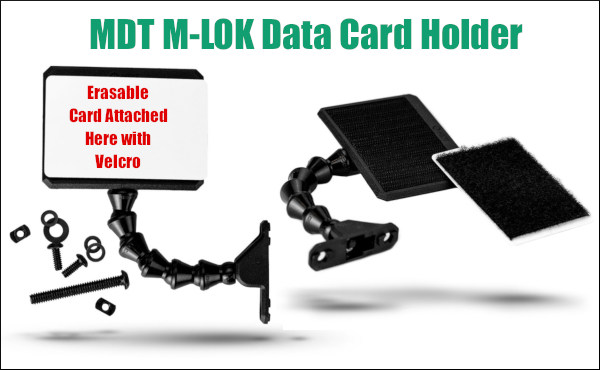
MDT M-LOK Data Card Holder
The MDT M-LOK Data Card Holder has an adjustable neck allowing you to easily position your ballistics data for optimal viewing. Data entries are written on on a reusable card that attaches with Velcro. The Data Card Holder Kit comes with hardware to mount to any M-Lok rail. In addition the card holder fits directly to an MDT ACC chassis attachment point. This MDT kit includes: M-LOK Data Card Holder, Wet Erase Data Card, Wet Erase Marker, and installation hardware. NOTE: The Card Holder sticks out about 6.7″ when fully extended, but arm links can be removed to make the arm shorter. The unit folds flat for storage. This complete kit is $59.95 at Creedmoor Sports.
Warne Universal Data Card Holder
The Warne Universal Data Card Holder easily attaches to the scope tube, in left or right configurations, for a universal fit. Data is displayed in a convenient location to make quick and accurate target transitions, and the articulating arm allows for low profile storage while not in use. The Warne Universal Data Card Holder retails for $88.49 at Warnescopemounts.com. Three ring sizes are offered: 30mm, 34mm, 35mm. A 50-pack of Warne Data Card label refills is currently $16.99 from Warne.
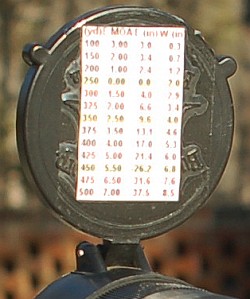
Scope-Cover Mounted Ballistics Table
Another option is to place your ballistics card on the back of the front flip-up scope cover. This set-up is used by Forum member Greg C. (aka “Rem40X”).
With your ‘come-up’ table on the flip-up cover you can check your windage and elevation drops easily without having to move out of shooting position.
Greg tells us: “Placing my trajectory table on the front scope cover has worked well for me for a couple of years and thought I’d share. It’s in plain view and not under my armpit. And the table is far enough away that my aging eyes can read it easily. To apply, just use clear tape on the front objective cover.”
Cheap But Effective — Tape on the Stock with Ballistics Data
At the 2021 Nightforce ELR Steel Challenge, Applied Ballistics guru Bryan Litz wrote his come-ups on blue masking tape applied to his stock. He did this based on a tip from Chase Stroud. With the tape applied behind the action, the numbers are easily visible. This “cheap trick” does work apparently — Bryan won the match with a convincing victory over 220 other shooters. READ Match Report.
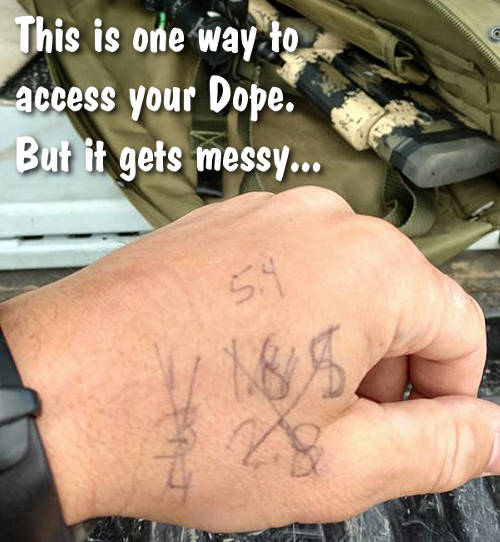
Cheap But NOT So Effective — Numbers on Hand
Many of us have scribbled some come-ups on the back of a hand or on our forearm using a marking pen. That can work if you only have a couple distances to deal with — say 100 and 300 yards. But if you want a more complete Come-up table, get one of the card-holders shown above. Writing numbers on the skin is generally not such a good idea….
If you shoot F-TR competition, or PRS/NRL precision rifle matches, you definitely need a sophisticated bipod — something that offers exceptional stability along with quick adjustments for both height and angle. Today we cover four bipod options — two wide-base, ski-type bipods, along with two sturdy, precision shooting bipods that can fit to ARCA or Picatinny rails.
SEB JoyPod-X Coaxial Bipod for F-TR Competition
The upgraded SEB JoyPod-X bipod features an enhanced head unit and new rapid height adjustment for the legs. The new JoyPod-X is also offered in a variety of colors: Blue (as shown), Red, Green, Purple, Black, and Bronze. The Joypod-X weighs 19.16 oz. complete with the Picatinny adapter, new pivotal feet, and the joystick. JoyPod-X designer Sebastian Lambang tells us: “Now height adjustment of the JoyPod-X can be much easier, quicker, and more precise employing a simple, adjustable brake and improved ratchet system.” Contact Seb Rest USA for current pricing.
The next three bipods are sold through Creedmoor Sports. For these products Creedmoor Sports is offering FREE SHIPPING on orders over $49 this weekend. The FREE SHIPPING deal ends Monday, May 22, 2023 at 12:00 noon Central Time.
Phoenix Precision Wide-Base Bipod
The popular Phoenix Precision Bipod has been slimmed down (to help with F-TR class weight limits). The new Phoenix Bipod is now just 1.95 pounds. There are other enhancements including a swivel fixture on the skis (bipod feet) to compensate for uneven firing positions. Creedmoor Sports says the Phoenix Precision Bi-Pod is one of the most advanced on the market. It employs a unique Worm Gear System which provides very smooth and positive most positive height adjustment. This drive system virtually eliminates “creep-down” and allows the shooters to make very precise height adjustments. With a rigid bipod like this you can keep both hands on the rifle. This bipod retails for $498.95 at Creedmoor Sports.
Warne Skyline Precision Bipod — ARCA and Pic Rail Interfaces
The Warne Skyline Precision Bipod is one of the most functional, ergonomic, and strongest bipods on the market today. Designed to attach to your ARCA rail or Picatinny Rail, the Skyline bipod allows the shooter to make quick, one-handed height adjustments. It also offers smooth cant and panning ability for use on uneven terrain or less than ideal positions. Current price for both versions is $349.95 at Creedmoor Sports.
MDT Gen 2 Ckye Pod Double Pull Leg Bipod
This bipod has some impressive engineering, with 3 locking positions from front to back — stowed, angled. and down. The MDT CKYE-POD Gen2 bipod features quick single-handed adjustable height, allowing you to achieve from 9″ to 18.5″. It also offers 170 degrees of cant, 360 degrees of pan capability, and an integrated barricade stop. Mix and match the independent leg heights and angles to create the perfect shooting position no matter what the terrain or hill angle.
A high-end, full custom Benchrest, F-Class, or PRS rifle can cost upwards of $5000.00. Some top-tier competition and tactical scopes (March, Kahles, Schmidt & Bender) cost $2500-$3600 by themselves. If you’re transporting multiple custom rifles with premium scopes to the range, you could easily be hauling $20,000 worth of scoped guns. Bring along a Co-Axial rest, spotting scope, rangefinder, Kestrel, and LabRadar chronograph, and that could push the total closer to $25,000+. Think about that — your guns and gear could be worth way more than your vehicle!
How do you safeguard a big-money collection of guns (without driving around in a Brinks armored truck)? One of the best storage systems available is the TruckVault, built in Washington state. TruckVaults are custom-fitted, locking storage cabinets that fit in a Pick-up truck bed, SUV, or station wagon. Various designs are available, including a waterproof “Extreme Series”. Both single-drawer and multi-draw layouts are offered with lengths up to 60″ overall, and top-load capacity of 2000 pounds. A variety of interior configurations are available.
For transporting scoped match rifles, we suggest TruckVault’s Magnum Height line, which ha 10.5″ of vertical clearance. This is available with two drawers or one full-width drawer with two diagonal internal compartments for long rifles.
Truck-Vault Video Showing Break-In Attempt
Truck-Vaults carry a big price-tag. One-drawer SUV models start at around $1775.00, but you can pay over $4000.00 for a large truck unit with all the bells and whistles. Balance that cost against the value of the all firearms and accessories you are transporting. If you spend much time on the road with a pricey collection of guns, optics, and accessories, a Truck-Vault may be a wise investment. This editor first saw a Truck-Vault on a Chevy Suburban belonging to an Arizona gunsmith who does a lot of work for the military. It was not unusual for him to haul $50,000 worth of Class III weapons. For him, the Truck-Vault was an essential security feature. For more info, visit TruckVault.com or call (800) 967-8107.
Precision Rifle fans should watch Shooting USA this week. On Wednesday, May 17, 2023 Shooting USA offers a special edition devoted to the 2022 Armageddon Gear AG Cup Invitational. The AG Cup posts the biggest cash money match in Precision Rifle Competition. It’s an elimination format shot over three days of challenging competition on stages of fire created at K and M Precision’s ranges in West Tennessee. Match organizer, Tom Fuller joins John Scoutten to narrate the action and the award of the cash in extended coverage of the match.
This video shows highlights from the 2022 AG Cup, with many stages illustrated.
It’s the fourth year for the richest rifle tournament in the world. The AG Cup is the brainchild of Tom Fuller, the owner of Armageddon Gear, and to say it’s a success is a bit of an understatement. $75,000 in prize money was up for grabs, with a huge cash prize for the overall matche winner.
Shooting USA runs on the Outdoor Channel Wednesdays 9:00 PM Eastern and Pacific, 8:00 PM Central.
No Outdoor Channel on cable? Then you can subscribe to Stream the Broadcast on the internet.
During this week’s Shooting USA special, John Scoutten and Armageddon Gear’s Tom Fuller report the action and interview top precision rifle shooters. The Grand Prize of $20,000 was awarded for the best overall score, based on accuracy and time. There were also substantial cash prizes for each stage winner.
This 2022 AG Cup video has good footage of the stages and views downrange.
Arena Training Facility — 2300 Acres
The 2300-acre Arena Training Facility is a premier shooting facility with multiple shooting ranges from 50m to 2100m. Arena’s 1000-yard covered Known Distance range offers multiple benches, steel and paper targets out to 1000 yards. On Arena’s UKD (unknown distance) range shooters can engage steel out to 2300 yards. This 2100m UKD range boasts a 3-Story Shooting Tower, Air-Conditioned Shoot House, and multiple Positional Challenges.space.
Armaggedon Gear — Tactical Accessories Armageddon Gear, founded by former U.S. Army Ranger Tom Fuller, sells support bags, gun cases, slings, suppressor covers, scope covers, and a wide variety of other accessories popular with the PRS/NRL crowd. Armageddon Gear now provides products to the U.S. Military, Law Enforcement, as well as PRS/NRL competitors.
AccurateShooter’s Target Page provides over 50 FREE downloadable targets. You’ll find all types of targets — sight-in targets, varmint targets, rimfire targets, bullseye targets, tactical targets, load development targets and more. CLICK HERE for all our free targets, including our popular LOAD DEV target.
On this load development target, all your load data fits neatly in the boxes under each target. The diamonds have 1/2″ sides and you can align your cross-hairs on the horizontal and vertical lines. When we test, we crank in a little elevation, setting the point-of-impact higher. That way our shots fall in the gray circles, leaving the red diamonds intact for precise aiming.
Storm Tactical Targets — Hundreds of FREE, Printable Targets
If you want an even greater selection of targets, specialized for PRS and NRL shooters, Storm Tactical offers a vast collection of tactical targets, available in three different versions: MOA, MIL Yards, and MIL Meters. These target sets were created with input from Sniper’s Hide. Storm Tactical also created a great rimfire target set. This includes side-by-side target blocks for fun, one-on-one competition. If you shoot NRL22 or just enjoy shooting with a buddy, we highly recommend the rimfire target set.
Overall there are 299 Storm Tactical Targets in four sets.
CLICK links to launch each Storm Tactical target collection. Then you can click the download icon to save to your hard drive. OR, you can scroll up and down to select the target(s) you like which you can tell your printer to print. We do recommend downloading the complete archives. File sizes are listed.
Here’s a Tikka T3 in Third Eye Tactical cerakoted chassis.
Rimfire Twin Target, for One-on-One Shooter Challenges
You’ll find this fun target on the third page of the Rimfire Target Pack. Just download the PDF file and instruct your printer to deliver page three. Or print out all six (6) rimfire targets if you like.
Article by Paul Ivnitskiy and David Lewis of AmmunitionToGo.com
As you know, if your magazine spring loses its elasticity or breaks, it can render your firearm almost worthless. AmmunitionToGo.com conducted a test to determine how long mag springs can last. The test also examined whether leaving a mag loaded for an extended period of time causes problems, or if loading a mag can damage its spring. The test findings are eye-opening and show that, under controlled conditions, the springs themselves will last more than a human lifetime for most shooters.
The test crew subjected 13 different mags (from multiple manufacturers) to a test protocol over a year. The protocol included loading and unloading to full and half capacity, storing in climate-controlled and fluctuating temperatures, and storing in a non-climate controlled shed.
Field Testing — Magazines Performed Flawlessly
The crew took the mags to the range for field testing throughout the test study. The results revealed that regardless of the frequency of loading or unloading, or storage conditions, not a single magazine failed. The use of a digital force gauge showed no significant variability in the springs’ resistance from mag to mag but all the tested springs put up 20-25% less resistance than when they were fresh out of their factory packaging. That said, all of the mags performed flawlessly during field testing.
Laboratory Magazine Testing — Tens of Thousands of Cycles
To determine precisely how much punishment a mag can tolerate before its spring starts wearing out, the team recruited help from lab technicians at Applied Technical Services. The results showed that a factory Glock 17 mag spring endured 14,842 cycles (the equivalent of 252,314 rounds) before it snapped, while the Magpul Gen 3 PMAG endured 69,881 cycles (2,096,430 rounds) before it finally gave up.
While this testing was not perfectly emulated under real-world conditions, it is safe to conclude that mag springs are remarkably durable. Many believe that by downloading a mag, that is, loading the mag shy of full capacity, they can protect their mag springs. However, the real world trials don’t offer up any evidence to support this kind of behavior by shooters.
Conclusion — Get Good Mags and Don’t Worry About Them
Common wear and tear from everyday use is more likely to degrade the overall quality of a firearm magazine than the spring failing on its own from being loaded to full capacity and stored for long periods of time. So, unless you’re part of the group of individuals that actually shoots thousands of rounds down range on a weekly basis for training or completion reasons, the whole issue of worrying about the lifespan of your magazine springs is somewhat trivial.
Other Important Factors to Consider
There are many other factors to consider before worrying about magazine spring failure. First, address the overall quality and cleanliness of your firearm, magazine housing, guide rod, buffer tube spring, ammunition choice, the list goes on. Magazine springs are relatively cheap items that can ultimately fail, just like any other man-made item before it. Luckily, magazine springs are very easy to replace once identified as the cause of a malfunction.



 Scope-Cover Mounted Ballistics Table


 How do you safeguard a big-money collection of guns (without driving around in a Brinks armored truck)? One of the best storage systems available is the TruckVault, built in Washington state. TruckVaults are custom-fitted, locking storage cabinets that fit in a Pick-up truck bed, SUV, or station wagon. Various designs are available, including a waterproof “Extreme Series”. Both single-drawer and multi-draw layouts are offered with lengths up to 60″ overall, and top-load capacity of 2000 pounds. A variety of interior configurations are available.


 If you want an even greater selection of targets, specialized for PRS and NRL shooters,