At the request of our readers, we provide select “Deals of the Week”. Every Sunday afternoon or Monday morning we offer our Best Bargain selections. Here are some of the best deals on firearms, hardware, reloading components, optics, and shooting accessories. Be aware that sale prices are subject to change, and once clearance inventory is sold, it’s gone for good. You snooze you lose.
1. Midway USA — Factory Seconds Bullets Sale
⏺ Great prices on huge variety of major brand bullets
Here’s your chance to score major-brand bullets at very significant discounts. MidwayUSA is running a big Factory Seconds Bullets Sale. Right now a wide selection of bullets are offered with major discounts. For the most part, these “seconds” bullets just have slight cosmetic flaws, so they still meet the needs of 99% of shooters. MidwayUSA doesn’t list brand names, but you’ll probably recognize the bullets by shape, weight, and tip type. Grab what you need now — the most popular calibers will sell out.
2. Amazon — Garmin inReach Mini GPS/SAT Comm, $349.99
⏺ Very important safety system for hunters and hikers
Being in the wilderness on a hunt or backpacking trip is great. But it can also be daunting in cases of emergency. Cell phones are great when there’s service but that rarely extends into the backcountry. Stay safe with the Garmin inReach Mini GPS Satellite Communicator. This small, lightweight unit can send a life-saving SOS in an emergency. Plus, with the inReach service you can send/receive text messages via satellite. Measuring just 4″ x 2” wide and weighing a mere 3.5 ounces, the Garmin inReach Mini connects for messaging via the global Iridium satellite network (satellite subscription required). You don’t have to worry about being within range of a cell tower. NOTE: This Mini GPS device can link to your cellphone to display maps and routes.
Would you like the functionality of caliber-specific powder funnels, but don’t want to spend big money on multiple units? Here’s one smart solution — get the Lyman Pro Powder Funnel for under $25. The caliber-specific inserts effectively make the funnel a custom fit for each of your case neck sizes. The Lyman Pro Powder Funnel features a convenient carry case that holds the funnel plus six (6) inserts for 22, .243/6mm, .25/6.5mm, .270/7mm, .308 and .338 caliber rifle cartridges.
4. Graf’s — Sierra 7MM 180g MatchKing, Box of 500 for $169.99
⏺ Excellent F-Open bullet at great price — $33.99 per hundred in 500/ct box
We’ve focused on bullets this week because they’re getting harder to find at a good price. If you’re looking for some great 7mm match bullets at killer pricing, check out these Sierra 7MM HPBT 180gr MatchKings in 500-count box for $169.99. That translates to just $33.99 per hundred (you could pay twice as much for other brands). We can’t remember the last time we’ve seen true match-quality 7mm bullets at this price so stock up now while you can.
5. PMA — PMA Mini Mite Priming Tool, $99.95
⏺ Handy, very precise, with primer depth adjustment
Precision priming tools are favored by many serious reloaders for good reason. These one-at-a-time units permit you to feel how far the primer is seating, even when it’s at crush depth. If you’re in the market for one, check out the Mini Mite Priming Tool from PMA. It features an easily and infinitely adjustable primer depth adjustment (in the head) and easy to swap out primer punch assemblies and utilizes Redding press-type shellholders (one is included with the tool).
6. Sportsman’s Warehouse– Blaze Orange Hunting Gear SALE
⏺ Hunters should wear Hi-Viz orange gear for safety
Hunting season is here. During a hunt, safety is all-important. Many states require Hi-Viz blaze orange safety gear (hats, vest etc.). If you need to pick up Blaze Orange gear for your next hunting adventure, check out the blaze orange assortment at Sportsman’s Warehouse. You’ll find great prices on hats, vests, jackets and more. As a bonus, many of these items can do double duty the rest of the year for personal protection while running or biking on the road.
7. Powder Valley — Shooters World Powders
⏺ We’ve been hearing good things about Shooters World powders
Have you been looking for a good powder replacement for well-known powders that are always out of stock? Head over to Powder Valley where you’ll see a complete selection of Shooters World Powders that can be substituted for your normal powder. These powders have received many good reviews. You’ll find burn rate profiles that work well as substitutes for popular powders such as Varget, H4198, and H4831.
8. Midway USA — Pelican Case Sale — Save 25%
⏺ Some great deals — Add cases to cart to see discounts
We use (and recommend) Pelican cases because they are rugged, secure, and do a great job of protecting your precious arms and optics. Pelican cases always offer good value, but right now you save big (25%) with MidwayUSA’s Pelican Rifle Case SALE. With sale prices up to 25% Off, MidwayUSA is offering deals you can’t find anywhere else. NOTE: You must add each Pelican item to your cart to see the actual discounted price. For example, the Pelican V800 is $149.96 marked down from $199.95 (25% Off). And the Pelican 1750 is $202.46 marked down from $269.95.
⏺ Great for hunters — insert in seconds before taking the shot
Shooters need good hearing protection — you only get one set of ears! While muffs work well, they are not ideal for some situations, such as hunting. When you need easy on/off and light weight, consider Sellstrom Reusable Banded Ear Plugs. These washable 25dB NRR banded plugs rest comfortably around your neck when not in use. Get good protection for under $4. Hunters can keep the band around their neck and then instantly put hearing protection in place when it’s time to shoot.
The November 3rd election is just 18 days away. If Joe Biden wins, he has promised an aggressive anti-gun agenda starting with further restrictions on semi-auto rifles. Joe’s running mate Kamala Harris said she would enforce gun control via Executive Order. Gun confiscation by Executive Order happened in Canada when Prime Minister Trudeau, without legislative approval, ordered Canadians to turn in their magazine-fed semi-auto rifles.
So, is it time to finally get an AR-platform rifle? Or get another if you already have one? Only you can decide that, but we have identified three great AR deals — two complete lowers under $190 and a complete AR Carbine for under $550. And yes, these are all IN STOCK NOW. Check out these deals:
PSA Complete Lower with Adjustable Stock — $179.99
Complete Palmetto State Armory AR lower is fully assembled. It will take take standard complete uppers, which you can build or purchase later without an FFL. The lower is the section that much be purchased through an FFL with a background check.
Machined from Aluminum Forgings 7075-T6
Hardcoat Anodizing: MIL-A-8625F, Type III, Class 2
Milspec diameter Receiver Extension
M4 Stock
Staked M4 Lock Nut
Standard Carbine Buffer
Un-notched Hammer compatible with 9mm use
PSA Complete Lower with Adj. Magpul FDE Stock — $199.99
Complete Palmetto State Armory lower with Magpul Flat Dark Earth grip and stock is fully assembled. It will take a standard complete upper, which you can build or purchase later without an FFL. The lower is the section that much be purchased through an FFL with a background check.
Machined from Aluminum Forgings 7075-T6
Hardcoat Anodizing: MIL-A-8625F, Type III, Class 2
Milspec diameter Receiver Extension
Magpul MOE Stock, Flat Dark Earth
Magpul MOE Grip, Flat Dark Earth
Staked M4 Lock Nut
Standard Carbine Buffer
Enhanced Polished Trigger (EPT)
Un-notched Hammer compatible with 9mm use
PSA 16″ Freedom Rifle Olive Drab ($539.99) or Black ($549.99)
This is a full, complete AR15-type rifle with 16″ barrel, and M4-type receiver. Twist rate is 1:7″. Sold complete, except for magazine. This same rifle is also available in all-black for $549.99. This rifle must be transferred through an FFL with background check.
Barrel Length: 16″
Barrel Profile: A2
Barrel: A2 Profile, Chrome Moly Vanadium, Nitride finish
Muzzle Thread Pattern: 1/2″ x 28
Twist Rate: 1 in 7″
Barrel Extension: M4
Gas System Length: Midlength
Receiver Material: Forged 7075-T6
Receiver Type: M4
Handguard Type: Mid-Length Classic with heat shields, ODG
Fire Control Group: Standard Mil-Spec Trigger Group
Grip: A2-style, ODG
Stock: M4-style, ODG
Overall Length: 32 inches
Weight (as configured): 6.8 lbs
Here’s good news for owners of M1 Garands, 1903 Springfields, and 1903A3s. The CMP eStore sells brand new Criterion chrome-moly barrels for these rifles for $200.00 or less. In addition there are M1 Carbine barrels for $229.50. These authentic-profile barrels are made by Criterion Barrels in Richfield, WI, using the button-rifling process. They are “semi-finished” meaning they come chambered and headspaced within .010″ of finished size, with final fitting to be done by a competent gunsmith. The barrels are also externally Parkerized to match the finish of your vintage ’03, Garand, or M1 Carbine. To order, go to the CMP eStore and click the Barrels Link in the upper left.
NOTE: Final assembly and headspacing by a qualified gunsmith is required!
New 1903 barrels by Criterion Barrels, Inc., 4140 chrome moly steel, button rifled, contoured, and finish lapped after contouring. These comply with CMP competition rules and are legal for the 1903 Matches. Parkerized like the original 1903 and chambered .010″ from finish size to be fitted and headspaced when assembled to fit your receiver and bolt dimensions.
New 1903A3 barrels by Criterion Barrels, Inc., 4140 chrome moly steel, button rifled, contoured, and finish lapped after contouring. These comply with CMP competition rules and are legal for the 1903A3 Matches. Parkerized like the original 1903A3 and chambered .010″ from finish size to be fitted and headspaced when assembled to fit your receiver and bolt dimensions.
New .30-06 M1 Garand barrels by Criterion Barrels, Inc. 4140 chrome moly steel, button rifled, contoured, and finish lapped after contouring. These complyl with CMP Competition Rule 7.2.4 (6) and are legal for M1 Garand Matches. Parkerized like the original M1 and chambered .010″ from finish size to be fitted and headspaced when assembled to fit your receiver and bolt dimensions. Barrel is .30-06.
New .308 Win Garand barrels by Criterion Barrels, 4140 chrome moly steel, button rifled, contoured, and finish lapped after contouring. Parkerized finish and chambered .010″ from finish size to be fitted and headspaced when assembled to fit your receiver and bolt dimensions. NOTE: Barrel is chambered for .308 Winchester.
New Carbine barrels by Criterion Barrels, 4140 chrome moly Steel, button rifled, contoured, and finish lapped after contouring. Comply with CMP Competition Rules and are legal for the CMP M1 Carbine Matches. Parkerized like the original M1 Carbine and chambered .010 away from finish size to be fitted and head-spaced when assembled to fit your receiver and bolt dimensions. Barrel is .30 Carbine.
At the request of our readers, we provide select “Deals of the Week”. Every Sunday afternoon or Monday morning we offer our Best Bargain selections. Here are some of the best deals on firearms, hardware, reloading components, optics, and shooting accessories. Be aware that sale prices are subject to change, and once clearance inventory is sold, it’s gone for good. You snooze you lose.
1. Sportsman’s Warehouse — Tikka T3x SS Superlite, $699.99
⏺ Very good choice for hunting rifle — light, accurate, good action
We are fans of Tikka rifles for hunting. Build quality is good, and Tikkas have nice triggers and smooth-running actions. The Tikka T3x SS Superlite Rifle, a Sportsman’s Warehouse exclusive, is now on sale for $699.99 — a $100 savings off the regular price. Offered in numerous chamberings, this rifle features stainless action and barrel, light overall weight, and nice, 2-4 lb. adjustable trigger. Weight (without scope) is just 5.9 pounds. The T3x has a “noise reduction” synthetic stock.
2. Amazon — Tipton Ultra Gun Vise, $129.95
⏺ Very strong and versatile — use for all kinds of firearms
You need a solid, secure platform to clean and work on your guns. Most gun cleaning stands aren’t adjustable enough or are too flimsy. Not so with the Tipton Ultra Gun Vise. Weighing-in at about 10 pounds, this beefy gun vise provides a steady base. The frame is metal for strength. This Ultra Vise boasts stout adjustable jaws, specialized AR holder, and several accessory trays. Threaded feet allow the vise to be leveled on your bench. With this system you can work on just about anything including bolt-action rifles, AR-platform rifles, shotguns, pistols, and even compound bows. To fit wide forearms, you may have to remove or modify the front pads. Our Deals Editor, who owns this gun vise, reports this is an outstanding product, well worth the $129.95.
3. Sportsman’s Warehouse — Leupold Scope Sale with Gift Cards
⏺ Great prices on Leupold scopes — cash gift cards too
Hunting season is upon us. If you’re looking for a tough, “go anywhere and never lose its zero” hunting scope, think Leupold. Sportsman’s Warehouse is running a Leupold Gold Event Sale right now. You’ll find riflescopes, binoculars and more at very good prices. PLUS you’ll earn free gift cards worth $10, $25, $50, or $75 depending on how much you spend.
Nearly every firearm, press, ring set, or other gun accessory relies on hex or torx wrenches. You need the right tools for the job. Check out this SAE/Metric/Hex/Torx P-Handle Driver Set 30 Piece tool kit at Midsouth. It features popular driver types/sizes you’ll need, held in a convenient stand. These special “P-handle” drivers provide two different lengths and leverages ensuring you’re always in control of any threaded fastener.
⏺ Everyone needs a good .22 LR pistol — this is complete kit
Everyone should own a good .22 LR pistol. Rimfire pistols are fun and great for training. Plus .22 LR ammo is cheap! If you’ve been looking for a nice, yet affordable .22 LR pistol, the Smith & Wesson SW22 Victory is a good option. And right now you can get a complete SW22 Victory Pistol plus STS RANGE KIT for just $389.88. Not only do you get a great stainless .22 LR handgun (with fiber optic sights and included Picatinny rail), but you also get a range bag, ear muffs, safety eyewear, a bore snake, and a 10-pack of Caldwell Orange Peel bullseye targets.
⏺ Good spotter for price that includes tripod and carry case
Spotting scopes are vital tools for shooters. But they can be pricey, especially those with large front objective lenses. Enter the Konuspot 80 20-60x80mm Spotting Scope from Creedmoor Sports. The big 80mm objective gathers plenty of light —- good for low-light shooting and observing. For the money, this is a surprisingly good spotter (though don’t expect it to compare with a high-end Kowa, Swaro, or Zeiss). And if you order now you get a small tripod, protective case, camera adapter, and smartphone adapter at no extra charge. Very good package deal.
7. Graf & Sons — Alternatives for Hodgdon H4350 & H1000
⏺ Can’t find H4350 or H1000? Try these powders instead
Powder shelves are empty in stores, and popular powders like H4350 and H1000 are even out of stock at online vendors. Did you know there are some great alternatives out there That ARE in stock? If you’re looking for a great alternative to H4350 that shoots cooler and is temp-stable, consider Vihtavuori N165. If you’re searching for H1000, we recommend IMR 7977 Enduron as a fine substitute. Both of these choices are in stock now at Graf’s, which has very reasonable shipping and HazMat fees.
8. Brownells — MagPul 30rd PMAG Gen M2 10-pack, $119.99
⏺ Insanely good deal on quality MagPul PMAG® AR magazines
In today’s world, AR owners can use plenty of high-quality, reliable “full-capacity” magazines. Right now Brownells is running a great sale on MagPul PMAGS — some of the best you can buy. MagPul’s TEN-Packs of AR-15 PMAG Gen M2 30-round MOE Magazines are on sale now for just $119.99. But it gets better — on checkout use Brownells CODE PTT to save another $10, for a net cost of $109.99. This is a killer deal on excellent AR PMAGs.
9. Amazon — Silicone Gun Socks with Multiple Sizes, From $3.79
⏺ Long guns should be in gun socks or borestores when in gunsafes
Most people think that once you put a gun in the vault it’s safe from corrosion but that couldn’t be further from the truth. We can’t count the number of people who have left guns in a safe for years only to pull them out and find rust all over them. Avoid future surprise and disappointment by using these affordable silicone treated socks. Offered in assorted sizes for pistols, rifles, and shotguns, prices range from $3.79 (pistol) to $7.39 (tactical rifle). We also recommend using Eezox or other good corrosion inhibitor on metal parts. With that and a good treated gun sock and a Goldenrod, rust should not be a worry anymore.
Here are three videos from the U.S. Army Marksmanship Unit (USAMU). On Tuesdays, the USAMU regularly releases a new Training Video. Most of these Training Tuesday Videos cover match rifle shooting, but there are also tips on pistol marksmanship and shotgun shooting. You will find all the latest Training Tuesday videos on the USAMU YouTube Page.
Getting Set-Up for Prone Shooting with Mat and Spotting Scope
SGT Forrest Greenwood of the USAMU Service Rifle Team explains how to set up service rifle gear for a slow-fire, 600-yard course of fire. This video offers some helpful tips for all prone shooters — even F-class competitors. SGT Greenwood explains how to place the mat, set up the spotting scope stand, lay out the log book and ammunition, and then get ready to shoot. SGT Greenwood has earned the Distinguished Rifleman Badge and the President’s One Hundred Tab.
Rifle Shooting from the Sitting Position with SFC Brandon Green
SFC Brandon Green, three-time NRA National High Power Champion, is one of America’s greatest marksmen. In this video Brandon explains the sitting position while SGT Benjamin Cleland demonstrates. This video was filmed at the 2019 Eastern Games Rifle Small Arms Firing School (SAFS) in Butner, North Carolina. The USAMU Service Rifle Team soldiers helped run the SAFS Class hosted by the CMP.
Setting Up a Sling for High Power Service Rifle Standing Position
SPC Kade Jackovich with the USAMU Service Rifle Team offers clear advice on how to set up a sling for the standing portion of a service rifle match. The sling must be adjusted to a shorter length. Kade shows the most efficient method to do this.
Gander Outdoors in Kenosha, WI — reader-submitted photo on GMToday.com
There is major ammunition shortage right throughout the nation. The unrest and riots in urban areas along with left-wing calls to “defund the police” have caused millions of Americans to be concerned about safety, so they are buying ammo wherever they can find it, online and in stores. Another reason ammo demand is exceeding supply is that 2020 has seen record numbers of first-time gun owners buying acquired rifles, pistols, and shotguns, primarily for self-defense. According to the NSSF, gun sales are up 95% in the first half of 2020 compared to Jan-June 2019. Even more remarkable, the NSSF says ammo sales are up 139% compared to the same time period in 2019. That’s a massive increase.
One ammunition manufacturer, Arizona-based Ammo Inc. has revealed that it has $80 million in unfilled ammo orders. “We’re working right now seven days a week, 24 hours a day in all the manufacturing plants”, Ammo Incorporated CEO Fred Wagenhals told AZFamily.com.
“We just bought 2.8 million dollars worth of machinery and equipment last week to increase our production and increase our volume”, Wagenhals added.
According to GunsAmerica Digest, “Wagenhals attributed the jump in demand to various factors, including COVID-19, the upcoming presidential election, and widespread civil unrest[.]” Wagenhals noted: “As you’ve seen in a lot of cities, the looting and the burning, and I think people are just scared.”
Mark Oliva, NSSF Director of Public Affairs, told GunsAmerica that the spike in demand for ammo mirrors that of firearms, with ammo sales skyrocketing:
“The sale on ammunition goes hand-in-glove with the sale of firearms. NSSF estimates there are more than 5 million people who bought a gun for the first time this year and we’ve recorded more than 13.8 million background checks for the sale of a gun this year. That tops figures for all of 2019 in just the first eight months of 2020. That’s caused an unprecedented demand in the marketplace and we’re seeing this happen everywhere.”
“Ammunition makers are working as quickly as possibly to meet this demand,” Oliva continued. “We’ve seen spikes before and we’ve seen sustained period of demand. This year, though, is unlike any before.”
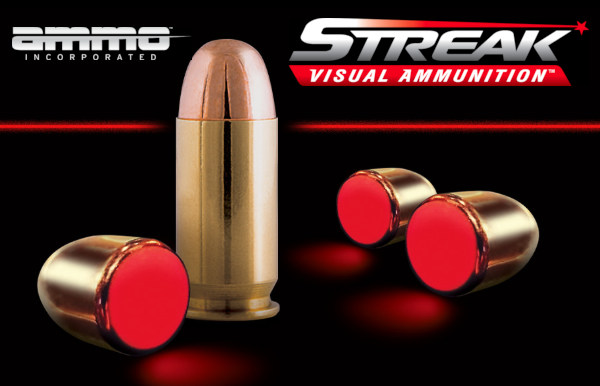
Ammo Inc.’s STREAK Ammo — Tracers without Heat
Ammo Inc. produces a unique type of STREAK ammo that delivers a tracer-like light trail when fired. Through patented technology, a photo-luminescent coating is applied to the base of the bullet. This is “activated” on firing, allowing the shooter to see the projectile’s path toward its target. STREAK rounds are NON-incendiary. They do not generate heat so they are safe to use in environments where tracers are prohibited or could be a fire hazard. Ammo Inc. says these STREAK bullets are “game-changing” for indoor range use and low-light shooting.
Olin Corporation announced that, effective 10/1/2020, its ammunition division, Olin Winchester LLC (“Winchester”), assumed full management and operational control of the Lake City Army Ammunition Plant in Independence, Missouri. The U.S. Army selected Winchester to operate and manage the Lake City plant in September 2019. The contract has an initial term of seven years and may be extended by the U.S. Army for up to three additional years. Winchester is now the world’s largest small arms ammunition manufacturer.
Winchester President Brett Flaugher stated: “We were selected to manage the Lake City plant because of our industry-leading capabilities and track record. For decades, we have successfully demonstrated those capabilities in quality, innovation and on-time delivery as well as through our partnership with the U.S. Army in developing solutions that service the U.S. Warfighter. Our team is fully prepared and 100% committed to the safe, reliable and efficient operation of the Lake City plant.”
Currently in its 154th year of operation and 90th year as part of Olin, Winchester has been providing ammunition to the U.S. military since World War I.
About Lake City Ammunition Plant
Lake City Army Ammunition Plant (LCAAP) is a 3,935-acre government-owned, contractor-operated facility in Independence, Missouri that was established by Remington Arms in 1941 to manufacture and test small caliber ammunition for the U.S. Army. The Lake City Plant has remained in continuous operation except for one 5-year period following World War II. The plant also serves as a national test center for ammunition performance and weapons firing.
Remington Arms operated the plant from its inception until 1985. Then Winchester took over the facility from 1985-2000. Prior to its acquisition by Northrup Grumman in 2018, Orbital-ATK ran the plant since late 2000, initially as Alliant Techsystems (ATK). In 2019, Olin Winchester, LLC, was selected by the U.S. Army to operate and manage the Lake City Army Ammunition Plant for the next seven years. Winchester took full operational control of the Lake City plant on October 1, 2020.
Considered the biggest PRS-type rifle match in the world, the 2020 GAP Grind/Bushnell Pro/Am kicks off today. The big GAP Grind runs for three days, October 2-4, at the K&M Shooting Complex in Finger, Tennessee. In association with the Precision Rifle Series (PRS), the format will again be a professional-amateur, individual and team match to promote sportsmanship and welcome new shooters to the competition scene. Competitors ranging from top professionals to those seeking their first taste of the sport are invited to attend.
The GAP Grind is held at the impressive K&M Shooting Complex in Tennessee:
Lots of Action, with 20+ Stages
The GAP Grind is a challenging, “high tempo” match with minimal down-time between stages. Over the course of 20+ stages, competitors will fire 200+ shots at a variety of steel, paper, moving, and reactive targets out to 1,200 yards. Targets vary in size/difficulty based on the shooter’s position, distance, and time allotted. Most stages include “stressors” — i.e. time limits or required movement(s).
Ramia Whitecotton Facebook photo.
The GAP Grind typically attracts over 300 competitors — half experienced shooters and the other half newcomers to the sport. The key to growing the shooting sports is attracting new shooters. The best way to bring in “new blood” seems to be the Pro-Am type format. At the GAP Grind, experienced shooters share their knowledge and guide the new shooters through the competition.
Bushnell Side Match on October 2, 2020
On Friday, October 2, Bushnell will sponsor a side match featuring the RXS-250, a new red dot optic. This is an impressive impact-resistant design, with 10 user-adjustable brightness and True Tone coatings for a sharp, distortion free image. Bushnell will provide prizes to competitors — a lucky amateur will receive a new Bushnell Elite Tactical optic. Plus range officers will receive product prizes to thank them for dedicating time to the event.
True Velocity is a Texas-based ammo-maker with 145 issued patents on its products and technologies. More than 1 million rounds of True Velocity composite-cased cartridges will be delivered through 2020-2021 to the U.S. Army. This revolutionary new ammo will be tested by the U.S. Army’s Next Generation Squad Weapons program. The advantage of the composite cases, which employ various polymers, is primarily weight savings. True Velocity-made ammo is 30% lighter than conventional ammunition. That means that a typical soldier’s load-out can be reduced by many POUNDS with this innovative ammo. And the military can transport much more ammo with existing vehicles and aircraft.
The company claims: “True Velocity’s precision engineering and manufacturing capabilities allow for substantial improvements in consistency over brass. Our proprietary technology and manufacturing process, combined with progressive process and quality control standards … yields a cartridge of unparalleled performance.” In addition, True Velocity can produce ammo in smaller facilities than a typical large ammo plant. The company states: “The company’s manufacturing capabilities can power customizable and highly-portable ‘cells’, allowing for decentralized and automated ammunition production.”
True Velocity’s modern composite cases withstand temperature changes very well and can function well even in sub-zero environments (however you still may have issues with the powder inside at super-low temps). In addition, the composite cases are 100% recyclable. This can make a difference for shooting ranges and training facilities. One question we have, however, is long-term durability. Brass cartridges can remain strong and functional for decades. Some plastics degrade in just a few years. It will be interesting to see how the True Velocity composite cases hold up over time.
True Velocity is an advanced technology and composite manufacturing company based in Garland, Texas. Founded in 2010, True Velocity has more than 250 patents pending or issued on its products, technology, and manufacturing processes. True Velocity products are manufactured in the U.S. in a state-of-the-art, 66,000-square-foot facility and are currently available to public agencies, with consumer products available soon. For more information, visit TVammo.com.
Looking for a match-worthy PRS/NRL rig for under $1750.00? Check out Savage’s new Elite Precision Model 110. GunsAmerica Digest recently did a very thorough test of the 110 Elite Precision, declaring that this modern Savage is “Competition-Ready Out of the Box.”
The 110 Elite Precision has many notable features:
1. Modular Driven Technologies (MDT) Adjustable Core Competition (ACC) Chassis
2. Trigger adjusts from 1.5-4.0 pounds
3. Barrel comes with timed muzzle brake from factory
4. MDT Stocks easily accepts Weights and Accessories
5. Takes AICS-compatible Magazines
6. Titanium Nitride coated bolt body
This rifle boasts an excellent MDT ACC modular chassis. GunsAmerica stated: “Combined with the excellent trigger, an AR-compatible vertical grip, flared magazine well, and AICS mag system (along with a host of additional features), the 110 Elite Precision comes with everything you need [for PRS/NRL matches].” The stock has ARCA rails on the fore-end and M-LOK mounting points for accessories and/or weights. You can add an additional 9 pounds of steel to customize the balance/mass of the rifle to improve stability and minimize recoil.
The Cheekpiece and Buttpad are adjustable, along with Length of Pull (LOP).
Another reviewer noted that the 110 Elite Precision has important accurizing tweaks from the factory: “Key upgrades include a blueprinted action … Savage squared the receiver face and cleaned up the receiver threads to ensure they’re concentric with the barrel’s bore. This combination goes a long way in eliminating the occasional flyer that can ruin a good group or cause a miss in a match.” Source: GunsandAmmo.com.
Decent Accuracy with Factory Ammo
What kind of accuracy can you expect? Decent for a factory barrel and factory ammo. With Hornady 6.5 Creedmoor ammo, shooting off a sled, the test rifle delivered 1.1-MOA average groups. We would expect considerably better accuracy using a proper front rest with a bag-rider fitted to the fore-end. Likewise, the gun would almost certainly shoot better with handloads with Lapua brass and Berger bullets. Handling was good: “The Elite Precision is about as shootable as it gets. The 12.6-pound rifle produces very little recoil with the 6.5 Creedmoor cartridge, and … the ACC chassis can be weighted to control recoil even further.”
Actual owners have been impressed with the 110 Elite Precision. One buyer posted: “You couldn’t build a complete PRS rifle that is this good of a platform for even close to the price!” GunsAmerica tester Jordan Michaels concurred that this rig is a great choice for PRS/NRL factory-class: “If you’re in the market for a rifle to compete in a long-range competition, the Savage 110 Elite Precision is an excellent choice.”







 Olin Corporation announced that, effective 10/1/2020, its ammunition division, Olin Winchester LLC (“Winchester”), assumed full management and operational control of the Lake City Army Ammunition Plant in Independence, Missouri. The U.S. Army selected Winchester to operate and manage the Lake City plant in September 2019. The contract has an initial term of seven years and may be extended by the U.S. Army for up to three additional years. Winchester is now the world’s largest small arms ammunition manufacturer.


