Savage Introduces 10/110 Stealth Evolution in Six Popular Chamberings
Savage has just introduced the new 10/110 Stealth Evolution Chassis Rifle in six chamberings, including the PRS-pleasing 6mm Creedmoor and 6.5 Creedmoor. This rifle will be offered in right-hand and left-hand models. Big Boomer fans can order a .300 Winchester Magnum or the .338 Lapua Magnum.
The 10/110 Stealth Evolution pairs a heavy fluted 5R barrel with a monolithic aluminum chassis finished in bronze Cerakote. The hard polymer-ceramic coating resists abrasion, corrosion, and impact damage. The rifle features a factory-blueprinted 10/110 action, matched with user-adjustable AccuTrigger. The Stealth Evolution comes standard with an extra-long top rail and factory muzzle brake. MSRP for standard calibers is $1799.00 (.300 Win Mag $1999.00 MSRP; .338 Lapua Magnum $2149.00 MSRP).
AccurateShooter Comment: We like the availability of the 6mm Creedmoor chambering, which is finding favor among many PRS shooters. The 6mm CM has less recoil and a flatter trajectory — plus 6mm bullets are cheaper. Savage did the 6mm version right. At 26″, the barrel is long enough, and the 1:7.5″ twist can stabilize the new 110gr SMKs. That Magpul PRS GEN3 stock looks good — controls are tucked away and the toe can be used with a sand-bag. Some other tactical stocks have rails and/or other “pointy bits” that snag on a rear bag. In .223 Rem or 6mm Creedmoor, this rifle would be a good choice for Prairie Dog safaris. We do wish Savage offered a front sled for bag use though.
Here Todd Jarrett nails three steel targets and a pop-up orange clay bird. Watch full video below.
If you are a fan of 3-Gun competition, tune in to Shooting USA this week. The latest episode, which airs Tuesday October 3 and Wednesday October 4, features the 2017 USPSA Multi-Gun Nationals in Boulder City, Nevada. You can see many of the nation’s top 3-Gun shooters attacking some very challenging stages with pistols, rifles, and shotguns. CLICK HERE for TV Schedule.
Multi-gun competition has evolved considerably since it started 30 years ago. The firearms are more sophisticated, the optics are better, and the stage times are much faster. Still, the challenge remains the same: How fast can you shoot multiple targets, with the score determined by speed and accuracy? For the best in the sport, the answer is very fast indeed, but Match Director Pete Rinsing has a few tricks up his sleeve to challenge competitors on never-before-seen courses of fire at the USPSA Multi-Gun Nationals held in April 2017.
Todd Jarrett highlights from 2017 USPSA Multi-Gun Nationals. Check out 300-yard prone rifle at 00:30, and blazing rifle-pistol-shotgun transitions at 00:50:
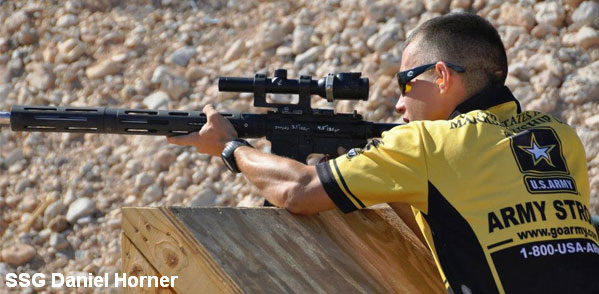
Most people compete in the Tactical Division, including 8-time Champion, SFC Daniel Horner of the U.S. Army Marksmanship Unit. Competitors in that division are not allowed a bipod, so many competitors utilize structures on the stage to stabilize their long gun. Regardless of division, the USPSA Multi-Gun Nationals is a true test of manipulating three different weapons, under pressure, on run-and-gun courses of fire. And the pressure is definitely on when a National Championship is on the line.
The 2017 Fort Benning Multi-Gun Challenge will be held November 16-19, 2017. This year there will be at least 12 stages, plus more than 40 guns on the prize table!
Rifle, pistol, shotgun. More guns = more fun. If you are curious about multi-gun matches, check out this video from Shooting USA. This episode covers the 3-Gun Match at Fort Benning, Georgia. This one-of-a-kind match is the only multi-gun competition where civilians can run-and-gun on an active U.S. Army installation. What’s more, at this match competitors get to ride in a Stryker armored vehicle and shoot Army weapons such as the M249 SAW and M203 Grenade launcher. The lure of playing with military hardware, along with the quality of the stages, makes this a hugely popular 3-Gun event which quickly sells out every year.
Interested in 3-Gun Shooting? Here’s an in-depth report on the Fort Benning Multi-Gun Challenge:
Getting Started in 3-Gun Competition
Thinking of getting started in 3-Gun competition? In this NSSF video, Top Shot Finalist Chris Cerino reviews the hardware you’ll need for multi-gun matches. Chris talks about carbine configurations — including barrel, handguard, and optics options. In reviewing shotguns, Chris discusses shotshell caddies and the high-capacity extended tubular magazines now available. Cerino also demonstrates pistol techniques and explains the key features of a belt/holster rig for 3-Gun competition.
SSG Dan Horner of the USAMU, a past winner of the 3-Gun Nation Championship, is one of the country’s best multi-gun competitors. Here Horner offers some tips on 3-Gun hardware, and safety procedures:
Adapting to New Equipment
There’s a lot of hardware in 3-Gun Competition. To succeed you need mastery of ALL the tools: “New competitors should know how to operate all their equipment. They should spend time getting familiar with their equipment. I spend exponentially more time ensuring the gear is right than I do shooting.”
Safety in 3-Gun Competition
Everyone practicing with shotguns, rifles and pistols must keep safety as top priority. “Obviously, safety is the No. 1 priority, but after that, the focus should be on developing specific skills,” noted Horner. A good three-gunner must not only be fast, but he or she must also be accurate and be able to adapt to a wide variety of shooting positions. And strategy is involved too. Successful 3-gunners develop a ‘plan of attack’ for each stage.
Check out that bolt assembly. It features a fluted stainless bolt body, laser-engraved Titanium shroud, and Titanium dragon-scale bolt knob with polished stainless handle.
You haven’t seen a Ruger Precision Rifle (RPR) like this before. Forum member TerryH has customized his Second-Gen 6.5 Creedmoor RPR with a wicked purple finish, snazzy stainless/titanium bolt, and slick HDPE (polymer) bag-riders front and rear. The mods on this Hot Rod Ruger don’t stop there. Terry added a Seekins hand rail, Timney trigger, ergonomic grip, and more…
For his Hot Rod Ruger, Terry has the right skill set, learned on the job: “I work in a body shop and have pretty much custom-painted all my stuff for many years. For this 6.5 CM RPR, colors of choice are House of Kolor PBC-65 Passion Purple and black covered with Cerakote MC-161 matte clear.” Terry even painted his Bald Eagle rest purple to match his Hot Rod RPR.
Terry reports: “I’m shooting an RPR in 6.5 CM. It has a Patriot Valley Arms 26″ barrel. Josh at PVA is making a thread protector for me so I can remove the Mad Scientist brake. The butt stock has a V-Tab adjustable butt plate and Wiebad check rest pad. Glass is a currently a Vortex Gen I PST 6-24x50mm but I have a Golden Eagle on layaway”. To learn more about this rifle or ask TerryH questions about the build, visit this Shooters’ FORUM THREAD.
Ruger Precision Rifle Modifications: Chassis and Hanguards Painted Passion Purple
Patriot Valley Arms 26″ Barrel with Brake
Timney Trigger with Ambi Safety
Custom HDPE (Polymer) Bag-Riders front and Rear
V-Tab adjustable butt plate and Wiebad cheek-pad
Seekins Rail
Good Accuracy with Factory Ammunition
Terry reports: “The RPR is shooting .3 MOA @ 100 with factory Fed American Eagle 140s.” Terry plans to start handloading for the rifle with the goal of shooting F-Class matches next year: “I’ve successfully shot steel out to 1140 yards on the range but [I don’t know] if that will actually translate well in a match. I’m committed to practicing as much as I can and starting to shoot some matches in 2018.”
Front and Rear Bag-Riders with Protektor Rear Bag and Upgraded Bald Eagle Rest
Terry has engineered a slick set-up for F-Open competition and load testing. Up front is a Bald Eagle rest upgraded with windage knob mod, stainless F-Class feet, and longer adjusters. Terry also “changed the hardware to all stainless and added a couple of levels”. In the rear, Terry runs a Protektor Doctor rear bag with 1″ ear spacing.
The really impressive additions are custom HDPE bag-riders Terry crafted himself: “I realized that the butt stock wasn’t going to cut it on the rear bag and even though I got the 2 1/4″ front bag and the Seekins rail is 2″ wide and flat that it wasn’t as stable or smooth as I’d like.” So Terry made his own front and rear bag-riders from HDPE, a material similar to Delrin. Currently the front unit is 2.25″ wide, but Terry will be changing that to a 3″-wide front sled: “I decided that I’d get a 3″-wide front bag and mill a new front bag-rider. I’m going to recess the center to fit around the hand guard and I’ll mill a recess on the bottom of that one.”
Shown below is the Hot Rod Ruger before Terry added the HPDE Bag-Riders front and rear. Terry says the rifle now handles much better with the bag riders, and he plans to upsize the front sled to 3″ width.
Bling’s the Thing. Below is the Hot Rod Ruger’s bolt assembly. It features a custom flat-fluted bolt shaft, laser-engraved Titanium shroud and Titanium dragon-scale knob with polished stainless handle. Terry confesses: “I simply can’t resist anything shiny!”
Proper eye protection is ‘must-have’ gear for shooting sports. In addition to providing reliable impact protection, good shooting glasses should be comfortable, fog-free, and not interfere with your preferred hearing protection. Those who require corrective lenses also need to consider the various options available. In a past episode of their Weekly Gear Review, the 6.5 Guys discuss a variety of shooting glasses they have tried, including examples from DeCot, Oakley, and Wiley-X. Ed and Steve outline the key considerations when choosing eye protection, and then review practical aspects of eyewear design and construction that enhance comfort and functionality in the field.
The 6.5 Guys (Ed and Steve) offer a number of smart tips consider safety eyewear, helping you select the most effective safety glasses at an affordable price. Here are the 6.5 Guys’ KEY Take-aways when choosing shooting glasses, including prescription eyewear:
Key Things To Consider When Choosing Eye Protection
1. Avoid polarized lenses or lenses that reduce light transmission significantly (except for action shooting in very bright conditions with large, close targets).
2. Avoid frame designs that interfere with prone shooting.
3. Avoid designs that easily fog.
4. Avoid frame designs with thicker temples that are uncomfortable to wear underneath hearing protection.
5. Select lenses with an appropriate degree of ballistic protection. CLICK HERE to learn more about eyewear safety standards.
6. When you get your prescription, be sure your ophthalmologist includes the interpupillary distance. This is a critical measurement particularly for heavier prescriptions.
7. If you have a complicated prescription select a vendor who will actually spend time with you to address any concerns.
Safety First — Your Eyes Are Irreplaceable Accurate shooting begins and ends with the human eye. Your career as a marksman could be cut short if you don’t use good eye protection every time you go to the range and/or handle a firearm.
Every year, 1,000,000 people suffer serious eye injuries. Shooting is hazardous; it is estimated that there are 30,000 firearms-related eye injuries each year (if you include paintball sports.) After paintball, general hunting accidents comprise most firearms-related eye injuries.
Quality eye protection need not be expensive. You can find comfortable, ANSI Z87.1-certified shooting glasses for under $10.00.
If you select shooting glasses carefully, and ensure that your eyewear is safety-certified, inexpensive shooting glasses can perform very well. But you need to avoid cheap, soft-plastic lenses that claim “impact resistance” without satisfying a testing standard.
We’ve seen new shooting disciplines emerge in recent years (3-Gun, PRS, ELR to name a few) and now we’re seeing another trend — shooting matches that combine action shooting with precision Long Range competition. The latest and greatest example of that is the Nosler King of the Range event slated for late October in Oregon. 3-Gun, Long Range, and a combined match title will all be up for grabs in this two-day, combo event. Competitors can shoot either the 3-Gun or Long Range match, or shoot both, going after the title of “King of the Range”.
It is unusual for a 3-Gun action match to be combined with a long-range competition, because few venuea offer the right combination of terrain and facilities for both disciplines. Mason Payer, Nosler Marketing Manager says: “The size and varied terrain of the COSSA park facility [near Bend, OR] presents the opportunity to combine both 3-Gun and Long Range, making this a truly multi-discipline match that will be fun for and challenging for everyone.”
The Nosler King of the Range, presented by MGM Targets and COSSA, will be a combined-match format, spread over two days of competition. Day One will feature 5 or 6 stages of 3-Gun, while Day Two will be comprised of 5-6 stages of Long Range, for both Bolt Guns and Gas Guns.
Nosler King of the Range Course of Fire:
Day 1: Match consists of 5-6 stages of 3-Gun that run anywhere from 30 to 160 seconds.
Day 2: Long Range 5-Stage Match with Bolt Guns out to 1000 yards and Gas Guns out to 800 yards.
NOTE: Separate rifles can be used for the 3-Gun half and the Long Range half.
The Nosler Cup 3GN Long Range Match will be comprised of approximately 10 stages of challenging precision shooting. This will be a standard 3-Gun match running concurrent with the long range match. Ten stages with 6-8 rifle targets per stage, and 4-10 pistol targets on most stages.
The Nosler Cup 3-Gun Match, hosted by COSSA, will be a one-day competition, featuring 5-6 stages of running and gunning. Shooters will have the opportunity to shoot on Saturday OR Sunday (either day).
GAP Grind PRS Competition and Vintage Sniper Rifle at Talladega — that’s what you get in a double-feature episode of Shooting USA TV, now available on YouTube. This is a killer episode, with great coverage of two rapidly-growing shooting sports. The GAP Grind is the biggest PRS tactical match of the year, while Vintage Sniper Rifle matches have proven popular with competitors of all ages, from 18 to 80. Learn all about these shooting disciplines in this 48-minute Shooting USA production. Photos, unless otherwise indicated, come from Ramia Whitecotton’s GAP GRIND 2016 photo album
PRS Competition — the GAP Grind
This Shooting USA episode features the Bushnell GAP Grind Pro-Am, a tough tactical/practical match in Tennessee with 300 competitors. Conducted in association with the Precision Rifle Series (PRS), the GAP Grind features a Pro/Am format — new shooters partner with an experienced shooters for the two-day, 25-stage event. This year John Scoutten teamed up with novice shooter Jen Hodson.
Yes this video includes the GAP Grind PRS match. Click the arrow and it should begin with the PRS segment, 28 minutes into the episode:
One stage required the use of “human support” by one’s team-mate. Here Shooting USA’s John Scoutten provides a strong shoulder for female competitor Jen Hodson.
Lots of Action, with 20+ Stages
The GAP Grind is a notoriously challenging, “high tempo” match with minimal down-time between stages. Over the course of 20+ stages, competitors will fire 200+ shots at a variety of steel, paper, moving, and reactive targets out to 1,200 yards. Targets vary in size/difficulty based on the shooter’s position, distance, and time allotted. Most stages include “stressors” — i.e. time limits or required movement(s).
On the first day of the Bushnell GAP Grind, teams are scored together. On the second day team members still work together but scores are logged individually. This is a difficult event with awkward positions, barriers, and other challenges. Targets vary in size, shape, and distance. One of the toughest targets is the 500-Yard Mover. And the shooting platform (below) offered a double-decker challenge…
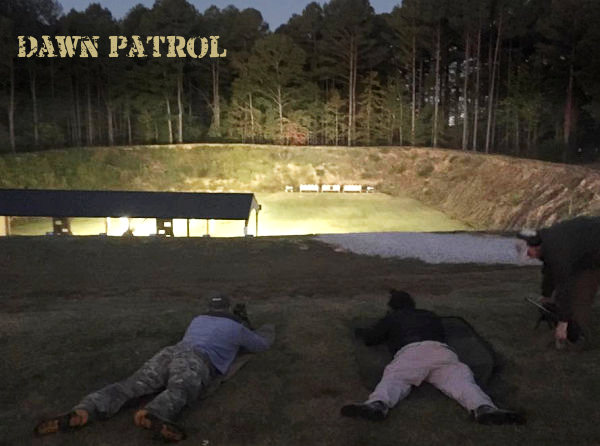
Here’s a “Dawn Patrol” shot from Bryan Sikes. He mastered this stage: “6:00 am cold bore — nailed it!”
Vintage Sniper Rifle Competition at Talladega
In this episode, Shooting USA features the Vintage Sniper Match at the CMP’s Talladega Marksmanship Park. This is a popular two-man team event, for shooter and spotter, using military rifles in service up to 1953. One added challenge is the time limit. The team has only 20 seconds to complete each shot — That’s 20 seconds for the spotter to read the conditions, and for the shooter to pull the trigger.
File photo from Vintage Sniper match at Camp Perry. At Talladega, there are video target monitors at each shooting station.
Guns of Grandfathers…
In this episode two USAMU marksmen, SGTs Daniel Crody and Robert Shoup, compete with an Springfield M 1903 A4 reproduction topped with a vintage optic. “For me it holds a little bit of sentimental value,” says SGT Crody. “I did have two grandfathers in World War II. It is definitely a pleasure holding a piece of history… and to be able to see and feel what these guys had as far as tools to operate with.”
“It’s a match that brings a different type of competitor out. It brings a nostalgic competitor out. You’ll see World War II time-period rifles, sniper-type rifles that were used during World War II, Korean War era,” says the CMP’s Chief Executive Officer, Mark Johnson. “The optics are either original optics or current reproduction of old optics.”
How’d you like to score a check for $25,000? That’s the winner’s pay-out for the 2017 NRA World Shooting Championship (WSC), which runs September 14-16 at the Peacemaker National Training Center in Glengary, WV. This event offers over $250,000 in cash awards and product prizes, making the WSC the richest combined shooting event in the USA (if not the world).
WSC Highlight Video with Competitor Interviews:
You can still Register for the WSC — though remaining spots are filling up fast. It ain’t cheap — Pros pay $395 while amateurs and juniors pay $325. Keep in mind though that all guns and AMMO are supplied. This unique 3-day multi-gun match tests competitors’ skills across twelve challenging stages involving nearly every major shooting discipline for rifles, shotguns, and pistols. REGISTER HERE.
All the Equipment is Supplied
“What makes this event very unique, especially to a professional shooter, is all the equipment is supplied. You have to leave your ego at home and just try to adapt as best you can to the equipment that you have supplied.” — Jerry Miculek
This major match attracts both sponsored Pros and “regular Joes”. For 2017, shooters will be split into two groups: a Professional Division for sponsored shooters, and the Amateur Division for non-sponsored competitors. All firearms, optics, and ammo will be provided by match sponsors for both divisions. “This year the NRA is going back to basics and returning the match to the original format of two divisions for professionals and amateurs, putting everyone on an even playing field”, said Cole McCulloch, NRA Competitive Shooting Director.
Video Shows 2014 World Shooting Champion SFC Daniel Horner in 3-Gun Stage
Cash Awards, Huge Prize Table, and New Random Drawings
The NRA World Shooting Championship will offer $250,000 in cash and prizes. Along with the $25,000 winner’s pay-out, there will be fat cash prizes for second and third place overall, High Lady, and High Amateur Junior. Then there are the prize tables — a real treasure trove. The designated Amateur prize table by itself will offer products and certificates topping $100,000 in value.
NEW Random Drawings — The WSC has added a new type of prize for 2017. Ten (10) Random Draw Prize Winners of $400 will be chosen during the WSC Awards Banquet. These random drawings give every competitor a chance to win cash, no matter what their event ranking.
Match entry fees are $395 for Professionals, $325 for Amateurs and Juniors. All firearms and ammunition are provided, and entry fees include one awards banquet ticket. For more information, visit WSC.NRA.org, call the WSC Coordinator at 703-267-1479, or email NRAhighpower@nrahq.org. On the official WSC.NRA.org you’ll find descriptions fo the 12 WSC stages. In addition, there is information about Peacemaker National Training Center and nearby lodging options.
How to Win the World Shooting Championship
“The format at the NRA World Shooting Championship is unique in that you don’t know what you have to shoot until you show up, so training for the event is a little difficult. My advice is to pack some good eye and ear protection, bring an open mind, be prepared to listen to the stage descriptions, figure out the best way you can take the guns they provide, and post the best score you can. When the match supplies all the guns and ammo, all you have to do is deal with ‘the performance’. This is the most level playing field in the shooting sports — anyone from around the world can come and play.” — Bruce Piatt, 2015 NRA World Shooting Champion
Competitors can register in one of two divisions: professional and amateur. The pro division is reserved for shooters who possess sponsorships, receive financial support for their competitive shooting or those who have been part of specialized firearms teams. All other shooters register in the amateur division. The playing field is completely level — every competitor uses the same guns, optics and ammunition. No competitors are allowed to bring their own gear, so everyone starts the match on equal footing.
If you like accurate rifles and reactive targets, you’ll enjoy this episode of Shooting USA TV, which features long-range varmint silhouette competition in Texas, the Lone Star State. We have participated in these kind of matches on the West Coast — they are definitely a ton of fun. The sport combines the pure accuracy of benchrest competition with the fun of knocking down critter targets. These are smaller than standard silhouettes, so it’s quite a challenge to hit them at 300 yards and beyond. In this episode, host John Scoutten competes with his 6.5 Creedmoor PRS rifle. He found that 1-MOA Coyotes offered plenty of challenge at 385 meters! Most shooters use benchrest-grade rifles with premium front rests.
EDITOR: We strongly recommend you take the time to watch this Shooting USA feature — it shows some top-flight benchrest rifles, and also covers the origins of benchrest varmint silhouette in Pennsylvania. There are even some AccurateShooter Forum members on screen. John Scoutten also does nice job explaining the challenges of shooting this discipline with a PRS rig. We think any benchrest or tactical shooter will really enjoy watching this video.
Full 48-Minute Episode of Shooting USA featuring TX Varmint Silhouette:
Travis Frazier of Field & Cave Outfitters says shooters love the reactive targets: “The most exciting thing is seeing your hits — these [targets] really go airborne”. Yep, that’s the best thing about Varmint Silhouette matches — hits deliver instant gratification. Travis designs and produces these steel targets.
This Texas match features multiple target shapes, 10 at each distance: Tiny Prairie Dogs at 200m, 3″x3″ Armadillos at 300m; 3″x5″ Coyotes at 385m; 5″x4″ Hogs at 500m; Chickens (on swingers) at 600 yards; and Pigs (on Swingers) at 750 yards. Competitors are allowed 10 rounds and 10 minutes to hit each set of targets.
BONUS Features in this Shooting USA Episode
Rimfire Challenge World Championship
This episode also includes the Rimfire Challenge World Championship in Alabama (starting at 33:25). This event attracts hundreds of shooters who ring steel with .22 LR rifles and pistols. This may be the ultimate fun match for the whole family. Many of the top shooters are juniors, who can run the all-steel stages in three seconds. The 16 stages each have 5 to 8 steel targets that can be shot in any order, but the last round must go on the red-marked “Stop Plate”.
History of the Gun: Remington 700
This week’s gun history segment of Shooting USA features the Remington 700, one of the most successful bolt-action rifles ever, with over 5 million produced. The Rem 700 has served hunters, military marksmen, and Rem 700 actions have been used for countless competition rifles.
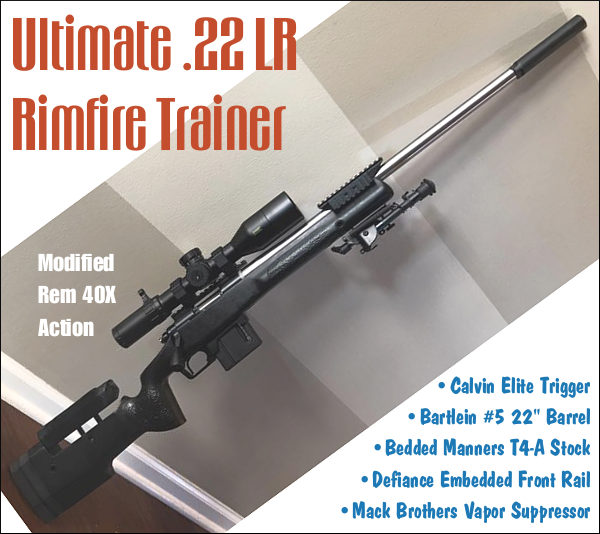
Brian, a gunsmith at GA Precision, built this rimfire rig with GAP colleague Anthony Soukup.
On his Facebook page, Tactical competitor Bryan Sikes posted a photo of a rimfire rig we really liked. Brian works at GA Precision. He and fellow GAP gunsmith Anthony Soukup built this rifle. With a modified Rem 40X action, Manners stock, Bartlein barrel, and Mack Brothers suppressor, this rig has top-quality components stem to stern. And Bryan tells us this rifle performs as good as it looks: “This is the baddest little .22 LR trainer ever. I’m stoked about it. With the barrel length and can, it’s the exact length of my regular comp rigs.” With length, balance, and ergonomics near identical to Bryan’s centerfire competition rifles, this 40X is a superb training tool.
Many readers wanted to know about the bottom metal and the detachable box magazine. Bryan Sike reveals: “The magazine setup is designed specifically to replicate my actual competition rifles. The bottom metal is for use with AI magazines and uses a standard M5 type inlet just like any centerfire completion rifle. In this case with the .22LR, Mike Bush designed a high reliability rimfire magazine using the same outside dimensions as an AI magazine. This rifle was built no different from any other. The action was modified and trued, barreled, fully bedded, etc. using ALL components common to centerfire match rifles.” The Rem 40X action was modified by Modacam Custom Rifles to work as a repeater with box mags.
Bryan adds that a new rimfire action is in the works: “My preference is modified Remington 40X actions and the soon-to-be available, V-22 action from Mike Bush. Both of which are TRUE repeaters and don’t feed from a Savage magazine. This rifle feels nothing like a .22 LR and that was the whole point.”
Why You Need a .22 LR Tactical Cross-Trainer
Many guys who shoot long-range tactical matches practice with .22 LR rifles of similar configuration. Rimfire ammo is way more affordable than centerfire, you do not need a big range facility, and shooting rimfire saves wear and tear on your centerfire rifle. Further, for learning how to read the wind, there really is no better training tool than a .22 LR, even as close as 50 yards.
Our Friend “DesertFrog”, who shoots tactical matches in Southern California, explains: “I used to shoot an average of 200 rounds of .308 Match ammo a month for training (50 per weekend). These days I shoot maybe an average of 50 rounds of .308 Win per month and probably around 600 rounds of .22 LR. Using mainly the .22 LR for practice did NOT hurt my standings in actual competitions. I shot my .308 just as well in matches, but saved the cost of hundreds of rounds of .308. If I didn’t reload and was still buying boxes of Federal Gold Medal Match .308 Win [at $1.00/round], this would be a savings of [$150 per month on the centerfire ammo.]” Money saved is money earned.
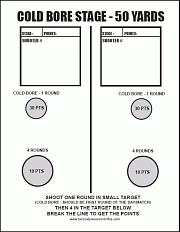
Targets for Rimfire Cross-Training
SPECIAL BONUS–Rimfire Tactical Precision Targets
These FREE targets by DesertFrog are offered in Adobe Acrobat format for easy printing. CLICK HERE to download all six targets as a .ZIP archive.




 Accurate shooting begins and ends with the human eye. Your career as a marksman could be cut short if you don’t use good eye protection every time you go to the range and/or handle a firearm.




 Guns of Grandfathers…



 .
.