American Outdoor Brands Corporation (AOBC) announced that its firearms business, Smith & Wesson Corp., has agreed to acquire the assets of Gemini Technologies, Inc. (“Gemtech”), a leading provider of suppressors and accessories for the consumer, law enforcement, and military markets.
Smith & Wesson intends to complete the acquisition of Gemtech utilizing cash on hand and expects the transaction to close this summer. Ron Martinez, President of Gemtech, will continue in his leadership role as General Manager, heading up the company’s strong team located in Eagle, Idaho. For more information, visit Smith-Wesson.com and Gemtech.com.
James Debney, AOBC President/CEO, said, “Gemtech is widely recognized for producing some of the finest rifle and pistol suppressors in the market. Gemtech’s strong product development capabilities, combined with our experience in brand management and our manufacturing expertise, will help us to efficiently develop both firearms and suppressors, minimizing our time to market for both product categories. We view this acquisition as opportunistic, allowing us to enter the suppressor category[.] These elements combine to make Gemtech an excellent fit with our long-term strategy.”
About Gemini Technologies, Incorporated
Gemini Technologies, known as Gemtech, began as a group of leading designers with roots in the suppressor business going back to 1976. Gemtech’s suppressors are in use with all branches of the U.S. military and are also in use by many special operations forces, military, and police around the world. Based in Eagle, Idaho, Gemtech is an International Organization for Standardization (ISO) 9001:2008 certified company and maintains effective rigorous quality assurance systems and processes. Visit Gemtech online at https://gemtech.com.
As part of its online Load Data Center, Nosler offers very complete load data for the popular 6.5 Creedmoor cartridge. This medium-sized cartridge has become one of the most popular chamberings for tactical and PRS shooters. The 6.5 Creedmoor combines excellent accuracy, good mag-feeding, good barrel life, moderate recoil, and reasonable component cost. That’s why this cartridge has caught on quickly. GET ALL 6.5 Creedmoor Load Data.
How does barrel length affect 6.5 Creedmoor Muzzle Velocity? CLICK HERE for RifleShooter.com barrel cut-down velocity test.
According to the Sierra Load Manual: “Developed in 2007 by Dennis DeMille and Dave Emary, the 6.5 Creedmoor is a shortened and improved 30 TC cartridge case that was inspired by the .308 Winchester design. This short action design was created to maximize case capacity and a wide range of loading lengths, while still fitting in standard short action magazines. With the correct twist barrel, the versatile 6.5 Creedmoor can take advantage of the wide range of bullet weights available in 6.5 mm (i.e. .264 caliber). Reloaders should keep in mind that the 6.5 Creedmoor works best with medium to medium-slow powders such as H4350, Varget, Win 760, and RE-17.”
Click Image to Load PDF File for Listed Bullet Weights
The Fourth of July is just four days away. Along with flags and fireworks, what better way to celebrate Independence Day than by shooting a Red, White, and Blue rifle? This limited-edition rifle makes a bold statement in support of the Second Amendment. We love it. But you pay a lot for those fancy graphics — this red, white, and blue rig costs $3149.99. Freedom doesn’t come cheap, right?
The Axelson Tactical Tribute Series Centerfire Rifle shows off both your American pride and love of the Second Amendment. This is a Limited Edition of one hundred (100) rifles. Each Tactical Tribute model features a forged 7075-T6 hardcoat-anodized aluminum receiver set with custom Cerakote™ “Stars & Stripes” coating end to end. Even the Magpul Mags are coated with a matching design. This rifle, a Cabela’s exclusive, is on sale this week (as a 4th of July Special) for $3149.99. CLICK HERE to order.
See Features of Freedom Tribute Rifle in this Video:
Along with Independence Day Tribute Rifle shown here, Axelson offers a Lone Star State Texas Tribute rifle as well as a Vietnam Era Tribute Rifle. SEE all Tribute Rifles HERE.
What does a two-time High Power National Champion choose for PRS comps? A set of twins. Twin rifles that is. SFC Brandon Green of the USAMU is one of America’s best marksmen. He’s excelled in Service Rifle and High Power disciplines, and now he’s getting very serious about the Precision Rifle Series (PRS). Brandon recently took delivery of “Twins” — two impressive rifles optimized for PRS competition. Green told us: “The Twins are ready for business! The silver one is a 6XC and the black one is a 6.5×47 Lapua”. Both rifles feature Impact Precision actions (with AICS-type mags), 24″ Proof stainless barrels, and Fat Bastard muzzle brakes. Rifle work was done by Stuteville Precision (Wade Stuteville) and Exodus Rifles (Joe Walls).
In the 6XC, Brandon runs Berger 105gr VLDs in Norma 6XC brass. For the 6.5×47 Lapua he shoots 140gr Berger Hybrids or 143gr Hornady ELD-Xs in Lapua brass. Both rifles have stainless steel Proof barrels, but the 6.5x47L has a matte black Cerakote finish.
Brandon loves his new Twins. He said he likes the “feel” of the guns with the Foundation stocks: “These rifles weigh around 17 pounds with optics. They feel very solid under recoil — without the ‘tuning fork’ vibration you can get with a metal-chassis gun. They feel like a good wood-stocked gun, but the material is stronger and more rigid than wood. I’ve heard that guys are having success with these Foundation stocks with the actions installed without pillars or conventional bedding.” Currently Brandon is running both guns without action-screw pillars. He did have one skim-bedded, but he doesn’t think that was really needed. “Both rifles hammer now”, Brandon tells us.
Green Runs Vortex Razor HD Gen II 4.5-27x56mm FFP scopes on both rifles:
High-Tech Micarta Stock Material
At first glance, those stocks may look like wood, but they are actually a special “Micarta” material that is strong, durable, and stable. Micarta, often used for knife handles, is a “a brand name for composites of fiberglass, carbon fiber, or other fabric in a thermosetting plastic.” The stock-maker, Foundation Stocks, says Micarta offers some distinct advantages over laminated wood or conventional fiberglass: “The solid block of material gives us a dense, homogenous material that is absent of any voids or air pockets commonly found in composite stocks. The high compression strength of the material allows us to build an action/DBM specific stock that requires no bedding or pillars. The material is very durable and stable in extreme environments. We use advanced CAD software to design and model our stocks, working in conjunction with action manufacturers and rifle builders to provide exact fitment.”
Here is a close-up of a Foundation Stock showing the distinctive Micarta texture:
Tactical Competition vs. NRA High Power Competition
Brandon says PRS competition is tough: “PRS can be pretty humbling, but it’s been a lot of fun and a great challenge. For a shooter (like me) with a Service Rifle/High Power background, the variations in stages combined with the time limits can be very challenging. And the unusual shooting positions put a new spin on things. PRS is definitely a different ball game, but I really enjoy it. After the National Championships this summer I hope to shoot three or four PRS matches in September and October.”
SFC Brandon Green honored as the 2015 High Power National Champion.
Life before the Twins… Here is Brandon, with his previous PRS rig, at the MasterPiece Arms Precision Rifle Shootout, a PRS event at the CORE Shooting Solutions Range in Florida:
We’ve been telling folks that the Japanese Howa 1500 barreled actions are an attractive option for a hunting, varminting, or tactical rifle. Priced at under $450.00, these barreled actions include the excellent HACT two-stage trigger. These Howa 1500 actions are smooth-running (noticeably more so than some “major-brand” domestic receivers).
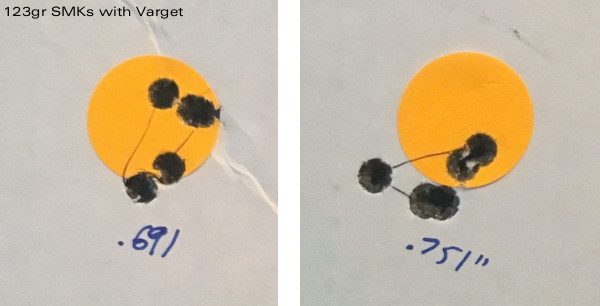
Our friends at RifleShooter.com recently acquired a Howa 1500 barreled action in 6.5 Creedmoor and installed it in an MDT ESS modular chassis. This project turned out well. The barreled action mated well to the ESS chassis, providing an ergonomic platform with comfortable grip, adjustable cheekpiece, and adjustable LOP. Most importantly the gun shot well. With virtually no load development, the project rifle delivered 3/4-MOA accuracy right out of the gate.
As tested with Hornady brass and Hodgdon Varget powder pushing Sierra 123gr MatchKings, the Howa 1500 MDT showed good accuracy right from the start. With more load development (and a few more rounds through the new barrel), half-MOA groups may be possible.
Brownells now sells barreled Howa actions in a variety of configurations. Rifleshooter.com acquired a Howa 1500 barreled action with a 24″ #6 contour barrel chambered in 6.5 Creedmoor. RifleShooter.com plans to test this barreled action in multiple modular chassis systems. That should provide an interesting comparison test, providing the pros and cons of various stock/chassis configurations.
RifleShooter.com’s Editor writes: “I was pleasantly surprised by the number of chassis and stock offerings for the Howa barreled action.” For this project rifle, RifleShooter.com chose the Modular Driven Technologies (MDT) Elite Sniper System (ESS) chassis, for the initial build.
Like MDT’s other chassis systems, the ESS uses any AR-15/M16 M4 pistol grip. The ESS departs from the rest of the MDT product line it does not use a standard AR-15/M16 M4 stock. Eliminating this interface allows for a design that does not increase the length of pull. The stock has an adjustable comb, adjustable length of pull, and horizontally adjustable recoil pad. Comb and LOP adjustments are accomplished with a hand wheel, plus a cap screw and clamp system.
RifleShooter.com’s Howa 6.5 Creedmoor rifle has the following components:
While the HACT 2-stage trigger is very good, RifleShooter.com’s Editor replaced the HACT with a Timney because he favors a single-stage design. The Timney adjusts lower than the HACT, allowing a crisp pull at ~1.5 pounds: “You’ll notice I swapped out the factory trigger in favor of a Timney. I’ve had great luck with their products and Timney’s Howa trigger was no exception. Adjusted to 1.5 pounds, it is a pleasure to shoot with.”
Are you a tactical competitor, or are you considering getting started in the PRS series or other practical shooting competition? Then here are three videos you’ll definitely want to watch. Ed Mobley and Steve Lawrence, aka the 6.5 Guys, interview PRS Director Shawn Wiseman, as well as the founders of the New National Rifle League. In addition, the 6.5 Guys catch up with Frank Galli, founder of Sniper’s Hide. These three interviews cover important developments in the tactical/practical disciplines, such as the new PRS Gas Gun Series.
Precision Rifle Series — Shawn Wiseman
6.5 Guys: We sat down with Shawn Wiseman of the Precision Rifle Series (PRS). We discussed the new divisions (gas gun and tactical) as well as the club series. We got authoritative answers in response to the many questions that have been floating around. Shawn discussed the challenges the PRS has faced with its rapid growth and how these challenges have been addressed.
National Rifle League — Tyler Frehner and Travis Ishida
6.5 Guys: We met with Tyler Frehner and Travis Ishida of the new National Rifle League (NRL). The NRL is 501(c)3 non-profit organization that conducts a series of practical/tactical style matches around the country and promotes a range of outdoors-related public interest activities. The interview covers the formation of the National Rifle League, the goals of the program, and the match schedule for 2017.
Snipers Hide — Frank Galli
6.5 Guys: Frank Galli shared his observations from SHOT Show as well as the future of Sniper’s Hide. Frank has been a terrific mentor and supporter of the 6.5 Guys. Frank talks about important developments for the Sniper’s Hide Forum. In addition, Frank discusses the evolution of the tactical disciplines and precision rifle hardware.
Father’s Day is Sunday, June 18, 2017, four days away. If your father enjoys the shooting sports, here are some recommended items that our staff owns or uses. All selections cost less than $100.00. It’s not too late to order. If you have an Amazon Prime membership, you can get two-day shipping in most areas of the country. For non-Prime members, many items will ship in 3-4 days. That’s enough time to get the gift to “Pops” by next Sunday.
TEN Great Father’s Day Gifts for Dad Under $100.00
This Columbia Bahama II guide shirt is durable and comfortable. More importantly it provides UPF 30 protection from the sun’s damaging rays. The added cape over the shoulder area provides extra protection for shooters in the prone position. This is offered in 17 colors in breathable nylon. This is popular for fishing, sailing, hiking and other outdoors sports.
These Howard Leight Electronic Muffs are Amazon’s #1 Seller in the Safety Ear Muffs category. These offer 22 dB sound protection with the ability to still hear conversations and range commands. For regular use, we do recommend running plugs under these muffs for higher effective NRR.
This is an excellent shooting mat — it is very well made with good padding/insulation. On gravel, concrete, or hard-packed ground this is way more comfortable than typical mats. It is wide enough and easy to fold. Any Dad who shoots would love this.
The Lyman Case Prep Xpress lets you chamfer inside and out, brush your necks, and clean/uniform primer pockets. On sale at Amazon.com for $107.71, this qualifies for a $25.00 REBATE from Lyman, putting net cost at just $82.71. Verified Review: “The unit is quiet, sturdy, and the attachments do what they are supposed to do. I highly recommend this unit.”
We’ve used Bog-Pod shooting supports on varmint hunts. They’re great for down-angle shots from a ridge or kneeling shots to get above terrain obstacles. Bog-Pods adjust from 17″ to 39″.
Walkie-Talkies are “must-have” items for long-range shooting. The 22-CH Motorola MH230R Two-Way Radio is Amazon’s #1 Best Seller in FRS/GMRS Handheld Radios.
Plano’s AirGlide case is a unique, top-loading rifle case. Ideal for benchrest guns with wide forearms, the AirGlide case puts no side-pressure on scopes. We like the ease of loading. This fits rifles up to about 27-28″ barrels.
The versatile MTM Range Box includes cradles so you can do gun maintenance while at the range. A lift-out tray holds small items such as patches and jags. This is a durable product that can hold ammo and other gear.
This cleverly-designed Shotshell thermos will make Dad smile. Styled just like a 12ga shotgun shell, the Stansport thermal bottle holds 25 oz. of hot or cold liquids.
The light-weight, compact RCBS Partner Press is ideal for loading at the range. It can easily be mounted to a bench with C-Clamps.
Wouldn’t it be great if your rifle case could do double-duty as a shooting mat? You’d have one less gear item to haul to the range. Well there is such a product — Uncle Mike’s Long Range Tactical Bag quickly and easily converts to a 78″ shooting mat. Measuring 50″ in length, with a 15″-tall main compartment, this bag is big enough to handle most tactical and F-TR rifles with optics and Harris-type bipods attached. A 30″ flip-out forward section includes a front load strap that allows shooters to pre-load the bipod legs while shooting prone.
The Long Range Shooting bag has four self-adjusting magazine pockets, which will hold magazine sizes from .223/5.56mm to .308/7.62mm. Conveniently, this new 50″-long soft case will fit inside the popular Pelican model 1750 hard case (for those situations where you need greater protection).
Fits Long-Range and Tactical rifles up to 49″ in length
Fold out front section has bi-pod front load strap
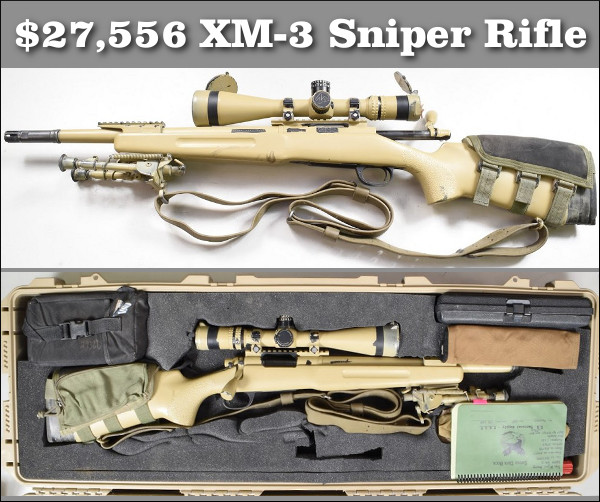
Would you pay over twenty-seven grand for a slightly-used Rem 700 bolt-action rifle and Nightforce scope? Well somebody did just that recently, paying the princely sum of $27,556.00 for a DARPA XM-3 Sniper Rifle system in a CMP Auction. In fairness the buyer did get a case, a PVS22 Night Vision Device (NVD), and some other accessories. Created for the USMC, only fifty-two (52) XM-3s were ever made, so this is a pretty rare rifle. But, honestly, is this thing really worth $27,556? What do you think?
This XM-3 system was recently sold by the CMP at auction (SEE Auction Photos). There was plenty of interest in this item, with 111 total bids for the rifle, case and accesories. Here is the CMP Auction product description:
DEFENSE ADVANCED RESEARCH PROJECT AGENCY (DARPA) XM-3 Sniper Rifle S6533990
These XM-3 sniper rifles used by the United States Marine Corps. In mid-2005, DARPA worked with Lt. Col. Norm Chandler’s Iron Brigade Armory (IBA) to field items to expeditionary units in Afghanistan. Since they already had a great working relationship, DARPA contracted IBA to build and test lightweight sniper rifles that incorporated the improvements the snipers desired in combat. The mission was to be lighter and smaller than the existing M40s, while having better accuracy, clip-on night vision that did not require re-zero, better optics, and better stock, and it had to be suppressed. The barrel had to be short enough to allow maneuverability yet long enough to deliver a 10” group at 1,000 yards. If the barrel was too heavy, maneuverability would decrease, yet if the barrel was too light it would only be able to shoot a few rounds before the groups started to shift due to barrel temperature. IBA tested a number of barrel lengths, ranging from 16 to 20 inches and in different contours. Each rifle with a different length was assigned an XM designator starting with XM1 through XM3. In each case, everything on the prototype rifles was kept the same except the barrel.
During the final phases of testing it was found that the 18” barrels had no issues keeping up with their longer 20” brethren. The final barrel length was set at 18.5”, and the contour was a modified #7. The straight taper on the barrel was only 2” vs. 4” and the overall diameter at the muzzle was .85” vs. .980”. This helped reduce a lot of the rifle’s weight while not negatively affecting accuracy or effective range. A number of the groups at 1,000 yards were < 1 MOA. The Marines of I-MEF were the first to field test the rifles at Camp Pendleton. Shortly after I-MEF took receipt of the XM-3s, the first units in II-MEF took receipt of theirs. By mid-2006 there were dozens of XM-3s in Iraq. There were 52 XM-3s made.
More info on the XM-3 Sniper Rifle can be found at SteveReichertTraining.com.
Also included: Scope SN P06798; Sniper Data Book with some firing information; PVS22 Night Vision Device SN 2936D (NVDs function); appears complete tool/cleaning kit with cleaning rod; sling; suppressor case and wrap (SUPPRESSOR IS NOT INCLUDED!); bipod; cold bore shot target; instructions; iM3200 Storm case.
Are you looking for a .22 LR Rimfire rifle that has the look and feel of a centerfire rig? Then check out the CZ 455 rimfire rifle featuring a black-finished, laminated wood stock. This gun, dubbed the “Varmint Tacticool” by CZ-USA, features a 5-round detachable magazine and adjustable trigger. And recently CZ added a Suppressor-Ready version fitted with a 16.5″ barrel and threaded muzzle.
The original CZ-455 Varmint Tacticool was built as an affordable tactical trainer with the ergonomics and stock profile of a full-size centerfire tactical rig. The Tacticool’s stock looks similar to the Manners Composites stock on CZ’s 455 Varmint Precision Trainer, but the wood-stocked ‘Tacticool’ version is much less expensive. The CZ 455 with Manners stock retails at $940.00 MSRP while the latest suppressor-ready Tacticool model lists for $549.00 MSRP. The $391.00 you save will buy a LOT of ammo (or a scope).
Tacticool Accuracy Demo — Nailing Match-Sticks at 30 Yards — Five for Five
We like the looks of the CZ-455 ‘Tacticool’, and the stock has some nice features. The butt-hook stock has ambidextrous palm swells on the grip and a raised comb to provide a comfortable cheek weld for shooting with a scope. The fore-end features a wide, beavertail swell for greater stability on a front sandbag. There are two (2) sling swivel studs so you can attach both a sling and a bipod.
At $940 MSRP, the CZ 455 Precision Trainer in Manners Stock is much more expensive.