The Ruger Precision Rifle (RPR) has been a hot seller since it was first released. All versions (.243 Win, 6.5 Creedmoor, and .308 Win) have been in high demand, with the 6.5 Creedmoor probably being the hardest to find. The RPR represents a solid value, and it is the logical “default” choice for the new Production Class in the Precision Rifle Series. (NOTE: If you spend around $1400 for the RPR, then add a $950.00 6-24x50mm Viper PST, you’re still well under the $3000.00 Production Class price limit for rifle and optic combined.)
In this video, Gavin Gear of UltimateReloader.com, along with Ed and Steve of 6.5Guys.com, review the Ruger Precision Rifle (RPR) in 6.5 Creedmoor. This particular rifle was fitted with the Vortex Viper PST 6-24x50mm scope. Together, Gavin and the 6.5 Guys give their opinions on the rifle, the 6.5mm chambering, and the Vortex optic. They provide candid evaluations (of rifle and optic) based on field tests with targets from 100 to 1000 yards.
Gavin tells us: “The Ruger Precision Rifle is a great rifle platform. I’ve had some great groups right out of the box, and have had no problems staying on target at ranges of 1000 yards and beyond. To me, the Ruger Precision Rifle is an ‘easy buy’ for the new competitive shooter or practical field shooter. But what about optics? It can be very confusing and overwhelming when shopping for ‘just the right scope’. There are so many great scopes on the market it can be staggering to take in all of the options. We wanted to give you some hands-on impressions of one of the most popular picks for optics for the Ruger Precision Rifle and similar rifles in the ~$1000 price range: the Vortex Viper PST 6-24×50 riflescope.”
Gavin was very pleased with the Vortex Viper PST: “Having used this scope in a variety of scenarios, ranges, and over the course of more than 1/2 of a year, I’m confident with not only the scope itself, but the entire package: Rifle + Scope + Mount (rings).”
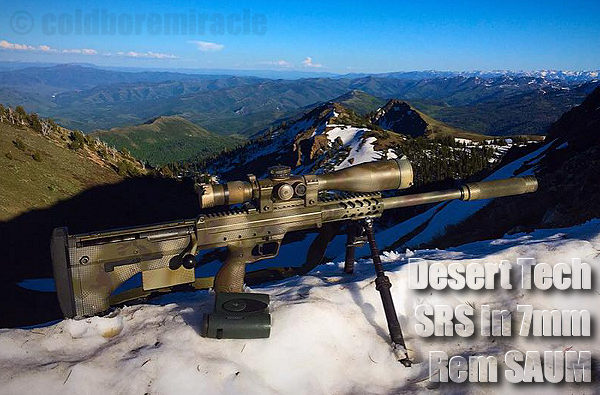
Here is the view from 9500 feet ASL. The SRS in 7mm Rem SAUM almost outran the Swarovski laser…
7mm RSAUM in a bolt-action bullpup? Yes it works. A talented shooter, who calls himself “ColdboreMiracle” in social media, has a Desert Tech SRS bullpup rifle chambered for the 7mm SAUM, and it hammers. The 7mm Remington SAUM (Short Action Ultra Magnum) is popular with F-Open competition shooters. It can also work well for long-range hunting and tactical tasks. Learn more about the 7mm Remington SAUM in our 7mm Cartridge Guide.
ColdboreMiracle explains how he selected the 7mm Rem SAUM chambering for his Desert Tech SRS Bullpup: “I just did a comparison between barrel life, velocity, brass, etc. and came to the SAUM. I can tell you this, if you go with one for your SRS, make sure you use long bullets like the 183 or 195, and seat them long. That will aid in smooth cycling.”
Mr. ColdboreMiracle tested the new generation 183gr Sierra MatchKings (item # 1983). These impressive projectiles are “tipped” at the factory. Claimed G1 BC is a lofty 0.707 (at 2300 fps and above). We have heard other reports that these bullets “hold waterline” exceptionally well at 1000 yards. That indicates the bullet-to-bullet BC is very consistent. No doubt the factory uniforming/pointing of the bullet tips helps in that regard.
As you can see, these 183-grainers shoot well in ColdboreMiracle’s SRS rifle. Here are five shots at 100 yards. That’s very impressive for a tactical-style rifle shot from a field-type bipod.
ColdboreMiracle says: “This is the only reason I need to shoot Sierra bullets. On the right (above) you can see the results of the 183gr SMK from my 7mm SAUM. Five shots at 100. A huge thanks to Mark at Short Action Customs, LLC for [chambering this barrel] for my Desert Tech SRS.”
ColdboreMiracle says the bullpup design has many advantages: “The Stealth Recon Scout (SRS) rifle from Desert Tech is a bullpup-configured precision rifle with a shorter length than many carbines. The SRS has a multitude of barrel options that can be swapped in under a minute — all of them come with a 1/2-MOA accuracy guarantee and return to zero. The SRS’s bullpup design puts the rifle’s COG closer to the shoulder, making the rifle balance better off-hand. The straight-line geometry of the SRS makes recoil seem lighter, and barrel hop is reduced, allowing the shooter to stay on target better. It takes a little getting used to, when converting from a traditionally-configured bolt gun. But once you do, you won’t go back.” To learn more about this rifle (and other Desert Tech arms), visit ColdboreMiracle’s Facebook Page and YouTube Channel.
7mm Remington SAUM — Key Considerations
In some respects, the 7mm SAUM cartridge may be better than the 7mm WSM. The 7mm SAUM holds less powder — but that’s a good thing, since the capacity is more than adequate to do the job. You can drive the 180s at 3000 fps with a SAUM using less powder than with a WSM. Additionally, the SAUM case has a slightly longer neck. This gives you greater flexibility in bullet seating. With a long neck you can set the throat so the long 180+ graing bullets are above the neck shoulder junction, yet you can still seat shorter hunting bullets close to the lands. Additionally, long case necks, some believe, cause less throat erosion than shorter necks. That’s not “hard science” but it is certainly a view shared by many experienced shooters. The long neck is one reason many varminters favor the 6mm Remington over the .243 Winchester.
7mm RSAUM Is More Efficient than 7mm WSM
7mm RSAUM shooter Steven Ikeeda tells us: “I decided that some type of 7mm was the ticket for doing well at 1000-yard matches, especially if one could drive the high-BC bullets at 2900+ fps. Looking over various 7mm cartridges that could produce those velocities (and didn’t require case-forming), I was impressed by the 7mm SAUM and the 7mm WSM. According to the load manuals, the 7mm WSM offered a bit more velocity than the 7mm SAUM. However, to achieve its small velocity advantage, the larger 7mm WSM had to burn 7-10% more powder than the 7mm SAUM. (The 7mm WSM has 81.0 grains of capacity vs. 73.6 grains for the 7mm SAUM.) The SAUM is a very efficient case. It looks like a 6.5×47 Lapua on steroids.”
MidwayUSA has just introduced a new compact shooting mat that should work great for varmint hunters as well as tactical competitors. The new MidwayUSA Lightweight Tactical Shooting Mat rolls up into a very compact 15″x 8″ package that fits into a handy carry pouch. Despite its light weight and portability, this mat has some nice features: 5 millimeter-thick close-cell foam padding, four corner tie-downs, and a water resistant, non-skid bottom. The rugged, abrasion-resistant exterior is constructed of 400D PVC-coated polyester fabric on top, with 1200D PVC-coated polyester on the bottom. There is also a data card pocket.
The price is right — as an introductory special, MidwayUSA is offering this new Lightweight Tactical Shooting Mat for just $29.99. You read that right — you can purchase the mat for just $29.99, thirty bucks off the regular $59.99 price. That’s a great deal…
When not in use, the mat conveniently stores in its included MOLLE-compatible, zippered pouch. Unrolled, the mat is 69″ long and 30.25″ wide. Rolled dimensions are 15″ x 8″. The MidwayUSA Lightweight Tactical Shooting Mat is currently offered in three colors: faded olive drab, black, and coyote tan (featured above).
Shooting really well with a lightweight bipod requires good technique. One thing you want to do with most field-style bipods is to “pre-load” the bipod with forward pressure. In a helpful “how-to” article, Accuracy-Tech Blog Editor Rich offers some good advice on bipod technique, explaining how to pre-load your bipod before each shot. Hunters and practical/tactical shooters may want to read this article.*
Rich explains: “The purpose of loading a bipod is to take any and all slack out of the shooter and rifle system. If the shooter … doesn’t have a solid position behind the rifle it will jump around more.” With good technique and a solid position, Rich explains, you should be able to tame the recoil pulse and eliminate the dread “bipod hop” which can force you to re-establish your position.
Rich offers two methods to load the bipod before each shot:
“Method number one is to get into position behind the gun, bring the stock up to your shoulder and relax. Then slowly, pressing off the tips of your big toes with your feet, shimmy your entire body as a unit forward slightly against the rifle. You don’t want to move it, you just want to put a little pressure against it.”
“The second method is to get into position, and then lift your chest up off the ground with the muscles in your back. You want to do a little sea otter impression here. As you lift your trunk up slightly, pull the rifle stock up into your shoulder pocket. Then as you relax push the gun forward in front of you but stop short of removing all the forward pressure against the rifle. If you push too far it won’t have any pressure against it. You don’t have to make large movements here, just a small lift, pull the rifle in, then relax back against the gun.”
Here’s a video of Rich shooting from bipod. You can see how his Atlas Bipod is pre-loaded. Watch how the gun recoils with no “bipod hop”. Rich shows very good form on the gun with smooth follow-though. Regarding follow-through, Rich says: “Don’t slap the trigger, don’t play gopher head[.] You want to remain motionless behind the rifle until the recoil impulse is over. If you lift your head between shots on the same target, you are hurting your chances of making a hit on subsequent shots.”
* The techniques recommended here are for lightweight, field-type bipods such as the Harris and Atlas models. You may want to use a completely different technique with large, wide-track F-TR and joystick bipods, allowing them to slide backwards on their sled feet during recoil.
Are you fed up with all the “Tacticool” nonsense? Do you wonder about guys who are more into “macho” fashion statements than actually learning effective gun-handling skills? Are you tired of the whole “tactical lifestyle” silliness? Well so is respected firearms trainer David Spaulding. In this refreshingly frank and candid video, Dave speaks the “plain truth” about firearms training, pistols in particular.
Great “No-BS” Video — David Spaulding Calls Out Firearms Training Nonsense:
David explains that you don’t need to dress up like a Spec Ops Warrior. You don’t need a beard and you don’t need to wear tactical pants and combat boots. Jeans and sneakers work just fine.
David also says that too many people are caught up in hardware “one-upsmanship”. Get the pistol that works best for you — it doesn’t matter if it’s not the one used by Delta Force. Likewise, get the holster that fits YOU best, even if it’s not on the cover of Guns & Ammo magazine.
Most importantly, David says that, to be truly proficient with any firearm, you must TRAIN with that firearm in real life. Surfing the web won’t substitute for actual training time, David says. AccurateShooter.com agrees wholeheartedly — while this website provides a wealth of info on reloading, marksmanship, and other topics, you still need to get out to the range and train. There is no substitute for actual trigger time, preferably under the guidance of a competent mentor or instructor.
“The fact remains [that] if you really understood the psychological and financial trauma that occurs to someone when they take a life, you won’t want to do it. So the fascination with war-fighting, and gear, and killing people just does not make sense.
I’ll have people that contact me and say ‘What kind of trousers were you wearing?’ Who cares! They’re [just] a pair of pants…” — David Spaulding
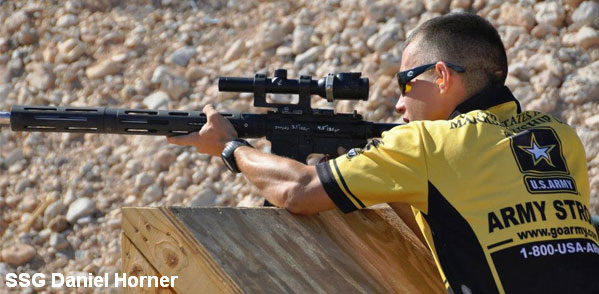
There’s no denying that 3-Gun competition is growing in popularity nationwide. Using a pistol, rifle and shotgun to shoot multiple targets at varying distances is exciting and challenging. Here are some pointers for performing better on the 3-Gun range by the USAMU’s SSG Daniel Horner, a two-time winner of Crimson Trace’s Midnight 3-Gun Invitational (M3GI) match.
Competing in Night-Time Stages
“I use the same gear all year long, so when it comes time for this match (the M3GI), I just adapt the guns, so they will work for the night time,” stated Daniel Horner. “I attach the Crimson Trace lasers and lights to the guns in whatever is the easiest way possible. Last year I just screwed a rail to my shotgun with wood screws. So, people can compete with pretty much whatever they have available and make it work.” Horner also recommends using a pair of head-mounted lamps. One can illuminate your firearms’ iron sights while the other headlamp is aimed at the targets.
If you’ve been looking for a premium-quality stock for a new gun project, now’s the time to buy. As a Memorial Day promotion, McMillan is offering 10% off the price of its entire inventory of stocks and accessories in the McMillan Online Store. That can save you some serious coin on many of McMillan’s most popular stocks, including benchrest stocks, hunting stocks, varmint stocks, and tactical stocks such as the A2, A3 and A5.
You can get 10% off McMillan merchandise now through 11:59 pm on May 30, 2015. This applies sitewide on the McMillan online store. The sale applies to all of McMillan’s most popular designs as well as new-for-2016 stocks such as the XTR and Game Warden. To get 10% off, use Promo Code “MemorialSale” at check out.
Sale Tip by EdLongrange. We welcome reader submissions.
The Precision Rifle Series (PRS) has introduced a new, price-capped Production Class in an effort to boost participation by making competition more affordable. Under recently-issued PRS rules, Production Class rifles may cost no more than $2000.00. The rules state:
“Production Division combined rifle and scope MSRP as listed on the company’s website shall not exceed $3,000 USD, the rifle shall not exceed $2,000 USD and the optic not exceed $2,000 USD.
Production Division rifles are not permitted to be altered or improved in any way from the original factory configuration.
In an effort to prevent exorbitant costs for beginning shooters, Production Division round count will not exceed 80 rounds.”
To fit the new Production Class Rules, MasterPiece Arms (MPA) has developed the new BA Lite PCR Competition Rifle built around a Savage Model 12 short action. Designed specifically for the new PRS Production Class, MPA’s PCR Competition Rifle offers many premium features yet stays under the $2,000 Class limit. The Savage action is upgraded with a Rifle Basix 2-lb trigger, and the adjustable, modular chassis offers a bag rider, barricade stop, and even a built-in bubble level. Bipods can be attached up front to a rail, with optional spigot mount. MPA PCR Rifles come with stainless Bergara barrels, 22-26 inches in length, fitted with MPA muzzle brakes (muzzle thread is 5/8-24 TPI).
MPA BA Lite PCR Competition Rifle Specifications:
Chamberings: 6mm Creedmoor, 243 Win, 6.5 Creedmoor, 308 Win, 6.5 x 47 Lapua, 6mm x 47 Lapua
Action: Savage Model 12 Short Action
Trigger: Rifle Basix Savage Trigger Set to 2 lbs.
Barrel: Bergara 416R Stainless Premium Barrel Blank
Chassis: MPA BA Lite Chassis
Muzzle Brake: MPA High Performance Muzzle Brake
Magazine: AICS Type (10 Round Accurate/AICS Type Magazine Included)
Chassis Weight: 2.9 lbs. (Overall rifle weight depends on barrel length and contour.) MSRP: $1,999.99
Left-Hand and Right-Hand Models in Choice of Five Cerakote Colors
The MPA BA Lite PCR Competition Rifle is available in black, burnt bronze, flat dark earth, gunmetal, and tungsten in both left- and right-handed set ups. All chassis and barrels are Cerakoted® in a multitude of colors and patterns. (Custom patterns are $150.00 extra). Barrel lengths available include 22 inches through 26 inches. The barrel twist is caliber-specific and the barrel muzzle thread is 5/8-24 TPI.
Editor’s Note: While the MPA PCR Competition rifle has nice features, it’s hard not to compare it to the Ruger Precision Rifle costing hundreds less. The latest Gen 2 Ruger Precision Rifle, with a sleeker handguard and factory muzzle brake, is available for under $1500.00 “street price”. Ruger lists a $1599.00 MSRP for the Gen 2 RPR versus $1399.00 for Gen 1 models.
There are two segments on Shooting USA this week that are well worth watching. On Wednesday (May 18, 2016), Shooting USA features a lengthy segment on the Bushnell Brawl tactical match. This is followed by an “Impossible Shoots” episode featuring top USAMU shooter SSG Daniel Horner.
This Wednesday, May 18th, Shooting USA TV features the Bushnell Brawl, a tactical competition that draws top long-range shooters from the military, law enforcement and the civilian shooting communities. The match is held at the famed Rifles Only range in Kingsville, Texas. The Brawl is a one-of-a-kind physical and mental challenge that tests each shooter’s ability to read wind, figure ballistics, and adapt to difficult shooting scenarios. There is even a helicopter stage.
Shooting from a helicopter, shooting off of a wire, and shooting from the physically demanding maze called the Mouse Trap. These are just a few of the unique courses of fire at the Bushnell Brawl, part of the PRS series. Over the course of two days, competitors tackle more than a dozen stages, and this year Bushnell hosted a special one-day event for the new PRS Production Class. This new division should attract new shooters by limiting the cost of equipment — making PRS competition affordable.
New PRS Production Division — Lowering the Cost of Entry
The Production Division is a new PRS classification. Under Production Division rules, the rifle and scope must cost under $3,000, combined. All other accessories, such as bipod, rear bag, and the sling, can be added at the shooter’s own discretion. By lowering the cost of entry, PRS organizers hope to get more shooters involved: “There’s a lot of gear out there that’s not that expensive that you can use to get into this and start to play the game,” says Production Division Match Director Jacob Bynum.
Shooting USA’s Impossible Shots — Threading the Needle
This time, SSG Daniel Horner has combined with the Army Marksmanship Unit Gunsmiths to set up the ultimate Impossible Shot. Horner attempts to send one bullet through two barrels to pop a balloon.
This challenge is definitely demands the ability to “thread the needle”. In other trick shot challenges this week, Randy Oitker switches to a crossbow to set up his Annie Oakley-style, over the shoulder challenge. Julie Golob is your guide to some of the most amazing exhibition shots ever seen.
Shooting USA Hour on Wednesday Nights
Eastern Time – 3:00 PM, 9:00 PM, 12:30 AM Th
Central Time – 2:00 PM, 8:00 PM, 11:30 PM
Mountain Time – 1:00 PM, 7:00 PM, 10:30 PM
Pacific Time – 12:00 Noon, 6:00 PM, 9:30 PM
Also on Saturdays Prime Time:
Eastern Time – 12:30 AM
Central Time – 11:30 PM
Mountain Time – 10:30 PM
Pacific Time – 9:30 PM
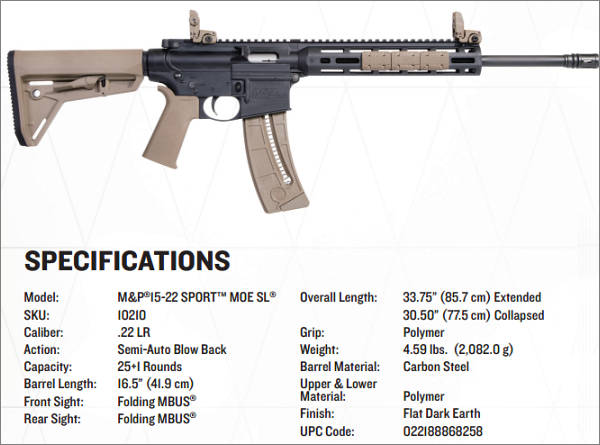
We like AR-style .22LR rigs for Rimfire Tactical Matches and 3-Gun cross-training. With an AR-style rimfire rifle you can train with low-cost ammunition while enjoying the same ergonomics, controls, and sighting systems found on your centerfire ARs.
Smith & Wesson has upgraded its M&P 15-22, a fun rifle that we’ve praised in the past. The new M&P 15-22 Sport MOE SL model (Magpul Original Equipment Slim Line) features a more comfortable handguard, an improved grip, and an adjustable Magpul buttstock. The dedicated .22 LR M&P rifle retains the look and features of the company’s popular M&P rifle line, with the enhanced ergonomics of Magpul furniture. Click HERE for Spec Sheet.




 In some respects, the 7mm SAUM cartridge may be better than the 7mm WSM. The 7mm SAUM holds less powder — but that’s a good thing, since the capacity is more than adequate to do the job. You can drive the 180s at 3000 fps with a SAUM using less powder than with a WSM. Additionally, the SAUM case has a slightly longer neck. This gives you greater flexibility in bullet seating. With a long neck you can set the throat so the long 180+ graing bullets are above the neck shoulder junction, yet you can still seat shorter hunting bullets close to the lands. Additionally, long case necks, some believe, cause less throat erosion than shorter necks. That’s not “hard science” but it is certainly a view shared by many experienced shooters. The long neck is one reason many varminters favor the 6mm Remington over the .243 Winchester.


 Competing in Night-Time Stages


 This Wednesday, May 18th, Shooting USA TV features the Bushnell Brawl, a tactical competition that draws top long-range shooters from the military, law enforcement and the civilian shooting communities. The match is held at the famed Rifles Only range in Kingsville, Texas. The Brawl is a one-of-a-kind physical and mental challenge that tests each shooter’s ability to read wind, figure ballistics, and adapt to difficult shooting scenarios. There is even a helicopter stage.