The NRA will debut a new long range training program this summer at the Peacemaker National Training Center in West Virginia. Registration is now open for the National Rifle Association’s Precision Long Range School. Three summer sessions will be offered: July 2-3, August 13-14, and September 3-4, 2016. Price is a painful $1900.00 per two-day session. That does include guns, ammo and instruction, but NOT lodging. (Think about that — for $1900.00 you can buy a pretty nice rifle and practice on your own. Likewise that $1900.00 will buy a very high-quality scope.)
The NRA Precision Long Range School is designed to teach students how to hit very small targets out to (and beyond) 1,100 yards, and how to make hits on the first shot. Sessions will be lead by some of the nation’s best long range instructors and students will be provided with top-of-the-line guns, ammo, optics, and all necessary gear.
This unique school covers a spectrum of long range shooting disciplines. Students will learn long-range competition “best practices”, tactical long-range methods, and long-range hunting techniques. This school will be taught in MILS. Specific techniques covered will include: Dialing, Holding Off, Target Transition, Advanced Long Range Marksmanship, Suppressor Usage, and Long Range Speed Shooting.
The school will also cover Advanced External Ballistics, Advanced Wind Reading, and Applied Ballistics Software Usage. For these subjects, seminar-style instruction will be combined with range practice to put learned skills into practice at long range.
The NRA Precision Long Range School will provide top-quality hardware to participants: Surgeon rifles built on Modular chassis systems, chambered for the .260 Remington cartridge. These rifles will be fitted with Nightforce ATACR MIL-R optics and AWC Silencers suppressors. The Top-of-the line Swarovski spotting scopes and range-finding binoculars will be employed, along with Kestrel wind meters with Applied Ballistics software. Nexus-brand .260 Rem ammo completes the package available to Long Range School attendees.
To register, or obtain more information about the NRA Precision Long Range School, visit the Long Range School Webpage or call (844) 672-6883.
The Ruger Precision Rifle (RPR) has been a huge sales success. Nearly a year after its introduction, the RPR remains in very high demand. The first production run by Ruger essentially sold out, so it is very hard to find one for sale, in any caliber.
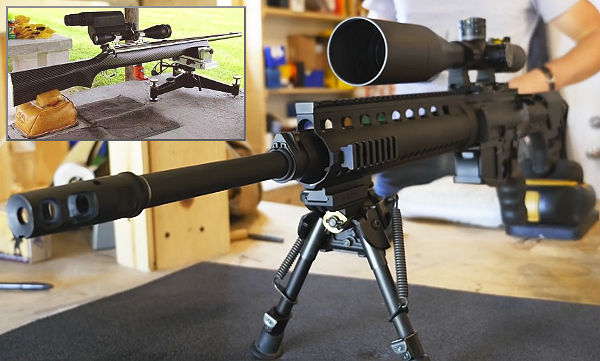
Though it has a big winner on its hands, Ruger has made some upgrades to its popular RPR. An “enhanced” RPR will be offered with a new handguard, bolt shroud, and muzzle brake. Two new models have been added to the RPR line-up, the model 18004 in .308 Win, and the model 18008 in 6.5 Creedmoor. These models, priced at $1599.00 MSRP, feature a new, low-profile handguard, a new aluminum bolt shroud, and a muzzle brake. The new handguard will work better for scopes with large front objectives. The muzzle brake should reduce felt recoil, but we do wonder whether accuracy might suffer. The brakeless, first-generation RPRs exhibited very good accuracy most of the time.
For the time being, the original model RPRs will be offered along with the new enhanced RPRs: “Both the original and enhanced configurations will be available from Ruger for a time, with the initial pattern being phased out as supplies are depleted.” (Source: American Rifleman). But there is a catch. The new models cost $200.00 more than Gen 1 RPRs. Ruger lists a $1599.00 MSRP for the enhanced RPRs versus $1399.00 for Gen 1 models.
To See NEW FEATURES, click the image below, then SCROLL down the page on the Ruger web page that loads. Yes, the VIDEO is there — you just have to scroll down.
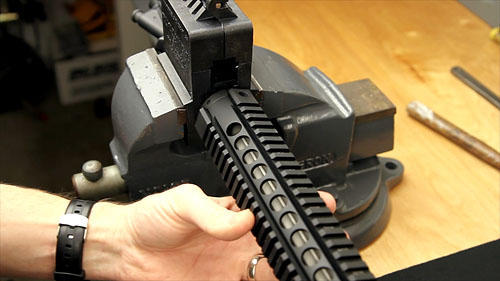
According to American Rifleman, the new handguard has multiple benefits: “Still free-floating and KeyMod-compatible, the new design omits the original’s top-mounted Picatinny rail in order to increase scope clearance. Given the larger objective lenses utilized by long-range optics, this enhancement makes a lot of sense. The bottom surface of the new handguard is also contoured with a flatter surface, providing for a more stable foundation for the mounting of bipods than the original model.” Current RPR owners can purchase the new-style 15″ aluminum handguard for $249.95 from ShopRuger.com.
Ruger RPR Hybrid Muzzle Brake
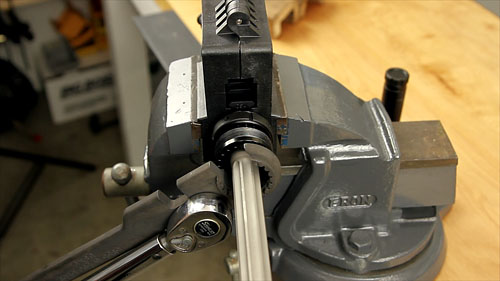
The original, Gen 1 Ruger Precision Rifle had a threaded muzzle covered by a thread cap. The new “enhanced model” features a factory-installed “hybrid” brake fitted to the barrel. This brake combines radial holes in the rear half with large, angled side ports in the front. Ruger claims the brake reduces recoil almost 40% on a 6.5 Creedmoor. This brake can be purchased separately for $99.95 from ShopRuger.com.
With barrels, one wonders “Can a little more length provide a meaningful velocity gain?” To answer that question, Rifleshooter.com performed an interesting test, cutting a .308 Win barrel from 28″ all the way down to 16.5″. The cuts were made in one-inch intervals with a rotary saw. At each cut length, velocity was measured with a Magnetospeed chronograph. To make the test even more interesting, four different types of .308 Win factory ammunition were chronographed at each barrel length.
Test Barrel Lost 22.7 FPS Per Inch (.308 Win Chambering)
How much velocity do you think was lost, on average, for each 1″ reduction in barrel length? The answer may surprise you. With a barrel reduction from 28″ to 16.5″, the average speed loss of the four types of .308 ammo was 261 fps total. That works out to an average loss of 22.7 fps per inch. This chart shows velocity changes for all four ammo varieties:
Summary of Findings: The average velocity loss per inch, for all four ammo types combined, was 22.7 FPS. By ammo type, the average loss per inch was: 24.6 (Win 147 FMJ), 22.8 (IMI 150 FMJ), 20.9 (Fed GMM 168gr), and 22.5 (Win 180PP).
Interestingly, these numbers jive pretty well with estimates found in reloading manuals. The testers observed: “The Berger Reloading manual says for the 308 Winchester, ‘muzzle velocity will increase (or decrease) by approximately 20 fps per inch from a standard 24″ barrel’.”
How the Test Was Done
The testers described their procedure as follows: “Ballistic data was gathered using a Magnetospeed barrel mounted ballistic chronograph. At each barrel length, the rifle was fired from a front rest with rear bags, with five rounds of each type of ammunition. Average velocity and standard deviation were logged for each round. Since we would be gathering data on 52 different barrel length and ammunition combinations and would not be crowning the barrel after each cut, we decided to eliminate gathering data on group sizes. Once data was gathered for each cartridge at a given barrel length, the rifle was cleared and the bolt was removed. The barrel was cut off using a cold saw. The test protocol was repeated for the next length. Temperature was 47° F.”
CLICK HERE to Read the Rifleshooter.com Test. This includes detailed charts with inch-by-inch velocity numbers, multiple line charts, and complete data sets for each type of ammo. Rifleshooter.com also offers ballistics graphs showing trajectories with different barrel lengths. All in all, this was a very thorough test by the folks at RifleShooter.com.
Much Different Results with 6mmBR and a Longer Barrel
The results from Rifleshooter.com’s .308 barrel cut-down test are quite different than the results we recorded some years ago with a barrel chambered for the 6mmBR cartridge. When we cut our 6mmBR barrel down from 33″ to 28″, we only lost about 8 FPS per inch. Obviously this is a different cartridge type, but also our 6mmBR barrel end length was 5″ longer than Rifleshooter.com’s .308 Win start length. Velocity loss can be more extreme with shorter barrel lengths (and bigger cartridges). Powder burn rates can also make a difference.
Here’s a new tactical-style rifle you should consider if you are involved in the Tactical/Practical shooting disciplines. It features a modern, adjustable Archangel stock with the smooth, made-in-Japan Howa 1500 action, outfitted with a detachable 10-round box magazine.
Legacy Sports, distributor for Howa rifles, is offering the new Howa Archangel Rifle in .223 Remington and .308 Winchester. The ambidextrous, carbon-reinforced polymer stock features a click-adjustable cheek-riser, adjustable length-of-pull, grip storage compartment, plus front/rear quick-detach flush cups. There is also a clevet, integrated, push-button bipod attachment system. The Howa actions mate precisely into the stock and ride on aluminum pillars.
In .223 Rem or .308 Win, the complete rifle, with either 20″ or 24″ barrel, starts at $915.00 MSRP, including 10-round mag. We expect the actual street price to be around $800.00. That makes this a more affordable alternative to the Ruger Precision Rifle, which is commanding $1200.00+ these days (if you can find one). Note: Archangel Mfg. offers this Howa 1500-compatible stock in Black, OD Green, and Desert Tan, but it appears that the initial Legacy Sports complete rifle will be in black only. These rifles are fitted with the very good HACT adjustable two-stage trigger and 3-position safety. The Howa Archangel rifle is also available (for about $230 more) in a scoped package with a 4-16x50mm Nikko Sterling Scope (see below). For more information call Legacy Sports at 1-800-553-4229 or visit LegacySports.com.
Note: If you already own a rifle with a Howa 1500 barreled action, you can purchase the Archangel AA1500 stock separately (MSRP $355.99) from Arizona-based Archangel Manufacturing. This company also offers similar stocks for Rem 700, Springfield M1A, and K98 Mauser barreled actions, starting at just $202.99 for the Mauser variant.
What do you get when you cut a 6.5 Creedmoor-chambered barrel down to just over 16 inches? A lot more velocity than you might think. Our friends at Rifleshooter.com recently did a barrel cut-down test with 6.5 Creedmoor test rifle, shortening the barrel from 27 to 16.1 inches in one-inch increments. Surprisingly, with a 142gr Sierra MK, the total velocity loss (as measured with a Magnetospeed) was just 158 FPS, an average of 14.4 FPS per inch of barrel length. With the lighter 120gr A-Max bullet, the total velocity loss was 233 FPS, or 21.8 FPS average loss per inch of barrel.
Test Procedure
Five (5) rounds of each type of cartridge were fired at each barrel length and the velocity data was recorded with a MagnetoSpeed V3 barrel-mounted chronograph. The rifle was then cleared and the barrel was cut back one inch at a time from 27″ to just over 16″. NOTE: During this winter test, the air temperature was a very chilly 23° F. One would expect higher velocities across the board had the outside temperature been higher.
The photo below shows how the barrel was cut down, inch-by-inch, using a rotary saw. The barrel was pre-scored at inch intervals. As the main purpose of the test was to measure velocity (not accuracy) the testers did not attempt to create perfect crowns.
6.5 Creedmoor vs. Other Mid-Sized 6.5mm Cartridges
The 6.5 Creedmoor is a very popular cartridge with the tactical and PRS crowd. This mid-size cartridge offers good ballistics, with less recoil than a .308 Winchester. There’s an excellent selection of 6.5mm bullets, and many powder choices for this cartridge. When compared to the very accurate 6.5×47 Lapua cartridge, the 6.5 Creedmoor offers similar performance with less expensive brass. For a tactical shooter who must sometimes leave brass on the ground, brass cost is a factor to consider. Here’s a selection of various 6.5 mm mid-sized cartridges. Left to right are: 6.5 Grendel, 6.5×47 Lapua, 6.5 Creedmoor with 120gr A-Max, 6.5 Creedmoor with 142gr Sierra MK, and .260 Remington.
When asked to compare the 6.5 Creedmoor to the 6.5×47 Lapua, Rifleshooter.com’s editor stated: “If you don’t hand load, or are new to precision rifle shooting, get a 6.5 Creedmoor. If you shoot a lot, reload, have more disposable income, and like more esoteric cartridges, get a 6.5×47 Lapua. I am a big fan of the 6.5×47 Lapua. In my personal experience, the 6.5×47 Lapua seems to be slightly more accurate than the 6.5 Creedmoor. I attribute this to the quality of Lapua brass.”
Last summer we published our comprehensive 6.5×47 Lapua Cartridge Guide, researched by the 6.5 Guys. In case you’ve been wondering what kind of accuracy is possible for a tactical-type rifle chambered for this mid-sized cartridge, check out this tack-driver built by gunsmith Ryan Pierce. That’s a mighty impressive 0.206″ five-shot group fired with Berger 140gr Hybrids using a Brux cut-rifled barrel. The powder was Hodgdon H4350, a very good choice for this cartridge.
Ryan reports: “Here is a 6.5×47 I built for a customer. It features a trued Rem 700 action, Brux 1:8″ Rem varmint-contour barrel, Mcmillan thumbhole stock, Surgeon bottom metal, and 3-port muzzle brake. The customer’s preferred load is the same that has worked in the last couple dozen 6.5x47s I’ve built: 41.1-41.3 grains of H4350 with 140 hybrids .050″ off the lands. This should run about 2810-2815 fps from a 26″ barrel. The 3.128″ refers to length of a loaded round from the base to ogive including the Hornady ogive comparator tool.”
Are you looking to improve your long-range shooting? Doubtless you’ve been thinking about upgrading your rifle or optics, but wonder what to buy (and how to get the best “bang for your buck”). In this video, Bryan Litz of Applied Ballistics offers “solid gold” advice on equipment selection for mid-level shooters (i.e. those who are somewhere between “newbie” and “Master of the Universe”). Bryan explains the logical first step is a barrel upgrade — a new tube from a top-barrel maker can make a huge difference. Then you should research the best factory ammo for your rifle, or get started in precision hand-loading. Bryan also offers advice on choosing a scope and optics accessories.
Equipment Upgrades: Barrel, Optics, Ammoby Bryan Litz
Every equipment element can be upgraded. You can run that factory rifle for a period of time, but the barrel eventually is going to be what holds you back. The twist rate probably won’t be fast enough to stabilize the high-BC bullets that you want to shoot at long range. So, the first thing you want to upgrade on your factory rifle is probably going to be the barrel. [With a new custom barrel] you’re going to get a fast twist rate, you’re going to get a chamber that’s optimized with a throat for your … bullet. And a good quality custom barrel is going to be easier to clean, won’t foul out as much, and it’s going to improve to overall accuracy and precision of your shooting. Barrel swaps are very common and routine thing for gunsmiths to do.
The next thing is improving your scope. If you don’t have a quality optic it’s going to hold you back. The job of the scope is to precisely and perfectly delineate [the target] within a half a degree (from 100 to 1000 yards is only a half a degree). The scope has got to put you on the money within that half a degree. So, it’s not a piece of equipment you want to go cheap on.
The other big factor is your ammunition. Getting into hand-loading is meticulous and it takes a long time to learn, but ultimately you’ll be making ammunition that is tailored for your rifle, and there simply won’t be anything better for your rifle than what you can develop through individual handloads.
So that’s typically the upgrade path: Get your factory rifle re-barreled, don’t skimp on a scope (or anything that attaches to it), improve your ammunition (whether by upgrading to better factory ammo or hand-loading on your own). All through this process is continuous learning… Once you have the best equipment (and it doesn’t get any better), the process of learning and education never ends. That is something you build on every single time you go to the range, and it’s what going to allow you to continually improve your skills.”
No matter what kind of rifle you shoot, whether it be an AR or a brenchrest rig, the principles are the same — develop a good load, learn the gun, hone your wind-reading skills, and practice in all conditions. Making a video of a practice session can help you identify and correct bad habits.
Bryan Litz says “don’t skimp on your scope”. Purchase a quality scope, rings, and scope level. Successful long-range shooting all begins with your view of the target.
Even with a top-of-the-line F-TR rig like this, you still have to practice diligently, putting in the “trigger time” needed to improve your game.
Planning to put together an AR-platform rifle? Or are you looking to upgrade your AR with a new barrel, stock, or trigger group? Then you should check out the AR-15 Rifle Build DVD from our friends at UltimateReloader.com. This DVD covers all the details of a custom build, using high-resolution video sequences, and helpful supporting graphics.
In this DVD, Gavin Gear guides you through the entire process including selecting components, acquiring and using the necessary tools, assembly steps and details for each component, and even mounting a scope. Building an AR-15 can be overwhelming, but with the right guidance and help it’s not difficult and is a lot of fun. With this DVD you’ll be able to build your AR-15 with confidence.
Right now, as a New Year’s promotion, the AR-15 Build DVD is on sale for just $9.90 (plus $3.80 shipping/handling). This DVD can pay for itself many times over by showing you how to do your own gunsmithing (and get quality AR components at attractive prices).
We often get questions about the 6.5 Creedmoor Cartridge — folks ask where they can find good resources for this cartridge, which is popular with Across-The-Course, High Power, and tactical shooters. We did some searching and found that the August 2011 digital edition of Shooting Sports USA has a good article for all fans of the 6.5 Creedmoor.
Development of the 6.5 Creedmoor Cartridge
In the August 2011 Edition of Shooting Sports USA you’ll find a lengthy feature on the 6.5 Creedmoor cartridge. This story covers the origin of the cartridge and its performance both as a match cartridge and as a hunting round. Hornady Chief Ballistician Dave Emary explained: “the original intent of the cartridge was as an across-the-course match cartridge. We envisioned it as an off-the-shelf round that would produced the accuracy and ballistics to compete in all match disciplines right out of the box. At the same time we realized that the same characteristics would make an exceptional hunting cartridge with the right bullets.”
6.5 Creedmoor Brass No Longer Washed After Annealing
Here’s an interesting update on Hornady 6.5 Creedmoor brass and loaded ammo. In a move to improve case quality and neck uniformity, Hornady recently changed the 6.5 Creedmoor production process, eliminating the case-washing step after annealing. So now you will see annealing coloration on 6.5 Creedmoor brass, just like on Lapua brass. Dennis DeMille of Creedmoor Sports wanted to improve the consistency/uniformity of 6.5 Creedmoor case-necks. At Dennis’ suggestion, Hornady conducted tests which showed that the “standard industry practice” of washing brass could potentially alter the necks in undesirable ways. Bottom line, unwashed annealed brass was determined to have an accuracy edge over washed brass. Looking at these results, Hornady decided to forgo the post-anneal washing process. As a result, the latest 6.5 Creedmoor brass now displays the distinctive coloration left by neck/shoulder annealing. Learn something new every day, eh?
Keanu Reeves, the A-List Hollywood actor who starred in The Matrix, Speed, Point Break, and other hit movies, is a talented shooter. For his role in the popular John Wick series of movies, Reeves has done extensive training with our friend Taran Butler, one of the nation’s top 3-Gun competitors. Check out this video showing Keanu Reeves running through some multi-gun stages. The actor’s speed on target is outstanding, and his transitions are very fast. We’ve run some multi-gun matches in the past. Trust us, it takes a lot of training and dedication to get this fast. You also need good equipment.
Watch Keanu Reeves Display Impressive Multi-Gun Speed in this Video:


 Ruger RPR Hybrid Muzzle Brake







 6.5 Creedmoor Brass No Longer Washed After Annealing


