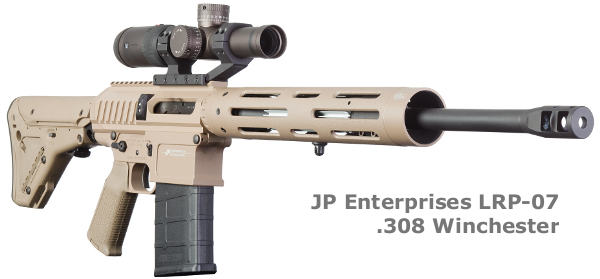
It seems like every manufacturer has a new “tactical precision” rifle these days, and Mossberg is no exception. Mossberg offers the MVP-LC, which combines the Mossberg MVP receiver with a sleek, modern MDT LSS metal chassis with an AR-type buttstock that adjusts for length (11.25″ – 14.5″ LOP). The light-weight, tan-finished aluminum chassis features a V-shapped bedding area for the Mossberg MVP action. The MVP-LC’s LBA trigger is user-adjustable from 3 to 7 pounds pull weight.
GunTalk TV Video Review of Mossberg MVP LC:
The new rifle features the MDT LSS chassis system, Magpul furniture and magazine and Silencerco Saker muzzlebrake/QD mount. The rifle is available with optional Vortex HS-T 4-16X rifle scope.
Available in either .223 Rem or .308 Win, the MVP LC rifle will accept standard AR-15 and AR-10 magazines. The barrels are pretty short, 16.25″ for .223 Rem, or 18.5″ for .308 Win, but they do come with threaded SilencerCo Muzzle Brakes installed. Weight, without optics, is 8 lbs. for the .223 Rem version, 8.5 lbs. for the .308 version. We think the lighter .223 Rem model would make a nice “carry-around” varmint rifle. The current “street price” is $1099.99.
MVP-LC Featured in Shooting Illustrated
If you want to learn more about this rifle, check out Shooting Illustrated this month. Mossberg’s MVP-LC is the “cover girl” of the October issue; you’ll find a full report on this new tactical rifle with complete specs and lots of big photos.
FEATURES: Mossberg MVP bolt-action design compatible with standard AR magazines (AR15, LR308/SR25). MDT LSS light chassis aluminum stock. Magpul CTR Adjustable LOP Stock with A-frame profile to reduce snagging for height adjustment. Either a 16.25″ (.223 Rem) or 18.5″ (.308 Win) barrel threaded with SilcencerCo Saker Muzzle Brake (thread cap included). Includes LBA adjustable trigger system (3-7 lbs.), oversized bolt handle, Picatinny rail, adjustable bipod.
Frank Galli, aka “Lowlight”, is the head honcho of Sniper’s Hide. In the video below, Galli offers a series of shooting tips he calls the “Long Range Shooting W.T.F”. No that’s not what you think it is — no cuss words are involved. “W.T.F.” stands for Wind, Trajectory, and Fundamentals of Marksmanship. To shoot well, Frank says, you first must gauge the wind correctly. Second, you must know the trajectory of your load in your rifle — i.e. know your ballistics. If you want to hit a target at long range, you must start with a rock-solid zero, determine an accurate muzzle velocity, and know the Ballistic Coefficient of the bullet. Plug all that into a good ballistic program (along with elevation, temp, and air pressure) and you should have your point of impact (within a click or two) out to 1000 yards.
Watch Video for Tips about Wind-Reading, Ballistics, and Shooting Fundamentals:
The third element of “W.T.F” is “F” for “Fundamentals of Marksmanship”. This actually involves multiple factors — body position (relative to the rifle), finding your natural point of aim, proper head alignment behind the scope, pre-loading the bipod, breathing modulation, trigger control, follow through, recoil management and more. Frank addresses all these “fundamentals” in the second half of the video, starting at the 3:40 time-mark.
For a prone shooter, particularly on dusty, dirty or sandy ground, muzzle blast is a major bummer. Muzzle blast can be very disturbing — not just for the trigger-puller but for persons on either side of the gun as well. Some muzzle brakes send a huge shockwave back towards the shooter, and others send blast towards the ground, kicking dirt and debris into the prone shooter’s face. If there was a way to illustrate those factors — shockwave and debris — that might help shooters select one brake design over another.
Cal Zant at PrecisionRifleBlog.com applied a unique blend of creativity and resourcefulness to try to answer that question for 20+ muzzle brakes. Using high-speed photography and household products, he captured the blast pattern of 20+ different brake designs for easy side-by-side comparison. Can you figure out how Cal managed to show muzzle brake blasts so clearly? His “hi-viz” solution, revealed in the article, is very clever. See the eye-opening results for 20+ brakes, with illustrative photos, by visiting the Precision Rifle Blog Muzzle Brake Ground Signature Test Page.
The Precision Rifle Series (PRS) is holding its season-ending Championship Match this weekend at a “top-secret” ranch location near Tehachapi, California. The nation’s top 75 PRS marksmen (plus 30 regionally-qualified shooters) have been invited to compete in a challenging series of stages, with targets from 100 yards to well over 1000 yards. This is supreme test of marksman and rifle. The PRS involves shooting from multiple positions, carrying all your hardware over considerable distances. This ain’t no belly benchrest match that’s for sure.
This video showcases the 2014 PRS Championship in Frost, Texas. This year’s PRS Finale will be held in California. (Video is well worth watching — with LOTS of action):
The PRS has attracted a host of sponsors, so the prize table will be huge for this event:
For those interested in learning more about the PRS game, Rich Emmons, one of the founders of the Precision Rifle Series (PRS), has written an insightful article about getting started in the tactical game. Here are highlights from Emmon’s PRS — Intro to Competition article.
Precision Rifle Series — Intro to Competition
by Rich Emmons, PRS President
Tactical Shooting with a precision rifle is not like other disciplines, there is no set course of fire or format. That is what makes it so fun! What I quickly learned from my first competition and the many that followed was there is so much to learn and shooting in competition put everything you thought you knew to the test.
Getting Started — What to Expect
If you’re reading this, you have probably already have been bitten by the long range shooting bug. It can seem quite intimidating to just jump in with a new bunch of shooters you don’t know and shooting lingo you don’t quite understand yet. But here is the key — show up and shoot! I guarantee you if you show up to a match as a new shooter, other experienced shooters will guide you along and give you help on anything you need.
AUDIO: Click Button to hear Rich Emmons Talk about the Precision Rifle Series.
Now, a couple things you should just expect. You’re not as good as you think you are. Don’t expect to come into your first match and beat all the veterans. That just doesn’t happen unless you have had some really good coaching or other shooting competition experience to get you ready for this type of competition. If possible, find a local rifle club that has monthly long range matches, or any type of match will help prepare you for a larger PRS event. Getting involved with a rifle club and starting out shooting monthly matches is definitely the way to jump into competition shooting.
The Gear You Need
The first question that many ask is: “What kind of rifle/caliber/scope do I need?” The easiest answer to this is, the best you can afford. It’s no secret the gear is expensive. It took me several years of buying sub-par gear and eventually trading up to figure this out. Now, a guy can get a real sense of pride of doing it on the cheap, or with a factory rifle. I’ve seen many old Savage 10FPs take down custom rigs that cost 10 times as much. And if that’s all you can afford, then eventually you will learn the limitations of yourself or your gear. As for choice of cartridge/caliber, the Precision Rifle Blog has analyzed three years worth of match results from the best tactical shooters in the nation. CLICK HERE to read an article that reveals what the “top guns” use.
The days of black rifles at Walmart are over apparently. Walmart plans to halt sales of AR-platform rifles and other mag-fed semi-automatic rifles (as well as certain semi-auto shotguns with capacities of 7+ rounds). Currently, AR-15s and other “modern sporting rifles” are sold in roughly one third of the company’s 4,600 U.S. stores. Walmart is the USA’s largest vendor of rifles and ammo, so this is a significant policy change that will impact sportsmen across the country.
Walmart says that its decision to stop selling semi-auto rifles is prompted by reduced demand for AR-type rifles, rather than by political pressures. Walmart spokesman Kory Lundberg told Bloomberg Business, “If you have a product customers aren’t buying, you phase it out,” he said. Shoppers “were buying shotguns and rifles, and so we are increasing assortment in that.” Lundberg stated that Walmart would sell down its remaining AR inventory to zero as stores transition from summer to fall merchandise. (Source: CTD Shooter’s Log, August 28, 2015).
In a recent CNN interview, Walmart CEO Douglas McMillon said: “Our focus, as it relates to firearms, should be hunters and people who shoot sporting clays, and things like that. So the types of rifles we sell, the types of ammunition we sell, should be curated for those things. We believe in serving those customers, we have for a long time, and we believe we should continue to.” But when asked if he would discontinue sales of semi-automatic long guns, McMillon said, “Yes.”
READ MORE About Walmart’s Decision to Halt AR Sales
Bergara USA offers a new metal-chassis rifle for tactical shooters, such as PRS competitors. Dubbed the Bergara Premier Series Tactical Rifle (aka BPR-17), this new rig features an XLR chassis, and is chambered in .308 Win or 6.5 Creedmoor. With a $2,200.00 MSRP, Bergara’s new rig costs less than a full custom, but it is WAY more expensive than the new Ruger Precision Rifle which sells for $1100-$1250 (street price) at most dealers. For Bergara, this may be a case of “too little, too late” — at least when compared to the new Ruger rifle.
The Bergara Premier Tactical is built with Bergara’s Premier action (which featurs a coned bolt nose and breech for smooth feeding). Notably, this rifle is fitted with a Timney 517 flat trigger with safety, adjustable from 1.5 – 4 pounds. The 416 stainless barrel has a Dead Air suppressor-ready Key Mount Brake. Both barrel and action are Cerakote finished in matte black.
The XLR chassis features an adjustable length of pull (11.25 – 14.75 inches) and adjustable cheek height. The lightweight chassis buttstock features QD flush cups on both sides, ambidextrous cheek rest, mono-pod provision and an enclosed design. For more information, visit www.bergarausa.com.
Bergara Premier Tactical Rifle Specifications:
Calibers: .308 Win., 6.5 Creedmoor
Action: Bergara PREMIER Action
Stock: Custom chassis stock by XLR
Trigger: Timney 517 flat trigger with safety, adjustable from 1.5 – 4 lb.
In this video Larry Vickers tries his hand at long-range shooting, with assistance from Gunsite Instructor Walt Wilkinson, a .50-Cal Champion. Larry shoots an Accuracy International AX chambered in .338 Lapua Magnum, while Wilkinson pilots a .50 BMG Steyr HS-50 rig. Wilkinson mentors Vickers, covering the basics of long-range shooting from bipod. Over the course of the shooting session, Wilkinson debunks some common misconceptions while Larry attempts shots out to 1470 yards.
This video is fun to watch, but understand that this is intended more for tactical shooters who will be satisfied with one-MOA accuracy. Wilkinson says that, with the kind of tactical rifles being used, and factory ammo, achieving one-MOA groups at long range is a realistic goal: “A one-MOA gun… that’s what you’re looking for. In most cases, with the … environmental changes, the ammunition, and the rifle put together, a one MOA group is really what you should expect [at best].”
Many of us dream of taking and making a shot at one mile (1760 yards). Well Top Shot Champion Dustin Ellermann pushed the envelope even farther during a recent ultra-long-range session at the NRA’s Whittington Center in New Mexico. On his Facebook page, Dustin wrote: “I earned the ‘One Mile+ Shot’ mancard this week with 1MOA Solutions. We reached out to 2,100 yards with the Barrett M99 .50 BMG out in the hills of the Whittington Center. You can see the target area marked in the center of the photo. This is a locked-down mountain range, with 30,000 acres.”
Bullet flight time was 3.7 seconds, drop was 94 MOA, velocity at target was only 1,100 fps. The 7,500′ elevation and a 5 degree down-slope helped the ballistics. Dustin reports: “About six seconds after impact you would hear the ‘ding’.” [Editor’s note: Yes it really takes roughly six seconds for sound to travel 2100 yards. The speed of sound at 7500′ elevation* is 1053.61 fps, or roughly 351.20 yards per second. The distance-to-target of 2100 yards divided by 351.2 works out to a 5.98 second time delay.]
One of Dustin’s friends commented: “We rarely think about what the bullet does after it exits, but seeing the 60% drop in velocity [over the trajectory] and how long it was actually in flight (3.7 seconds) makes these types of shots so amazing! Congrats to you making the One Mile + club!”
*This is with temperature corrected -30° F below standard at sea level.
A quarter million bucks in cash and prizes — that’s what’s up for grabs at the NRA’s World Shooting Championship (WSC) next month. This unique, multi-discipline event is the world’s richest shooting match, with $50,000 worth of cash awards ($25K to the winner) plus a monster $200,000 prize table. Competitors don’t even have to bring their own firearms — sponsors provide ALL guns and ammo.
The WSC, slated for September 24-26, at the Peacemaker National Training Center in Glengary, WV, is a multi-stage match involving 12 shooting disciplines over three days. Nearly all the firearms shooting sports (except benchrest and air rifle) will be showcased, so competitors must be skilled with rifle, pistol and shotgun. Speed is paramount. Although there are some accuracy-oriented stages, this is predominantly a multi-gun action match “on the clock” with relatively large, close targets.
The top WSC pro shooters, such as last year’s WSC winner SFC Dan Horner of the USAMU, are all seasoned 3-Gun competitors with blazing shot-to-shot speed and the ability to make rapid transitions from one gun to the next.
Reigning WSC Champion SFC Dan Horner is wicked fast. (File Photo, not from WSC).
All firearms and ammunition will be provided. This alleviates the need for shooters to purchase expensive new equipment and competitor travel costs are greatly reduced (since shooters won’t have to haul an arsenal of arms plus ammo). Think you’ve got what it takes to win? Then you can still register by visiting the World Shooting Championship Registration Page.
Here are the stages at the NRA World Shooting Championship:
Do you shoot an AR-platform rifle, or run a bolt gun chassis that uses AR-type grips? If so, you may want to consider the ergonomic UPG16 grip from Command Arms (CAA). This user-configurable grip includes six (6) interchangeable rubberized grip inserts (three front and three rear), allowing the user to customize the finger grooves and contoured backstraps. This can help shooters with big or small hands and also allows you to experiment with slightly different hand-holds. Sometimes a small change can improve your shot-to-shot consistency or improve comfort.
The UPG16’s interchangeable front and rear rubberized grip inserts can be swapped easily. The UPG16 pistol grip also has a capped storage area for small items or optional cleaning kit. The UPG16 modular grip weighs just 3.7 ounces and is offered in three colors: Black, Desert Tan, and OD Green. The UPG16 grip (including all inserts) costs $32.40 at Brownells.com.


 MVP-LC Featured in Shooting Illustrated