Sound can be a tricky subject, but Cal Zant, the editor of PrecisionRifleBlog.com, presents everything an informed shooter should know about muzzle brake noise in a straightforward and practical way. Most sound tests are measured from the side of the muzzle, in accordance with mil-spec standards, and Cal did that. But he also measured the sound level of each brake from behind the rifle, closer to the shooter’s position. This provides a more accurate indicator of the actual sound levels firearms operators will encounter while shooting.
Muzzle brakes ARE really loud — that’s something most active shooters have observed. But this study finally gives us some hard data and makes objective comparisons. The difference between brakes was quite significant. Some brakes were ear-splitting — more than twice as loud as other brakes tested.
As a bonus, Cal also provides data on how the new Ultra series suppressors from Thunder Beast Arms Corp (TBAC) compare in terms of sound level behind the rifle.
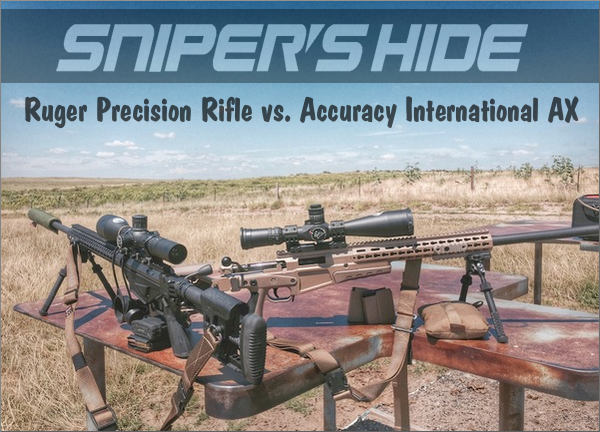
Sniper’s Hide has just released an interesting comparison test, running the $1150* Ruger Precision Rifle vs. a $7000 Accuracy International AX in a 450-yard “mad minute” drill. The goal was to see how many shots could be put on a 12″ steel target in one minute. Both rifles were chambered for the 6.5 Creedmoor and were fed with Hornady 140gr Amax ammo. The much cheaper Ruger did surprisingly well, though the AI AX did come out on top. Frank Galli, Head Honcho of Sniper’s Hide, got 19 rounds on target in one minute with the AI AX compared to 14 rounds with the Ruger.
Watch the “mad minute” face-off in this video:
Galli notes: “The target is 450 yards away, and, as noted in the video, we have winds gusting anywhere from 10 to 18 mph out on the Front Range of Colorado today. So my job is to not only hit the target as fast as possible, but to also manage the conditions.”
In Summary
Frank Galli says the Ruger offers a lot of bang for the buck:
“For those looking to get into competitive tactical shooting, like a PRS Event, there is absolutely no excuse. This rifle will allow you to be competitive, the only thing that would hold a person back is themselves. The more this rifle is shot, the more impressive it is. Would I trade my Accuracy International for one? Well, odd question, but no. However for those on a budget I would recommend the Ruger in a heartbeat.”
*MSRP for the Ruger Precision Rifle is $1399.00. Some dealers are posting prices as low as $1100.00, but $1150.00 seems typical.
Birchwood Casey has released an innovative Solid-Film Lubricant Pen that may be useful for some gun applications where conventional oils and greases are not appropriate. The Pen dispenses MLP Solid Film Lubricant, a semi-permanent, lacquer-like coating containing molybdenum disulfide (MoS 2) and corrosion-inhibiting elements.
Using the Pen, a low-friction lubricant coating can easily be applied to various friction points to reduce wear. Common application points on AR-style rifles include: charging handle, take-down pins, inside of bolt carrier, and mag well.
We can also see a use for this product on buttstock adjusting points, bipod joints/hinges, sling swivels — wherever a non-greasy lubricant can aid function. NOTE: We do not recommend this product for lubrication of bolt lugs on bolt-action rifles — we still think a high-quality grease-type lubricant is best for bolt-lug applications and other high-load points.
This Video shows where to apply Dry Film Lubricant on an AR-type rifle.
Birchwood Casey’s MLP Solid Lubricant Pen meets Mil-Spec requirements. The formula creates a tough, low-friction coating that helps prevent corrosion, galling, and seizing. IMPORTANT: after application, you should allow the dry-film coating to DRY for at least 6 hours before use.
Birchwood Casey claims that: “Once applied, MLP Solid Film Lubricant is virtually unaffected by atmospheric and fretting corrosion, solvents, acids, oils and degreasers. MLP Solid Film Lubricant operates at temperatures ranging from -320° to +300° degrees F.”
Larry Vickers is a respected firearms trainer who has served with the U.S. Special Operations Forces (SOF). In the course of teaching classes he’s learned that many gun owners waste money on impractical gun accessories. In his recent Ammoland.com article, “Don’t Be a Tacti-Cool Fool”, Vickers examines today’s trend of over-accessorizing firearms, particularly AR-platform rifles. Vickers doesn’t mince words… he states that too many people are spending too much money on poorly-designed hardware that may be “useless” at best.
Equipment Selection Advice from Larry Vickers
Every class I teach I see and hear students talking about the realization that some things about their gear and shooting in general just doesn’t add up on the range. Everything looks good in a Brownells Catalog but a significant amount of the parts and accessories offered on the market today are: a) useless; b) poorly designed; c) of questionable value; or d) downright dangerous.
No one is better at taking fully-functional, factory-made firearms and turning them into junk than a certain segment of the American gun-buying public.
Some people really don’t apply the common sense approach of not messing with what is potentially a life-saving tool. Sadly some of those same people will get on the Internet and talk bad about how the firearm they modified no longer functions and therefore is junk. Or they will recommend to fellow shooters the same parts and modifications they have used to turn their gun into, at best, a range toy.
Some of this shows up in my classes and usually by lunch on the first day the obvious flaws of the equipment at hand become apparent for everyone in the class, most of all to the owner of said equipment. It may have cost the shooter some money but in turn he learned a serious life lesson –be careful what you read on the Internet about firearms modifications and there is no substitute for shaking out your equipment at the range in a structured class.
I’ve said it before and I’ll say it again: you’ll learn more about guns and shooting in one class than you could in a month on the Internet.
READ about guns, gear, and shooting on the Internet. LEARN about guns, gear, and shooting on the range during well-thought-out and useful training. This approach is proven and consistently produces results and shooter confidence.
Larry Vickers is a retired U.S. Army Special Operations Forces veteran with 20+ years of service. Vickers served in Panama, the Middle East (Desert Storm), Somalia, Bosnia, and other locations. During his time with Delta Force, Vickers worked on weapons R&D, and served as a combat marksmanship instructor training new operational members of Delta.
First revealed at SHOT Show 2014, the Steyr SSG Carbon is finally making its way to America. It took Steyr 16 months to fill a large quantity of LEO orders, but now the innovative Steyr SSG Carbon should be available throughout the USA for $3695.00 MSRP. That sounds pretty expensive, but this is a very sophisticated rifle.
Here’s a very cool video — worth watching full-screen in HD.
The SSG Carbon is based on Steyr’s SBS action (with a +20 MOA rail on top). This gun features the same crisp, adjustable single-stage trigger used in the vaunted SSG 08. The rifle has a hammer-forged, four-groove 1:10″-twist barrel (20″ or 22.4″) chambered for the .308 Winchester. The SSG Carbon rifle offers excellent ergos, with adjustable cheek piece, adjustable butt plate, and an integrated adjustable rear mono-pod. But the real selling point for this rifle is the stock — a carbon stock built like a Formula 1 car chassis.
Chipped Carbon Stock Construction
Unlike conventional carbon-fiber stocks made from woven carbon fabric, the SSG Carbon’s stock is made using the same “chipped-carbon” Sheet Molding Compound (SMC) construction used to create load-bearing structures in Formula 1 racecars and high-performance aircraft. The SSG Carbon’s chipped-carbon flakes combine thermally with the binding agent to form the SMC for a distinctive appearance to the stock. The carbon chips interlock with each other to create a “tension net” that is superior to steel, at a fraction of the weight of steel or even aluminum. Steyr claims that the SMC stock material absorbs recoil better than wood, metal, fiberglass or other synthetics.
Steyr SSG Carbon Features
Caliber: .308 Winchester
Magazine type/capacity: Polymer double-stack detachable box/10 rounds
Finish: Mannox
Safety: 3+1 Position Safety
Trigger type: Single-stage, 3 lb. 8 oz. pull-weight
Stock material/type: SMC carbon fiber
Length of pull: 14.25 inches minimum (adjustable with 0.33″ inserts)
Comb adjustments: 0.5 inches longitudinal; 0.133 inch lateral (rotationally adjustable)
Drop at heel: +1.07 to -3.8 inches vertical adjustment
Pistol grip: Polymer with interchangeable rubber inserts
Initially drawn to the 6mmBR and 6mm Dasher, I realized these cartridges wouldn’t feed from an AICS magazine system without extensive modification. I took a look at the 6mm Creedmoor, 6XC, and 6mm-6.5×47 Lapua (aka 6×47 Lapua), all of which feed well from a detachable magazine. At right you can see the 6×47 Lapua in an AICS magazine. It has the “Goldilocks factor” — not too long, not too short.
The ability to simply convert 6.5×47 Lapua brass to 6×47 brass by running the parent 6.5mm brass through a full-length Forster sizing die in a single step was what made me choose the 6×47 Lapua over the 6mm Creedmoor and 6XC (both excellent cartridges in their own right). I also own a 6.5×47 Lapua rifle, so I had a supply of 6.5×47 brass ready to neck-down. Being able to create 6×47 brass easily (one pass and done) was very appealing.
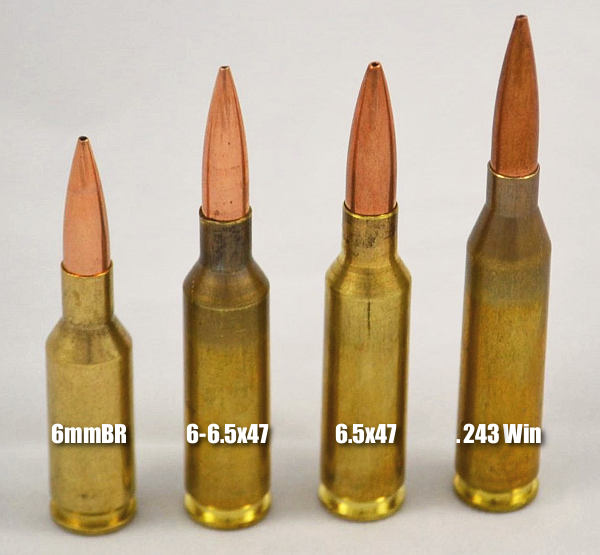
Left to right, below: 6mmBR, 6-6.5×47 Lapua, 6.5×47 Lapua, and .243 Winchester.
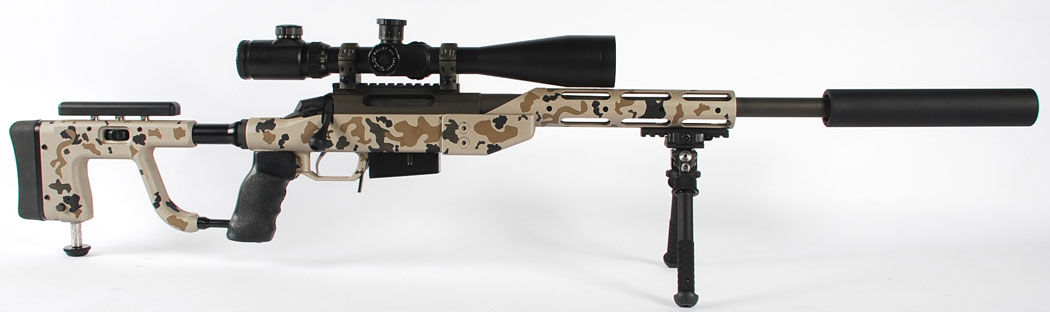
I cut the chamber end off my .243 Win barrel, threaded and chambered my rifle for the 6×47 Lapua cartridge. I have written a lengthy article on this cutting and re-chambering process. Home gunsmiths interested in this process can READ MORE HERE.
When the re-chambering was complete, I headed to the range and worked up a set of eight loads using Berger 108 BTHPs, H4350, Lapua brass, and CCI 450 primers.
Load development was a little trickier than with the 6.5×47 Lapua parent cartridge. The accuracy nodes were smaller. However, once I dialed in a load with Hodgdon H4350 and the 108-grain Berger BTHP, the rest was history. The 6×47 rig is now one of the most consistent rifles I own, holding just above 0.3 MOA for 5-round groups. Below is a 100-yard test target with 108-grain Berger BT in the 6×47 Lapua. Five-shot group sizes are (L to R): .369″, .289″, and .405″. The average size was .354″ or .338 MOA. [Editor: We think that is excellent accuracy for a tactical-type rifle shot from bipod.]
Learn More about this 6×47 Lapua Project
I’ve written more about this 6×47 rifle on my Rifleshooter.com website. To learn more about my experience with the 6×47 Lapua, click this link: 6-6.5X47 Lapua Review.
About the author: Bill has been a serious shooter for over 20 years. A former Marine Corps Sergeant, he’s competed and placed in High Power Rifle, ISPC, USPSA, IDPA, 3-Gun, F-Class, and precision rifle disciplines. In addition to being an NRA-certified firearms instructor and range officer, Bill has hunted big game in North America, South America, and Africa. Bill writes extensively about gunsmithing, precision rifles, and the shooting sports on his blog, Rifleshooter.com.
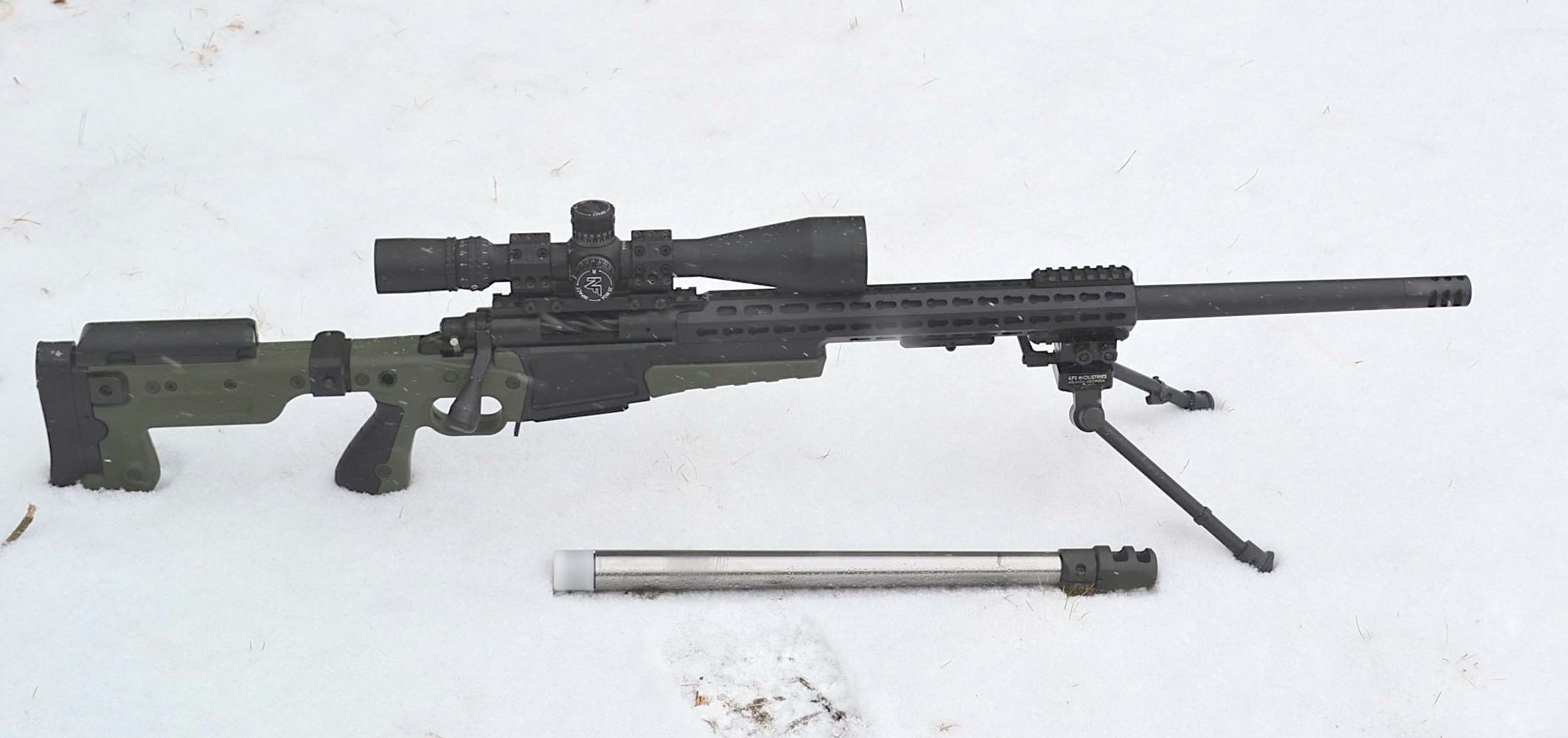
Tikkas are boring, nondescript hunting rifles right? Wrong. Check out this Tikka T3 tactical with “attitude”. For the British Shooting Show in 2014, the folks at Osprey Rifles placed a Tikka T3 action into a modern modular chassis: “A standard factory Tikka T3 was fully Cerakoted and dropped into a Third Eye Tactical chassis stock which also had the Cerakote treatment. It certainly pulled a crowd and was sold on the Show’s first day! We have been commissioned to do another one straight away.”
The NRA America’s Rifle Challenge (ARC) is a new short-range rifle discipline designed to develop practical shooting skills using modern sporting rifles such the AR-15. NRA-ARC is designed for shooters of all skill levels. With all targets positioned at 100 yards or less, almost any outdoor centerfire range is capable of hosting ARC matches. No pits or swinging target holders are required.
The ARC is a close-range, action-oriented discipline. The course of fire features targets placed from seven yards to 100 yards. Some stages also incorporate magazine changes and the use of barricades. ARC matches involve movement, as competitors transition into multiple shooting positions: standing, kneeling/sitting, and prone.
NRA-ARC is NOT limited to AR-15s. Any semi-automatic detachable magazine-fed rifle can be used. There will be three classes of firearms: Iron Sights, Optics Limited (with one non-magnified optical sight), and Optics Open (maximum two optical sights, one of which may be magnified).
SGT Tyler Payne of the USAMU gets rounds downrange quickly. Check out the spent brass.
The Sniper’s Hide Cup, one of the premier events on the tactical match circuit, has been underway this weekend in Colorado at the 6000-acre T3 Ranch. This year’s match got off to great start despite the bad weather. The 236 shooters completed all eight stages on time, a significant accomplishment in a field-type match of this scale. Here’s a video report from Day 2 of the event:
The National Shooting Sports Foundation (NSSF) this week learned that United Parcel Service (UPS) has apparently changed its policy regarding the shipment of firearms suppressors. According to the NSSF, a new policy is in effect at UPS facilities nationwide. This new policy states that UPS will no longer ship suppressors, even between Federal licensees.
NSSF representatives are now trying to find out why UPS has changed its shipping policies:
“NSSF is working with UPS executives to determine what prompted the enforcement of this unwarranted policy. We are unaware of any thefts or losses that would explain the shipping company’s sudden decision to enforce a prohibition against shipment. NSSF will keep you apprised of developments. Separately, NSSF is also working with the U.S. State Department to achieve a change of policy to allow export of suppressors.”