Do you know which one of your eyes is dominant? It’s easy to determine eye dominance with a simple exercise. Pick an object about 6-10 feet away (a light switch or door knob works well). Make an “OK” sign with your right hand (see photo) and hold that about 18″ from your face. Now, with both eyes open, look through the circle formed by your thumb and index finger. Center the circle on the object, so you can see the object in the middle.
Now, here’s the important part — while still holding your hand up, centered on the object, first close your right eye. If you don’t see the object anymore, then your right eye is dominant. If you still see the object, then repeat the procedure with the left eye shut and right eye open. If you don’t see the object when your left eye (only) is closed, then you are left-eye dominant.
The digital archives of Shooting Sports USA contain many interesting articles. A while back, Shooting Sports USA featured a “must-read” expert Symposium on Eye Dominance, as it affects both rifle and pistol shooting. No matter whether you have normal dominance (i.e. your dominant eye is on the same side as your dominant hand), or if you have cross-dominance, you’ll benefit by reading this excellent article. The physiology and science of eye dominance is explained by Dr. Norman Wong, a noted optometrist. In addition, expert advice is provided by champion shooters such as David Tubb, Lones Wigger, Dennis DeMille, Julie Golob, Jessie Harrison, and Phil Hemphill. NOTE: If the story doesn’t open at the links, go to the ssusa.org home page first, indicate you are over 18, and then CLICK HERE.
Top Rifle Champions Talk About Eye Dominance:
David Tubb — 11-Time National High Power Champion
I keep both eyes open, always. Some use an opaque blinder in rifle or shotgun shooting. If you close your non-dominant eye, you will not get as good a sight picture. If your aiming eye is not your dominant eye, you have even more of a problem to overcome.
Lones Wigger — World, National and Olympic Champion Rifleman
Shooters should try to use the dominant eye unless the vision is impaired and the non-dominant eye has better vision. You should always shoot with both eyes open since this will allow the shooting eye to function properly.
Dennis DeMille — National Service Rifle Champion
I close my non-shooting eye initially. Once I pick up my sight picture, it’s not something I focus on. For those that use a patch, I recommend that they use something white to block their view, rather than cover the eye.
Bruce Piatt — 2015 World Shooting Championship Winner
Some shooters, especially those with nearly equal or cross-dominance, will naturally find themselves squinting one eye. When anyone does this, you are also closing your dominant eye to some extent and adding stress to your face.
You have to admire someone with serious do-it-yourself skills. Not just hammer and nail skills, but formidable design and fabrication skills. Well Forum Member Dave D. (aka “AKShooter”) has a DIY skill set that might put some trained machinists to shame. You see, “DIY Dave” crafted his own pedestal front rest from scratch, using his own design and about $100.00 in materials (not counting the Edgewood front bag). Dave estimates he put 20 hours of labor into the project, but the end result was worth it: “This Do-It-Yourself rest drives like a dream. I’ve played with the Caldwell and a Sinclair, they have nothing on this one.”
Dave tells us: “Here is my Do-It-Yourself front rest. I wanted to show other folks who are handy that a solid front rest is doable with a bit of time — and you don’t need to spend $1000.00. (You could say this is a design for shooters with more time than money.) This is for F-Class. I was originally overwhelmed by the equipment needed, so I decided to make my own rest. I didn’t have the money for a SEB or Farley Coaxial. This is what I’ll run this season (my second as an F-Class competitor).”
We asked Dave what equipment was used to make the rest. He explained: “My brother has a CNC cutter. But most water-jet outfits would do the work for $100 or less. All the plates are tapped and screwed. I found small machine screws on eBay.” Dave says there are other ways to build a front rest: “You could do the same with a welder and plate stock for base. It’s easier to do the top out of aluminum though, with all the tapping.”
Dave enjoys fabricating his own gear, but he admits the process can be time-consuming: “I’m a DIY guy. Sometimes I wrap up a project and wonder why the heck I just spent X amount of time on it.” Dave has other projects in the works: “Another option we are making for a friend is taking a cheap front rest and bolting to a 3/4″ thick, wide MDF base and adding additional adjustment screws. The hardware store is your friend!”
On the competition front, Dave is tuning up a 6mm Dasher: “My rifle last year was a .260 Rem Savage repeater. I was about middle of the pack in my group of shooters. Just went with unsorted Bergers and Lapua brass, and had a ton of fun. Now I’m in — hook, line, and sinker. I have an unfired 6 Dasher barreled action from the folks at Kelbly’s to break in. I’m cheap, so I ended up with a Do-It-Yourself stock for the Dasher.” Hopefully Dave will send us a photo of his DIY-stocked Dasher when the gun is dialed-in and “ready to rumble”.
Many guys getting started in long range shooting are confused about what kind of scope they should buy — specifically whether it should have MIL-based clicks or MOA-based clicks. Before you can make that decision, you need to understand the terminology. This article, with a video by Bryan Litz, explains MILS and MOA so you can choose the right type of scope for your intended application.
You probably know that MOA stands for “Minute of Angle” (or more precisely “minute of arc”), but could you define the terms “Milrad” or “MIL”? In a helpful video, Bryan Litz of Applied Ballitics explains MOA and MILs (short for “milliradians”). Bryan defines those terms and explains how they are used. One MOA is an angular measurement (1/60th of one degree) that subtends 1.047″ at 100 yards. One MIL (i.e. one milliradian) subtends 1/10th meter at 100 meters; that means that 0.1 Mil is one centimeter (1 cm) at 100 meters. Is one angular measurement system better than another? Not necessarily… Bryan explains that Mildot scopes may be handy for ranging, but scopes with MOA-based clicks work just fine for precision work at known distances. Also because one MOA is almost exactly one inch at 100 yards, the MOA system is convenient for expressing a rifle’s accuracy. By common parlance, a “half-MOA” rifle can shoot groups that are 1/2-inch (or smaller) at 100 yards.
What is a “Minute” of Angle?
When talking about angular degrees, a “minute” is simply 1/60th. So a “Minute of Angle” is simply 1/60th of one degree of a central angle, measured either up and down (for elevation) or side to side (for windage). At 100 yards, 1 MOA equals 1.047″ on the target. This is often rounded to one inch for simplicity. Say, for example, you click up 1 MOA (four clicks on a 1/4-MOA scope). That is roughly 1 inch at 100 yards, or roughly 4 inches at 400 yards, since the target area measured by an MOA subtension increases with the distance.
MIL vs. MOA for Target Ranging
MIL or MOA — which angular measuring system is better for target ranging (and hold-offs)? In a recent article on his PrecisionRifleBlog.com website, Cal Zant tackles that question. Analyzing the pros and cons of each, Zant concludes that both systems work well, provided you have compatible click values on your scope. Zant does note that a 1/4 MOA division is “slightly more precise” than 1/10th mil, but that’s really not a big deal: “Technically, 1/4 MOA clicks provide a little finer adjustments than 1/10 MIL. This difference is very slight… it only equates to 0.1″ difference in adjustments at 100 yards or 1″ at 1,000 yards[.]” Zant adds that, in practical terms, both 1/4-MOA clicks and 1/10th-MIL clicks work well in the field: “Most shooters agree that 1/4 MOA or 1/10 MIL are both right around that sweet spot.”
CCI is now producing Catalyst lead-free primers and Catalyst-primed CCI and Speer ammunition at the CCI factory in Lewiston, Idaho. The proprietary Catalyst lead-free primer was first developed in 2016 by Federal Ammunition, a CCI/Speer partner company. The advanced lead-free Catalyst primers have been used in CCI- and Speer-brand pistol ammo, and are featured in Federal’s Syntech Range ammo and American Eagle lead-free ammo. Eventually, CCI may eventually offer lead-free primers for the reloading market.
Writing for the MagLife Blog, Kat Ainsworth described Catalyst lead-free primers: “Many manufacturers use lead styphnate mixtures in the production of primers, but Federal Ammunition states the proprietary design utilized in the Catalyst is not only lead-free but outperforms those other methods. The company also says the Catalyst primers are safer to manufacture and provide a host of benefits over lead designs. For example, the Catalyst primers deliver greater compatibility with modern powders, produce less pressure from the gases generated during live fire, and don’t cause degradation in the powder they touch.
The company says these primers are extremely clean-burning which helps them perform more uniform and complete propellant combustion. Even better, the Catalyst has minimal velocity variation[.] These primers are also non-hydrophilic, meaning they don’t attract water molecules like DDNP-based mixes that are found in other brands[.]”
Catalyst Primers Promise Best-in-Class Performance
“We are extremely proud of this new production capability which continues the rollout of an incredible primer technology” said Federal/CCI/Speer President Jason Vanderbrink. “This product has proven to be the best in its class after nearly seven years of continuous production. Its consistent performance has been tested over hundreds of millions of rounds. Most notably, the product is featured in Federal’s innovative Syntech Range ammo and American Eagle Lead-Free.”
The extremely clean-burning Catalyst primer creates more uniform and complete propellant combustion, yielding minimal velocity variation and consistent bullet launch for improved accuracy. It is also non-hydrophilic, so it does not attract water molecules like DDNP-based mixes found in most lead-free primers, resulting in better reliability.
“Catalyst lead-free priming technology provides the cleanest, most consistent ignition possible. We are excited that our Lewiston plant is now set up to run Catalyst priming in our target pistol products”, said Speer and CCI’s Director of Factory Operations Mike Overberg. “The Anoka facility has proven this to be the best lead-free priming technology available. Our staff here has done a fantastic job of working across factories to extend this product into Speer and CCI Blazer ammunition products made in Lewiston, Idaho.”
Firearms enthusiasts definitely need to employ hearing protection at all times when shooting or visiting an active range. Just a few moments of unprotected sound exposure can have permanent negative effects. For best protection, consider “doubling up” — wearing good foam plugs under quality muffs. This allows max sound reduction — as much as 5-6 dB quieter than good muffs alone. If the muffs are electronic (with filtered microphones that block extreme sounds), you can still hear range commands.
So How Loud Are Gun Shots?
A pistol gunshot can reach 160 decibels (dB), and rifle gunshots can be even louder, exceeding 170 dB. This means you can do permanent damage to your hearing with just a few shots fired. 160 dB is 20 decibels over OSHA’s threshhold for safe noise levels. This is why it’s essential to always use hearing protection when you are anywhere near firearms being discharged.
“Science tells us that exposure to continuous noise of 85 dB for eight hours is enough to cause permanent hearing loss, and worse, spikes of 130 dB and more can result in permanent hearing damage instantly.” Source: NRA Blog.
This American Suppressor Association (ASA) Video explains that gunshots can measure 160-170 decibels, high enough to cause permanent effects. (See: 00:20 time-mark)
The Risk of Hearing Loss
Hearing loss can be progressive and irreversible. If you are a shooter, this is serious business. As the NRA Blog cautions: “You may not even realize you’re harming your hearing. Hearing loss occurs gradually, and can go effectively unnoticed until symptoms become severe. By then, the damage is done. Effective hearing protection is a must whenever you are shooting firearms or when you are in the vicinity of gun-shots. For ultimate protection, we recommend a good set of tapered foam earplugs, topped by ear-muffs. However, there are situations when you may prefer lighter-weight hearing protection that can be quickly removed. For example, if you are standing well behind the firing line as an observer, or if you are working as a rangemaster or waddie some distance away from the shooters.” Good muffs or plugs will reduce sound by 23 to 33 dB.
Sound Levels for Common Noises:
9mm Luger pistol: 160 dB
Jet aircraft engine (near): 140 dB
.22 LR pistol: 134 dB
Normal human pain threshold: 120 dB
Noisy Nightclub: 110 db
Riding Motorcycle at 65 mph: 103 db
Power Lawnmower: 95 dB
Hearing damage possible: 85 dB (sustained for 8+ hours)
Ringing Telephone: 80 dB
Normal conversation: 60 dB
Hearing Protection Product Reviews
Shooters should have comfortable, effective muffs, preferably that allow normal conversations to be heard through internal electronics. For best protection, run good earplugs under electronic muffs. There are also electronic earbuds that provide protection, but these do not provide all the benefits of good muffs as some noise energy can be transferred through bone conduction.
The following videos evaluate a wide variety of earmuffs currently on the market. Some of the big muffs boast a 30 dB Noise Reduction Rating (NRR), while thin, muffs may only have a 22-23 dB NRR. Remember that decibel scale is logarithmic, so, according to the experts, a 3 dB gain represents twice the sound energy. So “this means that a small change in the number of decibels can result in a significant change in the intensity of noise and hence its potential to damage a person’s hearing. [F]or every 3 dB the sound level increases the impact on hearing health which is doubled. For example, 63 dB is twice as noisy as 60 dB. For every 3dB the noise level increases, the exposure time must be halved to keep the worker safe from harm.” Source: Institution of Occupational Safety and Health (IOSH).
Yes Hunters Need to Employ Sound Protection
According to Dr. William W. Clark, the current Director of the Washington Univ. School of Medicine’s Audiology/Communication Sciences Program, a “serious threat to hearing comes from recreational hunting or target shooting”. This is in large part due to the fact that many people choose not to use traditional hearing protection devices like earplugs and earmuffs because they want to be able to hear their surroundings. Multiple studies have found that between 70 to 80% of hunters never wear earplugs or earmuffs, and nearly half of all target shooters don’t consistently wear traditional hearing protection. Thus, it should come as no surprise that for every five years of hunting, hunters become seven percent more likely to experience high frequency hearing loss.
We recommend that hunters carry quick-insert plugs on a cord around your neck. These can be quickly deployed when you are getting ready to shoot. Or, get a lightweight neck band with earbuds, such as Howard Leight Quiet Band QB2HYG, Sellstrom Band, or 3M Safety Band, all with good Noise Reduction Ratings of 25 dB or higher. You can keep these lightweight bands around your neck for quick deployment.
Thanksgiving is just three days away. We know many of our readers will be traveling by air this week, and during the Christmas holidays. This article reminds folks who travel to alwasy comply 100% with rules. Don’t make an oversight that can land you in jail.
Handgun Transport During Flights — How to Do It Properly
It IS legal to take a handgun on an airline flight in checked baggage (if you follow the rules). But for goodness sake — declare the weapon as required by law and comply with all TSA and Federal regulations. Do NOT just toss your pistol in your carry-on and expect to board the plane. About 4,000 pistols were discovered in carry-on luggage in 2017. That can result in seizure and confiscation of the weapon, and just might land you in jail!
Gun writer Dean Weingarten has written an excellent article about handgun seizures at airports. Remarkably, in a single week a few years ago, 97 handguns were found in carry-on bags at U.S. airports.
TSA gives a list of the pistols found. The list shows the make, model and caliber of most of the pistols. There were 93 pistols where the caliber was identified.
9mm pistols were still the most common, with 36 represented. .380 pistols, known in Europe as 9X17, 9mm Kurtz, or 9mm Corto, were the next represented, with 24 present. That is 70 pistols, or 75% of the pistols found. There were a smattering of other calibers. There were eight .40 caliber pistols, seven .22 LR rimfire, six .45 caliber, five .32 caliber, four .38 caliber, one .410, and one .22 magnum.
Most of the pistols were semi-autos, there were a few revolvers, and three derringers.
How does this happen? It is the principle of rare occurrences. While an event may be extremely rare for each individual, if enough individuals are involved, the occurrence of rare events becomes a statistical certainty. About 4,000 pistols were discovered in carry-on luggage in 2017. There were about 770 million travelers passing through TSA checkpoints in that year. That is one pistol found for about 194,000 passengers. Each passenger presumably went through TSA checkpoints at least twice, once going, once returning. Some passengers go through multiple checkpoints, depending on the route taken.
I believe it happens in ways most people do not consider, because they are RARE. One way is to be distracted at a critical moment. Perhaps a business owner has made the decision to move a pistol from his briefcase to his locked desk [but then is distracted] and he has to rush to make his flight. The pistol remains in the briefcase and is discovered by the TSA.
The quality of the pistols found suggest most were taken from people who can legally carry them in most places. There are over 17 million people with carry permits in the United States. There are 13 states where no carry permit is required.
No one is perfect. Everyone makes mistakes. It is part of the human condition.
Another rare scenario is for a third party to put the pistol in the carry-on without the carrier knowing about it. In at least one case, this was done to a school student, maliciously. In that case, it was put in a teens’ backpack[.]
Some [handgun violations] occur because the traveler borrowed a piece of carry-on luggage, and missed a small pistol tucked into a dark recess of the luggage, where another family member kept it. I suspect that most pistols are discovered precisely because the carriers are NOT attempting to smuggle them.
Most of these errors are recognized as honest mistakes by the TSA. The TSA is not the end of the legal problems for a person who finds themselves in this situation. The biggest players are the states. How the situation is handled depends on where the situation occurs.
When traveling, check your carry-on twice. If you discover you have made a mistake, correct it.
Sinclair International has created a series of instructional videos illustrating the basics of metallic cartridge reloading. The 8-Part series starts with reloading basics and provides step-by-step, how-to instructions that will help new reloaders get started. Detailed, animated illustrations show you what happens inside the chamber when shooting, and inside the dies during each step of reloading. The videos can be viewed on Sinclair International’s YouTube channel. Shown below is the first video in the series:
Each of the Sinclair videos is hosted by then Sinclair Int’l President Bill Gravatt (now with Creedmoor Sports). Bill doesn’t just show you “how”, he tells you “why”. The how-to segments cover case inspection, proper die set up, case sizing, primer installation, powder measuring, bullet seating, crimping, and even goes into the record keeping needed for the handloader. “We wanted to give shooters who haven’t reloaded a look at all the advantages of creating your own ammo and how easy it is to get started,” said Gravatt, “without telling them they had to have any certain brand or type of equipment to do the job.”
The Eight Video Topics Are:
Part 1 — Intro to Video Series
Part 2 — Intro to Reloading Safety
Part 3 — Metallic Cartridge Components
Part 4 — The Firing Sequence
Part 5 — Tools for Reloading
Part 6 — Loading Bottle-Neck Cartridges (2 videos)
Part 7 — Loading Straight Wall Cartridges
Part 8 — Reloading Series Conclusion
Reloading Tools
Shown below is Part 5 of the video series, covering the tools used for precision reloading.
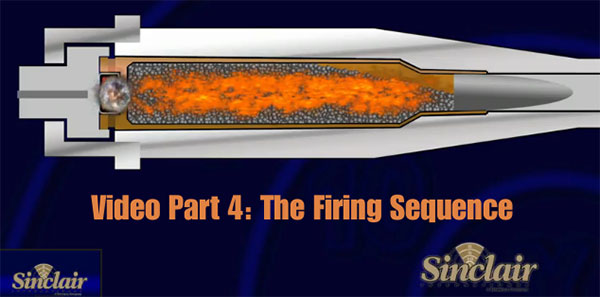
We also strongly recommend the Part 4 Video to readers who are getting started in reloading. This “How Things Work” segment covers the sequence of events inside the chamber (and barrel) when the cartridge is fired. The video includes helpful graphics that show what happens to the primer, powder, cartridge, and bullet when the round is fired. The video also illustrates “headspace” and explains how this can change after firing. We think this video answers many common questions and will help reloaders understand the forces at work on their brass during the firing process.
When shooting targets, the closer to the center the better the result. But this is not necessarily true when it comes to using jags and patches. There are some good reasons to try spiking your patches away from the center. This Creedmoor Sports Tech Tip explains why you may want to spike (puncture) your patch away from the center. CLICK HERE to order patches and Swab-Its cleaning bore tips from Creedmoor Sports.
You begin to push your first patch down the barrel and you notice it is extremely tight and then it jams! How can this be? A commonly overlooked solution to remedy the frustrating occurrences of overly tight or jammed patches is what we like to call “Side-Spiking”. Side-Spiking is super simple and works!
“Side-Spiking”, as the words suggest, refers to moving your patch spiking position from the center of the patch towards the corner of a square patch or the edge of a round patch.
Moving From Center-Spiking To Side-Spiking
The closer toward the edge of the patch you spike your jag, the looser the patch will be when pushed down the bore.
Important: Be careful to not go to the very edge of the patch. Leave enough patch material to fully cover the first set of rings on your jag as this insures your jag is properly centered in the bore and that no contact with the rifling will occur.
Proper Side-Spiking Location Creedmoor Sports recommends side spiking all wet patches. This allows for a looser patch in the bore which removes gross powder fouling and leaves more cleaning solution behind to start working on the remaining fouling.
When a tighter patch is needed, simply move your spike closer toward the center of the patch. The closer to the center of the patch you get, the tighter the patch will become in the bore. The objective is to have a snug-fitting patch that allows you to smoothly push your rod down the bore. Remember you do not need to end up in the center of the patch!
Bore-Tech Patch Size Selection Chart Recommends Patch Sizes by Caliber:
Here is a stunning highlight reel created by Bullet Theory Films, a Los Angeles-based production company that specializes in capturing action that is too quick for the human eye to see. Using ultra-high-speed cameras, these talented film-makers have captured blindingly fast phenomena — things that happen in micro-seconds. The resulting video imagery can be used for R&D, scientific analysis, product marketing, or (of course) entertainment.
We recommend you watch this video full-screen in High-Definition:
This impressive slo-mo “sizzle reel” features many notable sequences, including:
00:18: .45 ACP leaving m1911 muzzle
00:27: Rifle bullet penetrating barrier with explosive ejecta
00:33: M1A cycling 7.62×51 cartridges
00:38: Pistol bullet disintegrating on steel
00:40: Huge muzzle flame from 12ga shotgun and lead shot on steel
00:45: 5.56 bullet in ballistics gelatin with secondary explosion
01:07: Handgun flame ring from muzzle
01:11: Massive shotgun blast with slug in midair
About the Film-Makers
Bullet Theory Films Co-Founders Matt Novello and Matt Drake first met on the set of History Channel’s highly successful competition reality show TOP SHOT. Throughout five seasons, the show set a benchmark in the art of capturing firearms and live ammunition in action, which has yet to be surpassed.
Utilizing the latest digital high speed technology, Bullet Theory Films offers a full range of production services; from concept development, to the final delivery of your vision. For more information, visit BulletTheoryFilms.com.
We created this custom target in 5 minutes using PrintTargets.net. If you like it, DOWNLOAD HERE.
AccurateShooter.com has a HUGE collection of FREE downloadable PDF targets. We offer a very wide range of target designs: Load Development Grids, NRA Bullseye targets, Official-Size BR targets, Realistic Varmint Targets, Silhouette Shapes, Fun Plinking Targets, and even specialized tactical training targets. If our collection of free targets isn’t enough, or if you want to create a new kind of target — you’re in luck. The Australian-based interactive website, PrintTargets.net, allows you to create your own customized, printable PDF targets. Shown below are just a few of the target designs you can create in minutes:
CLICK Graphic to Create Your Own Targets.
Just follow the step-by-step instructions to set paper size, layout, bullseye color, line thickness, number of rings and diameter. You can even add Score Numbers to your target rings. PrintTargets.net is easy and fun to use. It’s much faster to create targets this way than to try to draw a series of circles with PowerPoint or MS Paint.
Power-User Tip: PrintTargets.net even offers a handy diamond-grid calibration diagram that you can add to your custom target designs. You’ll find the calibration grid as option #15 when you design your target — just scroll all the way down the PrintTargets.com home page.


 Do you know which one of your eyes is dominant? It’s easy to determine eye dominance with a simple exercise. Pick an object about 6-10 feet away (a light switch or door knob works well). Make an “OK” sign with your right hand (see photo) and hold that about 18″ from your face. Now, with both eyes open, look through the circle formed by your thumb and index finger. Center the circle on the object, so you can see the object in the middle.
 The digital archives of Shooting Sports USA contain many interesting articles. A while back, Shooting Sports USA featured a “must-read” expert Symposium on Eye Dominance, as it affects both rifle and pistol shooting. No matter whether you have normal dominance (i.e. your dominant eye is on the same side as your dominant hand), or if you have cross-dominance, you’ll benefit by reading this excellent article. The physiology and science of eye dominance is explained by Dr. Norman Wong, a noted optometrist. In addition, expert advice is provided by champion shooters such as David Tubb, Lones Wigger, Dennis DeMille, Julie Golob, Jessie Harrison, and Phil Hemphill. NOTE: If the story doesn’t open at the links, go to the ssusa.org home page first, indicate you are over 18, and then CLICK HERE.
 You have to admire someone with serious do-it-yourself skills. Not just hammer and nail skills, but formidable design and fabrication skills. Well Forum Member Dave D. (aka “AKShooter”) has a DIY skill set that might put some trained machinists to shame. You see, “DIY Dave” crafted his own pedestal front rest from scratch, using his own design and about $100.00 in materials (not counting the Edgewood front bag). Dave estimates he put 20 hours of labor into the project, but the end result was worth it: “This Do-It-Yourself rest drives like a dream. I’ve played with the Caldwell and a Sinclair, they have nothing on this one.”




 “Side-Spiking”, as the words suggest, refers to moving your patch spiking position from the center of the patch towards the corner of a square patch or the edge of a round patch.


