To optimize your loads and to generate precise ballistics tables, you need a quality chronograph. Having precise readings of bullet muzzle velocities lets you calculate ES and SD to determine the most repeatable load with least vertical dispersion. Very accurate velocity data is also essential to created a precise drop table for long range and to predict the effect of winds. There are many good chronographs on the market, ranging in price from around $100 to $1000, not counting tripods.
Today’s Saturday Movie showcase features a variety of modern chronographs. We include comparison tests, as well as video reviews of the new, small-format Bulletseeker Mach 4 and AndiScan Micro A2 Doppler Radar chronographs. If you are in the market for a new chronograph and have the resources, you should definitely consider one of these new small chronos, which are easy to set-up and can be mounted directly to your rifle. For those with a limited budget, MagnetoSpeeds still offer great performance for the price. However, you may have to conduct load tuning separately with the MagnetoSpeed removed.
Triple Chronograph Comparison Test
LabRadar, MagnetoSpeed, and Shooting Chrony Alpha Master
This video has an interesting comparison test with three chronograph devices operating at the same time. A Shooting Chrony Alpha Master unit was set up downrange, while a modern LabRadar was placed to the right side of the rifle. On the barrel of the rifle a MagnetoSpeed chrono was attached. This allowed the tester to compare shot velocity values from all three chrono systems at the same time. The video creator explained: “I was curious to see if my old [Shooting Chrony] chronograph could still give me useful velocity information compared to using the newer MagnetoSpeed and LabRadar.”
Chronograph Functions and Features — Vortex Nation Podcast
In this 78-minute video, experts from Vortex explaining how modern chronographs work. The discussion covers the technical features of various chronographs. Multi-time F-Class National Champion Ian Klemm and former sniper Tony Palzkill examine different chronograph types, explaining how they operate. Ian discusses the pros and cons of different chronograph designs, and provides many good tips for chronograph owners. This 78-minute discussion covers multiple chronograph designs, including LabRadar, MagnetoSpeed, and Caldwell Ballistic Precision. There is also extensive discussion of ballistics in the first 20 minutes.
MagnetoSpeed vs. Caldwell Ballistic Precision Chronograph
In this video the host compares a MagnetoSpeed with an older, first generation Caldwell Ballistic Precision Chronograph, mounted a few yards downrange on a tripod. The tester favored the Magnetospeed saying it was “incredibly accurate” while being much easier to set up and transport. He also says the MagnetoSpeed App was very “user-friendly”.
NOTE: Skip Forward to 5:40 to see the Bulletseeker field-tested as mounted on rifle and on tripods.
The Bulletseeker Mach 4 is a new radar chronograph that mounts directly to your rifle. The advanced Bulletseeker features 120 Ghz radar with a beam-forming lens. Developed in Europe, with made-in-Germany core components, this unit is sold in the USA for $999.00 by Longshot, trusted maker of long-range target cameras. We think this is a game-changer. You get advanced radar ON YOUR GUN, with no need to haul around a bulky LabRadar.
Comparison test with the Bulletseeker Mach 4 and LabRadar
Another Bulletseeker tester was very impressed: “Based on my experiences with the device it seems like a good product that does everything it advertises. All the benefits of a LabRadar without the drawbacks.” (SEE Product review HERE.)
In this video, our friend F-Class John tests the innovative, ultra-compact AndiScan Micro A2 Doppler radar chronograph. This unit is small enough that it can be fitted to your rifle, or attached to a front rest or mini tripod. John tested an early pre-production model. The production model is now available for 800 Euros on the SQI-AndiX eShop. The manufacturer notes: “The next large 2023 production series is expected to be ready by the end of February.”
Product Description: “The AndiScan Micro A2 is an advanced ballistic velocity Doppler radar for measuring muzzle velocity of projectiles. It operates in 24GHz frequency band. It is a highly integrated and extremely small form-factor device that is intended to be directly mounted on the rifle. This frees the user from a complicated setup alignment and it also allows to perform measurements under dynamic conditions. It is the first device [with] this form-factor on the public market.”
JKL Inertial Trigger for LabRadar
The JKL Inertial Trigger for the LabRadar is an easy-to-use, inertial-driven trigger that activates simply from the recoil of your gun. Rather than activate by sound or Doppler reading, the JKL Trigger works from the rifle’s instantaneous recoil pulse when a shot is fired. The unit consists of a small rectangular pad attached to a long audio cable. All you do is plug in the audio cable, attach the pad to your gun with the provided hook and loop (Velcro) material. Then (important), you must change the LabRadar trigger settings from “Doppler” to “Trigger”. The unit works great and is easy to set up.
The text in this article is Copyright 2023 AccurateShooter.com. No site shall reproduce this article without express authorization.
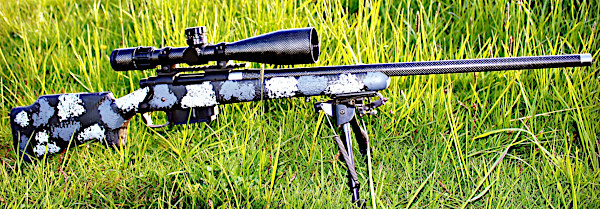
Are you looking to shave POUNDS from your hunting rig or varmint rifle? There are now multiple options for folks looking for a weight-saving, carbon fiber-wrapped barrel. You’ve probably heard about Proof Research. Yes that’s a good company that crafts good products. But now Proof Research has some noteworthy competition — Helix 6 Precision in Washington State.
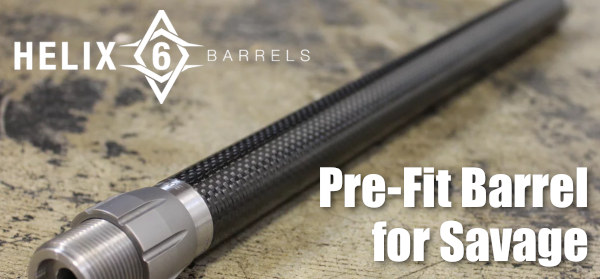
Helix 6 Precision crafts button-rifled and cut-rifled carbon-wrapped barrels in both conventional and “pre-fit” configurations. Pre-fits are offered for Savage rifles, Ruger Precision Rifle (RPR) series, and SIG Cross rifles. These pre-fit barrels are not cheap. A 6mm Creedmoor RPR pre-fit costs $1099.99, while the Savage pre-fits are also $1099.99 for most chamberings. The conventional (not pre-fit) carbon-wrapped Helix 6 barrel blanks cost $979.99 for most listed chamberings.
While Helix 6 barrels do offer significant weight savings, the founders of Helix 6 say low mass wasn’t the number one design goal: “Accuracy was paramount and weight reduction was secondary. We’ve taken the industry’s most advanced carbon fiber engineering and pushed the technology further with our proprietary … carbon fiber process.”
The founders of Helix 6 Precision say they build some of the best carbon/steel hybrid barrels on the market: “Our unique carbon fiber-layup design dampens barrel harmonics for better accuracy. Each barrel is cut from a 416R stainless steel core, and carbon fiber-wrapped using the Helix 6 Precision’s advanced process. This creates match-grade accuracy barrels with high heat dispersion that are 30% lighter than a steel barrel of the same contour. The bores are … hand-lapped for precision accuracy.” Helix 6 claims its barrels are “lighter, stronger, and faster cooling than anything else available on the market.”
Myth vs. Reality — What Carbon Can and Cannot Do
Carbon fiber is formed using thin strands of carbon bonded together with a plastic polymer resin. The resulting material is very strong and light weight. There’s a reason Formula 1 cars are crafted with carbon-fiber composites. But is a carbon-wrapped barrel the right option for you? Here are some factors to consider:
Weight Savings — There’s no doubt that a carbon-wrapped barrel will weigh less than an unfluted stainless steel barrel with identical length and contour (outside diameters). Helix 6 claims a 30% weight reduction compared to a conventional stainless steel barrel. That’s significant.
Accuracy — Carbon-wrapped barrels are NOT commonly being used for F-Class or Benchrest competition. However, Proof Research carbon-wrapped barrels have performed well in PRS competitions in the hands of top shooters. So, we can conclude that carbon accuracy is good enough for the PRS/NRL tactical game, at least at the local club level.
Heat Dispersion — Carbon-wrapped barrel-makers claim their hybrid design disperses heat better than an all-steel barrel. Some independent testers disagree, saying: “hold on now — the carbon actually acts as an insulator, so more heat is retained in the barrel”. The jury is still out. One thing that is true is that the carbon barrels seem to generate less mirage from barrel heat. Ask yourself, “if less heat is coming OFF the barrel, where is that heat retained?” But the reduced mirage could be a function of the black woven surface which may release heat differently than polished steel.
Pre-Fit, AR, and Custom Barrel Options
Helix 6 precision barrels are available as pre-fits for both Savage and the Ruger Precision Rifle in many popular long-range cartridges. Helix 6 can also thread and chamber a barrel for any precision rifle. And pre-fit AR barrels are available in a wide variety of chamberings and lengths. Helix 6 Precision also supplies carbon-wrapped barrel blanks which can be chambered and fitted by a professional gunsmith. Helix 6 barrel blanks, buttoned-rifled or cut-rifled, are sold in many calibers. Buttoned-rifled barrel calibers are: .224, .243 (6mm), .264 (6.5mm), .284 (7mm), .308 and .338. Cut-rifled barrel calibers are: .224, .243 (6mm), .257, .264 (6.5mm), .284 (7mm), .308, .338, and .375.
This article is Copyright 2023 AccurateShooter.com. No other website is allowed to publish this article in whole or in part without payment of fees.
Here are some really smart tips for hand-loaders compiled by Sierra Bullets. These suggestions were submitted by Sierra’s Facebook fans — and some are very valuable indeed. Some of these tips will help you load more accurate ammo. Other selections will help you stay SAFE — which should always be your #1 priority. For example, we concur with the advice to “Check and Double Check. Everything. Every Time”. Also definitely keep “One powder on the bench at a time” — that could be a life-saver. You may want to print these “words of wisdom” and place them on a wall in your loading room.
Reloading Safety Tips — Sound Advice
ALWAYS START LOW: “Just because a load manual says X grains of X powder with X bullet is max, your rifle could reach max pressure a grain or two before what the book says. Start low and work up.” — Walter Coats
BE SAFE and CAREFUL: “Check and double check. Everything. Every time. Only one type of powder on the bench at a time.” — Glen Lundgren
DON’T RUSH: “Be patient, don’t be in a hurry, have fun and find your rhythm. Just tell your family you’re putting yourself in ‘time-out’. They will understand.” — Erik Dyal
POWDER RULE #1: “One powder on the bench at one time, it might save your life.” — James A. Kimery
STAY FOCUSED: “Relaxed but concentrated attention. Have fun enjoying a great hobby and pastime but stay focused.” — Jim Caldwell
POLICE LOADING AREA: “Keep your reloading bench area clean and put items away ASAP.” — Eric J. Ford
BE PATIENT: “Focus, Focus, Focus — be patient — it AIN’T a race.” — William Stanley
RECORD YOUR LOADS: “Write down on a small card what you’re loading – bullet weight, powder weight, type of powder, and primer. And put it in the powder hopper. I am unloading .45 FMJ because I forgot what type powder was in the hopper.” — Michael Conniff
HAVE a PROCEDURE for INTERRUPTIONS: “If, for any reason, you have to leave the bench while in the process of dropping powder charges, turn the next case to be charged upside down in the loading block so you know where you left off.” — Bill Tinsley
LABEL EVERYTHING: “OCD is a good habit to have with your loading bench. CLEARLY label everything!” — Andy Pynckel
HAVE a GOAL: “Never start reloading or developing a load without a specific goal in mind. Second keep meticulous records.” — Peter Eick
RESEARCH THE JOB: “Read all you can about it before you start!” — Keith Shively
KEEP TRACK of the Brass: “I put all my primed brass upside down (primer up) and as I charge the casing, I (of course) flip it primer down.” — Mark Ewing
AR-platform rifles run dirty — very dirty. The gas system blows carbon and powder residues back into the action and into the bolt carrier group. That’s why you need to clean your ARs regularly, and you have to pay special attention to the nooks and crannies in the bolt and bolt carrer. The majority of AR failures we’ve witnessed have been from a combination of lube, carbon, and tiny brass shavings that collected in the ejector recess and the extractor spring recess. After that, plain carbon build-up on the bolt can be a gun-stopper too. And you need to keep the barrel extension clean too.
If you’re new to the (dirty) world of ARs, here are two helpful videos from the folks who make Froglube. That line of cleaners/lubes is pretty good stuff, though not our first choice for all AR lubrication and cleaning chores. But these videos do provide many helpful tips. They show the disassembly process and highlight the problem areas to which you must pay special attention.
How to Clean Your AR-15 Bolt Carrier Assembly
How to Clean Your AR-15 Lower Receiver Assembly
NOTE: Froglube also makes a video showing AR upper, chamber, and barrel cleaning. There are practices shown there that we do NOT recommend. Nor do we recommend Froglube products for bore cleaning. We think there are more effective cleaning products.
On Wednesdays, the U.S. Army Marksmanship Unit often publishes a reloading “how-to” article on the USAMU Facebook page. One “Handloading Hump Day” post covered bore-cleaning, specifically the use of pull-through style bore-snakes. Visit the USAMU Facebook page each Wednesday for other helpful tips.
Today, we’ll shift from handloading to rifle bore cleaning and maintenance, with information courtesy of the USAMU’s Custom Firearms Shop. We recently had some inquiries about bore cleaning, and this seems a good opportunity to share. After all, even the best handloads won’t yield their full potential in a poorly-cleaned and maintained rifle.
NOTE: Hoppes claims a trademark on the term “BoreSnake” (one word, no hyphen). For this article, the USAMU has used the term in hyphenated form, two words. We believe the USAMU is referring to a Hoppes Brand Boresnake, not a different bore cleaning rope.
BORE-SNAKES: MIRACLE REPLACEMENT FOR THE CLEANING ROD?
The experiences of both our firearms test specialist and this writer have given no evidence that proper use of a clean bore-snake will damage a match barrel. Of course, one does not pull the bore-snake at an angle to the crown when removing it — pull it straight out, parallel to the bore’s direction, to prevent crown wear over time.
Bore-snakes are very useful for some applications (primarily a hasty, interim wipe-down). In [my] experience they cannot replace a thorough cleaning with a proper rod and brushes. While the experiment cited here involves rimfire, it may help illustrate. Several years ago, the writer used his new, personal Anschutz to investigate the bore-snake issue. It had been fired ~350 rds with match ammo and had had 3 typical rod/brush cleanings.
Next, starting with a clean bore, the writer fired 300 more rounds without cleaning in order to build up a “worst-case” fouling condition. Afterwards, the writer examined the bore with a Hawkeye bore scope. There was a uniform, grey film down the entire barrel, with some small, intermittent lead build-up at and just forward of the throat.
Some bore-cleaning rope products feature separate, detachable bronze brush and bore mop segments. This allows more usage options (e.g. mop only), and makes it easier to clean the brush elements:
A new bore-snake was then wet with solvent and pulled through the bore. The Hawkeye revealed that the grey fouling was gone, and much of the visible fouling at the throat was reduced. However, nine more passes with the bore-snake, checking after each with the Hawkeye, revealed no further improvement in cleaning. The writer then cleaned with two wet patches, observed, then one stroke of a new, wet bronze brush, and one wet patch to clean out residue.
The Hawkeye showed a significant reduction in fouling at the throat; it was virtually gone. A second pass with a wet bronze brush and a wet patch removed the remaining fouling. Scrubbing the bore further, checking to see how much fouling was removed, revealed no significant improvement. The reason for this test was to learn what’s needed to get (and keep) this Anschutz clean with minimal cleaning rod use — and thus, minimal risk of bore damage/wear. Leaving fouling in the bore promotes corrosion over time.
Obviously, this applies to a nice, smooth rimfire match barrel, using good, well lubed ammo. It doesn’t apply directly to the use of copper-jacketed bullets, which leave a stubborn fouling all their own. However, it does suggest that while the bore-snake can be helpful and a useful field-expedient, to truly clean a rifle barrel one will still need a good quality rod, bronze brush and solvents. [Editor: Add a good-fitting cleaning rod bore guide.]
SO, WHAT ABOUT BORE SNAKES FOR BARREL BREAK-IN?
The goal of barrel break-in is to fire each shot through a clean barrel, preventing copper buildup and allowing the bullets their best chance at burnishing sharp edges. Thus, it seems this purpose would be best served by one’s usual rods, brushes and rod guides.
The Coriolis Effect comes into play with extreme long-range shots like this (2100 yards at Raton, New Mexico). The rotation of the earth actually moves the target a small distance (in space) during the long duration of the bullet’s flight.
When you’re out at the range, the Earth seems very stable. But it is actually a big sphere zooming through space while spinning around its axis, one complete turn every 24 hours. The rotation of the earth can create problems for extreme long-range shooters. During extended bullet flight times, the rotation of the planet causes an apparent deflection of the bullet path over very long distances. This is the ballistics manifestation of the Coriolis Effect.
Bryan Litz of Applied Ballistics discusses explains the Coriolis Effect in his Ballistics Books and Seminars. Bryan notes that Coriolis is “a very subtle effect. People like to make more of it than it is because it seems mysterious.” In most common shooting situations inside 1K, Coriolis is not important. At 1000 yards, the Effect represents less than one click (for most cartridge types). Even well past 1000 yards, in windy conditions, the Coriolis Effect may well be “lost in the noise”. But in very calm conditions, when shooting at extreme ranges, Bryan says you can benefit from adjusting your ballistics solution for Coriolis.
Bryan explains: “The Coriolis Effect… has to do with the spin of the earth. You are basically shooting from one point to another on a rotating sphere, in an inertial reference frame. The consequence of that is that, if the flight time of the bullet gets significantly long, the bullet can have an apparent drift from its intended target. The amount [of apparent drift] is very small — it depends on your latitude and azimuth of fire on the planet.”
Coriolis is a very subtle effect. With typical bullet BCs and velocities, you must get to at least 1000 yards before Coriolis amounts to even one click. Accordingly, Bryan advises: “Coriolis Effect is NOT something to think about on moving targets, it is NOT something to think about in high, uncertain wind environments because there are variables that are dominating your uncertainty picture, and the Coriolis will distract you more than the correction is worth.”
“Where you could think about Coriolis, and have it be a major impact on your hit percentage, is if you are shooting at extended range, at relatively small targets, in low-wind conditions. Where you know your muzzle velocity and BC very well, [and there are] pristine conditions, that’s where you’re going to see Coriolis creep in. You’ll receive more refinement and accuracy in your ballistics solutions if you account for Coriolis on those types of shots. But in most practical long-range shooting situations, Coriolis is NOT important. What IS important is to understand is when you should think about it and when you shouldn’t, i.e. when applying it will matter and when it won’t.”
So what does a “worn-out” barrel really look like? Tom Myers answered that question when he removed a 6.5-284 barrel and cut it down the middle to reveal throat wear. As you can see, there is a gap of about 5mm before the lands begin and you can see how the lands have thinned at the ends. (Note: even in a new barrel, there would be a section of freebore, so not all the 5mm gap represents wear.) There is actually just about 2mm of lands worn away. Tom notes: “Since I started out, I’ve chased the lands, moving out the seating depth .086″ (2.18 mm). I always seat to touch. My final touch dimension was 2.440″ with a Stoney Point .26 cal collet.”
Except for the 2mm of wear, the rifling otherwise looks decent, suggesting that setting back and rechambering this barrel could extend its useful life. Tom reports: “This was something I just thought I’d share if anyone was interested. I recently had to re-barrel my favorite prone rifle after its scores at 1,000 started to slip. I only ever shot Sierra 142gr MatchKings with VV N165 out of this barrel. It is a Hart and of course is button-rifled. I documented every round through the gun and got 2,300 over four years. Since I have the facilities, I used wire EDM (Electro Discharge Machining) to section the shot-out barrel in half. It was in amazingly good shape upon close inspection.”
Tom could have had this barrel set back, but he observed, “Lately I have had to increase powder charge to maintain 2,950 fps muzzle velocity. So to set it back would have only increased that problem. [And] I had a brand new 30″ Krieger all ready to screw on. I figured it was unlikely I’d get another full season on the old barrel, so I took it off.”
On our main Accurateshooter.com website, you’ll find a comprehensive review of the STM system for cleaning cartridge brass with stainless media. To clean brass with stainless media, start with five pounds of small stainless pins sold by StainlessTumblingMedia.com. Place these along with a gallon of water, a little liquid cleaner, and two pounds of cartridge brass in a rotary tumbler, and run the machine for one to four hours.
Forum Member Tests STM System
Our reviewer, Forum member Jason Koplin, purchased the STM media and a new Thumler’s Tumbler. He then tested the STM cleaning procedure on his own brass, including some extremely dirty and tarnished “range pick-up” brass. Jason was thoroughly impressed with how well the STM process worked — as you can see from the “before and after” photos below. Brass which looked like it was ready for the scrap heap was restored to “like-new” appearance. Check it out:
Works Great on Both Rifle Brass and Pistol Brass
The process works equally well on both rifle brass and pistol brass (see below). Jason observed that one surprise benefit of the STM cleaning procedure is a big reduction in noise in his reloading room. Jason said the water-filled rotary tumbler was much quieter than his vibratory tumblers.
You’ll want to read Jason’s full review which shows more before and after images. The full article features a “how-to” video created by Forum member Cory Dickerson, the young man who pioneered the stainless tumbling process and founded STM. The video shows how to load brass, media, and cleaner solutions into the tumbler, and how to separate media from brass once the tumbling is done.
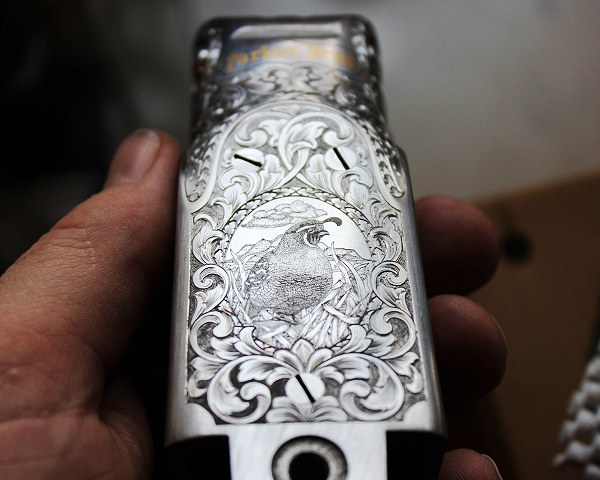
Impressive engraving by Jesse Kaufmann. Note how the scope rings have been engraved to perfectly match the engraving pattern on the Remington 547 action.
Who says fine craftsmanship is dead? There’s a modern day engraving wizard up in South Dakota, Jesse Kaufmann, who produces some of the most handsome engraving we’ve seen. Jesse, who operates Black Hills Gunstocks and Engraving LLC, is a true master at metal engraving and he also does superb stock checkering. Here are some examples of Jesse’s engraving work:
This 14-minute video showcases dozens of Jesse Kaufmann’s Engraving examples:
About Jesse Kaufmann, Master Engraver
Jesse Kaufmann was a professional stockmaker for Dakota Arms for over a decade. In 2009, he was inducted in the American Custom Gunmakers Guild as a checkering specialist. In January 2017, Jesse was awarded his Master Engraver certification by the Firearms Engravers Guild of America. With his broad skill set, Jesse is able to offer his clients a unique and complete package of stock work, finish, checkering, and engraving for a custom package that is all completed under one roof by his own hands.
Jesse Kaufmann’s work has been featured in American Rifleman, American Hunter, FEGA’s The Engraver, Sports Afield, Waidmannsheil Journal of German Gun Collectors Assn., Gun Digest 71st Edition, Modern Custom Guns Volume 2, Dangerous Game Rifles 2d. Edition. For more info, visit BlackHillsgunstocksandengraving.com, email blackhillsgunstocks [at] gmail.com, or call Jesse at (605) 499-9090 after 5:00 pm. SEE Gallery of Work.
A fire in the home is always to be feared. And a fire in your reloading room can be disastrous. Near your reloading bench you probably have flammable solvents, and maybe gunpowder. What would happen if an electrical fire started in your reloading room? Would you be alerted? Do you have a proper fire extinguisher at hand?
Here’s a true story from Forum Member Joe O. (aka “Joecob”) that provides a valuable safety lesson. After Joe started up his old tumbler, an internal connector worked loose, causing an arc which started a fire in his basement reloading area. Luckily Joe had a functioning smoke detector, and a fire extinguisher.
Very few of us would worry about fire when we plug in a tumbler or other AC-powered reloading tool. But there is always the possibility of a malfunction and a fire. Quick thinking (and a handy extinguisher) prevented serious damage to Joe’s reloading room and house — but things could have been worse (much worse), had Joe not responded quickly.
Fire in the Reloading Room — Report by Joecob
The day before ‘Sandy’ hit I was cleaning brass the way I always have. I set the vibratory tumbler on the back of my reloading bench in the basement. I loaded the media hopper with 40 fired empty brass cases (and walnut media), plugged the cord in, turned the tumbler on and went back upstairs to watch TV. I could hear the tumbler running in the background.
About half an hour later I heard the basement smoke alarm go off. I ran downstairs. Flames were licking from the melting plastic of the tumbler.
I grabbed the nearby ABC cannister extinguisher and squirted out the fire and soaked the charred bench areas with water. Good thing I had the extinguisher! And I was glad I religiously store powder and primers properly — away from the bench (and everything else).
What caused the fire? It looks like an internal AC connector finally vibrated loose enough to arc and ignite the plastic. WHEH! I had been using that thing for 25 years the same way without mishap. Guess I should have known to periodically check the guts of a thing that plugs in and vibrates for a living?
Today I went out and bought a new even bigger ‘Pro’ ABC extinguisher, plus a dual-detector smoke alarm, and an ultrasonic cleaner. That experience was scarier than the storm. I hope this true account might help someone else to avoid a bad experience.
In his account, Joe refers to an “ABC” cannister fire extinguisher. The “ABC” refers to the fire classification rating: Class A (trash, wood, and paper), Class B (liquids and gases), and Class C (energized electrical equipment) fires. There are many brands of ABC-rated extinguishers.
The rechargeable Kidde 210 unit (sku 21005779) contains four pounds of a multipurpose monoammonium phosphate dry chemical extinguishing agent. It has a discharge time of 13 to 15 seconds, a discharge range of 10 to 15 feet, and an operating pressure of 100 PSI. The seamless aluminum cylinder measures 4.5 inches in diameter and 15.7 inches tall. The Kidde 210 has a 6-year limited warranty. This is Amazon’s #1 Best Seller among Fire Extinguishers.





 Bore-snakes are very useful for some applications (primarily a hasty, interim wipe-down). In [my] experience they cannot replace a thorough cleaning with a proper rod and brushes. While the experiment cited here involves rimfire, it may help illustrate. Several years ago, the writer used his new, personal Anschutz to investigate the bore-snake issue. It had been fired ~350 rds with match ammo and had had 3 typical rod/brush cleanings.


 When you’re out at the range, the Earth seems very stable. But it is actually a big sphere zooming through space while spinning around its axis, one complete turn every 24 hours. The rotation of the earth can create problems for extreme long-range shooters. During extended bullet flight times, the rotation of the planet causes an apparent deflection of the bullet path over very long distances. This is the ballistics manifestation of the
 So what does a “worn-out” barrel really look like? Tom Myers answered that question when he removed a 6.5-284 barrel and cut it down the middle to reveal throat wear. As you can see, there is a gap of about 5mm before the lands begin and you can see how the lands have thinned at the ends. (Note: even in a new barrel, there would be a section of freebore, so not all the 5mm gap represents wear.) There is actually just about 2mm of lands worn away. Tom notes: “Since I started out, I’ve chased the lands, moving out the seating depth .086″ (2.18 mm). I always seat to touch. My final touch dimension was 2.440″ with a Stoney Point .26 cal collet.”

 On our main




 About Jesse Kaufmann, Master Engraver
 A fire in the home is always to be feared. And a fire in your reloading room can be disastrous. Near your reloading bench you probably have flammable solvents, and maybe gunpowder. What would happen if an electrical fire started in your reloading room? Would you be alerted? Do you have a proper fire extinguisher at hand?
 I grabbed the nearby ABC cannister extinguisher and squirted out the fire and soaked the charred bench areas with water. Good thing I had the extinguisher! And I was glad I religiously store powder and primers properly — away from the bench (and everything else).


