The Pew Pew Tactical website has interesting article on rifle and pistol cartridges and bullet types. This contains a large selection of interesting photographs and illustrations. If you load and/or shoot for a wide variety of cartridge types, you’ll find that article well worth reading. It has nearly 50 photographs and more than a dozen short videos. READ FULL Article.
The article shows all types of pistol bullets, along with a variety of rifle projectiles. It even illustrates multiple types of shotshell cartridges.
The article also explains the basic components of modern cartridges –bullet, case, powder, and primer:
Photo courtesy Ammunitiontogo.com which sells ammo from many leading brands.
Popular Cartridge Types Profiled
The article provides quick summaries of popular ammunition types including 9mm Luger (9x19mm), .357 Magnum, .40 SW, .45 ACP, .223 Rem, and .308 Winchester. The author’s favorite pistol round is the 9mm Luger: “9mm is my personal favorite and if there was a “Goldilocks” round, this would be it. The very first gun I bought was a 9mm. They’re fun at the range. They’re good for defense. It is the standard round for NATO countries and the majority of police forces around the world. It is mild shooting, can vary in weight from 115 to 147 grains, and has varying stopping power based on the type of bullet.”
This Pew-Pew Tactical guide to cartridge types also provides a quick explanation of cartridge ignition — both centerfire and rimfire: “The rimfire’s primer is built into the rim while the centerfire cartridge has the primer in the center. Pro tip — if you can see a circle in the middle…it’s a centerfire cartridge.”
There are two common types of centerfire primers — Boxer and Berdan. This helpful Wikipedia illustration shows how Boxer, Berdan, and rimfire primers ignite the powder in the cartridge:
This centerfire and rimfire ignition animation is by BBODO – Own work, CC BY-SA 3.0 licensed under the Creative Commons Attribution-Share Alike 3.0 license.
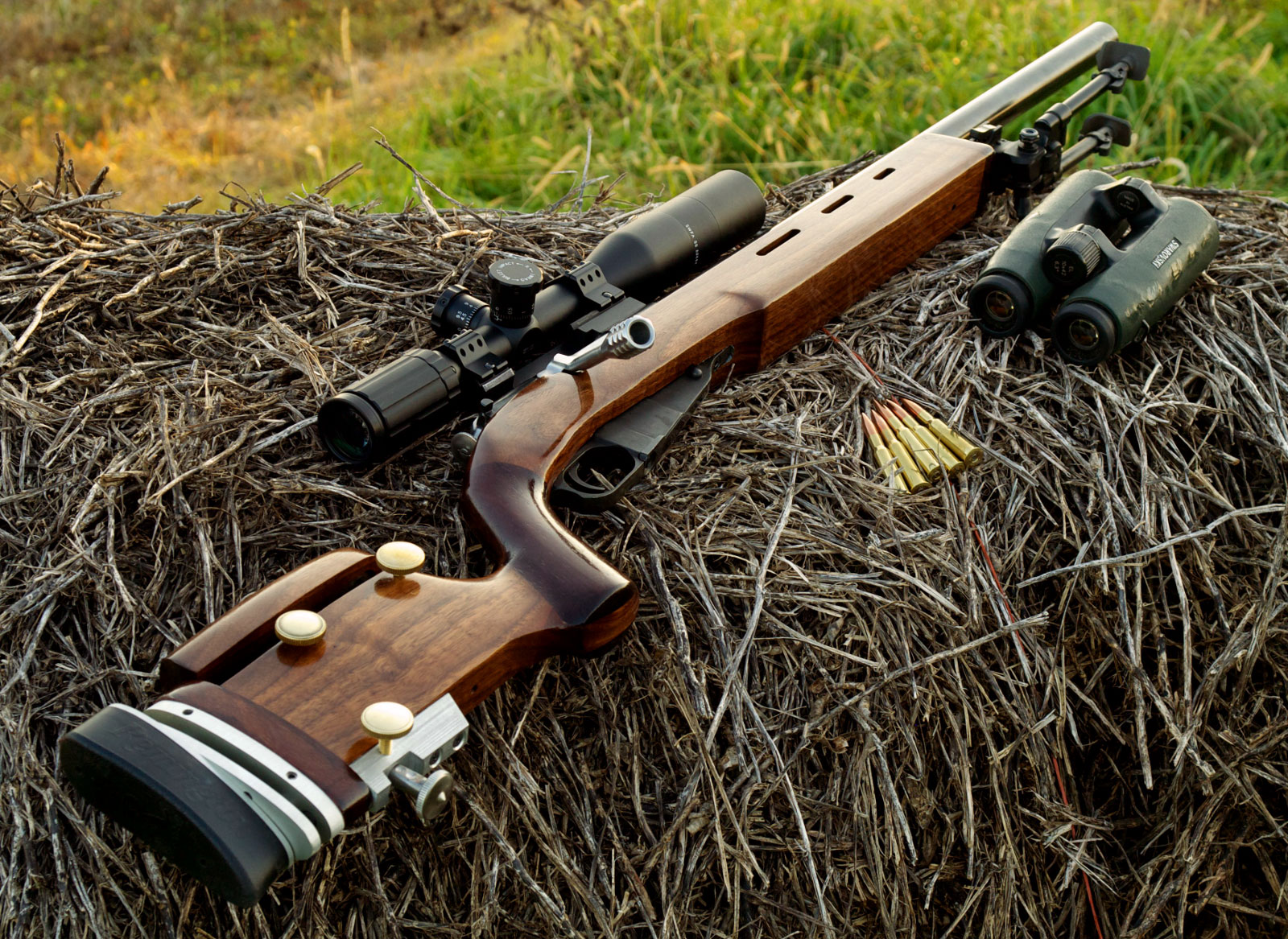
One of the most popular features of our Shooters’ Forum is the Official ‘Pride & Joy’ Rifle thread. There you’ll find dozens of interesting rifles, with photos and descriptions supplied by proud owners. Today we’re spotlighting one of the more interesting ‘Pride & Joy’ rifles unveiled this year, a Mosin Nagant “senior citizen”. This 72-year-old Russian bolt gun is not like any Mosin Nagant you’ve ever seen before. It has been brought into the 21st Century with a handsome target stock and some first-class upgrades, including Lothar Walther barrel and Timney trigger. Here’s a look at a very nice Russian rifle, belonging to Forum member Ben C. (aka “Grimstod”):
Video Shows Rifle Shooting Sub-Half-MOA from Bipod (in the Snow):
Name of rifle: Smyert Mk3 (Modified Mosin Nagant)
Make: Izhmekh/Izhevsk (“Izzy”) High Wall
Model: 91/30 | Year: 1942
Scope mount: Rock Solid (looks like an action sleeve)
Scope: SWFA 20x42mm MRAD
Gunsmith: Sheppard
Bolt handle: Rock Solid with Surgeon tactical handle
Bipod: Versa Pod
Total Weight: 18.6 lbs
Grimstod’s Mosin Nagant Custom Shoots Under 0.5 MOA From Bipod
Even in harsh winter conditions, the rifle shot well. (I guess we should expect that for a Russian gun). The photo below shows a group shot from bipod. (The video shows Grimstod’s snow-bound range session). Grimstod calculated the group at 0.394 MOA measuring from outside edge to edge. Using our On-Target software, which measures center to center of most distant shots, we came up with 0.428 MOA. Still that’s impressive for an ancient action being shot in the dead of winter with snow falling. To learn more about this rifle (and view photos of the build process), visit the SurplusRifleForum.com.
The History and Features of the Mosin Nagant M1891
Now that you’ve seen a modernized Mosin Nagant, we through we’d provide some information about the original rifle, first issued in the late 19th century. It is one of the most mass-produced military bolt-action rifles in history with over 37 million units having been made since 1891.
The is a lengthy Wikipedia article on the Mosin Nagant rifle design and history. The 3-line rifle M1891, known in the West as Mosin Nagant and in former Soviet Union as Mosin’s rifle (Russian: винтовка Мосина), is a five-shot, bolt-action, internal magazine–fed military rifle. It is primarily chambered for its original 7.62×54mmR cartridge. The 3-line rifle, Model 1891, its original official designation, was adopted by the Russian military in 1891. There have been several variations from the original rifle, the most common being the M1891/30, which was a modernized design introduced in 1930.
Here is a test of the Sniper Version of the Mosin Nagant:
Photo credit: Nemo5576 retouched by Ewan ar born, Copyrighted free use, via Wikimedia Commons.
Like the Gewehr 98, the 1891 Mosin uses two front-locking lugs to lock up the action. However, the Mosin’s lugs lock in the horizontal position, whereas the Mauser locks vertically. The Mosin bolt body is multi-piece whereas the Mauser is one piece. The Mosin uses interchangeable bolt heads like the Lee–Enfield. Unlike the Mauser, which uses a controlled-feed bolt head in which the cartridge base snaps up under the fixed extractor as the cartridge is fed from the magazine, the Mosin has a push-feed recessed bolt head in which the spring-loaded extractor snaps over the cartridge base as the bolt is finally closed similar to the Gewehr 1888 and M91 Carcano or modern sporting rifles like the Remington 700. Like the Mauser, the Mosin uses a blade ejector mounted in the receiver. The Mosin bolt is removed by simply pulling it fully to the rear of the receiver and squeezing the trigger, while the Mauser has a bolt stop lever separate from the trigger.
Photo courtesy Armémuseum (The Swedish Army Museum), public domain.
Like the Mauser, the bolt lift arc on the Mosin Nagant is 90 degrees. The Mosin bolt handle is similar to the Mannlicher: it is attached to a protrusion on the middle of the bolt body, which serves as a bolt guide, and it locks protruding out of the ejection/loading port in front of a split rear receiver ring, also serving a similar function to Mauser’s “third” or “safety” lug.
In this video Jerry Miculek tests the carbine version of the Mosin Nagant:
The rifling of the Mosin barrel is right-turning (clockwise looking down the rifle) 4-groove with a twist of 1:9.5″ or 1:10″. The 5-round fixed metallic magazine can either be loaded by inserting the cartridges singly, or more often in military service, by the use of 5-round stripper clips.
Photo courtesy Armémuseum (The Swedish Army Museum), public domain.
Wikipedia text courtesy Creative Commons Attribution-ShareAlike 3.0 Unported License (CC BY-SA).
“Shooting Chrony” is a product name. “Shooting Chrony” should not describe (post-mortem) what you have been doing to your chronograph. Sooner or later all of us may make a mistake, and ventilate our chronograph. With luck, the bullet just “wings” your chronograph, and the damage is minor. But if you hit the unit smack dab in the middle, you may have to retire your chrono for good.
A while back, Forum member Jeff M. (aka “JRM850″) experienced a “low blow” that put his Shooting Chrony out of commission. With tongue firmly in cheek, Jeff started a Forum thread entitled Chronograph Not Picking Up Shots in Bright Sunlight Anymore. Looking at the photo at top, the problem is obvious — he ventilated his Chrono.
This was Jeff’s first chrono kill in 23 years of use, so we shouldn’t be too critical. Jeff explained: “I didn’t realize a friend was shifting from a 300-yard target to 100 yards.” The agent of destruction was a low-traveling 58gr V-Max running at 3415 fps. What happened? Well, when one is shooting at 300 yards, the trajectory will be higher than at 100 yards. We should say, however, that this may have been a low shot, or the 100-yard aiming point may have been placed lower to the ground (closer to the bottom of the target frame), as compared to the 300-yard aiming point.
Other Forum members offered some sarcastic responses:
Try it on an overcast day – it might work again.
It looks like the V-Max performed just about as advertised.
Aww…a little duct tape and some Super Glue and you’re good to go.
Double Check Your Aim Point and Trajectory BEFORE You Shoot
The lesson learned here is that you should never change targets (or aim points) without checking your bullet’s flight over the chronograph. We like to align the barrel so the bullet exits a good 6-8 inches above the electronics (check your manual for recommended shot height). In addition, we always boresight the barrel so we can see the actual target through the bore. Then, with gun UNLOADED, bolt removed and action clear, we look back down the barrel so we can see daylight through the bore, with the gun set on solid rests. If you look through the middle of the “V” formed by the sky screen supports and you can’t see light shining through the barrel’s bore, you probably have a set-up problem and you should re-align the rifle.
Use a Test Backer to Confirm Your Bullet Trajectory
You can put tape on the support rods about 6″ up from the unit. This helps you judge the correct vertical height when setting up your rifle on the bags. Another trick is to hang a sheet of paper from the rear skyscreen and then use a laser boresighter to shine a dot on the paper (with the gun planted steady front and rear). This should give you a good idea (within an inch or so) of the bullet’s actual flight path through the “V” over the light sensors. Of course, when using a laser, never look directly at the laser! Instead shine the laser away from you and see where it appears on the paper.
After you have used the laser boresighter to get the rifle centered up in the chrono’s “sweet spot”, confirm with a test shot or two (see photo). Even when using an in-chamber laser boresighter, it is not uncommon for the bullet’s actual point of impact to be different than the laser’s dot location.
This report comes from the American Suppressor Association (ASA).
The Bureau of Alcohol, Tobacco, Firearms and Explosives (ATF) has announced the imminent launch of a new electronic system for NFA transfers. Known as the eForms system, this overdue modernization will allow consumers to submit both ATF Forms 1 and 4 electronically, hopefully resulting in a significant decrease in transfer times when compared to traditional paper Forms. This should speed up acquisition of firearm suppressors, since these require a Form 4.
According to ATF, the transition to the new system will occur sometime after December 15th, but before Christmas. The new eForms system will handle all existing NFA transfer forms, including the ATF Form 4, which is used for transfers of suppressors.
What is the NFA?
The National Firearms Act of 1934 (NFA) requires the Federal registration of fully-automatic firearms, of short-barreled rifles and shotguns, of rifles over .50 caliber, and of firearms sound suppressors (termed “silencers” under the NFA).
Do NOT Withdraw an Existing Form 4 Submission
If you recently submitted an NFA application, keep it in the queue. The ASA cannot stress this enough. Withdrawing your Form 4 and re-submitting electronically will take longer than allowing your Form 4 to make its way through the approval process. Withdrawing and re-submitting electronically will add months to your overall application process.
That’s because ATF isn’t going to dig through the tens of thousands of forms being processed to find your application. They’re going to wait until your Form 4 reaches an NFA examiner’s desk – the exact point at which it would normally be approved – to process your withdrawal. Instead of approving it though, they will acknowledge your withdrawal and release your serial number. You will not be able to re-submit an eForm 4 with the same serial number until ATF acknowledges your withdrawal and puts it back into your dealers’ inventory.
While traditional paper-based applications will remain a viable option, ASA recommends that suppressor buyers submit new NFA applications electronically. That’s because, if the new eForms system works as promised, it will increase efficiencies by reducing form submission and payment processing times, eliminating weeks of delays in data processing, and all but eradicating data entry errors.
The ASA plans to provide updated information about eForms as soon the ATF officially launches the new program for submitting ATF Forms 1 and 4 electronically. In the meantime, stay tuned by following the American Suppressor Association on Instagram, Facebook, and YouTube.
Once the transition to the new eForms system begins, ATF estimates that the transition will take between two to four days to complete, at which point the new eForms system will go live. ATF has indicated that it will notify the industry 24 to 48 hours prior to the transition, and the ASA will post information as soon as it receives this notifice.
We think every serious vintage rifle collector should acquire an M1 Garand at some point. If you ordered from the CMP this fall, perhaps you may find an historic M1 Garand under your Christmas tree this year. The CMP has, in the past couple of years, received over 90,000 Garands from overseas arsenals, so there are plenty to be had currently. This article explains how to order an M1 Garand from the CMP, and how to select the right grade for your needs and budget.
How to Order an M1 Garand from the CMP
To purchase an M1 Garand through the CMP, you must be an adult U.S. Citizen, and a member of an affiliated organization who has participated in a “Marksmanship Activity”. This basically means you need to join a gun club and participate in a clinic or match. Proof of club membership and citizenship is mandatory for all ages. However, the marksmanship requirement is waived for those over 60 years of age. Garands must be ordered by mail or through official CMP Auctions. CLICK HERE to Start Order.
This handsome M1 Garand was built with a CMP barreled action fitted to an aftermarket figured Walnut stock. That’s not war-worn GI wood.”
Here are two videos that explain the procedure for ordering an M1 Garand from the CMP. Along with mail-order sales, the CMP has brick-and-mortar stores where M1 Garands can be inspected and purchased and then transferred via your FFL (in compliance with state law). The three CMP stores are located in Anniston, Alabama; Talladega, Alabama; and Port Clinton (Camp Perry), Ohio.
M1 Garand Barreled Actions and Aftermarket Barrels
Along with complete M1 Garand rifles, the CMP also offers barreled actions. This can save you money, and also makes sense if you are looking to create a rifle with high-grade wood, or you want to bed the action for improved accuracy. You can order an M1 Garand barreled action, as well as complete M1 Garand rifles, from the Civilian Marksmanship Program (CMP). The eligibility requirements and ordering process will be the same for a barreled action as for a complete rifle.
If you already have an M1 Garand, but need a new barrel, you can order a pre-chambered Criterion barrel in .30-06 Springfield. Criterion tell us: “This is a direct replacement barrel for the M1 Garand rifle, manufactured to Mil-spec print #6535448. It has the original G.I. contour and Parkerized finish. Receiver threads are timed, all milling cuts are made, and all M1 Garand barrels are hand-lapped.” NOTE: Each barrel is .010 short-chambered and should be headspaced by a qualified gunsmith. These Criterion .30-06 replacement barrels, priced at $259.95, are legal for use in Service Rifle and John C. Garand matches.
If you want to re-chamber your M1 Garand to .308 Winchester, the CMP eStore sells brand new Criterion-made barrels in .308 Win for $199.95. These authentic-profile barrels are chambered and headspaced within .010″ of finished size, with final fitting to be done by a competent gunsmith. The barrels are also externally Parkerized to match your vintage M1 Garand.
Once you have an M1 Garand in your collection, you’ll want to keep it in tip-top condition so it works flawlessly for vintage military matches and fun shooting. Below we’ve linked two good SSUSA articles on M1 Garand maintenance. Following that you’ll find two excellent videos covering M1 Garand Disassembly, Cleaning, and Lubrication. Finally there are links to recommended print manuals for the M1 Garand.
M1 Service and Maintenance Shooting Sports USA (SSUSA) published an excellent article on Service and Maintenance of M1 Garand Rifles. This offers some smart tricks, such as using smoke from burning masking tape to darken the front sight post. There is also an older SSUSA article that covers basic cleaning and servicing and also explains how to upgrade the performance of your Garands. READ Article HERE.
As a resource for Garand owners, SSUSA recommends GarandGear.com: “[At] Garand Gear you’ll find USGI spec parts, tools, gauges, clips and a few Garand accessories. They also have some interesting freebies, most notably a direct analysis of M1 gas port pressures produced by different brands of commercial .30-06 ammunition, showing which ones exceed M2 Ball pressure, as well as the pressures produced by ammo manufactured specifically for the M1 Garand, such as Hornady’s M1 Garand Match and Federal’s American Eagle M1 Garand. Here you’ll also find free, downloadable and printable PDF copies of War Department M1 Garand maintenance manuals TM9-1275 and TM9-1005.”
Christmas is just 20 days away. If you are looking for a great gift for a shooting buddy, books have always been popular holiday gifts. Here are some recommended titles that should please the serious shooters and firearms enthusiasts on your shopping list. For shooting clubs, books also make great end-of-season member awards. Most of us would rather have a useful book than one more piece of wood to toss in a box in the closet. Check out these ten titles — for yourself or your shooting buddies.
Here Are TEN BOOKS Recommended for Serious Shooters:
If you’re a serious long-range shooter, consider adding this book to your library. Relying on extensive ballistics testing, Modern Advancements Volume II is a great successor to Volume I that contains some fascinating research results. UK gun writer Laurie Holland notes: “Volume II of the Modern Advancements series is as fascinating as Volume I and if anything even more valuable given a series of ‘mythbusters’ tests including: case fill-ratio, primer flash-hole uniforming, neck tension, annealing, and much more. The work also addresses that perennial discussion of a bullet ‘going to sleep’ and shooting smaller groups (in MOA) at longer distances than 100 yards.” The amount of testing done for this Volume II work, with a staggering amount of rounds sent downrange, makes this book unique among shooting resources. There is a ton of “hard science” in this book — not just opinions.
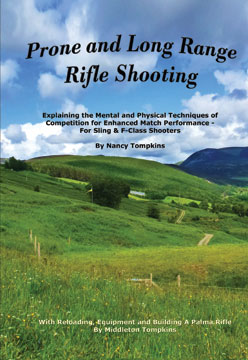
Nancy Tompkins is one of the greatest long-range shooters in American history. She has won five National Long-range Championships. Tompkins’ treatise is a must-read for serious Palma, F-Class, and High Power shooters. The revised Second edition includes F-Class equipment and techniques, and newly updated information. Color pictures. Topics include Mental & Physical training, Reading Wind & Mirage Shooting Fundamentals, International Competition, and Loading for Long Range. Nancy Tompkins is a 4-time winner of the National Long Range Championships, and has won countless other major events. Nancy has been on six Palma Teams (as both a shooter and a coach).
The new, 2020 Edition of The Wind Book was released a few months ago. The updates make this very helpful 144-page book even better. The Wind Book for Rifle Shooters by Linda Miller and Keith Cunningham, first published in 2007, is a very informative resource. But you don’t have to take our word for it. If you click this link, you can read book excerpts on Amazon.com. This lets you preview the first few chapters, and see some illustrations. Other books cover wind reading in a broader discussion of ballistics or long-range shooting. But the Miller & Cunningham book is ALL about wind reading from cover to cover, and that is its strength. The book focuses on real world skills that can help you accurately gauge wind angle, wind velocity, and wind cycles. Readers have praised the book, earning it 93% 4- and 5-star reviews on Amazon.
Ryan Cleckner is noted for his ability to explain complex topics in an easy-to-comprehend manner. Now Cleckner has authored a book, the Long Range Shooting Handbook, which expands on the topics covered in Cleckner’s popular NSSF video series. The Long Range Shooting Handbook is divided into three main categories: What It Is/How It Works, Fundamentals, and How to Use It. “What It Is/How It Works” covers equipment, terminology, and basic principles. “Fundamentals” covers the theory of long range shooting. “How to Use It” gives practical advice on implementing what you’ve learned, so you can progress as a skilled, long range shooter. You can view Sample Chapters from Ryan’s Book on Amazon.com.
Visualization is a process of mental preparation that is done before you get to the range. Many of the greatest shooting champions have used this technique to get ready for big matches, and to optimize their performance during record fire. If you want to enhance your “mental game” through pre-match visualization, we strongly recommend Lanny Bassham’s book, With Winning in Mind. As a competitive smallbore 3P shooter, Bassham developed a mental management system. Using this system, Lanny Bassham won 22 world individual and team titles, set four world records, and captured an Olympic Gold Medal in Montreal in 1976. His techniques have been embraced by professional and Olympic athletes in many sports. With Winning in Mind covers a complete system of “mental management” techniques used by Olympians and elite champions.
Thinking of getting started in the Practical/Tactical shooting game? Looking for ways to be more stable when shooting from unconventional positions? Then you may want to read Marcus Blanchard’s Practical Shooter’s Guide (A How-To Approach for Unconventional Firing Positions and Training). Unlike almost every “how to shoot” book on the market, Blanchard’s work focuses on the shooting skills and positions you need to succeed in PRS matches and similar tactical competitions. Blanchard provides clear advice on shooting from barricades, from roof-tops, from steep angles. Blanchard says you need to train for these types of challenges: “I believe the largest factor in the improvement of the average shooter isn’t necessarily the gear; it’s the way the shooter approaches obstacles and how they properly train for them.”
Tony Boyer, the most successful shooter in the history of short-range benchrest competition, shares match-winning tips in this 323-page book. The book covers all aspect of the benchrest discipline: loading, windflags, rest set-up, addressing the rifle, and match strategies. This is a high-quality publication, filled with valuable insights. Every serious benchrest shooter should read Tony’s book. Boyer has dominated registered benchrest in a fashion that will never be duplicated, having amassed 142 U.S. Benchrest Hall of Fame points. The next closest shooter, Allie Euber, has 47 Hall of Fame points. This handsome, full-color book is 323 pages long, with color photos or color illustrations on nearly every page.
This book by 11-time National High Power Champion David Tubb focuses on position shooting and High Power disciplines. Section One covers fundamentals: position points, natural point of aim, breathing, triggering mechanics and follow-through, sling selection and use, getting started, getting better, avoiding obstacles. Section Two covers mechanics of offhand, sitting, and prone positions. Section Three covers shooting skills, including wind reading and mental preparation. Section Four covers the technical side of shooting, with extensive discussions of rifle design, load development, reloading barrel maintenance, and rifle fitting. We consider this book a “must-read” for any sling shooter, and there is plenty of good advice for F-Class shooters too.
Gary Anderson’s book, Coaching Young Rifle Shooters, is an excellent, fully-illustrated guide for training young shooters. This 187-page, full-color book is the most comprehensive instructional guide of its kind now in print. Anderson created this resource for coaches and parents who work with beginning and intermediate junior rifle shooters. Anderson’s guidebook provides coaches with the tools needed to develop young shooters and improve their marksmanship skills. Gary Anderson is the Director of Civilian Marksmanship (DCM) Emeritus. In his 11 years of international competition, Gary won two Olympic gold medals, seven World Championships, and 16 national titles.
Bullseye Mind (Mental Toughness for Sport Shooting) by Dr. Raymond Prior, $15.95 (On Sale now) (Softcover).
Having a Bullseye Mind means thinking in ways that create confidence and consistency, even under pressure. A “must-read” for competitive shooters, Bullseye Mind is a mental training book written specifically for the shooting sports. The book is well-organized, with handy highlighted lists and key “talking points”. Each chapter concludes with examples from a world-class shooters such as: Matt Emmons, 2004 Olympic Gold Medalist; Vincent Hancock, 2-time Olympic Gold Medalist; Jamie Corkish, 2012 Olympic Gold Medalist; Petra Zublasing, 2014 World Champion/ISSF Shooter of the Year; and Nicco Campriani, 2012 Olympic Gold Medalist, 2010 World Champion. This book has earned rave reviews from competitive shooters who found it really helped their “Mental Game”. One recent purchaser states: “This book is as though you had a coach in your back pocket…”
Barrel nut system allows “Pre-Fit” barrel installation on a Remington action. CLICK photo to zoom.
REMAGE Project Report by Bill, Rifleshooter.com Editor
Installing a new barrel on your Remington 700 (especially without a lathe) may seem like a daunting task, but thanks to companies like McGowen Precision Barrels and Criterion Barrels there are easier alternatives. By adopting a Savage-style barrel nut on a 1 1/16″ thread for a Remington 700 receiver, pre-chambered (aka “pre-fit”) barrels can be easily swapped with just a few hand tools. This system is sometimes called a REMAGE conversion (for “REMington savAGE”). With simple tools a “Pre-fit” 6mmBR-chambered barrel was installed on the author’s Remington action — no machining or lathe-work required.
The existing barrel is simply removed from the action (normally the hardest part) and the new barrel is screwed on with the Go Gauge in place. After headspace is verified with the Go Gauge, the barrel nut is tightened against the action and you are off to the range. It takes all of the machine work out of the barreling process.
Note: Because barrel nut has a slightly larger diameter, some stocks may require minor inletting. Also, if you are shooting fired brass from another rifle with the same chambering, you should FL-size the brass before loading it for your new pre-fit barrel. And always check the set-up with a dummy round loaded to normal cartridge length BEFORE you head to the range. With Pre-Fits, the freebore should be adequate for your cartridge, but always check and adjust your seating depth as needed.
Bill has been a serious shooter for over 20 years. A former Marine Corps Sergeant, he’s competed and placed in High Power Rifle, ISPC, USPSA, IDPA, 3-Gun, F-Class, and precision rifle disciplines. In addition to being an NRA-certified firearms instructor and range officer, Bill has hunted big game in North America, South America, and Africa. Bill writes extensively about gunsmithing, precision rifles, and the shooting sports on his blog, Rifleshooter.com.
Image Courtesy NSSF. This story is based on an NSSF Article.
‘Tis the season of gift-giving (and Christmas Day is nearly here). Perhaps you’re considering giving a a first rifle to your grandson or perhaps a carry pistol to a spouse. When making a gun gift to a friend or family member, however, there are some very important legal considerations. Also the rules on firearms gift transfers vary from state to state. Bottom line here — you need to know the law BEFORE you deliver that shiny new firearm to a family member, close friend, or relative.
The first thing to remember if you’re thinking about giving someone a gun is that … it’s a gun! You already know that ownership of a firearm brings with it some serious legal and ethical obligations that other consumer products don’t. So let’s look at some questions you may have about giving a firearm as a gift.
Image Courtesy NSSF
The first question you have to ask is whether the intended recipient can legally own the firearm where he or she lives. With more than 20,000 different gun laws on the books, even the kinds of firearms that law-abiding citizens can own vary from place to place. For example, juveniles (under age 18) generally speaking are precluded by law from possessing a handgun. Check out the Bureau of Alcohol, Tobacco, Firearms and Explosives (ATF) website for an overview of local laws and, whatever you do, don’t forget that you can never under any circumstances transfer a firearm to someone you know — or have reasonable cause to believe — legally can’t own one. That’s a federal felony, so be careful.
There’s no federal law that prohibits a gift of a firearm to a relative or friend who lives in your home state. Abramski v. United States, a recent Supreme Court decision involving a “straw purchase” of a firearm did not change the law regarding firearms as gifts. The following states (California, Colorado, Connecticut, Delaware, New York, Oregon, Rhode Island, Washington State) and the District of Columbia require you to transfer a firearm through a local firearms retailer so an instant background check will be performed to make sure the recipient is not legally prohibited from owning the gun. Maryland and Pennsylvania require a background check for private party transfer of a handgun. There are exceptions, so it’s important to check the law of your state or ask your local firearms retailer.
Consider a Gift Card Instead of Direct Gift
The ATF recommends that if you want to give someone a new firearm, rather than going to a gun store and buying the gun on your own, consider instead purchasing a gift certificate/card from your favorite gun retailer. Then give that gift card as the present. That way the recipient can choose the exact gun he or she wants, and there’s no question about who is “the actual buyer of the firearm,” which is a question any purchaser must certify on the Federal Form 4473 at the time of purchase. The Gift Card option avoids any “straw purchaser” issues.
Curious about suppressors (aka “silencers”, “moderators”, or “cans”)? Below you’ll find an informative NSSF Infographic that covers the history, legal status, design, and operation of modern-day suppressors.
Here’s a cool video showing how suppressors work. This video features see-through rifle suppressors filmed with ultra-high-speed (110,000 frame per second) cameras. When played back in super-slow-motion, you can see the flame propagate through the suppressor and the bullet move through each baffle before it exists the muzzle. Check it out!
See Through Suppressor in Super Slow Motion (110,000 fps) — Click Arrow to Watch:
Suppressor Facts — What You Need to Know
In this infographic, the NSSF provides the history, specifications, benefits and uses of firearm suppressors. Don’t suppress your knowledge!
Suppressors reduce gunfire sound levels by using baffles that contain expanding gasses exiting a firearm’s muzzle when ammo is discharged. Suppressors are similar to car mufflers that were, in fact, developed in parallel by the same inventor in the early 1900s. Well-designed suppressors typically reduce the gun sound levels by 30-35 decibels (dB). Suppressors are becoming more popular even though it still takes many months to get approved. In fact, the number of suppressors registered with the ATF grew by over 1 million from 2011 to 2017. That’s a 355% increase.
Conventional brass jags work great — except for one thing. They can react to solvents, leaving a blue “false positive” on patches. In recent years, jag-makers have experimented with many different materials in an effort to cure the solvent-reaction problem. Today we have polymer jags, nickel-plated jags, and stainless steel jags. And the latest innovation is the aluminum jag from Dewey.
J. Dewey Mfg. offers a series of “Copper Eliminator” jags and brush adapters made from aircraft-grade aluminum with the same hardness as brass. Dewey claims that its aluminum jags will not become embedded with grit or particles that could harm your bore. At the same time, Dewey’s aluminum jags will not react to ammoniated bore solvents that can turn patches blue green when used with brass jags. Dewey aluminum jags are offered with either male OR female 8/32 threads. The $5.25 aluminum jags and $3.70 brush adapters are offered in a wide variety of calibers. You can order these products from Dewey Mfg. or Brownells.
Story Tip from Boyd Allen. We welcome submissions from our readers.


 Popular Cartridge Types Profiled









 The first question you have to ask is whether the intended recipient can legally own the firearm where he or she lives. With more than 20,000 different gun laws on the books, even the kinds of firearms that law-abiding citizens can own vary from place to place. For example, juveniles (under age 18) generally speaking are precluded by law from possessing a handgun. Check out the
  Consider a Gift Card Instead of Direct Gift


