|
|
November 1st, 2013
 Do you have a good story idea for the Daily Bulletin? Are you reasonably handy with a digital camera? Then you could win one of two (2) bolt fluting jobs we will award in our November Reader Story Contest. You can see your work in the Daily Bulletin, and win a cool bolt fluting job performed by Pro-Precision Rifles (PPR) on your Remington, Savage, Tikka, or Winchester action bolt.
Here’s how it works. You submit a story (that you wrote yourself) 500-800 words in length, plus at least three (3) quality digital photos. Our editors will review all the submissions and select the two best articles for publication.
The two winners will be named on December 1, 2013. Each of the two winners will receive a bolt fluting job by Pro-Precision Rifles, an $85.00 to $95.00 value. This is a modification of a bolt performed by PPR. The prize is the fluting job, not the bolt (which shall be supplied by each winner).

Bolt Fluting Job awards do NOT include custom bolt knobs shown in photo above.
Contest Rules
1. Contestants must submit an original article of 500-800 words. You must write the article yourself (you pledge that this is your 100% original work, not copied in any way from something else).
2. Contestants must submit at least three (3) quality digital photos (taken by contestant himself) to run with the story.
3. Images must be at least 1200 pixels wide and 800 pixels high in JPEG, PNG, or PSD format.
4. Article text and photos shall be submitted via email to mailbox@6mmbr.com .
5. Submissions must be emailed no later than 3:00 pm EST on November 30, 2013. The two (2) winners will be selected by AccurateShooter.com’s editors on December 1, 2013.
6. Each of the two (2) winners will receive a free bolt fluting job of his or her choice limited to the following types of actions: Remington, Savage, Tikka, and Winchester. Note, the prize is the fluting work, not the bolt. Each winner must supply a bolt to be fluted.
7. Each winner must ship one bolt to Pro Precision Rifles, 2397 East Garber Drive, Meridian, ID 83646, (208) 871-7429. PPR will pay for the return shipping inside the continental United States.
8. This contest is limited to U.S. citizens living in the United States. Contestants must be over 21 and eligible to own firearms.
9. Contestants agree that their submissions (both text and photos) have not appeared before in any publication or on any other website. Each contestant warrants that he/she is sole owner of all rights and copyrights associated with the submitted article(s) and photos. Contestants agree that their submissions become the property of AccurateShooter.com, and contestants agree to give AccurateShooter.com the right to publish all submitted stories and photos as AccurateShooter.com sees fit, in its sole discretion.
10. Bolt Fluting Job awards do NOT include custom bolt knobs shown in photo.
November 1st, 2013
 Many shooting ranges have been closed over the past few years, victims of “urban sprawl” and concerns over noise and land use. Now there’s a bill in Congress that will help fund new ranges around the country. The U.S. House Judiciary Committee last week voted to advance the Target Practice and Marksmanship Training Support Act (HR 2463). This legislation is sponsored by Congressional Sportsmen’s Caucus (CSC) member Duncan Hunter (Rep., CA) and Caucus Vice-Chair Tim Walz (Dem., MN), along with a bipartisan coalition of 14 other House Members. This bill would allow states to use the excise taxes already collected on sporting equipment and ammunition to develop and maintain much-needed public shooting ranges. Having already received the approval of the Natural Resources Committee, passage of HR 2463 through the Judiciary committee was the final step necessary to send the bill to the House Floor.
If passed by the House, HR 2463 would have to be approved by the U.S. Senate, and then signed by the President before it could become law. Based on recent experience, a Presidential veto doesn’t seem likely. Through December 2012, President Obama has vetoed just two of 621 bills that crossed his desk. That’s the fewest number of vetos since Millard Fillmore held office in the early 1850s.
Summary: H.R.2463 — 113th Congress (2013-2014)
Target Practice and Marksmanship Training Support Act – Amends the Pittman-Robertson Wildlife Restoration Act to: (1) authorize a state to pay up to 90% of the costs of acquiring land for, expanding, or constructing a public target range; (2) authorize a state to elect to allocate 10% of a specified amount apportioned to it from the federal aid to wildlife restoration fund for such costs; (3) limit the federal share of such costs under such Act to 90%; and (4) require amounts provided for such costs under such Act to remain available for expenditure and obligation for five fiscal years.
Shields the United States from any civil action or claim for money damages for injury to or loss of property, personal injury, or death caused by an activity occurring at a public target range that is funded by the federal government pursuant to such Act or located on federal land, except to the extent provided under the Federal Tort Claims Act with respect to the exercise or performance of a discretionary function.
Urges the Chief of the Forest Service and the Director of the Bureau of Land Management (BLM) to cooperate with state and local authorities and other entities to carry out waste removal and other activities on any federal land used as a public target range to encourage its continued use for target practice or marksmanship training.
October 31st, 2013
Today is Halloween. That means it’s pumpkin time. Just how much fun can you have with pumpkins? Watch these two videos and find out. In the first video, the RatedRR team sends a few orange gourds to pumpkin heaven using Det Cord, C4, and binary explosives. The sequence starting at the 2:00 minute mark in the first video is truly amazing. WARNING: DO NOT TRY THIS AT HOME!
Watch Pumpkin Blasting with Explosives
In the next video, a pumpkin carved as a Death Star serves as the target for a .50 caliber rifle (looks like a Barrett M82 .50 BMG). As you may guess, the pumpkin Death Star suffers the same fate as the Hollywood version in Star Wars. NOTE: At the 0:42 mark in the video, a graphic displays “30,000 FPS”. That’s the high-speed camera’s frame-per-second rate, NOT the projectile velocity in feet-per-second.
Watch .50 BMG Rifle vs. Death Star Pumpkin
Warning: These demonstrations were carried out on closed ranges by experienced professionals certified to use explosives. Possession of C4 and Det Cord may be a violation of various Federal, State, and local laws. Detonating cord and C4 are classified as high explosives and are regulated by the BATFE. Don’t even think about trying to repeat these stunts on your own.
October 31st, 2013

There was “Thunder Down-Under” last week at the 2013 World Benchrest Championships (WBC 2013) in Australia. The event was held at the Silverdale Range, a 1.5 hour-drive west of Sydney, NSW. This event drew roughly 80 of the world’s best 100/200 yard Benchrest group shooters who competed both individually and on national teams. Squads from Australia, Canada, Finland, Italy, New Zealand, Russia, South Africa, the United Kingdom, and the USA vied for WBC team honors. Both Australia and the United States fielded three teams, while New Zealand and South Africa each fielded two squads.

Conditions were vicious at times, with extremely high winds in a few relays. To show you how tough things were, legendary shooter Tony Boyer had a 1.560″ group during the LV 200-yard match, while Tom Libby shot a shocking 2.280″ group in the same relay. We can’t remember when we’ve ever seen groups like that posted by shooters of this skill level.
In team competition, the strong USA ‘A-Team’ finished first followed by South Africa A (second place) and Australia A (third place). Ed Adams, Tony Boyer, Gene Bukys, and Bob Scarbrough Jr. were the members of the winning USA A-Team.

In individual competition, Americans finished 1-2-3 in the Two-Gun. Texan Charles Huckeba topped the field, winning the Two-Gun Overall with a 0.2804 Grand Agg. Gene Bukys (0.2863) was second, and Bob Scarbrough Jr. (0.2881) finished third. In fourth place overall was South African Roland Thomsen (0.2919), while New Zealander Peter Haxell (0.2940) finished fifth. The top five for each of the LV and HV yardages are listed below.

Complete WBC 2013 Results have been posted on the Australian Benchrest Bulletin website. Scroll down and look for the blue “Latest Stuff” tab on the lower left. There you’ll find links for WBC 2013 events under the “Latest Results” header.
Light Varmint Grand Agg
1. Gene Bukys (USA-A) .2796
2. Todd Tyler (USA-C) .2817
3. Roland Thomsen (SA-A) .2952
4. Peter Haxell (NZ-A) .2971
5. Jan Hemmes (SA-A) .3024 |
Light Varmint 100 Yards
1. Freddie Botha (SA-B) .1936
2. Todd Tyler (USA-C) .2258
3. Wayne Campbell (USA-B) .2464
4. Peter Haxell (NZ-A) .2484
5. Gene Bukys (USA-A) .2486 |
Light Varmint 200 Yards
1. Jan Hemmes (SA-A) .2939
2. Gert Le Roes (SA-B) .2962
3. Roland Thomsen (SA-A) .2978
4. Gene Bukys (USA-A) .3106
5. Todd Tyler (USA-C) .3375 |
Heavy Varmint Grand Agg
1. Ivan Piani (ITA-A) .2389
2. Bob Scarbrough (USA-A) .2399
3. Ch. Huckeba (USA-C) .2424
4. Tony Boyer (USA-A) .2520
5. Ed Adams (USA-A) .2781 |
Heavy Varmint 100 Yards
1. Tony Boyer (USA-A) .1574
2. Ch. Huckeba (USA-C) .1722
3. C. Whittleton (AUS-B) .1872
4. Wyn. Campbell (USA-B) .1874
5. Bob Scarbrough (USA-A) .1900 |
Heavy Varmint 200 Yards
1. Ivan Piani (ITA-A) .2786
2. Ed Adams (USA-A) .2869
3. Bob Scarbrough (USA-A) .2897
4. Ch. Huckeba (USA-C) .3126
5. Jari Laulumaa (FIN-A) .3168 |

Photos by Todd Tyler, Tom Libby, and Scott Pieper, provided courtesy Aaron French.
October 31st, 2013
 AR-platform rifles are fun to shoot, but .223 Rem centerfire ammo can get expensive if you put a lot of rounds downrange. Dedicated .22 LR uppers let you do live-fire training with more affordable rimfire ammo while retaining the weight, balance, and feel of your AR-platform rifle. You use your regular lower, so the ergonomics and grip feel the same. Likewise, the trigger group is the same, so you don’t need to adapt to a different trigger pull. With these .22 LR upper conversions you can shoot reactive targets at relatively close range, with less noise and recoil. (But remember that rimfire bullets can ricochet, so always shoot at a safe distance and always wear eye and ear protection).
Dedicated .22 LR Rimfire Uppers for AR-Platform Rifles
A number of companies offer dedicated .22 LR rimfire uppers that work with any standard AR15-platform lower. Brownells carries dedicated .22 LR AR uppers starting at $419.99. Brownells offers flat-top AR uppers, allowing you to easily mount the aiming system (iron sights or optics) of your choice. Brownells offers a 100% satisfaction guarantee on all products it sells, including .22 LR uppers.

AR-Style .22LR Rimfire Rifles (Complete Guns)
Another option is to purchase a complete AR-style rimfire rifle chambered for the .22 LR cartridge. This option may be more affordable than you think. Right now Impact Guns is selling the Smith & Wesson M&P 15-22 with 16″ barrel for just $509.99 (marked down from $649.99). It’s a nice little rifle. The M&P 15-22 is designed and built as a true .22 LR semi-auto from the ground up, with ergonomics (and most operating controls) identical to a centerfire M&P 15 rifle. Here’s the black and tan version:

H&K offers the HK 416 D145RS, a dedicated .22 LR rimfire rifle. Engineered and built in Germany by Carl Walther, the HK 416 D145RS features a match-grade precision barrel, metal upper and lower receivers, retractable stock, and machined rail interface system with on-rail iron sights. These HK rimfire rifles (which employ a blow-back action) are accurate and reliable. Current ‘street price’ is around $660.00. One purchaser writes: “Great .22. I have had this gun a couple of months and have put about 500 rounds of 5 different brands of ammo through it. Not one FTE. I have shot other brands that can’t get through one 30-round mag without a failure. [The 416] is a little pricey compared to the competition but you get what you pay for.”

October 29th, 2013
As a member of the World Champion Team USA F/TR squad, Paul Phillips regularly competes (and wins) at 1000 yards. Paul is also a long-range hunter. Here’s his story about developing his ultimate long-range hunting rifle. Chambered for the .338 Lapua Magnum, this rig is accurate out to 1800 yards.
The Long-Range Challenge By Paul Phillips
Being an avid big game rifle hunter, my goal was to build the most accurate long-range hunting rifle possible that would still be light enough to carry. My thought was to use the same type of high-quality components as what I used on my US F/TR Team Rifle, except in a bigger caliber — a caliber that would have plenty of knock-down power at very long ranges. After extensive research, including both ballistic data analysis, as well as discussion with top gunsmiths and champion long-range shooters, I chose the .338 Lapua Magnum. My past experience from being a member of a USMC Scout Sniper Platoon and a shooting member of two World Champion U.S. F-Class F/TR teams, I knew that this rifle was more than capable of performing the task. After establishing that the rifle had half-MOA accuracy at 600 yards, we wanted to see how far the rifle could maintain sub-MOA accuracy, to see what the cartridge and rifle could achieve. Could this gun shoot sub-MOA at a mile? That was our challenge.

Rifle Components and Gunsmithing
My rifle was built on a Stiller Tac-338 single-shot action. It has a 30″, 1:10″-twist Brux barrel, a McMillan A-5 stock with Magnum fill, a Sinclair Bipod, and a Remington X-Mark trigger set at two pounds. The rifle wears a Nightforce NXS 8-32x56mm scope in Nightforce rings on a +40 MOA rail. I chose David Tooley to install the barrel, custom brake, apply a Cerakote dark earth finish and bed the stock. After speaking with Mr. Tooley in great length, I chose his no-neck-turn match .338 Lapua chamber specifically designed for the 300 grain Berger Bullet. This rifle weighs 17 pounds and, with the muzzle brake, it recoils like a standard .308 Winchester.

Load Development and Accuracy Testing
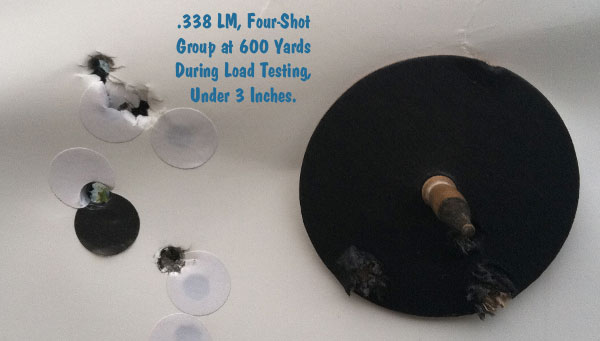
I used the 600-yard range at the Midland County Sportsman’s Club. If I was going to have any chance of hitting small targets at a mile, I would need to find a load that could produce half-minute (0.5 MOA) or better accuracy. I found an accurate load that gave me consistent half-minute groups that chronographed at 2825 FPS. My load consisted of Lapua brass, Federal 215M Primer, Alliant Reloder 25, and Berger 300gr Hybrid OTM bullet. With the Berger 300-grainer’s listed 0.419 G7 BC, this load would be good enough to reach 1880 yards before going subsonic. This load’s calculated energy at one mile is 960 ft/pounds. This is similar to a .44 magnum pistol round at point-blank range.
With my +40 MOA scope rail, my 100-yard zero ended up with the elevation at the bottom of the tube and the windage just 2 MOA left of center. This left a full 65 Minutes of Elevation — enough to get out to 1800 yards. This gave me the capability to aim and shoot from 100 yards to 1800 yards with a projectile that is still supersonic at 1800.
Hitting a 10″ Balloon at One Mile
For a one-mile target, I chose a balloon inflated to 10″ in diameter. The balloon would be a challenging, reactive target that would show up well on video. I teamed up with a fellow long-range shooter, John Droelle and friend Justin Fargo to attempt this feat. Using my known 600-yard Zero, my ballistics program showed my come-up for 1783 yards to be 53 MOA. After two sighters that measured 4 inches apart, I adjusted up one minute from my spotter shot and nailed my 10″ balloon at one mile. This video was recorded with my iPhone attached to my 25-power Kowa spotting scope, so it may seem a lot closer than it really is. Below is a video of the shot. Needless to say I achieved my goal and was very excited.
Watch Hit on 10″-Diameter Balloon at One Mile with .338 Lapua Magnum
After my balloon shot, I let my friend Justin Fargo, a novice shooter, try his skills. Justin told me that he had never shot past 100 yards using a common deer rifle. Surprisingly, Justin not only kept all his shots under 1 MOA, he hit the 9-inch white circle in the middle of the target. This bullet hole measured only 4.3 inches from the center of where he was aiming. Truly amazing! The target below shows Justin’s shots at one mile. Note that All the hits are located within the 24-inch black circle.

What I Learned — With the Right Equipment, Even a Novice Can Make Hits at a Mile
The above results demonstrate that even a novice shooter with a high-quality, custom rifle and match-grade ammo can make extreme long range shots with great accuracy. It is very important to understand the ballistics of the bullet and the effect of wind drift to make precision, first-shot hits on your target. It is also important that you know your target, backstop and beyond when making these shots. To date, I have shot approximately 40 shots at a mile in calm conditions while averaging 3-shot groups between ½ to 1 MOA (1 MOA is about 18.5″ at that distance). My next experiment is to see how well these bullets perform traveling at subsonic speeds out to 1.5 – 2 miles. Stay tuned!
Special thanks to the following people that helped out with this project: Geoff Esterline, David Tooley, Dick Davis, John Droelle, Ray Gross and Bryan Litz.
Editor’s Comment: The point of this article is to show the kind of accuracy a precision rifle system can achieve, consistently, at extreme long range. Though this rifle will do duty as a hunting arm, Phillips is not advocating that a .338 LM be used to harvest animals at the full limit of its supersonic range. Because winds are hard to predict at extreme long range in a hunting situation, Phillips cautions that the practical distance at which he would shoot game with a rig like this is much, much shorter.
October 29th, 2013
 A common lament among our Forum members is that they can’t find affordable .22LR rimfire ammo for fun shooting and plinking. This stuff flies off the shelf whenever it appears. However, Natchez Shooters Supplies has received substantial shipments of Remington bulk-box rimfire ammo. Note, due to high demand, there is a one-box limit for the 500-count and 525-count boxes per customer per day. Here’s what we found in-stock today at Natchez:
Remington .22 LR 36gr Golden Bullet Plated HP, 525 rounds per box — $39.99 On SALE
(1 box limit per day)
Remington .22 LR 40gr Thunderbolt Hi-Vel, 500 rounds per box — $39.99 on SALE
(1 box limit per day)
Remington .22 LR 33gr Yellow Jacket HP, 100 rounds per box — $15.99
(3 box limit per day)
If you want the good stuff, Natchez also has Lapua .22 LR 40gr Midas+ ammo in stock at $17.99 for 50 rounds. Not cheap, but this is top-flight stuff that has won matches at the Olympics. There is no purchasing limit on this Midas+.

October 28th, 2013
 This past weekend the IBS 600-yard Nationals were held at the Bench Rest Rifle Club of St. Louis. Attendance was strong, with 78 Light Gun shooters and 74 Heavy Gun competitors. Initial results are posted below. Forum member Mike Moses was the Two-Gun Overall winner, claiming the 2013 600-yard Title as National Champion. In the Two-Gun rankings, Johnny Powers finished second, followed by Dallas Johnson, Sam Hall, and Ryan Hunt. In the Light Gun Division Charlie Macke (shooting a big 7mm) finished first, ahead of second-place Mike Moses, and third place Ryan Hunt. In the Heavy Gun Class the top three were: Johnny Powers, Andy Ferguson, Dallas Johnson.
Past IBS 600-yard National Champ Sam Hall said conditions were brutal on the first day: “On Saturday, the wind was switching and gusting to 30 mph. Though there still were some crazy switches, Heavy Gun on Sunday was calmer thank The Lord! Day One was just about survival!”.
We will provide additional match details and photos as soon as they are available. Here are the unofficial standings for Two-Gun, Light Gun, and Heavy Gun. The order of finish is determined by combined rank points for Group Aggregate and Score Aggregate.
| Two-Gun Overall |
Light Gun Division |
Heavy Gun Division |
1. Mike Moses
2. Johnny Powers
3. Dallas Johnson
4. Sam Hall
5. Ryan Hunt
6. Andy Ferguson
7. David Dorris
8. Charlie Macke
9. Richard Schatz
10. Mike Hanes
JR Champion: Rory Jacobs |
1. Charlie Macke
2. Michael Moses
3. Ryan Hunt
4. Rich Elijah
5. Samuel Hall
6. David Dorris
7. Dallas Johnson
8. Steven Hall
9. Johnny Powers
10. Richard Schatz |
1. Johnny Powers
2. Andy Ferguson
3. Dallas Johnson
4. Mike Hanes
5. Danny Forehand
6. Sam Hall
7. Mike Moses
8. Jeff Godfrey
9. Ryan Hunt
10. Steve Hoskin |
October 28th, 2013
Want to guide one of America’s leading optics companies? Well here’s your chance. Leupold & Stevens, Inc. is seeking a Chief Executive Officer. Leupold is seeking a new CEO to “lead the company as it continues to expand into new markets and experience record growth.” Here’s the job description:
 “The CEO at Leupold & Stevens, Inc. partners with the Board of Directors and Corporate Executive Team to ensure short- and long-term organizational goals are achieved. This position is responsible for the strategic leadership and direction of the business, with the objective of providing optimum financial results while maintaining the vision and values of the company.
The Chief Executive Officer also has a key responsibility to ensure that the interests of customers, owner-shareholders, and employees are served in a manner that supports business objectives and in a manner consistent with Leupold & Stevens, Inc. core values. A strong outdoors background is preferred for this highly visible role within the organization and industry.”
Candidates should submit resumes via the Leupold Career Page at Careers.Leupold.com by November 15, 2013. For questions, contact Kimberly King, VP of Human Resources/ Organizational Development. King can be reached at (503) 526-1433 or by email at kking [at] leupold.com.
October 27th, 2013
Mirage shields are useful for all shooters, not just hard-core competitors. A mirage shield helps you see your target better, without distortion caused by heat waves coming off your barrel. This isn’t rocket science — it’s a simple, inexpensive way to see better and shooter more accurately. We’ve advocated that varmint shooters give mirage bands a try on those hot summer groundhog and prairie dog expeditions. And we observed that practically every shooter at the 2013 World F-Class Championship was using a mirage shield of some kind.
Forum member Fabian from Germany, whose Sako 6BR was featured as a Gun of the Week, has devised a clever and inexpensive mirage band option. Fabian is a radiologist by trade. He notes that many X-ray machines require a daily test film for calibration. These are normally just discarded in the trash, so you can get them for free.

Fabian explains: “I’m a radiologist, so I handle medical x-ray films every day. Modern X-ray machines use laser-based printers and they need to print a test-film every day. One x-ray film is about 43×35 cm (16.9″ x 13.7″). Made from polyester, the films are very stable and only 0.007″ inches thick. They are light-weight, semi-transparent, and very stable. Using normal scissors, you can easily cut four mirage shields from a single sheet of film. Then glue on some velcro to attach to your barrel. Try it, you will not be disappointed.”

If you’re not into making your own mirage shield, aka “mirage band” or “mirage shade”, you can also purchase these from Sinclair International. Two Velcro-attached sizes are offered, 18″ long (item 749-000-423WS) and 24″ inches long (item 749-000-426WS). Both sizes are priced at a reasonable $4.95.

|


