You don’t hear much about PacNor barrels in long-range competition, but FORUM member Wes J (aka P1ZombieKiller), proved that they can shoot “lights-out” in a rig assembled by a talented gunsmith. Wes tells us: “Since I restocked my 6BR more than a year ago, I have not had a chance to shoot it much since I have been playing the 100-200 game. Well, last week I decided to take it out and do some playing at 500 yards. I have to give some serious props to my buddy (and fellow FORUM member) ‘PREACHER’ who did the chambering and barrel work for me. He can certainly make a gun shoot good. The barrel is a PacNor 1:8″ twist. My load was 105gr Berger VLDs pushed by 29.6 grains of Varget.” The five-round, 500-yard group shot by Wes J with his 6BR, measured just 1.240″, as measured by OnTarget software. Now that’s one accurate rig!
This Editor knows something about the potential of a PacNor barrel. I have a 3-groove stainless PacNor SuperMatch on my trusty Savage-actioned 6BR. This barrel shoots quarter-MOA or better in calm conditions, and it cleans up super-easy. The interior finish is so good, I’ve never had to brush the bore or use abrasives, and after 750 rounds it shoots as well as ever. I attribute the easy cleaning to the fact the lands in a PacNor 3-groove are wide and flat, so they are gentle on bullet jackets. I think accuracy is helped by the fact that PacNors run on the tight side (0.236 land dimension) with a good amount of choke. That works well with the 105gr Lapua Scenars and 103gr Spencers I like to shoot. You can read more about my rifle, nick-named the “Poor Man’s Hammer”, in this Feature Article from our archives. In its last outing the Poor Mans’ Hammer put 3 shots in under 0.200″ (measured center to center) at TWO Hundred yards. If you get a good one, PacNor three-grooves can definitely shoot.
Target Measurement with OnTarget Software
We used OnTarget software to measure the 5-shot group in the target above. This easy to use software is very repeatable, once you get a feel for plotting the shots. The basic version 1.10 of OnTarget is FREE, while there’s a modest $11.99 registration fee for version 2.10. In addition to group size (in inches), OnTarget plots distance to aiming point, and the software automatically calculates the group’s vertical height, horizontal dispersion, average to center (ATC), and group size in MOA.
You can run a measurement on a scanned target or a photo of a target. You’ll need some known reference to set the scale correctly. The target above had a one-inch grid so it was easy to set the scale. Once you’ve set the scale and selected bullet diameter and target distance, you simply position the small circles over each bullet hole and the OnTarget software calculates everything automatically, displaying the data in a data box superimposed over the target image. To learn more about OnTarget Software, read AccurateShooter.com’s OnTarget Product Review. This article covers all the basics as well as some advanced “power user” tips.
We all have friends or acquaintances who are just getting started in the shooting sports. These newcomers are often overwhelmed with questions: “What gun do I buy… What gear do I need… How should I begin my training?”. With the upcoming launch of the MyFirstGun.net, new shooters can soon access a dedicated website that can provide answers to all these questions.
Ranks of New Shooters Are Growing
Since the year 2008 the numbers of first-time gun buyers, particularly in the handgun market, have risen dramatically. Thousands upon thousands of men and women are purchasing or considering purchasing their first gun.
Set to launch on Monday, June 11, 2012, MyFirstGun.net is an online resource specifically designed to assist the recent gun buyer or someone who is about to make that decision. The new website will feature numerous instructional articles, plus many training videos hosted by professional firearms instructor Paul Markel. Topics will include foundational material such as choosing the correct gun for the task, understanding handgun actions, ammunition choices, seeking professional training and practice. My First Gun can be accessed at www.myfirstgun.net or www.firstimegunbuyer.net.
NOTE: You can bookmark MyFirstGun.net in advance. However, the website is still two days from launch — so the links in this article may not be active before June 11, 2012. Just be patient. MyFirstGun.net will “open its doors” on Monday the 11th.
First Handgun Choice — This Editor believes that a very good choice for a first handgun is a Smith & Wesson .22 LR revolver, such as the S&W model 617. The model 617 is extremely accurate, with a very crisp trigger (in single-action mode), and good sights.
You can learn all the fundamentals with this ultra-reliable handgun, shooting inexpensive .22LR ammo. The model 617 is rugged, durable, and can give you a lifetime of shooting fun. Once you have mastered the basics of shooting with a .22 LR, you can move on to larger caliber handguns suitable for self-defense. Below is a slide-show illustrating a S&W model 617 ten-shot, with 6″ barrel. S&W also makes a 4″-barrel version of this revolver. (See: Shooting Demo Video with 4″ model 617.)
James Mock spotted some impressive new benchrest stocks at the recent Super Shoot. James told us: “Your readers may be interested in pictures of some striking stocks I saw at the Super Shoot. The purple one on the left belongs to Greg King. It is an HV with BAT action that has been coated and features a maple/carbon fiber laminated stock by Terry Leonard. Terry stained it purple (under the epoxy) at the request of Greg. The tuner was made by Sid Goodling.”
Terry Leonard can be reached at (423) 323-9327. Terry told us that a stock like this (tinted or natural wood colors) would typically run $1250.00 to $1300.00.
James Mock also spotted a handsome Walnut composite stock made by Roy Hunter. James writes: “The rifle on the right belongs to Sid Goodling (that’s Sid holding it), and it also features a BAT action. The rifle is a Light Varmint with a composite stock made from Balsa, English Walnut, and Carbon Fiber. The creator of this beautiful stock is Roy Hunter. Sid told me that a custom stock like this from Roy would cost about $1150.00. This is in line with other wooden composite stocks.” NOTE: The barrel on Sid’s gun is 21.5″. It may appear short because Roy Hunter builds his stocks “about 2″ longer than standard” according to Goodling. For more information on this rifle, contact Sid Goodling at www.GoodlingRifles.com.
Stock-Maker Roy Hunter Learned to Work Wood as a Master Furniture Craftsman
Although Terry Leonard is well-known to the BR community, Roy Hunter is a newcomer to the stock-making trade. But make no mistake — Roy is a highly-skilled craftsman who knows how to create both functional and beautiful stocks. This man knows his wood — Roy is an experienced furniture-maker who specializes in classic furniture of the 1700s and 1800s. Roy Hunter can be reached by phone at: (410) 259-7944.
Last fall we announced that Leatherwood/Hi-Lux Optics would be adding an 8X Unertl-type scope to its William Malcolm Series of externally-adjusting riflescopes. Well, the wait is finally over folks. The Hi-Lux Malcolm 8X USMC-Sniper Scope is now in stock and on sale at Creedmoor Sports for $549.00. This should prove quite popular with Vintage Sniper Rifle Match competitors. The new USMC repro scope duplicates the original windage and elevation controls on the 50s/60s-era USMC scope — but the new Hi-Lux offers modern multi-coated lenses.
Scopes of this design, with micrometer click external adjustment, were once favored by long range shooters. The Marine Corps utilized this style of externally-adjusting scope on sniper rifles during WWII, Korea, and the early stages of the Vietnam conflict. Today, a mint-condition, original USMC-marked scope can sell for as much as $5,000. And with the current interest in vintage sniper rifles, just a working standard model Unertl scope in good condition can still bring $2,000 or more.
With its $549.00 price at Creedmoor Sports, the Hi-Lux USMC-Sniper repro scope is far more affordable than a serviceable original. Like all Leatherwood/Hi-Lux Optics, the Wm. Malcolm USMC-Sniper model comes backed with a limited lifetime warranty. Each 8X USMC-Sniper repro scopes will be serial numbered — as were the original USMC models. Leatherwood/Hi-Lux also sells a variety of long-tube, external-adjusting scopes that are quite popular with BPCR shooters and vintage rifle fans.
Based on data from the National Instant-Check System (NICS), gun sales continue to rise. Halfway through this election year, the number of guns sold continues to climb, and the trend is expected to continue throughout 2012. The May 2012 NSSF-adjusted National Instant Criminal Background Check System (NICS) figure of 840,412 represents an increase of 20.6% over the NSSF-adjusted NICS figure of 696,947 in May 2011*. For comparison, the unadjusted May 2012 NICS figure of 1,305,392 reflects a 7% increase from the unadjusted NICS figure of 1,219,872 in May 2011. This marks the 24th straight month that NSSF-adjusted NICS figures have increased compared to the same period the previous year.
With President Obama’s campaign looking strong at this time, Americans are stocking up on guns and ammo in anticipation of new gun-control legislation that could be enacted during the next 4-year Presidential term. In addition, there is the possibility that the next President could nominate one or more Supreme Court Justices to replace aging members of the High Court. That creates uncertainty about future rulings on Second Amendment issues.
*Though not a direct correlation to firearms sales, the NSSF-adjusted NICS data provide a more accurate picture of current market conditions. In addition to other purposes, NICS is used to check transactions of firearms sales and transfers on new and used handguns and long guns.
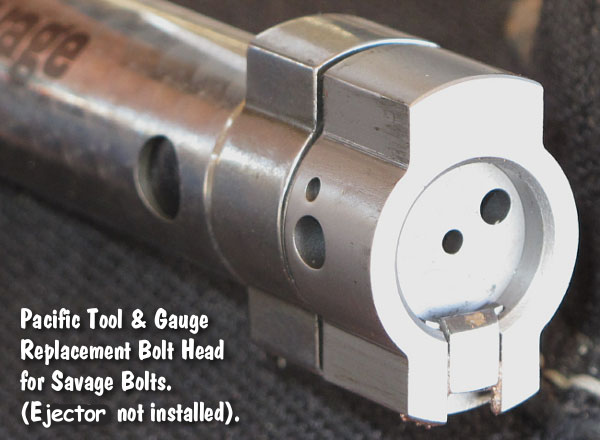
Pacific Tool & Gauge, has an outstanding new product, a precision-machined replacement bolt head for Savages. This product, available in a variety of bolt face sizes for $49.99 per unit, can benefit nearly everyone who shoots Savage bolt guns.
When visiting German Salazar’s excellent Rifleman’s Journal website, we were pleased to see a recent, in-depth review of the PT&G Replacement Bolt Head for Savage Bolts. Written by Norm Darnell, this detailed review explains the benefits of the PT&G replacements, compared to the standard Savage bolt heads. After polishing, the factory bolt head can become slightly dished. According to Darnell: “The area around the firing pin hole sometimes has an indentation deep enough to allow the primer to flow into this void. This makes an unsightly blemish on a fired primer and can lead to hard extraction or worse. One [Savage] rifle I inspected had a continuing problem with pierced primers despite reasonably mild loads[.]” Even after machining the factory bolt face to make it flat, Darnell encountered problems: “The firing pin hole seemed to wear excessively which was of some concern. Material strength of the investment-cast bolt head* appears to be the source of these recurring problems.”
After testing out PT&G replacement bolt heads, Darnell found that his problems were solved. With the PT&G replacement bolt head, “the cartridge case heads and primers indicated no case-head rounding or primer damage”. Darnell was convinced, so he proceeded to fit PT&B bolt heads “on all three of my 308 bolts and one 223 with one spare bolt of each.” It appears that PT&G has a winner here — a smart, affordable new product that remedies a commonly-observed problem with factory Savage bolt heads.
* In the article, author Darnell writes that Savage factory bolt heads are investment cast. Fred Moreo of Sharp Shooter Supply says this is not correct: “Savage bolt heads were NEVER investment cast. From the get-go they were machined from solid stock. In 1988 they went to special profiled 41L40 bar stock to save machining operations and heat treated to 35-42 RC.”
In 2009, to raise money for its defense budget, the Korean Defense Ministry announced plans to sell 87,000 M1 Garands to American collectors. Initially, it looked like there was a “green light” for the return of these historic arms, which were originally provided to South Korea by the American government. The rifles’ return was widely anticipated by American military rifle match shooters and gun collectors.
However, in March of 2010, the State Department blocked importation of the South Korean M1 Garands based on the expressed fear that the rifles would fall into the wrong hands. According to FoxNews.com, a State Department spokesman said that: “The transfer of such a large number of weapons … could potentially be exploited by individuals seeking firearms for illicit purposes.”
State Department Apparently Will No Longer Block Return of South Korean Garands
It looks like the State Department may have reversed itself. In response to pressure from Senator Jon Tester of Montana, the State Department now says that it will allow South Korea to return the rifles, once a qualified importer is selected. Sen. Tester’s office asserts that “the rifles will be sold in the U.S. through the Civilian Marksmanship Program” (CMP), which has sold many thousands of other surplus M1 Garands.
Sen. Tester declared: “From World War II to Korea and Vietnam, M1 Garand rifles played a crucial role in history. These American-made firearms will always be valued as collector’s items, and law-abiding Americans have the right to keep them under our Constitution’s Second Amendment. I’m glad the State Department listened to my concerns and those of America’s gun collectors.”
CMP States It Will NOT Sell Commercially Imported Garands
Senator Tester’s office has said the CMP will sell the Korean Garands. However, if the South Korean Garands are imported commercially, and NOT simply returned to the U.S. Army, it appears that these rifles would not be able to be sold or distributed by the CMP. Orest Michaels, CMP Chief Operating Officer, explained that the CMP would not re-sell commercially imported rifles:
“The CMP is not a firearms importer and we would not have any involvement of any kind in anything that may happen with these Korean rifles and carbines if they were ‘sold’ to an importer. The only way any rifle or carbine from any country can find its way to the CMP is if the country returns ‘loaned’ rifles back to the U.S. Army — at no cost to the U.S.[.] When that happens, the CMP ‘may’ possibly receive some of those rifles. Korea does not plan on returning (repatriating) any rifles to the U.S. Army, but plans to ‘sell’ these rifles to an importer. According to the recent news and rumors, the U.S. State Dept. has agreed to allow Korea to sell the rifles, even though the U.S. Army claimed the rifles and carbines should be returned to the U.S. Army at no cost. CMP will not have any involvement in this.” Michaels added: “There is no need to wait for the Korean Garands to make a purchase. CMP has plenty of M1 Garands for sale now.”
We commend the State Department for reversing its misguided policy blocking return of these historic arms. We wonder if this reversal can be attributed in large part to Tester’s efforts in Washington. After the State Department blocked the rifle’s sale in 2010, Tester drafted legislation blocking Executive-branch interference with importation of American-made guns that were originally provided to a foreign government. Tester, Chairman of the Congressional Sportsmen’s Caucus, also led efforts in the U.S. Senate to block U.S. funding to promote the United Nations Arms Trade Treaty.
Scientists at the Oak Ridge National Laboratory (ORNL) have developed a system that uses lasers and fiber optics to measure very small changes (deflections) in a rifle barrel. These deflections are recorded with laser sensors, and then algorithms are used to compute the resultant changes in bullet trajectory. Using computer-calculated trajectories, the digital sighting system’s “virtual” reticle automatically adjusts to compensate for barrel deflection, as well as changing environmental conditions. The microprocessor-controlled digital reticle can adjust to 1/1000th of a Minute of Angle (MOA). That makes it far more precise than any conventional riflescope reticle.
ORNL Barrel Sensor with Compensating Reticle
Shown below is a laboratory prototype of Oak Ridge National Laboratory’s Reticle Compensating Rifle Barrel Reference Sensor. This system precisely measures the deflection of the barrel relative to the sight and then electronically makes the necessary corrections. The system was developed by a team led by Oak Ridge National Laboratory’s Slobodan Rajic, shown in the photo.
The Reticle Compensating Rifle Barrel Reference Sensor takes the guesswork out of shooting by shifting the burden of knowing the relative position between the barrel and the weapon sight axes from the shooter to an electronic sensor. The system precisely measures the deflection of the barrel relative to the sight and then electronically realigns the moving reticle, or crosshairs, with the true position of the barrel, or bore axis.
“When a weapon is sighted in, the aim point and bullet point of impact coincide,” Rajic said. “However, in the field, anything that comes into contact with the barrel can cause perturbation of the barrel and induce errors.”
With modern high-caliber rifles boasting ranges of up to two miles, even very small barrel disruptions can cause a shooter to miss by a wide margin. That makes this technology indispensable from a marksman’s perspective, Rajic said.
From a technological standpoint, the approach is straightforward. ORNL starts with fluted barrels (the flutes play a key role). With the ORNL technology, glass optical fibers are placed into the flutes. The sensor system contains a laser diode that sends a signal beam into the optical fibers parallel to the bore axis of the barrel.
“The optical fibers are designed to split the laser beam twice, sending one beam along the top of the rifle barrel and another light beam along the side of the barrel,” Rajic said. “Thus, we can measure both the vertical and horizontal barrel deflection.”
Through a combination of algorithms, optics and additional sensor inputs, the system can take into account distance and other factors affecting the bullet trajectory. Ultimately, the whole optical/laser/digital system provides the shooter with crosshairs that automatically adjust for conditions in real time.
A Compensating Reticle with 1/1000 MOA Precision
Skeptics of electronic sighting systems have complained that the resolution of a digital rifle-sight is too crude to allow precise aiming. There simply aren’t enough pixels on a viewscreen to allow ultra-precise aiming at long-range targets, shooters have said. In fairness, the existing commercially-available digital rifle sighting systems HAVE been crude — with a lo-rez screens like you might find in a portable GPS.
Well you can forget all that. ORCL has achieved a break-through in digital sighting. The bar has been raised — by an order of magnitude. The resolution of ORNL’s digital, sensor-informed Compensating Reticle is 125 times better than that of traditional target reticles, which can normally be adjusted by one-eighth Minute of Angle (MOA) (at best). Now get this — the ORNL sensor can sense angular displacement and shift the reticle by 1/1,000th of a minute of angle. While this system is expensive, and designed (at this point) for the military, this technology could eventually benefit sport shooters. A decade from now, we would not be surprised if long-range civilian shooters commonly use electronically-enhanced optics, with digital reticles that automatically compensate for bullet drop (and maybe even windage).
ORNL scientists are also working on technology that could yield much more precise and accurate plots of bullet trajectories. We will no longer have to rely on “guesstimated” data inputs, and certain assumptions about bullet drag factors. Rajic and colleagues are developing a laser-based, bullet tracking system that would record plot the bullet’s actual flight path while the bullet is in the air. In other words, this tracking system would be able to plot the bullet’s true trajectory from muzzle to target. That is much differerent than current ballistic “solvers” which merely draw a predicted arc based on muzzle velocity, wind and temp inputs, and a reference BC value.
Oak Ridge National Laboratory is a multi-program science and technology laboratory managed for the U.S. Department of Energy by UT-Battelle, LLC. Over 3000 scientists and engineers at ORNL conduct basic and applied research and development to create scientific knowledge and new technology in key areas of science, energy, the environment, and national security.
Every year, the third Sunday in June is Fathers’ Day. In 2012 this is June 17, so mark your calendars. If your father enjoys the shooting sports, we suggest planning a day at the range with him. And if you’re looking for a gift that will surely be appreciated, consider a Sinclair Int’l Gift Card. These are available in a variety of money values, and Sinclair can mail them directly to your father’s residence. If you’re running short on time, you can get an “eGift Card” sent directly to you father via email. Click the link below to learn more about Sinclair Gift Cards.
Take Your Daughter to the Range Day
This month, along with Father’s Day, there’s another special day to mark on your calendar. June 9th, 2012 is National Take Your Daughter to the Range Day. This is a great way to spend “quality time” with your daughter, and teach her the basics of firearms safety.
The organizers of this event explain: “Boys learn to shoot in Scouts, or with their Dads. Often the girls are left behind, because shooting isn’t ‘girly.’ Well, young ladies can, and do, shoot, and they often do it very well indeed. Learning to shoot gives young women confidence, helps to build self-esteem, and introduces them to a sport they can participate in their whole lives. This event will promote firearms safety and education, as well as family bonding through participation in an exciting and fun sport.”
Crimson Trace (CTC) is extending its popular FREE Batteries for Life promotion. CTC customers will receive free replacement batteries for the lifetime of their laser sights, in exchange for registering their Crimson Trace products with the company’s customer service department.
“There are very few things in life that are truly free,” said Nate Hoke, Director of Customer service for Crimson Trace. “This is one of them. Just register online or via our 800 number and every year, we’ll send a fresh set of batteries for your Lasergrips® or Laserguard® product for as long as you own it.”
Hoke reported that many customers were still using the original batteries in their sights after six or seven years. “While Crimson Trace products have the longest run times in the industry, laser sights are safety devices and as such, should have regular battery changes.”


Target Measurement with OnTarget Software
 We all have friends or acquaintances who are just getting started in the shooting sports. These newcomers are often overwhelmed with questions: “What gun do I buy… What gear do I need… How should I begin my training?”. With the upcoming launch of the
 First Handgun Choice — This Editor believes that a very good choice for a first handgun is a Smith & Wesson .22 LR revolver, such as the S&W model 617. The model 617 is extremely accurate, with a very crisp trigger (in single-action mode), and good sights.




 The Reticle Compensating Rifle Barrel Reference Sensor takes the guesswork out of shooting by shifting the burden of knowing the relative position between the barrel and the weapon sight axes from the shooter to an electronic sensor. The system precisely measures the deflection of the barrel relative to the sight and then electronically realigns the moving reticle, or crosshairs, with the true position of the barrel, or bore axis.


