If you’re looking for a modestly-priced holiday gift for a shooting buddy that is sure to bring him (or her) a smile, consider a shooting-theme T-shirt from Creedmoor Sports. Regularly priced at $12.95, these shirts are marked down to just $10.00 for the holidays. Creedmoor’s graphic T-shirts are emblazoned with clever messages such as: “Life’s Too Short to Shoot 9s”, and “X-Ring: The Only Six Inches That Matter”. There are also gift shirts for family members. Options include: “World’s Greatest DAD”, “Father of the World’s Greatest Kids”. There are more fashionable specialty shirts for the ladies: “Shoot Like a Girl … If You Can”, “Nothing Says Love Like a Girl and her AR-15″ (women’s shirts $18.00 on sale, normally $21.95). And for serious shooters who prefer to let their guns do the talking, there are simple designs with just an M16 or M1 Garand logo.
Long-Sleeve and Sweatshirt models also
These Creedmoor shirts are available in white or gray fabric. And, with most of Creedmoor’s graphic designs, you can get a long-sleeve T-shirt version for $2.00 extra, a crewneck sweatshirt version for $5.00 more, or a hooded sweatshirt version for $10.00 more. (Holiday discount pricing listed; regular prices are higher.)
Much anticipated, the NRA’s new 575-page history of the National Matches, is now in stock at the NRA Program Materials Center. The $69.99 book, entitled The National Matches: 1903-2003 The First 100 Years, covers all the National Match venues, starting with New Jersey’s Sea Girt, followed by Creedmoor in New York, and finally the present-day home at Camp Perry, Ohio.
Richly illustrated with hundreds of photos, this book includes complete National Match results, and notable shooter histories. The book also covers the evolution of match rifles and pistols over the past century. Any shooter who has competed at the National Matches, or who has an interest in National Match history, should consider adding this book to his personal collection. The National Matches: 1903-2003 The First 100 Years can be purchased online through the NRA Program Materials Center, item number CC19740, or you can call 1-800-336-7402 and asking for Item# CC19740.
Two New England gun-making facilities will soon close their doors. The operations of both Bushmaster (Maine) and Thompson/Center Arms (New Hampshire) are being relocated to other facilities owned by their respective corporate parents.
Bushmaster Plant in Maine to Close
First, the Freedom Group, which owns Remington, Bushmaster, Marlin and other companies, announced that it will close Bushmaster’s Windham, ME facility, “effective March 31, 2011″. According to an official press release: “The Company will relocate manufacturing of all Bushmaster products currently produced at Windham to other, existing Freedom Group Facilities. The move will have no impact on customers or the existing supply base.” John B. Blystone, Chairman of the Freedom Group’s Board of Directors, commented: “We are continuing to adjust our operations in order to remain competitive…. Given increasing costs and pricing pressures affecting the entire firearms industry, this action is clearly necessary[.]”
T/C New Hampshire Facility To Be Phased Out
Smith & Wesson, parent of Thompson/Center Arms (T/C), is pulling the plug on T/C’s Rochester, New Hampshire operation. The Rochester factory will be phased out starting in January 2011, and finishing before the end of next year (2011). T/C production will be switched to Smith & Wesson’s Springfield, MA facility. Some workers may be relocated, but most will lose their jobs. According to S&W Mktg. Service Director Paul Pluff: “We needed to streamline in order to make our company more efficient and profitable.” S&W Human Resources VP Bill Lachenmeyer explained that the plant closure was due to a big decline in T/C sales over the last three years. S&W invested heavily in the new line of T/C Icon hunting rifles but the Icons didn’t sell well. Likewise sales of T/C’s signature Encore and Contender tilt-breech hunting pistols declined in the economic downturn.
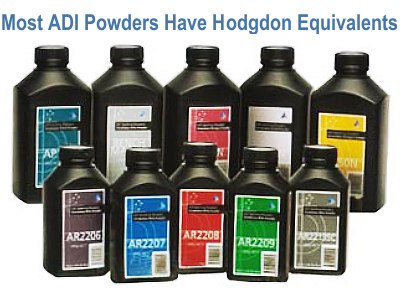
Many of the most popular powders sold under the Hodgdon brand in the USA (including Varget and H4350) are actually made by Thales Australia Ltd. (formerly ADI, Ltd.) in Australia. Some load manuals list Thales (ADI) data, but not Hodgdon data, or vice-versa, so we’ve compiled this list of equivalent powders. If you can’t find a recommended load for a particular Hodgdon powder in your caliber, download the latest ADI Smokeless Powders Handloaders Guide (2010, 5th Edition), a 5-megabyte Acrobat file.
Here’s a list of ADI to Hodgdon Powder equivalents:
AS30N=Clays
AP50N = (No Hodgdon)
AS50N = International
AP70N = Universal
AP100 = (No Hodgdon)
AR2205 = H4227
AR2207 = H4198
AR2219 = H322
Bench Mark1 = (No Hodgdon)
Bench Mark2 = BenchMark
About IMR 8208 XBR
NOTE: Although new IMR 8208 XBR is made by Thales (ADI), Hodgdon has not published an ADI-equivalent product code. Thales has loaded some of the 8208 XBR into military ammo. However, Thales Australia Ltd. tells us: “[We] have yet to release the IMR 8208 XBR propellant in Australia to the sporting shooters market; thus it does not have an equivalent Thales (ADI) name”.
Jeff Stover, president of the International Benchrest Shooters (IBS), told us his organization is looking to grow the ranks of shooters in registered benchrest matches. As part of that effort, the IBS Executive Board has commissioned two online surveys to gauge the opinions of both active benchresters and the general precision shooting community. Below are links to the two surveys. The first is for current, or former, benchrest competitors and the second is for NON-benchrest shooters. Jeff adds: “The survey takes only a few minutes to fill out.” So have at it guys…
Results of the survey will be presented and discussed at the IBS Annual Meeting on January 15, 2010 in Harrisburg, PA. Details of the meeting, and the survey results, will be posted on the IBS web site within 48 hours of the meeting’s conclusion.
The Future of IBS Competition — Comments by Jeff Stover
The primary purpose for the surveys is determine how we can grow benchrest shooting. We realize there are a lot of shooters that were once into the sport but have drifted away. Why? Have they found something else, or are we doing something wrong?
The second group we want to reach are serious shooters that do not consider themselves to be benchresters. How do they view us? Are they interested in learning more? How can we help?
By design, the surveys contains some quite provocative and controversial questions. Some questions seek opinions on caliber-neutral scoring in Score and whether the two benchrest organizations should be combined. We even tackle the age-old questions about competitions for factory rifles and whether there should be shooter classifications.
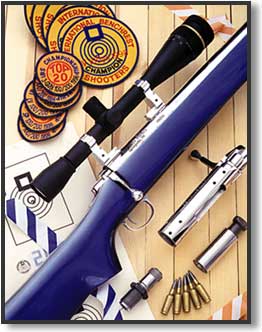
I have been thinking a lot about benchrest in comparison to the other shooting disciplines. In doing so, it is nearly impossible to avoid buzz words, such as “elite”, “ultimate” and “cutting edge”. Simply put, benchrest shooting CAN be described as such, because that is what we do. If that turns off some, so be it. The rifles that sit on the rests aimed at IBS or NBRSA targets from 100 to 1000 yards ARE the most accurate on the planet. Note I did not say “some of the most accurate”.
Probably the most challenging part of our game is there is NO room for error. A group or aggregate that measures, say .270″ is a far cry from a .170″. Point out a .10″ tick mark on a ruler to the average Joe and tell him that is the distance that represents the difference between great and average. I think the very nature of our discipline appeals to a particular type of individual. We are trying to place each shot in the same hole or on top of a small ‘x’. It is hard to dabble in benchrest. It is a bit of an “all or nothing” game.
Selling our sport can be a little difficult. Some of the uninitiated think it is either too complex or too easy (see the comments on this benchrest video on Youtube if you want to lose your lunch).
I don’t mind that we are a “niche” sport, but we need to be a critical mass to make sure the normal weekend shoots have healthy numbers. Interestingly, most of the really large shoots, such as both Nationals and the Super Shoot have held their own in recent years. So, maybe the economy does play into the number of shoots that a person attends. There is a question to that effect in the survey.
Recently, I had a call from a fellow that is building a sophisticated range here in the east. He was not a benchrest shooter, but wanted information on what we needed so that he can host registered matches. He directly told me that benchrest was important because that is where all the accuracy improvements were coming from and he felt his range needed to cater to our discipline. Enough said.
Comments can be directed to me at jstover33 [@] comcast.net. — Jeff Stover, IBS President
Kestrel has teamed with Horus Vision to produce a new Kestrel Weather Meter with integrated ballistics software. Previously, shooters would need to obtain environmental data from a Kestrel meter and then input that data into a PDA loaded with Horus ATrag ballistics software. Now, the Kestrel Ballistics Weather Tracker with Horus ATrag software contains all of the necessary data and solutions in one Kestrel device, which is IP67 waterproof and MIL-STD-810F rugged. MSRP for the Kestrel with Horus Ballistics is $619.00 (non-Bluetooth).
The new unit allows users to load and customize multiple guns and rounds from the extensive proprietary Horus database. You can create up to six targets, each customized for location, distance, direction, declination and winds. The Kestrel meter will meter wind velocity and direction, and, using its built-in digital compass, it will give the bearing to the targets. Once these parameters are set, the Kestrel meter takes over — tracking the current met data and automatically updating the firing solution. The Horus ATrag software even compensates for coriolis and spin drift at extreme long range.
When you switch out of Ballistics mode, you still have all the capabilities of a 4500 NV unit which can measure: speed and direction, temperature, humidity, heat stress, barometric pressure, altitude, density altitude, crosswind and more.
Q: Which Kestrel Meters will be available with Horus ATrag ballistics software?
A: The Kestrel 4500 NV series will be available with Horus Vision ballistics. The Kestrel 4500 is the only model to give wind direction, which is important for long-range shooting. For more money, you can order a model with Bluetooth capability that allows wireless data transfer to a laptop or PDA.
Q: When will the Kestrel/Horus be for sale and how much will it cost?
A: Kestrel is currently offering a limited supply of Kestrel/Horus 4500NVs to “preferred users” via an email campaign. If you did not receive the email solicitation, but really, really have to get one right now, contact Kestrel directly at 800-784-4221. MSRP for the Kestrel 4500NV with Horus ATrag Balllistics is $619.00, while the Krestrel/Horus 4500NV with Bluetooth capability lists for $739.00. According to Kestrel, “Supplies are very limited.”
Q: Can I upgrade my current unit to include Horus Vision software?
A: No. The Kestrel with Horus Vision ATrag software was specially designed and built to support the integrated ballistics solutions along with the Kestrel environmental data capturing capability. This is not just a software upgrade. Kestrel does offer a Customer Care Discount program where you may trade in your current Kestrel for credit towards the new Kestrel Weather Tracker with Horus Ballistics software.
USA Shooting has named Kim Rhode and Staff Sgt. Joshua Richmond as the 2010 Female and Male Athlete of the Year. Rhode had an outstanding year with a World Championship title, a National title, two World Cup gold medals, a World Cup Final silver and an equaled world record. Just three weeks after Nationals, Rhode took on the top shooters in the world at the World Shooting Championships in Munich, Germany. Rhode won the gold medal and World Champion title with 97 out of 100 targets. National Shotgun Coach Bret Erickson said, “Kim is a dominating force on the international scene and has been for years.”
Rhode currently leads the point total in U.S. Olympic Team selection, and unless another shooter equals or exceeds her point total, she will compete at the 2012 Olympic Games in London. That would be her fifth consecutive Olympic Games appearance (she has medaled in the previous four). In London, Rhode would have a chance to become the first individual-sport American athlete to medal in five consecutive Olympics.
Richmond Rises to Top in 2010
Staff Sgt. Joshua Richmond was a world-beater in 2010, finishing as the ISSF World Champion in double-trap. Josh began his impressive year in Acapulco, Mexico at the first shotgun World Cup of the season. Richmond scored 192 out of 200 targets for the gold medal. In Colorado Springs, Richmond won the silver medal at the USA Shooting National Championship with 333 out of 350 targets.
In the video below, you can watch Richmond win the Gold Medal for Men’s Double-Trap at the 2010 ISSF World Shooting Championship in Munich Germany. In Munich, Richmond was on fire. He nailed 146 out of 150 targets in qualification and shot a perfect 50 in the final. That gave Josh a total of 196 out of 200 targets — equaling the world record, and securing the World Championship.
Richmond is stationed with the U.S. Army Marksmanship Unit at Fort Benning, GA, where he is training in preparation for the 2012 Olympics. Richmond credits the USAMU for his success: “I would like to thank the USAMU for molding me into a champion.”
March scopes (built by Japan’s Deon Optical) have become extremely popular with short-range benchrest competitors, and we are seeing an increasing number of 600-yard and 1000-yard shooters upgrade to March scopes. The March product line offers high magnification (up to 60X power), a wide choice of reticles, and extremely bright, sharp lenses.
March has also quickly acquired a reputation for reliable tracking and shot-to-shot consistency. In the unforgiving short-range benchrest game, if your reticle shifts just a tiny amount from shot to shot, that can open up your group and drop you from a top place to “also-ran” status. Top short-range shooters have praised the March for its ability to “stay put” with no reticle movement, shot after shot.
New Website with All the New Scopes (with Specs)
In the USA, March scopes are sold by Kelby’s Inc., which has a page dedicated to March products on the www.Kelbly.com website. If you need MORE Information about the March scopes, there is now a new March Website, with more models, more photos, more data, and more reticle diagrams. You’ll find the latest Benchrest models on the new March website, including the popular 36-55x52mm Benchrest EP Zoom Scope, the 10-60×52 Zoom, and the 40X, 50X, and 60X fixed-power BR scopes. In addition, the website features March’s new hunting and tactical series of optics, including the 1-10×24, 2.5-25×42 scopes which boast a revolutionary ten times Magnification Ratio.
Most reloaders have used a powder trickler at one time or another. However, they can be frustrating to use for a variety of reasons — e.g. the tube is too short, or the trickler is too low, or the unit isn’t stable enough, or the powder volume isn’t adequate. Well, the inventors of the Omega Powered Powder Trickler have considered all those practical shortcomings in existing tricklers, and built a superior product — a “better mouse trap.”
Every aspect of the new $55.00 Omega powered trickler (from Dandy Products LLC) shows smart thinking. First, hopper height can be adjusted from 1/2″ to 5.5″ high. The tube is long enough to reach the middle of large-footprint scales such as the Denver Instrument MXX-123. And the outer end of the tube is cut at an angle, so you can see the powder kernels as they flow out — no more surprise clumps that raise your charge 0.2 grains. The powder hopper itself is bigger than most, holding a full 1000 grains. That lets you load all afternoon without having to constantly replenish your trickler.
In practice, the Omega trickler is easy to use. It is reasonably fast, while being as precise as anything on the market. The unit is controlled by a two-button control pad, with a black button for slow feed and red button for fast feed. You can use the fast button to load the bulk of reloading powder and then use the slow button to maximize the accuracy of your load. The control pad is connected to the dispenser by a 24″ cable. That two-foot cable run allows plenty of trickler placement options on your bench. Watch the video below to see the Omega Trickler in use.
Omega User Comments
Posting on 24HourCampfire.com, JasonK gave the Omega Trickler high marks: “This thing rocks! It can trickle fast, it can trickle slow, it can drop a kernel or two at a time. After ordering my Omega I quickly shopped for an Acculab VIC-123 scale, accurate to within .02 grains.”
Another Omega user, In2Deep, writes: “You can actually tap the low-speed button and drop kernels while watching the scale. After a little practice it only takes a few seconds to trickle up a load. Using an Acculab 123 scale, it can drop charges that repeatedly read down to around 4 one-hundredth’s of a grain. It turned out to be a tool that really works and saves time. There are rubber feet on the unit and surprisingly it does not cause interference with the digital scale which is often mentioned as a problem with most of the vibratory tricklers. Not many products are even worth the time to do a testimonial but this is a winner[.]”
Forum member Barry O (aka TheBlueEyedBear) has been using an Omega Trickler for a while, and he currently has a second-generation (upgraded) unit on his bench. Barry likes the unit, with some reservations. Barry tells us: “it took me some time to get used to it. One main gripe is the length of time it takes to get the thing primed and ready to dispense powder. But after that, not too bad. I still use my trusty tweezers for fine tuning loads.”
Handy View Prism for Beam Scale Viewing
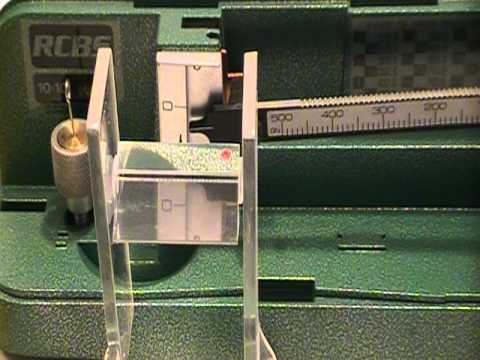
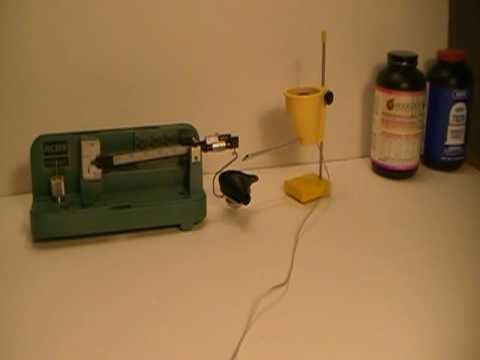
For reloders using balance-beam scales, Omega offers a clever portable prism that makes it much easier to see the tip of the balance beam, when the scale is on the benchtop. Omega’s Handy View accessory mounts a prism in a plastic stand. The prism changes the sightline so you can easily monitor the beam tip without having to bend down to see the beam alignment marks.
The prism slides up/down and swivels (around horizontal axis) to allow adjustment of viewing angle. It is a simple set-up, but it really works, allowing you to monitor scale beam movement with greater precision (and less neck strain). The Handy View costs $17.95, and is offered with either a yellow stand or clear plastic stand. You can see how the Handy View works in the video below.
Thanks to Boyd Allen for suggesting this product for review.
Technoframes Ammo Carriers and Display Cases.
These CNC-machined display boxes look great. There are many varieties to choose from, including wood, metal, and plexiglass. We like the fact that many of the boxes are lockable.
Custom Tool for Loading and Unloading Revolver Moon Clips
This unique moon/de-moon tool set retails for $80 and is available from Randell Kenner, 3111 Lien Street, Rapid City, SD 57702, (605) 605-348-3538, bmtmooner@rushmore.com.
Faux Guitar Case Gun Bag
This Ultimate Discrete Rifle Case, produced for LWRC Int’l by Blue Force Gear, stows a tactical carbine inside what appears to be a guitar case. Looks nicely made, but when you think about it, why pay $149.99 for the “Ultimate Discrete Rifle Case” when, for forty bucks or less on eBay, you can buy a real “previously-owned” guitar case that will do the same job — and be even more stealthy.
Check Out the Podcasts from PersonalArmament.com
You should visit the Personal Armament Podcast Site. Launched in 2009, this website features dozens of podcast interviews with interesting folks, including 2010 National Long-Range Champion John Whidden, Chris Hodgdon of Hodgdon/IMR Powders, and Kevin Thomas from Nammo Lapua.


 If you’re looking for a modestly-priced holiday gift for a shooting buddy that is sure to bring him (or her) a smile, consider a shooting-theme T-shirt from Creedmoor Sports. Regularly priced at $12.95, these shirts are marked down to just $10.00 for the holidays. Creedmoor’s graphic T-shirts are emblazoned with clever messages such as: “Life’s Too Short to Shoot 9s”, and “X-Ring: The Only Six Inches That Matter”. There are also gift shirts for family members. Options include: “World’s Greatest DAD”, “Father of the World’s Greatest Kids”. There are more fashionable specialty shirts for the ladies: “Shoot Like a Girl … If You Can”, “Nothing Says Love Like a Girl and her AR-15″ (women’s shirts $18.00 on sale, normally $21.95). And for serious shooters who prefer to let their guns do the talking, there are simple designs with just an M16 or M1 Garand logo.
 Much anticipated, the NRA’s new 575-page history of the National Matches, is now in stock at the NRA
 Bushmaster Plant in Maine to Close
 T/C New Hampshire Facility To Be Phased Out

 I have been thinking a lot about benchrest in comparison to the other shooting disciplines. In doing so, it is nearly impossible to avoid buzz words, such as “elite”, “ultimate” and “cutting edge”. Simply put, benchrest shooting CAN be described as such, because that is what we do. If that turns off some, so be it. The rifles that sit on the rests aimed at IBS or NBRSA targets from 100 to 1000 yards ARE the most accurate on the planet. Note I did not say “some of the most accurate”.
 Kestrel has teamed with Horus Vision to produce a new Kestrel Weather Meter with integrated ballistics software. Previously, shooters would need to obtain environmental data from a Kestrel meter and then input that data into a PDA loaded with Horus ATrag ballistics software. Now, the Kestrel Ballistics Weather Tracker with Horus ATrag software contains all of the necessary data and solutions in one Kestrel device, which is IP67 waterproof and MIL-STD-810F rugged. MSRP for the





 Most reloaders have used a powder trickler at one time or another. However, they can be frustrating to use for a variety of reasons — e.g. the tube is too short, or the trickler is too low, or the unit isn’t stable enough, or the powder volume isn’t adequate. Well, the inventors of the

 Handy View Prism for Beam Scale Viewing