|
|
April 1st, 2010
In recent years, environmental concerns over lead toxicity have inspired efforts to eliminate conventional lead-based ammunition. To protect endangered species from lead poisoning, California has banned hunting altogether on huge tracts of public land. In other areas which harbor protected species, hunters are forbidden to use lead-core or solid lead bullets. There is an ongoing FDA investigation into the health of venison taken with lead-core bullets. Responding to such concerns, in 2008, Barnes Bullets (now part of the Freedom Group), introduced its MPG™ (Multi-Purpose Green) lead-free bullets. These bullets are intended for hunting and for rifle training in locations where lead is restricted.
 Following Barnes’ lead, BIO-Bullets, a small company in Wanganui, New Zealand has invented a jacketless bullet that is not only lead-free, but is also 100% non-toxic, and bio-degradable. The new bullets have zero lead content and are made from “all-natural”, organic compounds. Unlike conventional bullets formed in a die, the new BIO-Bullets are pressure-molded from a proprietary composite, using sintered mineral compounds in a silica matrix. The mineral compounds, interestingly enough, not only bind the bio-degradable bullet together, but they provide nutritional benefits for any game that might ingest the projectiles. If an animal eats the bullet, it won’t get sick — it will actually get healthier.
That’s right — these edible BIO-Bullets are not only non-toxic, they are actually nutritious. “When we came up with a non-toxic component mix, we realized we could actually provide a blend of flavorful nutrients in the matrix.” Said Trevor MacDiarmid, BIO-Bullets’ chief bullet designer. “It may seem far-fetched but just look at the label on a typical multi-vitamin supplement. You’ll see iron, chromium, magnesium, potassium, and zinc, among other minerals. These are all elements that can be combined into a durable bullet form that is actually healthy when ingested by an animal.” MacDiarmid, who holds a Ph.D in chemical engineering, explains that the health benefits of the BIO-Bullet came as an unexpected bonus: “Our first goal was simply to create a shootable, lead-free bullet that was non-toxic. But when our silica matrix proved more than hard enough to survive the friction, heat, and pressure of a 3500 fps trip through a rifle bore, we realized we could add additional minerals into the mix that would have a salutary effect on wildlife health.”
 BIO-Bullet’s founder, Steven Williams, is a gregarious 45-year entrepreneur who earned his first millions promoting dietary supplements in his native New Zealand. Noting the growing interest in “eco-friendly” ammunition components, Williams expects a huge demand for his new BIO-Bullets. “Globally, the annual sales of hunting bullets exceed €500 million in value. And the military bullet market may be triple that number — as long as you Yanks keep fighting wars”, he joked. Williams believes his new company is in the right place at the right time: “Being based in eco-aware New Zealand gives us a strong marketing advantage in launching this new product.” Williams’ company has earned the coveted “100% Pure New Zealand” certification, signifying that Bio-Bullets are “all-natural” and organic.
A select group of New Zealand hunting guides has already been using prototype BIO-Bullets in the field. The new eco-friendly bullets have earned high praise from these tough-to-please outdoorsmen. “In terms of ballistics and knock-down power, I reckon the ‘greenies’ are as good as anything on the market”, reports veteran outfitter Bart Coutts. South Island guide and deer farmer Dennis Amon said, “I’ve used them for predator control, and, as a test I even fed them to some of our captive Red Deer. The Reds ate them up like they were candy. Ever since then we’ve been calling these BIO-bullets the ‘incredible edibles’.”
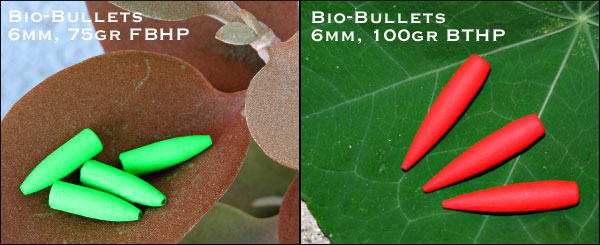
BIO-Bullets will initially be available in .224, 6mm, and .308 calibers starting at $40 (NZ) per box of 100. The varmint-grade, flat-based bullets will be finished with a day-glo green outer coating, while the longer, boat-tail match bullets will be fluorescent red. Said designer MacDiarmid: “Since our BIO-Bullets don’t use a conventional jacket, we can finish them in any color by adding non-toxic dyes to the silica matrix. It’s sort of like putting the colored shell on a jelly bean. I favored a more sedate color, but the boss wanted something bold and eye-catching. Steven’s the marketing guru, and he writes the checks, so we went with fluorescent colors. But any exterior color scheme is possible, even digital camo.”
BIO-Bullets is currently finalizing arrangements with North American distributors. The company expects its eco-friendly bullets to appear on American and Canadian store shelves in time for the traditional fall hunting season.
April 1st, 2010
Just days after surprising the firearms industry with the announcement that the Marlin Firearms factory in North Haven, Connecticut would be shut down, executives of Remington Arms today dropped another bombshell concerning the fate of Marlin, a Remington subsidiary. This morning, Remington released a statement declaring that Marlin would be “re-constituted” as a multi-product outdoor gear manufacturer, with a primary focus on fishing tackle and equipment.

In the wake of Remington’s decision to shut down the North Haven plant by mid-2011, laying off all 265 Marlin employees in the process, many questions remained as to the fate of legendary arms-maker Marlin, which has been building firearms in Connecticut continuously since 1870. When the Marlin plant closure was announced, Remington, part of the Cerberus Freedom Group of companies, would neither confirm nor deny that Marlin firearms, particularly the popular lever-action rifles, would still be produced. Sources inside Remington were quoted as saying that Marlin rifle production would be relocated to Remington’s Ilion, New York facilities.
Now it appears that Remington has other, quite radical plans for Marlin, which surely reflect the strategic goals of Remington’s parent, Cerberus Capital Management, a private holding company. Cerberus has no doubt “seen the writing on the wall”, recognizing that gun sales are in a steep decline following the buying frenzy precipitated by the Democratic election victories in 2008. To protect its investment in Marlin, Cerberus saw the need to shift Marlin into a whole new market. That’s certainly a bold strategy, but is it wise?
AccurateShooter.com was able to reach one high-level Remington insider with insights into the latest Marlin transition. Our source confirmed that “most of the Marlin firearms line will survive, but not every product will be staged into production right away. Only the most popular rifles will be transitioned into immediate production at Remington plants in Ilion, New York and elsewhere.” Our source explained that building Marlin rifles outside Connecticut is not easy: “Understand that most of the machines and tooling in North Haven were quite antiquated. It’s not even worth moving most of the big equipment. We have to figure out how to replace that junk before we can start building lever guns again.”

“Marlin’s real focus”, our source continued, “will be the fishing stuff — and that’s where 90% of our resources will be allocated. Our market research shows we can sell more rods and reels, at a higher profit margin, than we can old-fashioned rifles. Demographically, fishing is growing while rifle shooting has become a cultural anachronism — a hobby for old white guys. With the Marlin name and trademark, we realized we had a perfect platform to get into the fishing market. Ask most Americans what a Marlin is… nine out of ten will say it’s a fish, not a rifle. Since most consumers already connect the name Marlin with fishing, it made perfect sense to change the company’s focus. And now’s the perfect time to do it, what with the imminent North Haven plant closure.”
While devotees of Marlin rifles may lament the passing of yet another storied American gunmaker, anglers nationwide, who outnumber rifle shooters by nearly 3 to 1, have reason to celebrate. The “rebirth” of Marlin as a rod, reel, and tackle manufacturer promises to offer fishing enthusiasts a wide range of new products, proudly marketed with the “Made in USA” legend. Shown above is Marlin’s new “Fish Eagle II” Rod and Reel combo, complete with Marlin’s signature lever action. The fishing gear industry is currently dominated by foreign manufacturers. Marlin’s movement into the fishing market gives anglers a chance to “buy American” again.
March 31st, 2010
Savage Arms has released a new line of Savage EDGE centerfire rifles. This new platform was built from the ground up as an affordable entry-level rifle. The EDGE features a new modern look, and while it shares key features with its older brother the Model 110, it has a different receiver design.

Though the basic model has a low, $329.00 MSRP, the EDGE includes some nice features: detachable box magazine, pillar bedding, and 2-position safety. For $379.00, you can get the EDGE XP, which includes a 3-9×40 scope (mounted and bore-sighted). Factory camo versions are also offered in both basic and XP configurations.

The EDGE action is apparently long enough to handle both short and long cartridges. This “one size fits all” approach has been used on some recent European rifles as well. We were pleased to see that Savage is offering a wide variety of chamberings: 223 Rem, 22-250, 243 Win, 25-06, 270 Win, 7mm-08, 308 Win, 30-06 Springfield.
An Affordable Gun for a Tough Economy
The EDGE was conceived in January of 2009. At the time, Savage observed heavy activity at the entry level pricepoint from consumers as well as manufacturers. The poor economy created more interest in pricepoint hunting guns and key manufacturers were cutting already low prices even lower.
“We wanted to not only maintain our market share, but to grow it,” Savage VP of Sales & Marketing Brian Herrick said. “We felt the only way to accomplish this was to develop a new rifle designed for this segment, rather than discount current models. We wanted a rifle that not only had a lower price, but one that had better features and was more aesthetically appealing than what was out there at the time.”
March 30th, 2010
 We just got the complete F-Class Nationals match results from Jim O’Connell of the Sacramento Valley Shooting Center. Jim provided two (2) MS-Word documents, one for F-Open and the other for F-TR. Jim added: “Thanks to the California Grizzlies (target pullers) for all their work and helping to make the Saturday and Sunday shoots more enjoyable. Thank you all for your support of the Folsom Shooting Club and we hope to see you at future matches.”
DOWNLOAD 2010 Nationals F-Open Scores
DOWNLOAD 2010 Nationals F-TR Scores

March 30th, 2010
 The Hickory Groundhog Shoot, the nation’s most popular groundhog shooting competition, will be held Saturday, April 3rd in Vale, North Carolina. Now in its 30th year, this is the biggest Varmint competition on the East Coast, with over $4000.00 worth of prizes awarded each year, including $1000.00 in cash.
You can compete individually or as part of 3-man teams. The entry fee is $25 per gun, plus (optional) $10 per team. There will also be a 500-yard Egg Shoot with a $2.00 entry fee.
Custom or Factory Classes — Simple Rules — Valuable Prizes
There are two classes, custom and factory, and the rules are pretty basic. You can run pretty much anything but a rail gun in custom class, and you can use any kind of front rest (including one-piece rests). A “factory” gun must be “bone stock” as purchased and you are limited to bipod, sandbags, or basic pedestal style front rest. The only modifications allowed for factory class are: 1) bedding job; and 2) trigger tuning (without replacement parts). Competitors may enter one gun in each class, but the fee is $25.00 per gun.
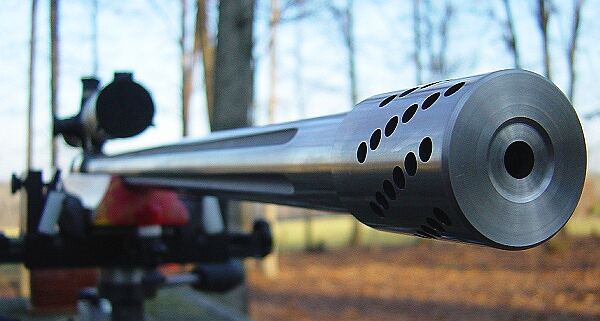
This year, ALL targets will be at known distances: 100, 300, and 500 yards. That should be a cake walk for you 1000-yard shooters. In the past, 6BRs, 6BR Improveds and the mid-size 6mms have been the calibers to beat. To see what it takes to win, read this article about Harold Seagroves’ Spencer-built 6BR (below), which has won the Hickory Shoot multiple times.
The range will be open for practice Monday through Friday the week preceding the match. The practice range is open ’til 6:00 pm Tu-Thurs, but will close at 1:00 pm on Friday. The match will start 8 o’clock sharp Saturday morning, April 3rd. If you have any questions call Larry Willis, Bulls Eye Sporting Goods, (704) 462-1948, or visit www.BullseyeLarry.com. To find the actual range using online maps or your GPS, use this address: 8216 Will Hudson Road, Lawndale, NC 28090.
March 30th, 2010
 A decade ago, Prof. John Lott wrote More Guns, Less Crime, a ground-breaking book that used advanced statistical analysis to prove that gun ownership by law-abiding citizens can reduce violent crime rates. Lott was initially assailed by the mainstream media, who refused to believe Lott’s numbers.
Now, it appears that the national media is grudgingly accepting that the increase in concealed weapon permits in many states has been associated with reductions in violent crime and in particular a notable decline in murder rates. MSNBC.com, a website known generally for its liberal-leaning news reports, recently ran an article on citizen gun carry that reveals that crime has dropped significantly in “shall-issue” states where concealed weapons permits are available to law-abiding citizens. MSNBC.com states that it is too simplistic to credit gun-toting citizens for the reduction in crime (which may have had other causes), but the statistics are noteworthy. MSNBC.com reports: “From its beginnings in the 1980s, the ‘right-to-carry’ movement has succeeded in boosting the number of licensed concealed-gun carriers from fewer than 1 million to a record 6 million today, according to estimates from gun-rights groups that are supported by msnbc.com’s research.”

Disagreement Persists as to Causes for Reduced Crime Rates
While MSNBC.com explains that the connection between lawful gun ownership and crime rates is “hotly debated” and not completely understood, MSNBC.com does acknowledge that crime rates have fallen virtually everywhere that “right to carry” laws were adopted. MSBNC.com quotes John Pierce of Opencarry.org: “Firearms in the hands of law abiding citizens prevent 1 million robberies, murders and rapes every year.” On the other hand, MSNBC.com cites a Harvard professor, Dr. David Hemenway, who claims that the available research is inconclusive and that “when it comes to concealed-carry laws, neither side can make a legitimate claim about their effects on crime”.
It is worth reading the MSNBC.com article, which includes a video on firearms training for CCW-holders in Washington state.
March 29th, 2010
2010 F-Open Class Champion Derek Rodgers, a young shooter from Albuquerque, New Mexico, proved that youth and skill can triumph over age and experience. Though Derek had placed third in F-TR class at the 2009 Nationals, this was Derek’s very first year competing in Open Class at the Nationals, and his NRA Classification was “Sharpshooter”. Derek’s win was a great victory for an unheralded newcomer. On the last day of the competition, Derek put together three superb 1000-yard matches, out-shooting High Masters and past National Champions to secure the Open Class title. Derek finished with 1330-57X, five points ahead of runner-up Ken Dickerman (1325-57X).

Ironically, Derek only decided to shoot in Open Class only because his favorite F-TR rifle is currently being upgraded by his gunsmith, and so the rifle wasn’t ready for the Nationals. (We suspect some F-Open competitors wish that gunsmith had finished Derek’s F-TR rifle a bit sooner).

 Derek brought a 300 WSM to the Nationals, a “big boomer” by F-Class standards. A fan of “heavy bullets”, Derek loads his 300 WSM with high-BC, 210gr JLK bullets. In Derek’s home state of New Mexico, strong winds are the norm. Shooting in those conditions has shown Derek the effectiveness of heavy 30-caliber bullets at long range. Derek’s load certainly shot well in the windy conditions during the final 1000-yard match on Sunday. While some of Derek’s success can be attributed to his wind-bucking WSM (built by Score High Gunsmithing in New Mexico), he also is a careful reloader who “goes the whole nine yards” to produce the best possible ammo. Derek anneals, weight-sorts and neck-turns his Remington brass. He weight-sorts and ogive-sorts his 210gr JLK bullets, and he points up the tips for uniformity. He spared no effort in loading for the Nationals because he knew “those other guys are really, really good.”
The Sierra Cup (at left) is presented each year to the U.S. F-Open Class National Champion. This year Derek Rodgers’ name will be placed on the trophy alongside other F-Open Champions including John Brewer (2004), Jeff Cochran (2005), Eric Bair (2006), Robert Bock (2007), and Charles Ballard (2008, 2009).

March 29th, 2010
The 2010 U.S. F-Class Nationals concluded yesterday. It was a big success, drawing nearly 120 individual competitors and 18 teams. Young Derek Rodgers (Sharpshooter Class, 1330-57X) from Albuquerque, New Mexico, is the new Open Class Champion, and Californian Lane Buxton (1302-42X) won the F-TR division using a .308 Win Palma Rifle with Sierra #2156 bullets. Forum member Ken Dickerman finished second in F-Open posting a 1325-57X. Past multi-time F-TR Champ Danny Biggs shot F-Open this year, finishing third with a 1324-67X. While we are still waiting to receive ALL the final official results, it appears Danny set the high X-count for the match, while shooting with a Sinclair bipod equipped with a vertical adjustment knob. (The Open-class guns work amazingly well off the wide-base bipods.) Charles Ballard, the reigning (back to back) F-Open champ, finished seventh in F-Open.
 |
 |
New F-Open Champ Derek Rodgers was shooting a 300 WSM with 210-grain bullets. This heavy bullet/short magnum combo performed well in the windy afternoon conditions during Sunday’s afternoon matches. Most of the other top F-Open competitors were shooting a .284 Win or some other 7mm. Charles Ballard told us told us: “with so many guys shooting 7mms this year, the competition is tougher than ever. If I had a caliber advantage before… that’s gone. With the winds we had in the afternoons, I’m not surprised Derek Rogers did well with his 300 WSM and the heavy bullets. I want to congratulate Derek on his well-deserved win.”


The team event was hotly contested, with 18 teams on the line, most of which were in F-TR Class. In Open Class, the North American Shooters Team, coached by Bryan Litz won the Berger Trophy for the 600 + 1000-yard combined Aggregate, as well as the 1000-yard Team Match. The Sierra Spindle Shooters team took first place in the 600-yard Team Match. In F-TR Team shooting, Savage Shooters pulled off a clean sweep, winning the 600-yard match, the 1000-yard match, AND the Team Aggregate. Congrats to Savage Shooters!

NAS Team shooters (left to right): David Mann, Dean Morris, Bryan Litz (coach), Rick Jenson, Larry Tait.
F-Open Class Results
Winner: Derek Rodgers (Sharpshooter) – 1330-57X Nat’l Champion
Second: Ken Dickerman (High Master) – 1325-57X
Third: Danny Biggs – 1324-67X – High X Count?
Fourth: Jeff Cochran – 1324-28X
Fifth: Jeff Traylor – 1323-51X
High Woman: Brenda Hill – 1302-31X
High Senior: Larry Bartholome – 1321-51X
High Grand Senior: Danny Biggs – 1324-67X
F-TR Class Results
Winner: Lane Buxton – 1302-42X – National Champion
Second: Robert Lach – 1297-36X
Third: John Hayhurst – 1293-37X
Fourth: Jeffery Rorer – 1293-28X
High Senior: Robert Lach – 1297-36X
High Grand Senior: Peter Church – 1279-31X
Complete Results for Download
Check the attachments for all the scores. FCNAT2010OPEN.doc has all the F Open scores and FCNAT2010TR.doc has all the F-TR scores.
Download All F-Open Scores/Standings | Download All F-TR Scores/Standings

March 28th, 2010

Coating bullets with a friction-reducing compound such as Molybdenum Disulfide (Moly) offers potential benefits, including reduced barrel heat, and being able to shoot longer strings of fire between bore cleanings. One of the effects of reduced friction can be the lessening of internal barrel pressures. This, in turn, means that coated bullets may run slower than naked bullets (with charges held equal). To restore velocities, shooters running coated bullets are inclined to “bump up” the load — but you need to be cautious.
Be Careful When Increasing Loads for Coated Bullets
We caution shooters that when your start out with coated bullets in a “fresh barrel” you should NOT immediately raise the charge weight. It may take a couple dozen coated rounds before the anti-friction coating is distributed through the bore, and you really start to see the reduced pressures. Some guys will automatically add a grain or so to recommended “naked” bullet charge weights when they shoot coated bullets. That’s a risky undertaking.

Instead we recommend that you use “naked” bullet loads for the first dozen coated rounds through a new barrel. Use a chronograph and monitor velocities. It may take up to 30 rounds before you see a reduction in velocity of 30-50 fps that indicates that your anti-friction coating is fully effective.
We have a friend who was recently testing moly-coated 6mm bullets in a 6-6.5×47. Moly had not been used in the barrel before. Our friend had added a grain to his “naked” bullet load, thinking that would compensate for the predicted lower pressures. What he found instead was that his loads were WAY too hot initially. It took 30+ moly-coated rounds through the bore before he saw his velocities drop — a sign that the pressure had lowered due to the moly. For the rounds fired before that point his pressures were too high, and he ended up tossing some expensive Lapua brass into the trash because the primer pockets had expanded excessively.
LESSON: Start low, even with coated bullets. Don’t increase your charge weights (over naked bullet loads) until you have clear evidence of lower pressure and reduced velocity.
Procedure After Barrel Cleaning
If you shoot Moly, and clean the barrel aggressively after a match, you may want to shoot a dozen coated “foulers” before starting your record string. Robert Whitley, who has used Moly in some of his rifles, tells us he liked to have 10-15 coated rounds through the bore before commencing record fire. In a “squeaky-clean” bore, you won’t get the full “benefits” of moly immediately.
 To learn more about the properties of dry lubricants for bullets, read our Guide to Coating Bullets. This covers the three most popular bullet coatings: Molybdenum Disulfide (Moly), Tungsten Disulfide (WS2 or ‘Danzac’), and Hexagonal Boron Nitride (HBN). The article discusses the pros and cons of the different bullet coatings and offers step-by-step, illustrated instructions on how to coat your bullets using a tumbler.
March 27th, 2010
No matter how you feel about the new Health Care Reform Act, there is at least ONE aspect of the legislation that should please you, thanks to the Gun Owners of America (GOA). Here’s the deal — at the insistent request of the GOA, a special provision was added to the health care reform bill that expressly FORBIDs any “wellness program” (public or private) from collecting (or distributing) any information about gun ownership. Why is this important? If such information was collected, health care providers could pass on the information to insurers who might then charge gun-owners higher rates based on perceived “unhealthy lifestyles” or higher risk factors.

In addition to the ban on information collection, the GOA, through the efforts of Senator Majority Leader Harry Reid of Nevada, added a second critical protection to the new legislation. According to the Slate Blog, the GOA “won another provision forbidding private insurers participating in the bill’s exchanges from charging higher premiums, or denying coverage, or denying wellness discounts on the basis of gun ownership.” The “exchanges” mean the state-level insurance pools from which citizens may purchase health insurance if they are not currently covered.
Will this make a difference? You bet. One web reader, commenting on the Slate story, explained: “I’ve worked as a consultant to insurance companies and I can promise you they [the insurance companies] will not only use that data to charge you and your family more for insurance (dangerous activities), but then also pool their data and sell their data to any company or government agency that has the cash to pay the price. Is that what you wanted from health care?”
Obviously there are many other controversial issues associated with the new Health Care Reform Act. However, thanks to the GOA and Nevada Senator Harry Reid, at least firearm owners can take some comfort that health care providers and insurers will NOT be asking questions about our guns, and using the answers to raise our rates… or worse.
|


