|
|
August 3rd, 2008
It’s great that Reloder 17 can allow shooters to boost velocities by 150 fps or more (in suitable cartridges). Pushing a bullet faster can flatten its trajectory and reduce the amount of wind drift (at a given distance). However, in our quest to shoot bullets ever faster, we must remember that higher speeds come with a price. Higher velocities can increase fouling, may accelerate throat wear, and without question, higher velocities increase recoil.

How can you determine how much added recoil you’ll get when you speed up your bullets? The FREE Point Blank software program has a feature that calculates recoil. All you have to do is type in bullet weight, muzzle velocity, powder charge, and gun weight. Then the program automatically calculates recoil energy in ft/lbs and recoil velocity in fps. To use this feature, after launching Point Blank, click the “Misc Functions” tab, then select “Calculate Recoil”.

Point Blank Software Calculates Ballistics and Much More…
Point Blank Software is very versatile. It offers a full-featured ballistics calculator that figures bullet drop and wind drift. A built-in database will hold all your load data. In addition, you can keep track of your firearms with the firearms inventory database. A target screen lets you plot shots and calculate group size. Among the miscellaneous functions, in addition to calculating recoil, Point Blank can calculate muzzle energy, “knockout factor”, and bullet sectional density. Point Blank even offers a handy English/metric measurement converter.

What does all this calculating power cost? Zero. Zip. Nada. Point Blank Software is FREE. Just click on the link below to go to the download page. Point Blank will run on any PC using Windows 95 or newer operating system.
DOWNLOAD FREE Point Blank Reloading & Ballistics Software
August 3rd, 2008
Looking for a joystick-type front rest at a bargain price? Now through the end of August, 2008, the Caldwell Fire Control Rest is on sale at MidwayUSA for just $179.99 (product #956104). That’s a $20.00 savings.

This Caldwell Fire Control Rest costs hundreds of dollars less than a Farley Co-AX or a SEB coaxial rest, though the function is very similar. We’ve tried the Caldwell. While we much prefer the more costly Farley and SEB units (they have better bases and much better bags), the Caldwell does a creditable job. Movement of the rest head is fairly smooth in all directions. The rest can be adjusted so the control arm doesn’t “droop” or move even if you remove your hand. The one knock on the product is most people think the supplied front sandbags are not good enough for competitive benchrest. But for a varminter looking for the ability to adjust both vertical and horizontal aiming point quickly, this unit should suffice. Below is a video we created at the 2008 SHOT Show.
CLICK HERE (or on VIDEO frame) to watch Fire Control Rest DEMO Video

To view another Caldwell-produced short video showing the basic Fire Control Front Rest plus a full-length version that supports the rifle at the front AND rear, click the link below:
VIDEO — Caldwell Fire Control Front Rest and One-Piece Rest (with stock cradle)
August 2nd, 2008
Robert Whitley recently received some of the new Alliant Reloder 17 powder. He was able to test it in his 6XC, 6.5-284, and his .284 Winchester. Robert’s results with all three calibers were remarkable. First, he confirmed German Salazar’s findings that RL17 offers big velocity gains in the 6XC. Second, very importantly, Whitley found that RL17 allowed him to drive 180gr Bergers at 3000 fps in his .284 Win. That represents a gain of about 150 fps over his “max load” with other powders. Robert reports: “I just got back from the range and chrono-tested three rifles with RL17 using 5-shot chrono sequences. My results are presented below.”
CLICK HERE for COMPLETE Reloder 17 TEST REPORT
| WARNING: This report lists experimental findings based on a new powder for which very limited official load data is available. Always start low and work up in small increments. For a multitude of reasons, the SAFE velocities you might achieve in YOUR rifle may be substantially lower than the numbers listed here. |
Rifle #1: .284 Winchester with 180gr Berger VLDs
.284 Winchester Prone Rifle built up by Warner Tool Co. with Masterclass Stock, Barnard Action, Broughton 1:9″ twist 5C barrel (31.5″ long).

All loads used neck-turned, Winchester-headstamp .284 brass, CCI BR-2 primers, and naked (non-moly) Berger 180gr VLD bullets seated .010″ in the lands:
51 gr RL 17 – Mean Velocity 2881 fps, ES 17, SD 7 – No pressure issues at all
52 gr RL 17 – Mean Velocity 2953 fps, ES 19, SD 7 – No pressure issues at all
53 gr RL 17 – Mean Velocity 3003 fps, ES 25, SD 10 (Slight sticky bolt lift on 3 rounds – this is about top end for my liking but I would not hesitate to shoot it however if it turns out to deliver good accuracy).
Big Speed Gain with Reloder 17 in .284 Win
RL 17 clearly enables me to run the Berger 180s easily 125-150 fps faster that I normally was able to shoot them with H4350 and H4831SC in this rifle. My previous load ran around 2825 – 2850 fps with the Berger 180s and that was about all I could get out of it.
Rifle #2: 6.5-284 with 140gr Berger BTs
6.5 x 284 Prone Rifle built up by Warner Tool Co. with Masterclass Laminate Stock by Carl Bernosky, Barnard Action, Bartlein 1:8.5″ twist 5R rifled barrel (31″ long).
All loads used neck-turned Lapua 6.5 x 284 brass, Fed 210M primers, and naked (non-moly) Berger 140gr BT Thick Jacket bullets jumped .010″:
48 gr RL 17 – Mean Velocity 3035 fps, ES 17, SD 7 – No pressure issues at all
49 gr RL 17 – Mean Velocity 3078 fps, ES 25, SD 11 – No pressure issues at all
50 gr RL 17 – Mean Velocity 3130 fps, ES 35, SD 12 – No pressure issues at all
51 gr RL 17 – Mean Velocity 3185 fps, ES 17, SD 6 (Sticky bolt lift on 4 rounds – this is about top end for my liking but I would not hesitate to shoot it however if it turns out to deliver good accuracy).
Bear in mind my typical loading with this rifle is 48 grains of H4350 with a Fed 210M primer and the Berger 140gr BT Thick Jacket bullets (no moly) jumping .010″. This H4350 load runs 2987 fps and has sticky bolt lift on just about every round.
Nearly 200 fps More Velocity Using RL17 with 140s in 6.5-284
In this rifle, Reloder 17 clearly enables me to run the Berger 140s almost 200 fps faster than I normally was able to shoot them with H4350. My previous H4350 load ran around 2987 fps with the Berger 140s and that was about all I could get out of it.
Caution — The 6.5-284 already has a reputation as a barrel burner. We can’t predict the long-term effects of using RL17 and shooting 150-200 fps faster, but the higher velocities might cause barrels to wear even more quickly.
Rifle #3: 6XC with 107 SMKs and 115 DTACs
6XC Prone Rifle, MAK Tube Gun kit with Remington 700 short action glued in, Pac-Nor 30″ 1:8″ twist barrel (conventional 4-groove) chambered with an earlier design 6XC reamer (i.e. .275 neck, .090″ free bore and one and a half degree throat angle).
All loads were with Winchester 22-250 brass prepped via the Medler method and pre-fireformed to 6XC, BR-2 primed and loaded with either naked Sierra 107s jumped .020″ or DTAC 115s jumped .020″.
38 gr RL 17 (Sierra 107s) – Mean Velocity 2995, ES 34, SD 14
39 gr RL 17 (Sierra 107s) – Mean Velocity 3114, ES 19, SD 7
40 gr RL 17 (Sierra 107s) – Mean Velocity 3204, ES 32, SD 11
38.5 gr RL 17 (DTAC 115s) – Mean Velocity 3031, ES 45, SD 19
Comment: There were no pressure signs with any of the 6XC loads. With RL 17 I was shooting naked Sierra 107s at 3200 fps with no sticky bolt lift. My prior loading with this rifle was with 40 gr of N160 shooting Moly Berger 105 VLDs and above about 2950 fps I used to get sticky bolt lift so I stayed around 2950 fps. The primers with the 40 gr loading with Sierra 107s were flattening out a bit but there was never any sticky bolt lift with any of the loads. I suspect if I used the Russian primers that I typically use with my other 6mms, the ES and SD numbers might tighten up a bit.
Big Velocity Gain with DTAC 115s in the 6XC
Previously with this barrel and the DTAC 115s I could never get them over about 2875 fps without very excessive pressure, but with RL17 there were no pressure issues at 3031 fps. That’s a gain of +156 FPS and there may be more room above that.
Superior Velocities with Reloder 17 Confirmed
Generally speaking, my results confirm that German Salazar’s results with this powder were not an anomaly and that this RL17 powder is really quite different than the propellants we have previously been using in the shooting community. RL17 really takes both the .284 Win and 6XC to whole new performance levels, previously unattainable. Is RL17 a “miracle powder”? I don’t know, but it sure seems to be pointing in that direction.
| CALIBER |
Previous
Max Vel |
Previous wind drift @ 1000 (10 mph) |
RL17
Max Vel |
RL17 wind drift @ 1000 (10 mph) |
| .284 Win, 180 Berger VLD |
2840 fps, H4350 |
55.25″ |
3003 fps, RL17 |
50.42″ |
| 6.5-284, 140 Berger BT Thick |
2987 fps, H4350 |
61.55″ |
3185 fps, RL17 |
55.56″ |
| 6XC, 107 SMK moly |
2950 fps, N160 |
73.14″ |
3204 fps, RL17 |
64.77″ |
August 2nd, 2008
McRee’s Precision, based in Post Falls, Idaho, has developed a modular metal stock system that has proven itself versatile, rugged, and capable of outstanding accuracy. There are three basic components in the system: center section (which holds the action), forearm, and buttstock. These three sections bolt together using hex-head fasteners torqued to 50 inch/pounds. A wide variety of configurations are available. Hunters and tactical shooters can choose a folding buttstock with narrow fore-end. Varminters may prefer a bag-riding assembly in the rear with raised or foam-covered cheek-piece. There is also a 3″-wide benchrest forearm. McRee-stocked guns have shown competitive accuracy in long-range matches.

The McRee Modular Stocks work well with calibers from 20 all the way to the big magnums and they have proven very popular with tactical and LEO shooters. Tactical stocks can be fitted with rails for mounting night-vision optics or other specialized gear. McRee currently produces stocks for the following actions: Rem 700 (long and short), Lawton 7000/7500 (long and short), Lawton 8000, Surgeon Short and XL, Savage Short action AccuTrigger, RPA Quadlite, 338 Xtreme (Xtreme Machine). While cost varies with the particular features, a basic McRee 3-part modular stock is priced competitively with name-brand fiberglass stocks.


For more info, visit McReesPrecision.net, call (509) 226-5057, or write McRee’s MultiServices, 9528 N. McGuire Road, Post Falls, ID 83854.
August 1st, 2008
With the relentless pursuit of more velocity and the “next higher node” by many reloaders, it is important to pause and think about safety. And one has to remember that most brass will not hold up to high pressure the way Lapua or RWS does. Many readers have asked us: “How does one detect excess pressure?”. Well first, one can obviously monitor the primer pockets and measure the diameter of the case near the web. Excessive stretch or pocket loosening is a sure sign you’re running too hot. There are also many visible signs of over-pressure which you can see. Reader ScottyS provided this comparison photo of cases, showing the tell-tale signs of over-pressure.

Scotty tells us: “These samples were from a lot of Federal soft-point hunting ammunition that were fired in a custom .308 with a chamber on the tight side (although still allowing a .308 Winchester GO gauge). Among the pressure symptoms were heavy recoil, sticky bolt lift, and the left case had to be manually removed from the boltface. This demonstrates why: 1) you should never assume that all lots of factory ammo are the same (and safe); and 2) you should ALWAYS wear eye protection. This also shows how high pressure can spike once you approach maximum load levels.”
Scotty noted that there was a big pressure difference between the left case and the right case, although both were fired sequentially, and both were from the same lot of ammo. So take heed–always take precautions when testing new ammo, even if it is factory-loaded.
August 1st, 2008
The best way to view the Daily Bulletin is on the dedicated page: accurateshooter.com/bulletin.html. This way you can see the full width of the photos.
Many of our readers prefer to view the Daily Bulletin on our website home page. Unfortunately the width of the home page is fixed, and it is not easy for us to change that right now. We have recently “super-sized” our Bulletin page layout, but this means some of the photos may be partially obscured on the home page. You can still read the text just fine. But if you want to see the photos in full width, just click one of the links on the home page to go to:
http://accurateshooter.com/bulletin.html
We suggest you may want to bookmark the Daily Bulletin Page for your convenience.
July 31st, 2008
Glen Harrison, creator of the original Nesika actions, has been designing and building precision bolt actions for over 15 years. Glen’s products are known for high-quality machining, precision tolerances, and superior accuracy. Glen’s Nesika Bay operation was sold to Dakota Arms, but Dakota tried to grow too big, too fast, and has experienced some difficulties.
Glen has started a new company, appropriately called Phoenix Machine Technologies. Phoenix is currently up and running, building a variety of actions. Some of the first Phoenix actions will be the new Templar design. The Templar features a Rem 700 footprint, Picatinny rail, precision-ground recoil lug, and oversize bolt knob. The Phoenix Templars will be used in the new Crusader Tactical Rifle built by G.A. Precision, of Kansas City, MO.
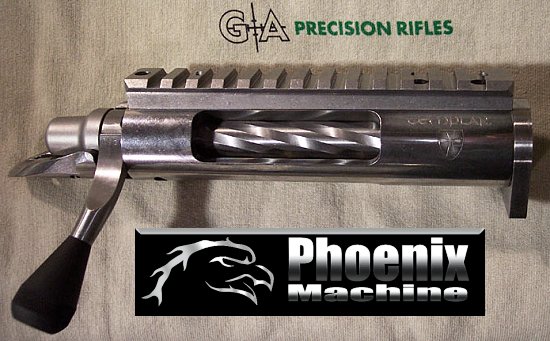
George Gardner, owner of G.A. Precision, is pleased that Glen is back in the action-building business. He reports the new Phoenix actions are top-quality: “At G.A. Precision, we use only top notch, field-tested, durable parts and accessories. We are proud to be offering the Templar Action, built by Glen Harrison at Phoenix Machine Technologies.”

For more info about Phoenix Machine Technologies, LLC, call (406) 756-2727, write to 36 Jellison Lane, Suite B, Columbia Falls, MT 59912, or email Lisa [at] boltactions.net .
July 31st, 2008
 A quality borescope is a pricey tool, but once you have the opportunity to use one, it is hard to imagine how you ever did without it. Rifle Shooter magazine has an excellent article about using a Gradient Lens Corp. HawkEye BoreScope.
In this feature, What the Eye Can See, writer Terry Wieland explains how to inspect for defects in new barrels, how to recognize different kinds of fouling (in both barrels and brass), and how to spot throat erosion in its early stages. The current generation of HawkEyes can be attached to a still or video camera to record digital images of your bore. The most interesting part of the article is on the second page. There, author Wieland provides photos of various types of internal flaws that can appear in barrels. This will help you spot pitting, excessive land wear, rust damage, and damage from corrosive primers.

Wieland also explains that BoreScopes aren’t just for barrels: “The borescope has other uses as well. It can be used to examine the interior of a cartridge case to look for the beginnings of a case separation or to examine the interior of a loading die that is giving you trouble. When you consider the number of tubular objects that play such an important role in rifle shooting, it is a wonder we were ever able to function without such a method of studying bores.”
July 30th, 2008
Richard Schatz, 2007 IBS 600-Yard Shooter of the Year, has done it again. While competing in the South Dakota 600-yard State Championships, Richard nailed a superb 5-shot group that may be a new IBS 600-yard Heavy Gun score record. Richard tells us: “Got home from the VHA Jamboree and IBS 600-yard South Dakota state championship match held last week at Fort Pierre, SD. During the 600-yard match I managed to lay down a ‘lucky’ 50 for score in Heavy Gun with a 0.634″ group for a potential new score record.” While other perfect 50s have been shot in competition, under current rules, group size is the tie-breaker. Schatz’s impressive 0.634″ group, we believe, is the smallest “50” shot to date, and one of the smallest groups ever shot at the 600-yard distance. Amazingly, there is just one bullet diameter of vertical:

In the South Dakota Championship, Richard won Heavy Gun group, finished second in HG score, and finished third overall for the Two-Gun. Richard was shooting his trusty 6mm Dasher in both Light Gun and Heavy Gun classes. This rifle features a Shehane Baby Tracker stock, Nesika Model ‘K’ RBLP, right-eject action, and a 27″ Krieger barrel. The chamber is basically a no-turn neck, but Richard does “clean up” his necks, turning them to a uniform .013″ neck-wall thickness. Richard’s match load was 33.0 grains of Reloder 15, with 105 Berger VLDs, seated about .005″ off the lands. This load runs 3020-3050 fps. Richard notes: “That’s the [velocity] spot where every barrel I’ve had likes to run.”

Richard used Sierra 107gr Match-Kings with great success last year. He recently switched to the Berger 105 VLDs. His testing at 250 yards showed that the Bergers “had a very slight edge in agging capability. It wasn’t much…but enough that I decided to go with the Bergers.” Richard’s Krieger barrel has about 800 rounds through it, and he typically cleans the bore every 70-90 rounds: “I’ll clean after a match, and don’t let it go past 100 rounds.”
July 30th, 2008
It took years of litigation to do so, but Dick Heller and his team of lawyers prevailed in the U.S. Supreme Court, establishing that the U.S. Constitution guarantees Heller’s right to have a handgun in his District of Columbia home for self-protection. Despite that landmark victory, the D.C. politicians charged with complying with the High Court’s ruling are still trying to impose strict requirements on handgun ownership. D.C.’s amended handgun laws limit the types of handguns allowed while imposing strict licensing requirements that are difficult to satisfy.

As a result, Dick Heller, the plaintiff in the Supreme Court case that overturned Washington’s 32-year-old handgun ban, has filed a new lawsuit against the District of Columbia. In a complaint filed Monday in U.S. District Court, Dick Heller and two other plaintiffs allege that DC’s new gun regulations still violate rights guaranteed under the Constitution. The lawsuit cites the District of Columbia’s ban on firearms that carry more than 12 rounds of ammunition, which includes most semi-automatic handguns. The suit also claims that the city’s regulations make it all but impossible for residents to keep a gun ready for immediate self-defense in the home.
Plainly, the District of Columbia is attempting to skirt the D.C. v. Heller decision. By imposing difficult licensing regulations, the District’s politicians hope to maintain a de facto ban on handguns in place of the previous absolute ban. We applaud Heller’s effort to haul the District back into Federal Court to ensure full compliance with the Supreme Court’s ruling.
|


