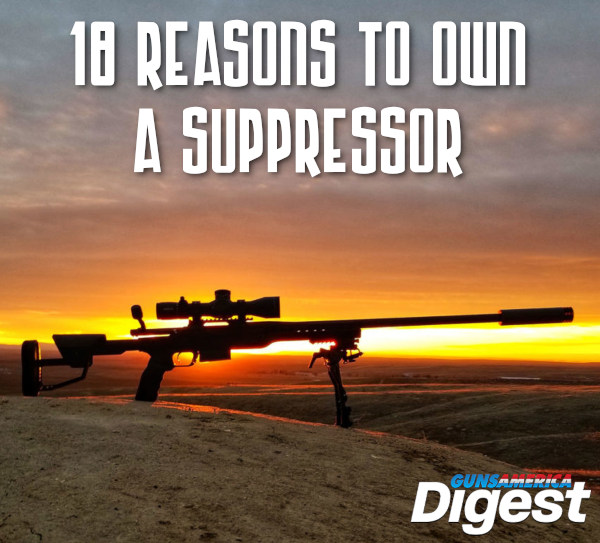
Read full story in GunsAmerica Digest for all 18 reasons to own a suppressor.
Do you own a suppressor yet? If you live in a state where silencers are allowed, there are many good reasons to get a modern suppressor. The process for acquisition has been streamlined. Vendors such as SilencerCo can now handle most of the legal paperwork required. And the choice of suppressors is greater than ever before.
Along with basic noise reduction, what are the key reasons to get a suppressor? There are actually many. True Pearce, Editor of the GunsAmerica Digest, has written an excellent article about the benefits of suppressors: Why a Silencer Might Prevent Dementia & 17 Other Reasons You Need a Suppressor. Here are FIVE of the 18 reasons outlined in the article. We recommend you read the full story to access ALL 18 reasons. That full article has worthwhile insights for anyone considering getting a suppressor.
Reason — Protect Your Hearing
Owning and using a suppressor helps prevent hearing loss. Hearing loss is a legitimate health concern that all firearms owners should be concerned about. Firearms are loud. The average firearm without a suppressor is between 140-165 dB and creates what is called an impulse noise (i.e. a noise that lasts for less than one second).
OSHA’s limit for impact/impulse noise is 140 dB…. Every time you fire a gun (including a .22 LR) without hearing protection or a suppressor, you can permanently lose hearing and it never returns. Surgery and hearing aids cannot restore the hearing you lose — it’s gone forever. Suppressors do not make your gun silent! However, they can make the impulse noise much less than 140 dB.
Reason — Reduce Muzzle Blast
A suppressor reduces or eliminates muzzle blast. Traditionally, we associate flinching with recoil, and while recoil can contribute to flinching, many shooters are finding that when using a suppressor on a caliber with no recoil they don’t suffer from the concussion, noise, and blast. As a result, they don’t close their eyes, flinch, or jerk the trigger.
Reason — Reduce Felt Recoil
A suppressor … reduces recoil or kick. Nobody that’s telling the truth enjoys getting punched in the shoulder, and that’s essentially what happens when you shoot a lightweight centerfire magnum rifle. Suppressors are very effective at slowing the recoil down or [reducing it significantly]. I personally observed a small (70-lb) 12-year-old boy shoot a 5.5-pound 6.5 PRC with a suppressor. After shooting he got up smiling and said, “That didn’t kick at all!”.
Reason — Reduce Muzzle Rise to Keep Your View on Target
Suppressors reduce muzzle rise and make it possible to stay on target through your shot [so you can watch the trace and impact]. This allows you to make your own wind calls and corrections.
Reason — Reduce Dust and Dirt Kicked Up from Muzzle Blast
Suppressors prevent snow, dust, dirt, or other debris from blowing up when you shoot prone. If you’ve shot much with muzzle brakes, you know this is a real thing.
Every month Shooting Sports USA (SSUSA), an NRA publication, releases a new issue with a variety of feature stories on gun industry products and important pistol, rifle, and shotgun competitions. SSUSA also regularly posts valuable guides for handloaders, plus instructional articles that can help shooters improve their skills.
The March 2023 Digital Edition of Shooting Sports USA is packed with interesting content. There is a guide to Sighting in New Shooters which covers Eye and Hand Dominance. In addition, there is a big 6-page article on the Best New Products from SHOT Show 2023. But the feature that really caught our attention is a summary of new .22 LR rimfire ammunition.
Match Grade .22 LR Ammunition Offerings for 2023
With the rapid growth of NRL22, NRL22X, PRS 22 and other rimfire rifle sports, we were pleased to see a four-page SSUSA feature on match grade .22 LR ammunition offerings for 2023. This covers new (or notable) rimfire ammo from Lapua, ELEY, Norma, SK, RWS, Aguila, and Wolf.
New for 2023, Norma has released innovative XTREME LR-22 ammo, which features a unique, patented bullet design. This has a special base with a cone (see diagram). Norma claims that this “rocket tail” design reduces drag by creating less negative pressure at the back end of the bullet. It will be interesting to see how this new bullet design works in rimfire ELR competition.
Lapua recently introduced its impressive Super Long Range and Long Range rimfire ammunition. These two new ammo types are optimized for long range accuracy and consistency. The goal was to have extremely low extreme spread (ES) and standard deviation (SD), to yield the highest precision down range. Shooters competing in disciplines such as NRL22X and Rimfire ELR should benefit.
Smith & Wesson has just introduced an all-new, very innovative folding rifle — the M&P FPC 9mm carbine. Pistol-caliber carbines are hot right now for good reason. 9mm Luger (9x19mm) ammo is inexpensive — $15-$18 per 50rd box in bulk. That’s a fraction of the cost of .223 Rem, 6.5 Creedmoor, or .308 Win ammo. With ample quantities of factory 9mm ammo available, you don’t have to struggle to find powder and primers. And a complete, factory-loaded 9mm Luger round (at $0.30-$0.36 per round) costs less than what you might pay just for the bullet you’d put in a 6mm or 6.5mm rifle cartridge.
Moreover, the “fun factor” is high with 9mm carbines. You can shoot the same ammo in your pistol and rifle. That makes it simpler to do a fun day at the range. Plus, many indoor ranges that prohibit most other centerfire rifles will allow you to shoot a 9mm carbine indoors.
S&W M&P FPC Carbine Folds to 16⅜” and Takes S&W Pistol Mags
S&W’s new M&P FPC Carbine ($659.00 MSRP) has some other major advantages — easy transport and smart on-board storage for full-capacity magazines. The FPC’s buttstock has twin slots that hold 17-rd and/or 23-rd magazines compatible with S&W 9mm pistols. That’s cool. And here’s the notable attraction — when folded, S&W’s FPC Carbine is just 16 3/8″. S&W delivers the new FPC in a cool zippered carry case with four internal pockets. That nice, padded carry case is included in the affordable $659.00 price.
Because it folds at the bolt face rather than behind the action the new M&P FPC is much more portable than most folding stock rifles. And your optics stay in place. Smith & Wesson states: “[Our] side-folding mechanics … deliver a unique compact feature and allow the user to keep their sight system mounted on the gun both in the folded and extended positions. Extra magazine storage in the buttstock, familiar M&P fire controls, and reliable palm swell grip adaptors all make this new pistol carbine a great addition to the M&P family”. The barrel is 16.25″ with a suppressor-friendly 1/2-28 threaded muzzle with thread protector. To reduce felt recoil, the FPC has an integrated recoil buffer system.
Watch this video to see how S&W’s new FPC Carbine unfolds and shoots. You’ll see impressive rapid-fire action starting at the 00:24 time-mark. This is indeed a pretty cool carbine.
The FPC carbine’s compatibility with pistol magazines is a real plus. John Myles, S&W New Product Manager, explained that: “The team at Smith & Wesson aimed to design a pistol carbine that was compatible with various M&P series pistol magazines.”
S&W M&P 9mm FPC Features
The M&P FCP ships with three (3) magazines: one 17-rounder and two 23-round mags. The buttstock can hold two magazines, which are accessible with a handy quick-release catch. Notably the M&P FPC is sold with an excellent, zippered carry bag that transports the folded carbine securely along with magazines and other gear. Check it out:
One reviewer was very impressed with the value of this new carbine: “Smith & Wesson M&P FPC ($659) ups the ante with a few premium touches while staying $100 under the MSRP of the cheapest Ruger PCC model — to get the same features from Ruger’s platform you’d spend over a grand, and it doesn’t fold.” – FreeRangeAmerican.us.
Smith & Wesson M&P FPC Video Reviews
Gun reviewers have released hands-on test videos showcasing Smith & Wesson’s new M&P FPC carbine. Generally the reactions have been very positive. Reviewers noted that the FPC’s folding mechanism works great, the carbine is very reliable, the trigger is decent, and the supplied carry case is excellent. Here are three videos released in the last week after S&W’s official product announcement on February 28, 2023.
Smith & Wesson M&P FPC List of Features
Smith & Wesson’s official product release states: “The new optics-ready M&P® FPC™ showcases our brand new, compact, folding design. Coming with (one) 17-round and (two) 23-round magazines, the in-stock magazine storage w/ quick-release latch makes reloading convenient and quick. The M&P FPC™ is compatible with M&P full-size and compact pistol double-stack magazines, and includes a carrying bag with additional storage and Velcro straps.”
Smith & Wesson M&P FPC Folding Carbine Features:
Compact, horizontal folding design with locking latch
Folding design does not interfere with optics
30 3/8″ unfolded length to 16 3/8″ folded
Flat-face trigger with crisp break
Integrated recoil buffer system
Picatinny rail on top for optics
Reversible magazine catch
1/2-28 threaded muzzle with thread protector
In-stock mag storage w/quick-release tab
Compatible with M&P Pistol magazines
M-LOK handguard slots on handguard
Charging handle doubles as retainer
Carrying case with inside pockets
This article is Copyright 2023 AccurateShooter.com. Any appearance of this article on a different website is unauthorized and obligates payment of damages.
The February 2013 edition of Shooting Sports USA magazine has an interesting feature by Glen Zediker, who sadly passed away in October 2020. In this Transporting Success, Part I article, Zediker explains the advantages of loading at the range when you are developing new loads or tuning existing loads. Glen, the author of the popular Handloading for Competition book, discusses the gear you’ll need to bring and he explains his load development procedure. In discussing reloading at the range, Glen focuses on throwing powder and seating bullets, because he normally brings enough sized-and-primed brass to the range with him, so he doesn’t need to de-prime, re-size, and then re-prime his cases.
Zediker writes: “Testing at the range provides the opportunity to be thorough and flexible. You also have the opportunity to do more testing under more similar conditions and, therefore, get results that are more telling. Once you are there, you can stay there until you get the results you want. No more waiting until next time.”
Zediker starts with three-shot groups: “I usually load and fire three samples [with] a new combination. I’ll then increase propellant charge… based on the results of those three rounds, and try three more. I know that three rounds is hardly a test, but if it looks bad on that few, it’s not going to get any better.”
Glen reminds readers to record their data: “Probably the most important piece of equipment is your notebook! No kidding. Write it down. Write it all down.”
There’s More to the Story…
Editor’s Note: In Zediker’s discussion of loading at the range, he only talks about throwing powder and seating bullets. In fact, Glen opines that: “There is little or no need for sizing.” Well, maybe. Presumably, for each subsequent load series, Zediker uses fresh brass that he has previously sized and primed. Thus he doesn’t need to de-prime or resize anything.
That’s one way to develop loads, but it may be more efficient to de-prime, re-size, and load the same cases. That way you don’t need to bring 50, 80, or even 100 primed-and-sized cases to the range. If you plan to reload your fired cases, you’ll need a system for de-priming (and re-priming) the brass, and either neck-sizing or full-length sizing (as you prefer). An arbor press can handle neck-sizing. But if you plan to do full-length sizing, you’ll need to bring a press that can handle case-sizing chores. Such a press need not be large or heavy. Many benchresters use the small but sturdy RCBS Partner Press, for sale now at Amazon for $114.99. You may even get by with the more basic Lee Precision Compact Reloading Press, shown in Zediker’s article. This little Lee press, Lee product #90045, currently retails for $44.99 at Midsouth.
The RCBS Lock-Out Die can also be used with some Dillon and Hornady progressive presses.
If you load pistol or rifle ammo with a progressive press, we strongly recommend you get a Lock-Out Die from RCBS. This unique reloading die will prevent your progressive press from advancing if the dispensed powder charge is more or less than about 0.3 grains too high or too low. The Lock-Out Die really works. Your Editor uses it on his RCBS 2000 progressive press. I can affirm that a Lock-Out Die has “saved my bacon” a half-dozen times over the years when there was an over-charge (which could cause a Kaboom) or a low charge (which could cause a squib load).
The Lock-Out Die works by using a central die detection rod that sets its vertical position based on the height of the powder column in the case. Through an ingenious design, if the powder column height is too low or too high, the rod locks in place as you start to pull the press handle. This halts the press before the ram can lift and the cartridge plate can advance. Unlike a beeping alarm system (which can be ignored or defeated), the Lock-Out Die physically stops the movement of the press ram and prevents a bullet being seated in the “problem” case.
It takes a bit of tweaking to get the Lock-Out Die detection rod setting just right, but once it is correctly positioned, the Lock-Out Die works smoothly in the background. The Lock-Out Die won’t interfere with the loading process unless it detects a high or low charge — and then it positively stops the progressive loading cycle.
While crafted for use in RCBS progressive presses, the RCBS Lock-Out Die can also be used on a Dillon XL Progressive (see video below) or Hornady Lock-N-Load progressive — though it does take up one station which could otherwise be used for a final crimp die (after the seating die). The RCBS 2000 has one more station than a Dillon 550/650, so it’s an ideal platform for using the Lock-Out Die.
Learn More at UltimateReloader.com
On the UltimateReloader.com website, run by our friend Gavin Gear, you’ll find an excellent two-part series on the function and set-up of the RCBS Lock-Out Die. Part One explains how the Lock-Out Die functions, using cut-away illustrations. Part Two shows how to install and adjust the Lock-Out Die on various progressive presses. The Ultimate Reloader video at the top of this article shows setup of the RCBS Lock-Out Die on the Dillon XL-650 progressive press, while the Reloading Bench video below shows the Lock-Out Die on a Hornady LnL progressive.
While many AccurateShooter.com readers load their own competition centerfire rifle ammunition, we all still need factory ammo for our rimfire rifles in .17 and .22 calibers. And most of the 60+ million American handgun owners rely on factory-made ammunition for their pistols and revolvers.
Today’s video collection showcases state-of-the-art ammunition factories in Europe and the United States. You can see the extremely accurate Lapua .22 LR ammo being produced, as well as excellent centerfire ammunition being made by Norma, Remington, Sellier & Bellot and other makers.
From the creation of lead bullet cores to the final packing of ammunition, you can see it all in these videos. Watch primers being made, brass being annealed, bullets being jacketed, tips being inserted, and every phase of production. Weighing and testing procedures are also revealed.
Modern Ammo Production in Multiple Facilities
This 11.5-minute video shows highly automated bullet and ammunition production in multiple facilities in Europe and the USA. You can see bullets produced from start to finish beginning with lead smelting. Then watch pistol and rifle cartridges being made on modern, computer-controlled assembly lines. Watch from start to finish. Here are some notable highlights:
00:10 — Lead Melting Pots and Billet Caster
01:20 — Lead made into strings and then formed into bullets
01:50 — Brass alloy sheets fed into machine and then punched (2:10-2:35).
03:35 — Lead pistol cores being produced
04:15 — Pistol ammo being packaged
06:15 — Ammo loaded into belts
07:15 — Completed primers being shuttled then loaded into brass (Second factory)
07:20 — Bullets being seating into rifle ammunition
07:32 — Cartridge case-neck treatment
07:42 — Robot arm loads finishes cartridges into boxes
08:04 — Cups being pressed (Third Factory S&B)
08:45 — Cartridge case draw
09:06 — Priming pistol cases
09:20 — Bullet production and weight control (10:02)
10:08 — Cartridge assembly and cartridge sealing (10:38)
11:00 — Pistol ammo packaging
Lapua Rimfire Ammunition Production in Germany
This video shows Lapua rimfire ammo production in Schönebeck, Germany. The video shows quantities of the excellent X-ACT .22 LR ammunition being produced and packaged. Starting at the one-minute mark, you can see the ammo being inspected with advanced scanning machines. Then at 1:16 time-mark you can see the ammo accuracy-tested in a tunnel, with results displayed on a computer screen (1:27).
Norma Ammunition Production in Sweden
In this video, the RecoilTV team lead by EIC Iain Harrison ventures to Sweden to visit the Norma ammunition production plant in Huvudentré, Sweden. Demand for Norma ammo has risen dramatically. A Norma marketing manager notes that production has doubled in the last three years.
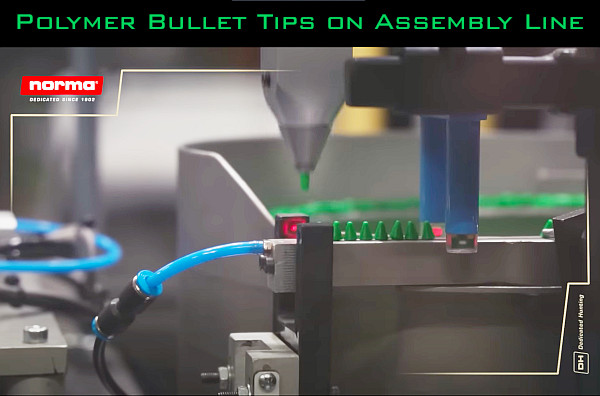
This second Norma ammunition video shows close-ups of the production process and the machinery used for centerfire ammo. This was filmed at the Norma factory in Åmotfors, Sweden, which has operated continuously for over 120 years. Among the many interesting highlight is a sequence showing how polymer bullet tips are inserted. See 6:50 time-mark.
Sellier & Bellot Ammunition Factory in Czech Republic
In this video, Larry Vickers of Vickers Tactical tours a Sellier & Bellot ammunition plant in the Czech Republic. This video shows details of primer production as well as bullet-making, brass-making, and production-line cartridge manufacturing.
Remington Ammunition Plant Re-Opened by Vista Outdoors
This video shows ammo production at the re-opened Remington ammunition plant in Lonoke, Arkansas. “This is one of the largest ammunition manufacturing plants in the world” said Mark Keefe, NRA Publications editorial director. “It was set up in 1969 by DuPont, who owned Remington at the time. They do it all here. Cases, bullets, centerfire rifle, centerfire pistol, rimfire and shotshell.” It’s great to see this plant back in production after Remington Ammunition filed for bankruptcy in 2020 and the assets of the Remington conglomerate were auctioned off. Ultimately, Vista Outdoor, owner of Federal, CCI and Speer, purchased the assets of Remington Ammunition and got the Lonoke plant running again, better than ever.
This article is Copyright 2023 AccurateShooter.com. Republication on any other site gives rise to statutory penalties and compensatory damages.
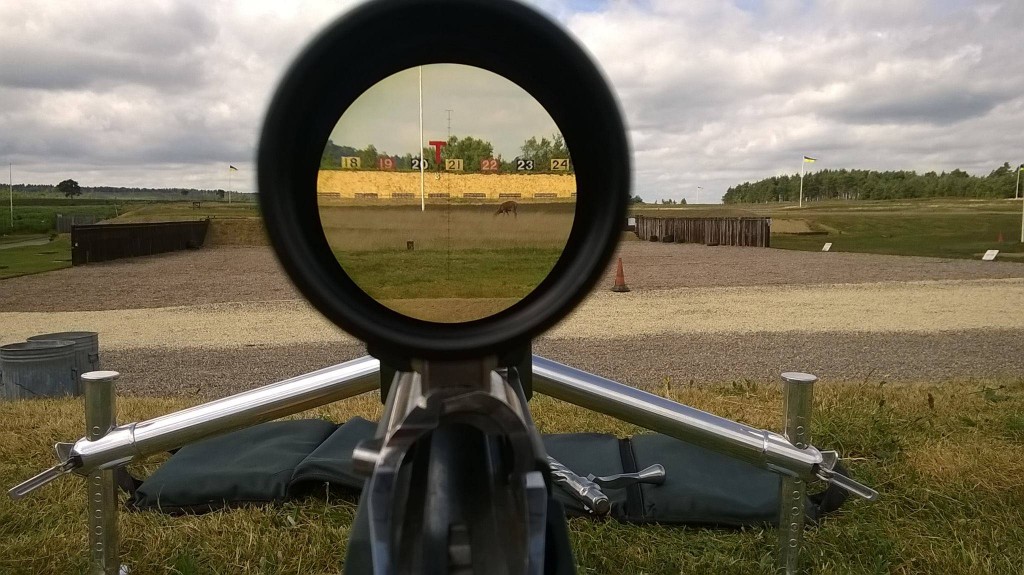
What’s wrong (or right?) with this picture? Does the “F” in F-class refer to “Fauna”? Look carefully at this Bisley Range photo taken by Australian R. Hurley while looking downrange through his March 8-80X scope. The photo was taken in 2015 at the Bisley National Shooting Centre in the UK.
The Story Behind the Photo
British shooter T. Stewart reports: “I was there when this photos was taken. All I can say was that Mr. Hurley was firmly reminded that should said deer accidentally jump in front of his bullet … he would spend five years ‘At Her Majesty’s Pleasure’.”
“That morning we had five deer moving across the targets, literally blocking the V-Bull. Since we were on the 900-yard Firing Point, and elevated for such, obviously the bullet would pass well above them. But they do NOT move or flinch at the noise or passing bullets since they are not hunted on the Bisley Ranges. Earlier this year we saw a herd of 20 or so deer grazing slowly across the Range.”
More Fauna Findings…
Apparently Bisley is not the only place were “the deer and the antelope play”. In Canada, on the Connaught Ranges near Ottawa, Ontario, shooters often encounter a variety of wildlife. William McDonald from Ontario says: “Animals are a common sight on the Range. Along with deer we see geese, turkeys, and coyotes on a daily basis.”
Likewise, E. Goodacre from Queensland, Australia often sees ‘Roos on his home range: “I shoot at Ripley, Australia, and shooting is regularly interrupted by kangaroos. Our last silhouette match was delayed by an hour while 30 ‘Roos dawdled across — silly buggers!”
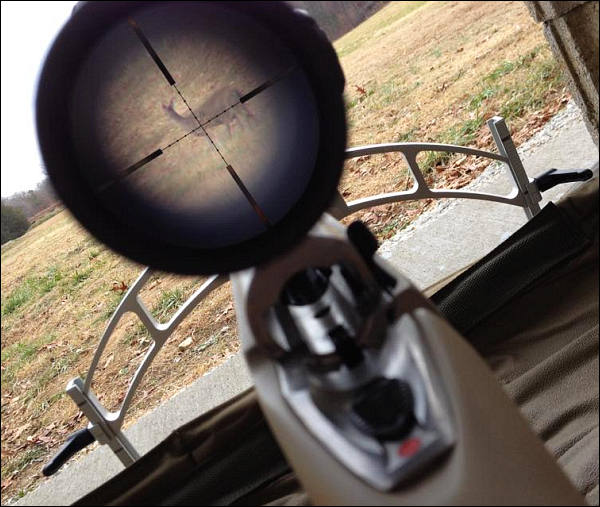
R. Hurley wasn’t the first fellow to view deer through his F-Class rifle’s scope. After seeing Hurley’s photo from Bisley, B. Weeks posted this image, saying: “Been there, done that!”
The March 2023 issue of Shooting Industry Magazine was just released. This special 5th Annual Woman’s Edition focuses primarily on lady shooters and gun owners. There are some very interesting articles about products for women and increased female participation in the shooting sports. CLICK HERE to access the full March 2023 issue for FREE.
Women have become increasingly important in the shooting sports world. The NSSF notes that nearly 5 million Americans purchased a firearm for the very first time in 2020, and of that figure, 40% were women! If trends continue, nearly half of all gun sales will be to women. And the age span for lady shooters is significant — in Shoot Like A Girl’s Annual Report, of their 3,457 guests who participated in 2022, 67% were over 40 years old, and 17% were over 60 years old.
Gun shop owner and instructor Ava Flandell states: “In my experience, female-taught classes fill up much quicker than those taught by men, especially when it comes to entry-level classes.”
CLICK HERE for the four March 2023 Shooting Industry lead stories about women and the firearms trade. And CLICK HERE for dozens of other articles about firearms Products for Women.
In this NSSF video, Kay Miculek and Babes with Bullets camp director Deb Ferns explain eye dominance. First they explain how to identify one’s dominant eye. Then Kay — a cross-dominant-eye target shooter — explains how cross-dominant individuals can maintain a proper sight picture.
One notable female-centric shooting organization is A Girl & A Gun Women’s Shooting League (AG&AG). This year’s major AG&AG event will be held April 27-30, 2023 in Grand Junction, Colorado. There will be workshops, live-fire training, fun matches, and other active.
Here’s an positive report about a major gun industry company giving back to the shooting sports community. Birchwood Casey, part of GSM Outdoors, has shown its support for the First Shots introduction-to-target-shooting program by donating 10,000 Shoot-N-C targets. Those targets will help thousands of new shooters hone their skills.
First Shots is an introductory and refresher program made available through host target-shooting ranges across the country. With interest in firearm ownership at record high levels, First Shots programs are meeting the demand for education and experiences in the classroom and on the range.
Birchwood Casey has been a longstanding partner of First Shots. Along with the donated targets, NSSF provides First Shots host ranges with program materials and promotional resources. Participants are provided handbooks, safety literature, plus hearing and eye protection for their time spent on the range.
This video features the Shoot-N-C Handgun Training Target. This target’s labeled impact zones help diagnose hold/sighting/trigger issues. Pistol shooters can improve their skills quickly using such targets. Birchwood Casey also makes excellent rifle targets, such as this 12″ Shoot-N-C Sight-In Target featuring a 1″ grid and five diamonds. Bullet impacts show with a high-contrast yellow circle.
It is estimated that over 21.5 million Americans are currently licensed/permitted to carry concealed weapons.* And with the 2022 U.S. Supreme Court decision in NYSRPA v. Bruen, we can expect that number to increase significantly. That landmark case stated that the Second Amendment guarantees citizens the right to bear arms outside their homes.
There are now seven (7) major business entities which provide insurance coverage and legal services for CCW holders. These providers are listed below. We suggest, BEFORE you commit to any particular policy/membership, you comparison shop at least three different options. We also recommend you read the full 3400-word GunDigest Article that examines, in detail, the coverage offered by these seven companies:
Factors to Consider When Choosing a Gun Insurance Program:
Attorney Fees and Expert Fees
The key benefit of any CCW insurance plan is coverage for attorneys fees. If you need a lawyer for a civil case or criminal defense, the fees pile up very fast. Good lawyers can charge $400-$500 per hour, and a trial can go on for many days. GunDigest explains: “If your case goes to trial you might find a bill that runs up to six figures.” You should check to see if a policy covers lawyer retainer, hourly fees, expert fees, AND potential damages.
Bail Bond Coverage
If you are involved in an incident, and an arrest is made, you want to avoid spending time in a jail cell. That’s why it’s important to have a CCW insurance plan that will quickly provide funding for bail bonds. As GunDigest notes: “bail-bond coverage is typically part of a sound concealed carry insurance policy”.
Multi-State Coverage
Gun laws vary among states, and state insurance laws vary as well. This affects the coverage an insurance program can and will provide. When choosing a policy, ask questions to determine how coverage may vary from state to state. With some programs you can purchase additional coverage for trips outside your home state. These can be time-limited for cost savings.
Policy Limits (Dollar Amounts)
When considering a CCW insurance program you need to look at the policy limits — the amount the program might pay to provide legal assistance and potentially settle a claim. You need to read the fine print here, just as you would with an automobile or home policy.
The detailed GunDigest article on CCW Insurance Coverage, notes that there are some additional factors to consider when choosing CCW Insurance:
“You’ll find there are other areas covered by some concealed carry insurance plans worth contemplating. Many of them fall within the policies themselves, however, some cost extra. In many cases, CCW policies go well beyond legal expenses and cover some other aspects you might not have considered:”
Crime Scene Clean Up
Negligent Discharge
Spouse And Family Self-Defense
Property Damage
Firearms Replacement
Work Loss Coverage
Personal Use Of Firearm (non-defensive)
* According to a recent estimate by the Crime Prevention Research Center (CPRC), over 21.5 million Americans are now licensed to carry a firearm in the United States. And the numbers are growing — the NRA-ILA posted that the number of concealed handgun permits reached 18.66 million in 2019 – a 304% increase since 2007.




 There’s More to the Story…
 If you load pistol or rifle ammo with a progressive press, we strongly recommend you get a Lock-Out Die from RCBS. This unique reloading die will prevent your progressive press from advancing if the dispensed powder charge is more or less than about 0.3 grains too high or too low. The Lock-Out Die really works. Your Editor uses it on his RCBS 2000 progressive press. I can affirm that a Lock-Out Die has “saved my bacon” a half-dozen times over the years when there was an over-charge (which could cause a Kaboom) or a low charge (which could cause a squib load).