Ever wondered how factory ammunition is produced, from start to finish? How are brass cases made, how are bullets created, and how are finished cartridges produced on automated assembly lines? Today’s video showcase features six major factories that, collectively, produce bullets, powder, and finished ammo. We start with the Berger Bullet plant, follow by Vihtavuori powder production in Europe. Then we show the Remington (now Vista Outdoor) ammo plant in Utah, along with a Federal plant that produces rimfire ammunition. Last but not least, there’s an excellent, very informative video from the Norma ammo factory, plus a Hornady ammo plant video.
Bullets being seating at Hornady ammo factory.
Berger Bullets Factory Tour — Made in USA
In this video, Recoil TV takes a behind-the-scenes look at Berger Bullets, and how the outstanding, match-winning Berger bullets are created. The video covers the entire process — from raw materials, to the placement of bullet cores inside jackets, to the final ultra-consistent and uniform projectiles. To see the complete line of Berger Bullets, with full Ballistic data, visit BergerBullets.com
Vihtavuori Powder Production in Europe
Vihtavuori produces some of the most consistent, high-quality powder on the planet. Vihtavuori powders have been used to set world records and win countless championships in multiple disciplines. This excellent video goes inside Vihtavuori’s European production centers. It is really fascinating — you see how extruded powder starts with long spaghetti-like strings, before being finalized into the tiny sticks that we load.
Along with the powder production process, this video includes the entire VV production line, so you see how powder bottles are filled with powder and the tops of the bottles are secured by automated machines.
Remington Ammo Factory (Now Operated by Vista Outdoor)
This SHWATteam video visits the Remington ammunition plant in Arkansas. Vista Outdoor, the company that produces Federal, Speer and CCI ammo, purchased Remington’s ammunition business in Lonoke, Arkansas. Including the new high-tech plant in the back, this facility has the equivalent of 13+ football fields (1200 acres) under roof at its ammo plant, with over 1100 employees. Production capacity is impressive. When running at maximum output, this Remington ammo plant can crank out a staggering 7,000,000+ rounds every day. To produce that volume of ammunition, the facility needs a huge amount of resources: one million pounds of copper per month and 124,000 pounds of lead per day. Remington started manufacturing ammunition at this Lonoke facility in 1970, but some of the machines have been churning out ammo since long before.
Norma Factory Tour
Guys — honestly, if you do anything today on this site, watch this video. You won’t be disappointed. Guaranteed. This is a very informative (and surprisingly entertaining) video. Every serious hand-loader should watch this video to see how cartridge cases are made. The camera work and editing are excellent — there are many close-ups revealing key processes such as annealing and head-stamping.
VERY Informative Video Show Cartridge Brass and Ammunition Production:
Norma has released a fascinating video showing how bullets, brass, and ammunition are produced at the Norma Precision AB factory which opened in 1902. You can see how cartridges are made starting with brass disks, then formed into shape through a series of processes, including “hitting [the cup] with a 30-ton hammer”. After annealing (shown at 0:08″), samples from every batch of brass are analyzed to check metal grain structure and hardness. Before packing, each case is visually inspected by a human being (3:27″ time-mark).
Federal Rimfire Ammunition Production
Field & Stream Tours Federal Ammo Plant in Minnesota
A reporter for Field & Stream recently got a chance to tour the Federal ammunition production facility in Anoka, Minnesota. This large plant produces both rimfire and centerfire ammunition. While touring the plant, the reporter was allowed to capture video showing the creation of .22 LR rounds from start to finish. This is a fascinating video, well worth watching. Watch and learn how rimfire ammo is made.
Note to Viewers — After Starting Video, Click Speaker Icon to HEAR audio!
This revealing video shows all phases of .22 LR ammo production including cupping, drawing, annealing, washing, drying, head-stamping, priming, powder charging, bullet seating, crimping, waxing, inspection, and final packaging. We recommend you watch the video from start to finish. You’ll definitely learn some new things about rimfire ammo.
Hornady Ammunition Factory
If you wonder how ammo is made, starting with raw metal, check out this video from Hornady. It shows how bullet jackets are formed from copper, followed by insertion of a lead core. The jacket is then closed up over the core with the bullet taking its final shape in a die (a cannelure is applied on some bullet types). Next the video shows how cartridge brass is formed, starting with small cups of brass. The last part of the video shows how cases are primed and filled with powder, and how bullets are seated into the cases, using an automated process on a giant assembly-line.
Editor: Many new barrels will deliver higher velocities with the same load after 100-150 rounds through the bore. The exact reasons for this speed-up are not 100% certain, and velocity increases (if any) will vary from one barrel to the next. But this “speeding up” phenomenon is common, so be prepared if this happens with your next barrel. If you do experience a significant velocity increase you should probably re-tune your load AFTER the velocity stabilizes at the higher level.
From the Sierra Bullets Blog Article by Mark Walker, Sierra New Product Development Director
In a previous post, I discussed a couple of methods to tune a load to your barrel to help achieve the best accuracy possible. People most often work on load tuning if they get a new rifle or have a different barrel installed. In both instances, the barrel is new and has not been fired very much. According to most competitive shooters, this is the most accurate your barrel will ever be, so getting it tuned and shooting accurately is a priority.
The Speed Up Phenomenon After 100-150 Rounds
Even though after you work up a load and your new barrel is shooting great, a lot of shooters notice that at around 100 to 150 rounds their rifle may stop shooting as accurately. I had this happen to a rifle and I was confused as to why something that worked so well to begin with would all of a sudden quit shooting. I decided to break out the chronograph to do another load work up to see what was going on. To my surprise, the velocity had increased around 80 fps over the original velocity! After performing another ladder test and adjusting the seating depth, the rifle was once again shooting well.
There are several thoughts on why this may happen, however, you can rest assured that it does happen. One thought is that as the barrel breaks in, the tooling marks in the throat of the chamber smooth out and allow less resistance to the bullet as it exits the bore thereby increasing speed. Another idea is that the throat area starts to get a little rough which in turn causes more resistance which increases pressure and therefore more velocity. I’m sure there are some out there who have a better understanding as to why this happens, but it can definitely affect the accuracy of your rifle. So be aware and never be afraid to rework a load to keep your rifle in tune.
Experts Confirm That Barrel Speed-Up Is Common Two respected shooters have observed an increase in velocity with new barrels, typically after 100 rounds. Gunsmith and Hall-of-Fame benchrest shooter Thomas “Speedy” Gonzalez has documented barrel speed-up with testing. Moreover, Speedy’s bore-scope barrel inspections revealed a smoothing of the barrel lands. Jim See, a top PRS competitor, has encountered barrel speed-up many times. Accordingly, he re-tunes his load at 150 rounds.
“Alex Lipworth and I documented this phenomenon about four years ago and I have told all my customers about this. My son Mikee would shoot 100 rounds through all new barrels we planned on shooting before we would begin to do load development. We had a shooting snail that caught all the bullets set up in front of an indoor bench. We called it a wear-in process because upon careful examination of the bore when the ‘Speed Up’ takes place the cut-rifled bore resembles that more of a button-rifled barrels with the lands taking on more the softer look of a buttoned bore.” — Speedy Gonzalez
“Seen it [barrel velocity increase] too many times to count. All my match barrels get a ‘generic round’ loaded for them, which has worked well in barrels historically. After I hit 150 rounds I fine-tune the load and never look back, until the tube starts to slow down at it’s life end.” — Jim See
The NRA National Matches at Camp Atterbury Indiana are just a month away. The first event, the National High Power Rifle Matches, begins with Competitor Orientation on July 10, 2022. Then, after the Opening ceremony, the fun begins with Team Matches on July 11th. There is still time to register for one or more of the events. CLICK HERE to register.
National High Power Matches
July 10-29, 2022
Camp Atterbury, Indiana
PROGRAM
July 10 Packet Pick Up/Orientation
July 11 Team Matches
July 12-15 Across the Course (XTC)
July 16 Mid-Range Packet Pick Up & Squadded Practice
July 19 Mid-Range Team July 17-18 / 20-21 MR Course
July 24 Long Range Packet Pick Up
July 25-27 Long Range
July 26-27 Team Matches
July 28 Palma Individual Match
July 29 Palma Team
National Pistol Championships
July 17-23, 2022
Camp Atterbury, Indiana
PROGRAM
July 17 Registration
July 18 Un-squadded Practice
July 19 Revolver / .22 EIC
July 20 Prelim
July 21 .22
July 22 Center Fire
July 23 .45
National Smallbore Championships
July 25 – August 7, 2022
Camp Atterbury, Indiana
PROGRAM
July 25 3P Registration
July 26-27 3P Metric
July 28-29 3P Conventional
July 30 Prone Registration / Practice
July 31 – August 1 Conventional Prone Iron
August 2 Team/Spc Team
August 3 Pershing/Goodwill
August 4-5 Conventional Prone Any
August 6-7 Metric Prone
NRA Extreme
Long Range Championship
August 5-7, 2022
Camp Atterbury, Indiana
PROGRAM
August 5 Registration
August 6-7 Extreme Long Range
The new covered range at Camp Atterbury was a big hit in 2021 during the Precision Pistol and Smallbore Rifle Championships. This was built with the help of the State of Indiana, Indiana National Guard, the NRA, and the Indiana State Rifle and Pistol Association.
Earlier this week, U.S. House of Representatives passed a sweeping gun-control package titled the “Protecting Our Kids Act” (POKA). This radical legislation involves eight new statutes, covered below. Voting primarily on party lines, the Democratic-majority House approved the eight measures that collectively comprise POKA by a 223-204 vote.
NOTE: No part of POKA has become actual Federal law yet — it has only made it through the Democratic-controlled U.S. House of Representatives. For any part of POKA to become law, the provisions must be approved by the U.S. Senate and then signed by President Biden.
Here Are Key Statutory Components of the New POKA Federal Legislation:
1. Anthony Brown’s Raise the Age Act — This raises the lawful age to purchase a semi-automatic rifle from 18 to 21 years old.
2. David Cicilline’s Untraceable Firearms Act — This makes so-called “ghost guns” subject to existing federal firearms regulations.
3. Ted Deutch’s Keep Americans Safe Act — This is a new Full-Capacity Mag ban that would ban the sale, manufacture, and possession of New gun magazines that hold more than 15 rounds.
4. Robin Kelly’s Prevent Gun Trafficking Act — This creates new federal offenses for gun trafficking and straw purchasing.
5. Dina Titus’s End Bump Stock Loophole Act — This carries the Biden Executive orders further, by banning the manufacture, sale, or possession of Civilian bump stocks.
6-8. Gun Storage Regulations — There are three Gun storage proposals which mandate gun storage: Rosa DeLauro’s Ethan’s Law, Elissa Slotkin’s Safe Guns, Safe Kids Act, and Sheila Jackson Lee’s Firearm Safe Storage Act.
According to GunsAmerica Digest: “Only two Democrats — Reps. Jared Golden of Maine and Kurt Schrader of Oregon — voted against [POKA] while five Republicans — Reps. Anthony Gonzalez of Ohio, Fred Upton of Michigan, Brian Fitzpatrick of Pennsylvania, Adam Kinzinger of Illinois, and Chris Jacobs of New York — voted for it.”
The National Shooting Sports Foundation (NSSF) criticized lawmakers for supporting measures that clearly violated the Second Amendment rights of law-abiding citizens. The NSSF stated that POKA is seriously flawed, and violates the U.S. Constitution:
“This legislation isn’t a serious attempt to find common ground and effective answers. This was nothing short of a partisan effort to advance a radical gun control agenda”, said Mark Oliva, NSSF’s Managing Director of Public Affairs in a message to GunsAmerica.
“Many of the ideas included in this legislative package are unconstitutional, including denying Second Amendment rights to adults under the age of 21″, he continued. “The U.S. Court of Appeals for the Ninth Circuit just struck down California’s age-based gun ban as unconstitutional.”
Here is the analysis of the new POKA legislation from the NRA Institute for Legislative Action (NRA-ILA):
Among its many provisions, H.R. 7910 would ban law-abiding 18-20 year old adults from acquiring semi-automatic rifles and shotguns. This unconstitutional legislation would extinguish law-abiding adults’ Second Amendment rights and contends that these individuals are responsible enough to defend their country or vote in an election, but cannot be trusted to follow the law.
H.R. 7910 would generally ban standard-capacity magazines that are overwhelmingly popular with law-abiding Americans for self-defense, as well as redirect federal tax dollars intended for law enforcement and other public safety programs to “buyback” existing lawfully-possessed magazines.
Furthermore, H.R. 7910 includes several “safe storage” mandates that would control how individual Americans keep firearms in their own homes. These provisions are in direct contravention to the U.S. Supreme Court decision in Heller that held mandatory storage provisions that prevent a law-abiding American from having ready access to a firearm for self-defense are unconstitutional.
- – – -
The second bill, H.R. 2377, is a combination of legislative proposals to create ‘red flag orders’ that allow for the confiscation of firearms without due process of law. The legislation would directly empower federal judges to nullify Second Amendment rights on a case-by-case basis and issue orders to seize firearms from the named individuals. It would also provide funding to encourage states and localities to pass and enforce laws allowing judges to issue orders to seize firearms.
H.R. 2377 would strip Second Amendment rights of individuals by confiscating firearms without constitutional due process by allowing courts to issue ex parte (meaning the accused is not present) firearm confiscation orders. A person could be forcibly disarmed of otherwise lawfully-possessed firearms before he or she had so much as an opportunity to contest the accusations – this would represent a clear denial of constitutional due process protections.
Moreover, H.R. 2377 would generally authorize indefinite firearm deprivations, giving courts options to issue orders without a time cap, or choose to allow for indefinite order renewals. This legislation treats the Second Amendment as a second-class, disfavored right and flies in the face of due process, the presumption of innocence and fundamental fairness.
With all the anti-gun rhetoric coming out of Washington these days, it’s great to know that some organizations are helping Americans celebrate their liberties and their Constitutional rights. U.S. LawShield is organizing a nationwide series of Summer Freedom Celebrations to be held in cities across America from early June through the end of August 2022. This weekend, Freedom Celebrations take place June 11th in three locations: Springfield, MO; Tulsa, OK; and Selma, TX. Other events are listed below.
“We are excited to connect with folks from all over the U.S. as we join in celebrating our unique heritage and honor our forefathers’ vision of freedom for future generations. Encouraging our members, their families, and friends to enjoy togetherness is especially important this summer. As the Summer Freedom Celebrations travel around our great nation, we’re proud to present education on local self-defense and gun laws in conjunction with the family-friendly festivities”, stated U.S. LawShield CEO P.J. Hermosa.
At these celebrations, U.S. LawShield Independent Program Attorneys (IPAs), officials, VIPs, and guest speakers with talk about gun laws and answer questions. Because regulations differ regionally, every Summer Freedom Celebration features local IPAs and authorities who can answer questions and educate folks about local requirements. Attendees will have the chance to get answers directly from experienced attorneys and local officials.
These Summer Freedom Celebrations feature fun attractions for people of all ages, including refreshments (food trucks and/or concessions), music/entertainment, and games with prizes. These will be family-friendly events, so parents are encouraged to bring their kids.
U.S. LawShield Summer Freedom Celebration Dates and Locations
Event activities, daily schedules, and speakers are subject to change. Visit this link to register and/or check for updates on times and venues. CLICK HERE for a full, updated schedule of events nationwide.
· June 11, Springfield, MO
· June 11, Tulsa, OK
· June 11, Selma, TX
· June 18, Springdale, AR
· June 18, Cleveland, OH
· June 18, Lubbock, TX
· June 25, Morton, IL
· June 25, Fort Wayne, IN
· June 25, Jacksonville, NC
· June 25, El Paso, TX
· June 25, Midland, TX
· June 25, Ashland, VA
· June 26, Littleton, CO
More Summer Freedom Celebration events are planned for July and August in states including: Alabama, Arizona, California, Colorado, Connecticut, Delaware, Florida, Georgia, Idaho, Illinois, Indiana, Kansas, Kentucky, Louisiana, Massachusetts, Michigan, Minnesota, Mississippi, Missouri, North Carolina, Nebraska, Nevada, New Jersey, Ohio, Pennsylvania, South Carolina, Tennessee, Texas, Utah, Virginia, Washington, and Wisconsin.
Here are three current discount/rebate programs that can save you serious money on a new firearm. For example you can save $250 on a Christensen Arms Ranger 22. Or save $25-$75 on Browning rifles and shotguns. There are deals on pistols too — get $100 off a Beretta APX A1 Carry pistol.
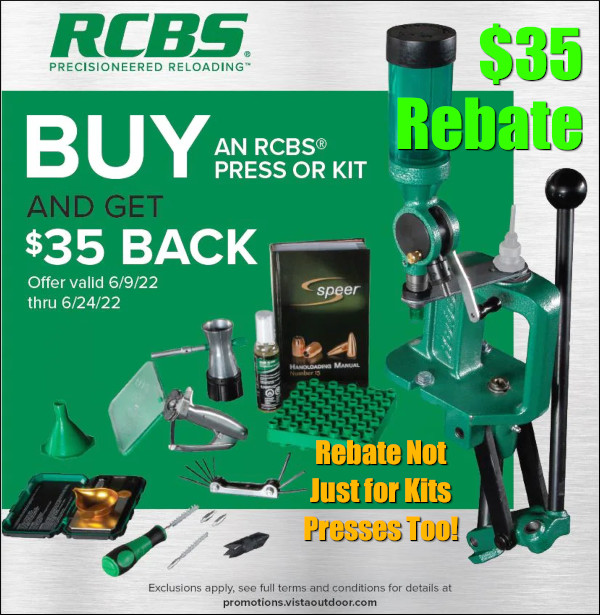
Along with these gun discounts, RCBS is offering a $35 mail-in rebate on all its reloading presses and combo press kits. This $35 RCBS rebate works even on the lower-priced compact presses, such as the Partner Press.
Browning Firearms Summer Rebates
Receive a rebate of up to $75 when you purchase a new Browning firearm between May 27 and July 4, 2022. You get $50 off all X-Bolt Rifles, Citori CX and Hunter shotguns, and A5 and Maxus II shotguns. You can also get $25 back on all AB3 and Rimfire rifles, BPS shotguns, and pistols. The full $75 rebate is for the higher-end Citori shotguns (not CX or Hunter). CLICK HERE for Details.
The Beretta APX A1 Carry pistol retails for $399.00, and a $100 Factory Rebate lowers your net cost to just $299.00. The 9mm Luger APX A1 Carry has 4 frame color options: Black, Gray, Brown (FDE), and OD Green. This is an extremely compact pistol. OAL is just 5.63″, and it weighs a mere 19.8 oz. unloaded. CLICK HERE for Details.
Start Date: 5/3/2022
End Date: 8/15/2022
RCBS Reloading Press and Press Kit $35 Rebate
If you buy any RCBS Reloading Press or multi-product Press Kit, RCBS will give you a $35 Rebate. While that’s great on a $350+ press kit, the rebate is a bigger percentage on a lower-cost press. Submit your Rebate Request ONLINE or with Mail-In Form. Here are products that qualify for the RCBS Rebate:
Today Shooting USA features the Palmetto State Armory (PSA) Gathering, the largest industry Range Day on the East Coast. The PSA Gathering allowed industry representatives and the general public to try out a huge collection of new products. Attendees got to shoot new pistols, rifles, and shotguns. View this Shooting USA episode on the Outdoor Channel Wednesdays at 9:00 PM (Eastern/Pacific), 8:00 PM Central.
The PSA Gathering is a Firearms Range Day and Expo presented by Palmetto State Armory. The Gathering brings together the firearms community, gun media, and public to showcase new and existing products. The 2022 Gathering took place March 18-20 in Clinton, SC at the Clinton House Plantation, a 2000-acre facility with 17 shooting bays, 2 clay courses, a 1000-yard range, and a one-mile range.
One major shooting industry impact of the COVID Pandemic was the cancellation of the 2021 SHOT Show and range day. That inspired Palmetto State Armory to launch its own Industry Range Day called the Gathering. The first Gathering was a big success in 2021. So for 2022, PSA had its second-ever Gathering, which was even bigger and better.
SHOOTING USA TV Air Times
View Shooting USA on the Outdoor Channel Wednesdays 9:00 PM (Eastern and Pacific) + 8:00 PM Central.
NOTE: If you miss today’s 6/8/22 broadcast, you can still view the show on Vimeo for a small 99-cent fee, or just $1.99 per month unlimited. LINK HERE: Shooting USA on Vimeo.
Shooting USA is available On Demand via Vimeo.com. Watch a single episode for $0.99, or get a full-month subscription for $1.99 and watch as many shows as you like with limited commercial interruptions.
Get WAY Better Groups with New Criterion Pre-Fit Custom Barrel
In our Shooters’ Forum, you’ll find a lengthy thread about accuracy problems with a Savage LRPV, chambered in 6mmBR. The gun would repeatedly split groups at 100 yards, and at 300 yards, the “flyers” would open up the groups to 1.5 MOA or larger. Interestingly, the factory test target (at right) showed a split group — not a good sign.
The gun’s owner, forum member LR_Shooter, tried a variety of tweaks: “I did this, done that… [changed] torque, tang floated, bedded action, recut chamber, and [adjusted firing pin]”. But nothing really helped. Frustrated, LR_Shooter asked his fellow Forum members for help. Much advice was proffered, including the novel idea of removing the middle action screw in the Savage 3-screw target action. Some of the advice proved helpful, but none of the suggested remedies produced a major improvement. This rifle, out of the box, tossed flyers and no amount of tweaking (or changes in shooting technique) really cured the basic problem. That is, until, the factory barrel got replaced…
New Criterion Pre-Fit Barrel Works Wonders
LR_Shooter acquired a Criterion pre-fit barrel from Jim Briggs at Northland Shooters Supply (NSS). These pre-fits are designed for easy installation with the standard Savage barrel nut. Wouldn’t you know it, with a new 30″ heavy-contour barrel on the LRPV, the gun started shooting way better. No more crazy fliers, no more split groups, no more excessive vertical. And the improvement came without any other major modifications. LR_Shooter reports: “I got a replacement barrel from Jim at NSS. It is a 30″ bull Criterion barrel. So far, without playing with torque screws and having my old setup… I’m very satisfied with the barrel I got. Now I have no problem getting [groups] under 0.25 MOA. Finally this thing can shoot!” The targets below, shot with the new Criterion barrel, speak for themselves. The left target was shot at 100 yards, while the target on the right was shot at 300 yards (very impressive).
Targets Shot with Savage LRPV Fitted with Criterion Barrel
Moral of the Story — Sometimes A New Barrel Really Is the Right Solution
All of us have struggled at times with a rifle that won’t live up to expectations. This Editor personally struggled for over a year with a .260 Rem Savage with a factory tube. The gun tended to split groups and the POI walked as the barrel heated. I tried one powder/primer combination after another, working through a variety of seating depths over many months. I was persistent. Out of stubbornness, I just believed that sooner or later I’d find the magic load.
Well folks, sometimes there’s really nothing you can do about a sub-par barrel. It is what it is. To really improve a gun’s accuracy (particularly a gun with a factory tube), you may need to open your wallet and get a quality aftermarket barrel. Spending months trying one recipe after another may simply be an overwhelming waste of powder, bullets, and your precious time.
Albert Einstein supposedly said: “Insanity is defined as doing the same thing over and over again, and expecting different results.” Well that sort of describes my efforts with my .260 Rem. Once I had enough evidence that my barrel split groups no matter what load combo (and seating depth) I tried, it was time to pony up for a new barrel. When I did finally screw on a nice PacNor 3-groove SuperMatch, that Savage suddenly became a true tack-driver. As re-chambered in 6mmBR with the Pac-Nor, in calm conditions, my Savage will now consistently shoot in the twos with heavy bullets, and it can sometimes dip down into the ones with Berger 80gr flat-base bullets. The moral of the story here is simple — don’t waste weeks or months chasing your tail with a barrel that just won’t deliver (after a reasonable amount of testing). Save up for a custom barrel, get it chambered properly, and stop your cycle of frustration.
The CMP National Matches will run from July 11 to August 13, 2022 at Camp Perry, Ohio. This major event attracts thousands of shooters over the course of the summer. The 2022 National Matches start with pistol competition and conclude with Long Range Rifle. The Full 2022 Nat’l Matches Calendar is available online. There is still time to register for pistol and rifle matches. We provide registration links below.
Held annually at Camp Perry, the CMP National Matches include the CMP National Trophy Pistol and Rifle Matches, the Pistol and Rifle Small Arms Firing Schools, the National Games Rifle Matches, the National Smallbore Matches, and the National Long Range Matches. These matches are conducted by a partnership of the CMP and Ohio National Guard.
Registration for the 2022 CMP National Matches is still available, but don’t delay much longer. Click the links below to register for particular disciplines.
Headed out for a varmint trip this summer, but don’t have the time (or the right tools) to load all your own ammo? Well don’t worry, we’ve found online ammunition vendors that carry a big selection of popular varmint cartridge types, from .17 caliber up to the popular 6mm varmint cartridges. OutdoorLimited.com offers a wide selection of rifle ammo types, including some hard-to-find types such as 22 Nosler and .221 Fireball. In addition, MidwayUSA has good small-caliber ammo available, including .204 Ruger, .223 Rem, and 22-250. MidwayUSA is a good place to start.
Shown below are some of the small-caliber varmint ammo types currently in stock at OutdoorLimited.com. NOTE: If you order any of this factory-loaded ammunition, you can save $10 on an order of $250 or more with CODE “10off250″.
Large Caliber Ammunition Available Also
Outdoor Limited has a big selection of larger-caliber ammunition for hunting rifles as well. You’ll find popular ammo types such as .270 Win and .308 Win, as well as big calibers such as the .338 Lapua Magnum. However, the ammo page is somewhat frustrating, as it shows some ammo varieties that are NOT in stock. You must click the photo for each ammo type to see if it is available.


 Vihtavuori produces some of the most consistent, high-quality powder on the planet. Vihtavuori powders have been used to set world records and win countless championships in multiple disciplines. This excellent video goes inside Vihtavuori’s European production centers. It is really fascinating — you see how extruded powder starts with long spaghetti-like strings, before being finalized into the tiny sticks that we load.
 Norma has released a fascinating video showing how bullets, brass, and ammunition are produced at the Norma Precision AB factory which opened in 1902. You can see how cartridges are made starting with brass disks, then formed into shape through a series of processes, including “hitting [the cup] with a 30-ton hammer”. After annealing (shown at 0:08″), samples from every batch of brass are analyzed to check metal grain structure and hardness. Before packing, each case is visually inspected by a human being (3:27″ time-mark).
 If you wonder how ammo is made, starting with raw metal, check out this video from Hornady. It shows how bullet jackets are formed from copper, followed by insertion of a lead core. The jacket is then closed up over the core with the bullet taking its final shape in a die (a cannelure is applied on some bullet types). Next the video shows how cartridge brass is formed, starting with small cups of brass. The last part of the video shows how cases are primed and filled with powder, and how bullets are seated into the cases, using an automated process on a giant assembly-line.
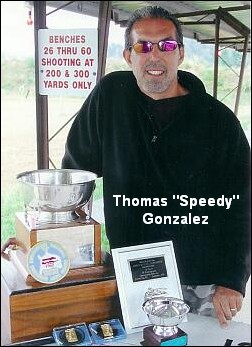 Two respected shooters have observed an increase in velocity with new barrels, typically after 100 rounds. Gunsmith and Hall-of-Fame benchrest shooter Thomas “Speedy” Gonzalez has documented barrel speed-up with testing. Moreover, Speedy’s bore-scope barrel inspections revealed a smoothing of the barrel lands. Jim See, a top PRS competitor, has encountered barrel speed-up many times. Accordingly, he re-tunes his load at 150 rounds.


 At these celebrations, U.S. LawShield Independent Program Attorneys (IPAs), officials, VIPs, and guest speakers with talk about gun laws and answer questions. Because regulations differ regionally, every Summer Freedom Celebration features local IPAs and authorities who can answer questions and educate folks about local requirements. Attendees will have the chance to get answers directly from experienced attorneys and local officials.




 In our


 Large Caliber Ammunition Available Also


