Do you know someone getting started in the shooting sports? Or perhaps you know shotgun or rifle shooters who want to improve their handgun skills because they have obtained CCW pistol permits? Then here is a good resource for those shooters-in-training. Smith & Wesson GUNSMARTS is a new video series that covers the key points of firearm ownership, from purchasing a pistol, to shooting techniques, gun safety, and storage. While this 38-part series does include some rifle-centric videos, it is mostly focused on handgun training, as you might expect from Smith & Wesson.
The GUNSMARTS series has 38 different videos covering gun safety, gun operation, marksmanship, maintenance, and secure storage. There are both general videos about gun handling and very specific videos about topics such as sight alignment, magazine loading, optics and more. Here are six of the best videos in the series. You will find 32 more on the Smith & Wesson Gunsmarts Playlist Page.
10 Tips for Your First Visit to the Range
Shooting Fundamentals — Sight Picture and Sight Alignment
Handgun Skills — Grip Pressure
Concealed Carry Positions and Holster/Belt Options
Christmas is coming up soon, so today we’re featuring a hand-picked collection of six “stocking stuffers” for precision shooters. Some of these are recent new inventions. All are handy items that you’ll use over and over again at the range, on your vehicle, and/or at your loading bench (so you’re allowed to buy them for yourself, even after Christmas).
B&T Industries BT62 Determinator — $7.95
The acrylic BT62 Determinator measures groups with laser-cut concentric measuring rings. Check group size quick and easy — simply place the Determinator over shot group. Adjust until one of the circles crosses the center of the two outer-most holes. That gives you the center to center group measurement (1.5″ maximum). Alternatively, you can measure edge to edge (of the farthest shots) and then subtract the bullet diameter. Cool tool for gun guys. The supplied lanyard also glows in the dark.
Cabela’s Multi-Tool — $6.99
You won’t find a more versatile tool at this low price — just $6.99. The Cabela’s multi-tool performs many functions. The stainless steel frame features 8 tools: wire-cutting pliers with bolt grip, wire-stripper, knife, Phillips and flat-head screwdrivers, saw, bottle opener, and scissors.Closed length is 3″. This handy tool is available in six colors: Red, Orange, Green, Teal, Purple, and Silver. A durable nylon belt sheath protects and carries the multitool.
Frustrated with your LabRadar missing shots? With this $35 LabRadar Recoil Trigger you will be much happier — and you won’t get false readings from the guy on the next bench. This plug-in device, made by JLK Precision, activates the LabRadar from your rifle’s inertial recoil pulse. It will work with any rifle from a .22 LR up to the big magnums. NOTE: The inertial trigger is sensitive so a “phantom” reading may occur with hard bolt manipulation. However, our Forum members who use this trigger say it is is a great improvement, with no more LOST shots and LabRadar placement is no longer critical. One owner noted: “This unit works flawlessly. Didn’t miss a single shot, and allows you to place the LabRadar in pretty much any position.” Velcro attachment standard — Picatinny and magnetic mounts sold separately. This trigger is made by JLK Precision, NOT by the LabRadar company.
Surveyor’s Tape (for Wind Indicators) — $2.69
Always watch the wind when you shoot. Inexpensive ($2.69/roll) Day-Glo Surveyors’ Tape (aka “Flagging Tape”), attached to a stake or target frame, makes a good wind indicator. It will flutter even in mild breezes, alerting you to both angle and velocity shifts. This should be part of every range kit. Don’t leave home without it. This can also be ordered from Creedmoor Sports for $3.95 per roll.
MagnetoSpeed — RifleKuhl Barrel Cooling Fan — $54.99
Cooling your barrel with a compact fan can extend barrel life. This bright red RifleKuhl from Magnetospeed is quite effective. The battery-powered impeller pushes cooling air down the barrel. It has a chamber seal for increased cooling efficiency while a neodymium magnet helps secure the device to your action. The RifleKuhl includes a belt/pocket clip and there is a Replaceable built-in 50 Micron air filter. The RifleKuhl costs $54.99 on Amazon.
Amazon — Digital Display Timer with Big Buttons — $10.95
If you shoot in a discipline with time limits, or you time your firing strings during practice, having a reliable and easy-to-read timer is critical. We like this very affordable Digital Display Timer with both count-up and count-down functions. Just $10.95 on Amazon, this unit boasts an easy-to-read display and LARGE buttons making it perfect for F-Class, Palma, and other matches. This timer comes with both a built-in stand AND a strong magnet so you can position the timer conveniently.
Creedmoor Sports — Leather 20Rd +2 Ammo Holder — $24.95
This handsome red leather ammo holder secures twenty (20) rounds of .308 Win-size ammunition, in a handy plastic carrier. In addition there are loops for 2 more sighter rounds on the outside. This is a very nice gift for a target shooter or hunter. There is also a .223 Rem version in black leather. Both these leather ammo holders conveniently fit into a shooting coat pocket via a leather pocket flap.
Bore Squeeg-E Cleaning Kit, Multi-Caliber — $9.99
The Bore Squeeg-E Cleaning System Kit contains cleaning tools for ARs, rifles, shotguns and handguns in .223/5.56mm, .308/7.62mm, .357/.380/.38/9mm, .44/.45 and 12/16/20/28GA. The compact canvas pack features quiet zipper pulls, and MOLLE mountable rear-velcro straps. There are rifle and handgun pull cables with T-pull handle. These Squeeg-E are very effective for quick cleaning of pistols and shotguns.
Creedmoor Mesh Bag for Brass — $5.95 on Sale
This durable 12″ x 9″ mesh bag for Cartridge Brass is good for collecting and holding your spent brass on the range. The open weave allows dust and gravel to fall out while the brass is retained securely. This lightweight, high-quality nylon mesh bag with draw string conveniently fits in you shooting stool or hangs on your shooting cart. User reviews have been excellent: “Capacity is generous… it works great”; “I bought two of these and they are simply perfect for bringing used brass back from the range.”
Grafs.com — Peregrine MAGnet Gun Caddy — $5.69
Here’s a handy item that can hold your rifle vertically alongside any steel surface. This works great on gun safes (outside or inside), and the MAGnet Gun Caddy can be used on vehicles too (see photo). The patented design makes it possible to secure and remove your gun from the holder with just one hand. The $5.69 MAGnet Gun Caddy is modular so you can arrange multiple units at whatever height works best.
BONUS — TACTICAL STOCKINGS for Your Stocking Stuffers
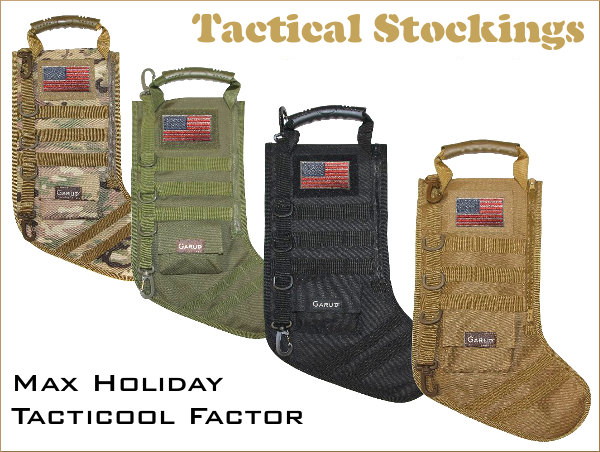
Don’t have a stocking to hold your small gift items? Then check out these cool, heavy-duty stockings. These Garud Tactical Stockings come in five camo varieties (including pink digital camo) plus OD Green, Khaki, and Black. They all feature 4 MOLLE attachments, rugged carry handle, hanging hook, swivel carabiners, outside draw pocket, and even Velcro USA Flag Patch. Get all this for the low price of $15.99 or $16.99. These stockings are sure to bring smiles to your tacticool family members and friends.
Talented sharpshooter Kirsten Joy Weiss is featured in an episode of NRA All Access. The show covers Kirsten’s development as a competitive shooter, and her success as a trick-shot artist with her own popular YouTube channel. Here’s the All Access segment featuring many of Kirsten’s most famous trick shots.
During the video Kirsten also talks about her background in shooting and how she wants to be a good ambassador for the shooting sports, “spreading the positive reality of shooting”. Kirsten explains: “The fun challenge and joy of shooting is important to me because I really wanted to be a positive example. So when the media says the ‘guns are a bad thing and nobody does anything good with guns’, they can say ‘Well, what about her [Kirsten]’?”
Kirsten: “I think that it’s important for young girls to have somebody that they can look up to… I feel responsibility to show young shooters coming up, especially females, that you can respect yourself and shoot a gun as well.”
A gifted “natural” shooter, Kirsten started shooting fairly late — at age 16. Despite her relatively late start, she learned very quickly, and managed to earn a place on the University of Nebraska shooting team. That literally opened up a new world for Kirsten: “During the course of my career, I’ve had a lot of success. I’ve gone to World Cups… in Zagreb, Croatia, in Munich, Germany. I’ve won National Championships, and got on to the U.S. Olympic short list, so it’s been a good career.”
Kirsten tells us: “A lot of people don’t think of shooting as a sport, but it absolutely is, and I would even go so far as to say that it is an art form.” We don’t know if this is art, sport, or magic, but very few shooters have the skill or flexibility to make this upside-down shot…
In this video, former Army Ranger sniper team leader Ryan Cleckner explains how proper head and scope position is a critical component to accurate shooting. Ryan finds that some shooters place the scope too far forward or too far rearward. If the scope is too far back you may have issues with eye relief and stock reach to shoulder. If it is too far forward, you may have cheek-weld problems or get neck strain. Cleckner cautions: “When you are in a good prone position, you don’t want any strain in your neck muscles or back.”
In the video, Cleckner offers a simple method to check your scope position:
“To see if your scope is set up properly … close your eyes, lay your head on your gun, get completely comfortable, and only when you are set-up, then open your eyes. If you can’t see clearly through your scope, CHANGE something [such as comb height or scope position]”.
“When you open your eyes, if you see some scope shadow [i.e. the black ring around the edge of the scope picture], figure out which way you need to move your head to get rid of that shadow, and then make adjustments to either your position, the rifle, or the scope.”
“Very often you’ll open your eyes and realize you need to move further back or further forward. Instead of moving your position [or head], move the scope and get it set up properly.”
Tip on Viewing Your Reticle:
Cleckner: “Sometimes it can be difficult to focus between the target and the reticle, even with the parallax adjusted properly. I recommend you focus only on the reticle. Just like the front sight on a rifle or a handgun, that reticle is what you can control, and it’s what matters. Focus on a crisp, clear reticle, in a stable platform, and all that’s left is trigger control.”
Long Range Shooting Handbook — A Good Resource
Cleckner’s Long Range Shooting Handbook covers a wide range of topics important for precision marksmanship — both shooting skills and technical matters. You can view Sample Chapters from Ryan’s Book on Amazon.com. Cleckner’s book is designed as an intro to key concepts such as MOA vs. Mils, External Ballistics, and Environmental Effects. Included are personal tips and advice based on Cleckner’s years of experience as a sniper instructor and special operations sniper.
The Long Range Shooting Handbook is divided into three main categories: What It Is/How It Works, Fundamentals, and How to Use It. “What It Is/How It Works” covers equipment, terminology, and basic principles. “Fundamentals” covers the theory of long range shooting. “How to Use It” gives practical advice on implementing what you’ve learned, so you can progress as a skilled, long range shooter.
Ryan Cleckner was a special operations sniper (1/75 RGR) and he served as a U.S. Army sniper instructor. Currently he works as a firearms industry executive and practicing firearms attorney.
Product innovation is all about “building a better mousetrap”, or in this case, building a better bore-cleaning patch. A real smart guy, Shane Smith, has invented a triangular patch that earned a patent. The U.S. Patent Office has awarded a utility patent for BoreSmith’s Triangle Patch™. This unique cleaning patch was designed by Shane Smith, a mathematician/physicist who employed his scientific and firearms knowledge to create innovative bore-cleaning products.
BoreSmith’s clever Triangle Patch™ (aka Pyramid Patch) presents more cleaning surface area to the bore wall than does a conventional square or round patch (of equivalent size). At the same time, the unique geometry makes Triangle Patches much less likely to jam in the barrel. This is because the notches in the sides of the triangle allow the patch to sit more uniformly on the jag (without bunching up). In addition, the Pyramid patch is must less likely to jam due to pleating. One reason conventional patches get stuck is unwanted 5-layer pleating. The special notches in the Pyramid patch remove all or most 5-layer pleating. As a result the patch does not bunch up and this also reduces rod bowing. SEE Triangle Patches HERE.
Triangle Patch Function and Geometry Explained (See 1:18 time-mark):
NOTE: Despite what you may see in this video, you should ALWAYS insert brushes and patches from the chamber end first, using a fitted cleaning rod bore guide. With bolt-action rifles, NEVER insert a cleaning rod (with brush or jag) in through the muzzle. This may damage the delicate crown of your barrel.
The Triangle Patches work great with Boresmith’s patented dual-diameter bore brushes:
At the request of our readers, we provide select “Deals of the Week”. Every Sunday afternoon or Monday morning we offer our Best Bargain selections. Here are some of the best deals on firearms, hardware, reloading components, optics, and shooting accessories. Be aware that sale prices are subject to change, and once clearance inventory is sold, it’s gone for good. You snooze you lose.
1. Natchez — Holiday Ammo Sale, Good Prices and Selection
⏺ Big savings on pistol, rifle, and shotgun ammunition, with ample inventory
Finally we are starting to see substantial quantities of factory-loaded ammo at dealers. If you need loaded pistol, rifle, or shotgun ammunition, Natchez is now running a major Holiday Ammo Sale. You’ll find everything from .22 LR ammo to 12ga shot-shells all at discounted prices. This is a great chance to stockpile good ammo at reasonable prices.
2. Sportsman’s — Charles Daly 12ga Semi-Auto Shotgun, $269.99
Interested in trap shooting or waterfowl hunting? Here’s a serious 12ga semi-auto shotgun for just $269.99 — a truly great deal. The Charles Daly Model 601 28″ Black 12ga Shotgun features a Beretta/Benelli Mobil Choke Tread MC-3 with IC, M, And F chokes. This is a lot of shotgun for the money. If you prefer a pump shotgun, Sportsman’s Warehouse also has the Charles Daly Model 301 12ga pump shotgun on sale. With a nice wood stock and forearm, the Model 301 at just $239.99 is a great bargain.
3. Graf & Sons — Major Year-End Sightron Optics Sale
⏺ High quality scopes at 25% savings — Forum members praise Sightrons
Sightron scopes offer excellent performance for the price, and are used by successful competitors in many shooting disciplines. With a wide range of scope styles and power ranges, you can find a Sightron to fit your purpose — whether hunting, varminting, or competition. For a limited time, you can pick up a fine Sightron scope at major savings, during the Sightron sale at Graf’s. Through the end of the year, nearly all the Sightron scopes are 25% off, with a few discounted over 30%! Sightron spotting scopes and binoculars are also discounted up to 25%.
⏺ Quality 6.5mm match bullets at a very good price
It’s tough to get match bullets at a big discount these days. If you shoot a 6.5 Creedmoor or 6.5×47 Lapua, check out the 500-count pack of Hornady 140gr 6.5/.264 match bullets on sale. These 6.5mm projectiles have a high BC plus Hornady’s Advanced Manufacturing Process (AMP) jackets. These bullets have performed well for PRS/NRL and Tactical competitors.
5. Amazon — RCBS Auto Priming Tool, $104.39
⏺ Good bench-mounted priming option — durable and reliable
Seating your primers consistently is critical to proper ignition and good accuracy. A good choice for high-volume priming tasks is the RCBS Auto Priming Tool. It offers vertical primer feed plus plenty of leverage. This video from Brownells shows how the RCBS bench-mount priming tool works and how to install the primer tubes. This unit is set up for both large and small primers, with two primer rod assemblies and two primer feed tubes. The long, horizontal arm offers plenty of leverage and doesn’t cramp up your hand like some hand priming tools.
6. EuroOptic — Garmin GPS Watch Sale, Save up to $200
⏺ Save up to $200 on state-of-the-art Garmin GPS watches
Garmin Fenix watches are amazing — with remarkable functionality, including built-in GPS mapping. And right now at EuroOptic, you can get a variety Garmin Fenix 6 watches and save up to $200.00 off the regular price. These Fenix 6 GPS watches come preloaded with a wide array of specially-designed apps and features. If you are a hunter or outdoorsman, a GPS watch is a great asset — well worth the investment.
7. Creedmoor Sports — DLX Rifle Case 55″ or 60″, $119.95
⏺ Great cases for match rifles with long barrels
Protect those valuable match rifles during transport. Creedmoor’s Deluxe 55″ or 60″ rifle cases are some of the best soft-side gun cases you can buy, and now they are $30 off, on SALE. These deluxe cases are long enough for F-Class, Palma, and PRS rifles with long barrels. They are made from 1000 Denier Cordura and lined with nylon pack cloth with ample 1/2″ padding for rifle protection. Four large, padded exterior pockets (2 on each side) are great for carrying cleaning supplies, data books, wind meters, and ammo.
8. Amazon — Cleaning Kit with Three 40″ Rods, $49.99
⏺ Versatile triple-rod kit that all use the same handle
Is it time for a new cleaning rod? Consider this 3-Rod cleaning kit for $49.99. This kit features three different-sized PVC-coated 40″ steel rods that all work with the supplied rolling bearing handle. That allows this system to cover a wide range of calibers from .22 up to 12 gauge. The kit also includes jags, brushes, and patches for different calibers. This kit includes a handy storage tube that holds all three rods. That can save space in your loading room.
⏺ Very versatile aerosol lubricant and protective oil
We have been using Ballistol Aerosol for over 20 years now. This is a fairly unique product. It can help clean and preserve the metal parts on your firearms, PLUS it can be used for case cleaning and lubrication. Developed for the German Army which needed an oil that would lubricate, clean, and protect firearms, Ballistol is very versatile. It provides protection to steel — however, for long-term storage a true anti-corrosion product such as Eezox is best. We use aerosol Ballistol applied on a patch to clean carbon off case-necks after firing. For small cartridges it can also function as an effective case lube during reloading (spray on patch then wipe on case). NOTE: This can be used on wood and leather BUT test a small area first — it can change coloration on stocks and darken leather!
Forum member 1LessDog calling in coyotes in a cold North Dakota winter landscape.
Forum member DNorton posted: “I live way up north where our white sandy beaches look like this!”
There is a nice thread in our Forum appropriately entitled “Winter Time”. You’ll find some great backcountry images taken by our Forum members. Winter is a special time in the outdoors. Forum member JDP explains: “Winter is the best time to shoot! One of the few of life’s ironies that works in my favor. The range is empty and barrels keep cool, no bugs, no waiting on people, no mirage. Yup, this world needs more thin blooded snow birds. This cool weather is terrible and dangerous, tell your friends! Do people get lonely while shooting or something? It’s the true holiday season in multiple ways.”
These two images come from Forum member Bill K on a winter varmint safari. He posted: “This was Varmint Shooter’s truck [showing the outside temperature] when we set up.” Brrrr… that’s cold.
The above photo is from Forum member 1LessDog, who posted: “The mound behind the Coyote is a Indian burial mound. There are six of them within a half mile of this one. I would really like to know how many coyotes I have shot off the mound. I would guess 4-5 a year over 35 years. It is one of my favorite spots to call from… any time I have a South to Southeast wind[.]”
Forum member Bojo posted images of his hunting trip in Northwestern Pennsylvania last week. Bojo wrote: “It was an early winter for us — temps from low 20s to mid 40s through a week’s swing. Our cold hits hard in January/February.”
Parting Shot — Some Folks Are Happier without Snow
While he acknowledged that these “white winter” photos are lovely to look at, Forum member D-4297 prefers warmer climes: “Just lookin at all those pictures of that white stuff makes me get chills. You hearty souls can keep it. I grew up in the ‘Snow-belt’ on the east side of Cleveland. Moved to Phoenix forty years ago, and don’t miss the snow at all. And nobody has tried to sell me a shovel or broom for keeping the sunshine off my driveway, either.”
For today’s Sunday GunDay story we showcase seven interesting metal-chassis rifles. While we love the look and feel of wood and fiberglass, metal does have its advantages. It can be crafted very straight and true, and the designs can achieve a very low center-of-gravity without sacrificing rigidity. In addition, a precisioned machined metal chassis tends to track extremely well.
Massive IBS Heavy Gun Milled from Solid Aluminum Billet
This remarkable 70-lb IBS Heavy Gun, was machined from solid aluminum billet, by Bruce Baer. It rests on a G&G Alvey rest split in the middle to comply with rules. This “heavy metal” CNC-machined wonder is a work of art designed for the 1000-yard game in the Heavy Gun class. Wood stocks, and to a lesser extent fiberglass stocks, are more forgiving, offering greater damping and recoil absorption. However, metal stocks offer superior rigidity, and the CNC machining allows tracking surfaces to be perfectly parallel.
Williamsport limits Heavy Guns to 100 pounds. Under IBS and NBRSA rules weight is unlimited. You will see a few massive 200-lb behemoths at IBS matches, but most competitors find that something in the 60-90 pound range works best. Bruce Baer explains, “You can’t stop a gun from recoiling. If it doesn’t recoil it will jump. If it jumps you might as well go home because you won’t shoot a good group. So it is pointless to try to build a gun so heavy as to eliminate all recoil. The more you restrict the rifle’s recoil the more temperamental that rifle will be. The 200-pounders just don’t out-perform something in the 60- to 80-pound range, and I think the optimal weight is 60-70 pounds.”
Bruce Baer likes the 70-lb overall weight for a heavy gun: “Extreme mass is not necessarily an advantage. Watch a locomotive starting up from zero–it will vibrate from one end to another. If the gun is too heavy I think it will vibrate at the start of recoil and that will kill accuracy. I want the gun to start from recoil with very little effort so it will be smooth from start to stop.”
Water-Cooled World Record-Setting Wondergun
We like “outside of the box” thinking. And in the world of competitive shooting, it can’t get more unconventional than this. But this radical liquid-cooled benchrest rig wasn’t just a crazy experiment — it actually delivered the goods. This IBS Heavy Gun, built by Joel Pendergraft, produced a superb 10-shot, 3.044″ group that stood as an International Benchrest Shooters (IBS) 1000-Yard Heavy Gun record for seven years, not being broken until 2016.
Using this water-cooled wondergun, Joel shot the record-breaking group in April 2009 at Hawks Ridge, NC. This monster features a .30-Caliber 12-twist, 4-groove Krieger barrel inside a water-filled sleeve (like on a liquid-cooled machine gun). Joel shot BIB 187gr flat-based bullets in Norma brass, pushed by a “generous amount” of Alliant Reloder 25 and Federal 210M primers. The cartridge was a big custom wildcat Joel listed as “.300 Ackley Improved”.
Pendergraft’s 3.044″ 10-shot group was a great feat, breaking one of the longest-standing, 1000-yard IBS World Records. And Joel’s 3.044″ record stood for 7 years!
Richard King’s Radical .223 Rem F-TR Skeleton Rifle
Here’s something exotic from our Gun of the Week archives. We like this rig because it is so radical (we doubt that you have ever seen anything quite like it). Gun-builder Richard King calls this his “Texas-T”, noting that “this is my personal gun, built the way I wanted it. I know it’s radical and some may not care for it. But it works.” The rig was designed to shoot F-TR, but it can also be converted easily to shoot F-Open with a front rest.
Richard reports: “This is pretty much an all-aluminum rifle. The action is a Kelbly F-Class with a Shilen stainless steel competition trigger. The scope is a 1″-tube Leupold 36X with a Tucker Conversion set in Jewell spherical bearing rings. The .223 barrel is 30″ Pac-Nor 3-groove, 1:6.5″-twist mounted in a V-type barrel block. The bipod has vertical adjustment only via a dovetail slide activated by a stick handle. It works like a joy-stick, but for vertical only. I adjust for windage by moving the rear sandbag.”
Richard likes how the barrel block works: “With the barrel block forward, the vibrations should be at a low frequency. Instead of one long rod whipping, I now have two short rods (barrel halves) being dampened. This is my fourth barrel block gun. They work, but so does a good pillar-bedded action. [This rifle] is designed for my style of shooting. It is not meant to be a universal ‘fit all’ for the general public. However, I will say the design is adaptable. I can easily convert the system to run in F-Open Class. I would drop a big-bore barreled action into the V-block, slide on a heavier pre-zeroed scope and rings, add plates on the sides up front to bring the width to 3″, and maybe a recoil pad.”
F1 F-Open Chassis from Competition Machine
Along with his famed tube-guns, Gary Eliseo of Competition Machine has designed a modern, low-profile chassis system for F-Open competition. Assembled with Cerakoted aluminum beams, these F1 F-Open chassis systems offer great tracking with an ultra-low center of gravity.
Here is the F1 Chassis with “Marine Corps Red” powder coat finish. Read Full Report.
This F1 aluminum alloy chassis stock features a super-low center of gravity, plus adjustable length of pull, cheek rest, and drop. The stock is available in a wide choice of Cerakote finishes. The current Model F1 chassis features a action block mounting system to fit most actions. There was also an earlier version that had a free-floated action with the barrel in a barrel block, secured with epoxy. Both F1 versions (action block and barrel block) shot great, with excellent performances in competition.
Gen 1 F1 F-Open Chassis System with Barrel Block
State Championship Win with Home-Built Aluminum Stock
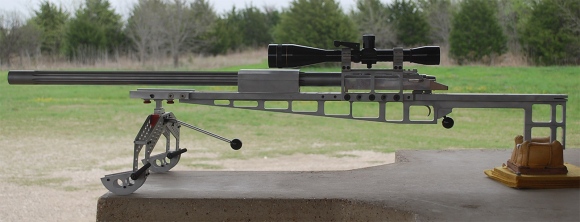
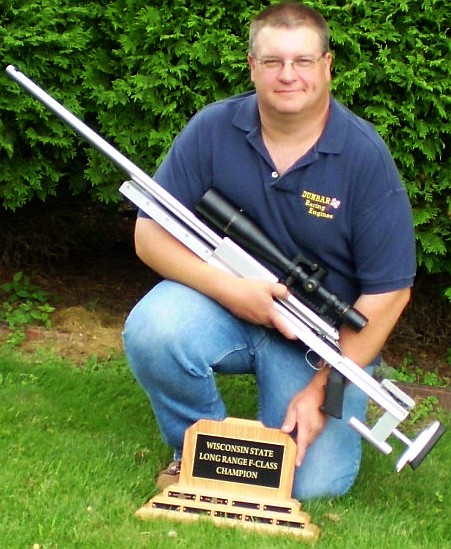
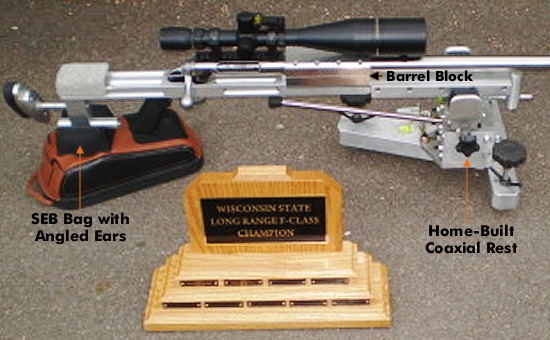
While most of the stocks featured above were crafted by professionals, the properties of aluminum allow it to be used by persons with some basic mechanical skills and metal-working tools. Here’s proof. Back in 2009, Forum Member John Dunbar (aka JD12) crafted his own aluminum F-Open stock. And he used that impressive metal stock to win the Wisconsin State F-Class championship. READ Full Story.
The stock for John’s “home-built” .284 Winchester was mated with a Savage target action. John designed and fabricated the aluminum stock himself. It features a central barrel block clamping a 32″ Brux barrel. Get this — John completed the rifle only 5 days before the match: “I finished machining/assembly on Monday night, did load workup Wednesday and Thursday nights, loaded rounds Friday night, and headed to Lodi at 4:30 on Saturday morning.” John even made his own co-axial front rest (see below)
When Fiberglass Fails, Aluminum Stock Saves the Day
Australian Mark Fairbairn performed a “Quick Fix” during the 2018 Berger SW Nationals. Mark’s F-Open rifle, in a conventional fiberglass stock, was giving him random vertical during one yardage: “I had a bit of a problem with elevation — the stock was hitting somewhere [causing vertical]. I was X-X-X then a shot popped up in the 9 ring with no good reason. So I figured I better put a new stock on it. I got my old aluminium stock I brought from Australia and quickly adjusted it to fit on the Stolle.”
Right on the firing line berm Mark swapped his barreled action into the metal stock of his own design. The clock was ticking… but the story had a happy ending. For the next yardage Mark shot a brilliant 150-7X, not dropping a point. So the “Quick Fix” did the trick. As they say Down Under — “Good on Ya, Mate!”
Home-Built Aluminum Chassis with Innovative A-Arm Bipod
Here is another home-built rig featuring an aluminum chassis mated to a Savage barreled action via a forward-mounted barrel block. This rig was crafted by Forum member Patrick Lundy, who followed the maxim: “If you can’t buy it, then build it.”
Patrick Lundy was so impressed with a fellow shooter’s barrel-block rifle, that he build a similar match gun himself, complete with barrel block and aluminum chassis. Patrick was inspired by a metal stock belonging to Peter Gagne. But he added his own custom touches, including an innovative “A-Arm”-design bipod for shooting in F-TR class. The gun has been very successful in competition. READ FULL Report
Pat told us: “This new stock was a milestone in my shooting career — it was my very first attempt to build a stock. I wasn’t much of a wood worker but I did have a talent for building with metal. The stock was fabricated from 6061 T6 aluminum. With this gun I was able to shoot from a rest or a bipod.”
Pat crafted the bipod from aluminum tubing: “The bipod was a very rigid A-frame design with welded aluminum tubing. I added slippery feet under the pod skis to facilitate smoother recoil. I realized that a wide-stance bipod had to recoil the same on both sides or the group would string horizontally.” Here is the innovative “A-Arm” bipod that Pat Lundy built for his rifle.
Emil Praslick III is widely recognized as one of the greatest wind wizards on the planet — a master at identifying wind value and direction, and predicting wind cycles. As coach of the USAMU and top civilian teams, Emil has helped win many high-level championships. In the three videos we feature today, Emil, who works with Capstone Precision Group (Berger, Lapua, SK, Vihtavuori) and Team Applied Ballistics, explains how to determine wind direction and velocity using a variety of indicators. Praslick, now retired from the U.S. Army, was an 18-time National and 2-time World Champion coach with the USAMU.
Video ONE: Wind Theory Basics — Understanding “Wind Values”
In this video from UltimateReloader.com, Emil explains the basics of modern wind theory. To properly understand the effect of the wind you need to know both the velocity of the wind and its angle. The combination of those variables translates to the wind value. Emil also explains that the wind value may not be constant — it can cycle both in speed and velocity. Emil also explains some of the environmental conditions such as mirage that can reveal wind conditions.
Video TWO: Determining the Direction of the Wind
Key Point in Video — Find the Boil
Emil explains how to determine wind direction using optic. The method is to use spotting scope, riflescope, or binoculars to look for the “Boil” — the condition in mirage when the light waves rising straight up. The wind will generate that straight-up, vertical boil in your optics when it is blowing directly at you, or directly from your rear. To identify this, traverse your scope or optics until you see the boil running straight up. When you see that vertical boil, the direction your optic is pointing is aligned with the wind flow (either blowing towards you or from directly behind you).
Video THREE: The No Wind Zero Setting
In this second video, Emil defines the “No-Wind Zero”, and explains why competitive shooters must understand the no-wind zero and have their sights or optics set for a no-wind zero starting point before heading to a match. In order to hit your target, after determining wind speed and direction, says Emil, “you have to have your scope setting dialed to ‘no wind zero’ first.”
Coach of Champions — Emil Praslick III
SFC Emil Praslick III, (U.S. Army, retired) works with Berger Bullets and Applied Ballistics. Emil served as the Head Coach of the U.S. National Long Range Rifle Team and Head Coach of the USAMU for several years. Teams coached by Emil have won 33 Inter-Service Rifle Championships. On top of that, teams he coached set 18 National records and 2 World Records. Overall, in the role of coach, Praslick can be credited with the most team wins of any coach in U.S. Military history.
Most competitive shooters are pretty good about bore cleaning (some may even clean their bores too aggressively). However, we’ve found that many shooters neglect the chamber area and the bolt lug recesses. It’s too easy to clean the bore, slip out the guide rod and say “I’m done.” Sinclair Int’l explains why it’s important to clean the action interior: “Shooters use a lot of grease and oil on their bolts to reduce friction and to prevent wear[.] Unfortunately, both of these compounds attract grit, powder and primer residues. Cleaning your receiver is especially critical [with] custom actions where the fit between the action and bolt is held to very tight tolerances. Routine cleaning of the action will prevent unnecessary wear on the bolt body, locking lugs, and the action raceways/guide rails. Frequent action cleaning is also essential to keeping the trigger area free of debris which can cause trigger hang-ups and failures.”
Your rifle deserves a clean action and lug recesses. For action cleaning, our friend Danny Reever favors the PMA Action Cleaning tool. This handy tool speeds up the cleaning process, letting you do a better job in less time. Danny reports: “I’ve been using the PMA Action Cleaning Tool Kit for quite some time. Previously, I used one of the old style (round knob) action-cleaning tools with cylindrical cotton rolls. I think the PMA Action Cleaning Tool Kit is easier to use, and possibly achieves better results. Read Full Tool Review.
Cleaning the Chamber
Combustion by-products, lubricants, and solvent residues can collect in your chamber. Severe build-up of grease and carbon can interfere with chambering. Also some solvents will promote corrosion. You need to keep your chambers clean.
1) Install a clean cotton mop of the correct size on the end of a chamber rod and insert the mop into the chamber. Rotate the mop several times to remove any brush bristles left behind and any excess solvent that was between the rod guide snout and the end of the chamber. Make sure the chamber is dry. Prior to storing a rifle you can oil the chamber but make sure the oil is removed prior to firing the rifle.
2) Alternatively, install an old bore brush on a chamber rod, overlap a couple of patches on the brush bristles, and wrap them around the brush completely. Then insert the patch-covered brush into the chamber while rotating it to remove the excess solvent and debris. Push it firmly into the neck area of the chamber. A similar method is to pierce a large patch on the end of the brush loop and insert it into the action, again rotating the brush as you push the patch up against the breech.
Cleaning the Lug Recess Area
The action lug recess area is one of the dirtiest places on a bolt-action rifle. To properly clean this area, always use a tool designed for the task, such as the $29.99 Sinclair Action Cleaning Tool (part # ACT1) which is part of the full Sinclair Action Cleaning Tool Kit ($49.99, part #ACT2).
1) Insert a cotton roll or cleaning felt into your lug recess cleaning tool and wet both ends and the face of the cotton roll/felt with solvent.
2) Insert the tool into the action and push it forward until it is positioned fully in the lug recess area and rotate the tool head several times. Then reverse the rotation for another few turns. While rotating the tool move it slightly in and out to cover the entire recess area and to also clean the breech face.
3) Remove the tool from the action and inspect the surface of the felt or cotton roll. If there is quite a bit of residue on both sides of the felt/roll, then repeat with another wet felt/roll.
4) When you feel the recess area is completely clean, insert a dry cotton roll into the tool and rotate the tool head to remove any remaining solvent and debris. If necessary, use a second dry cotton roll.
5) You can follow this step up with another pass of a mop or patches into the chamber to get any debris or solvent that pushed forward out of the lug recess area.




 A gifted “natural” shooter, Kirsten started shooting fairly late — at age 16. Despite her relatively late start, she learned very quickly, and managed to earn a place on the University of Nebraska shooting team. That literally opened up a new world for Kirsten: “During the course of my career, I’ve had a lot of success. I’ve gone to World Cups… in Zagreb, Croatia, in Munich, Germany. I’ve won National Championships, and got on to the U.S. Olympic short list, so it’s been a good career.”