Stunners in silver. Above are the NRA Leech Cup (left) and Wimbledon Cup (right).
Shooting Sports USA has a fascinating article about the Perpetual Trophies awarded in national-level NRA matches. The story recounts the history behind the elaborate trophies, some from the 1870s. SSUSA’s Jennifer Pearsall writes: “The pieces of wood, stone and precious metal … are more than just instant recognition of achievement. They are the link of the American shooter’s present to his or her patriotic past. As you read this legacy of the NRA ranges, their founders, and the long list of cups, bowls, and plaques, realize that the history of competitive shooting is undeniably a significant part of the foundation of this country”. Read Full Trophy Story HERE.
The NRA was co-founded by Col. William Church and Gen. George Wood Wingate (ranked Captain at the time). Both Church and Wingate hoped to improved the marksmanship skills of American soldiers. One of the newly-formed NRA’s first actions was to issue: “An Act to Establish a Rifle Range and Promote Skill in Marksmanship”. That led to the opening of the famed Creedmoor Range, with a special inaugural match in June of 1873.
Many of the awards presented in the first NRA matches were cash or firearms. Some of these firearms were heavily embellished works of art. In the very first match, a member of the 22nd New York Regiment took home a gold-mounted Winchester Model 1866 valued at $100 — big money for the time.
In the 1870s shooting competitions were social as well as sporting events. Ladies and gentlemen came to watch and cheer the winners. This illustration, originally from Harpers Weekly, portrays the shooters and the viewing gallery at the 1876 Grand Centennial Championship — the “Palma” Match.
The Leech Cup — A Gift from Ireland
The Leech Cup was created for the first meeting of the American and Irish shooting teams. The elaborate cup was presented by Major Arthur Leech, captain of the the Irish team, to the Amateur Rifle Club of New York. This masterpiece of Irish silversmithing was later given to the NRA in 1901 by the New York Club. Today, the Leech Cup is the oldest trophy offered in overall NRA competitive target shooting, awarded through the National High Power Long Range Championships.
Michelle Gallagher with Leech Cup in 2013.
The Wimbledon Cup
The Wimbledon Trophy was a gift from the NRA of Great Britain. It was given, as a gesture of sportsmanship, after the the U.S. Team was denied the ability to compete in England’s Elcho Shield match, then limited to Britain, Scotland, and Ireland. To maintain friendly competitive relations, the British presented the Americans with a large, engraved, lion-footed tankard trophy to be awarded each year to the Champion U.S. long-distance rifleman.
The Palma Team Trophy
Originally named the Centennial Trophy, in honor of the Centennial celebration of the independence of the United States of America, the Palma Trophy was commissioned from Tiffany’s at a cost of $1,500. The trophy was a full-sized replica of a Roman Legion standard, executed in bronze with silver and gold inlay. On the banner of the standard was the legend, “In the name of the United States of America to the Riflemen of the world”. Above the banner was an eagle, bearing in its talons a wreath of palm leaves and a plaque on which was the single word, “PALMA”, the Latin word for palm tree, which was used by the Romans to signify victory, or the ultimate in excellence.
Because the word Palma was so easily seen, the trophy soon became known as the “Palma Trophy”, and by 1878 was referred to officially by that name. The original seven and one-half foot trophy is now lost, having not been seen since at least 1954. Serving in its place is a copy which was commissioned by Dr. Herbert M. Aitken of Eau Claire, WI. The copy was made from the original Tiffany blue-prints at a cost of $32,500. Dr. Aitken has given this copy of the Palma Trophy to the NRA for use in the Palma Match. The trophy is retained by the winning team until the next Palma Match.
In 2008, the Palma Trophy was returned to the NRA, and it was decided that the trophy, once refurbished, will travel to the host nation for the match every four years, then returned to the NRA for safekeeping.
The first competition for the Palma Team was a challenge match for which the British Commonwealth nations were invited. The match was fired in 1876 at the old Creedmoor Range on Long Island as part of the Centennial celebration of the United States. Teams representing Scotland, Ireland, Canada, Australia, and the United States took part. The match is currently fired on a four-year interval.
Happy New Year to all our readers, and especially the 60,850+ members of our AccurateShooter Forum. We hope 2022 brings you happiness in your lives and success in your endeavors. We wish for small groups, high scores, and successful hunts in the New Year. And, yes, we wish for mankind’s victory over COVID and its variants, so we can return to our normal lives, before all the lock-downs and cancelled events.
Forum Members — Upgrade Your Membership to Get Unlimited Classifieds for 12 Months.
Looking Forward to 2022 Every year we work to improve AccurateShooter.com. We have continued to upgrade the Forum, adding enhanced search features. We also added more security measures, with background checks on all sign-ups and enhanced scammer detection. On the content side we have expanded our popular Deals of the Week and Sunday GunDay features. We also now offer more technical videos and product reviews in our Daily Bulletin. We hope you’ll continue to enjoy our feature articles, our Deals of the Week, our match reports, and our Forum Classifieds. The formula seems to be working — our audience is bigger than ever, with Forum membership growing substantially year after year.
Forum Membership Increased 12.45% in 2021
Our Shooters’ Forum grew significantly in 2021. Total registered membership grew by 12.45% as Forum ranks swelled to 60,855 members! More people are successfully buying and selling through our Forum Classifieds services than ever before. Silver and Gold members get unlimited Classifieds for 12 months. Gold members also get custom Avatars and other privileges.
We need your support. For 18 years the site has relied largely on volunteer efforts. But as the site grows, we need the assistance of Forum moderators, product testers, web gurus, and computer software experts. Those guys don’t work for glory alone.
Consider this — you could pay $25 for a couple medium pizzas. For the same twenty-five dollars you can become a Silver Forum member for an entire YEAR and help this site provide info, tests, tech tips, bargains, and shooting news.
And consider the benefits — Silver or Gold Members get unlimited classifieds for 12 months. If you were to sell just ONE $1500 rifle through Gunbroker.com, you would pay $58.75 in fees! That’s more than our Gold Membership — just to sell one single rifle.
In the last quarter of 2021 about 540 site users have donated or upgraded their Forum membership. That’s less than 1% of the current membership. We thank all those who have generously contributed. But that still leaves tens of thousands of users who access the site every week without contributing. With more donations and more Forum upgrades, we can deliver more premium content and offer more services to our members.
How to Contribute
If you ARE a Forum member, you can help the site by UPGRADING your membership. CLICK HERE to UPGRADE.
If you are NOT a Forum member, you can still help by making a donation. Donating is simple and easy. Just click on the orange “Donate” button at right. If you have a credit card, you don’t need a PayPal account to contribute.
IMPORTANT: After you click on the orange button a PayPal screen will load. You’ll also see a field that says “0.00”. Fill in the amount you want to give. For example, to give $25, type 25.00 in the amount field. You choose the amount.
Help Support this Site by Making a Secure Donation.
If You Don’t Like PayPal, You Can Send a Check.
Make the check payable to: Jeff Williams. Please list your Shooters’ Forum Log-In Name (if any), and mail the check to:
Jeff Williams
P.O. Box 240
Solon Springs, WI 54873
As a 2022 New Year’s bonus for our Bulletin readers we decided to showcase 10 of our favorite gun tech, reloading, and shooting technique videos for our readers. These videos were created by top YouTube content providers: F-Class John, Gavin Gear, Keith Glasscock, Erik Cortina, Thomas Haugland, and Pieter Malan. Consider this like an all-star gun channel collection. These videos will help you load more accurate ammo, improve your “mental game”, and shoot better in matches. Enjoy!
Today marks a New Year — 2022. The difficult year of 2021 is history now. Let’s all hope things get better in 2022. One should start a new year with a positive spirit. With that in mind, here are six “fun and games” targets. While each requires good conventional marksmanship skills — hitting a small aiming point — there are other strategies involved, such as playing darts or hitting the right combination of poker cards. Most of us started shooting as kids, just plinking for fun. Here’s an opportunity to be like a kid again — to spend a day at the range just having fun with friends and family members.
NSSF Billiards Table Target
This Billiards Table Target offers 15 brightly-colored numbered balls with the cue ball at the bottom. Aim for the numbers, shooting 1-15 in sequence, or alternate between stripes and solids. You can also draw an “X” on the white cue ball (or attach a paster), and use that to set your zero. This target is fun for shooting outdoors with rifles at 50 or 100 yards or indoors with pistols.
This billiards target is part of a set of 12 Fun Targets from the NSSF. These were issued a couple seasons back for National Shooting Sports Month, held in August of each year. The other free targets include Golf Links, Bowling Pins, Fireworks, Baseball Diamond, Dutch Windmill, Water Balloons, Light Bulbs, Dartboard, and three Bullseye targets.
Dartboard Target with Colored Rings
This printable Dartboard Shooting Target has the numbers inside the outer dartboard ring to allow a larger target. With this target you can shoot for the center bull, or actually play pub-style dart games, aiming for numbers and particular rings. If you don’t know how to play traditional dart games, visit NiceDarts.com for complete darts rules. One popular game is “Around The World”. The object is to hit the numbered zones, starting with number 1. Then you try for 2, 3, and so on. After hitting all the numbers 1 through 20, then hit the bullseye to win. CLICK HERE for Other Dart Board Color combinations.
Poker Target — Get the Best Hand
Poker players will enjoy this target. With this playing card-themed poker cards target, each shooter takes five shots and the one with the highest hand wins. You can also shoot for four-of-a-kind, against the clock, fastest four (without a mistake) wins.
Slot Machine Jackpot Target
Enjoy a little Las Vegas-style fun on your next trip to the range. This cool Slot Machine Target has four sets of slot machine patterns each with three rows of three symbols. Connect three in a row to win — and hit the Jackpot! This is one of many colorful, free targets available from Targetz.com.
Flies in Circles Target
Now you can boast to your buddies that you hit a fly on your target — 16 times. On this target, 16 flies with bright red eyes are arranged in a inside circles, 16 to a page. There are various ways to use the fly targets. Some shoot to hit the head only — so aim for those red eyes. There are 11 other variations of this Fly Target available on the Targets.WS website.
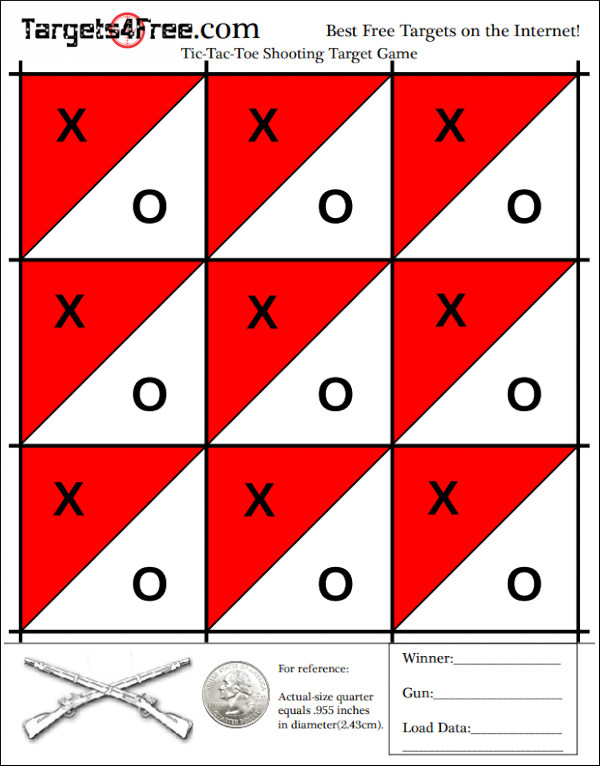
Tic-Tac-Toe Fun Game Target
This Tic-Tac-Toe Shooting Game Target lets you challenge your shooting buddies at the range. One player can shoot the red triangles, while the other shoots the white zones, taking turns. You proceed just like a regular Tic-Tac-Toe game, alternating shots, with the goal of getting three of the same color in a row. This is a fun game for a parent and a young family member. You’ll find other fun targets on Targets4free.com.
Special BONUS — AccurateShooter.com Load Development Target
Our Load Development Target has been used by tens of thousands of shooters. It has proven very popular, since all your load data fits neatly in the boxes under each target. In fact this target is being employed by both rifle-makers (Bergara) and barrel-makers (including Criterion) to test their products. The target was designed for aiming efficiency. The red diamonds have 1/2″ sides and you can align your cross-hairs on the horizontal and vertical lines. It is a clean design that is easy to see even at 200 yards with a 20X scope. NOTE: When we test, we usually crank in a little elevation, setting the point-of-impact higher, so our shots fall in the gray circles. That way you leave the red diamonds intact for precise aiming.
Do you use an AR15 for service rifle, 3-Gun, or tactical competitions? Then you should consider dry-fire training. Many top competitors spend an hour (or more) dry-firing for every minute they shoot live cartridges in competition. The allows effective training without spending a fortune on live ammunition (which can run $1.00 per round or more).
There is a handy new system that resets the trigger on AR-platform rifles — the Mantis Blackbeard (see videos below). This permits you to make multiple successive shots without having to alter your grip and manually recycle the charging handle. This two-part system employs a replacement bolt carrier/bolt and replacement magazine. With these two components installed, your AR can automatically reset the trigger instantly after you pull the trigger. It works, it’s effective, and it’s affordable at $219.00 MSRP.
The Blackbeard system is used by the U.S. Marine Corps and U.S. Army (including Special Forces), so you know it works. During training the Mantis Blackbeard allows unlimited, repetitive Dry Firing without resetting the charging handle. That eliminates a tedious task that requires altering your hold on the rifle.
No Gun Modifications
Same Trigger Weight, Break, and Reset
Installs in under a minute
Up to 10 shots per second
Up to 100,000 Shots per Charge
Save on Ammunition Costs
In the video below Top Shot Champion Dustin Ellermann shows how to use the Mantis Blackbeard. He vividly demonstrates the clear advantage of the Blackbeard compared to manually pulling the charging handle over and over (See 00:02 – 00:20 time).
Dustin Ellermann Review of Mantis Blackbeard Trigger Reset System
This next video, from the manufacturer Mantis, shows how to install the Mantis Blackbeard, how to set the zero, and how to operate the unit with your AR-platform rifle.
The easy-to-install-Mantis Blackbeard replaces your bolt carrier and magazine in less than a minute, allowing easy training transitions. The magazine battery pack is good for 100,000 shots per charge and the Blackbeard is rated to reset as quickly as 10 shots per second, allowing rapid fire training for 3-Gun and tactical competitions.
Americans love AR-platform rifles. However, they can be maintenance-intensive, as hot gasses are directed right back into the action to operate the bolt. Because ARs have a somewhat unique (and dirty) semi-auto operating system, we think all AR owners should learn how their rifles operate — from the inside out. This feature provides an “inside look” at the AR, with X-Ray and Cutaway views created through advanced 3D computer modeling.
AR15 Functions Revealed with 3D Computer Animation
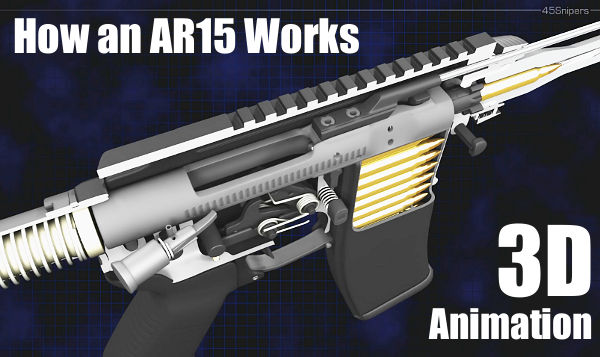
Ever wondered how the parts inside an AR15 work together? Just exactly how does the reciprocating bolt carrier feed rounds from the magazine? How do the elements in the trigger group work and reset after each shot? How does the gas system bleed gas from the barrel and operate the bolt carrier? These and other questions are answered in this eye-opening video from 45Snipers. Using “cutaway” 3D computer animation, this 5-minute video shows all features of an AR15 inside and out. This fascinating firearms animation allows the viewer to look inside the upper and lower receivers, into the bolt carrier, chamber, barrel, and magazine.
This video starts off slow and has annoying background music, but it is well worth watching if you own or shoot any AR-platform rifle. It illustrates all the key operations during the charging, loading, firing, and ejection processes. The cutaway animation shows how rounds are stripped from the magazine and then chambered. It then shows how every part of the trigger group works, and how the firing pin strikes the primer. You can even watch the bullet move down the barrel before the empty shell casing is removed from the chamber and tossed out the ejection port. Here are sample frames from the video:
How AR-Platform Rifles Work — General Introduction
To help reader understand the general operation of AR-type rifles, this video shows the control functions of an AR and how the upper and lower sections work together.
Cutaway 3D Animation of AR15/M16 Action — Watch Video
Here is an excellent “cutaway” animation by Thomas Schwenke that shows how an AR-15 functions — how the entire loading cycle works from start to finish.
AR platform rifles are semi-automatics version of the M16. These feature distinctive upper and lower receivers which can be readily separated via front and rear pins. The upper includes the barrel, handguard, forward gas tube, and bolt assembly, while the lower contains grip, trigger group, fire selector, and mag well. In addition the lower is attached to the stock which encloses the buffer assembly.
The original ArmaLite AR-15 was a select-fire, air-cooled, gas-operated, magazine-fed rifle designed by American gun manufacturer ArmaLite in 1956. It was based on Armalite’s AR-10 rifle chambered for the 7.62×51 NATO (.308 Win). In 1959, ArmaLite sold its rights to the AR-10 and AR-15 to Colt. Some key modifications were made — most notably, the charging handle was re-located from under the carrying handle to the rear of the receiver. The redesigned rifle was adopted by the U.S. military as the M16 carbine, which went into production in March 1964.
OK, it’s the last day of 2021. Are you feeling lucky? If so, here is a chance to enter an end-of-year contest with an impressive Grand Prize. Primary Arms and outdoor media site GoWild have partnered with a precision bolt-action rifle giveaway, which runs through January 3, 2022. To enter the giveaway, visit the GoWild Giveaway Landing Page.
IMPORTANT: What is the downside to entering? Well, you have to provide a name and email. You WILL be put on a list to receive promotional emails until you request exclusion. If you do choose to enter, we recommend you do NOT use your primary personal or business email. Use a different email.
This giveaway includes everything needed to get started in long-range precision shooting. Here is the list of all products in the winning package:
Bergara B-14 HMR 6.5 Creedmoor Bolt-Action Rifle
Primary Arms Optics SLx 3-18x50mm FFP Scope
Seekins Precision 30mm 4-Cap Scope Rings
Seekins Precision 20 MOA Picatinny Rail
Harris Engineering S-BRM 6-9″ Swiveling Bipod
Viktos Perimeter 40L Backpack in Black Multicam
Under Armour Tactical All Season Jacket 2.0 and Enduro Cargo Pants
High Speed Gear Cobra 1.5″ Rigger Belt
Centered around a Bergara B-14 HMR 6.5 Creedmoor bolt-action rifle, this prize package can be an effective set-up PRS/NRL factory-class shooters. The Bergars B-14 rifle comes equipped with a 3-18x50mm FFP scope plus a Harris S-BRM 6-9″ Swivel Bipod. In addition, this giveaway comes with an apparel and gear package from Under Armour, High Speed Gear, and Viktos.
Bergara B-14 HMR 6.5 Creedmoor Field Test
Here is a good review of the Bergara B-14 HMR in 6.5 Creedmoor. The Precision Rifle Network team tested seven different types of 6.5 CM ammunition and recorded Velocity, SD, ES, and group size for each type.
About Primary Arms and GoWild This is the first major giveaway partnership between GoWild and Primary Arms. Founded in 2008, Primary Arms is a large vendor that carries over 15,000 products from 500+ manufacturers. Primary Arms Online carries a complete selection of rifles, handguns, tools, shooting gear, ammunition, and more.
GoWild is a free social community helping outdoor enthusiasts improve their skills, discover gear and earn rewards. GoWild members can share their stories without worry of censorship, find authentic gear reviews, store trophy logs and connect with local hunters, anglers and firearm enthusiasts.
The past couple weeks we have had the privilege to test an impressive new First Focal Plane riflescope from ZEISS. Our tester, Jim See of Elite Accuracy LLC, received the ZEISS LRP S5 525-56 optic, Milrad version, and took a quick look at it. Jim was immediately impressed by the bright, clear markings on the turrets, and the positive clicks. He liked the lever-equipped zoom control, the positive zero-stop on the elevation knob, and he believed the lockable windage turret can have definite benefits in the field.
After doing his first inspection, Jim quickly installed the LRP S5 525-56 on his 6mmBR PRS/NRL rifle, which features a red J. Allen Chassis and Impact Precision action. Jim placed the scope in high-quality Zeiss rings with integral bubble level. He then took the rig out into the field and completed an initial Tall Target test. That test confirmed the precision and repeatability of the 0.1 MRAD elevation and windage click values.
Jim also liked how positive the clicks felt with both elevation and windage knobs. Jim told us: “The scope operates well, it tracks well, and the turrets are accurate in their movements. All the functions work well — elevation, windage, parallax. This LRP scope has a quality feel — similar to other ZEISS products I have used.” Jim also noted that the ZEISS LRP S5 scope resisted solar flare very well: “This is important in PRS matches where we get that low sun in the afternoons”. Jim had high praise for the highly visible numbers on the dials: “With my eyes, I can’t read the numbers on most scopes, but with this ZEISS LRP S5 scope I CAN read the numbers.” Overall, Jim believed this ZEISS 5-25x56mm optic “will fit well in its intended market”, namely PRS/NRL and long range hunting.
Scope mounted in ZEISS rings with bubble level. Optional sunshade is attached in front.
Stay Tuned for Full Field Test of ZEISS LRP S5 525-56 Optic
The past few weeks Jim See has been testing the impressive new 5-25X ZEISS scope in the field, with the optic fitted on his PRS/NRL competition rig. Even in cold winter weather, the optic has performed very well, with positive adjustments and good results in the tall target test. Jim is now doing field tests with targets from 100 yards to 1200 yards and beyond.
To test ruggedness and weatherproofing, Jim is putting the Zeiss LRP through its paces in harsh winter conditions. He’s using a tripod here to keep off the snowy ground. The tripod mount also allows smooth traversing to view a wide selection of terrain and objects near and far.
Advanced Optical Technology — ZEISS LRP S5 Features
The ZEISS LRP S5 525-56 has many notable features, including a lockable windage turret, adjustable reticle illumination, and a HUGE amount of elevation travel — 40.7 Mils in the MIL model and 140 MOA in the MOA version. That gives this optic the ability to shoot at extreme range without requiring holdovers.
F-Class ace Erik Cortina recently interviewed noted author and Olympic Gold Medal-winning shooter Lanny Bassham. For his popular video channel, Erik asked Lanny about his book With Winning in Mind. The two talented shooters also broadly discussed the “mental game” in the shooting sports and Lanny’s program for visualization of a winning performance. Lanny explains that after you have mastered your rifle skills, and learned to read the wind, it is important to adopt a winning mentality and to visualize success. Lanny should know. He won a shooting Gold Medal in the Olympics along with 22 world individual and team titles.
Watch Full Video Interview
Here is the wide-ranging and fascinating hour-long Lanny Bassham interview hosted by Erik Cortina. If you are looking to enhance your motivation, discipline, and “mental focus” when competing, this video is worth watching:
Visualization is a process of mental preparation that is done before you get to the range. Many of the greatest shooting champions have used this technique to get ready for big matches, and to optimize their performance during record fire. If you want to enhance your “mental game” through pre-match visualization, we strongly recommend Lanny Bassham’s book, With Winning in Mind.
As a competitive smallbore 3P shooter, Bassham developed a mental management system. Using this system, Lanny Bassham won 22 world individual and team titles, set four world records, and captured an Olympic Gold Medal in Montreal in 1976. His techniques have been embraced by professional and Olympic athletes in many sports. With Winning in Mind covers a complete system of “mental management” techniques used by Olympians and elite champions.
Putting principles into practice — Anette Wachter
Our friend Anette Wachter, aka “30CalGal”, did a series of videos for the NRAWomen.com site. In one episode, Anette talks about the “mental game” in competition. Specifically she explains how to “visualize success”:
I have found that a lot of my success in competition has come through what I call a ‘mental rehearsal’. I actually visualize every stage of the match and I visualize the success of the match and winning the match.
I actually visualize that round going downrange into the target, and the target coming up with a dead-center ‘X’. I visualize this over and over. If you visualize success you will achieve success.
Headed to SHOT Show in January? It will be a huge event, with a new twin-building layout. As before hundreds of exhibitors will be in the Venetian EXPO Center. But next door, the new Caesar’s Forum building will house scores of other exhibitors, and there is a new Outdoors Pavilion. Check it out:
This animation shows the layout of SHOT Show 2022, with the multiple buildings and levels. At the end you can see the new elevated walkway connecting the Venetian facility with the new Caesar’s Forum building. NOTE: This video will auto-run once. Click the button lower left to replay or pause.
FREE SHOT Show 2022 Mobile Apps
As in years past, FREE Mobile Apps are available for both iOS and Android users. These handy Apps provide interactive maps, schedules of seminars, plus a full directory of exhibitors. One of the best features of the App is that you can plot the most efficient route among multiple booths. That saves considerable time. To download the SHOT Show Mobile App for Android (Google) and iOS (Apple), go to SHOTmobile.com.
This 59-page digital resource contains the full list of exhibitors, along with maps, activity schedules, resource links, and much more. If you will be attending SHOT Show in January, this Notebook provides a wide collection of important information all in one place.
There is a special website with detailed maps of all the exhibitor locations. IMPORTANT: You can type in the name of a vendor, such as LAPUA, and this page will display that vendor’s booth on the appropriate floor map. This is very helpful for planning. CLICK HERE to search vendors on Floor Plan.


The Palma Team Trophy






 This is the first major giveaway partnership between GoWild and Primary Arms. Founded in 2008,

 After doing his first inspection, Jim quickly installed the LRP S5 525-56 on his 6mmBR PRS/NRL rifle, which features a red


 F-Class ace Erik Cortina recently interviewed noted author and Olympic Gold Medal-winning shooter Lanny Bassham. For his popular video channel, Erik asked Lanny about his book
  Our friend


