Today we feature a top-flight tactical .22 LR rig belonging to Jonathan Ocab. A talented Highpower marksman with the Distinguished Rifleman Badge, Jonathan also enjoys rimfire tactical disciplines which he features on his Youtube Channel. Jonathan now runs a monthly NRL22 match in California. His interest in the NRL22 game started with a CZ 455, but soon he stepped up to the impressive rig you see here. This boasts all top-tier components: Vudoo V-22 mag-fed action, Bartlein barrel, MPA Chassis, and Kahles K525i scope. Jonathan carefully selected all this hardware and assembled the rifle himself.
My Vudoo/MPA Rifle for NRL22 and Long Range Rimfire Report by Jonathan Ocab,Ocabj.net.
I became interested in rimfire shooting due to not having as much access to longer distance ranges, and the emergence of NRL22 matches. Back in 2017 I had acquired a CZ 455 and ran it in NRL22 club matches. It worked well, but as I started spending most of my time on my club’s rimfire range, I focused on getting a Vudoo Gun Works V-22. The Vudoo V-22 appeared to offer a true repeater that had the feel of a full-sized centerfire rifle along with high accuracy/precision potential.
After a lot of research, I decided to put in an order for a barreled action and acquired a Vudoo Gun Works V-22 action with a 20″ Bartlein barrel, 1-16″ twist, and MTU contour, all in Flat Dark Earth Cerakote (along with a +30 MOA base). I then acquired the TriggerTech Diamond Trigger Pro Curved, Masterpiece Arms BA Comp chassis (in Flat Dark Earth), American Rifle Company M10 34mm rings (28mm height), and Kahles K525i 5-25x56mm SKMR3 LSW scope.
CZ as a Starter NRL22 Option — The CZ 450-series is a solid family of .22 LR rifles, but I wanted to see what existed beyond the CZ level of rimfire rifles. One of my complaints with the CZ 455 is that the trigger leaves much to be desired even with the trigger kits available. Since the Vudoo V-22 action has a Remington 700 footprint and can accept most Rem 700-compatible triggers, I can actually run a top-tier trigger that would exceed anything available for the CZ.
Component Selection for the Ultimate NRL22 Competition Rifle
My choices in components were biased due to my prior experience — I went with quality hardware I knew and trusted…
Barrel Choice — I chose the Bartlein barrel over Vudoo’s in-house Ace barrels because I run a Bartlein barrel on my 6mm Creedmoor rifle and I have become a big Bartlein fan. Secondly, I chose the Masterpiece Arms BA Competition chassis because I also run the MPA BA Comp on my 6mm Creedmoor rifle. You can see the two rifles side-by-side below:
You are not seeing double. There are two rifles, both with an MPA Comp BA chassis, and both weighing about 15 pounds. In front is the featured Vudoo-action .22 LR rimfire rig with 20″ barrel, while behind is Ocab’s ARC Mausingfield 6mm Creedmoor PRS/NRL centerfire rig with 24″ barrel.
After running this rifle build for over a year now, I can say that I am more than happy with this platform as I have it configured. Having a .22 LR rifle in the same chassis as my 6mm Creedmoor rifle makes me feel right at home behind either rimfire or centerfire platform. My Vudoo V-22 weighs 15.2 lbs with Atlas CAL bipod while my 6mm Creedmoor rifle build weighs right at 15.0 lbs with the same Atlas CAL bipod. The “feel” and handling of my Vudoo V-22 MPA is as close to a centerfire gun as you can get.
Scope and Rings — I chose the 5-25x56mm Kahles K525i SKMR3 LSW because I was interested in running the Kahles after handling a few K624i and K525i scopes and hearing about how great they tracked. I run ARC M10 rings on several rifles because I think they are superbly designed.
Trigger Choice — I chose the TriggerTech Diamond because I already have a TriggerTech on one of my centerfire platforms and I wanted to try their Diamond trigger on a gun.
Outstanding Accuracy with Multiple .22 LR Ammo Types — Lapua and SK
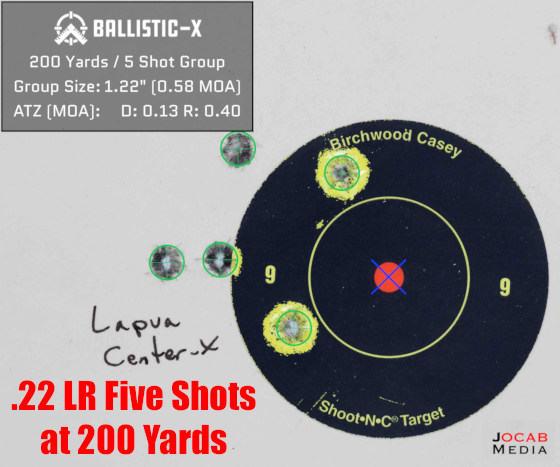
My .22 LR ammo of choice is Lapua Center-X. This is the most commonly-chosen ammunition among Vudoo V-22 shooters. I also had good results with SK Rifle Match and Lapua Midas+ in casual 50-yard and 100-yard testing but have stayed with Lapua Center-X because my rifle shot all the lots of Center-X I put into it equally well out to 200 yards.
SUMMARY — The Vudoo V-22 and MPA Package Is Outstanding
I can hands down recommend the Vudoo Gun Works V-22 for anyone who is interested in getting one. The “full-sized” rimfire rifle segment is not a one-horse race anymore and there are other options out there, but I feel very few will regret going with a Vudoo V-22 over another alternative. If you do not have a centerfire rifle designed for NRL/PRS style of shooting, you could probably just opt to go with a CZ 457 or Tikka T1x and have a lot of room to modify and tailor those rifles to your own tastes and still have an accurate rifle for NRL22. But if you also run a precision centerfire rifle, you should seriously consider a Vudoo V-22 or other 700-pattern rimfire action if purchasing a new .22 LR rimfire rig.
My Vudoo Gun Works V-22 build is an all-purpose gun for me. It is setup for NRL22-style matches but can be utilized for (extreme) long range .22 LR shooting (300 yards and beyond). For that rimfire ELR Game, I am seriously considering getting a Vudoo V-22S (single-shot) action to put in an F-Class stock to have a dedicated ELR .22 LR gun. While I built my Vudoo Gun Works V-22 with NRL22 in mind, I realized this gun could do more so I took it out to shoot 300 yards. After that, I stretched it out to 400 yards and then 500 yards in subsequent range visits. Now I am intrigued by extreme long range .22 LR shooting and often shoot 400 yards and beyond with the Vudoo V-22 when I can.
Long Range .22 LR Rimfire — Out to 500 Yards
Jonathan shoots his competition rifle in Long Range Rimfire matches with targets out to 500 yards. That’s definitely Extreme Long Range for the little .22 LR cartridge, requiring 27.8 MILs of up elevation! Jonathan notes: “I originally had a +30 MOA base on my rifle and it worked fine to 400 yards, but I ran out of adjustment on the K525i to get to 500 and had to hold over. I ended up getting a +40 MOA base.”
NRL22 Competition — Tactical Rimfire Matches
The NRL22 match format is a great shooting discipline. NRL22 offers a high fun factor at relatively low cost. You don’t have to reload match ammo. A couple of 50-round boxes of .22 LR ammo will get you through the match. While some people bring lots of gear to matches, that’s by choice and not by necessity. You can keep it simple and still be competitive (and win).
Tips for NRL22 Competitors
I am a match director at my gun club and run our local NRL22 matches. People often ask me for tips for competing in NRL22. First, I recommend getting the course of fire for the month in advance and practicing those stages at the range. Here are other specific tips that should help NRL22 competitors improve their gun-handling and match results.
1. Dry Fire Practice — If you are not able to do live fire practice at the range, I encourage shooters to practice their shooting positions at home via dry fire. Setup props or barricades with pasters or other faux targets on a wall in the garage or inside the house and run through each stage.
2. Scope Magnification Level — The most common issue I see with newer shooters in NRL22 is the tendency to maximize their scope magnification. The timer will start, and the shooter gets into position on a target, but the scope is set to 15x or higher and the shooter can’t find the target. The shooter lowers the magnification, locates the target, and then increases the magnification again, takes the shot, transitions to another target, and repeats the process of decreasing magnification, locating target, etc. Novice NRL22 shooters should try using the mid-range magnification. Try shooting 7x-12x and learn to balance field of view and target image.
The author at NRL22 Match at West End Gun Club in San Bernardino, CA.
3. Support Side Shooting — NRL22 matches often include support-side shooting stages. This requires you to shoot with your opposite (non-dominant) hand and eye. I often hear people complain about shooting support-side. My only real tip for this is to actually spend time at the range shooting this way. Practice makes perfect. It’s all a question of learning how to shoot again and using fundamentals. Learn to get a consistent cheek weld and consistent eye relief. If necessary, figure out if you need to set your scope’s diopter for your opposite eye and mark it on the scope.
4. Tripod Practice — Even though tripods are not used in the NRL22 courses of fire, I practice shooting off of a tripod often. I will often setup targets at various distances and spaced far apart to run drills firing shots on each target with the goal of speeding up transitions and target acquisitions. Target acquisition after transition from target to target is where time is lost, so it is good to become efficient in this area.
One of the most important aspects of precision reloading is setting the shoulder bump during the full-length (FL) sizing process. You want the amount of “bump” to be precise and identical for every loaded round. However, when you switch brands of brass you may need to change the die position to get the desired bump and case body sizing. And even with the same brand of brass, you may find that you need to adjust your FL die as the number of brass load cycles increases. Brass that has been fired many times will behave differently than new or near-new brass.
Also, even with the same cartridge type, brass loaded for a semi-auto rifle may need more bump than brass fired in a bolt gun. For example, with .223 Rem ammo, you’ll normally want to push the shoulder back farther if the ammo will be shot in a AR15 as opposed to a bolt-action rig.
So how do you make all these needed adjustments for your full-length dies? You can move a conventional locking ring up and down, but that can be a tedious, trial-and-error process. Some guys use shims in one-thousandth intervals, but that still requires taking your dies in and out of the press. Well there is a better way now…
PMA Tool Micro-Die Adjuster
Wouldn’t it be great if you could precisely adjust your FL die up and down in half-thousandth increments, with a simple indexed click. That is now possible with products offered by PMA Tool and Whidden Gunworks. PMA Tool offers a Micro-Die Adjuster that replaces your existing lock ring and can be used with nearly any 7/8-14 full length sizing die. The engraved marks correspond to approximately .001″ of shoulder bump adjustment. Splitting the engraved marks is therefore approximately equal to .0005″ (half a thousandth). Users love this product, saying it adds precision and saves time.
Whidden Click-Adjustable FL Sizing Die System
Whidden Gunworks offers a complete click-adjustable FL sizer die with a special, indexed ring. With Whidden’s patent-pending Click Adjustable Sizer Die system, the die and lock ring work together to allow rapid, precise bump adjustments. One click changes the bump .001″. It’s simple and fast. Included with the Click Adjustable Sizer Die is a shoulder bump gauge. John Whidden (in video below) explains:
“There has become a need for an easier way to adjust the sizer die properly. Until now there have been few options other than trial and error to get the shoulder setback correct. Anyone who has done this can attest that it’s a slow and imprecise job! Our die and lock ring work together to give the user a clicking feel to the adjustment. Each click moves the shoulder bump .001” so you can easily find the exact shoulder bump that you desire.” — John Whidden
Military pistol collectors take note — you will soon be able to order classic military-issue Model 1911 pistol from the CMP. The Civilian Marksmanship Program (CMP) will begin accepting orders to purchase CMP 1911 Type Pistols at the beginning of the new year. Orders will be accepted from January 4 to March 4, 2021. NOTE: All 1911 requests must be made through the mail. No 1911s will be available in CMP stores, and no in-store orders will be accepted. For CMP 1911 Pistol Order Forms and additional INFO CLICK HERE.
The CMP’s Historic Model 1911 Handguns
In 2018, the National Defense Authorization Act granted the first transfer of 1911s to the CMP for sale and distribution. Arguably one of the most iconic handguns ever produced, the M1911 served as the standard issue handgun for the U.S. Armed Forces from 1911 to 1985. The single-action, semi-automatic pistol uses .45 ACP rounds and is comprised of a comfortable, basic design.
New orders for CMP 1911s will not be accepted before January 4, 2021, or after March 4, 2021. Any packets received or postmarked outside of those dates will be discarded. Only one CMP 1911 order form per customer per envelope may be submitted. Those who have already purchased a CMP 1911 through the CMP RGN system or the Auction site will NOT be eligible to purchase a second 1911 at this time.
The Model 1911 Pistol — An American Classic
Designed by J.M. Browning, the M1911 is a single-action, semi-automatic, magazine-fed, recoil-operated pistol chambered for the .45 ACP cartridge. It served as the standard-issue sidearm for the United States Armed Forces from 1911 to 1986. It was widely used in World War I, World War II, the Korean War, and the Vietnam War.
CMP 1911 Pistol Grades and Prices
Each pistol is inspected and test fired by the CMP before it is shipped. Prices for the 1911s are marked at fair market value, in accordance with CMP’s enabling legislation, at the following levels (shipping cost included):
Service Grade, $1050: Pistol may exhibit minor pitting and wear on exterior surfaces and friction surfaces. Grips are complete with no cracks. Pistol is in issuable condition. Pistols may contain commercial parts.
Field Grade, $950: Pistol may exhibit minor rust, pitting and wear on exterior surfaces and friction surfaces. Grips are complete with no cracks. Pistol is in issuable condition. Pistols may contain commercial parts.
Rack Grade, $850: Pistol will exhibit rust, pitting and wear on exterior surfaces and friction surfaces. Grips may be incomplete and exhibit cracks. Pistols may require minor work to return to issuable condition but are functional. Pistols may contain commercial parts.
Auction Grade — Sales by auction. The condition of the auction pistol will be described when posted for auction.
Selection Priority Procedures
Since these firearms are in high demand, a Random Number Generator will be utilized to provide a list of names in sequential order. Customers will be contacted in the sequence provided by the Random Number Generator. When contacted, CMP 1911 customers will select their grade of pistol (Service, Field or Rack). Customers with higher generated numbers may have fewer grades from which to choose. When the allotment of 1911s is exhausted, the remaining orders will be held in the existing sequence for all future allotments of 1911s. For questions, call CMP 1911 customer service number at 256-770-4744 or send email to: cmp1911@thecmp.org.
Background Checks Are Mandatory
As part of the CMP’s enabling legislation to supply these firearms, all customers will be subject to and must be approved by the National Instant Criminal Background Check System (NICS), conducted through the FBI, to assure eligibility to purchase prior to shipment to a required Federal Firearms License (FFL) dealer.
The Civilian Marksmanship Program (CMP) returns to its regular competition schedule in 2021 and will add a few new events around the country. And for the first time, pistol matches will be offered at ALL major CMP competition events. The 2021 season kicks off March 12-21, at the Ben Avery Shooting Facility in Phoenix, Arizona, with the Western CMP High Power and Games Matches. The Western Games, entering its 17th year, has added new competitions — pistol matches — that have been long anticipated but never fired at the annual event. Registration for the Western CMP Highpower and Games Matches opened November 1, 2020. CLICK Here for Western Games INFO.
Following the Western Games on the other side of the country will be the Eastern CMP Games & CMP HP Rifle Matches, set for April 23-May 2, 2021, at the Camp Butner National Guard Facility in North Carolina. Eastern Games will follow the same lineup of rifle and pistol clinics and competitions (including the Pistol Marksmanship 101 course) as the Western Games. Registration for the CMP Eastern Games opens December 1, 2020. CLICK Here for Eastern Games INFO.
2021 CMP Competition Schedule
January 12-18 – Talladega 600 Matches (rescheduled from 2020) | Talladega, Alabama
March 12-21 – Western CMP Games & CMP HP Rifle Matches | Phoenix, Arizona
April 23-May 2– Eastern CMP Games & CMP HP Rifle Matches | Camp Butner, North Carolina
June 8-13 – Talladega D-Day Matches | Talladega, Alabama
September 19-26 – New England CMP Games & CMP HP Rifle Matches | Jericho, Vermont
October 17-24 – Oklahoma CMP Games & CMP HP Rifle Matches | Oklahoma City, Oklahoma
November 16-21 – Talladega 600 | Talladega, Alabama
Electronic Targets — As in previous years, rifle competitions will be fired on CMP Targets, a user-friendly electronic target system that instantly displays shot placement. These electronic targets eliminate the need for pit duty, allowing matches to run more efficiently.
About CMP Competitions and Travel Games
These competitions are regional competitions held throughout the year, featuring CMP’s unique rifle and pistol outdoor events. Recognized as staple events of the CMP schedule, Travel Games are centered around recreation-oriented competition and educational activities that are designed to accommodate experienced marksmen as well as those hoping to learn more. The CMP will continue to adhere to evolving safety precautions, including mask wearing and social distancing, that may be in place while events are held.
Classification System (including Match Pistol Classification)
Competitor scores in the 80 Shot and/or EIC Rifle matches will count towards CMP’s HP Rifle Classification System. The CMP also has introduced the Match Pistol Classification. Competitors firing in the CMP Pistol 2700 will have their scores count towards their CMP Match Pistol Classification. Classifications are based on a competitor’s average scores fired in his or her most recent competitions. The CMP maintains a national database of competitors and scores that are used to establish competitor classifications. Competitors can view his/her current CMP Classification by logging into CMP Competition Tracker and clicking in his/her personal “Competitions” and “EIC Results” files.
CMP Adds Pistol Events for Major Matches
For the first time, pistol opportunities will be available at all CMP competition events.
Registration for the Western CMP Highpower and Games Matches opened Nov. 1, 2020. Learn more about the event by visiting the CMP website.
Ruger has created a helpful set of online resources for new Firearm owners. The New Firearm Owner Resources site features a Fundamentals of Firearms Ownership Video Series, Industry Resources for local “hands-on” training, as well as information on safe storage. In addition, this online Resource Center offers a full library of product instruction manuals along with suggestions for recommended safety equipment.
There will be new video releases each week, hosted by Mark Gurney, Ruger Director of Product Management. These short (2 min. on average) videos provide key information for new gun owners. If you have friends or family members who are new gun owners, they should watch ALL these videos.
Introduction for New Firearms Owners
Safety Rules — The FOUR Fundamental Safety Rules
Range Safety Equipment — What You Need
This video reviews essential Eye and Ear Protection for shooters.
The Cartridge Comparison Guide is a remarkably comprehensive 340-page, spiral-bound book. Covering over 250 cartridges, the Second Edition of the Cartridge Comparison Guide is the product of many years of labor by Andrew Chamberlain, a Utah-based hunter. Andrew says his Guide “compares every factory available cartridge from the 17 calibers up to the 50 caliber cartridges”. (Sorry, most wildcat cartridges are not covered.) Chamberlain’s Guide also compiles cartridge data from major ammunition manufacturers such as Barnes, Federal, Hornady, Norma, Nosler, Remington, Sierra, Swift, Weatherby, and Winchester. It shows the optimal velocity achieved for each bullet weight and calculates bullet energy, recoil, and powder efficiency. Large color photos illustrate handgun and rifle cartridges.
The Cartridge Comparison Guide provides data for thousands of cartridge/bullet/velocity combos. Quick reference sheets and ballistics charts cover Trajectory, Velocity, and Energy out to 500 yards. The Cartridge Comparison Guide also offers a firearms lexicon, plus Appendices covering Cartridge Selection for Game Animals, Bullet Selection/Design, Bullet Expansion, and Wound Channel Characteristics.
New Content in Second Edition of Cartridge Comparison Guide
The Cartridge Comparison Guide (Second Edition) costs $29.99 plus shipping and tax. CLICK HERE to visit the Online Store where you can order the 340-page book. Here’s what’s new in the Second Edition:
Addition of Shotgun Ammunition (Both Slug and Shot loads).
Momentum Calculation for all Rifle, Shotgun and Handgun loads.
Integration of Shotgun Slug Ammunition with Center Fire Rifle Data Tables.
Factory Load Summary Added (Shows manufacturers and loads produced).
One factory load and one hand load for every bullet weight available in each cartridge.
Over 90 pages of additional ballistics content (roughly 35% more than in First Edition).
Great Resource for Hunters
One of Chamberlain’s main goals in creating the Cartridge Comparison Guide was to help hunters select the right cartridge for the job: “This started as a personal project to gather information on the more popular cartridges commonly used for hunting. I wanted to find the best all-around performing cartridge and rifle that a guy on a budget could shoot. I began comparing cartridge performance, versatility, bullet selection, powder efficiency, recoil generation vs. energy produced, standing ballistic data for different environments….”
Black Rifle Cartridge Comparison Guide
The Black Rifle Cartridge Comparison Guide (CCG) was created for semi-auto AR-platform and Modern Sporting Rifle users. The Black Rifle CCG covers virtually all popular rifle, shotgun, and handgun cartridge types used with magazine-fed, semi-automatic black rifles or AR “pistols”. There is information for 50 unique rifle cartridges plus shotgun and handgun cartridges. The book provides ballistics data for all these cartridges via easy-to-use data tables. The tables cover factory ammunition and handloaded cartridges, included the newer .224 Valkyrie.
The data tables compare standardized rifle and handgun cartridges from .17 caliber to up to .50 caliber. The book also provides data for 20-, 16-, and 12-gauge Shotgun cartridges. A handy summary table identifies each rifle cartridge presented and notes if it can be fired from a factory available MSR platform, a semi-custom platform/upper, as well as a semi-custom barrel. This 275-page, spiral-bound book is on sale now for $21.99.
Giant Cartridge Poster for Computer Wallpaper (1665×1080 pixels)
Here’s a great illustration of hundreds of cartridges and shotshell types. For dedicated reloaders, this would work great as desktop “wallpaper” for your computer. CLICK HERE for full-size image.
The Sporting Arms and Ammunition Manufacturers’ Institute, Inc., (SAAMI), has announced the acceptance of three (3) new cartridges for SAAMI standardization: 1) 277 SIG FURY; 2) 6.5 Weatherby Rebated Precision Magnum (WBY RPM); 3) 6.8 Western. While the 277 SIG FURY was developed originally for the U.S. Military, it should serve well for hunters, as will the new 6.5 Weatherby RPM and 6.8 Western. SAAMI has standardized the dimensions, max pressures, and load specs for all these three new cartridges.
277 SIG FURY from SIG Sauer
Developed by SIG SAUER for the U.S. Military, the 277 SIG FURY boasts a SAAMI maximum average pressure of 80,000 psi, driving a 135-grain bullet to 3,000+ fps. That 80K PSI pressure is WAY higher than almost all other cartridge types. To achieve these high pressures, the 277 FURY uses a hybrid case with a brass body and harder alloy metal case head. This design allows the cartridge to run very high pressures. Dan Horner of SIG Sauer told us: “When the handloaders get hold of this brass, it will be a game-changer for sure”. We envision this cartridge could be necked down to 6.5 mm and it would dramatically out-perform the 6.5 Creedmoor. And yes the official name of the cartridge is all caps “277 SIG FURY”.
Developed by Weatherby, the 6.5 Weatherby Rebated Precision Magnum (WBY RPM) was introduced with a maximum average pressure of 65,000 psi, with a 140-grain bullet traveling at a velocity of 3,075 fps. The 6.5 WBY RPM offers signficantly higher velocities that most other 6.5mm cartridges, including the 6.5-284 and .265 Win Mag. SEE 6.5 Cartridge Comparison Table
Developed by Olin Winchester, the 6.8 Western was introduced with a maximum average pressure of 65,000 psi, with a .277-caliber 175-grain bullet traveling at a velocity of 2,840 fps. A shorter variant of the Winchester Short Magnum (WSM) family, the new cartridge appears to be about .090″ shorter than the .270 WSM. It has the same 35-degree shoulder angle as the .270 WSM.
Enjoy the Shooting Sports USA Archives
With the COVID-19 restrictions we’re all spending more time indoors at home. For some folks that means long sessions in front of the boob tube. Here’s a better idea — there’s a vast resource of great gun-related content available online for FREE. Check out the Shooting Sports USA Articles Archive. SSUSA maintains a vast digital library with hundreds of articles going back to June 2009.
It’s easy to find back issues of Shooting Sports USA magazine. Here’s how: Using the gray toolbar at the top, click on the “ARCHIVES” icon in the upper right area (indicated with red arrow). When you click on “ARCHIVES”, a window will open with a selection of Shooting Sports USA magazine covers/dates in a vertical column.
Next use the vertical scroll bar to go from November 2020 (the latest issue) all the way back to June 2009. Click any issue cover to read.
How to Find and Save Articles
To search through back issues, select “MORE OPTIONS” from the toolbar. Then click the “SEARCH” button. When that opens, select either “Search archives” for ALL back issues or “Search Only this Issue”. When you’ve made your choice, enter your search term(s). For example, you can search for “Camp Perry” or “Palma” or “F-Class Championship”. You can also save any archived issue as a PDF for viewing offline. Just click “SAVE” to download the article you’re currently viewing/reading.
Read Sample Articles
Here are a couple of our favorite SSUSA feature stories from recent years. There are hundreds of other informative articles worth reading.
Before you load that nice new cartridge brass for the first time, run an expander mandrel down the case necks. This will iron out dents and provide more uniform neck tension. Chose a mandrel diameter that provides appropriate neck tension.
Lapua brass is so good that you’ll be tempted to just load and shoot, if you have a “no-turn” chamber. However, some minimal case prep will ensure more uniform neck tension. Keeping your neck tension very uniform allows more consistent bullet seating. That, in turn, usually yields better accuracy, and lower Extreme Spread and Standard Deviation (ES/SD). Lapua brass, particularly 6mmBR, 6.5×47, 6.5 Creedmoor, and .308 Win comes from the factory with tighter-than-optimal necks. Before you seat bullets, at a minimum, you should inside chamfer the case mouths, after running an expander mandrel down the necks. The expander mandrels from both Sinclair Int’l and K&M will both leave the necks with enough neck tension (more than .001″) so you can then seat bullets without another operation. We suggest putting a bit of lube on the mandrel before running it down the necks — but remove any lube that gets inside the necks before seating bullets.
Both Sinclair and K&M Tools make a die body specifically to hold expander mandrels. The Sinclair version, is shown above. This $32.99 unit fits caliber-specific expander mandrels ($9.99) which measure approximately .001″ less than bullet diameter for each caliber. This is an updated “Gen II” design that completely captures the mandrel within the die so the mandrel cannot pull out. It also has an O-ring in the die cap that allows the mandrel to self-center within the case neck. Sinclair now offers three sizes of die bodies for expander mandrels: .17 -.338 Caliber (#749-011-715WS $32.99); .357 – .50 caliber (#749-008-843WS, $32.99), and a special .50 Cal die body for large-diameter 50 BMG presses (#749-009-163WS, $39.99). All Generation II dies are machined from stainless steel and the standard diameter 7/8-14 dies include the Sinclair Stainless Steel Split Lock Ring.
Once you run the Sinclair expander mandrel down the necks of Lapua brass, after you account for brass spring-back, you’ll have about .002″ neck tension*. This will make the process of seating bullets go much more smoothly, and you will also iron out any dents in the case mouths. Once the case mouths are all expanded, and uniformly round, then do your inside neck chamfering/deburring. The same expander mandrels can be used to “neck-up” smaller diameter brass, or prepare brass for neck-turning.
Forum member Mike Crawford adds: “These expanders can also reduce runout from offset seating. Prior to bullet seating, expand the sized necks to force thickness variance outward. With the Sinclair system, the necks will springback fine, and will not be pulled out of center. This leaves plenty of tension, and bullets seated more centered. I do this, even with turned necks, to get improved seating.”
Mandrels vs. Expander Balls on Decapping Rods
If you haven’t acquired an appropriate expander mandrel for your brass, but you DO have a full-length sizing die with an expander ball, this will also function to “iron out” the necks and reduce tension. However, using a die with an expander ball will work the necks more — since you first size them down, then the ball expands them up again. Typically (but not always), run-out is worse when using an expander ball vs. an expander mandrel.
* This .002″ tension is what we have observed with Lapua 6mmBR, 6.5×47, 6.5 Creedmoor, and .308 Win brass. This might vary with much smaller or larger cases, and of course a different brand of brass might yield different results. If you get too little tension with your current mandrel, you can get a smaller-diameter mandrel from 21st Century Shooting. 21st Century even offers low-friction Titanium Nitride-coated mandrels.
Top to bottom – Remington firing pin assembly with ISS, Tubb SpeedLock alloy-composite system without ISS (current versions have dual, opposite-wound springs), and Remington short action firing pin assembly without ISS.
The U.S. Army Marksmanship Unit regularly publishes technical articles on the USAMU Facebook page. One informative USAMU article covered mechanical issues and related ignition irregularities that can cause vertical fliers even with good ammunition in an otherwise excellent rifle. We highly recommend you read this article, which offers some important tech tips.
Vertical Dispersion: Mechanical/Ignition Issues?
Poor or inconsistent ignition has long been known to be one of the “usual suspects” when one encounters vertical fliers that just shouldn’t be there. By having a sense of some of the basic principles involved, and a few basic areas to check, the shooter may avoid colsiderable frustration, not to mention time, expensive loading components and barrel wear.
Is your well-built rifle of high-quality components plagued with vertical fliers across more than 1-3 handload combinations? Consider the bedding, crown and scope/sight mounts. Are they correct? If so, then you might check for ignition issues before boldly undertaking an extensive, expensive, and quite possibly fruitless quest for the “magic handload”.
SEEING IS BELIEVING: While the author had been aware for many years that poor ignition should be considered and ruled out when dealing with vertical fliers in an otherwise-excellent rifle, actually seeing the problem and its almost instantaneous cure really drove the lesson home.
He was working with a “dot” rifle – a .22 LR match rifle that really stacked bullets into little piles at 50 yards and beyond. With one lot of ELEY Tenex, it produced consistent “bughole” groups at 50, but with another, selected lot of Tenex, similar groups were regularly ruined by single, vertical fliers that did not appear in other rifles. Rather than spending days burning up expensive, select ammunition looking for “magic lots”, he contacted a well-respected rimfire gunsmith and explained the situation.
Without so much as batting an eye, the highly-experienced ‘smith tore into the rifle’s action, and quickly found the cause(s) of the problem. He discovered a demonstrably weak firing pin spring, plus a chip out of the face of the firing pin where it contacted the cartridge rim.
After replacing and tuning the offending parts, the rifle immediately began shooting tiny, bughole groups with the previously “unacceptable” lot of Tenex. Centerfire rifles can also benefit from ensuring positive, consistent ignition. A wise riflesmith is literally worth his weight in gold!
So, what are some issues we as shooters can inspect in our rifles to help determine if ignition woes could be part of our problem? At the club level, ask yourself if that “experienced” Remington, Winchester 70, or even Springfield-based match bolt gun you’re using is still running its’ original 40-80 year-old factory striker spring? If so, a new replacement is cheap insurance against current or future problems. (And BTW, it might be best to stick to the normal, factory-spec spring weight. A super-powerful spring can cause vertical, just as a weak one one can.) Along with that, a routine check for proper firing-pin protrusion is a quick preventive measure that can rule out potential issues.
Other areas to consider are the centering and consistency of the firing pin’s operation in the bolt. Admittedly, with the increasing use of precision-machined custom actions, this is becoming less an issue every day. Below is the firing pin assembly from a custom BAT action:
However, particularly with factory actions, a very quick and easy check is to remove the bolt, let the firing pin go forward, and look at the firing pin tip through the firing pin hole. Is the tip off-center in the hole, and possibly striking it as it moves forward? Is the hole out-of-round or burred from being struck repeatedly? If so, a trip to the riflesmith is likely in order.
Similarly, machining issues in the bolt/firing pin system can lead to rough and erratic firing pin movement, in which the firing pin drags against an internal surface of the bolt. In high-quality rifles these issues are relatively rare, but not unheard-of, and it takes mere minutes to rule them out. It may be worthwhile to remove the cocking piece/firing pin/spring assembly and look for any unusual gouges, dings, peening, burrs or signs of abnormal wear.
This task is especially easy with Winchester 70s, Springfields, and the similar Mauser 98s, involving little more than the push of a button and unscrewing the cocking piece assembly. This is just one of the many reasons these tried-and-true actions have earned such a loyal following in the field, among hunters who must maintain their rifles away from a shop.
Particularly with older rifles, watch for and remove excess grease (or even Cosmoline!) from both the firing pin assembly and inside the bolt. This can help improve firing pin speed and consistency. Other bolt-action designs may need a take-down tool or other measures.
As part of this inspection, AFTER ENSURING THE RIFLE IS UNLOADED, slowly cock the rifle, dry-fire, and repeat several times. Listen carefully near the action for inconsistency in the sounds it generates. Does the striker falling make the same sound each time? Do you hear or feel grinding upon operation? If so, where?
Be sure to check the operation of the cocking piece (bolt shroud), firing pin within the bolt shroud, the cocking piece cam and the rear of the bolt body where the cocking piece cam operates. As with our examination for abnormal wear marks discussed above, look for marks indicating roughness or a possible need for light polishing. Then, clean and lightly grease the bearing surfaces while you’re at it.
Remington 700 bolt shroud and cocking cam
These are relatively easy checks that shooters can undertake to perform a preliminary inspection on their own. Other mechanical issues can also cause ignition issues, chiefly centered around the action of the trigger, sear and sear spring. If these are suspected, a trip to an experienced, qualified riflesmith for diagnosis is recommended. We hope you find this information helpful! Join us again next week, and in the meantime, enjoy the shooting sports safely!






 The
The 



 Is your well-built rifle of high-quality components plagued with vertical fliers across more than 1-3 handload combinations? Consider the bedding, crown and scope/sight mounts. Are they correct? If so, then you might check for ignition issues before boldly undertaking an extensive, expensive, and quite possibly fruitless quest for the “magic handload”.


