The National Rifle Association (NRA) has announced that the 149th Annual Meeting of Members, previously scheduled in Nashville, TN in April, has been rescheduled for Saturday, September 5, 2020 in Springfield, Missouri. The 2020 NRA Annual Meeting will be held at the Springfield Expo Center. The NRA has not yet released a full schedule of events. But this will be a meeting of members only — not a large trade show with entertainment and celebrity guests.
We’re told that this will be a much smaller event than originally planned for April 16-19 in Nashville. The rescheduled NRA Meeting will take place in Halls A/B/C at the Springfield Expo Center at 635 E. Saint Louis Street, Springfield, Missouri. The meeting will sart 9/5/20 at 9:00 am Central Time. All NRA members are invited to attend.
The Springfield News Leader reported that this event will NOT be a large trade show. It will be a meeting of members only — there will be no large trade show with hundreds of exhibitors.
Dana Maugans with the Springfield Visitors and Convention Bureau, said that, due to the COVID-19 pandemic, the NRA had to cancel the large NRA Convention originally scheduled for April in Nashville. “But with their bylaws, [the NRA] still has to have the membership meeting,” Maugans said. “They are going to have their membership portion of the meeting here. But it will not be nearly as large as the Convention/Trade Show that was planned.” Maugans revealed that, to allow for social distancing, the NRA reserved double the amount of space normally need for the 1,000 to 1,250 people expected to attend.
Sightron’s Latest and Greatest Long Range Scope Field Test and Review by James Mock
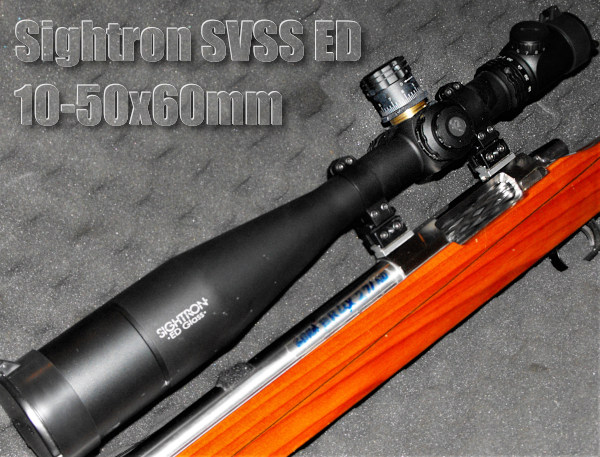
When I was writing for Precision Shooting Magazine I appreciated those vendors who would trust me to test their products. One such person was Alan Orr of Sightron. Alan was willing to send his scopes to me for testing and I found them to be some of the best values. I have shot Sightron’s SII 36X BR, the Sightron SIII 10-50x60mm Long Range (30mm tube). Recently I tested latest and greatest (in my opinion) high-magnification Sightron — the SVSS ED 10-50x60mm with MOA-H reticle. This unit boasts ED Glass and has a fat 34mm main tube.
Sightron’s SIII 10-50x60mm riflescope (30mm tube) is a fine value at $1050-$1190 street price. That popular 10X-50X LR optic (PHOTO HERE) delivers great performance for the price. However, long range shooters wanted more and Sightron has delivered with the new-generation SVSS ED 10-50x60mm ZS MOA-H optic (34mm tube). This impressive new scope features higher-grade ED (Extra Low-Dispersion) glass and many great features. These features include illuminated reticle, zero stop, and FAST parallax adjustments with coarse and fine adjustments. Also, there is a locking windage turret for the models NOT fitted with zero stop. I tested the Zero-Stop (ZS) version.
This new scope has exactly what I look for in a scope since most of my shooting is at 600 yards. This boasts Sightron’s proprietary “Exact Track” and a 7-layer lens coatings. One feature that is drawing rave reviews is the new parallax side focus control. This employs BOTH a coarse and a fine adjustment, as found on premium spotting scopes. This seems like a minor point, but it allows one to fine-tune the parallax with little effort. This, along with the fast-focus eye piece, enables one to get a crystal clear and sharp image quickly. The 1/8 MOA clicks are positive and the clicks are very audible.
Review in a Nutshell — This scope is amazing and I have used some of the best scopes to be found. It is as good or better than some scopes costing $1200-$1500 more. What does a Sightron 10-50X SVSS ED cost? If you shop around aggressively you can find the basic (non-illuminated) version for under $2000 (See footnote*). I know that seems like a lot of money and it is, but this product represents true value, as it performs with scopes costing $1000 more.
With its large 60mm objective lens with ED glass and the 7-layer coating, this scope has the brightest image of any that I have tested at high power settings. (Of course there are premium scopes that I have not yet tested that may equal or exceed this one.) A person must choose a scope best suited for the type of shooting planned. For long range benchrest competition, I don’t think that there are many optics that exceed the quality of this riflescope (especially for the cost).
The test scope has 1/8 MOA adjustments and illuminated MOA-H reticle. The MOA-H has hash marks that subtend 2 MOA at 24X; therefore the hash marks are 1 MOA apart at 48X. Since this scope is so bright and clear, I tend to leave it at 48X for most of my shooting. During very bright conditions, the depth of field can be increased with an aperture ring that can be purchased from Sightron. The illuminated reticle has 11 brightness settings. The above picture displays a high brightness level. Personally, I don’t envision using illumination during my shooting sessions.
This reticle is a little “busy” for many shooters who use the scope at close range. But for longer range, it seems ideal for my old eyes. If you wish, you can order a 10-50X SVSS ED with a 1/10th-MOA target dot reticle, non-illuminated. You’ll save money with that more basic version, model #27008.
Competing with New Sightron Scope at 300 Yards
I shot the scope in its maiden match at 300 yards. Spotting my 6mm bullet holes was easy, even in Louisiana’s famous mirage. I shot the entire match at 48X. The scope tracked perfectly during the match and the 1/8 MOA adjustments were spot on. At this 48X power, the MOA hash marks serve as a great aid in determining how far one needs to adjust his aim. The set-up for the match is shown in the photo above. The scope performed excellent even in tough conditions — it was hot, windy, and mirage was very bad. Today really tested my ability to battle the conditions with this new scope. The sun was bright; the ground was wet; and the wind was blowing; and it was hot. I shot the four score targets with a 49/50, a 50/50, another 49, and finished with a 48.
What Things Could Be Better
What, if anything, are things I dislike about this scope? Most reviews that I have seen object to the 42-ounce weight, but with my benchrest rifle, this is not a problem for me. Another complaint that I have seen is the indicator line for the elevation turret. This scope has a Zero Stop and that stop obscures the indicator line. I added a line with a pencil and the problem is solved.
Tester Was So Impressed He Bought this Sightron SVSS ED
I have tested many premium scopes in the past and have chosen to purchase two of them after testing. This is one of the two I bought. If you are in the market for a $2000-$2500 (street price) scope that will compare favorably with $3500 scopes, this may be the one for you.
This is a quality scope in every way and there are few things with which to find fault. The reticle seems too busy for me, but many long range shooters use the tree-shaped series of dots that are 1 MOA apart at 48X and 2 MOA at 24X. Part of my problem is 76-year-old eyes that need cataract surgery. One cannot fault a scope for this problem.
I can recommend this scope for the long range shooter without reservation. If your type of shooting can tolerate the weight and the cost, I believe that you will find this scope to your liking. Good shooting — James Mock
Here is a European video review of the Sightron SVSS 10-50x60mm with ED Glass:
* There are TWO different Sightron SVSS 10-60X scopes. The basic model (#27008), non-illuminated without Zero Stop, can be found for under $2000, but typically retails for around $2300. As tested in this review, the Zero Stop Model with illuminated MOA-H Reticle (#27011) is about $2450 street price.
Gun guys are always shipping stuff around the country — whether it’s a barrel to be chambered, or a scope that needs to go back for warranty repair. Or maybe you’ve sold some bullets or reloading dies you no longer need. To ensure your precious packages get to their destination in one piece, it’s important to take precautions when boxing up your items. And by all means insure packages for full value — even if your packaging is perfect, there is always the possibility that your shipment might be lost altogether. Sadly, that can happen, no matter which carrier you choose: Fedex, UPS, or the U.S. Postal Service (USPS). Here are some tips for shipping gun stuff — we explain how to pack items properly and how to minimize the risk of loss.
Tips for Shippers
Dennis Haffner from McGowen Precision Barrels offers some advice on how to avoid damage when shipping gun parts or other valuable or heavy items. Dennis explains:
“First, I started double-packing the contents and in many cases double-boxing. I spend a fortune on heavy-reinforced shipping tape. If the contents are loosely packed, the package is going to get crushed. On real important items or delicate items, wrap the content in plastic and spray the inside void areas with non-expanding foam. They make shipping foam just for this. This method really works. Since I started paying more attention to packaging, I have just about wiped out my issues with all three companies (Fedex, UPS, USPS). Yes, I hate doing it, but in the long run for us, it’s cheaper.
Bullet shipments are the worst — a shipment of 500+ bullets can destroy a cardboard box. I have ordered bullets from individuals who put them in baggies and filled the remainder of the box with foam peanuts. That is not going to work. Any piece of metal, including a die, will puncture a cardboard box, or destroy a padded envelope. Just look at the tracking information and imagine your package bouncing around in the back of the shipping truck, probably under many other packages. My advice is to NEVER use padded envelopes. Barrel nuts or recoil lugs will most likely never make it.
ORM-D items are required to be shipped in heavily-reinforced, double-walled containers. The packages still get a little damage, but the contents usually survive.
How do shipments get damaged? Consider this — one of the shipping companies this year flipped (overturned) one of our new CNC machines (which rendered it useless). Maybe your small packages were in the same delivery truck as my CNC machine. I wonder how many little boxes were crushed underneath it.
As for USPS flat rate boxes — you would not believe what people try to stuff in these boxes. USPS finally put a weight limit on the boxes — they had to. I sometimes take my delicate items packed in an envelope or small box. I spray foam in a larger flat rate box and insert the smaller package, then fill the remainder of the void with foam. It works, and part usually arrives undamaged.”
Shipping Rifle Barrels (PVC Tube and Tennis Ball Method)
A new match-grade barrel can cost $350 or more, and it might take six months (or more) to replace it, given the current wait time with top barrel-makers. So, you don’t want your nice new tube to get damaged in transit. Forum Member Chuck L. (aka “M-61″) offers these tips for shipping rifle barrels:
“Packing a barrel can be a problem. Here’s a shipping method that won’t stop lost shipments but so far has stopped damage. Get a PVC pipe (of size appropriate to your barrel) with fitted caps for each end. Attach a cap to one end. Tape the barrel threads and tape over the muzzle. Then drop one standard tennis ball into the pipe. Place barrel in pipe. Next add whatever peanuts or foam you can jam in to support the barrel on the sides. Then place a second tennis ball into the opposite end of the PVC pipe. (So now you have a tennis ball on either end of your barrel.) With everything secure inside, attach the upper cap and tape it down securely. With this packing procedure, when the carrier launches the pipe like a javelin, at least the barrel will not come through like a spear and be gone. Label the pipe with very large address labels so no one suspects it’s just garbage laying around. This procedure may seem ridiculous but it has worked for me. Oh and definitely get insurance. If your item is insured, the shippers will look harder to find it.”
Editor’s Note: Fedex also makes a triangular-profile cardboard shipping box. This 38″ x 6″ x 6″ x 6″ Fedex Tube (designed for blueprints and posters) is free for the asking. For most barrels, there should be enough clearance to hold your PVC tube (with barrel packed inside tube). However, don’t ship the barrel inside the cardboard box by itself. Cap and pad the ends and bubble wrap it heavily, or better yet, use the PVC tube method described above, with the PVC tube inside the box.
The anvil is the tripod-shaped thin metal piece protruding above the bottom of the primer cup. Getting the primer sitting fully flush on the bottom of the case primer pocket, without crunching it too much, requires some keen feel for the progress of primer seating.
In two informative Midsouth Blog articles, Glen Zediker offers helpful advice on priming. First he examines what happens to the primer itself as it is seated in the cup. Glen explains why some “crush” is important, and why you never want to leave a high primer. Glen also reviews a variety of priming tools, including his favorite — the Forster Co-Ax Bench Primer Seater. Then he offers some key safety tips. Glen provides some “rock-solid” advice about the priming operation. You’ll find more great reloading tips in Glen’s newest book, Top-Grade Ammo, which we recommend.
Priming Precision vs. Speed
Glen writes: “The better priming tools have less leverage. That is so we can feel the progress of that relatively very small span of depth between start and finish. There is also a balance between precision and speed in tool choices, as there so often is.”
Benchtop Priming Tools — The Forster Co-Ax
Glen thinks that the best choice among priming options, considering both “feel” and productivity, may be the benchtop stand-alone priming stations: “They are faster than hand tools, and can be had with more or less leverage engineered into them. I like the one shown below the best because its feeding is reliable and its feel is more than good enough to do a ‘perfect’ primer seat. It’s the best balance I’ve found between speed and precision.”
Load Tuning and Primers
Glen cautions that you should always reduce your load when you switch to a new, not-yet-tested primer type: “The primer is, in my experience, the greatest variable that can change the performance of a load combination, which is mostly to say ‘pressure’. Never (never ever) switch primer brands without backing off the propellant charge and proving to yourself how far to take it back up, or to even back it off more. I back off one full grain of propellant [when I] try a different primer brand.”
Priming Safety Tips by Zediker
1. Get a good primer “flip” tray for use in filling the feeding magazine tubes associated with some systems. Make double-damn sure each primer is fed right side up (or down, depending on your perspective). A common cause of unintentional detonation is attempting to overfill a stuffed feeding tube magazine, so count and watch your progress.
2. Don’t attempt to seat a high primer more deeply on a finished round. The pressure needed to overcome the inertia to re-initiate movement may be enough to detonate it.
3. Don’t punch out a live primer! That can result in an impressive fright. To kill a primer, squirt or spray a little light oil into its open end. That renders the compound inert.
4. Keep the priming tool cup clean. That’s the little piece that the primer sits down into. Any little shard of brass can become a firing pin! It’s happened!
Legacy Sports Int’l has just introduced a new bolt-action rimfire rifle — the Howa M1100. This new rifle will be available in three chamberings: .22 LR, .22 WMR, and .17 HMR. The rifle has a smooth action and comes with a “SUB-MOA” accuracy guarantee — something rare for a rimfire.
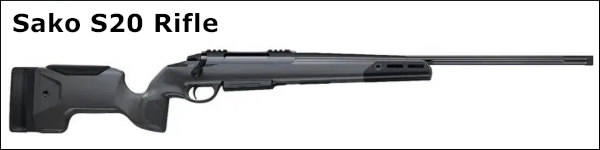
With a stock that somewhat resembles a SAKO S20 in terms of grip angle and ergonomics, we think the Howa M1100 could be a good PRS trainer or NRL22 competition rifle. The .17 HMR version should be a good carry-around varmint rig for ground squirrels and other small critters. We hope to get our hands on an M1100 for testing this summer.
SAKO S20 Centerfire Rifle for Comparison
The product description states: “The HOWA rimfire bolt action comes with an oversized tactical bolt handle, an 18″ threaded and capped barrel, and two detachable mags. All are housed into a tough synthetic Tactical / Varmint style stock with a beavertail fore-end with options of OD or Black finish.” There is also an extra-cost camo option — the whole M1100 rifle (stock and barreled action) is finished in Kratos Camo hydrodip. With the threaded barrel, the M1100 is suppressor-ready.
Legacy Sports Int’l will also be offering a Howa M1100 scoped package. This comes completes with rings and a Nikko Stirling 3.5-10×44 Gamepro Scope.
Howa M1100s come with a Lifetime Warranty and a SUB-MOA guarantee. That is 3 shots at 100 yards with “premium factory ammunition”. At least that’s what the guarantee page states. We expect that Howa might want to modify that for its rimfire rifles. But in any case, right now Legacy Sports Int’l says the M1100 rifle is guaranteed to be sub-MOA at 100 yards*. It will be interesting to see if that really can be achieved.
The Howa M1100 MSRP ranges from $478 to $589 depending on the package, with scoped models costing more. We expect “street price” for the basic models to be about $425.00.
* From website: Legacy Sports Int’l guarantees all Howa rifles to deliver SUB MOA Performance of 1 inch or less at 100 yards with Premium Factory Ammunition. Legacy Sports International requires an original receipt, and that the firearm be registered with Legacy Sports International. All Howa rifles purchased in the U.S. on or after January 1, 2017 are covered by this offer.
Video Podcast about Rimfire Testing June 10, 2020
Lapua’s Rimfire Performance Center East (Ohio) Manager Luke Johnson talks about rimfire ammunition testing on “The Shooter’s Mindset” Podcast this week. During this hour-long episode, Luke explains how rimfire ammo is tested in Lapua’s test tunnel facilities.
During this June 2020 podcast (see video below), The Shooter’s Mindset (TSM) hosts covered all aspects of rimfire performance testing with Johnson. Johnson explained the testing process, the importance of ammo testing, how to best identify good groups, and the benefit of having multiple lots of ammunition while shooting competitively.
“Many shooters are familiar with Lapua’s Rimfire Performance Centers, but have yet to take advantage of the service. Both of our facilities offer shooters the opportunity to test various styles and lots of Lapua ammunition under tightly controlled conditions”, stated Johnson. “Our goal is to help shooters match the perfect lot of ammunition with their rifle so they may hit the range with confidence knowing their ammunition will perform.”
About Luke Johnson — Smallbore Silhouette Champion
Luke Johnson is the manager of the Lapua Rimfire Performance Center housed at the Cardinal Shooting Range near Columbus, Ohio. Luke, a native of Marysville, PA, has a long background of competitive shooting and hunting.
Johnson was a four year letterman for the Univ. of Alaska-Fairbanks D1 Rifle Team. In addition to his 3P/Prone shooting pedigree, Luke is a High Master rifle silhouette competitor and past National Smallbore Silhouette champion.
NRA Smallbore Rifle Silhouette Champion
USA Junior National Champion (50 meter rifle)
NCAA – CRCA All-American
Patriot Conference – All-Conference
About Lapua
Lapua produces the highest-quality small caliber cartridges and components for civilian and professional use. Lapua is a part of the Capstone Precision Group, exclusive U.S. distributor for Berger, Lapua, Vihtavuori and SK-Rimfire products. For more information, visit Lapua.com.
One side of this gauge is the “go” side which quickly tells you the depth of a primer pocket, whether any crimp is properly removed, and whether the primer pocket is loose. If it feels loose on the “go” side, use the other end of the tool, the “no go” side, to test to see if the primer pocket is too loose to hold a primer. If the no-go slides into the pocket, then you know to junk that brass.
Primer Pocket Growth and Useful Case Life
Repeated firings at stout pressures can cause primer pockets to grow in diameter. This can create an unsafe condition if your primers are not seating properly. Are your primer pockets “good to go”, or have they been pushed to the point of no return? Do you really know? Many guys try to gauge primer pocket tightness by “feel”, as they seat the primer. But that method isn’t precise. Now there’s a better way…
The folks at Ballistictools.com have created a handy set of precision-machined gauges that let you quickly and accurately check your primer pockets. These gauges (aka “gages”) are offered in two sizes — for large and small primer pockets. A two-piece set of both large and small gauges costs just $19.99. These gauges let you quickly measure the depth of a primer pocket, and check if the crimp has been removed properly. Most importantly, the gauge tells you if the primer pocket has opened up too much. One side of the gauge has an enlarged diameter plug. If that “No-Go” side fits in the primer pocket, you should ditch the case — it’s toast.
Precision ground from O-1 tool steel, The Ballistic Tools primer pocket gauges serve multiple functions. The inventor of these tools explains: “I created the prototype of this tool for my own use in brass processing. I needed a way to quickly and easily measure primer pockets that was reliable and did not require wasting a primer. This tool has been indispensable for me and I would never go back to the old method of uncertainty and guessing.”
Product tip from Boyd Allen. We welcome reader submissions.
We’re told the 6.5 Creedmoor is now the best-selling chambering in new bolt-action rifles sold in the USA. Accurate, versatile, with moderate recoil, the 6.5 Creedmoor serves hunters, paper punchers, and PRS shooters equally well.
As part of its online Load Data Center, Nosler offers very complete LOAD DATA for the 6.5 Creedmoor cartridge. This medium-sized cartridge has become one of the most popular chamberings for tactical and PRS shooters. The 6.5 Creedmoor combines excellent accuracy, good mag-feeding, good barrel life, moderate recoil, and reasonable component cost. That’s why this cartridge has caught on quickly.
How does barrel length affect 6.5 Creedmoor Muzzle Velocity? CLICK HERE for RifleShooter.com barrel cut-down velocity test.
Origins of the 6.5 Creedmoor Cartridge
According to the Sierra Load Manual: “Developed in 2007 by Dennis DeMille and Dave Emary, the 6.5 Creedmoor is a shortened and improved 30 TC cartridge case that was inspired by the .308 Winchester design. This short action design was created to maximize case capacity and a wide range of loading lengths, while still fitting in standard short action magazines. With the correct twist barrel, the versatile 6.5 Creedmoor can take advantage of the wide range of bullet weights available in 6.5 mm (i.e. .264 caliber).” Reloaders should keep in mind that the 6.5 Creedmoor works best with medium to medium-slow powders such as H4350, Reloder 16, IMR 4451, Varget, and Vihtavuori N150.
Click Each Image to Load PDF File for Listed Bullet Weights
In addition to the data sheets shown above, Nosler offers 6.5 Creedmoor data for 90 grain FB tipped bullets and 100 grain Ballistic Tip and Partition bullets.
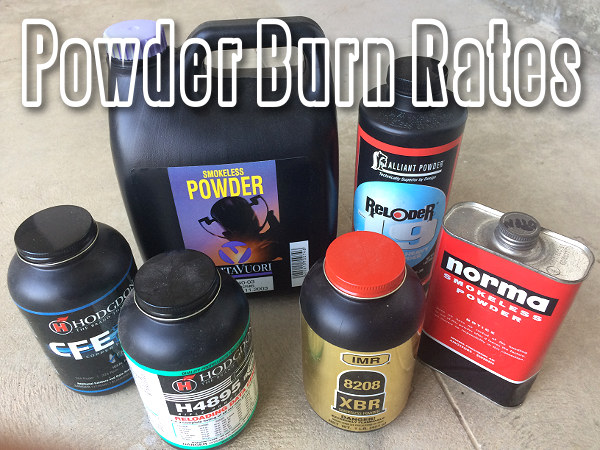
Day after day, one of AccurateShooter’s most-visited web pages is a reference guide featuring a comparative burn rate chart, ranking powders from fastest to slowest. Compiled by Hodgdon Powder Co., this Burn Rate Chart displays the relative burn rates of 163 different powders. Here is the latest table, released by Hodgdon in November of 2019.
You’ll want to download this Powder Burn Rate Table. This table shows the latest IMR powders including the Enduron series (IMR 4166, 4451, 4955, 7977), highlighted in green. This 163-entry comparison table provides vital information for hand-loaders. Note — this invaluable chart is not limited to Hodgdon and IMR propellants. This burn rate chart ranks powders from eight major powder-makers: Accurate, Alliant, Hodgdon, IMR, Norma, Ramshot (Western), Vihtavuori, and Winchester.
This chart provides useful information for all hand-loaders. When doing load development, and testing one powder versus another, it’s generally wise to choose propellants that share the same relative burn rate, as least for starters.
NOTE: Hodgdon powders are blue, IMR Enduron powders are green, IMR standard powders are yellow, and Winchester powders are red. DOWNLOAD Chart HERE.
SIG Sauer Eckernförde fireams production facility. Photo credit Alexander Losert, SIG Sauer
The parent company of SIG Sauer USA and SIG Sauer Germany will be shutting down a production facility in Eckernförde, Germany. SIG Sauer firearms production will continue elsewhere. One big reason for the shutdown, experts report, were the anti-gun policies of the current German government. In addition, because SIG Sauer is a multinational enterprise owned by Lüke & Ortmeier Holding Gruppe (L & O Holding Group), it was excluded from many German military and police contracts. Also the economic effects of the COVID-19 Pandemic hurt the company. SIG executives* stated:
“The locational disadvantages in Germany for SIG Sauer do not economically allow for manufacturing of sports and LE/military firearms in the future. Legislation is increasingly restricting the use of sports firearms. When awarding public contracts, both the German police and the Bundeswehr prefer a few local producers. SIG Sauer is systematically excluded from tenders due to its international orientation, most of its developments originating from the USA. In addition to the existing problems, there are the current effects of the Corona crisis, which place an additional considerable economic burden on the continuation of business operations in Eckernförde”.
So what SIG Sauer guns have been produced in the Eckernförde factory? German website All4Shooters answered: “A large part of [SIG Sauer’s] European catalog products comes from Eckernförde, Germany. In addition to the complete P220 and P226 X series, this includes the P210 series, various classic P226/P229s, as well as the SSG 3000 and STR rifle lines.”
What is the Future for SIG Sauer USA?
The Shooting Wire noted: “With L&O Holding Group’s announcement [that] SIG Sauer GmbH division in Eckernforde, Germany was being shut down, the speculation began almost immediately as to what the impact might be on SIG Sauer’s operations in Newington, NH. Since the U.S. operation has recently celebrated scores of defense and law enforcement contracts, any disruption in that operation could have a significant impact on the status of our military and many law enforcement agencies.” However, SIG’s official release affirmed that SIG Sauer USA will “continue business as usual”.
SIG Sauer Official Statement about USA Operations:
L & O Holding group has announced that it is closing its SIG SAUER, GmbH (Germany) division in Eckernförde, Germany. L&O Holding owns and operates numerous business units in the defense and hunting market including SIG SAUER, GmbH (Germany), SIG SAUER, Inc. (U.S.A.), and German Sports Group, GmbH (GSG), among others.
SIG SAUER, Inc. operations in the U.S. will continue business as usual. The U.S. based division, headquartered in Newington, New Hampshire, has over 2,300 employees throughout 9 facilities in New Hampshire, Arkansas and Oregon where the company designs and manufactures firearms, ammunition, optics, suppressors and air guns[.] SIG SAUER, Inc. markets and distributes its U.S. made products in 88 countries. The SIG SAUER, Inc. International Sales Team, based in Europe, will expand its responsibilities to include the German market.
SIG Sauer Rifle and Pistol Production Will Continue in the USA
What Went Wrong in Germany for SIG Sauer?
Why did SIG Sauer Suffer Business Setbacks in Germany? The Firearm Blog (TFB) suggested multiple issues: “A number of factors have led to the downturn in SIG Sauer GmbH’s fortunes, [including its] exclusion from Bundeswehr small arms programs due to ITAR restrictions (as the company’s firearms are principally developed in the US, by SIG Sauer, Inc). The impact of the European Union’s increasingly hampering firearms legislation and recent legal issues have also been factors. The ongoing Coronavirus Pandemic has also no doubt played a part with sales slowing significantly in 2020.”
SIG Sauer Company Background and Organization
SIG Sauer was created in 1976 as a partnership of Swiss company Schweizerische Industrie Gesellschaft (SIG) and German enterprise J.P. Sauer & Sohn. SIG Sauer products were sold in the USA under the SIGARMS brand for some years, and then SIG Sauer Inc. was created in 2007. Currently, under L & O Holdings, SIG Sauer runs as three entities: SIG Sauer, GmbH (with Eckernforde facility), SIG Sauer, Inc. (U.S.A.) and SIG SAUER’s International Sales Team (based in Europe).
* In a press release to German media, SIG Sauer Mng. Dir. Tim Castagne declared that “SIG Sauer [GmbH] is systematically excluded from the tender because of its international orientation.”




 Gun guys are always shipping stuff around the country — whether it’s a barrel to be chambered, or a scope that needs to go back for warranty repair. Or maybe you’ve sold some bullets or reloading dies you no longer need. To ensure your precious packages get to their destination in one piece, it’s important to take precautions when boxing up your items. And by all means insure packages for full value — even if your packaging is perfect, there is always the possibility that your shipment might be lost altogether. Sadly, that can happen, no matter which carrier you choose: Fedex, UPS, or the U.S. Postal Service (USPS). Here are some tips for shipping gun stuff — we explain how to pack items properly and how to minimize the risk of loss.
 “First, I started double-packing the contents and in many cases double-boxing. I spend a fortune on heavy-reinforced shipping tape. If the contents are loosely packed, the package is going to get crushed. On real important items or delicate items, wrap the content in plastic and spray the inside void areas with non-expanding foam. They make shipping foam just for this. This method really works. Since I started paying more attention to packaging, I have just about wiped out my issues with all three companies (Fedex, UPS, USPS). Yes, I hate doing it, but in the long run for us, it’s cheaper.
 How do shipments get damaged? Consider this — one of the shipping companies this year flipped (overturned) one of our new CNC machines (which rendered it useless). Maybe your small packages were in the same delivery truck as my CNC machine. I wonder how many little boxes were crushed underneath it.
 “Packing a barrel can be a problem. Here’s a shipping method that won’t stop lost shipments but so far has stopped damage. Get a PVC pipe (of size appropriate to your barrel) with fitted caps for each end. Attach a cap to one end. Tape the barrel threads and tape over the muzzle. Then drop one standard tennis ball into the pipe. Place barrel in pipe. Next add whatever peanuts or foam you can jam in to support the barrel on the sides. Then place a second tennis ball into the opposite end of the PVC pipe. (So now you have a tennis ball on either end of your barrel.) With everything secure inside, attach the upper cap and tape it down securely. With this packing procedure, when the carrier launches the pipe like a javelin, at least the barrel will not come through like a spear and be gone. Label the pipe with very large address labels so no one suspects it’s just garbage laying around. This procedure may seem ridiculous but it has worked for me. Oh and definitely get insurance. If your item is insured, the shippers will look harder to find it.”




 The folks at