The King of 2 Miles (KO2M) event has gone global. This past weekend, in France, talented long-range marksmen competed at the first-ever Euro version of K02M. The King of 2 Miles in France was conducted April 20-22, 2019 at Camp de Canjuers, a French military zone in Southern France, west of the city of Nice.
The Finals targets were placed at 2657, 3038, and 3576 yards. The longest distance is a bit more than two statute miles (2.0318 miles to be precise), so this was a genuine two-mile competition. During the Finals, conditions were extremely tough, with heavy winds. Hitting the Finals first target (at 2657 yards) on a cold bore proved impossible for most of the shooters. But French shooter (and new King) Bruno Put prevailed, scoring two hits at 2657, and one each at 3038 and 3576.
K02M in France winner Bruno Put (center) with his match-winning rifle. We are told this is chambered in .375 Snipe-Tac, a .408 CheyTac case necked down to .375 caliber and shoulder blown out to 35°.
King of 2 Miles France Results: Click chart photo above to see large version.
Frenchman Bruno Put Wins K02M France
Hail to the King! We congratulate Bruno Put, the new King of 2 Miles in France. Bruno dominated the Finals, scoring hits at all three distances to finish with 25,368 points. He got two hits at 2657 and one each at 3038 and 3576. We are told Bruno was shooting a .375 Snipe-Tac rifle with Warner 361gr Flatline bullets in Peterson brass (according to sources). Conditions were challenging and Bruno was the only finals competitor to score hits at 3038 yards and 3576 yards. Paul Phillips got one hit at 2657 yards, but no other competitor (except Bruno) managed ANY hits in the Finals. K02M founder Eduardo reported: “We had very difficult conditions with fish-tailing winds that complicated hugely the shooting. But even in these conditions Bruno Put was able to reach the 2 miles target.”
Benjamin San Marco during qualifying stages at Camp de Canjuers. Photo by Target Shooter Magazine.
For those who’ve attended the North American K02M at Raton, New Mexico, there was a familiar face in France — Paul Phillips of the Global Precision Group and Team Applied Ballistics. Paul finished second overall, with a Finals score of 19,954 points.
Paul was shooting on the three-man Team BCM squad with two Italians, Gian Molina, and Gianfranco Zanoni. The trio did great in the prelims, placing first (Molina), third (Phillips), and fifth (Zanoni). All three team members made the Finals — a very impressive collective performance. Their final places were Phillips 2nd overall, Molina 3rd, and Zanoni 6th.
Paul reported: “After a long day of shooting, the top ten qualifiers [moved on to] the Finals. Due to inclement weather rolling in, [match directors held] all qualifiers in one day. The wind was pretty much a tail wind all day which benefited the faster shooters greatly.”
Many leading companies have helped Paul Phillips and his team: Applied Ballistics LLC, Bartlein Barrels, Barrett, BAT Machine, Bullet Central, CROSSTAC, Cutting Edge Bullets, Edgewood Bags, Garmin, Holland’s, Kryptek, McMillan Fiberglass Stocks, Nightforce Optics, Peterson Cartridge Co., Vihtavuori Powders.
At the request of our readers, we provide select “Deals of the Week”. Every Monday morning we offer our Best Bargain selections. Here are some of the best deals on firearms, hardware, reloading components, optics, and shooting accessories. Be aware that sale prices are subject to change, and once clearance inventory is sold, it’s gone for good. You snooze you lose.
1. Sportsman’s Guide — Ruger 10/22, $189.99 with CODE
If there’s one gun that’s synonymous with shooting sports, it’s the Ruger 10/22. This classic rimfire rifle is inexpensive to buy, yet very reliable. If you’ve been looking to pick one up or buy your kid his or her first rifle, here’s your chance to get a wood- or synthetic-stocked 10/22 from Sportsman’s Guide. Member Price is $199.49 while non-member price is $209.99. But it gets better — use Code GUNSNGEAR to save an additional $20.00. With that Code, SG members can snag one for just $179.49! The non-member price is $189.99 with Code. NOTE: The GUNSNGEAR $20 OFF Code works with or without a membership.
2. Grizzly Industrial — Bald Eagle Mini Arbor Press, $74.95
Have you been looking for a low-cost arbor press to get started with in-line seating? Perhaps you’d like to load your bullets long initially, and then adjust the bullet seating depth during load development (or even at matches). Arbor presses are great for bullet seating tasks at the range. If you need a compact arbor press for your loading duties — here is really good deal. Grab a Bald Eagle Mini Arbor press and you’ll be off and running for the low price of $74.95.
3. Midsouth — RCBS ChargeMaster Lite, $229.99
Do you need an electronic powder scale and dispenser? Check out this great deal at Midsouth Shooters Supply. Suggested retail for the ChargeMaster Lite is $299.99. Amazon’s best price for this unit is $269.49. But now you can get it for just $229.99 at Midsouth. So you can save at least $40 with this Midsouth sale. Put the money saved into bullets or powder. The RCBS ChargeMaster Lite is the modern second generation Scale/Dispenser, descended from the original ChargeMaster. The ChargeMaster Lite features an easy-to-use LCD touchscreen. Dispenser precision is plus/minus 0.1 grains. The unit comes with twin check weights and a convenient plastic cover for the powder pan.
4. Graf’s — Platinum Case Prep & Trim + EZ Tumbler, $179.99
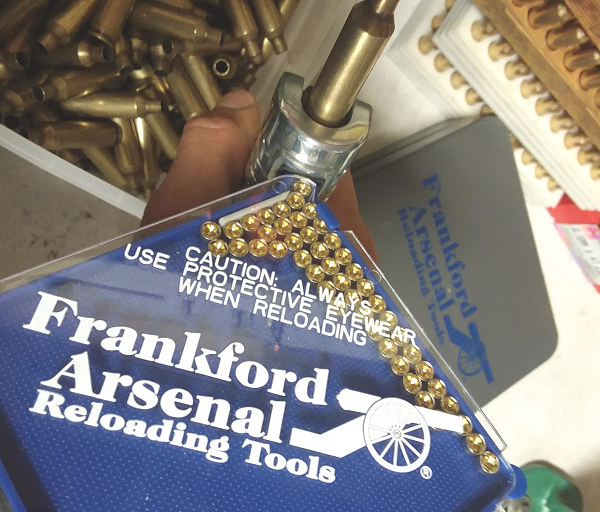
If you want to step up your brass preparation game, here’s a great deal. Graf’s is offering the Frankford Arsenal Case Prep & Trim PLUS the EZ Tumbler for only $179.99. That’s an amazing deal considering you could pay $199.99 or more for the Prep & Trim unit by itself, and the EZ Tumbler is regularly $50 or more. This Grafs.com combo deal represents a savings of nearly $70.00.
5. Bruno Shooters Supply — Labradar w/ FREE SHIPPING
Labradar is considered the class leader in shooting chronographs. The ultra-accurate, state-of-the-art Labradar chronos have become so sought-after that they’re hardly ever discounted. While that may be true, Bruno’s is doing the next best thing and offering the Labradar with FREE SHIPPING as well as any accessories you buy along with it. This is a great time to grab the most advanced chrono on the market, along with genuine Labradar accessories.
6. Midsouth — 350 Rds 9mm FMJ in Container, $74.99
Nearly all gun guys (and gals) own one or more 9mm pistols. Here is some very cost-effective Aguila 9x19mm ammo that lets you train more often. Right now Midsouth is offering 350 rounds of 9mm FMJ plus a nice ammo can for the low price of $74.99, a great deal. At that price you can may want to buy 1000 rounds or more. We’ve shot this ammo. It is reliable and the brass is reloadable.
7. Black Widow — Refurbished Trim-II with Die, $79.50
Trimming your brass to length can be a chore with manual trimmers. There are high-end motorized trimming systems, but some of these cost hundreds of dollars. Fear not as Black Widow Shooters now has the refurbished trim-II w/ free die for only $79.50! That’s a savings of over 50% off the normal price. The beauty of this unit is that you simply attach it to any drill, adjust it to length and start trimming. It’s just that easy. Once you use a tool like this you may never go back to manual trimmers.
8. Midway USA — Wheeler Scope Mounting Kit, $79.99
Does the thought of mounting your own scope scare you but you’re tired of paying someone else to do it? With the help of the Wheeler Engineering Scope Mounting Kit your fears will be put at ease. This $79.99 Kit includes everything you need including a torque wrench, alignment bars, levels and more. All of this comes packaged in convenient transport case.
Have you ever been ready to run to the range and blow off a few rounds only to find that you’re out of targets? If you’re like us that’s one of the most frustrating things that can happen when heading to the club and nobody likes using printer paper and a marker to make a target. Pick up this 100 count set of sight-in targets and you won’t have to run to the store last minute or dig through the range trash cans hoping to find a barely-used target. This is a great value — only 13 cents per target! Great deal.
Our friend Jim See of Elite Accuracy LLC recently tested the depth-adjustable hand priming tool from Frankford Arsenal. This product, called the Platinum Series Perfect Seat Hand Primer has some unique features. Primer seating depth can be adjusted with a handy wheel in the tool’s center handgrip. Each “click” of the wheel moves the primer post .001″ (one one-thousandth of an inch). Additionally, the design of the case-holder allows quick and easy removal of a primed case. The unit ships with a full set of shell-holders to match all types of cases. Like many other hand priming units, the primers are loaded into a flip tray that attaches to the head of the tool.
Here is Jim See’s quick review of the Frankford priming tool:
“The Frankford Arsenal perfect hand-priming tool is legit. The tool is built heavy and strong. The only plastic parts in it are the tray and lid. The [primer] seating depth adjustment… is simple and accurate. Easy to operate. I primed 1000 cases, averaging 23 per minute. I adjusted the depth of seating between two different lots of brass in seconds. The system seats primers easily with one hand operation. The cases slide out on their own after seating. Insert, seat, reach for a new case at the same time as you are operating the lever, case slides out and you are inserting the next piece.”
Overall, Jim was “Super impressed with the quality and the results. This thing is super smooth — way less pressure needed than my Lee or RCBS. It’s a lot faster too.” Jim add that one can switch from small to large primer posts in 10-15 seconds.
This Video Shows the Frankford Priming Tool in Operation:
Even with premium brass you may want to adjust your primer seating depth: “Every thing has a tolerance that is acceptable in manufacturing. If primer pocket depth has a .005″ tolerance and the primers themselves have a .002″ tolerance you can see why adjustments would be needed. In this case the two lots were manufactured on year apart. Could you expect them to be identical?”
This 6 PPC features a Nesika Extended ‘C’ action, Krieger 1:13.5″-twist LV barrel, Kelbly stock, and stunning paint by Mike Lavalle of killerpaint.com. For an eye-catching R-Rated paint surprise, Click HERE.
One of the most popular items in our Shooters’ Forum is the ongoing “Pride and Joy” thread. Since 2009, Forum members have posted photos and descriptions of their most prized firearms. Here are some of the most recent “Pride and Joy” rifles showcased in our Forum. Do you have a gun you’d like to see featured there? Register for the Forum and you can add your favorite gun to the list.
Click image to view large, full-screen photo!
For this week’s Sunday GunDay we’ve selected five fan favorites from the Pride and Joy archives. First up is this custom 30 BR brought to you by ANSHUTER2013 and built by Dave Bruno. We were captivated by the clean lines and handsome looks of the Roy Hunter Curly Maple stock. Nestled in that stock is a BAT B action fronted by a 1:17″-twist James Lederer 24″ HV barrel. A Jewell trigger with fixed 42x44mm Nightforce scope round out this beauty.
This state-of-the-art 6 PPC boasts all top-tier components. And owner Wes R. shoots it with a superb rest/bag/pad set-up that inspires envy. This “Bughole 6 PPC” features a Bat DS action, Bix’N Andy trigger, with Bartlein 1:13.75″-twist barrel. The stock is a super-low-profile Scoville with carbon strengthening. The front rest is a SEB NEO, while in the rear is the new Lenzi sandbag. Folks tell us the Lenzi is super stable, which improves tracking from shot to shot. Note the timer attached to the front rest as well as the nice Edgewood leather bench “blanket” and arm-rest pad.
Forum Member Killick attached PickleForks to his handsome blue Eliseo R1 TubeGun now chambered in .284 Winchester, a top choice for the F-Open discipline. Killick explains: “Behold! An Eliseo R1 F-Classer. This started out as an R1 Long Range sling rifle (6XC) with a Borden TubeGun action. It is now rebarreled in .284 Win with Gary’s PickleFork fore-end adaptor. Props to Gary Eliseo at Competition Machine LLC.”
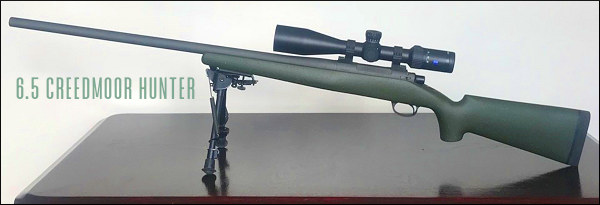
Sometimes clean and simple is the way to go — particularly with a hunting rifle. WEATHERBYFAN’s 6.5 Creedmoor is built around a Stiller Predator single-shot action in a texturd, green Wildcat Var-Tac stock. The 1:8″-twist Bartlein barrel is finished at 28″. That’s pretty long for a hunting rig, but it delivers added velocity. Finishing off this nice rigle is a Zeiss 6-24x50mm optic. Sometimes less is more and this is a perfect example of that.
Our final offering is from Forum member 300_WHISPER. Completed just months ago by gunsmith CALEB85, this .308 Win rifle features a Bighorn TL3 action with a Bartlein M40 26″ 1:10″-twist barrel, and Manners TA Elite stock. Other components include Trigger Tech Special, Area 419 self-timing muzzle brake, and a Weaver Tactical 3-15x50mm FFP mil/mil optic. When test-fired by Caleb with ammo using Berger 175gr OTM Tactical bullets, this nice .308 Win delivered a 1.6″ 5-shot group at 400 yards. The owner says “It’s my dream rifle. I couldn’t be happier”.
The Giraud power trimmer indexes off the shoulder of the case. It is costly, but offers high production rates, trimming to length and chamfering in one operation.
The folks at PMA Tool, makers of arbor presses, neck-turning tools, and other case-prep tools, offer some good advice about case trimming on the PMA Tool Blog. Here we reprint a PMA blog post that explains case trimming basics and helps you choose the right case-trimming tool for your needs.
Case Trimming Basics
Trimming the cartridge case to the proper length is a crucial step in case preparation that should not be overlooked or underestimated. The cartridge case or the rifle can be damaged, or even worse you get badly injured. In most instances cases should be trimmed after firing and sizing. Trimming new brass is necessary for a lot of wildcats and can be beneficial in some instances, but by and large, trimming new brass is not necessary for most situations (unless you are neck-turning). Cases should be trimmed after you have sized the case, because the expander ball on the decapping pin can (and will) stretch the neck. Those of us who neck size should get into the habit of trimming after sizing as well. This is a good rule of thumb to go by, and hopefully it will keep you safe during the reloading and shooting process.
There are so many case trimmers out there that work, deciding which one is right for you can be confusing. Even though I have trimmed thousands of cases, using about every method possible, I can’t answer the question of what case trimmer is right for you because of all the variables that may be involved. I can, however shed some light on the subject.
The two most popular designs of trimmers either index (1) off the base or the head of the case, (2) off the shoulder or datum line of the case. There are pros and cons to each and it all depends on what you are willing to live with.
Indexing off the Base (Case Head)
Let’s talk about the first one I have listed, indexing off the base, or the head of the case. The pros to this method are that you can achieve a very accurate over all length and that is after all, what it is all about. The cons to this method are that you can get some variation doing it this way. Let me explain, the base is not always square to the body or can be damaged during firing especially if it is fired through a military style rifle with a very aggressive ejector. These cases should be discarded, but sometimes they can be overlooked. This condition can lead to an over all length that is incorrect. The case head being out of square will be corrected upon firing, however that case will wind up being shorter than the rest of your cases, possibly creating a difference in the neck tension on the bullet. The more you can do to eliminate variables in your reloads the better off you are going to be. This method can also be very slow, and if the user gets careless the result will be a inconsistent over all length.
Indexing off the Shoulder (Datum Line)
The second method I mentioned, trimming off the shoulder or the datum line of the case, has its pros as well. I have found this to be the quickest of the methods and very accurate as well. After the case has been sized through the die the dimensions (particularly the headspace) of the cases are usually very uniform and exact, this allows the case to be trimmed by indexing off the shoulder. This method can be done very quickly, by hand, or by powering either the case, or the trimmer. You also don’t have to worry about the case heads being out of square with the body using this method. Generally the trimming time is cut in half, and this leads to greater focus on the job, without becoming careless.
The PMA Micro-Adjust Case Trimmer indexes case length off of the shoulder of a properly fire-formed and full-length re-sized case. We accomplish this through the use of interchangeable Delrin™ inserts which capture the shoulder and neck of the case. This insert is contained in a spring-loaded tool head that rides on a linear bearing. When the case is captured within the tool head the tool head rotates along with the case, the spring allows for the case to self-align squarely to the cutter and allows you to control the feed rate into the cutter.
— Indexes off shoulder for easy, consistent trim length
— Fully rotating head with bearing for smooth operation keeps cuts square
— Large, ergonomic design fits the hand well
— Sharp carbide cutter for quick, smooth cuts with minimal bur
— Cases captured in Delrin™ (completely non-marring material)
— Spring loaded head allows complete control of rate of feed.
Our trimmer can be used in three ways. The first method utilizes our PMA Tool caseholder drivers and your power screwdriver, drill, case lathe, drill press or lathe. Trimming via this method the case is spun and fed into the trimmer while it is held in your hand. In the second method, the trimmer’s adjustment knob is removed (after adjusting and locking the setting) and the cutting shaft is chucked in a drill, drill press or lathe. Using this method, the case itself is held by hand and fed into the cutter. We’ve found this to be the quickest method to trim.
Summary
The choice is yours to make. I hope that this was some help to you, whether you are looking for your first trimmer or looking to replace the trimmer you have. Just remember to always put safety first and accuracy second, and you will start making little bug holes in no time.
Story Tip by EdLongrange. User submissions are welcome.
“Koenig” (or König) means “king” in German. That is indeed appropriate for Doug Koenig, 18-Time Bianchi Cup winner, who is now starting to conquer the rifle world as well. Koenig, considered by many to be the best action pistol shooter on the planet, proved he’s an ace with rifles too, as he recently won two PRS matches in Production Division. Koenig, Captain of Team Ruger, was shooting a Ruger Precision Rifle (RPR), chambered in 6mm Creedmoor. Notably, Production Division limits rifles to $2000.00 for the gun ($4000.00 overall with scope). You can buy an RPR for around $1100.00 typically ($795.00 at GrabAGun), so Koenig was shooting against competitors with rifles that cost nearly twice as much. That’s impressive.
Koenig Wins Production Class at two Spring PRS Matches
Koenig took home a pair of Production Division titles at this year’s WAR Rifles Shootout and MAP Spring Shootout Precision Rifle Series (PRS) matches.
With a final score of 128.00 and a time of 58.51, team captain Doug Koenig took first place in Production Division at the WAR Rifle Shootout PRS match in Mount Victoria, MD. The WAR Rifle Shootout has a challenging 22-stage course of fire. Along with winning Production Division, Koenig also finished twelfth overall. “The tough course of fire and 15-25 mph winds at the War Rifle match were brutal, but my Precision Rifle, equipped with a Leupold VX-3i LRP and loaded with Hornady ammunition, continued to perform,” said Koenig.
Koenig then secured another Production Division win at the MPA Spring Shootout held at the Arena Training Facility in Blakely, GA with a final score of 173.00 and a time of 58.89. “The MPA match had some long shots out to 800-1356 yards, but my factory rifle got the job done and helped me win my third production class title in a row. That proves you don’t need to spend a fortune to get started in PRS competition.”
According to PRS standards, Production Division rifles are not permitted to be altered or improved in any way from the original factory configuration, and the retail price may not exceed $2,000.
Pre-Fit Barrel Options for the Ruger Precision Rifle
While PRS Production Division competitors like Koenig must stick with factory barrels, there’s no law that says you can’t upgrade your own RPR that’s not used in PRS matches. A barrel swap is probably the single best hardware upgrade you can make. A new custom barrel will improve inherent accuracy and shot-to-shot consistency. Krieger Barrels offers Pre-Fit barrels for the RPR in many popular chamberings including 6XC, 6mm Creedmoor, .243 Win, 6.5 Creedmoor, 6.5 PRC, and .308 Win. These “Drop-In Ready” barrels come finish-chambered and threaded to fit the Ruger action, with factory-spec muzzle threads. The Ruger barrel attachment system allows correct headspace with a pre-chambered barrel. Krieger explains: “Thanks to Ruger’s proprietary barrel nut design, a competent gunsmith will be able to swap out your barrel using an AR15 barrel wrench and proper headspace gauges.”
Do you need an electronic powder scale and dispenser? Check out this great deal at Midsouth Shooters Supply. Suggested retail for the ChargeMaster Lite is $299.99. Amazon’s best price for this unit is $269.49. But now you can get it for just $229.99 at Midsouth. So you can save at least $40 with this Midsouth sale. Put the money saved into bullets or powder.
The RCBS ChargeMaster Lite is the modern second generation Scale/Dispenser, descended from the original ChargeMaster. We have a 10-year-old first gen RCBS ChargeMaster in our loading room that is still going strong. The ChargeMaster Lite features an easy-to-use LCD touchscreen with many nice features. The hopper holds nearly one pound of powder. The unit comes with twin check weights and a convenient plastic cover for the powder pan. Your choice of propellant can be measured out 2 to 300 grains with a plus or minus accuracy of 0.1 grains.
Berger Match Solids are now government-endorsed. The U.S. military has selected Berger’s .375 caliber ELR Match Solid Bullet for the Extreme Sniper Strike Operations (ESSO) program (Phase 2). The ESSO program is a U.S. government project to develop a high performance, extreme long-range sniper weapon system built on a bolt-action, magazine-fed platform.
For ESSO, .375-cal Berger solids are loaded into the .375 EnABELR (Engineered by Applied Ballistics for Extreme Long Range) cartridge. This was designed to offer .375 CheyTac performance in a slightly shorter package that mag-feeds well.
Bryan Litz, Berger’s Chief Ballistician said: “The .375 caliber Berger ELR Match Solid Bullets were optimized for use in the ESSO project, which requires high performance and reliability over many rounds in adverse conditions. In addition to meeting the needs of our US military, the Berger Match Solids provide proven, match winning performance for the ELR competition shooter as well.”
ELR Match Solid Bullets drive state-of-the-art ESSO weapon systems. The EnABELR is designed to reliably engage targets at distances out to 2500 meters.
Table 1 below presents basic load data for the .375 EnABELR. Considering the Berger .375 Cal 379gr and 407gr solid bullets were developed in conjunction with the EnABELR case, load data is provided to achieve certain landmark velocities with these bullets, for a range of suitable powders. According to Applied Ballistics, with a 30″ barrel, “the .375 EnABELR can safely push the Berger 379gr Solid to 2900 fps, and the Berger 407gr Solid to 2800 fps.”
Table 1 — .375 EnABLER Load Data
Table 2 — .375 EnABELR Comparative Velocities
Applied Ballistics notes that: “These are conservative, baseline velocities. Higher velocities are possible but the above performance is safely achievable well within pressure limits of the cartridge. Note the performance of the .375 EnABELR is driven by the high BC Berger Solid bullets. If the .375 CheyTac were loaded with the same bullets, the performance would be about the same. ”
About Berger Bullets
Berger manufactures precision projectiles and match-grade ammunition for Target, Hunting and Tactical applications in Mesa, AZ. Berger is part of the Capstone Precision Group, the exclusive U.S. distributor for Berger, Lapua, Vihtavuori and SK-Rimfire products. For more information, visit Bergerbullets.com.
Each Wednesday, the U.S. Army Marksmanship Unit (USAMU) publishes a reloading “how-to” article on the USAMU Facebook page. A while back, the USAMU’s reloading gurus addressed a question frequently asked by handloaders: “How much neck tension is optimal, and how should I select a neck bushing size?” The USAMU offers a straight-forward answer, suggesting that hand-loaders start with a neck bushing that sizes the neck so that it is .003″ less than the loaded outside diameter with bullet in place. From there, you can experiment with more or less tension, but this is a good starting point for many popular cartridge types.
Determining Optimal Case-Neck Tension
This week, we examine determining the correct case neck tension for optimum accuracy. Our method is simple, but relies on the use of case sizing dies which accept interchangeable neck diameter bushings graduated in 0.001″ increments. (Those readers using fixed-diameter dies with expander balls aren’t forgotten, however. Methods of tailoring these dies for proper neck tension will be found below.)
In our experience across many calibers, sizing case necks 0.003″ under the loaded-case neck diameter usually yields excellent accuracy. In other words, the sized case neck expands 0.003″ when the bullet is seated.
Bushing Choice for Optimal Sizing
Over the years, we have periodically experimented with increasing neck tension to possibly improve accuracy. In testing with machine rests at 300/600 yards, accuracy often deteriorated as neck tension increased; thus, 0.003″ expansion (from sized neck to loaded neck) is where we usually start.
Using the .260 Remington as an example, our loaded cartridge case necks measure 0.292”. Simply subtract 0.003” from that, and use a bushing that sizes necks to 0.289” (after springback). There are exceptions — sometimes, brass may be a bit soft or hard. Some case necks might need, say, 0.001” more tension, but in general, this works well.
This .003″ standard of neck tension works very well for single-loaded, long range cartridges. Depending on your caliber and firearm, it MAY also work very well for magazine-fed cartridges. If this neck tension proves inadequate for your purpose, one can increase neck tension as needed while monitoring for possible accuracy changes.
Special Considerations for Coated Bullets: If you are using moly-coated bullets, this significantly reduces the “grip” of the case neck on the bullet, and you can expect to have to tighten your case necks accordingly — particularly for magazine-fed ammunition. In any event, we do not crimp rifle cartridges, and advise against it for accuracy handloads.
Tips for Using Expander Balls
Many savvy handloaders avoid the use of expander balls in high-accuracy reloading, if possible. These can stretch cases and/or disturb the concentricity of the case neck vs. case body. If using a die with an expander ball, tapering both ends of the ball and polishing it to a mirror finish can significantly reduce these effects. (Special carbide expander ball/decapping stem sets are available for this as well.)
The typical dies used with expander balls are intended to take any cases the user may find, and size them down well below the ideal “spec” to ensure any cases will give good neck tension. The necks are then expanded up to provide heavy to medium neck tension as the expander ball exits the neck. The brass is over-worked, leading to premature work-hardening, and seated-bullet concentricity may suffer. However, the cartridges produced are perfectly adequate for most handloaders. Those who seek finest accuracy generally prefer not to over-work their brass if possible.
Another Option — Custom-Honed FL Dies
There are companies which offer to convert one’s standard dies to accept neck bushings, and that gives excellent flexibility. Another, more “old-school” approach, is to have the neck of one’s FL die honed out to the desired diameter for sizing, based on one’s case neck thickness. The expander ball may then be reduced until it barely touches the case necks after sizing, or it may be eliminated entirely. However, once performed, this modification is permanent and leaves fewer options than the bushing route, if one later changes case neck thickness.
Those shooters who turn their case necks for optimum neck wall thickness uniformity, or for a tight-neck chamber, will want to take the reduced neck wall thickness into consideration. For example, when setting up a 7mm match rifle to use a standard hunting die without an expander ball, the slightly thinner necks resulted in a perfect 0.003″ reduction in the fired-neck diameter. The result was a low-cost die that fit with custom precision and yielded excellent, match accuracy!
Keeping your barrel cool has many important benefits — it will definitely enhance barrel life and can help maintain accuracy over the course of long shooting sessions. Now there is a new way to quickly dissipate heat from your rifle barrel — Barrel Blizzard
The makers of BarrelCool have created a new dual-fan barrel cooling device, called the Barrel Blizzard. Each powerful fan moves 30 cubic feet of air per minute — that’s serious cooling power. This unit is powered by a common USB-style battery. The housing mounts easily to the barrel, and the twin fans can each be adjusted 360° to various angles (You can even use one to cool the gun and the second to cool the operator on a hot day). This should be available very soon at the introductory price of $74.99
Reduce Barrel Cooling Time from 45 Minutes to 10 Minutes
How well does the Barrel Blizzard work? The makers tell us: “Repeated tests show that the Barrel Blizzard cuts barrel cool-down times significantly. What might take 45 minutes, can often be reduced to less than 10 minutes. And if you combine the new Barrel Blizzard with BarrelCool, the in-chamber fan, you can get a hot barrel down to near-ambient temperature in approximately 5 minutes.”
Barrel Cool-Down Times for Barrel Blizzard Alone and Blizzard + BarrelCool
We think this product will definitely be popular with varmint shooters in the summer months. Those guys may shoot hundreds of rounds in a day. Many serious varminters bring along a couple spare rifles, so that they can swap rigs when one barrel heats up. With the Barrel Blizzard they may be able to keep shooting with minimal wait time, and no rifle change-outs. Byron Sumoba, one of the designers, notes: “With a rechargeable 2600 mAh battery. We are getting about 2.5 hours of continuous use out of a battery pack.”
Who can benefit from this product? The makers say this is “For the shooter wanting to drastically reduce their load development time at the range… or the varmint hunter looking to cool that barrel down and increase barrel life.”
Barrel Blizzard Can Also Cut Mirage
This system can also cut mirage, by reducing the hot air rising from your barrel. If a mirage band is not enough on hot days, you can just rotate one of the fans to send the flow down the barrel towards the muzzle. This will help reduce mirage coming off the barrel.











 Bushing Choice for Optimal Sizing


