Our friend Gavin Gear of UltimateReloader.com recently made a pilgrimage to Connecticut, home base for Lyman Products. He went East to talk with Lyman’s design engineers and learn about the latest products in development by Lyman. Gavin wrote: “During my visit I got to see the factory, meet the team, and even get a behind-the-scenes look at some products to come.”
Gavin noted that Lyman’s management, design team, and production are all under one roof. That definitely streamlines Lyman’s product development process, and helps explain why the Connecticut-based company has been so successful: “At Lyman headquarters you have the CEO, the Engineering team, the Marketing team, machinists, laboratory staff, and warehouse workers all under one roof.”
Gavin found the production area very impressive: “When you step into this area… it’s pure action! Lots of parts on racks, material waiting to be machined, CNC machines running, and machinists running machines. Lyman is one of the few companies to use American cast iron, an American manufacturing facility, with American labor start-to-finish. They are able to do this because of how efficient their process has become. Heavy iron comes from nearby and is machined/assembled on-site, and then shipped to distributors and retailers. Outsourcing (like powder coating) is done close-by as to avoid excessive transport cost and to quicken turn-around time.”
Lyman Now Offers Advanced Mark 7 Reloading Systems
Big News — Lyman now sells the highly sophisticated Mark 7 Reloading system. Lyman acquired Mark 7 Reloading earlier this year. The Mark 7 machines represent the most advanced, automated progressive reloading systems available to the general public. The computer-controlled Mark 7 machine makes a Dillon look downright primitive.
This Video Shows Mark 7 Reloading Machines in Action:
Now in its sixth year of operation, Mark 7 Reloading produces a full line of reloading presses ranging from hand operation to light commercial operation. Here’s a detailed video showcasing the Mark 7 reloading system. In this video Gavin Gear interviews Lyman engineer Spencer Carroll:
About Lyman Products — Nearly 140 Years Serving Shooters and Reloaders
Lyman Products, founded by avid outdoorsman William Lyman, has been innovating firearms and reloading accessories and gear for almost 140 years. The proud history of Lyman Products began in the late 1800s when William Lyman created the Lyman No. 1 Tang Sight — a major improvement in rifle sighting. Now a century and a half later, Lyman continues to introduce popular and innovative products, such as the Lyman BoreCam, Case Trim Express, Case Prep Express, and Brass Smith Series Reloading Presses.
See Latest Lyman Products at NASGW Expo in Orlando
Lyman Products will be exhibiting at the 2019 National Association of Sporting Goods Wholesalers (NASGW) Expo & Annual Meeting in Orlando, Florida, October 22 – 25, 2019. Along with the new Mark 7 reloading machines, Lyman Products will showcase its other respected brands: Pachmayr, TacStar, A-Zoom, Trius, Butch’s, and Targ-Dots.
The mainstream media (CNN, MSNBC, CBS, ABC, the N.Y. Times, etc.) loudly report that the USA is experiencing a tidal wave of gun-related killing and violence. From the barrage of anti-gun stories in the news media, you’d think that deaths caused by firearms (especially those fearsome “Assault Rifles”) are increasing dramatically.
In fact, the truth is just the opposite — overall violent crime is declining, and firearm-related gun violence has DECREASED significantly. We are NOT seeing more murders-by-gun than ever before. In fact, “Homicides with firearms were down 7% from 2017″. Read on to get some REAL facts…
VIOLENT CRIME CONTINUES TO TREND DOWNWARD
Report by Elizabeth McGuigan for NSSF.org
The FBI has released its crime data for 2018 and the news is good. Violent crime dropped 3.3% in 2018 compared to 2017. According to the report, a decrease was seen across nearly every type of violent crime.
Looking at a 10-year trend, the numbers of violent crimes were down a full 9% from 2009 through 2018. The rate shows a more dramatic drop: “There were an estimated 368.9 violent crimes per 100,000 inhabitants in 2018, a rate that fell 3.9 percent when compared with the 2017 estimated violent crime rate and dropped 14.6 percent from the 2009 estimate.” (Source: FBI Report)
Homicides with firearms were down 7% from 2017. And in stark contrast to the theatrics of last week’s House Judiciary Committee hearing on banning modern sporting rifles, rifles were again only used in 2% of homicides, far less than the share committed with knives (11%) or hands and feet (5%).
Modern Sporting Rifle Ownership is UP… And Violent Crime is Down
This chart says it all. Through 2016, there have been over 16 million modern sporting rifles in the hands of law-abiding citizens. Meanwhile, violent crime is declining. The message is clear. Tragic criminal actions must be addressed. Banning certain types of firearms is not the answer.
Real Solutions from the NSSF
The firearms and ammunition industry shares the goal of finding the root causes of criminal violence and has created programs over the years to help address safety practices and problems of unauthorized access. The firearms and ammunition industry prides itself on high rates of compliance and on our voluntary programs, often in partnership with local, state and federal government agencies, to help curtail the actual problems of guns illegally getting into the wrong hands.
We work to make sure states are submitting all prohibiting records to NICS. We provide millions of free gun locks and educational materials in all states. We train our members to spot straw purchasers, to comply with all laws, and to use discretion when making transactions and keeping their inventory secure.
ARs in PRS? Yes PRS has a “Gas Gun” division. And frankly, shooting a PRS match is one of the most fun and challenging things you can do with your Black Rifle (Beto O’Rourke notwithstanding). Since the early days of the PRS, Gas Gun shooters have wanted to play. Recognizing the interest among semi-auto shooters, the PRS now offers a Gas Gun Series for semi-auto rifles such as AR15s and AR10s. The Gas Gun Series started in 2017, and has quickly become quite popular.
Photo Credit Michael Cage.
Gas Guns to 800 yards — Yes there are targets down there somewhere.
PRS Gas Gun Series Rules
For the new PRS “Gasser” Competition, the PRS developed rules on gun types, scoring, match timing, penalties, safety and other key topics. CLICK HERE for Full PRS Gas Gun Series Rules.
Open Division: Open Division rifles will not exceed a caliber of .30 or a velocity of 3,200fps. A match DQ will result any rounds over the speed limit of 3,200 fps (+/- 32 fps for environmental factors and equipment discrepancies). Match Officials may request at any point during a match that a competitor fire their rifle through chronograph. If the bullet exceeds the 3,200 fps speed limit, the shooter will receive an automatic match DQ. [“For Ammo in Open Class, 6mm and 6.5mm Creedmoor are popular.” — John Parker, SSUSA]
Tactical Division: Tactical Division: Intended to allow competitors the opportunity tocompete using traditional military and law enforcement caliber. This promotesActive Duty military and law enforcement competitors use of their Service and Department issued rifles. Tactical Light Division rifles are restricted to 5.56 NATO/.223 Remington and 7.62 NATO/.308 Winchester calibers only. .223 Bullet weight cannot exceed 77 grains and muzzle velocity cannot exceed 3,000 fps, .308 bullet weight cannot exceed 178 grains and muzzle velocity cannot exceed 2,800 fps. No modified wildcat rounds permitted to shoot in the Tactical Divisions. Tactical Division shooters will shoot the exact same COF as Open Division shooters. [NOTE: This division now replaces the previous Tactical Light and Tactical Heavy divisions.]
Scoring and Penalties
The Gas Gun Series utilizes a time plus penalty based scoring system for all match scoring. This means your score is your total combined time on all stages plus any penalties you may have accrued.
Stage Course of Fire and Targets
No more than 50% of the stages at a match can utilize an unlimited round count. At least 25% of the targets in Gas Gun Series match must be 2 MOA or smaller. Maximum distance is 800 yards.
The preferred rifle color choice at the first PRS “Gasser” Match was definitely black…
Gas Gun Match Loads — Short Range vs. Long Range
“The .223/5.56 [Tactical Light] guns had some lag time waiting on shot impacts. I believe the long-term solution may be to find a light and fast load for closer stages for near-instant reaction time and use a heavy load for the long shots to see splash and get the target to move a little more.” — Sean Murphy, Nightforce
Gear Options for PRS Gas Guns
There are many buttstock options for ARs. For the PRS game, we like the Magpul PRS stock. This features a quick-adjustable cheek-piece and butt-plate — allowing you to easily adapt head position and LOP for your discipline of the day. (You may want a different LOP for prone shooting vs. bench shooting). The Magpul stock works well in a rear bag.
We recommend something like the Blackhawk grip which is more comfortable than the typical grips supplied by most black rifle makers. Up front, you’ll want a handguard with adaptability. Shown is a handguard with Picatinny rails on top and on both sides, affording lots of options. We might move one of the rails to the bottom, however, so it could be used for a bipod mount.
Add Your Favorite Premium Barrel:
PRS with a Gas Gun — Gavin Gear’s Experience
Thinking of trying out the Precision Rifle Series, starting off with a gas gun? Well Gavin Gear of UltimateReloader.com did just that, competing in his first-ever PRS match up in Washington State. With its timed stages (some just 90 seconds long), Gavin learned that PRS is about speed as well as accuracy. As a PRS newbie, Gavin found the competition fun but challenging. Gavin’s account of his experiences, set forth in two articles with accompanying videos, will help other novice PRS competitors prepare for PRS-type matches and assemble the right equipment.
This video has cool Aerial Drone footage, and in-depth explanation of stages:
Gavin enjoyed his first match: “Overall, the match was more fun and more laid back than I thought it would be. The guys in our squad were all really helpful, and even loaned me gear to try out when they noticed my gear wasn’t right for a particular shooting activity. One such case was when Ken Gustafson (of KYL Gear) offered to loan me one of the bags he had made. Below you can see me shooting off the infamous unstable tippy tank trap with a KYL Gear bag, and I’ll have to say [the bag] was amazing. It helped me lock down my rifle and get on target. What a great feeling!”
A while back your Editor was in New Mexico, on a prairie dog expedition. While in the field, my companions and I used two pairs of Steiner 8x30mm Military/Marine binoculars to spot the critters. Finding the Prairie Dogs (PDs) could be challenging in the high grass. Often, a PD would reveal only its head — a small target at distances approaching 400 yards. We really needed sharp optics with high contrast to spot the dogs hiding behind tufts of grass or dry brush.
The Steiner Military/Marine binoculars performed superbly. I came away very impressed with these armored 8x30mm binoculars (now called Model 2033). The glass is bright and super-sharp. And the rubber-armored body is truly rugged. These binoculars offer both right and left diopters — important for me as my right eye requires more correction than the left eye. One great feature of the Steiners is the focusing system which keeps everything you can see in focus. This really is a big deal. You don’t have to constantly fiddle with focus — everything past about 20 yards is in sharp focus all the time.
As one Steiner owner reports: “Focusing set-up is worth the price of admission. Set it and forget. Amazing. This single feature makes these worth owning.” And the sharpness is impressive. I compared the Steiners’ image with a 6.5-20×40 Leupold EFR riflescope set at 8X. Both 8×30 Steiners were brighter than the Leupold scope, and the Steiners resolved individual blades of grass and fine details better than the Leupold. Of course, comparing a binocular optic with a riflescope is like comparing apples and oranges. The advantages of binoculars (compared to a monocular scope) are well known — the brain combines the two images (left eye and right eye) to create a more vivid, 3D effect, with greater perceived contrast.
Good Binoculars are a “Must-Have” Item for Hunters
After three days in the prairie dog fields I came away convinced that a good set of binoculars is absolutely essential for any varmint hunter. As the PD population was fairly thin where we were shooting, we probably spent five minutes glassing for every minute actually behind the trigger. Over 90% of the dogs were first spotted with binos rather than riflescopes. We had a fixed (non-rotating) bench so it was difficult to swing the rifle more than about 30° from one side to another (60° total arc). With the binoculars, and their wide field of view, we could quickly scan a much wider arc.
Steiner 8×30 Military/Marine Binocs are Just $249.99
At the end of our hunt, I told my host that I planned to purchase a Steiner 8×30 Military/Marine Binocular similar to the one we used during our hunt. When I arrived home I was amazed to see that the Steiner 2033 8×30 Military/Marine is available for $249.99 on Amazon.com, with free shipping. That’s a great value, considering the ruggedness and optical quality of the unit.
The Steiner 210 10×50 Military/Marine is also offered on Amazon.com. It has more magnification and better low-light performance. However, it currently runs about $469.99, more than twice the price of the 8×30 Military/Marine! Unless you really need the 10×50’s extra low-light capability, the 8×30 M/M is the smart choice.
Are you feeling lucky? Then you may want to take a chance at some product giveaway contests that are running this month of October. Here are ten notable giveaway promotions offering readers a chance to win rifles, pistols, ammo, and firearms accessories. To find over 60 more prize offerings, visit GunGiveways.net.
Be aware that the true chances of winning are always very low, and most of the vendors use these contests to capture your email address for marketing purposes. Expect to get solicitations sent to that email. Accordingly, you may not want to use your primary email. However, you still need to provide a valid name and real email address. Otherwise your entry could be disqualified. Firearms prizes subject to legal transfer restrictions.
Forum member Kevin (aka “N10Sivern”), revealed he needs some help with a compulsion — a compulsion to keep buying more and more guns and ammo. Particularly ARs, all shapes and sizes of ARs. Way too many ARs. You could say he has an ARdiction….
In a Forum Thread, Kevin posted: “I may need an intervention. Trying to clean my office and pulled this stuff out. I’m missing an AR10 lower somewhere and an AR15 upper. I’ll find them before the day is done. I have a big box full of parts as well, and 4 barrels still in the cardboard tubes. Sigh. This is gonna be a lot of Cerakoting for me.”
Another Forum member said: “For the love of God, man. Delete this thread lest you be accused of hoarding!”
Kevin replied: “I guess I am hoarding a little. But it’s good hoarding right?”
And then he posted this “Mail Call” photo:
Kevin’s caption: “It only gets worse. Mail Call today: 20″ .308 Ballistics Advantage barrel, 26″ Savage 25-06 barrel, 700 pieces of .38 special, 300 pieces of .357 magnum, 500 pieces .308 Win, gas tube, Hornady Modified Case Gauge. I have more crap on the way too.”
Forum Member’s Chime In…
Kevin’s “Need Intervention” post drew plenty of comments from other Forum Members:
“God! It is so refreshing to see that my illness is widespread with little hope (or desire) for a cure. I smiled reading each post.” — Gary0529
“You know you have a problem when you open a drawer and find components you forgot you bought.” — JoshB
“It’s not hoarding if you intend to use it. Says he who has 12,000 primers.” — Uthink
“I guess I’ll go ahead and volunteer to help you with your obviously much needed intervention… send me the pictured items and then you’ll no longer have to deal with those nasty temptations. Just think about it, you’ll have less clutter in your office plus you’ll not have to fret over the need for any cerakoting either. I’m just one human being volunteering to help out another fellow human being who needs help!” — PikesPG
How fast can you shoot a bolt-action rifle? We doubt you can out-pace the ace “Stangskyting” shooters from Scandinavia. Some of these guys can run more than two rounds per second, including mag changes! That’s impressive. Bulletin reader C. Lemmermann from Denmark told us: “In Scandinavia we have this competition called ‘Stangskyting’. It’s similar to the ‘Mad Minute’ but we only have 25 seconds to hit the target [at] 200-300m distance with a 6.5×55 [target rifle].” In the Stangskyting video below a shooter named Børklop puts 16 rounds on target in just 25 seconds. (He starts with a round in the chamber and cycles through three, 5-round magazines).
Børklop’s performance, with just a sling and iron sights, is impressive. He’s shooting a Sauer 200 STR target rifle with 5-round magazine. Note that Børklop manipulates the Sauer’s bolt with his thumb and index finger, while pulling the trigger with his middle finger. As good as Børklop is, some Stangskyting competitors are even better. Roy Arne Syversrud from Oslo, Norway tells us: “The best shooters in Norway can do 21 shots in 25 seconds, changing the mag three times.”
Here’s another Stangskyting video. Check out the speed with which John Olav Ågotnes works that action — simply amazing!
This Guy Could Break the “Mad Minute” Record
Børklop’s rate of fire, 16 rounds in 25 seconds, is the equivalent of 38.4 rounds in 60 seconds. That’s a notable number because the record for the “Mad Minute”, a British Army marksmanship drill, is 38 rounds in one minute. That record was set in 1914 by Sergeant Instructor Alfred Snoxall, and still stands. So as you watch Børklop, keep in mind that Snoxall shot that fast for a full minute with a Lee-Enfield nearly 100 years ago!
Børklop has an average cycling time of 1.56 seconds per shot, starting with a round in the chamber. To beat the record of 38 rounds, he would need to make seven mag changes in sixty seconds. All those mag swaps could reduce his average time per shot, making it difficult to achieve 38 hits in a minute. But, if Børklop could use 10-round mags with his Sauer STR, this guy has the skills to break the record.
To emphasize the capabilities of the WWI-era British shooter who set the record, Snoxall shot as fast as Børklop does, but Snoxall reloaded with stripper clips. Snoxall’s SMLE (Lee-Enfield) rifle also had relatively crude open sights and the stock was far less ergonomic than Børklop’s Sauer STR stock.
Here’s another Stangskyting video showing John Ågotnes shooting rapidfire with his Sauer 200 STR (Scandinavian Target Rifle) chambered in 6.5×55. By our count, Ågotnes manages 17 shots within the 25-second time period. That rate of fire (17 in 25 seconds) equates to 40.8 rounds in one minute!
Here is the BEMIS-SC (Small Caliber) Barrel Inspection Machine. This laser system captures thousands of precise data points over the full length of a .22-.50 caliber bore
Do you think your digital borescope is a state-of-the-art bore inspection device? Well think again. There is now something way more advanced than any optical or electro-optical borescope. A new laser-equipped scanning device can map the entire interior surface of a barrel bore. With this new technology you can now examine every land and every groove, millimeter by millimeter, from the chamber to the tip of the muzzle. The most minute flaw in a barrel can now be revealed.
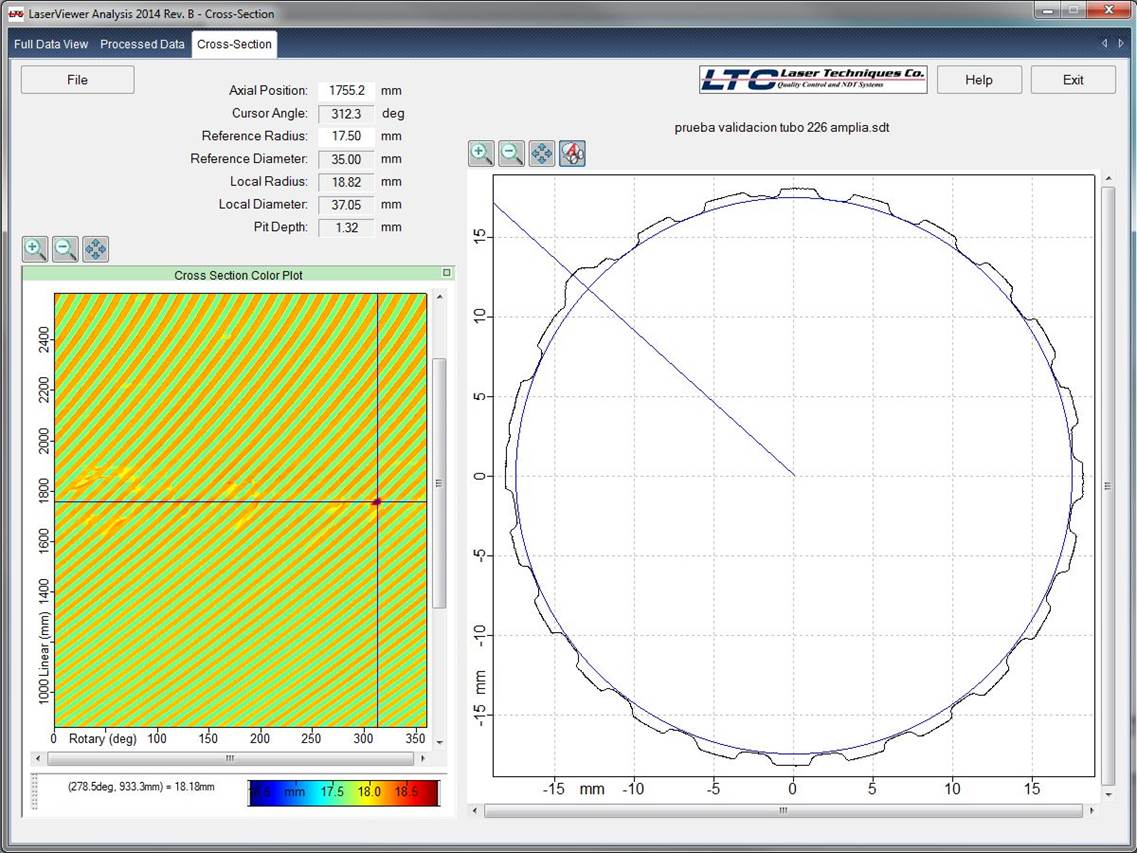
The new device is called the BEMIS-SC™ (for Barrel Inspection Machine Small Caliber). Operated by NTS Chesapeake Testing, BEMIS-SC performs non-destructive laser-based mapping of gun bores. The BEMIS-SC currently works with .22 caliber to .50 caliber (5.56 – 12.7 mm) barrels. The BEMIS captures thousands of highly accurate data points over the full length of a barrel. The inspection can be completed in mere minutes, with scan results displayed in graphical, tabular, and 3D visual formats. Here is a barrel cross-section, as scanned by the BEMIS-SC:
Click for Full-Screen Version
Until the 1980s, gun tube inspection had to be conducted by hand using a manual “star” gauge, a process that would take hours and provide minimal data. Electronic gauges were eventually developed along with the video bore scope, but these systems were still limited to very few, low-resolution data points. That has all changed with the BEMIS™, a huge leap forward in technology that is capable of rapidly capturing thousands of precise data points.
Chesapeake Testing commenced BEMIS-SC barrel inspection services in September 2014. Testing is performed in Chesapeake’s commercial barrel inspection laboratory, located in Belcamp, MD, minutes from the U.S. Army Aberdeen Proving Ground. While testing is currently limited to .22 to .50 caliber barrels, Chesapeake Testing will accommodate both smaller and larger calibers in the future.
“We have always focused on building our company around very unique technologies. BEMIS™ has changed the industry in regards to the inspection of weapon systems. We are excited to be an exclusive partner with LTC in this industry and look forward to contributing to the future of this technology,” says Jim Foulk, founder and president of Chesapeake Testing.
Remington is offering some attractive Rifle Rebates for the remainder of the year. Get $75 back on many of Remington’s most popular Model 700 rifles, or $50 on the Rem 700 SPS. This offer is good for Remington rifles purchased now through the end of 2019. To get your rebate, submit original Sales Receipt and Proof of Purchase Sticker with Rebate Form. There is also an Online Registration but receipts and proof of purchase must still be submitted by mail. For more information visit Remington.com/rebates-promotions.
2019 Remington Big Game Promotion — Offer #89342
This offer runs from 09/17/2019 until 12/31/2019. (End date is 01/10/2020 for California and Washington residents to accommodate ATF compliance checks.) Submissions must be postmarked by 01/31/2020. The following items must be submitted by mail qualify for this offer:
1. Completed Registration Form | CLICK HERE for Form (Scroll to Page 2)
2. Original sales receipt showing the eligible product(s) purchased.
3. Original UPC code showing the eligible product(s) purchased.
Mail the completed Registration Form with all applicable original cash register receipts and original proof of purchase sticker(s)/UPC(s) to:
PROMOTION #89342
REMINGTON BIG GAME PROMOTION 2019 – US
P.O. BOX 22177
TEMPE, AZ 85285-2177
Each Wednesday, the U.S. Army Marksmanship Unit publishes a reloading “how-to” article on the USAMU Facebook page. A recent “Handloading Hump Day” post covered preparation of once-fired 5.56x45mm brass. This article, the first in a 3-part series, has many useful tips. If you shoot a rifle chambered in .223 Rem or 5.56x45mm, this article is worth reading.
This week, Handloading Hump-Day will answer a special request from several competitive shooters who asked about procedures for morphing once-fired GI 5.56mm brass into accurate match brass for NRA High Power Rifle use. The USAMU has used virgin Lake City (LC) 5.56 brass to win National Championships and set National Records for many years. In this 3-part series, we’ll share techniques proven to wring match-winning accuracy from combat-grade brass.
GI brass has an excellent attribute, worth noting — it is virtually indestructible. Due to its NATO-spec hardness, the primer pockets last much longer than most commercial brass when using loads at appropriate pressures.
Preparing Once-Fired GI 5.56 Brass for Reloading (Part 1 of 3)
Assuming our readers will be getting brass once-fired as received from surplus dealers, the following steps can help process the low-cost raw material into reliably accurate components.
1. Clean the Brass
First, clean the brass of any dirt/mud/debris, if applicable. Depending on the brass’s condition, washing it in a soap solution followed by a thorough rinsing may help. [This step also extends the life of the tumbling media.] Approaches range from low-tech, using gallon jugs 1/2 full of water/dish soap plus brass and shaking vigorously, to more high-tech, expensive and time-consuming methods.
2. Wet-Tumbling Options (Be Sure to Dry the Brass)
When applying the final cleaning/polish, some use tumblers with liquid cleaning media and stainless steel pins for a brilliant shine inside and out, while others take the traditional vibratory tumbler/ground media approach. Degree of case shine is purely personal preference, but the key issue is simple cleanliness to avoid scratching ones’ dies.
If a liquid cleaner is used, be SURE to dry the cases thoroughly to preclude corrosion inside. One method is to dump the wet brass into an old pillow case, then tilt it left/right so the cases re-orient themselves while shifting from corner to corner. Several repetitions, pausing at each corner until water stops draining, will remove most water. They can then be left to air-dry on a towel, or can be dried in a warm (150° F-200° F max) oven for a few minutes to speed evaporation.
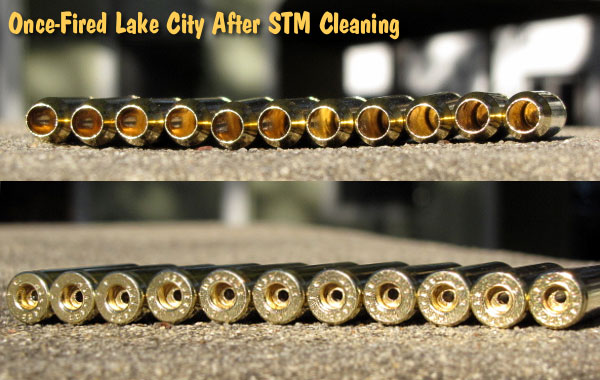
Shown below are Lake City cases after cleaning with Stainless Media (STM). Note: STM Case cleaning was done by a third party, not the USAMU, which does not endorse any particular cleaning method.
3. Inspect Every Case
Once dry, inspect each case for significant deformation (i.e., someone stepped on it), damaged mouths/necks and case head/rim damage. Some rifles’ ejectors actually dig small chunks of brass out of the case head — obviously, not ideal for precision shooting. Similarly, some extractors can bend the case rims so badly that distortion is visible when spinning them in one’s fingers. These can be used for plinking, but our match brass should have straight, undamaged rims.
Dented case mouths are common, and these can easily be rounded using a conical, tapered tool, [such as a .223 expander mandrel. A dummy 7.62 or .30-06 cartridge with a FMJ spitzer can also work.] If most of your brass is of one headstamp, this is a good time to cull out any odd cases.
4. Check the Primers Before Decapping
Your clean, dry and inspected brass is now ready for full-length sizing, decapping and re-priming. Historically, primer crimps on GI brass have caused some head-scratching (and vile language) among handloaders. Our next installment will detail efficient, easy and practical methods to remove primer crimp, plus other useful handloading tips. Until next week, Good Shooting!
NOTE: The USAMU Handloading (HL) Shop does not RE-load fired 5.56 brass. We use virgin LC brass with our chosen primer already staked in place. However, our staff has extensive personal experience reloading GI brass for competition, which will supplement the Shop’s customary steps. In handloading, as in life, there are many ways to accomplish any given task. Our suggestions are note presented as the “only way,” by any means. Time for loading/practicing is always at a premium. Readers who have more efficient, alternative methods that maintain top accuracy are invited to share them here.
Accuracy Potential of Mil-Surp 5.56×45 Brass
So, how accurate can previously-fired GI surplus brass be in a good National Match AR-15? Well, here’s a data point from many years ago that might be of interest. A High Power shooter who wrote for the late Precision Shooting magazine took a Bill Wylde-built AR match rifle to a registered Benchrest match. His first 5-round group ever fired in a BR match was officially measured at 0.231″ at 200 hundred yards. This was fired in front of witnesses, while using a moving target backer that confirmed all five rounds were fired.
He recounted that his ammo was loaded progressively with factory 52gr match bullets and a spherical powder using mixed years of LC brass with no special preparation whatsoever. Obviously, this was “exceptional”. However, he had no difficulty obtaining consistent 0.5-0.6 MOA accuracy at 200 yards using LC brass and a generic “practice” load that was not tuned to his rifle.
Saving Money by Using GI Brass
So, with good commercial brass readily available, why would one go to all the extra steps necessary to process fired GI brass? [Editor: It’s about saving money.]
Economically, it makes great sense. When the author was actively practicing and competing with the service rifle, he had ~3,000 rounds of 5.56mm brass, which allowed him to load during winter and spend most time in the summer practicing. If one were wealthy and wanted to shoot nothing but the finest imported brass, the current cost of 3,000 is ~$1920 (plus shipping.)
Dropping down to good, but less-expensive new, U.S. commercial brass brings the price to a much more realistic ~$720. However, at current rates, the same amount of surplus GI once-fired brass costs between $120 — $150, leaving lots of room in the budget for other expenses. [Editor: that’s less than 10% of the cost of the best imported brass.]


 A while back your Editor was in New Mexico, on a prairie dog expedition. While in the field, my companions and I used two pairs of


 Steiner 8×30 Military/Marine Binocs are Just $249.99


 The new device is called the BEMIS-SC™ (for Barrel Inspection Machine Small Caliber). Operated by