The 2017 Fort Benning Multi-Gun Challenge will be held November 16-19, 2017. This year there will be at least 12 stages, plus more than 40 guns on the prize table!
Rifle, pistol, shotgun. More guns = more fun. If you are curious about multi-gun matches, check out this video from Shooting USA. This episode covers the 3-Gun Match at Fort Benning, Georgia. This one-of-a-kind match is the only multi-gun competition where civilians can run-and-gun on an active U.S. Army installation. What’s more, at this match competitors get to ride in a Stryker armored vehicle and shoot Army weapons such as the M249 SAW and M203 Grenade launcher. The lure of playing with military hardware, along with the quality of the stages, makes this a hugely popular 3-Gun event which quickly sells out every year.
Interested in 3-Gun Shooting? Here’s an in-depth report on the Fort Benning Multi-Gun Challenge:
Getting Started in 3-Gun Competition
Thinking of getting started in 3-Gun competition? In this NSSF video, Top Shot Finalist Chris Cerino reviews the hardware you’ll need for multi-gun matches. Chris talks about carbine configurations — including barrel, handguard, and optics options. In reviewing shotguns, Chris discusses shotshell caddies and the high-capacity extended tubular magazines now available. Cerino also demonstrates pistol techniques and explains the key features of a belt/holster rig for 3-Gun competition.
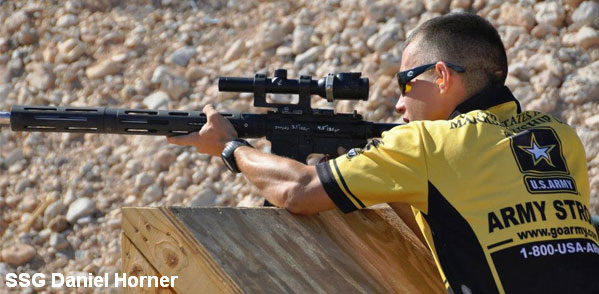
SSG Dan Horner of the USAMU, a past winner of the 3-Gun Nation Championship, is one of the country’s best multi-gun competitors. Here Horner offers some tips on 3-Gun hardware, and safety procedures:
Adapting to New Equipment
There’s a lot of hardware in 3-Gun Competition. To succeed you need mastery of ALL the tools: “New competitors should know how to operate all their equipment. They should spend time getting familiar with their equipment. I spend exponentially more time ensuring the gear is right than I do shooting.”
Safety in 3-Gun Competition
Everyone practicing with shotguns, rifles and pistols must keep safety as top priority. “Obviously, safety is the No. 1 priority, but after that, the focus should be on developing specific skills,” noted Horner. A good three-gunner must not only be fast, but he or she must also be accurate and be able to adapt to a wide variety of shooting positions. And strategy is involved too. Successful 3-gunners develop a ‘plan of attack’ for each stage.
Sig Sauer recently issued a safety recall for certain SIG 516, 716, and M400 model rifles with two-stage triggers. There was a production problem with the hammer that could create a “significant safety hazard”. If you own one of these SIG rifles, read this Safety Warning and Recall Notice. Sig Sauer will fix the particular rifles that have defective hammers at no cost to the customer. The replacement trigger will also be a two-stage match model.
SIG SAUER Safety Warning and Recall Notice
Published Date: 09/15/2017
SIG SAUER, Inc. has determined that a limited number of rifles in the SIG716 DMR®, SIG516® Carbon Fiber, and SIGM400® Predator models were built with a two-stage SIG SAUER trigger that may have an improperly heat-treated hammer. Over time this could result in a trigger malfunction creating a significant safety hazard. SIG SAUER is issuing a mandatory recall to replace the hammer and trigger assembly in these specific rifles. This recall does not affect any military or law enforcement rifles or any SIG MCX®/SIG MPX® products.
SIG SAUER will correct any of the affected firearms at no cost to the customer. The firearms affected by the recall can be identified by the presence of a SIG mark etched into the hammer:
To determine if a specific firearm is affected by the recall, go to:
If you are a customer who is affected by the recall, stop using the firearm immediately and follow the instructions on the website or call SIG SAUER Customer Service by dialing 603-610-3000, option #1. Have the rifle’s serial number available. If your rifle is affected you will be issued a pre-addressed shipping label and box.
Sig M400 Predator Product Features
Recall/Safety Tip from EdLongrange. We welcome reader submissions.
MagnetoSpeed’s technology has completely changed the market for firearms chronographs. With a MagnetoSpeed barrel-mounted chrono you can quickly and easily record muzzle velocity (MV) without having to set up tripods or walk down-range. The compact MagnetoSpeed chronos are easy to set up and transport. With the full-featured V3 model, everything you need comes in a small fitted case. In the top photo are the components used with the MagnetoSpeed V3 Kit:
1. V3 Bayonet sensor
2. Display and control unit
3. Bayonet spacers (plastic and rubber)
4. Cords and mounting hardware (left), suppressor heat shield (right)
5. Alignment rod (square cross-section)
6. Rail adapter (sold separately)
Our friend Gavin Gear of UltimateReloader.com recently reviewed the MagnetoSpeed V3 and came away impressed. Gavin explains the a good chrono is essential: “If you want to load and shoot precision ammunition, you need the tools that will produce and validate the precision of your loads. A good chronograph is one of those tools! In this post I’m going to introduce you to the MagnetoSpeed V3 chonograph, the high-end electromagnetic chronograph which fills out the top slot in MagnetoSpeed’s equipment portfolio.”
In this 11-minute video Gavin reviews MagnetoSpeed’s top-of-the-line V3 Chronograph. He shows what ships with the unit, how to set it up for both rifles and pistols, and then he puts it through its paces showing how it captures velocity data. Gavin says he will follow-up with future videos showing how to link the MagnetoSpeed V3 to your mobile phone and how to log velocity data for future reference. To learn more about this high-tech chrono, visit UltimateReloader.com.
National Hunting and Fishing Day (NHF Day) takes place on Saturday, September 23, 2017. The annual celebration serves as a reminder that conservation succeeds because of leadership and funding from hunters, shooters and anglers. National, regional, state and local organizations will run thousands of “open house” hunting- and fishing-related events around the country. Events will include Fishing Derbys, Hunting Expos, Wing-shooting tournaments, and much more. Over four million Americans will participate.
Take the Pledge to take someone hunting or fishing on or before September 23, and you can enter a sweepstakes with valuable prizes. ENTER Contest HERE.
Find Events in Your State
For info on NHF Day, visit www.nhfday.org. To find NHF Day events in your state, click links below:
Hunters Aid Conservation Efforts
The contributions of hunters, in the form of excise taxes paid on firearms, ammunition, and archery equipment, benefit every state. These taxes have generated approximately $5.6 billion for wildlife conservation since 1939.
The Visalia Sportsman’s Association Dale Wimp Shooting Range — a great place to shoot.
Report by Boyd Allen | Photos and video by Pete Kitrinos
The IBS is in the West! The first International Benchrest Shooters (IBS) match at the Visalia, CA range was held over the recent Labor Day Weekend. Despite scorching 106° heat, many of the West’s top short-range benchrest shooters assembled for the first IBS-sanctioned match (after a 30-year history with the NBRSA) at the Visalia range. The mix of shooters included at least one Benchrest Hall of Fame member, as well as NBRSA record holders. Competitors were happy to return to Visalia, which had been closed for seven months while range improvements were made (some parts of the East berm were still under construction). With only two ranges in the entire state holding short range group matches, the temporary loss of Visalia had a significant impact. It was time to get back to business — the business of shooting tiny groups.
This video includes Aerial Drone footage of the range — worth watching!
Surrounded by fields, the Visalia Range is located in California’s Central Valley, a rich agricultural area.
For about thirty years the California 3-Gun Benchrest Championship match has been held at the Visalia Sportsman’s Association Dale Wimp Range over Labor Day weekend. For all those years, the matches have been put on by local shooter and current club president Dennis Thornbury. During a good part of that time, he has also managed to keep his name in the NBRSA record book, and pick up four Benchrest Hall of Fame points, as well as having recently done a tour as NBRSA president. This year’s match is sanctioned by the IBS, a first at Visalia.
Don “The Pumpkin” Nielson used an action he fabricated, a “fat bolt” aluminum 3-lug with steel insert.
Dennis Thornbury has been putting on registered matches at the Visalia range for 30 years. He holds an NBRSA record, and has 4 Hall of Fame points.
The format: On Saturday competitors shot 100 yards all day, Sporter in the morning, Light Varmint in the afternoon. The following day the morning competition was Heavy Varmint at 100 and at lunch the targets were moved to 200 yards with Heavy Varmint being shot that afternoon. On Monday, Labor Day, at 200 yards, Light Varmint was shot in the morning and Sporter in the afternoon. All three days consisted of five, 5-shot matches in the morning and five more in the afternoon.
Morning, Day 1 — Very few “daisy wheels”. This has been the trend for many years at this range.
Getting down to business. Shown, from right to left: Henry Pinkney, Joe Stanovich, Steve Epstein, Keith Cottrell (face obscured), Jim Nicolas (standing).
Sunday Top Shots: Jack Childers, Keith Cottrell, John Pierce, Lester Bruno, Dennis Thornbury, and Don Nielson. (Yes that’s a corn field in the background):
With the big temp changes between morning and afternoon, competitors were chasing powder loads all weekend. Small groups were hard to find, so only three “screamers” were recorded all weekend, and no teen Aggs. With the oppressive heat, attrition was also a factor: “We started with 30 shooters, and ended with just 21 competitors”.
Temperatures were in the triple digits for Saturday and Sunday, backing off to the high 90s on Monday. High humidity made it feel even hotter — heat stress was a definite issue. Even the rifles seemed to be at less than their best, causing very light wind conditions to produce Aggregates that were larger than the observed wind conditions would lead one to expect. Wind was generally light and switchy. Lighter mornings with wind increasing slightly through the days. Sunday saw more wind than the other two days after ten o’clock or so.
Loading benches with the usual clutter. Note the LabRadar chronograph on a bench at the firing line. Lawrence Weisdorn tracked his velocities during the match to know when a powder charge adjustment was needed.
Top Shooters: The Top Five in the 3-Gun (HV, LV, and Sporter) Championship were: Keith Cottrell (.2534), John Pierce (.2695), Dennis Thornbury (.2714), Art Kawai (.2885), and Rich Shaw (.3016). Winners of the Class Grand Aggs were Dennis Thornbury (HV .2424), Lester Bruno (LV .2400), and Keith Cottrell (Sporter .2395). CLICK HERE for full Match Results.
Equipment List for Top Five Shooters
You can use a LabRadar during competition. This was Lawrence Weisdorn’s set-up at Visalia.
Benchrest Technique — How to Shoot at Visalia
This range is built a bit like a large bathtub, dug into a flat field with the excavated earth thrown up in steep berms on three sides. This configuration and the usual lack of strong winds creates a lot of thermal-generated switchiness with flags changing direction often and very little agreement within any shooter’s set. This places a high premium on visual memory and the ability to judge equivalent conditions, because duplicates are almost never seen. Although the opportunity to run groups can happen, this is mostly a “pickers” range, which places a high premium on visual memory.
Facilities at Visalia Sportsman’s Association Range
There are 28 monolithic, steel-reinforced, concrete benches (poured in place, base and top all one pour). The reloading area is behind the benches with most of it on the same level as the benches. There are permanent (fixed position) tables that have laminate tops, except for where the range house sits, mid-range, with a “wailing wall” along its east and north sides. The direction of fire is north. The benches are under a slightly pitched metal roof that has recently been extended so that it has a good amount of overhang in front of the benches. Electricity is available in the reloading area and there are a few electrical outlets in the parking lot for RVs. There are both steps and a wheelchair ramp connecting parking lot to the reloading level and the shooting level.
Field of (Benchrest) Dreams — Precision Shooting Among the California Corn Fields.
Fit, capable, self-assured young women hunting in the Texas backcountry. What’s not to like? This is what’s offered by Extreme Huntress, a TV series that pits six lady competitors in a season-long shooting and hunting competition. It’s like a ladies-only version of Top Shot, but with a focus on hunting skills. Twenty-Six six-minute episodes are now available online at GetZone.com. Each episode features a game hunt, skills event, or competitor profile.
Twenty-Six short episode are available online right now on GetZone.com:
The 9th season of Extreme Huntress (2018) premiered on GetZone.com on September 15, 2017. A ton of 2018 content is online now — 26 six-minute episodes. This interactive, online competition series showcases female shooters and huntresses who compete head-to-head in hunting and skills challenges. According to its producers: “Extreme Huntress™ is about preserving our outdoor heritage and creating positive role models for women in the shooting and hunting sports.”
Held at YO Ranch Headquarters in Texas, the Extreme Huntress Competition takes nine months for the contestants to complete. Viewers can vote for their favorite competitor at www.ExtremeHuntress.com. The winner of the 2017 Extreme Huntress Competition is announced at the Dallas Safari Club.
Check out that bolt assembly. It features a fluted stainless bolt body, laser-engraved Titanium shroud, and Titanium dragon-scale bolt knob with polished stainless handle.
You haven’t seen a Ruger Precision Rifle (RPR) like this before. Forum member TerryH has customized his Second-Gen 6.5 Creedmoor RPR with a wicked purple finish, snazzy stainless/titanium bolt, and slick HDPE (polymer) bag-riders front and rear. The mods on this Hot Rod Ruger don’t stop there. Terry added a Seekins hand rail, Timney trigger, ergonomic grip, and more…
For his Hot Rod Ruger, Terry has the right skill set, learned on the job: “I work in a body shop and have pretty much custom-painted all my stuff for many years. For this 6.5 CM RPR, colors of choice are House of Kolor PBC-65 Passion Purple and black covered with Cerakote MC-161 matte clear.” Terry even painted his Bald Eagle rest purple to match his Hot Rod RPR.
Terry reports: “I’m shooting an RPR in 6.5 CM. It has a Patriot Valley Arms 26″ barrel. Josh at PVA is making a thread protector for me so I can remove the Mad Scientist brake. The butt stock has a V-Tab adjustable butt plate and Wiebad check rest pad. Glass is a currently a Vortex Gen I PST 6-24x50mm but I have a Golden Eagle on layaway”. To learn more about this rifle or ask TerryH questions about the build, visit this Shooters’ FORUM THREAD.
Ruger Precision Rifle Modifications: Chassis and Hanguards Painted Passion Purple
Patriot Valley Arms 26″ Barrel with Brake
Timney Trigger with Ambi Safety
Custom HDPE (Polymer) Bag-Riders front and Rear
V-Tab adjustable butt plate and Wiebad cheek-pad
Seekins Rail
Good Accuracy with Factory Ammunition
Terry reports: “The RPR is shooting .3 MOA @ 100 with factory Fed American Eagle 140s.” Terry plans to start handloading for the rifle with the goal of shooting F-Class matches next year: “I’ve successfully shot steel out to 1140 yards on the range but [I don’t know] if that will actually translate well in a match. I’m committed to practicing as much as I can and starting to shoot some matches in 2018.”
Front and Rear Bag-Riders with Protektor Rear Bag and Upgraded Bald Eagle Rest
Terry has engineered a slick set-up for F-Open competition and load testing. Up front is a Bald Eagle rest upgraded with windage knob mod, stainless F-Class feet, and longer adjusters. Terry also “changed the hardware to all stainless and added a couple of levels”. In the rear, Terry runs a Protektor Doctor rear bag with 1″ ear spacing.
The really impressive additions are custom HDPE bag-riders Terry crafted himself: “I realized that the butt stock wasn’t going to cut it on the rear bag and even though I got the 2 1/4″ front bag and the Seekins rail is 2″ wide and flat that it wasn’t as stable or smooth as I’d like.” So Terry made his own front and rear bag-riders from HDPE, a material similar to Delrin. Currently the front unit is 2.25″ wide, but Terry will be changing that to a 3″-wide front sled: “I decided that I’d get a 3″-wide front bag and mill a new front bag-rider. I’m going to recess the center to fit around the hand guard and I’ll mill a recess on the bottom of that one.”
Shown below is the Hot Rod Ruger before Terry added the HPDE Bag-Riders front and rear. Terry says the rifle now handles much better with the bag riders, and he plans to upsize the front sled to 3″ width.
Bling’s the Thing. Below is the Hot Rod Ruger’s bolt assembly. It features a custom flat-fluted bolt shaft, laser-engraved Titanium shroud and Titanium dragon-scale knob with polished stainless handle. Terry confesses: “I simply can’t resist anything shiny!”
Proper eye protection is ‘must-have’ gear for shooting sports. In addition to providing reliable impact protection, good shooting glasses should be comfortable, fog-free, and not interfere with your preferred hearing protection. Those who require corrective lenses also need to consider the various options available. In a past episode of their Weekly Gear Review, the 6.5 Guys discuss a variety of shooting glasses they have tried, including examples from DeCot, Oakley, and Wiley-X. Ed and Steve outline the key considerations when choosing eye protection, and then review practical aspects of eyewear design and construction that enhance comfort and functionality in the field.
The 6.5 Guys (Ed and Steve) offer a number of smart tips consider safety eyewear, helping you select the most effective safety glasses at an affordable price. Here are the 6.5 Guys’ KEY Take-aways when choosing shooting glasses, including prescription eyewear:
Key Things To Consider When Choosing Eye Protection
1. Avoid polarized lenses or lenses that reduce light transmission significantly (except for action shooting in very bright conditions with large, close targets).
2. Avoid frame designs that interfere with prone shooting.
3. Avoid designs that easily fog.
4. Avoid frame designs with thicker temples that are uncomfortable to wear underneath hearing protection.
5. Select lenses with an appropriate degree of ballistic protection. CLICK HERE to learn more about eyewear safety standards.
6. When you get your prescription, be sure your ophthalmologist includes the interpupillary distance. This is a critical measurement particularly for heavier prescriptions.
7. If you have a complicated prescription select a vendor who will actually spend time with you to address any concerns.
Safety First — Your Eyes Are Irreplaceable Accurate shooting begins and ends with the human eye. Your career as a marksman could be cut short if you don’t use good eye protection every time you go to the range and/or handle a firearm.
Every year, 1,000,000 people suffer serious eye injuries. Shooting is hazardous; it is estimated that there are 30,000 firearms-related eye injuries each year (if you include paintball sports.) After paintball, general hunting accidents comprise most firearms-related eye injuries.
Quality eye protection need not be expensive. You can find comfortable, ANSI Z87.1-certified shooting glasses for under $10.00.
If you select shooting glasses carefully, and ensure that your eyewear is safety-certified, inexpensive shooting glasses can perform very well. But you need to avoid cheap, soft-plastic lenses that claim “impact resistance” without satisfying a testing standard.
There a number of good rebate programs going on right now, but many of them conclude at the end of October. To take advantage of these deals you’ll need to start your shopping. Here’s are some current Rebate Programs for ammunition, loading equipment, and shooting accessories.
Bet you’ve never seen anything like this before — a “double-decker” indoor shooting range. Lotus Gunworks of Jensen Beach, Florida, operates a super-sized twin-lvel indoor shooting range featuring a two-story-high steel funnel bullet trap. Nicknamed the Lotus 8/11 for the number of steel panels used to create it (eight panels on the bottom slope and 11 panels on the top slope), this version of Action Target’s Total Containment Trap is the first of its kind. “No one has ever seen a range like this before” noted Lotus Gunworks’ Robbie Abell.
Abell came up with the two-story concept when it became clear that the new Lotus building in Jensen Beach was not wide enough for two side-by-side ranges AND a gun store. Necessity was the mother of invention… Lotus wanted at least two ranges, so the only option was to make a double-decker range where both levels shot into the same bullet trap.
Indoor ranges require ventilation to remove potentially hazardous dust and lead particles. The sheer size of the double-decker range presented a unique challenge, but Carey’s Small Arms Range Ventilation installed a system that can completely replace all the range air every 80 seconds.
Other Multi-Level Shooting Ranges
While the Lotus Range may have the first two-story bullet trap, it’s not really the first-ever double-decker indoor shooting range. Other multi-level ranges exist, they just don’t have the giant bullet trap. In fact, some of the multi-level ranges in Europe are bigger and even more sophisticated.
Brünig Indoor facility — Multi-Level Range Underground
Switzerland boats a popular shooting facility built completely underground. The large, deluxe Brünig Indoor facility includes a 300m underground range with multi-level shooting stations.
This video shows centerfire rifle practice on the upper level of one of Brünig Indoor’s shooting tunnels:
Dutch Double-Decker Range
Here’s a Dutch Double-Decker Range. Check out Schietsportvereniging (SSV) Katwijk, a great twin-level range in Holland featuring electronic targets with displays at each shooting station (on both levels):






 Accurate shooting begins and ends with the human eye. Your career as a marksman could be cut short if you don’t use good eye protection every time you go to the range and/or handle a firearm.