How do you trim your cases? We use a variety of tools, including power case trimmers. But our go-to trimmer for Benchrest-type cartridges is the L.E. Wilson Trimmer unit, now available in a handsome and durable stainless assembly. This thing is slick. It trims very precisely with the use of Wilson case holders combined with a micrometer-type stop for length control. As sold complete with micrometer, quick clamp, and metal stand, this new Wilson Stainless Trimmer is $139.95 at Creedmoor Sports. We think that’s a fair price for a unit that can last a lifetime, trimming many thousands of cases.
In this video, Bill Gravatt demonstrates the new Stainless Wilson trimmer. Gravatt offers some smart tips so this video is worth watching even if you’ve used a Wilson trimmer before:
Tips for Trimming with Wilson SS Micrometer Trimmer:
1. After inserting brass in the case holder, tap the case lightly to ensure it seats fully.
2. When starting your case-trimming session, do one or two test cases to check cut length. Adjust length with micrometer, then test length again. If “good to go”, set length stop. NOTE: Release the Stop Screw to make major adjustments. Use the Micrometer to make fine adjustments, in .001″ increments.
3. After trimming operations, be sure to chamfer case mouth after cutting to remove burrs. NOTE: After you have made the chamfer, we recommend gently spinning the chamfer tool backwards a couple times in the case neck. This will burnish/smooth the newly-cut champing, which helps with bullet seating.
Features of Deluxe Wilson Stainless Case Trimmer with Micrometer
— Long lasting Stainless finish with Micrometer adjustment.
— New 304 Stainless Steel Handle included with Micrometer Trimmer.
— Rotary-style clamp swings to secure case-holder — quick and easy.
— Larger stop screw adjustment from 3/8″ (old) to 1/2″ (new) with increased width on stop nut. Coated with black oxide for a long lasting durable finish.
— Made in the USA with American Steel.
— Power Adaptor compatible.
How’d you like to score a check for $25,000? That’s the winner’s pay-out for the 2017 NRA World Shooting Championship (WSC), which runs September 14-16 at the Peacemaker National Training Center in Glengary, WV. This event offers over $250,000 in cash awards and product prizes, making the WSC the richest combined shooting event in the USA (if not the world).
WSC Highlight Video with Competitor Interviews:
You can still Register for the WSC — though remaining spots are filling up fast. It ain’t cheap — Pros pay $395 while amateurs and juniors pay $325. Keep in mind though that all guns and AMMO are supplied. This unique 3-day multi-gun match tests competitors’ skills across twelve challenging stages involving nearly every major shooting discipline for rifles, shotguns, and pistols. REGISTER HERE.
All the Equipment is Supplied
“What makes this event very unique, especially to a professional shooter, is all the equipment is supplied. You have to leave your ego at home and just try to adapt as best you can to the equipment that you have supplied.” — Jerry Miculek
This major match attracts both sponsored Pros and “regular Joes”. For 2017, shooters will be split into two groups: a Professional Division for sponsored shooters, and the Amateur Division for non-sponsored competitors. All firearms, optics, and ammo will be provided by match sponsors for both divisions. “This year the NRA is going back to basics and returning the match to the original format of two divisions for professionals and amateurs, putting everyone on an even playing field”, said Cole McCulloch, NRA Competitive Shooting Director.
Video Shows 2014 World Shooting Champion SFC Daniel Horner in 3-Gun Stage
Cash Awards, Huge Prize Table, and New Random Drawings
The NRA World Shooting Championship will offer $250,000 in cash and prizes. Along with the $25,000 winner’s pay-out, there will be fat cash prizes for second and third place overall, High Lady, and High Amateur Junior. Then there are the prize tables — a real treasure trove. The designated Amateur prize table by itself will offer products and certificates topping $100,000 in value.
NEW Random Drawings — The WSC has added a new type of prize for 2017. Ten (10) Random Draw Prize Winners of $400 will be chosen during the WSC Awards Banquet. These random drawings give every competitor a chance to win cash, no matter what their event ranking.
Match entry fees are $395 for Professionals, $325 for Amateurs and Juniors. All firearms and ammunition are provided, and entry fees include one awards banquet ticket. For more information, visit WSC.NRA.org, call the WSC Coordinator at 703-267-1479, or email NRAhighpower@nrahq.org. On the official WSC.NRA.org you’ll find descriptions fo the 12 WSC stages. In addition, there is information about Peacemaker National Training Center and nearby lodging options.
How to Win the World Shooting Championship
“The format at the NRA World Shooting Championship is unique in that you don’t know what you have to shoot until you show up, so training for the event is a little difficult. My advice is to pack some good eye and ear protection, bring an open mind, be prepared to listen to the stage descriptions, figure out the best way you can take the guns they provide, and post the best score you can. When the match supplies all the guns and ammo, all you have to do is deal with ‘the performance’. This is the most level playing field in the shooting sports — anyone from around the world can come and play.” — Bruce Piatt, 2015 NRA World Shooting Champion
Competitors can register in one of two divisions: professional and amateur. The pro division is reserved for shooters who possess sponsorships, receive financial support for their competitive shooting or those who have been part of specialized firearms teams. All other shooters register in the amateur division. The playing field is completely level — every competitor uses the same guns, optics and ammunition. No competitors are allowed to bring their own gear, so everyone starts the match on equal footing.
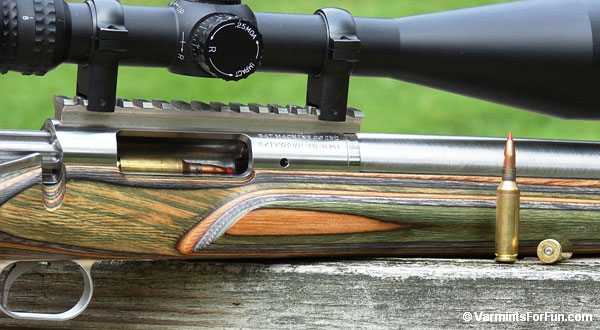
A while back, John Seibel, creator of the Varmints for Fun website, put together a 6-6.5×47 Varminter with a Lilja 10-twist barrel and BAT RBRP three-lug action. Richard Franklin smithed the gun using a Model 10 Varminter stock, one of Richard’s own stock designs.
Varmint Loads with 75gr and 87gr V-Maxs
Our Forum readers have asked for recommended 6-6.5×47 Lapua loads for the lighter bullets. Well, John has some useful load data that should provide excellent starting points for 75gr and 87gr projectiles. John writes: “The 75s and 87s will be my main groundpig/varmint rounds. I have worked up loads for all of them but I need to work on the 95s to fine tune them for the egg shoot. I used CCI 450 primers for all loads. They have shown to reduce ES greatly. This case has a small primer pocket and I reasoned with the slower burning powders I wanted to get my velocity as high as possible. I had plenty of H414 and N550 … so that’s what I tried. Velocities and case fullness seemed to be pretty dang good.”
John favored Vihtavuori N550 for the 75 V-Max, while H414 was his powder of choice for the 87gr V-Max. John found these two powders offered near 100% fill density. There are other good powder choices for these bullets. For pure accuracy, you may want to try the 80gr Berger Varmint bullet — it has shot superbly in our 6BRs.
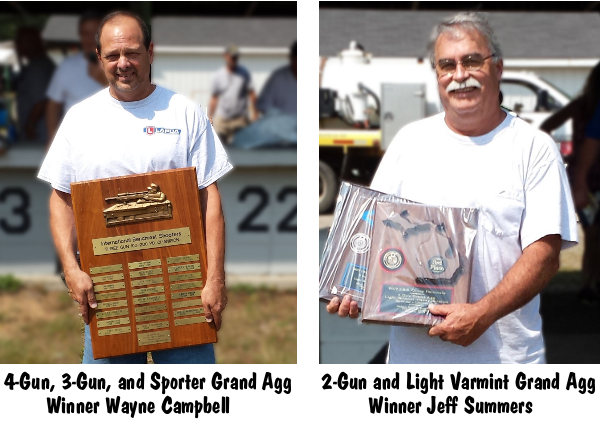
The IBS Groups Nationals has a 4-man team competition based on the HV Grand Aggregate results. The 2017 winning team was a “Murderer’s Row” consisting of Wayne Campbell, Billy Stevens, Bart Sauter, and Larry Costa. Each boasts Hall of Fame and/or multiple World Team accomplishments. Hamming it up in the background is HOF shooter Jack Neary.
2017 IBS Group Benchrest National Championships
Holton Gun & Bow Club, Holton, Michigan
August 14-19, 2017
Report by Jeff Stover, IBS President
This year the 2017 IBS Group Benchrest Championship was held at the Holton Gun & Bow Club, in Holton, Michigan. This is a pretty facility boasting an impressive firing line with forty (40) concrete benches. Monday morning in western Michigan saw the Heavy Bench (HB) shooters hauling their big railguns to the line. Hall of Fame and multiple World Team shooter Wayne Campbell shot a nice .1858 aggregate for five 10-shot groups. The only other “Teen Agg” was Iowa’s Dave Coots with a .1978. Wayne’s win foretold what was to come the rest of the week.
Wayne Campbell and Jeff Summers Put on a Show
On Tuesday, the bag guns came out for Light Varmint (LV) and Sporter (SP). Mr. Campbell maintained his mojo, shooting yet another “Teen Agg”. Wayne’s .1788 edged fellow HOF member Larry Costa’s .1854. The Light Varmint 100 was also contested on Tuesday. Peter Smith shot a very fine .1658 to beat out Canadian Bill Mitchell at .1960.
Wednesday was reserved for Heavy Varmint (HV) at 100 yards. Holton is Bob Scarbrough’s home range, but he can shoot “lights out” anywhere. Nevertheless, his .1518 had to be satisfying. Wayne Campbell, still on fire, laid down a .1694. In third place, Tennessean Jeff Summers posted a .1800. Mr. Summers is always near the top of any benchrest leader board. He is coming off another Super Shoot win. Most of the time Jeff does not win the small group of the day, but he wins many Aggregates. He is one of the most mistake-free shooters in the game.
File photo courtesy Holton Gun & Bow Club
Benchrest for Group Basics — Four Classes at Nationals
IBS group competition is contested at 100 and 200 yards. At the National Championships, it takes thirty targets of five shots each and ten targets of 10-shot groups to win a “4 Gun Nationals”. That includes four (4) gun classes: Light Varmint, Heavy Varmint, Sporter, and Unlimited. For all practical purposes, the first three are known as “bag guns” while the heavy bench rifles are “railguns”.
In fact, most competitors shooting a bag gun opt for a single rifle, which has been benchrest standard for decades: a 10.5-lb rifle chambered in 6PPC. This can compete in three classes: Sporter, Light Varmint, and Heavy Varmint. The fourth class shot at the Nationals is Unlimited (aka Heavy Benchrest or “HB”). This class features the big, heavy railguns — the most sophisticated Benchrest rigs of all which shoot 10-shot groups at 100 and 200 yards.
For the IBS Nationals, group-shooting competition features 100-yard targets for the first three days followed by three days at 200 yards. Six days total. It is done this way to require only one change of wind flags. Nationals competition requires “full rotation”. That means that every time a shooter goes to the line for the next match target, he or she must move a requisite number of benches to the right. At the end of the day a shooter will shoot across the full width of the line. Some ranges offer unique properties that render some parts of the range harder or easier to shoot small groups. Bench rotation is important to even out those factors.
Thursday was set for 200 yards. Starting off was Heavy Bench (HB), the big railguns. Upper Midwest shooter, Mark Buettgen shot steadily for a .2406 Agg, aided by a small .378. His largest group was a .527. Consistency wins bench matches. Lee Hachigian drove in from the Detroit area with his railgun to be next to the winner with a .2608.
On Friday, two Aggs were shot, Light Varmint and Sporter. Larry Costa nearly nicked a Teen Agg to win LV 200 with a .2027. Lurking high in the standings once again was Jeff Summers and his .2352. Wayne Campbell was not asleep. He was merely third at .2480. The Sporter competition was won by the best benchrest shooter of all time, Tony Boyer. Tony shot a .2287 to edge Billy Stevens. Mr. Boyer added another Hall of Fame point. His 170 points are 120 more than the next shooter (Lester Bruno, no slouch!) in the ranking.
Benchrest legend Tony Boyer added another Hall of Fame point to his amazing total. (File photo from 2016 IBS Group Nationals in Weikert, PA)
The HV guns came out to contest 200 yards on the last day of the Nationals. Jeff Summers worked a .1868 to the winner’s circle. The always tough Larry Costa was close at .1929.
At the IBS Group Nationals, shooters compete for Grand Aggregate (100+200) honors in four classes: LV, HV, Sporter, and HB. In addition, there are multi-gun titles: 2-Gun (all HV and LV targets in 100 & 200); 3-gun (all HV, LV, SP in 100 & 200), and 4-gun (all HV, LV, SP and Heavy Benchrest in 100 & 200).
The Grand Aggregate (100+200) winners were:
Heavy Varmint: Bob Scarbrough, Jr. (.1824)
Light Varmint: Jeff Summers (.2313)
Sporter: Wayne Campbell (.2119)
Heavy Bench: Lee Hachigian (.2374)
In the prestigious multi-gun competition, Jeff Summers won the 2-Gun. Wayne Campbell added more HOF points by winning BOTH the 3-Gun AND the 4-Gun. With his impressive 3-Gun and 4-Gun victories, the talented Mr. Campbell claimed the title of Top Overall shooter after six days of trigger-pulling.
2017 IBS Nationals Powderpuff Exhibition Shoot
For decades, IBS hosts an exhibition shoot on the afternoon of a day when only one Aggregate is contested instead of two. It is called the Powderpuff and is intended to allow family members and others who do not shoot competitively to give benchrest shooting a try. Each shooter is assisted by a coach who instructs the shooter. World-class shooters such as Billy Stevens and Bob Scarbrough give their time and talents to assist the novice competitors. There is no time limit to rattle the inexperienced shooters.
File Photo from previous Powderpuff Event at 2015 IBS Group Nationals
The competition is financially supported by the IBS President’s Fund. This year, at Holton in Michigan, we had four youth and 11 adult competitors. Chris Jeffers won the adult category with a nice .204″ group, while Jake Henderson put his five shots into a .244″ to win the youth division. Congratulations to all the Powderpuff competitors — we hope this inspires them to get more involved in Benchrest shooting.
To get the best accuracy out of any benchrest rifle, you need to find the optimal position of front rest and rear bag. The important point to remember is that each rig is different. One gun may perform best with the front rest right at the tip of the forearm (Position ‘D’ in photo), while another gun will work best with the rest positioned much further back. This Editor’s own 6BR sits in a laminated stock that is pretty flexy in the front. It shoots best with the front rest’s sandbag located a good 6″ back from the forearm tip (position ‘A’).
Here’s some benchrest advice that can help you reduce vertical and shoot tighter groups… without spending another penny. Many benchrest shooters spend a fortune on equipment and devote countless hours to meticulous handloading, but they never experiment with their rifle’s position/balance on the bags. This article explains why you should test your rifle in various positions. What you learn may surprise you (and improve your scores).
Next time you go to the range, experiment with the position of your rifle on the front rest, and try a couple different positions for the rear bag. You may find that the rifle handles much better after you’ve made a small change in the placement of your gun on the bags. Recoil can be tamed a bit, and tracking can improve significantly, if you optimize the front rest and rear bag positioning.
This competitor has the front rest positioned fairly far forward but not all the way out. Note the stop on the front rest — this limits forward stock travel.
Balance Your Gun BEFORE You Spend Hours Tuning Loads
In the pursuit of ultimate accuracy, shooters may spend countless hours on brass prep, bullet selection, and load tuning. Yet the same shooters may pay little attention to how their gun is set-up on the bags. When you have acquired a new rifle, you should do some basic experimentation to find the optimal position for the forearm on the front rest, and the best position for the rear bag. Small changes can make a big difference.
Joel Kendrick, past IBS 600-yard Shooter of the Year, has observed that by adjusting forearm position on the front rest, he can tune out vertical. He has one carbon-fiber-reinforced stock that is extremely rigid. When it was placed with the front rest right under the very tip of the forearm, the gun tended to hop, creating vertical. By sliding the whole gun forward (with more forearm overhang ahead of the front sandbag), he was able to get the whole rig to settle down. That resulted in less vertical dispersion, and the gun tracked much better.
Fore/aft stock position is important even with very wide fore-ends.
Likewise, the placement of the rear bag is very important. Many shooters, by default, will simply place the rear bag the same distance from the front rest with all their guns. In fact, different stocks and different calibers will NOT behave the same. By moving the rear bag forward and aft, you can adjust the rifle’s overall balance and this can improve the tracking significantly. One of our shooters had a Savage 6BR F-Class rifle. By default he had his rear bag set almost all the way at the end of the buttstock. When he slid the rear bag a couple inches forward the gun tracked much better. He immediately noticed that the gun returned to point of aim better (crosshairs would stay on target from shot to shot), AND the gun torqued (twisted) less. The difference was quite noticeable.
A small change in the position of the forearm on the front rest, or in the placement of the rear bag, can make a big difference in how your gun performs. You should experiment with the forearm placement, trying different positions on the front rest. Likewise, you can move the rear bag back and forth a few inches. Once you establish the optimal positions of front rest and rear bag, you should find that your gun tracks better and returns to battery more reliably. You may then discover that the gun shoots smaller groups, with less vertical dispersion. And all these benefits are possible without purchasing any expensive new gear.
Hunting season is coming up soon. To help hunters get outfitted with the proper hunting gear and clothing, MidwayUSA is running some big promotions. First, a wide variety of hunting clothing is now priced up to 50% off. Then on Tuesday, September 5, 2017, MidwayUSA conducts its Camo Tuesday One-Day Sale. Pitched as the “Hunters’ Black Friday”, Camo Tuesday will be a major, one-day Sales Event with huge discounts, starting at 12:01 AM on 9/5/2017. There is also a Camo Tuesday Contest with big product give-aways.
Editor’s Comment: Young people are the future of the shooting sports. If we don’t get young boys and girls involved in target/recreational shooting, the shooting sports will decline dramatically as our population ages. That can eventually lead to range closures, gun/accessory makers going out of business, and our heritage as a nation being lost. Therefore it is in the interest of every shooter to encourage young people to enjoy the shooting sports. Here are some of the best programs dedicated to getting the next generation of shooters started.
Article based on report in NRABlog.com.
Want to get young people involved in the shooting sports? Through organized training programs youngsters learn safe firearms handling, improve marksmanship skills, and meet other kids with similar interests. They also learn important life skills such as teamwork and goal attainment. There are several youth marksmanship programs available. All these programs let you share your joy of shooting with the younger generation. Remember today’s juniors are the future of our sport.
NRA National Junior Shooting Camps
File photo from NRA Smallbore Rifle Championship
The NRA’s National Junior Shooting Camps provide high-quality training opportunities in rifle, pistol and shotgun disciplines. Instruction is directed by highly qualified, top-level coaches. NRA offers camps for advanced and intermediate juniors. There are also Junior Olympic Shooting Camps, hosted by USA Shooting and supported by the NRA and the Civilian Marksmanship Program.
National 4-H Shooting Sports
The National 4-H Shooting Sports Program was created to teach marksmanship, the safe and responsible use of firearms, the principles of hunting and archery, and much more. State level 4-H clubs offer programs for individual training as well as team competitive shooting. There is also a National 4-H Shooting Sports Championship each summer which hosts Shotgun, Air Rifle, Air Pistol, Smallbore Rifle, Smallbore Pistol, Compound Archery, Recurve Archery, Muzzleloading Rifle and Hunting Skills events.
Boy Scouts of America
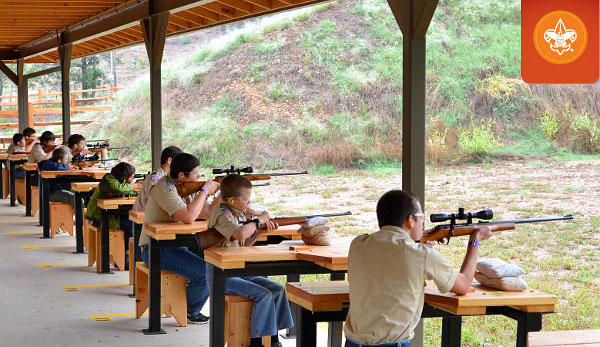
The Boy Scouts of America (BSA) offers several marksmanship opportunities for new and intermediate shooters. Programs provide training for marksmanship badges and there are a variety of other competitive and recreational programs. Check with your local Boy Scout organization to learn about the range offerings for scouts in your region.
American Legion Junior Program
Thousands of male and female junior shooters have participated in the American Legion Junior Shooting Sports Program, which has a perfect safety record. The Junior Program includes a Basic Marksmanship Course, Qualification Awards and Air Rifle Competition. To learn more, visit www.legion.org/shooting.
Youth Hunter Education Challenge (YHEC)
The NRA’s Youth Hunter Education Challenge (YHEC) program helps kids 18 and under to learn hunting, marksmanship, and safety skills. From rifle, bow, and muzzleloader shooting, to wildlife identification, map & compass orienteering and more, YHEC participants get hands-on training in eight skill areas. This is a great program for parents and kids who want to go on family hunts together.
Winchester/NRA Marksmanship Qualification Program
From a young shooter’s first BB gun to sophisticated air rifles, shotguns, muzzleloaders, pistols, and rifles, the year-round Winchester/NRA Marksmanship Qualification Program offers a pathway to excellence for young shooters. Qualification shooting provides incentive awards for developing and improving marksmanship skills. Progression is self-paced and scores are challenging but attainable. Performance is measured against established par scores and any shooter who meets or exceeds those scores is entitled recognition awards for that rating.
Brownells / NRA Day
Brownells / NRA Day events provide adults, youth, families, hunters, sportsmen, competitors – literally everyone – the opportunity to come together under a formal program to learn, experience, share, and grow in appreciation of the shooting sports. The event themes offered in the program are designed for discovery. They provide exposure to the many different activities available in shooting sports and offer participants the opportunity to explore them in a safe, controlled environment.
Got Bullets? Right now Midsouth Shooters Supply is running a big sale on Berger Bullets, including many Hybrid and VLD match projectiles in all the popular calibers. You can save $3-$5 on a 100-count box. CLICK HERE for BERGER BULLETS SALE.
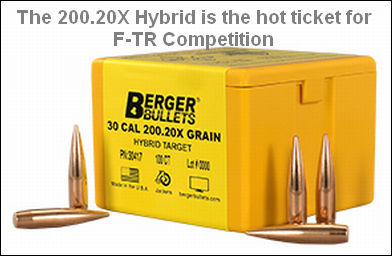
Here are some of the best deals we found on some of the most popular Berger Bullets, caliber by caliber. Berger’s 7mm 180gr Hybrid is the bullet-to-beat in F-Open competition, and the new 200.20X is favored by many top F-TR shooters, including members of the world-championship-winning F-TR Team USA. The Berger 6mm 105gr Hybrid Target has long been a favorite of Benchrest, High Power, and PRS shooters, as loaded up in match rifles chambered for 6mmBR, 6mm Dasher, 6XC, or 6mm Creedmoor.
.20 Caliber 35gr Match Varmint HP, $24.43 marked down from $27.18 .22 Caliber 80gr Match Target VLD, $29.13 marked down from $32.40 .243 Caliber (6mm) 105gr Match Hybrid Target, $34.46 marked down from $38.32 .264 Caliber (6.5mm) 130gr Match Target VLD, $42.44 marked down from $47.21 .284 Caliber (7mm) 180gr Match Hybrid Target, $47.61 marked down from $52.96 .30 Caliber 200gr 200.20X Match Hybrid Target, $49.65 marked down from $55.22
Review by James Mock
If you were charged with building a scope for F-Class or long range Benchrest, what features would you want? Vortex asked that question, received feedback from many competitors, and then set out to build a new high-magnification, zoom comp scope that would set a new “performance for price” standard.
The new Vortex Golden Eagle has features that this shooter really appreciates. It has a power range of 15x to 60x with a 52mm objective lens. Vortex has attempted to keep the weight as low as possible and the cost reasonable. My initial impression is that Vortex spared no expense in developing this scope. The “street price” for this premium scope is a reasonable $1499.00. Plus it has Unconditional Lifetime Warranty. Given its features, performance, and price, I believe that this scope will sell very well.
Premium HD, extra-low dispersion glass
APO (apochromatic) objective lens system with index-matched lenses
XRP multi-coated lenses for max light transmission
ArmorTek extra-hard lens coating to protect lens from dust, dirt, and smudges
Fogproof and Waterproof (Argon gas purged)
Specifications
Field of View at 100 yards: 6.3 feet at 15X; 1.7 feet at 60X
Main Tube: One-piece 30mm
Length: 16.1 inches; Weight is 29.7 ounces
Objective Lens: 52mm
Eye Relief: 3.9 inches
Reticles: SCR-1 FCH; ECR-1 MOA
Testing the Golden Eagle
I recently tested a Golden Eagle with the ECR-1 reticle. On this model the Hash Marks subtend 1 MOA at 40X. There is also a fine crosshair reticle (SCR-1) available. Initial tests with the scope were done on June 28th and I was very impressed with what I saw. With a new scope I always shoot the square (box test) to test tracking and amount of movement. I shot the square today after shooting a 5-shot group at 250 yards (my longest available distance). Below is a picture of the box test target that I shot. Yes, shot #5 went through the exact same hole as shot #1.
Below is the 250-yard target I shot before doing the box test. To get to the 100-yard target, I clicked down 14 clicks (1/8th MOA) and the scope was spot on. It is really a pleasure to use instruments that do exactly what they are supposed to do. With the Louisiana mirage, I shot this orange/white target at 40X instead of the maximum 60X. I did not have any problem seeing the 6mm bullet holes at 40X. The optics in this scope are to my old eyes are as good as any that I have used (regardless of price).
Competition Test Success — Golden Eagle Delivers a Win
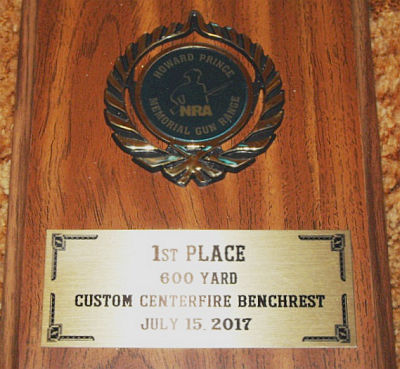
My next use of this scope was at our monthly 600-yard match on July 15th. It was a typical mid-July day in north Louisiana — very hot and humid with light switching winds. The mirage was terrible, but I managed to squeak out a victory with a 188/5X score out of 200/20X possible. I shot the Golden Eagle at 40X all day and it performed perfectly. No one could see bullet holes today, even with the high powered premium spotting scopes. This is a quality scope and it may be a “lucky” scope in that I did not expect a win with a 6mm Dasher barrel with 2500 or more rounds through it.
Point of Aim Test with Hood Scope Checker
I also tested the Golden Eagle for holding Point of Aim (POA). For this procedure, I used the Hood scope checker (loaned to me by Bart Sauter). To use this, one mounts two scopes side by side. Ideally one scope has proven its ability to hold POA. Here I used a Valdada 36X BR model as my control scope. It has proven over an 8-year period of time to hold its point of aim. I mounted these scopes on my BAT/Leonard 6mm PPC and adjusted each to the same point on the target.
As one can see in the above picture, these are big scopes. After the first shot, I noticed that the reticle dot on the Vortex seemed to be about 1/8th MOA to the right of its original position. I stopped to check for ring slippage (which I had experienced in prior tests). There was no apparent slippage, so I checked the parallax and found that there was some parallax correction needed. This was probably the source of the apparent shift in point of aim, but I cannot be sure of that. I fired three more shots (checking after each) and found no shift.
After testing for POA shift, I fired the remaining rounds using different aiming points. I fired 5 rounds (upper left) using the Vortex and 3 rounds to the right of those using the Valdada scope.
CONCLUSION — A Very Fine Optic at a Reasonable Price
While testing this Vortex Golden Eagle scope, I developed a real fondness for it. I appreciate its great optics, eye relief and crispness of adjustments. If I thought that this scope did not hold POA, I would use my old Valdada in the 600-yard matches in which I participate. Further testing has shown no tendency to shift point of aim.
If I am allowed to keep this scope until the fall, I am sure that I will be able to see 6mm bullet holes in the white at 600 yards. Seeing those 6mm holes is very difficult, but that is my dream for a premium high-powered scope. During the summer months in north Louisiana, the air is much too “dirty” to spot small holes at 600 yards. By October, there should be some conditions in which one can use the premium optics to see bullet holes in the white at 600.
In summary, let me say that this scope has become one of my all-time favorites because of its bright, clear images and its great reliability. If you are looking for a great long-range scope that is reasonable in cost, try the Golden Eagle from Vortex.– James Mock
The White Horse Center Range near Peeltree, West Virginia, will host the 2017 National IBS 1000-Yard Nationals from September 1-3, 2017. This will be a great match — over 100 shooters have signed up so far, including many of the nation’s top 1K benchrest aces. It’s not too late to sign up. You can register (on-site) up until 5:00 pm on Friday, September 1. The current match fee is $90.00 per gun class, or $175.00 for both classes (Light Gun and Heavy Gun). The White Horse 1000-yard range will be open on Friday for sight-in and practice.
This record-setting offset (assymetical) Heavy Gun belongs to talented shooter Mike Gaizauskas.
2016 IBS 1000-Yard Overall (2-Gun) Champion Tom Mousel (below) will travel to West Virginia to defend his title this weekend at White Horse. Last year Tom posted a stunning 3.356″ Group Agg to win Light Gun Group as well. That’s a 1/3 MOA Agg at 1000 yards — truly remarkable precision.
The Deep Creek Tracker stock, with adjustable “keel”, is the hot ticket now in the 17-lb Light Gun class.
Match Schedule and Fees The 1K Nationals will be a 3-target Aggregate match for both Light Gun (LG) and Heavy Gun (HG) with six (6) targets total. Practice and Sight-in will be available Friday (9/1/2017). NOTE: There will be a $10.00 per target fee during practice days. Match fees for the Nationals are now $90 per gun ($45 per gun for juniors). All registrations MUST be received by 5:00 pm Friday, September 1st. No walk-up registrations will be accepted on match days.
How to Get There
The Center is located 9.7 miles south on State Route 20 from I-79, exit 115 or 10.1 miles north of Route 20 from Buckhannon. Look for a brown and yellow Dept. of Natural Resources sign on Route 20. Take Crouse Road to the next sign, turn right at the sign, and proceed up the hill to the Center. Map coordinates are: 39°, 7′, 11″ North latitude; 80°, 13′, 4″ West longitude. The White Horse Center website has information on area hotels and campgrounds.





 Varmint Loads with 75gr and 87gr V-Maxs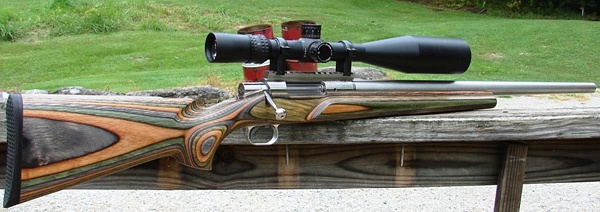









 Competition Test Success — Golden Eagle Delivers a Win


 The
The 


 The 1K Nationals will be a 3-target Aggregate match for both Light Gun (LG) and Heavy Gun (HG) with six (6) targets total. Practice and Sight-in will be available Friday (9/1/2017). NOTE: There will be a $10.00 per target fee during practice days. Match fees for the Nationals are now $90 per gun ($45 per gun for juniors). All registrations MUST be received by 5:00 pm Friday, September 1st. No walk-up registrations will be accepted on match days.


