Here’s something you don’t see very often — Lapua cartridge brass on sale. As part of its Back-to-Black promotion, Brownells has deeply discounted its inventories of Lapua Brass. For most cartridges/calibers, the price has been reduced at least $10.00 per 100-count box. Here are the sale prices, good through the end of the week:
Many Northern States have been hit by some early snowstorms dropping lots of the white stuff. Think a little snow should end your shooting season? Heck no — just grab your snow shovel and go shooting. Here’s how Forum Member Nick (aka “ChevyTruck 83″) coped with winter’s fury back in 2012. Never underestimate the resourcefulness of a dedicated AccurateShooter Forum member….
We admire the fortitude of Forum Member Nick who braved wintry December weather to enjoy a day at the range in his native Pennsylvania. A little snow on the ground couldn’t stop this intrepid shooter, who brought snow shovel and arctic gear to his range session. Folks, here’s a true “hardcore” fan of shooting! Despite the “relentless snow”, Nick reports that “at least it wasn’t windy”. Nick shot a variety of long guns, including his .22LR rimfires, a .223 Rem, and a .308. Not daunted by the cold, Rick said it was fun to “play like a kid once in a while.” That’s the spirit!
Nick reports: “There was no wind to speak of — just relentless snow. I’ll tell you what — it’s awesome to get out and play like a kid once in a while.”
Nick’s foray into the winter wonderland really puts things in perspective for “fair-weather” shooters. After viewing Nick’s Forum thread about his snowy range session, fellow Forum member DennisH observed: “I will never complain about our super hot sugar cane fields in south Louisiana ever again! We can hold matches 12 months a year. I have NEVER had, owned, or used a snow shovel.”
Creedmoor Sports is having a big sale on printed books. On sale now are many of the most popular training and competition books. If you are looking for some good reading material this winter, check out the Creedmoor Book Sale. Gun books also make great holiday gifts for your shooting buddies.
At the request of our readers, we have launched a “Deals of the Week” feature. If this proves popular, we’ll try to run this every Monday. Here are some of the best deals on hardware, reloading components, and shooting accessories. Be aware that sale prices are subject to change, and once clearance inventory is sold, it’s gone for good. You snooze you lose.
1. Remington — $100.00 Cash Back on Rem 700 BDL and CDL
Remington is running a Black Friday factory mail-in rebate program. This can save you $100.00 on Remington 700 CDL and BDL rifles. Remington is also offering $50-$75 Rebates on Rem 700 SPS, Rem 700 ADL, and Rem 783 rifles. CLICK HERE to download PDF Rebate Form.
2. Bruno’s — Krieger Barrels $25.00 Off Plus FREE Shipping
Krieger makes some of the very best barrels you can buy. With demand for Krieger cut-rifled barrels being so high, you can expect to wait 3 months or so for a new barrel. Or, you can order from a vendor that maintains Kriegers in inventory. Right now Bruno’s is offering $25 off all Krieger barrels in stock, plus FREE shipping. A variety of lengths/contours are available in .22, 6mm, 6.5mm, 7mm, .308, and .338 calibers. CLICK HERE for Barrel Inventory list.
You won’t find a better deal on a Magnetospeed Chronograph anywhere. This chrono fits to your barrel so you don’t have to walk downrange to fiddle with a tripod-mounted unit. As part of the Brownells 3-Week “Back to Black” promotion, this Sporter Chrono is marked down to $159.99 for the next few days. Don’t hesitate — this is a killer deal on a very good product.
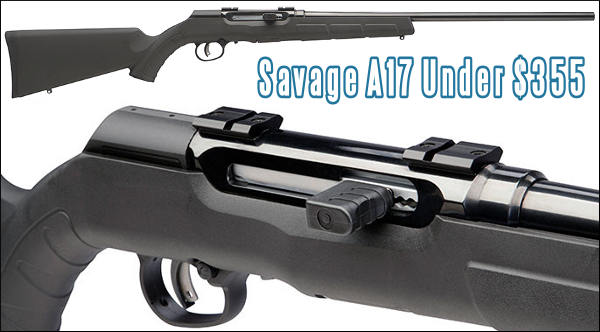
4. Southern Shooters — Savage A17 in 17 HMR
The Savage A17 is an impressive new semi-auto rifle. With its delayed blow-back mechanism, the A17 can safely handle the added pressure of the 17 HMR cartridge (unlike some previous designs). Though some owners have complained about a stiff trigger (and hard-to-seat magazines), overall the A17 is a very good design — a great choice for small varmints.Now you can purchase one for under $355.00. Southern Shooters is currently offering the A17 for just $352.62. The A17 was named Guns & Ammo Rifle of the Year.
5. Botach Tactical — Double Rifle Padded 36″ Case with Straps
Here’s a nice case for short carbines or hunting rifles. This double Gun Case will transport TWO (2) 35″ rifles inside the main double compartments. This is a nice set-up for hauling a couple of varmint rifles or an AR with a collapsible stock. Three large external pockets will carry magazines, range-finders and other gear. This rugged case includes nice padded shoulder straps so you can carry your rifles backpack-style. Right now this double gun case is just $49.00 from Botach Tactical. That’s $99 off the original price. The case is offered in tan, OD green, or black.
A few years back, we comparison tested four laser rangefinders — a Nikon, Leica, Swarovski, and Zeiss. To make a long story short, three out of four testers preferred the Zeiss PRF Victory. While larger and heavier than the Leica CRF 1600, the Zeiss Victory PRF was easier to hold steady, and it ranged as well as the Leica (and better than the Swaro and Nikon). Now the Zeiss Victory is on sale for $649.00, making it $150.00 cheaper than Leica’s CRF 1600. With this price advantage, we think the Zeiss is the smart choice (unless you need an ultra-compact unit). A recent LRF comparison test in the UK reached the same conclusion.
7. Brownells — Stripped AR Lower Just $39.99
This is the lowest price we’ve seen on a lower with a solid warranty. This Anderson Mfg. Lower sells elsewhere for up to $79.99. If you’re planning a budget AR build, you can start with this inexpensive lower and put the money you save into a top-quality barrel.
8. Bullets.com — Thanksgiving Ultrasonic Cleaner Sale
For Thanksgiving Week, Bullets.com has slashed prices on all its Ultrasonic Cleaning Machines. These start at just $31.95 (for 1 pint capacity), and run up to 9 liter capacity for the biggest jobs. We like the 2.5 liter unit which has been marked down to $89.95 from $199.95. That’s a good price for a 2.5 liter machine.
9. Bushmaster — $200 Cash Back on Select AR & ACR Models
Looking for a Black Rifle on Black Friday? Here’s a sweet deal from Bushmaster. Now through November 30, 2015 you can save $200.00 on a variety of semi-auto “modern sporting rifles” from Bushmaster. This includes AR-clone rifles as well as Bushmaster’s gas piston operated ACR series rifles. You save $200.00 through a $50 Rebate combined with a $150.00 Black Friday Bonus.
10. Gander Mountain — $20 and $50 Discount Coupon “EARLY20″
As a lead-in to Black Friday, Gander Mountain is offering online shoppers $20.00 off a $100.00+ purchase and $50.00 off a $250.00+ purchase. Simply use Code EARLY20 during checkout. This coupon works through midnight on 11/24/2015. Also, during Black Friday (11/27/2015), Gander Mountain will offer big discounts on Liberty Gun Safes.
Credit EdLongrange for finding the Bushmaster Rebate Offer.
Click Calendar above to download large-size 2016 National Match Calendar PDF.
It’s never too early to start planning for the National Matches at Camp Perry, Ohio. Here is the official calendar for next year’s National Matches to be held in the summer of 2016. Registration for the CMP National Trophy Rifle & Pistol Matches and CMP Games Events will open on April 1, 2016. Competitors should note that most events and matches have returned to the previous dates before the adjustment for the Palma (Fullbore) World Championships in 2014 and 2015. However, the Smallbore National Championships will be held at the Wa-Ke-De facility in Bristol, Indiana, rather than at Camp Perry.
The 2016 SHOT Show, slated for January 19-22, 2016, is less than two months away. If you’re curious, the “SHOT” acronym stands for “Shooting, Hunting, and Outdoor Trade Show”. SHOT Show is the largest trade show in the world for the firearms, ammunition, hunting and shooting accessories industries. Held every January, this “start-of-year” event is where new guns, optics, reloading tools, and all manner of shooting gear are unveiled. To preview some of the new products that will be on display, visit the SHOT Show New Product Center. You’ll find photos and short descriptions.
SHOT Show is a huge event. For 2015, there will be more than 1,600 exhibitors, whose displays collectively cover 630,000 square feet of exhibition space. SHOT Show attracts more than 62,000 industry professionals from all 50 states and 100 countries.
If you plan to attend SHOT Show this year, you should get your reservation completed soon. Vegas hotels are filling up and tickets to SHOT Show Events are going fast. Register to attend the show, book your hotel rooms. and more at www.Shotshow.org.
If you own a Ruger Precision Rifle (RPR), or are considering purchasing one, you should watch this short video from Sniper’s Hide. The Hide’s head honcho, Frank Galli (aka “LowLight”), added some upgrades to his RPR, to enhance looks and ergonomics. Frankly we think the RPR is pretty good right out of the box. Our friend Gavin Gear of UltimateReloader.com is seeing near-half-MOA accuracy with his “box-stock” RPR in .243 Winchester. Nonetheless we know some RPR owners will want to swap barrels or otherwise “hot rod” their rifle. Here’s how it’s done…
Video Shows New Barrel, Stock, Grip and Handguards Installed on Ruger Precision Rifle:
Galli unbolted quite a few factory parts, replacing them with proven aftermarket components. That’s one of the advantages of the RPR — it’s modular nature allows the owner to make changes with simple tools. Off came the handguards, stock, and grip. While we’ve been fairly impressed with the accuracy of some RPR factory barrels, Galli decided to fit a custom barrel, courtesy Chad Dixon of LongRifles Inc. (LRI). All totaled, the new components cost more than the original rifle. Galli figures he now has about $2400 in the gun. A new RPR (if you can find one) will run you about $1100-$1200.00.
The new barrel was a good investment, but the other items could be considered indulgences. But we like the fact that Galli demonstrated how easily the RPR can be modified by anyone with basic mechanical skills. (The Ruger’s barrel-mounting system allows you to run a “Pre-fit” barrel with headspace set by clamping nuts.) CLICK HERE for details of the build.
New Components for LowLight’s Ruger Precision Rifle
Magpul MOE Grip
Magpul PRS Stock
Seekins Precision “Triangle” Handguards
LongRifles Inc. (LRI) Aluminum Bolt Shroud
Custom K&P “Pre-Fit” Barrel from LRI (chambered in 6.5 Creedmoor)
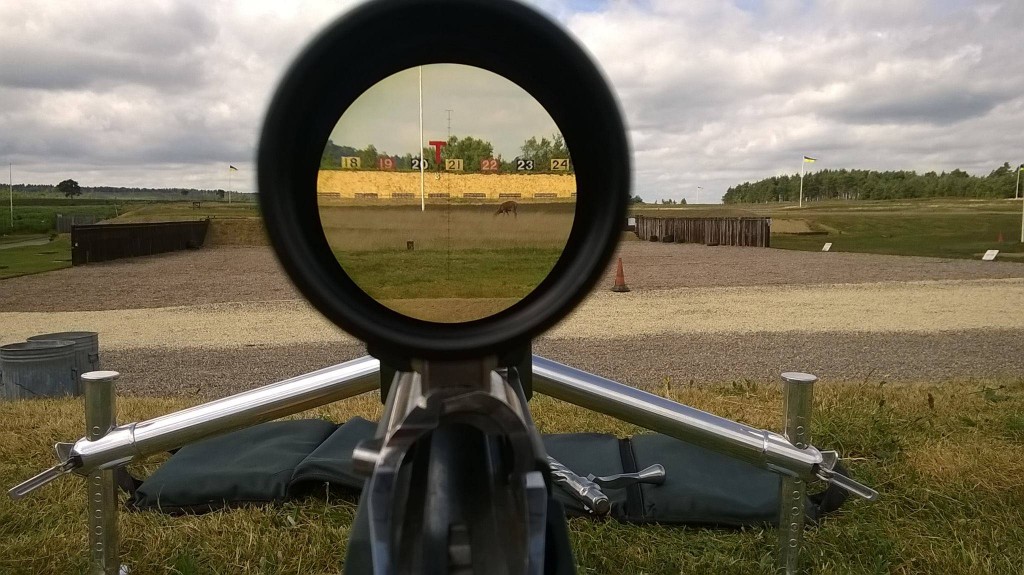
What’s wrong (or right?) with this picture? Does the “F” in F-class stand for “Fauna”? Look carefully at this Bisley Range photo taken by Australian R. Hurley while looking downrange through his March 8-80X scope. The photo was taken earlier this year at the Bisley National Shooting Centre in the UK.
The Story Behind the Photo
British shooter T. Stewart reports: “I was there when this photos was taken. All I can say was that Mr. Hurley was firmly reminded that should said deer accidentally jump in front of his bullet … he would spend five years “At Her Majesty’s Pleasure”. That morning we had five deer moving across the targets, literally blocking the V-Bull. Since we were on the 900-yard Firing Point, and elevated for such, obviously the bullet would pass well above them. But they do NOT move or flinch at the noise or passing bullets since they are not hunted on the Bisley Ranges. Earlier this year we saw a herd of 20 or so deer grazing slowly across the Range.”
More Fauna Findings…
Apparently Bisley is not the only place were “the deer and the antelope play”. In Canada, on the Connaught Ranges near Ottawa, Ontario, shooters often encounter a variety of wildlife. William McDonald from Ontario says: “Animals are a common sight on the Range. Along with deer we see geese, turkeys, and coyotes on a daily basis.”
Likewise, E. Goodacre from Queensland, Australia often sees ‘Roos on his home range: “I shoot at Ripley, Australia, and shooting is regularly interrupted by kangaroos. Our last silhouette match was delayed by an hour while 30 ‘Roos dawdled across — silly buggers!”
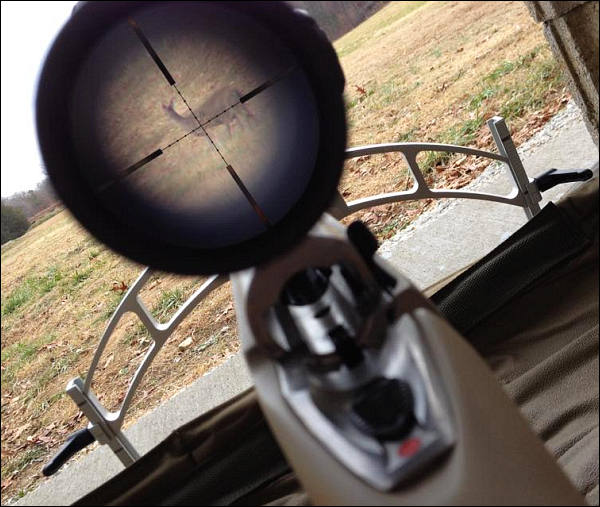
R. Hurley wasn’t the first fellow to view deer through his F-Class rifle’s scope. After seeing Hurley’s photo from Bisley, B. Weeks posted this image, saying: “Been there, done that!”
As a lead-up to Black Friday, Brownells.com is running three full weeks of special sales. You can get some very good deals during this 3-week “Back to Black” event. Above are three featured items for Week Two of this promotion. There are some nice Geissele and Timney triggers at good prices. In addition to these top deals, hundreds of other products are on sale at Brownells.com this week. Here are three products that caught our eye. You can’t go wrong with an RCBS Rock Chucker for $129.99 or a stripped AR15 Lower Receiver for $59.99 (or $99.99 with Tan or Sniper Gray Cerakote finish). Brownells offers a 100% satisfaction guarantee on these Aero Precision Lowers.
We congratulate Rebecca Richards of Australia for her incredible shooting in the recent RBA Benchrest Grand Prix at the Sydney International Shooting Centre. Consider this, out of the five (5) benchrest classes competing (two air rifle, and three rimfire) Rebecca won four classes outright while placing third in the fifth class. Wow — that represents complete and total domination. Remarkably, Rebecca dropped only 10 points in four days of shooting.
Rebecca’s amazing 4-day performance was near perfection. Overall, she scored 2740 out of a total of 2750 possible points. She shot four of 11 targets with perfect 250/250 scores, and six more with 249/250. Over the course of the event she hit 152 “dots” (center bulls) out of a total possible 275. That’s pretty amazing if you understand how small those center bulls really are. Take a look at the target photo below — the center dot is tiny.
All in all, this was a performance for the ages — one of the best combined airgun/rimfire benchrest performances in Southern Hemisphere history. Kudos to Rebecca for her brilliant performance.
Here’s the modern Sydney International Shooting Centre…


 We admire the fortitude of Forum Member Nick who braved wintry December weather to enjoy a day at the range in his native Pennsylvania. A little snow on the ground couldn’t stop this intrepid shooter, who brought snow shovel and arctic gear to his range session. Folks, here’s a true “hardcore” fan of shooting! Despite the “relentless snow”, Nick reports that “at least it wasn’t windy”. Nick shot a variety of long guns, including his .22LR rimfires, a .223 Rem, and a .308. Not daunted by the cold, Rick said it was fun to “play like a kid once in a while.” That’s the spirit!