Congratulations to Ben Emms of Australia for winning the World Fullbore Long Range Championship at Camp Perry. Nigel Ball of Great Britain finished second, while another Aussie, Mattthew Pozzebon, took third. There was some amazing shooting done this past week by the top competitors. Here is a report from Anette Wachter, a member of the U.S. Palma Team.
How Ben Emms Won the World Championshipby Anette Wachter (30CalGal.com)
For a while I thought he was not human. Ben Emms of Australia kept powering through every yard line of the Long Range Championship with perfect scores. When the rest of us got pummeled at the 1000-yard line on day 3 he still cleaned the string. He “finally” dropped one point the last day. I guess he is human after all.
But for some dramatic effect he kept us on the edge of our seats during the shoot off. Two crazy shots (a wide two and a low three) were nail biters. His last round for record had to be at least a four to keep the Gold medal from going to second place finisher Nigel Ball from Great Britain. Cheers came from the crowd and especially his team-mates when the final shot came up as a FIVE on the target. Nigel had a beautiful target of centered shots and won the Silver while Matthew Pozzebon also of Australia took the Bronze Medal. Tom Whittaker and Bob Stekettee were also in the Top Ten shoot-off. Tom came home with many awards last night.
The three top Lady trophies went to Sherri Jo Gallagher for the Gold, Trudie Fay with Silver and Jane Messer of GB with the Bronze. We were rooting for Trudie all week as she also was down only one point. Her last string at 1000 was difficult but she still finished in the top 25 in the world. Sherri almost made the shoot-off. She was in 10th place all day until the final results came in at the end and she was pushed to 11th. Although the 11th spot kept her out of the shoot-off, she did stay for the awards ceremony to receive her High Woman Gold Medal and then hit the road for an all night 14-hour trip back to Golden Knights turf for work. Hard core girl!
The Fullbore Team Championships are now underway, with squads from 11 countries competing for national honors. Team USA was ready to go on Day One, hoping to win the Worlds on our “home turf”:
Sound can be a tricky subject, but Cal Zant, the editor of PrecisionRifleBlog.com, presents everything an informed shooter should know about muzzle brake noise in a straightforward and practical way. Most sound tests are measured from the side of the muzzle, in accordance with mil-spec standards, and Cal did that. But he also measured the sound level of each brake from behind the rifle, closer to the shooter’s position. This provides a more accurate indicator of the actual sound levels firearms operators will encounter while shooting.
Muzzle brakes ARE really loud — that’s something most active shooters have observed. But this study finally gives us some hard data and makes objective comparisons. The difference between brakes was quite significant. Some brakes were ear-splitting — more than twice as loud as other brakes tested.
As a bonus, Cal also provides data on how the new Ultra series suppressors from Thunder Beast Arms Corp (TBAC) compare in terms of sound level behind the rifle.
Here’s a great feel-good family story. Will McChesney, wife Sarah, and their six (6) children ventured to Camp Perry this year for National Rimfire Sporter Match held August 1, 2015. The McChesneys like to do things together as a family “team”, and competitive shooting was no different. Father Will and all six kids competed in the event while mother Sarah provided logistical and moral support.
All of the six McChesney children fired side-by-side on the firing line during the Rimfire Sporter Match. From bottom right corner: Julia, Cheri, Bria, Judi, Heidi, and Jimmy.
The ace shooter among the McChesneys was 15-year-old daughter Judi, who earned a bronze medal during the Rimfire Match. Judi finished in the Top 20 of the junior marksmen, shooting “clean” in slow fire prone stage along the way. That earned her family bragging rights as she finished ahead of 14-year-old James, the one son in the family. But Jimmy helped his sisters during the match — adjusting their slings and loading their magazines.
This was the first big shooting match for the McChesney clan which hails from Beaver Falls, Pennsylvania. Will did some hunting and varmint shooting as a boy growing up, and he and wife Sarah did enjoy plinking and pistol shooting on Will’s father’s farm in New Galilee, PA.
Later on, when the Beaver Valley Rifle and Pistol Club was looking to expand its youth program, it recruited one of the McChesney daughters. As the club soon found out, the family does absolutely everything together, and recruiting one McChesney meant recruiting all.
The McChesney bunch chose the 2015 National Rimfire Sporter Match as their first real travel match and their first taste of competitive shooting. The days leading up to the match, the entire family practiced together to prepare themselves. All but Sarah actually competed at Perry this year. However, she still came along for support and she plans to compete next year.
Sniper’s Hide has just released an interesting comparison test, running the $1150* Ruger Precision Rifle vs. a $7000 Accuracy International AX in a 450-yard “mad minute” drill. The goal was to see how many shots could be put on a 12″ steel target in one minute. Both rifles were chambered for the 6.5 Creedmoor and were fed with Hornady 140gr Amax ammo. The much cheaper Ruger did surprisingly well, though the AI AX did come out on top. Frank Galli, Head Honcho of Sniper’s Hide, got 19 rounds on target in one minute with the AI AX compared to 14 rounds with the Ruger.
Watch the “mad minute” face-off in this video:
Galli notes: “The target is 450 yards away, and, as noted in the video, we have winds gusting anywhere from 10 to 18 mph out on the Front Range of Colorado today. So my job is to not only hit the target as fast as possible, but to also manage the conditions.”
In Summary
Frank Galli says the Ruger offers a lot of bang for the buck:
“For those looking to get into competitive tactical shooting, like a PRS Event, there is absolutely no excuse. This rifle will allow you to be competitive, the only thing that would hold a person back is themselves. The more this rifle is shot, the more impressive it is. Would I trade my Accuracy International for one? Well, odd question, but no. However for those on a budget I would recommend the Ruger in a heartbeat.”
*MSRP for the Ruger Precision Rifle is $1399.00. Some dealers are posting prices as low as $1100.00, but $1150.00 seems typical.
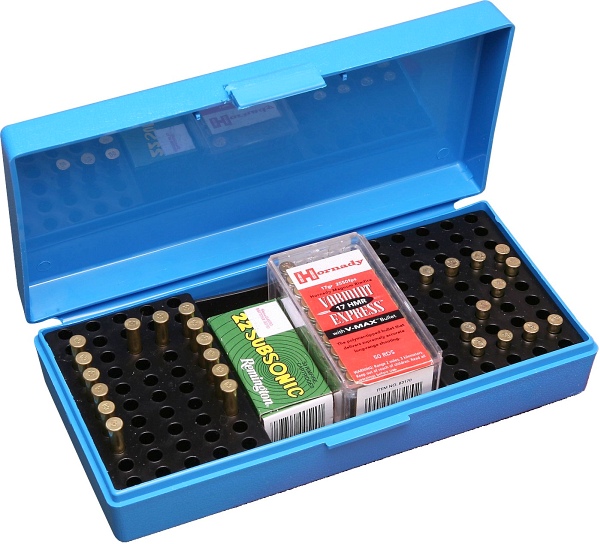
For centerfire ammo, you can choose from dozens of flip-top boxes, storage bins, or milsurp-style ammo cans. For rimfire ammo, there are not so many good choices. Our preferred rimfire ammo carrier is the MTM SB-200 Small-Bore Fitted Ammo Box. This flip-top plastic box holds 100 rimfire rounds in 10×5 black grids on the left and right. In the center is a storage area that will hold another 100 rounds in factory boxes. MTM’s SB-200 box was recently re-designed so it will now hold 17 HMR rounds, as well as 17 Mach 2, 22 short, 22 Win Mag Rimfire, and of course 22 Long Rifle (.22LR)
MTM Case-Gard 200 Round Smallbore Box
This is really the only product of its kind on the market. It allows you to conveniently and securely hold 200 rimfire rounds, and also segregate your ammo by brand or bullet type. These boxes fit all types of popular rimfire ammunition. The vertical clearance of the lid is sufficient to hold the longer .22 WMR Rounds, and 17 HMR (as well as .22 LR naturally). The lid fits securely so you don’t have to worry about your rimfire ammo spilling out on the way to the range.
If you don’t have one of these boxes yet, we recommend you order one or two. They cost less than $15.00 and are available in Blue or “Rust” (a brick color).
by Tony Chow
In recent years, the use of electronic trainer systems has revolutionized training in all disciplines of position shooting. By capturing (and illustrating) key performance variables like the steadiness of a shooter’s hold, accuracy of aiming, and the timeliness of trigger release, these devices can offer tremendous insights into the strengths and weakness of a shooter’s position and technique, making high-level marksmanship training less voodoo and more of a science.
Until now, electronic trainers all suffered from one critical limitation: the inability to be used outdoors in live fire training. Now, however, SCATT has introduced the next-generation MX-02 electronic trainer, a product that can finally support outdoor live firing in broad daylight, as well as dry firing indoors. In addition, the MX-02 is the first electronic trainer to support centerfire rifles. It goes without saying that, when we at AccurateShooter.com were offered an MX-02 test unit to review, we jumped at the opportunity.
How the SCATT MX-02 Works
The SCATT sensor mounted on the end of the barrel has a digital camera that “sees” the black bullseye in the target, even in broad daylight outdoors. Using the bullseye as a reference, the SCATT software tracks the movement of the muzzle relative to the center of the target. The unit can plot these movements as a continuous trace, which appears on a monitor as a squiggly, colored line. Data points from the trace are also available in a tabular spreadsheet format. This allows the shooter to “crunch the numbers”, revealing strengths and weaknesses in his gun-handling and aiming technique.
In our testing, we confirmed that, like SCATT’s earlier indoor-only WS-01, the MX-02 offers excellent support for indoor dry-fire training, which will continue to be the primary means through which position shooters sharpen their fundamental skills. Since the new SCATT uses the same familiar Windows software for data capture and analysis as its predecessors, shooters and coaches upgrading to MX-02 will have no learning curve to overcome, and newcomers to the SCATT platform can tap into the wealth of institutional knowledge accumulated over the years by the shooting community on how to interpret shot data.
It’s in the support for outdoor live firing, however, that SCATT MX-02 distinguishes itself from its predecessors and the competition. Shot trace data captured by MX-02 during live firing turned out to be every bit as valuable (and revealing) as we had hoped. The ability to correlate SCATT tracing with real shots on target gave us a better understanding of the shooting process, and helped the reviewer, already a high-level smallbore prone shooter, uncover a significant problem in his shooting. SCATT MX-02’s outdoor capability is therefore an invaluable feature, particularly for experienced shooters aspiring to world-class performance.
In summary, SCATT MX-02 is an outstanding product that delivers on its promises. We heartily recommend it, both for first-time users of electronic training aids, and also for those shooters who may wish to upgrade their current electronic training system. The MSRP for SCATT MX-02 is $1,799, $500 more than its predecessor, the SCATT WS-01, which is still available. In my view, the $500 premium for the MX-02 is justified by the MX-02’s enhanced capabilities, making it a better long-term investment.
Our complete, 3600-word MX-02 review of the SCATT MX-02 can be accessed through the link below. This full review contains many more photos plus detailed field test results. For the time being, the review only covers our experience with the product in smallbore shooting. An upcoming addendum to the review will include test results from centerfire shooting. Those attending SHOT Show in Las Vegas next week can examine SCATT MX-02 in person. SCATT will have the MX-02 on display at Booth 111.
Birchwood Casey has released an innovative Solid-Film Lubricant Pen that may be useful for some gun applications where conventional oils and greases are not appropriate. The Pen dispenses MLP Solid Film Lubricant, a semi-permanent, lacquer-like coating containing molybdenum disulfide (MoS 2) and corrosion-inhibiting elements.
Using the Pen, a low-friction lubricant coating can easily be applied to various friction points to reduce wear. Common application points on AR-style rifles include: charging handle, take-down pins, inside of bolt carrier, and mag well.
We can also see a use for this product on buttstock adjusting points, bipod joints/hinges, sling swivels — wherever a non-greasy lubricant can aid function. NOTE: We do not recommend this product for lubrication of bolt lugs on bolt-action rifles — we still think a high-quality grease-type lubricant is best for bolt-lug applications and other high-load points.
This Video shows where to apply Dry Film Lubricant on an AR-type rifle.
Birchwood Casey’s MLP Solid Lubricant Pen meets Mil-Spec requirements. The formula creates a tough, low-friction coating that helps prevent corrosion, galling, and seizing. IMPORTANT: after application, you should allow the dry-film coating to DRY for at least 6 hours before use.
Birchwood Casey claims that: “Once applied, MLP Solid Film Lubricant is virtually unaffected by atmospheric and fretting corrosion, solvents, acids, oils and degreasers. MLP Solid Film Lubricant operates at temperatures ranging from -320° to +300° degrees F.”
Deep Creek 1000-yard line: 46°55’35.03” N 114°14’45.40” W, elevation 3355′.
The International Benchrest Shooters (IBS) welcomes the Montana NW 1000 Yard Benchrest Club as a newly-affiliated club hosting registered IBS matches. The Montana club’s origins go back to 1996 when the Whitefish (Montana) Rifle and Pistol Club affiliated with the Original Pennsylvania 1000-Yard Benchrest Club (Williamsport) to conduct 1000-yard matches. Early in 1998 the Northwest 1000-Yard Benchrest Association was formed to promote 1000-yard benchrest competition in affiliation with Williamsport. The Club now operates at the Deep Creek Range as the Montana NW 1000 Yard Benchrest Club (www.MT1000yd.com), an IBS-affilated organization.
2015 Championships at Deep Creek
The 2015 Championships were held this past weekend, August 7-9. The video below features the winners from this year’s championships, Tom Mousel (Two-Gun Overall), Leo Anderson (Heavy Gun Overall), and Bill Johnson (Light Gun Overall). The three winners describe their equipment. Tom shot a pair of 17-lb 6mm Dashers, running Vapor Trail Bullets pushed by CCI 400 primers and Hodgdon H4895 powder. The brass is Lapua 6mmBR hydro-formed to Dasher with lightly-turned necks.
Here is one of Tom Mousel’s match-winning rifles, and an impressive 100-3X, 10-shot target:
The Club holds 12 shoots per year over six weekends that count towards the 6- and 10-shot Aggregates for the year. The Championship Shoot held in August is match number 11 and 12 and does not count for Aggs. More than $20,000 worth of prizes were donated by major sponsors this year. The prize table featured scopes from Nightforce and Vortex, actions from DeFrance, Borden, BAT, Kelbly, and Stiller, plus barrels from Bartlein, Benchmark, Brux, Caliber, Krieger, and McGowen.
The Deep Creek Rifle Range is located near Missoula, Montana. Club members are continually upgrading the 1000-Yard Range, which has become one of the best long-distance benchrest shooting facilities in the country. The Deep Creek Rifle Range invites shooters to visit this scenic shooting facility. Participation in club matches continues to grow, and club members hold several 1000-yard World Records for group, score, and Aggregates of both. For more information on club shoots and joining the club, contact Alex Wheeler: zfast_malibu [at] yahoo.com.
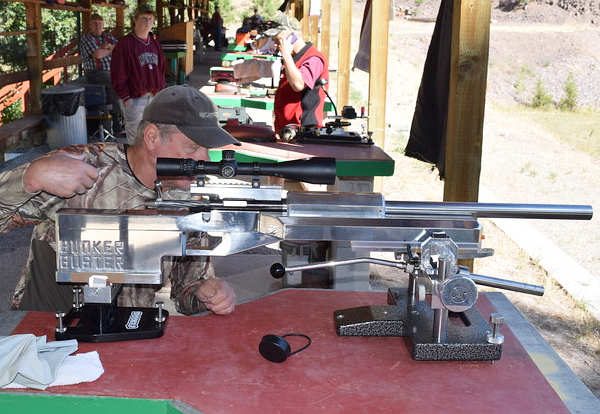
Here’s “Bunker Buster”, a metal-stocked Heavy Gun (HG):
At Deep Creek, competitors shoot three (3) classes: IBS Light Gun (LG), IBS Heavy Gun (HG), and a special 11-pound class. At registered matches, Light Gun shoots five shots per relay, Heavy Gun shoots 10 shots, while the 11-pound class shoots five shots. For more information on classes and courses of fire, visit MT1000yd.com or send email to: northwest1000ydbenchrest [at] gmail.com.
New World Records Set at July 2015 Match:
Important 1K records were set at the Club’s July 9-10 match earlier this summer. Tom Mousel broke the Light Gun 10-match score record and Heavy Gun 10-match group record. Jim Williams broke the HG 10-match score Agg record. In the video below, Tom Mousel talks about his record-breaking performances.
Missoula, Montana Travel Tips
The City of Missoula is nestled in the Northern Rockies of Montana, at the confluence of three rivers. Surrounded by seven wilderness areas, Missoula is an outdoor enthusiast’s dream. You can kayak, raft or tube through downtown, or take a relaxing hike in 60,000 acres of wilderness minutes from your hotel. Missoula is known for blue-ribbon trout fishing (made famous by the movie A River Runs Through It) and spectacular natural beauty.
Missoula is a popular destination for shopping and dining, featuring three shopping districts and an abundance of restaurants, cafes, and brew-pubs with something to fit all budgets and palates. Known for its eclectic culture, Missoula offers a wide variety of entertainment including theater, film festivals, college sports, ballet, and even roller derby.
Harrell’s Precision sells “semi-custom” full-length bushing dies for the PPC and 6BR chamberings. While the Harrell brothers do not cut the die to spec, they carry a large selection of dies made with slightly different internal dimensions. When you send in your fired brass, the Harrells choose a die from inventory with just the right amount of sizing (diameter reduction) at the top and bottom of the case. Given the quality, and precise fit, Harrell’s full-length dies are a good value at $70.00 plus shipping.
Bump Measuring Collar
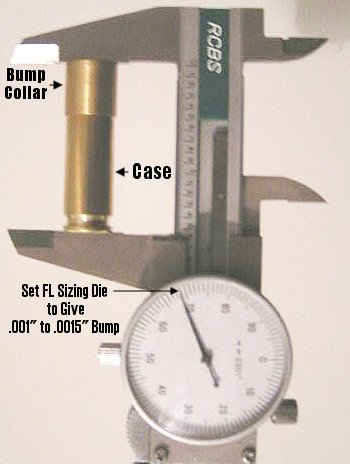
The Harrell brothers provide a nice bonus item with each full-length die — a neat, little shoulder bump measuring device as shown in the photo at right. Hornady/Stoney Point sells a stand-alone tool that does the same job, but the Harrell’s bump collar is simpler and faster. To measure your shoulder bump, simply place the Harrell’s bump collar over the front of your deprimed case (before sizing) and measure the OAL with your calipers. Then size the case in your full-length die, replace the collar and repeat the measurement. You want to set your die so the shoulder moves back about .001″ to .0015″ for most applications. (With semi-auto guns you may want more bump.)
Surgeon Rifles makes excellent tactical actions and complete rifles. Now you can save 10% off all Surgeon products (actions, rifles, bottom metal, bipods, suppressors etc.) with Coupon Code SR10. The sale even includes optics (if purchased with a complete rifle).
Surgeon recently marked 10 years in business, and the company now has 10,000+ Facebook fans. To celebrate those milestones, Surgeon has announced a special Customer Appreciation Sale:
Now through August 31st, all Surgeon Rifles’ products* are 10% off MSRP! That means EVERYTHING! In-stock rifles, custom rifles*, actions, bottom metals, bolt knobs, bi-pods, small parts, apparel, and AWC suppressors** are all on sale. Surgeon is even extending 10% off MSRP to all optics that we offer when purchased with a rifle.
All you have to do is use coupon code SR10 during online checkout, or mention this sale to Surgeon’s sales reps. NOTE: Discount cannot be combined with any other offers, deals, or discounts including MIL/LE or dealer pricing. The 10% off does not include tax or shipping.
*Custom rifles must be ordered and deposit received by 5:00 pm MST, August 31st, 2015.
**Only valid on AWC Silencers’ PSR, THOR PSR, Thundertrap, THOR Thundertrap, Raider, and THOR Raider models.
Sale tip from EdLongrange. We welcome reader submissions.


 The ace shooter among the McChesneys was 15-year-old daughter Judi, who earned a bronze medal during the Rimfire Match. Judi finished in the Top 20 of the junior marksmen, shooting “clean” in slow fire prone stage along the way. That earned her family bragging rights as she finished ahead of 14-year-old James, the one son in the family. But Jimmy helped his sisters during the match — adjusting their slings and loading their magazines.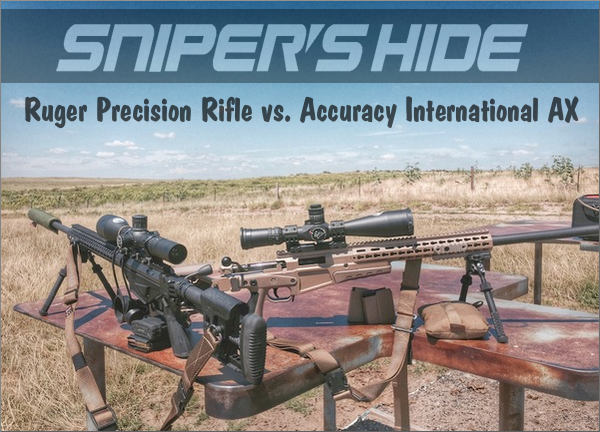





 Bump Measuring Collar


