First revealed at SHOT Show 2014, the Steyr SSG Carbon is finally making its way to America. It took Steyr 16 months to fill a large quantity of LEO orders, but now the innovative Steyr SSG Carbon should be available throughout the USA for $3695.00 MSRP. That sounds pretty expensive, but this is a very sophisticated rifle.
Here’s a very cool video — worth watching full-screen in HD.
The SSG Carbon is based on Steyr’s SBS action (with a +20 MOA rail on top). This gun features the same crisp, adjustable single-stage trigger used in the vaunted SSG 08. The rifle has a hammer-forged, four-groove 1:10″-twist barrel (20″ or 22.4″) chambered for the .308 Winchester. The SSG Carbon rifle offers excellent ergos, with adjustable cheek piece, adjustable butt plate, and an integrated adjustable rear mono-pod. But the real selling point for this rifle is the stock — a carbon stock built like a Formula 1 car chassis.
Chipped Carbon Stock Construction
Unlike conventional carbon-fiber stocks made from woven carbon fabric, the SSG Carbon’s stock is made using the same “chipped-carbon” Sheet Molding Compound (SMC) construction used to create load-bearing structures in Formula 1 racecars and high-performance aircraft. The SSG Carbon’s chipped-carbon flakes combine thermally with the binding agent to form the SMC for a distinctive appearance to the stock. The carbon chips interlock with each other to create a “tension net” that is superior to steel, at a fraction of the weight of steel or even aluminum. Steyr claims that the SMC stock material absorbs recoil better than wood, metal, fiberglass or other synthetics.
Steyr SSG Carbon Features
Caliber: .308 Winchester
Magazine type/capacity: Polymer double-stack detachable box/10 rounds
Finish: Mannox
Safety: 3+1 Position Safety
Trigger type: Single-stage, 3 lb. 8 oz. pull-weight
Stock material/type: SMC carbon fiber
Length of pull: 14.25 inches minimum (adjustable with 0.33″ inserts)
Comb adjustments: 0.5 inches longitudinal; 0.133 inch lateral (rotationally adjustable)
Drop at heel: +1.07 to -3.8 inches vertical adjustment
Pistol grip: Polymer with interchangeable rubber inserts
High-quality loading blocks precisely sized for your cartridge types make the reloading process easier. Bullets.com now offers acrylic loading blocks that set new standards for this kind of product. Precision CNC-machined from solid acrylic, these beautiful loading blocks were designed by a member of the U.S. Shooting Team. Dimensions are ultra-precise and these blocks even have a primer recess in each hole so the cases sit perfectly. You can order blocks for a variety of rifle cartridge types: .223 Rem Family, .308 Win Family, .308 Tall (.30-06), RSAUM and WSM Magnum, Magnum Tall, .338 LM Family, .50 BMG. In addition, there are blocks for most popular pistol cartridges: .380/9mm, .38 SPL, .38 Super, .40 SW, .44 Magnum, .45 ACP. These blocks are affordable, starting at just $10.95.
Click photo to view full-screen image:
Tech Insight — Acrylic Machining Process
The folks at Bullets.com tell us that machining acrylic is not as easy as it seems. Making precision blocks is a multi-stage process involving special equipment. Solid slabs are first machined flat so they are parallel. Then several custom cutters are employed to craft precisely-arranged holes with nice chamfers on each hole as well as the outside edge. Every hole bottom has a secondary primer pocket milled in so the primers do not contact the bottoms. The see-through blocks are finished to a nice sheen.
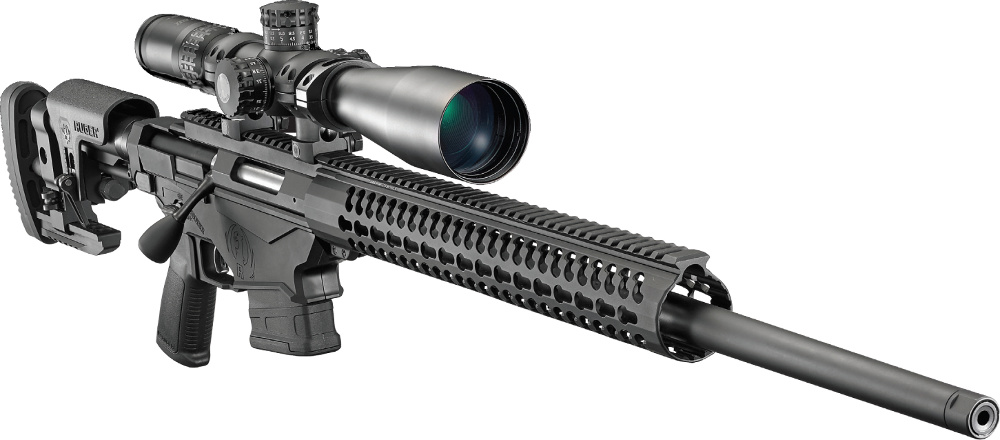
Ruger has introduced one of the most important factory rifles in years — the new Ruger Precision Rifle (RPR). The new RPR features the three-lug (70° bolt throw) action from the Ruger American Rifle mounted in a modular chassis system with many innovative features, such as cam-lock buttstock adjustments, and a “universal” mag well. Even with a hammer-forged barrel, the gun is very accurate. Everybody who has shot this gun so far has been impressed. This is a smart design, well executed. We predict Ruger will sell a ton of these guns. The new RPR is logical step up for AR owners seeking better long-range accuracy (and easier maintenance).
The RPR is currently offered in three chamberings with three different barrel lengths: .308 Win (20″ bbl, 1:10″-twist, 9.7 lbs); 6.5 Creedmoor (24″ bbl, 1:8″ twist, 10.6 lbs); and .243 Win (26″ bbl, 1:7.7″-twist, 11.0 lbs). All barrels are hammer-forged with 5R rifling, and are threaded 5/8″-24 at muzzle for brakes and suppressors. MSRP for all three models is $1399, so expect street price to be under $1200. You could pay that much for some tactical chassis systems by themselves, and then you’d still have to purchase action, barrel, and trigger!
So how does it shoot? Ruger designed the RPR to deliver sub-MOA 5-shot groups. At the media preview, using Hornady 6.5 Creedmoor factory ammo, test rifles shot well under 1 MOA, and in many cases closer to half-MOA. Frank Galli of Snipers’ Hide had a few three-shot groups in the twos. We would like to test this rifle with .308 Win hand-loads and a custom barrel — now THAT would be interesting…
Video Shows Features of Ruger Precision Rifle Receiver:
The lower receiver is CNC-machined from a 7075-T6 aluminum forging, Type III hard-anodized. The mag well front is contoured for bracing against shooting supports. The rifle even comes with a built-in +20 MOA tapered Picatinny scope rail. The trigger, unique to this gun, adjusts from 2.25 to 5 lbs. using a special tool that stows in the bolt shroud. The trigger has a Savage-type safety insert.
The buttstock is fully adjustable with quick-adjust cams. But if you prefer a different style of buttstock, that’s do-able — the left-folding stock hinge is attached to an AR-style buffer tube, so the MPR will accept any AR-style stock. Likewise, you can attach any AR-compatible forearm to the RPR.
Seven Patents Pending for RPR
Notably, Ruger has seven patents pending for this new rifle — that shows the design innovation packed into the RPR. Ruger is pursuing patents on the universal magazine latch system, dual barrel nut system, trigger system, dual-action stock cam levers, bolt body design and other features.
The RPR boasts a Universal Mag Well that works with front-latch AND side-latch mags.
Forum member Steven Blair notes the barrel attachment system is different than an AR: “It doesn’t incorporate a barrel extension, the bolt locks in the receiver. It does have a shoulder larger than the main barrel diameter that would require turning the full barrel length.”
Sniper’s Hide Boss Tests Ruger Precision Rifle
Frank Galli, head honcho of Snipers’ Hide, recently tested the 6.5 Creedmoor version of the RPR. Galli says the rifle offers excellent accuracy and an impressive feature set. Galli believes the RPR offers great value compared to a custom-built tactical rifle that could cost $3500 or more. Read Galli’s detailed review on the Sniper’s Hide website.
Click image to read Snipers’ Hide RPR Review…
Sniper’s Hide Boss Frank Galli reports:
This is a full-featured, precision rifle with an entry-level price tag. The feature list of this rifle is huge. I could probably write 1800 words and still not explain everything packed into this rifle. But suffice to say, it’s customizable. If you wanted to change the stock, use any AR15-capable stock, Magpul PRS, no problem. Want to change the fore-end, same thing, you can add any AR15 fore-end…. The only feature you cannot change is the trigger.
At distance, it’s easy to say, this rifle performs, in the video we [show] a 1/2 MOA Group at 850 yards on steel. The muzzle velocity with factory 140gr AMAX is 2810 fps out of this rifle.
This is the entry-level precision rifle that can put you in the mix of any precision rifle competition held anywhere in the US for under $2500 with scope. What is your excuse now?
Here’s a special savings opportunity from Midsouth Shooters Supply — save up to 60% on unclaimed special order items. From time to time, Midsouth’s customers request special order items but never claim them. To clear space for other inventory, Midsouth is running a blow-out sale on these items. If you’re looking for a super deal on dies, rings, and other gear, check out this Unclaimed Special Order Item Sale. Here are just a few examples of items at 30% off normal pricing:
AMMO: 6.5x55mm 100 Grain A-Max 20 Rounds (Closeout $28.90) SCOPE: Leupold VX-2 4-12x50mm CDS Duplex Reticle Matte Finish (Closeout $374.50) DIES: Forster 223 WSSM Full Length Die & Ultra Micrometer Seater Set (Closeout $67.92) SCOPE MOUNT: Integrated 1″ Ring Mount Weatherby/Howa Short Action (Closeout $36.96) KNIFE: Gerber Powerframe Serrated Knife (Closeout $14.91)
The CMP’s National Trophy Infantry Team Match (NTIT) has been a staple at the National Matches since 1922. Also known as the “Rattle Battle,” the event is one of the most unique in the competitive rifling world — scoring is based on how many hits six-person teams can score on a bank of targets during a series of 50-second firing periods at four yardages. Teams begin the NTIT match with 384 rounds of ammunition, which they fire upon eight silhouette targets from 600, 500, 300 and 200 yards during successive 50-second periods. After each rapid-fire string, team members move forward (to the next-closest distance) carrying all equipment from firing line to firing line. The match emphasizes extremely fast, accurate fire and good communication among teammates. The Rattle Battle is always an exciting competition for spectators to watch. View NTIT match results on the CMP website.
Watch CMP ‘Rattle Battle’ Video — 50 Seconds of Rapid Fire…
The video shows the California Grizzlies, one of the top junior squads. The lead photo shows the U.S. Army Reserve (USAR) Team in action during the NTIT match. See more in USAR “Rattle Battle” Video.
Here’s a great YouTube video that shows the creation of a high-end, 22-250 varmint rifle from start to finish. The rifle was crafted by Chad Dixon for O’Neill Ops. Once the build is complete, the video shows the rifle being tested at 440 yards. With the camera filming through the scope, you can even watch the trace, starting at the 2:36″ time mark (this is very cool).
Watch this Video in HD!
Any person with an interest in gunsmithing should watch this video. It shows barrel profiling, tenon-thread cutting, chambering, CNC stock inletting, bedding, and stock painting. This is one of the best short videos of its kind on YouTube.
For this build, Chad Dixon of LongRifles, Inc. teamed up with O’Neill Ops. The video shows the “Coyote Rifle” build, step by step, from the cutting of the tenon threads, to the 440-yard field test at the end of the build. To learn more about this rifle’s components and its performance in the field, contact James O’Neill, www.oneillops.com, (605) 685-6085.
Chad Dixon of LongRifles, Inc.
Chad Dixon’s introduction to firearms began in 1991 as a marksmanship instructor and competitive shooter in the U.S. Marine Corps. Chad began building rifles in 2000 at the Anschutz National Service Center, where he worked with U.S. Olympic shooters. In 2003 Chad took a position with Nesika Bay Precision/Dakota Arms. After leaving Nesika, Chad deployed to the Middle East as a security contractor for the U.S. Dept. of State. On his return to the USA, Chad started LongRifles Inc., a custom rifle-building company.
Dixon-built rifles combine modern CNC manufacturing methods with traditional expert craftsmanship. Chad’s rifles have won major int’l and national level competitions in Smallbore, Smallbore Silhouette, High Power, and Long Range Palma disciplines.
Reactive targets — whether balloons, steel gongs, or clay birds — always add fun to a range session. But precision shooters may want something more challenging (i.e. smaller) than a clay bird when shooting inside 300 yards. For a change of pace, try shooting at inexpensive pool cue chalks. Less than 1″ square, these will test your marksmanship skills.
Pool Cue Chalks — Cheap, Fun, Dramatic
If you’re looking for a small target that makes a nice big cloud of color when hit, try pool cue chalks — those little blue cubes you use to dust the end of billiard cues. Measuring about 7/8″ per side, billiard chalks make very challenging targets at 100 and 200 yards. When you hit them, if you nail the circular “dimple” in the middle, they disintegrate impressively, tossing blue “smoke” in all directions. Billiard chalks are inexpensive. You can buy a dozen chalks online for about $3.00 — just 25 cents each. And the prices drop with more quantity. One gross of chalks (that’s 144 pieces) costs just $19.95 at ozonebilliards.com.
To see actual hits on chalk at 100 and 200 yards, watch the video above. (WARNING: Soundtrack is loud and advertisement may play before movie.) The movie-maker, Phil of the Random Nuclear Strikes Blog, cautions that: “You’ll notice (in the video) that some of the hits are ‘wiffs’ instead of ‘poofs’. If you look at the picture above, you’ll see the 1/2 inch dimple in the cube face. If you don’t put the bullet in that dimple, it’ll ‘wiff’ on you.”
Garand matches are among the most popular and well-attended of the CMP competition disciplines. When obtained directly from the CMP, Garands are fun to shoot and affordable. However, with these classic battle rifles, you need to ensure that the headspace is set properly to ensure safe function and good brass life.
In the archives of The FIRST SHOT, the CMP’s online magazine, CMP Armorer John McLean has written an excellent article entitled: “Everything You Ever Wanted to Know about Checking M1 Garand Head Space.” We recommend all Garand shooters read the article.
McClean explains: “Excessive headspace will cause the brass to stretch more than it should and increases the likelihood of a case failure. Insufficient headspace may contribute to slam fires, light strikes on primers, misfires and more wear on parts due to the additional force needed to chamber the rounds.”
Garand Head Space Gauges
McClean writes: “Both Forster and Clymer make fine gauges but we have found that there are differences between the two companies’ gauges that make the Clymer gauges best for use with the M1. The headspace that the original manufacturers of the M1 considered correct can be determined by checking new or nearly new rifles that we have here at CMP. With that information we have determined that Springfield Armory and the other manufacturers of the M1 used gauges that were very close to the Clymer dimensions… and therefore we use, and recommend using only the Clymer gauges.”
How to Check for Proper Headspace
In the article, McClean goes on to show how to properly use the “GO”, “NO GO”, and “FIELD” gauges. You’ll want to read the Complete Article. One of the important points McClean makes is that the ejector can affect headspace reading. Accordingly, “the bolt must be disassembled and the ejector removed, or clearance notches must be made on the headspace gauges so there will be no contact between the headspace gauges and the ejector.”
Report by Kyle Jillson from NRABlog.com. Sergeant First Class (SFC) Keith Sanderson of the U.S. Army Reserve has been crowned the 2015 NRA National Pistol Champion. After six wet days at Camp Perry along the shores of Lake Erie, Sanderson unseated defending champion Brian Zins by 14 points – 2655 to 2641.
Sanderson, who served eight years in the Marine Corps and eight years in the U.S. Army, is a renowned sport shooter who holds an Olympic record and won an unprecedented three medals (gold, silver, and bronze) in three World Cups in 2009.
Wet Conditions at Camp Perry this Year
At Camp Perry, you can always expect a little rain to come off the lake, but the midwest is experiencing torrential storms this summer and parts of the range – especially along the firing line – became flooded ponds. This year some shooters even stuck “No Wake” signs in the larger puddles to keep attitudes light despite the muddy situation.
Some competitors wore rubber boots to help navigate the puddles.
The Swarovski Optik website features a blog with interesting technical articles. In the “On Target” series of blog stories, Swarovski has provided a handy explanation of how optics systems work, with exploded diagrams of rifle scopes, spotting scopes, and binoculars. CLICK HERE for Swarovski Optics Blog.
Scope Terminology Focusing Lens
The focusing lens is an adjustable lens inside the optical system for focusing the image at different distances…. In the case of rifle scopes, apart from focusing, the focusing lens also facilitates parallax compensation.
Diopter Adjustment
For rifle scopes, the reticle can be focused using the diopter adjustment on the eyepiece, thereby correcting any visual impairment. [Editor’s Note: Movable eyepiece diopter adjustment is not offered on all rifle scopes. It is a useful feature on Swarovski and other premium scopes. This allows shooters who need eyeglasses to get a sharply focus image even without wearing corrective lenses. Of course shooters should always wear ANSI-certified eye protection. With the diopter, folks who need correction can use inexpensive, non-Rx safety eyewear instead of expensive prescription safety glasses.]
Reversal System
The purpose of the reversal system is to reverse the image by means of prisms in binoculars and telescopes, and lenses in rifle scopes….The lens reversal system is needed in rifle scopes to control the variable magnification and move the exit pupil[.]
Resource tip by EdLongRange. We welcome reader submissions.




 Here’s a great YouTube video that shows the creation of a high-end, 22-250 varmint rifle from start to finish. The rifle was crafted by Chad Dixon for O’Neill Ops. Once the build is complete, the video shows the rifle being tested at 440 yards. With the camera filming through the scope, you can even watch the trace, starting at the 2:36″ time mark (this is very cool).


 In the archives of
 Sergeant First Class (SFC) Keith Sanderson of the U.S. Army Reserve has been crowned the 2015 NRA National Pistol Champion. After six wet days at Camp Perry along the shores of Lake Erie, Sanderson unseated defending champion Brian Zins by 14 points – 2655 to 2641.


