Hoping to impress consumers (and possibly secure a major military contract or two), Beretta has introduced the APX, a new striker-fired 9mm handgun. The APX borrows elements from the Glock, HK VP9, and S&W M&P pistols. The grip looks very ergonomic, with an extended rear overhang on the top (like the M&P) and contoured grooves on the front (like the VP9). The most distinctive feature of the new Beretta would be the prominent machined ridges on the slide designed to aid in racking the pistol.
The APX is built with a chassis system. This means that the internal sub-frame is the serialized part. The new APX features a reversible, ambidextrous magazine release. The magazines themselves have a prominent plate on the bottom for easier insertion/extraction. To better fit various hand sizes, three different backstrap inserts can be fitted to the grip.
Beretta hopes many of the world’s armies will adopt this new pistol, which was released at IDEX (International Defense Exhibition & Conference) in late February. According to Gear Scout:
“The pistol is designed specifically for the military market, and Beretta says it’s destined to become the company’s entry into the Army’s Modular Handgun System. But, the Army has yet to release the final requirements for that program to industry. The US Army contract might be the gold rush of pistol contracts, but it’s not the only tender happening at the moment. No doubt, getting the APX out at IDEX was a way to show worldwide (and cash-flush Middle East) defense ministers the major features of the pistol while the company finishes up development on the US military/LE and eventual commercial configurations that will hit the US market soon.”
Here’s a dream gun industry job for a skilled engineer. Weatherby, one of America’s leading firearms manufacturers, is seeking an experienced Design Engineer. The Design Engineer is responsible for the development of new and existing firearms products, and equipment from concept to production. This includes R&D, design, testing, troubleshooting, improvements, procedure development, and documentation.
If you have an engineering degree and at least six (6) years of experience in firearms design and product development, you may want to apply for this job at Weatherby’s facility in Paso Robles, CA. Weatherby offers competitive compensation with healthcare and 401K plans. As for the venue, we can assure potential candidates that Paso Robles is a great place to live and work. (There are some great shooting ranges nearby.) If you are interested, and meet the guidelines, send a cover letter and current resume to Jalene John, jjohn [at] weatherby.com .
Additional Qualification requirements include the following:
· CAD experience in two-dimensional drafting and three-dimensional solid design. Extensive experience with SolidWorks CAD software. A high level of proficiency is required.
· Familiarity with manufacturing processes including machining, metal finishing, heat treating, plastic & metal injection molding.
· Ability to travel domestically and internationally to industry trade shows and vendor factories to support production and product development.
· Strong communication, presentation and organizational skills. Ability to work independently as well as in a team environment.
Germany is the center of the gun world this week. Now through March 9, 2015 Nuremberg (Nürnberg) hosts the IWA Outdoor Classics trade show, Europe’s largest gun-related exposition. Nearly 1400 exhibitors will be displaying new guns, shooting accessories, and hunting gear. We know many of our readers would love to experience the IWA trade show first-hand, but traveling to Europe is impractical. Well for you guys, here are the keys to the castle. Just follow the tips below and you can preview thousands of products currently on display in Germany.
4707 Products in 2015 IWA Product Showcase
If you want to see all the guns and gear featured at the 2015 IWA show, visit the IWA Products Page on the web. There you’ll find descriptions of 4707 featured products, everything from ballistics software to safari rifles. Click on the “New Products” link to see 554 featured new items. You can browse all new products, or Choose Product by Category. For the main product categories (Such as Guns, Ammo, and Optics), you can further search by subcategory (e.g. Guns > Rifles, or Optics > Rangefinders).
Newcon Optik 12,000-meter LRB 12K Night GPS-Enabled Smart Rangefinder:
The LRB 12K and LRB 12KNIGHT from Newcon Optik are built to outperform any handheld laser rangefinder binocular available today. Features include: A 12,000m (NATO target) measuring range, built-in digital magnetic compass, built-in GPS receiver, and in the LRB 12KNIGHT a Gen 3 night-vision channel. Through USB and RS-232 interfaces, the LRB 12K and LRB 12KNIGHT can be operated remotely, and transmit data to external GPS systems and ballistic computers. Both units can communicate with Android™-based smartphones and tablets.
Alexander Arms Ulfberht .338 Lapua Rifle:
Here is the Ulfberht semi-automatic, .338 Lapua Magnum rifle from Alexander Arms. The rifle features a custom-designed gas piston operating system, steel receiver, 27.5-inch chrome moly barrel with 1:9.3″ twist, three-prong flash hider, folding Magpul PRS stock, and Geissele SSA® two-stage, match-type trigger. The rifle is 41.25 inches long with the stock folded and 50 inches long with the stock extended. Total rifle weight is 19.8 pounds.
Bluetooth-Enabled Ear Muffs with Retractable Microphone.
The Swedish-designed Hunter SMART Active Hearing protection system lets a hunter communicate with his guide or hunting companion. This works with reachargeable AA batteries and it can also play music. These electronic muffs boast bluetooth connectivity, with a retractable mic, and mini-USB port.
In the video below, Forum Member Thomas Haugland (from Norway) shows how to install a Picatinny-type rail on a Sako action. Every stage of the process is illustrated — removing the barrel from the action, drilling/tapping the action, aligning/attaching the rail, and finally mounting the scope and test-firing the rifle. Note that the action is removed using a large adjustable-end wrench with brass disks to protect the finish. This is possible because this particular Sako action has a flat bottom and top. With a different action you’ll want to use a custom action wrench.
In the video, Thomas and his assistant actually fabricate the rail from scratch. That’s probably beyond the ability of most do-it-yourselfers. You can purchase precisely machined Picatinnny rails from Seekins Precision and other sources instead. Still, it is interesting to see the milling of the rail. Note that, before screwing the rail to the top of the action, Thomas applies a marine epoxy (timeline 3:18). This effectively beds the rail to the top of the action and provides a more secure installation.
You can find more interesting gunsmithing, hunting, and long-range shooting videos on Thomas Haugland’s YouTube Channel.
The IWA Outdoor Classics trade show, aka “Euro SHOT Show”, opened today, March 6th, in Nuremberg, Germany. For the next four days (March 6-9), 1383 exhibitors will show their products at the Nuremberg Exhibition Centre. This is a hugely popular event — last year’s IWA Outdoor Classics trade show attracted 39,244 visitors from 117 countries, and attendance should be even higher this year. IWA is Europe’s biggest combined trade show for the hunting, shooting, and civilian/military security industries. And this year, IWA Outdoor Classics was coordinated with EnforceTac, a two-day Law Enforcment/Security trade show held in Nuremberg March 4-5, 2015.
IWA even features an indoor Archery Range. For many years, the Archery Range (located in Hall 5) has been a popular gathering place where exhibitors and visitors can practice their skills and learn about the latest archery products up close and personal.
About the IWA Outdoor Classics Trade Show
What is now the IWA Outdoor Classics trade show began 42 years ago as Germany’s national product show for gunsmiths and gun retailers. That product show started modestly in 1973 with less than 100 exhibitors. Over the past four decades IWA Outdoor Classics has grown into a massive event, drawing the major players in the hunting, security, and shooting sports industries. In the firearm universe, the IWA event is second only to America’s SHOT Show in importance. This video (produced in 2013) shows IWA highlights from the past four decades:
For guys who want an ultra-high contrast target with a square box in the center, Birchwood Casey offers ultra-bright neon green targets with box centers and spike-style extended vertical and horizontal lines. The manufacturer explains: “These newly designed adhesive Target Spots come in highly-visible Atomic Green. The crosshair design fulfills the needs of open-sight shooters along with scope users. Easily line up your open sights on the center square or lay the crosshairs along the vertical and horizontal diminishing lines.” You can also rotate the Atomic Green Target Spots 45° to create a diamond center with the crosshairs in an “X” pattern.
We like these targets. The Atomic Green background is a true “day-glo” color (like safety signs) so these circles appear very bright on a target backer. These work well in low light. NOTE: Atomic Green spots are NOT “splatter” targets — a contrasting color does NOT appear around your bullet holes.
Multiple Sizes Offered
Birchwood Casey sells the new Atomic green circles in various sizes. You can order a Combo Pack with sixty 1″-diameter spots, thirty 2″-diameter spots, and twenty 3″-diameter circles.
You have to love this — a shooting facility in Western Pennsylvania has its own ammo vending machine. This is the same kind of machine normally used to sell snack foods. But at the Beaver Valley Rifle & Pistol Club (BVRPC), you can get .38 Specials instead of Pretzels. The vending machine offers a wide assortment of pistol cartridges, packaged in 50-round bags. Fifty 9mm Luger rounds cost $21.00 and yes the machine takes credit cards.
The machine was installed by Sam Piccinini, owner of the Master Ammo Company. Sam says the machine is a convenience for club members, who had trouble finding ammo that complied with Club rules prohibiting jacketed bullets: “Most conventional commercial ammunition manufactured today is jacketed, and jackets can separate from the lead when it hits the backstops in gun ranges.” All the ammo in the vending machine features non-jacketed bullets. Piccinini states: “The machine sells pretty much everything — from .22 long rifle to .45 Long Colt and every standard caliber in between except .32 and .25 automatic. It’s got 380, 9, 38, 40, 45, .357 SIG.” (Source BeaverCountian.com)
Mainstream media reports of the ammo vending machine have spurred controversy. ATF rules prohibit an ammo-maker from selling handgun ammunition to persons under 21 years of age. The machine is located inside a locked, private facility restricted to persons over 18. On the machine is the warning: “You must be over 21 to purchase handgun ammunition from this machine.” BVRPC President Bill Fontana states: “It’s nobody’s business, it’s our club, we can do as our members allow us. Legally there’s nothing anybody can do about it.”
CMP Board Members and a few CMP staff members enjoyed a visit to the CMP Talladega Marksmanship Park yesterday. They fired a few shots downrange from the 200-yard line. Here’s an image from the Kongsberg electronic target system. Shot impacts are precisely triangulated with sonic target sensors, then shot locations (and scores) are displayed on monitors placed next to each shooter. For more information on the CMP Talladega Marksmanship Park, visit http://thecmp.org/competitions/talladega-marksmanship-park/.
The 13,000-square-foot CMP Park Club House overlooks the 600-yard range. Panoramic windows look out towards the firing line and the Alabama woodlands beyond.
Register Now for Inaugural D-Day Match at Talladega
The first official matches at the new CMP Talladega Marksmanship Park will be fired on the weekend of June 6-7, 2015. The celebration is a two-day event which includes tours of the facility. A special John C. Garand “D-Day Anniversary” Rifle Match On Saturday, June 6th will officially open the facility. On Sunday there will be an EIC Service Rifle Match, EIC Service Pistol Match, and a CMP .22 Rimfire EIC Pistol Match. The inagural event is limited to the first 350 Competitors, so register soon via the CMP’s Competition Tracker website.
You probably know by now that the ATF is seeking comments on a proposed regulation that would ban the importation and sale of M855 steel-core 5.56x45mm ammunition. The ATF has proposed banning this “green-tip” ammo (and similar products) on the grounds that it is “armor piercing”.
Nobody knows whether the proposed ban will actually go into effect. The ATF is solicting comments through March 16, 2015. The mere possibility of a ban has spurred a feeding frenzy of ammo sales. If you are looking for genuine M855-type Green Tip ammo, suitable for use in AR-platform rifles, Creedmoor Sports recently obtained a large supply. Creedmoor just located quantities of Lake City-produced, American Eagle-brand XM855 in cardboard boxes: “Our team found another source for 5.56 mm XM855F Federal Lake City Green Tip Ammo. This ammo is becoming almost impossible to source the closer we get to the [March 16th end] of the ATF comment period.”
Lake City M855 5.56 62gr Green Tip Ammunition (300 Rounds)
Product Description
High-quality 5.56x45mm ammo made in the USA by Lake City. This is “XM855″ ball ammo with a steel penetrator in the core, surrounded by a copper jacket. The projectile is color-coded with a green-painted tip as is traditional with US-made M855.
Product Specifications:
* Manufacturer: Federal / Lake City
* Model: XM855
* Caliber: 5.56 NATO (5.56x45mm)
* Grain Weight: 62 Grains
* Type: Full Metal Jacket with Penetrator
* Units per Case: 300 (in two 150ct boxes)
More Spin, Less Drag
In this article, we look at how twist rate and stability affect the Ballistic Coefficient (BC) of a bullet. Again, this topic is covered in detail in the Modern Advancements book. Through our testing, we’ve learned that adequate spin-stabilization is important to achieving the best BC (and lowest drag). In other words, if you don’t spin your bullets fast enough (with sufficient twist rate), the BC of your bullets may be less than optimal. That means, in practical terms, that your bullets drop more quickly and deflect more in the wind (other factors being equal). Spin your bullets faster, and you can optimize your BC for best performance.
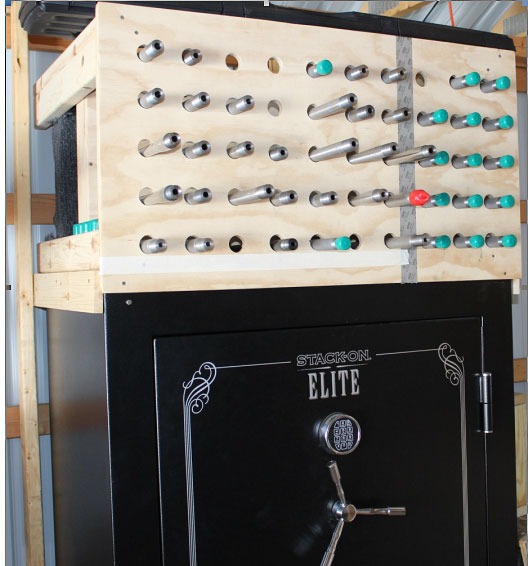
Any test that’s designed to study BC effects has to be carefully controlled in the sense that the variables are isolated. To this end, barrels were ordered from a single barrel smith, chambered and headspaced to the same rifle, with the only difference being the twist rate of the barrels. In this test, 3 pairs of barrels were used. In .224 caliber, 1:9” and 1:7” twist. In .243 caliber it was 1:10” and 1:8”, and in .30 caliber it was 1:12” and 1:10”. Other than the twist rates, each pair of barrels was identical in length, contour, and had similar round counts. Here is a barrel rack at the Applied Ballistics Lab:
Applied Ballistics used multiple barrels to study how twist rate affects BC.
“The Modern Advancements series is basically a journal of the ongoing R&D efforts of the Applied Ballistics Laboratory. The goal of the series is to share what we’re learning about ballistics so others can benefit.” –Bryan Litz
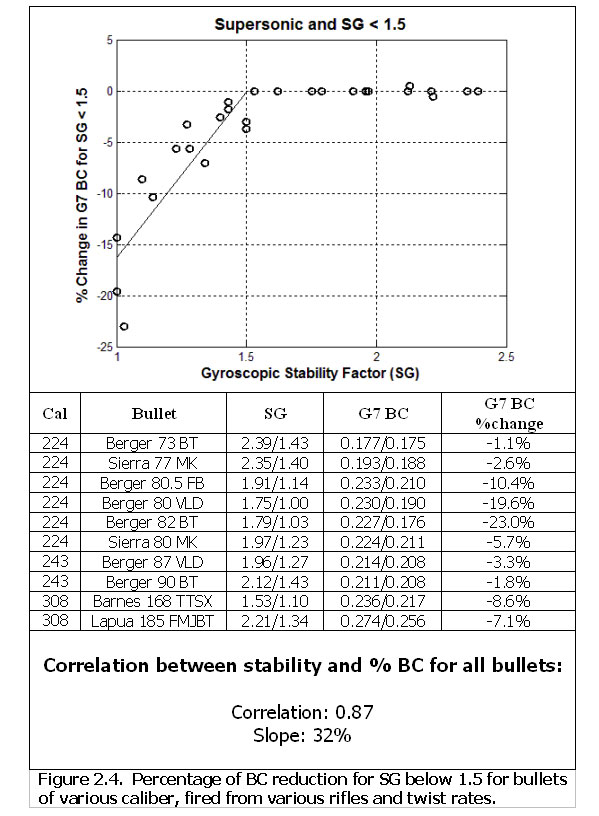
Barrel twist rate along with velocity, atmospherics, and bullet design all combine to result in a Gyroscopic Stability Factor (SG). It’s the SG that actually correlates to BC. The testing revealed that if you get SG above 1.5, the BC may improve slightly with faster twist (higher SG), but it’s very difficult to see. However, BC drops off very quickly for SGs below 1.5. This can be seen in the figure below from Modern Advancements in Long Range Shooting.
The chart shows that when the Gyroscopic Stability Factor (SG) is above 1.5, BC is mostly constant. But if SG falls below 1.5, BC drops off dramatically.
Note that the BC drops by about 3% for every 0.1 that SG falls below 1.5. The data supports a correlation coefficient of 0.87 for this relationship. That means the 3% per 0.1 unit of SG is an accurate trend, but isn’t necessarily exact for every scenario.
It’s a common assumption that if a shooter is seeing great groups and round holes, that he’s seeing the full potential BC of the bullets. These tests did not support that assumption. It’s quite common to shoot very tight groups and have round bullet holes while your BC is compromised by as much as 10% or more. This is probably the most practical and important take-away from this test.
To calculate the SG of your bullets in your rifle, visit the Berger Bullets online stability calculator. This FREE calculator will show you the SG of your bullets, as well as indicate if your BC will be compromised (and by how much) if the SG is below 1.5. With the stated twist rate of your barrel, if your selected bullet shows an SG of 1.5 (or less), the calculator will suggest alternate bullets that will fully stabilize in your rifle. This valuable online resource is based directly on live fire testing. You can use the SG Calculator for free on the web — you don’t need to download software.
Learn More About SG and BC This article is just a brief overview of the interrelated subjects of twist rate, Gyroscopic Stability, and BC. The coverage of twist rates in Modern Advancements in Long-Range Shooting is more detailed, with multiple live fire tests.
Other chapters in the book’s twist rate section include: · Stability and Drag – Supersonic
· Stability and Drag – Transonic
· Spin Rate Decay
· Effect of Twist rate on Precision
Other sections of the book include: Modern Rifles, Scopes, and Bullets as well as Advancements in Predictive Modeling. This book is sold through the Applied Ballistics online store. Modern Advancements in Long Range Shooting is also available in eBook format in the Amazon Kindle store.


 Here’s a dream gun industry job for a skilled engineer. Weatherby, one of America’s leading firearms manufacturers, is seeking an experienced Design Engineer. The Design Engineer is responsible for the development of new and existing firearms products, and equipment from concept to production. This includes R&D, design, testing, troubleshooting, improvements, procedure development, and documentation.