|
|
July 23rd, 2014
The President’s Rifle Match is a notable rifle competition that is steeped in history. This match was first held in 1878. The top shooter at the 2014 President’s Rifle Match Final was SGT Augustus Dunfey of Phenix City, Alabama. A member of the USAMU squad, Dunfey posted an Aggregate score of 393-14X. Reigning National High Power Champion Brandon Green, also of the USAMU, finished second with 388-15X. High Junior was Nash Neubauer firing a 383-8X. Interestingly. Neubauer’s 383-8X score was good for 6th place overall, beating 94 other shooters, including many military team members. Great shooting Nash! High Senior was Richard Zolnowsky with 376-14X.

CLICK HERE for Results of President’s Match and Other National Trophy Matches.
Origins of the President’s Match
The National Rifle Association’s President’s Match was instituted in 1878, as the American Military Rifle Championship Match. In 1884, the name was changed to the President’s Match for the Military Rifle Championship of the United States. It was fired at Creedmoor, New York until 1891. In 1895, it was reintroduced at Sea Girt, New Jersey. Today, the match is held at Camp Perry, Ohio.
 The President’s Match was patterned after an event for British Volunteers called the Queen’s Match. That British competition was started in 1860 by Queen Victoria and the NRA of Great Britain to increase the ability of Britain’s marksmen following the Crimean War. The President’s Match was patterned after an event for British Volunteers called the Queen’s Match. That British competition was started in 1860 by Queen Victoria and the NRA of Great Britain to increase the ability of Britain’s marksmen following the Crimean War.
The tradition of making a letter from the President of the United States the first prize began in 1904 when President Theodore Roosevelt personally wrote a letter of congratulations to the winner, Private Howard Gensch of the New Jersey National Guard.
After a hiatus in the 1930s and 1940s, The President’s Match was reinstated in 1957 at the National Matches as “The President’s Hundred.” The 100 top-scoring competitors in the President’s Match were singled out for special recognition.
CLICK HERE for history of the President’s Match.
July 23rd, 2014
 Goodbye Maryland, Hello Tennessee. Due to passage of restrictive laws in Maryland, Beretta will move all gun-making operations to Tennessee. On July 22, Beretta U.S.A. Corp., located in Accokeek, Maryland, announced that it will move its manufacturing capabilities from its existing location to a new production facility in Gallatin, Tennessee. The Gallatin facility is scheduled to be opened in mid-2015. Beretta U.S.A. had previously planned to use the new Gallatin, Tennessee facility for new machinery and production of new products only. Goodbye Maryland, Hello Tennessee. Due to passage of restrictive laws in Maryland, Beretta will move all gun-making operations to Tennessee. On July 22, Beretta U.S.A. Corp., located in Accokeek, Maryland, announced that it will move its manufacturing capabilities from its existing location to a new production facility in Gallatin, Tennessee. The Gallatin facility is scheduled to be opened in mid-2015. Beretta U.S.A. had previously planned to use the new Gallatin, Tennessee facility for new machinery and production of new products only.
“During the legislative session in Maryland that resulted in passage of the Firearm Safety Act of 2013, the version of the statute that passed the Maryland Senate would have prohibited Beretta USA from being able to manufacture, store, or even import into the State products that we sell to customers throughout the United States and around the world. While we were able in the Maryland House of Delegates to reverse some of those obstructive provisions, the possibility that such restrictions might be reinstated in the future leaves us very worried about the wisdom of maintaining a firearm manufacturing factory in the State”, declared Jeff Cooper, Beretta U.S.A.’s General Manager.
“While we had originally planned to use the Tennessee facility for new equipment and for production of new product lines only, we have decided that it is more prudent…to move the Maryland production lines in their entirety to the new Tennessee facility“, Cooper added.
The transition of production from Beretta U.S.A.’s Maryland facility to the Tennessee facility will not occur until 2015 and will be managed so as not to disrupt deliveries to Beretta customers. Beretta U.S.A.’s production of the U.S. Armed Forces M9 9mm pistol will continue at the Accokeek, Maryland facility until all current orders from the U.S. Armed Forces have been filled.
Beretta U.S.A. anticipates that the Gallatin, Tennessee facility will involve $45 million of investment in building and equipment and the employment of around 300 employees during the next five years. Beretta U.S.A. has no plans to relocate its office, administrative and executive support functions from its Accokeek, Maryland facility.
About Beretta
Beretta, established in 1526, traces its roots through 16 generations of continuous family ownership. Firearms bearing the Beretta name have been sold for almost 500 years. Beretta U.S.A. was founded in 1977 and supplies the standard sidearm to the U.S. Armed Forces. Today, Beretta manufactures and markets a complete line of firearms, accessories, and apparel.
July 22nd, 2014
Bullets.com has launched a huge closeout on its entire RCBS inventory. Here’s a great opportunity to save big bucks on high-quality RCBS tools and reloading accessories, including RCBS Chargemasters and even RCBS Rockchucker presses. The folks at Bullets.com report: “We have slashed prices to levels at or below cost on hundreds of items.” Guys — take note: this is a unique opportunity to pick up some great gear at truly rock-bottom prices. In fact the deals are so good that your Editor plans to purchase a couple presses, a powder measure stand, and some accessories for my RCBS 2000 progressive press. I really don’t think you can beat these prices… and remember this is an inventory close-out sale, limited to stock on hand. When it’s gone, it’s gone. So don’t say we didn’t warn you!

GO to RCBS Sale at Bullets.com
Closeout items include:
 Reloading Presses Reloading Presses
Electronic Powder Measures
Reloading Kits
Digital and Beam Scales
Tumblers
Ultrasonic Cleaners
Sizing and Seating Dies
Shell Holders
Bullet Casting Kits
Case Prep Tools and much more.
Here Are Some of the RCBS Presses on Sale:

Get RCBS Factory Rebates
In connection with this Bullets.com SALE, you can save even more with RCBS factory rebates. If you spend $50.00 you can get a $10.00 rebate. If you spend at least $300.00 on RCBS products you can save $50.00. These rebates are good through 12/31/2014. CLICK HERE for details.
Click for Detals

July 22nd, 2014
 Imagine if you could “steer” your bullet to the target, after the projectile leaves the muzzle. That has been a dream of marksmen ever since the first rifle was invented. Well that dream is now one step closer to reality, thanks to America’s Defense Advanced Research Projects Agency (DARPA). Imagine if you could “steer” your bullet to the target, after the projectile leaves the muzzle. That has been a dream of marksmen ever since the first rifle was invented. Well that dream is now one step closer to reality, thanks to America’s Defense Advanced Research Projects Agency (DARPA).
DARPA has developed a manueverable .50-caliber rifle bullet. DARPA’s Extreme Accuracy Tasked Ordnance (EXACTO) program recently conducted the first successful live-fire tests demonstrating in-flight guidance of .50-caliber bullets. Inside EXACTO bullets are optical guidance systems, aero-actuation controls, and multiple sensors. The top-secret technology permits the trajectory of the bullet to be altered in flight, allowing the bullet to move left or right, or even fly in an arc around an obstacle.
DARPA has released a video showing EXACTO 50-caliber bullets in flight. Watch carefully and you will see the tracked trajectory appear to bend off in one direction in the last segment of the bullet’s flight. Here is the DARPA Video:
According to DARPA: “This video shows EXACTO rounds maneuvering in flight to hit targets that are offset from where the sniper rifle is initially aimed. EXACTO’s specially-designed ammunition and real-time optical guidance system help track and direct projectiles to their targets by compensating for weather, wind, target movement, and other factors that could impede successful aim.”

DARPA states: “For military snipers, acquiring moving targets in unfavorable conditions, such as high winds and dusty terrain commonly found in Afghanistan, is extremely challenging with current technology. It is critical that snipers be able to engage targets faster, and with better accuracy, since any shot that doesn’t hit a target also risks the safety of troops by indicating their presence and potentially exposing their location.”
The Extreme Accuracy Tasked Ordnance (EXACTO) system seeks to improve sniper effectiveness and enhance troop safety by allowing greater shooter standoff range and reduction in target engagement timelines. The objective of the EXACTO program is to revolutionize rifle accuracy and range by developing the first ever guided small-caliber bullet. The EXACTO 50-caliber round and optical sighting technology expects to greatly extend the day and nighttime range over current state-of-the-art sniper systems. The system combines a maneuverable bullet and a real-time guidance system to track and deliver the projectile to the target, allowing the bullet to change path during flight to compensate for any unexpected factors that may drive it off course.
Technology development in Phase II included the design, integration and demonstration of aero-actuation controls, power sources, optical guidance systems, and sensors. The program’s next phase includes a system-level live-fire test and technology refinement[.]
July 22nd, 2014
 Carl Zeiss Sports Optics (Zeiss) has a new mobile Ballistics Calculator App for iOS (Apple) and Android devices. Modeled after the web-based Zeiss Ballistics Calulator, the new Mobile App is tailored to work precisely with Zeiss Ballistic reticles. Mike Jensen of Carl Zeiss Sports Optics explained: “We wanted those who use our proprietary ballistic reticles to have a ballistic tool that could be used virtually anywhere you have a signal for your device.” Carl Zeiss Sports Optics (Zeiss) has a new mobile Ballistics Calculator App for iOS (Apple) and Android devices. Modeled after the web-based Zeiss Ballistics Calulator, the new Mobile App is tailored to work precisely with Zeiss Ballistic reticles. Mike Jensen of Carl Zeiss Sports Optics explained: “We wanted those who use our proprietary ballistic reticles to have a ballistic tool that could be used virtually anywhere you have a signal for your device.”
The Zeiss Ballistic Calculator App allows users to pick their ballistic reticle from a drop-down menu. The user also has the ability to select factory or hand load data as well as environmental variables, and then the system will calculate and display the optimum magnification setting. With this system, distant yardages now coincide with the Zeiss ballistic reticle subtensions. The system allows the user to adjust standard settings for altitude and temperature, as well as other advanced settings, e.g. for muzzle velocity and sight height above bore.
Zeiss Ballistics Calculator App Features:
– One page screen application for fast data entry and easy to read results.
– Comprehensive and current database for factory and hand-loaded ammunition.
– Adjustable settings to customize unique shooting environments.
– Slide feature to visualize how magnification change alters point of impact.

The Zeiss Mobile Ballistic Calculator App can be downloaded at Google Play (Android App) and iTunes (iPhone App) for $4.99. Zeiss has noted that the App will soon be updated to include the Zeiss ASV ballistic turret system.
July 21st, 2014
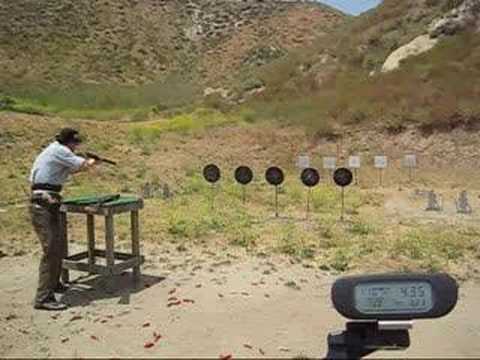
This Wednesday, July 23rd, on the Outdoor Channel, Shooting USA features End of Trail, the Cowboy Action World Championship. Hosted annually at the SASS Founders Ranch in New Mexico, End of Trail attracts nearly 1,000 shooters, hailing from 50 states and many foreign countries. SASS, the Single Action Shooting Society, is one of the most popular shooting organizations on the planet, having issued over 90,000 member badges. For SASS members, End of Trail represents the Superbowl and World Series combined. This special Shooting USA broadcast of the 2013 End of Trail airs at 3:30 PM, 9:00 PM, 12:00 Midnight (Thursday) Eastern Time. This year’s End of Trail took place June 19-29, 2014.

If you like multi-gun competition, you’ll enjoy watching Cowboy Action Matches. The top male and female shooters are experts with three kinds of firearms: Lever Rifle, Single-Action Revolver, and Shotgun (which can be a double-barrel side-by-side, or a pump, or even an 1887 lever-action). The guns must be originals or reproductions made prior to 1898 to be used in competition. A typical stage will require 5 shots from each of two six guns, ten rounds from the rifle, chambered in a pistol caliber, and 6 to 8 shotgun rounds.

24 Rounds from Four Guns in under 13 Seconds
To give you an idea of the action you can see on Shooting USA, here is a video of past world Champion Spencer Hogland, aka “Lead Dispencer”. In this video, Spencer fires 24 rounds, with four guns, in just 12.81 seconds (look at the timer in lower right corner). Spencer shows blazing speed with his lever gun and note how quickly he loads his shotgun. Fast loading is key to a successful stage run. Unlike modern multi-gun comps, normally Cowboy Action Shooters must start with empty shotguns.
July 21st, 2014
Muzzle brakes are controversial. Some people swear by them, while others swear at them. Still, there’s no question that a good brake can reduce felt recoil up to 45%. And likewise, the best brakes, when installed properly, seem to have no negative effect on accuracy.

Roy Bertalotto has done considerable experimentation with muzzle brakes, testing dozens of brake designs on his own rifles over the past few years. Roy’s article, Adventures with Muzzle Brakes, discusses various aspects of muzzle brake design and performance. Roy doesn’t claim that his testing is definitive, but his article is definitely worth a read. Here are some of Roy’s interesting findings:
Exit Hole Diameter
“Best accuracy and effectiveness of the brake was obtained with a hole .020″ over bullet diameter. If the exit hole is too small, such as +.005″ over bullet diameter, accuracy suffers. If the depth of the exit hole is too shallow, the metal around the hole will erode very quickly.”
Hole Placement
“The most effective braking was with a brake 1″ in diameter with a 3/4″ exit hole on each side, just in front of the muzzle. The bullet passes through a cone of 35 degrees before it exits the brake. (Like the tank example), Incredible reduction of recoil. But loud and ugly. Very easy to make since you don’t need a spin fixture or a dividing head.”
Bottom Gas Venting Helps Accuracy
“In my tests, not having holes all around the brake effects accuracy a bit. I believe it does something to the bullet by the air pushed ahead of the bullet creating unequal turbulence in the bullet path. I’ve tried a few brakes where I drilled only holes on the top, test fired, and then completed holes on the bottom and in every case, accuracy improved.” Below are spiral-ported brakes crafted by Clay Spencer.

Brakes Work Best with High-Pressure Cartridges
“The higher the pressure of the particular round, the more effective the brake. I have over 20 rifles with brakes. The 220 Swift is the king of reduction. Followed very closely by the 25-06, 6mm Remington, any Weatherby small bore. With a proper brake and a hot handload under a 40 gr bullet, the Swift will move 1/2″ to the rear and 0 muzzle rise! Big boomers with low pressure like 45-70s and shot guns benefit the least.” [Editor’s Note: Roy is judging effectiveness by the percentage of recoil reduction rather than absolute levels of recoil. Obviously if you start with a heavier-recoiling round, the absolute amount of recoil energy reduction is greater. Roy is really talking about efficiency–brakes are most efficient when used with high-pressure cartridges.]
Installation is Key to Accuracy
Roy’s findings are fascinating and suggest that further study of muzzle brakes is warranted. But we can all agree that precision installation of the brake is essential for accuracy. A poorly-installed, mis-aligned brake will degrade accuracy, that is well-known.
Harrell’s Precision has made thousands of muzzle brakes, in many styles and port arrangements. The Harrell brothers offer some good advice for gunsmiths installing brakes: “Muzzle brakes aren’t magic, they reduce recoil by redirecting exiting gas. What’s important is that they are straight and the threads are perpendicular with the base. The only way to get the base and threads perpendicular is to thread, not tap, them on a lathe.”
July 20th, 2014
Neither rain, nor geese, nor gloom of morn stays these competitors from the [sometimes swift] completion of their appointed rounds.
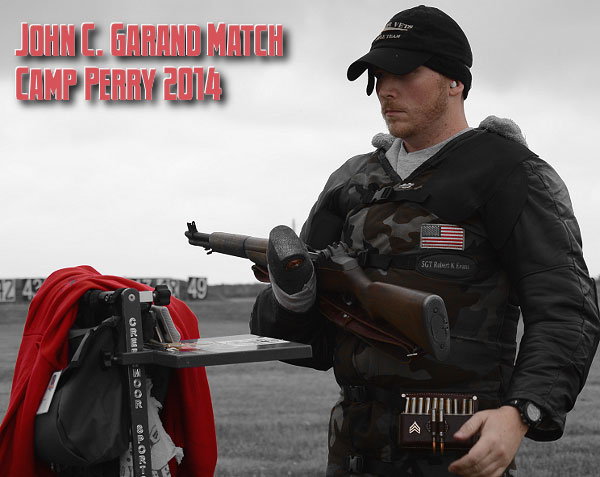
This year’s Camp Perry competitors at the John C. Garand Match had to battle rain, gloomy skies, plus an interruption by a bold flock of Canadian Geese. Nonetheless good fun was had by all. The challenge was to keep the guns and gear (and spectators) dry. All across the firing line one saw tarps and panchos, and even a few umbrellas. The match began on a very dark gloomy morning. Conditions improved during the day, but the rain clouds hovered all day long. CLICK HERE for hundreds more CMP photos from the event.
Wounded warrior Sgt. Robert K. Evans competes at Garand Match.

A flock of geese decided to fly across the firing line… VIEW LARGE PHOTO


It takes many helping hands in the pits to run a big match like this.


Here’s another way to store your gear on the firing line.

Spectators relied on panchos and umbrellas to stay dry.

“Been there, done that — got the T-Shirt.”


That’s all folks… until next year.

July 20th, 2014
 Trigger Blue-Printing — Why It Can Be Important Trigger Blue-Printing — Why It Can Be Important
by Thomas “Speedy” Gonzalez
To Blueprint or Not? That is the Question.
I often get asked is it really necessary to blueprint a custom match trigger. “Abolutely” is my answer. Here is an example that demonstrates why. After I completed a recent rifle project, the gun’s owner and I took the rifle to the range to break-in the barrel. But we quickly noticed a problem. The owner Alex L’s first statement was: “This trigger sucks — better blueprint it when you get back.”
Not only did the trigger feel rough and scratchy, but it failed to hold the cocking piece 2 out of 10 times when cocking the rifle for the next shot. Not good.
No matter what we tried at the range, the problem persisted. As soon as we returned from the range, I had to take the trigger apart to solve the mystery.
As soon as I opened her up on the operating table it was evident to me where the problem was. I have only seen the inside of about 3000 of these rascals and the head of the Over-Travel Screw stuck out like a sore thumb. The head of the Over-Travel Screw was nearly twice as thick as its other brothers and sisters. This caused the relationship between travel adjustment and sear engagement to be nearly impossible to adjust. And that, in turn, created a serious safety issue.
To remedy the situation, I replaced the screw with [another screw with] standard head thickness and ALL PROBLEMS DISAPPEARED… Amazing! Had I blue-printed this trigger before going to shoot, this never would have happened.
 
So, should one blueprint a trigger? I say “Hell yeah” if you are serious about competiting and winning. Otherwise be prepared for the worst. — Speedy
July 20th, 2014
Farley Manufacturing has just introduced a new gravity-fed cartridge caddy that puts your rounds right next to your rifle’s loading port. Farley’s new G-Feed Cartridge Elevator has a unique switchback-type feed path that provides high capacity in a compact unit. This unit is handy and fast to use. Farley says that, with a little practice, a skilled benchrest shooter can run five shots in less than 18 seconds. We believe that — provided a shooter has quality rests, a stock that tracks well, and good technique.

The G-Feed Elevator is held up by a 3/4″-diameter spring steel gooseneck (similar to 50s-style lamp support arm). You can easily adjust the gooseneck to the exact height and angle you want. (But Farley recommends at least 10 degrees of “tilt” to ensure proper feeding.)
Made from machined 6061 aluminum, the G-Feed Caddy ranges in price from $125.00 to $160.00 depending on cartridge size. Currently three sizes are offered: PPC, BR/PPC, and .284 Winchester. The BR/PPC model holds 22 rounds of BR cases or 23 rounds of PPC cases. The larger .284 Win model has a 25-cartridge capacity.

Product Tip from EdLongrange. We welcome reader submissions.
|


