Etymotic Research now offers its GSP•15® Electronic Earplugs in a smaller form factor. This gives shooters some of the best “wearable technology” on the market. These small, electronic earplugs protect the user from loud shot and blast noises, while at the same time allowing normal conversations. The active circuitry in GSP•15 earplugs allows for natural hearing when sound levels are safe. (Natural hearing is automatically restored when hearing is not at risk.) In this respect, these small earplugs do the job of a much larger, bulkier pair of electronic ear muffs.
GSP•15 plugs have a Noise Reduction Rating (NRR) of 25 dB, better than many electronic muffs. And these plugs are small, light, and comfortable. Using the company’s bean-sized Quiet Sound Amplifier® outer case, the latest GSP•15 earplugs fit great. A variety of tip shapes/materials are provided.
Special 15% Off Savings Now Through August 31, 2014
Etymotic GSP•15 Electronic Earplugs normally retail for $399.00. As a special offer for AccurateShooter.com readers, the full GSP•15 kit is now 15% off (roughly $339.15) if you use discount code AS2014 at checkout. This special offer is valid until August 31, 2014.
GSP•15 plugs pack impressive engineering inside a small package. High-sensitivity microphones, high-definition balanced-armature drivers, and advanced signal processing combine to deliver high-fidelity, natural sound. And, like the original model, the new GSP•15 earplugs come with a wide selection of ear-tips, with custom molds an available option.
“Hearing loss is preventable,” says Dr. Patricia Johnson, audiologist and hearing conservation specialist at Etymotic. “Etymotic has been providing the world’s only truly flat-attenuation in passive earplugs for over 25 years. We’re pleased to launch this new version of GSP•15 electronic earplugs that lets wearers hear naturally when sound levels are safe, but be protected when it counts.”
GSP•15s Work Well for Hunters — Providing Protection AND Amplification
Unlike bulky muffs, the GSP•15s fit perfectly under a hat or other cold weather headgear. And while they protect a shooter’s hearing from blasts, these electronic ear plugs also provides up to five times amplification in the enhancement mode. At the flip of a switch, sound is amplified, giving hunters “super hearing” in the field.
About Etymotic
Etymotic is a research, development and manufacturing company that designs high-fidelity personal audio products and hearing wellness solutions to assess, enhance, and protect hearing. For more information about Etymotic and its products, visit www.etymotic.com.
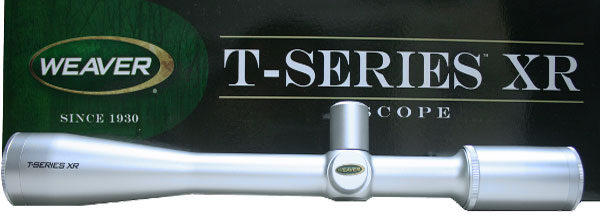
Weaver has a brand new, high-magnification, 46X target scope. Chances are you haven’t heard a thing about it — the new Weaver T-Series XR 46x48mm scope is so new you won’t even find it on the Weaver website. Compared to the older T-36, this new 46-power scope offers more magnification, more elevation, a larger front objective (48mm vs. 40mm), and a larger 30mm main tube (compared to 1″ for the old T-36). The new XR 46X Weaver also features side-focus parallax control. That’s a big change. You could instantly spot a classic Weaver T-36 by the adjustable front objective with its knurled ring and yardage markings. The T-Series XR 46X (as well as the new XR 24X and XR 36X) have the parallax control on the left side of the main tube (photo below).
We have looked through the new Weaver 46X scope and it is very sharp. Brightness is good — it seems comparable with a Leupold 45x45mm Competition (but that was on a bright, sunny day). Initial tests show the clicks to be tactile and positive, but we haven’t had a chance to do a full “box test” to confirm tracking. Weaver claims the new XR series scopes will focus down to 50 feet, but with the 46X we had some questions about its extreme close-focus capability. If you’re shooting beyond 50 yards, the focus should be fine.
The new T-Series 46X XR is offered with two reticle choices, a fine cross-hair (FCH), or FCH with 1/16th MOA dot. Both reticles are well-suited for benchrest work. The current “street price” for the new 46X Weaver is $829.95. That’s way more than the old T-36, but it undercuts Leupold fixed-power competition scopes by hundreds of dollars. We know of only two vendors who currently carry the Weaver 46X. These are Killough Shooting Sports, and Bruno Shooters Supply.
New 24X and 36X T-Series XR Scopes with Side-Focus and 1″ Tubes
The new 46-power XR scope is the star of the XR line-up. Designed to go head-to-head with Leupold’s 45X Competition scope, the 46X Weaver XR offers a modern 30mm main-tube and large (48mm) front objective. If you don’t need the bigger tube and larger objective, but still want side-focus parallax control, Weaver offers two other new XR scopes — a 36x40mm and a 24x40mm. These will both retail for under $600.
Dan Killough offers the black-finish 36-power XR for $559.95 and the black-finish 24-power XR for $549.95. Silver models are slightly more. These 1″-tube XR scopes are worth considering, but keep in mind that you can now purchase the older T-series scopes with adjustable front objectives for well under $400.00. For benchrest shooting at a fixed distance, side-focus is not necessary; adjustable front objectives work just fine. Just set and forget.
Which do you think is a better bullet-stopper — twenty-four (24) layers of drywall, or a $299 vest with 40 layers of Kevlar? Watch this video and you may be surprised. The makers of the BulletSafe vest fired a round from a .50-Caliber Desert Eagle pistol into the vest. The bullet did not penetrate the vest — not even close. If fact, the bullet only made it through seven of the 40 layers of Kevlar (see timeline 0:48″)
Would drywall be as effective? Surprisingly, the answer is “no”. A bullet fired from the .50-Cal Desert Eagle passed through all 24 sheets of drywall, exiting out the last sheet. Lesson learned? Don’t expect the drywall in your house to offer much protection. The makers of the video caution: “This video shows you how much damage your weapon can do….”
Bullet-Proof Vest Ratings
The BulletSafe vest tested is a Level IIIA model. Level IIIA is the thickest Kevlar laminated, flexible body armor available to the general public. Priced at $299.00, this Level IIIA vest is rated to stop most handgun rounds, buckshot, and shotgun slugs. You can get even more protection by adding a ballistic plate made from ceramic and/or metal. Fitted to a Level IIIA vest, BulletSafe’s $169.00 ballistic plates can stop some rifle rounds.
Plywood Stopping Power Test
The vest-makers also did a test with plywood. A box was constructed with 24 layers of 3/8″ plywood. The bullet from a .50-caliber Desert Eagle past through twelve layers of plywood before being halted by the thirteenth panel. So, you can say the BulletSafe vest is as effective at stopping this round as 13 layers of plywood. CLICK HERE for Plywood Stopping Test Video.
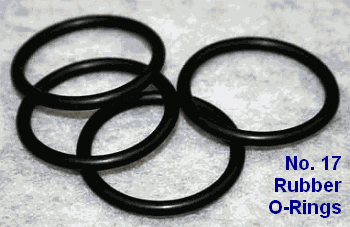
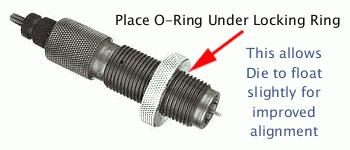
Here’s an inexpensive procedure that can help you load straighter ammo, with slightly better measured concentricity (i.e. less run-out) on the case necks and bullets. Simply use a rubber O-Ring on the underside of the die locking ring. This allows the die to self-align itself (slightly) to the case that is being sized. Without the O-Ring, if the flat surface on the top of your press is not perfectly square with the thread axis, your die can end up slightly off-angle. This happens when the bottom of the locking ring butts up tight against the top of the press. The O-Ring allows the die to float slightly, and that may, in turn, reduce the amount of run-out induced during case sizing.
Top prone shooter GSArizona has tried this trick and he says it works: “Go to your local hardware store and get a #17 O-Ring (that’s the designation at Ace Hardware, don’t know if its universal). Slip the O-Ring on the die and re-adjust the lock ring so that the O-Ring is slightly compressed when the die is at the correct height. Size and measure a few more cases. You will probably see a slight improvement in neck concentricity as the die can now float a bit as the case enters and leaves it. This isn’t going to be a dramatic improvement, but it’s a positive one.” We want to stress that adding O-Rings to sizing dies may help some reloaders, but we don’t offer this as a panacea. Try it — if using the O-Ring reduces measured runout that’s great. If it doesn’t, you’ve only spent a few pennies to experiment.
Lee Precision makes die lock rings with built-in O-Rings. Lee’s distinctive lock ring design allows the same kind of self-alignment, which is good. However, Lee lock rings don’t clamp in place on the die threads, so they can move when you insert or remove the dies — and that can throw off your die setting slightly. By using an O-Ring under a conventional die lock ring (that can be locked in place), you get the advantages of the Lee design, without the risk of the lock ring moving.
Commentary by Robert Whitley
In recent years several major firearms component suppliers have promoted the idea of the “do-it-yourself” AR-15 build up. In one sense this is a good thing because it promotes peoples’ education and understanding of firearms, but the down side of this is some folks are assembling and modifying AR-15s without an understanding of the rifle and without the necessary skills and tools to do things properly. The net result of this “do-it-yourself” work can be an AR-15 that is non-functional, problematic or dangerous. Here are two examples of common issues with “do-it-yourself” modifications.
Opening Up the Ejection Port
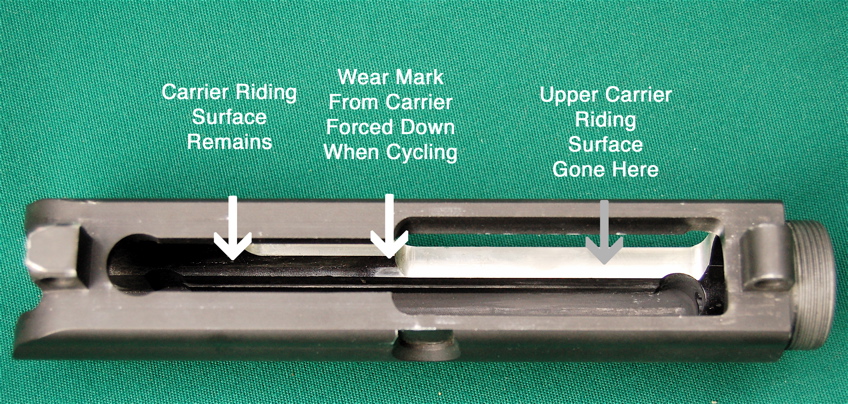
One common modification for AR-15’s is the opening up of the ejection port. This is typically done to permit more room for ejection or loading of the rifle, and it is also typically done in conjunction with a side charging handle modification.
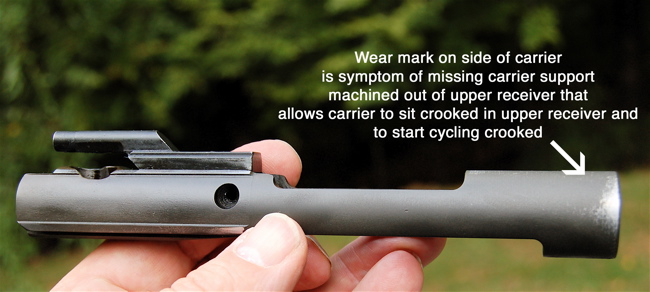
A common issue I have seen with this modification is that the person opening up the port removes the upper right hand carrier support and riding surface. The net result of this is that the carrier sits loose in the upper receiver when the bolt is in lock-up and this can have very detrimental effects on the function and accuracy of the AR-15. Below are more pictures of one that I saw recently.
Wrong Buffer Installed
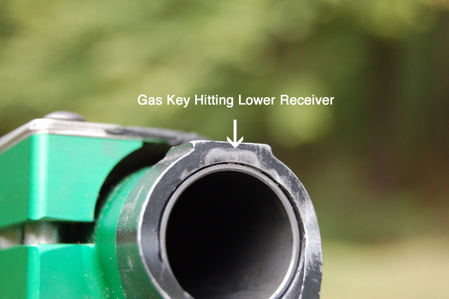
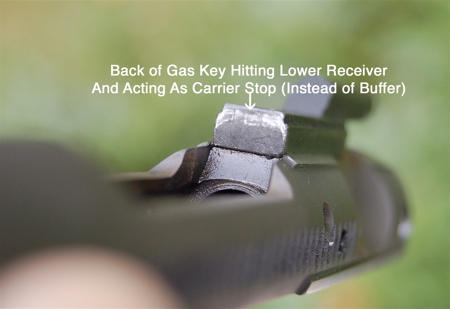
Another common mistake is the use of an improper buffer with the rifle (i.e. like using a carbine buffer in a standard rifle length buffer tube). There are many after market buffers being sold out there, but if the wrong buffer is used with the rifle, it can allow the bolt carrier to cycle too far back so that the rear of the carrier gas key becomes the stop for the carrier (i.e. when it smashes into the upper part of the lower receiver – OUCH!).
We have even seen situations where the gas key is snapped right off the carrier from this, and it completely disables the rifle and can also cause extensive damage to the firearm as well. Unfortunately we have seen this situation far too often and it is clear that a person needs to fully understand how the buffer assembly works if “do-it-yourself” work is going to be done to the buffer assembly, since everything done to the buffer assembly has an effect on the rifle, its function and accuracy.
While I applaud the person who is self-reliant and has a “can do” attitude, the other side of this is when it comes to a firearm, “do-it-yourself” work should only be done when and if one fully understands the rifle and how it functions and how the work will affect the rifle.
Robert Whitley
AR-X Enterprises, LLC
199 North Broad Street
Doylestown, PA 18901
(215) 348-8789 www.6mmAR.com
The 2014 National Matches started with the signature shot of a target rifle. This year the first shot was taken by a legendary marksman — DCM Emeritus Gary Anderson, who used the vintage Model 70 Winchester with which he had won many titles. Anderson, a two-time Olympic Gold Medalist, also served as keynote speaker for the National Matches Opening Ceremony. Anderson stated that the National Matches have “truly [become] a great shooting festival. It’s about all of us getting out on the field and participating.”
Anderson also talked about the skill of the shooters at the National Matches: “There’s a big difference between shooting and marksmanship. Marksmanship is a skill. Marksmanship is the ability to hit difficult, long-range targets. Marksmanship is extreme precision performed under the pressure of competition. Marksmanship, not just shooting, decides the ultimate results.”
This year’s National Matches started with a military theme. World War II aircraft flew overhead, a WW II Sherman tank rolled past the spectators, and cannons fired. The National Matches are a joint effort of the Civilian Marksmanship Program, the National Rifle Association, and the Ohio National Guard. The National Matches were were first held in 1903, and have been conducted at Camp Perry since 1907. After Anderson fired the first shot, he donated his Model 70 rifle to the Civilian Marksmanship Program.
In the short-range benchrest game, most of the attention goes to the 10.5-lb Light Varmint Class, and the 13.5-lb Heavy Varmint Class. But there’s another class that is enjoying increased popularity — Hunter Benchrest. In some ways, Hunter BR is more challenging, because you shoot a 10-pounder with a narrower (2.25″ forearm) and a 6-power scope (both LV and HV allow 3″-wide forearms and high-magnification scopes). It takes skilled gun-handling and careful aim to get the most from a Hunter Benchrest rig.
The modern Hunter BR rifle is a far cry from a typical deer rifle, or even a walk-around varminter. Jackie Schmidt explains: “Do not be fooled by that title ‘Hunter Benchrest’, or HBR. The typical HBR Rifle has, like its cousin the Group Rifle, evolved into a very singular-purpose piece of equipment, suited to do one thing very well — namely to shoot Xs in the competitive arena, governed by rather strict sets of rules promulgated by the IBS or the NBRSA.
Hunter Benchrest Rifle Standards
The two defining factors in HBR are the minimum case capacity, and the 6-power scope. Everything else is just window dressing. Can one shoot a real factory gun in Hunter BR Class? YES — IF your factory rifle meets these qualifications:
■ Total gun weight no more than 10 pounds.
■ Stock forearm must be convex (at least slightly) on the bottom, and no more than 2.25″ wide.
■ Gun must have magazine capable of holding at least two cartridges. (Normally, however, Hunter BR shooters don’t feed from the magazine.)
■ Gun must shoot cartridge with at least 45 grains of H20 capacity (same as a 30-30).
■ Scope must be a 6-power or capable of being set and used at 6X magnification.
If you go to the IBS website, you will see that there are a couple of exceptions, but in the end, to compete for the prize, you must have a legal Hunter BR rifle. But even if you’re not completely within the rules, most match directors will let a newcomer shoot along, for the fun of it, and to see what the game is really all about.”
Top Hunter BR shooter Al Nyhus tells us: “As Jackie has pointed out, the Hunter class in Benchrest has mutated into full race BR rigs…much like NASCAR ‘stock cars’ or NHRA ‘Pro Stock’. The original intent of Hunter was for a class where the average person with an interest in accuracy could bring a good shooting hunting rifle and give BR a try. Still a darn good idea, to me.
Hunter Benchrest Rig Chambered for the .30 Wolfpup
Here are photos of my Hunter Benchrest rig, which is pretty typical of what’s being used at this point in time. My Hunter BR rig is pretty standard stuff except for the chambering. It features a Stolle R/L Kodiak action tweaked a bit by Stan Ware, Kostyshyn 1:17 four groove, chambered for Stan Ware’s 30 WolfPup (30BR .240″ long/.085″ neck length). The photo below shows a Leupold 6X scope but I’ve been using a Sightron 6X lately.
This stock is an old Speedy/McMillan pattern HBR stock. I had it dipped (externally coated) with a carbon fiber pattern. By the rules, Hunter rifles cannot be glue-ins, so pillar-bedding is the norm. I guess the forearm is about as ‘convex’ on the bottom as any other stock currently in use. This is another area where the guns have evolved and the rulebook(s) haven’t exactly kept pace with the current state of what’s being used.”
Are you looking for an ultra-reliable, high-magnification target scope at a budget price? Well, you’re in luck. Right now, Bruno Shooters Supply has Weaver T-36 target series scopes on sale for just $379.95. That’s a great deal in today’s marketplace. These are non-zoom, fixed-power scopes suitable for benchrest competition. Weaver T-series scopes are well-known for their durability and repeatability. They also offer 1/8 minute of angle clicks for both windage and elevation. This is desirable when you’re trying to shoot bughole groups. Understand that, with a 40mm objective, a Weaver T-36 scope is NOT as bright as a Nightforce or March Competition scope. However, the Weaver is a fraction of the cost of those elite brands. Despite its affordable price, the Weaver T-36 has won plenty of benchrest matches.
Weaver T-Series scopes feature an adjustable objective for parallax-free shooting without moving the point of impact. Weaver T-36 features include 1/8 MOA windage and elevation adjustments using Weaver’s Micro-Trac dual-spring, two bearing contact design that allows for more independent movement in windage and elevation, and fully multi-coated lenses. T-36 scopes are waterproof, fogproof, shockproof, and covered by a limited lifetime warranty.
Other Vendors Are Charging Much More for Weaver T-Series 36X Scopes
Yes, the $379.95 price at Bruno Shooters Supply is a very good deal. Here is a screen shot of comparative prices charged by other vendors, as of today, July 7, 2014. See for yourself:
Jamie Gray, London 2012 Gold Medalist in Women’s 3 X 20, has retired from professional shooting this year. However, Jamie plans to stay involved in the shooting sports as a Public Relations/Marketing representative for ELEY, a leading maker of rimfire ammunition. Joining the ELEY team this month, Jamie will work with shooting clubs and educational institutions to promote smallbore target shooting.
Jamie’s role in the USA will be wide ranging. Her job description includes working with state associations, governing bodies, schools, colleges and retail partners, giving educational seminars, and meeting “grass roots” shooters across the USA. Jamie has always been an icon within the USA shooting community.
Those who have met Jamie know that she is passionate about her sport and that she’s always willing to help others. Jamie’s extensive knowledge, international experience, and engaging personality makes her a great choice for ELEY’s new PR & Marketing Executive for the USA. As an Olympian who competed in Beijing 2008 and then went on to win the Gold medal at the 2012 London Olympics, she is well qualified to “inform and inspire” the next Olympic hopefuls in the shooting sports.
Many of our readers travel far and wide during summer months, both on family vacations and to participate in shooting matches. When transporting firearms across state lines, it is vital to understand the laws and regulations that apply in each jurisdiction. Moreover, all of us need to stay informed about gun laws in our home states, since new laws are passed every year.
Indiana attorney Brian Ciyou has created an outstanding resource, Gun Laws by State (2014 Ed.) (GLBS), that explains firearms laws in all 50 states. Ciyou’s gun law treatise, available in both book and online (web) formats, covers state laws as well as key federal laws that apply in federal buildings, airports, National Parks, and school zones. There is a handy Reciprocity Map showing which states recognize concealed weapon permits issued in other jurisdictions. Moreover, GLBS covers Reciprocal Carry for all 50 states, Constitutional Law, Federal Statutory Law, Use of Force, Criminal Provisions, Civil and Criminal Liability, Preemption, Federal Property Rules, and Interstate Transportation.
Amazingly, you can access all this important legal information for FREE on the GLBS website. Click on an interactive map to quickly review gun laws in any state. Navigation links provide quick access to particular topics, such as rules for Airline Travel, Amtrak, National Parks, and Federal properties. The web version of Gun Laws by State is updated regularly, and Ciyou even provides a GLBS Gun Laws Blog with current “news and views” on gun regulations nationwide. This Editor regularly references the Gun Laws by State website. I suggest readers bookmark the site, and consider buying the book if you frequently travel with firearms outside your home state. The printed book version costs $19.95, while a digital eBook is $9.95. Click here to purchase GLBS books and eBooks.


 We have looked through the new Weaver 46X scope and it is very sharp. Brightness is good — it seems comparable with a Leupold 45x45mm Competition (but that was on a bright, sunny day). Initial tests show the clicks to be tactile and positive, but we haven’t had a chance to do a full “box test” to confirm tracking. Weaver claims the new XR series scopes will focus down to 50 feet, but with the 46X we had some questions about its extreme close-focus capability. If you’re shooting beyond 50 yards, the focus should be fine.
 New 24X and 36X T-Series XR Scopes with Side-Focus and 1″ Tubes




 In the short-range benchrest game, most of the attention goes to the 10.5-lb Light Varmint Class, and the 13.5-lb Heavy Varmint Class. But there’s another class that is enjoying increased popularity — Hunter Benchrest. In some ways, Hunter BR is more challenging, because you shoot a 10-pounder with a narrower (2.25″ forearm) and a 6-power scope (both LV and HV allow 3″-wide forearms and high-magnification scopes). It takes skilled gun-handling and careful aim to get the most from a Hunter Benchrest rig.
 The modern Hunter BR rifle is a far cry from a typical deer rifle, or even a walk-around varminter. Jackie Schmidt explains: “Do not be fooled by that title ‘Hunter Benchrest’, or HBR. The typical HBR Rifle has, like its cousin the Group Rifle, evolved into a very singular-purpose piece of equipment, suited to do one thing very well — namely to shoot Xs in the competitive arena, governed by rather strict sets of rules promulgated by the IBS or the NBRSA.


 Jamie Gray, London 2012 Gold Medalist in Women’s 3 X 20, has retired from professional shooting this year. However, Jamie plans to stay involved in the shooting sports as a Public Relations/Marketing representative for ELEY, a leading maker of rimfire ammunition. Joining the ELEY team this month, Jamie will work with shooting clubs and educational institutions to promote smallbore target shooting.


